From the Dust: Evolution? Yes! Creation? Yes, Please!

Is there a stark divide between creationists and evolutionists?  Not always.  But staking out a middle ground can be dangerous.

The Biologos Foundation insists that Christian belief and evolutionary science go hand in hand.

To help make their case for evolutionary creationism, Biologos recently released a film, From the DustSnippets are available for preview.

For old hands of the creation-evolution debates, there isn’t much new here.  But for those who see the debate as one of religion versus science, this film offers ideas that may seem surprising.

Filmmaker Ryan Pettey explains his goals:

we wanted to put something proactive on the table that could help motivate an elevated conversation about the “war” between science and faith. It was our goal to help Christians see (and accept) the complexity of the issues raised by modern science, as well as help them to courageously engage with the theological conversations happening within the sphere of Christian culture today.

As Biologos founder Darrel Falk explains in the film’s introductory segment,

If people think because of scientific evidence, ‘my Christian faith doesn’t stake up anymore’—that day needs to end. All of the richness in life that I know is because of my relationship with God, and so I don’t want people to miss out on that. I don’t want people abandoning the faith because they find out that evolution is really real. It is God’s truth. So here we have this segment, this all-important segment of God’s people, who are out of touch with God’s reality. I mean, it is God’s universe! This natural world is God’s creation—and so the people, who especially need to be in touch with God’s reality, are off in a corner.

Is there a war between Biblical Christianity and evolutionary theory?  Not according to the Biologos Foundation.  Will this message be successful?  Hard to say.  After all, the most dangerous place to be in any trench war is No Man’s Land.  Sure enough, Biologos has earned the enmity of both sides.

Ken Ham of the leading young-earth creationist ministry Answers In Genesis has warned that Biologos is part of the “epidemic” of pernicious doubt.

Jerry Coyne, perhaps the leading American exponent of science atheism, has lamented Biologos’ truckling to religious “fairy stories” and criticized their “duplicitous” strategy.

For many creationists, however, the message of Biologos seems welcome.  The ability to accept the truths of modern science without abandoning one’s faith comes as a blessing.  It might also offer a lesson to those who hope to spread evolutionary science among America’s deeply skeptical public.


 

Human Origins at the Smithsonian

What should we do to teach evolution better?  ILYBYGTH contributor David Long addressed that topic a little while back at the Smithsonian Institution.

The panel discussion was part of the Smithsonian’s Human Origins Program’s Broader Social Impacts Committee.  Long, a science education specialist and anthropologist at George Mason University, discussed some of the implication of his work, including his must-read book Evolution and Religion in American Education: An Ethnography.

David spoke for about thirty minutes.  Then the assembled panel offered reflections.

Panelist Connie Bertka of the Smithsonian committee asked the smart question: “What can the scientific community do?”

Fred Edwords of the American Humanist Association offered a striking example of the deep misunderstandings of creationism among outsiders.  Edwords made the point that a good education requires that students emerge different from when they go in.  Naturally.  But Edwords did not seem to recognize that the nature of this educational transformation is precisely the question at issue.  How should education transform young people?  Should education affirm or challenge existing religious or ideological commitments among the young?  Edwords seemed to assume that any good education would lead to a transformation in favor of evolution, in favor of challenging religious traditions.

Nancy Howell, who teaches about religion and science at a Methodist seminary, made the important point that denominational background can’t really be used to predict affinity for creationism or evolution.  That is, people of different sectarian backgrounds often embrace or reject creationism.  At times, people go against the teachings of their own denominations, without even knowing it.  Due to this splintering effect, assumptions about the numbers of creationists based on denominational affiliations must be viewed very skeptically.

At one point, an audience member suggested that creationism can be eliminated by the teaching of “critical thinking.”  Dr. Long replied diplomatically but correctly that we can’t assume too much about the meanings of teaching “critical thinking.”  After all, ardent creationists have long insisted that their programs are the only ones teaching critical thinking.  Young-earth Guru Ken Ham, for example, insists that creationists are the only ones resisting the intellectual bullying of evolution.  Only young-earth creationists,  Ham argues, don’t merely parrot the shibboleths of intellectually empty evolutionism.  Only young-earth creationists, Ham says, are doing any critical thinking when it comes to evolution.

So, in the end, what should we do to teach evolution better?

At the very least, we can take an hour or so to watch this presentation and discussion.


A Strange Sort of “Lion’s Den:” AiG at NEA

If I ever get thrown into a lion’s den, I want it to be the sort leading creationists complained about recently.

America’s leading young-earth creationist calls the National Education Association the “Lion’s Den,” “one of the most humanistic, pro-abortion, pro-“gay” marriage, anti-creation organizations in the USA.”

If so, why are creationists associated with Answers In Genesis spending time, effort, and money to make an appearance at the NEA convention?

Image Source: Creation Science Educators' Caucus

Image Source: Creation Science Educators’ Caucus

In leader Ken Ham’s words, the teachers and administrators affiliated with the NEA are “in dire need of the creation-gospel message (though we praise God for the Christian teachers who are something like “missionaries” in the public school systems).”

In order to reach those wayward teachers, Answers In Genesis supported a booth at this year’s convention.  As ever, as intrepid creationist Jobe Martin reported, the main goal is to spread their version of evangelical Christianity.  The topic of creation, Martin said, “is a great platform from which to spring off into the gospel.”

How did the creation ministry fare at NEA?

Results were mixed.  As young-earth creationists might have predicted, the booth provoked a lot of animosity.  In Dr. Martin’s words,

This year a man walked all the way around the booth, saying in a loud voice with a determined look on his face: “Lies! Lies! Lies!” A woman (who called herself a Christian) came by yelling that she was going to have us “kicked out” of the NEA convention. Many teachers passed by us with a comment that they seemed to think is original with them, but we hear this smug remark every year:  “No thank you, I teach science.”

As regular ILYBYGTH readers know, I’m no creationist.  But I try hard to be open-minded and sympathetic to creationists’ claims.  In other essays, I’ve defended Ken Ham’s right to his ministry, and encouraged my fellow non-creationists to reach across the culture-war trenches.

In this case, however, Ken Ham and his colleagues sound like the boys who cried lion’s den.

Full disclosure: I am a proud NEA member myself.  But I don’t think I’m offering here a knee-jerk defense of my union.  Based solely on the reporting from the young-earth creationists themselves, they seem to have been welcomed to the NEA convention.  According to Dr. Martin, the NEA has even offered official status to a caucus of creation scientists.  What’s more, though the creation booth attracted hostile attention, according to Dr. Martin, it also welcomed several creationist teachers who thanked them for their presence and took home bagloads of free curricular materials.

Is that life in a lion’s den?  It sounds to me more like life in a vibrant pluralistic organization, one that welcomes all kinds of people into its ranks, even when the leaders of the organization disagree vehemently with some of those people.


Would You Sign It?

Should creationism be banned from schools?  Intelligent design?

That’s the question posed by a new petition on the White House’s website.

As of this morning, the petition has garnered 7,662 signatures.  It only needs 92,338 more by July 15 to earn an official response.

The language seems mild to an evolution believer like me:

Since Darwin’s groundbreaking theory of Evolution by Natural Selection, scientists all around the world have found monumental amounts of evidence in favor of the theory, now treated as scientific fact by 99.9% of all scientists.

However, even after 150 years after the establishment of evolution, some schools across the US are “teaching the controversy,” including Creationism and Intelligent Design. Both of these so-called “theories” have no basis in scientific fact, and have absolutely zero evidence pointing towards these conjectures. These types of loopholes in our education are partially to blame for our dangerously low student performances in math and science.

Therefore, we petition the Obama Administration to ban the teachings of these conjectures that contradict Evolution.

I agree with these sentiments.  Though there are legitimate scientific questions about evolution, such questions do not merit teaching evolution as merely a “controversy.”  Evolution is a fundamental idea about science and deserves to be taught as such in public schools.

However, I think this talk of a “ban” misses the point.  The religious notions of creationism and intelligent design are already banned in public schools.  This kind of anti-creationist activism only antagonizes the substantial number of Americans who sympathize with religious explanations of the origins of life.  Antagonizes without purpose.

In the pages of the Christian Post, for example, young-earth creationist Ken Ham correctly pointed out that the petition could never have any real impact on the teaching of creationism.  The petition only proved, Ham insisted, “the intolerance of evolutionist activists who do not want to see any challenge to their deeply held secularist worldview.”  Since the petition did not specify public schools, Ham argued, this petition can be seen as an aggressive attempt to dictate the teaching even of religious private schools.

Similarly, John West of the Discovery Institute, an intelligent-design think-tank, called the petition “ill-informed, confused, and beside the point.”

I don’t want to see creationism of any sort taught in public schools.  But I agree here with West and Ham.  This petition looks like another well-meaning but ill-considered scheme by overzealous anti-creationists.

Would you sign it?

Fear and Loathing in Fundamentalist America

Who hates whom?  Do “fundamentalists” hate the rest of us?

A new article about the hate-centric Westboro Baptist Church confirms what many of my secular, liberal friends and colleagues believe: fundamentalists hate.  Hate seems to be at the core of their fundamentalist identity.

But hate is a tricky thing.  Is it okay to hate the Westboro Church and its horrific tactics?  How about other fundamentalist groups?

Image Source: Top Ten Unbelievable Westboro Baptist Church Protests

Image Source: Top Ten Unbelievable Westboro Baptist Church Protests

The hatefulness of the Westboro sect is hard to deny.  Writing in the Los Angeles Times, Jenny Deam offers a portrait of Westboro refugee Libby Phelps-Alvarez.  Phelps-Alvarez, granddaughter of Westboro founder Fred Phelps, shares a story of cultish indoctrination into the Phelps family business.  You’ve seen the images: soldiers’ funerals picketed by Westboro members holding up signs saying, “God Hates Fags” and the like.

As Deams’ story relates, Libby grew up with the family church.  She began picketing at age 12.  By her late teens, though, according to Deams, “Libby began to wonder: ‘Am I doing the right thing? Should I be telling people they are going to hell?’”

Eventually, Libby left her church and family.  But she seems strangely ambivalent about it. As Deams concludes, “Libby isn’t sure what she believes anymore. She no longer hates homosexuality, but her journey is far from complete: ‘Everyone thinks when you leave you do this 180. It doesn’t work that way.’”

Many other ex-fundamentalists take a much angrier tone.  For some, hating the haters has freed them to engage in their own brand of hatefulness.

Ken Ham has complained recently of vicious verbal attacks on him and his young-earth creationist ministry by groups of atheists.  Ham planned to speak at a Texas homeschooling conference, and Texas freethinkers posted their discussion about their planned response.

Most of their planning revolved around intelligent protests and information-sharing.  Vic Wang of the Houston Humanists made the intelligent point that their protests should not be against religion.  Rather, Wang argued, they should paint Ham as a specific sort of “extremist,” a “crackpot.”

Other speakers took an angrier tone.  “Sister Shayrah” equated creationism and conservative religion with child abuse.    She insisted that religious parents were free to teach their children their beliefs, but that no parent, in any sort of school, could be allowed to use religion as an “excuse for damaging or hurting or indoctrinating your child.”

Shayrah and other participants, such as Neely Fluke, noted that they had been brought up in the world of young-earth creationism and fundamentalist Protestantism.  That has left them angry.

I can’t claim to know what it is like to grow up in the world of fundamentalism.  Many of those who grew up that way, such as Jonny Scaramanga or “Forged Imagination,” have offered compelling insights into their feelings and transformations.

But whatever personal anguish or turmoil these folks may have experienced, it does not make sense in the cold light of cultural politics to use angry, confrontational language.  It doesn’t help.

Indeed, the beneficiary of this sort of anger seems to be Ken Ham himself. He has promoted this anti-Ham video on his blog and website.  As he says to his creationist readers,

Everyone needs to experience this video chat for themselves to get an understanding of the increasing intolerance and aggressiveness of many atheists against biblical Christianity. . . .

And let’s get churches in Texas aware of this intolerance by atheists and publically get out the word, including alerting the Christian media. Pastors should speak out about the increasing intolerance of atheists to their congregations. In fact, these video excerpts should be used by pastors across this nation to warn their flocks about the growing intolerance being directed at Christians and then equip their people to stand against these secular attacks. . . .

So, let’s use this video chat by atheists as a tool to offer some practical teaching about those people who oppose the Bible’s messages.

I can’t claim to know what it was like to be taught the doctrines of young-earth creationism or Protestant fundamentalism.  I understand that I might be angry if I had.  But like any political movement, venting too much spleen against our opponents only fuels the other side.  Hate may feel good sometimes.  It may feel righteous.  But it only digs deeper the culture-war trenches that have divided our country.


Does Science Hate God?

If God loves science and scientists love God, why do we keep hearing that they hate each other?

It’s the $64,000 question Daniel Silliman asked yesterday on his terrific blog.*  As Silliman points out, the “warfare thesis” between religion and science just doesn’t hold water.

Yet films such as The Unbelievers attract enormous attention and support.  In that upcoming documentary, leading science pundits Richard Dawkins and Lawrence Krauss apparently insist that true science must crush false religion.

Silliman could have extended the point on the other side, as well.  Plenty of religious leaders have encouraged the legend of warfare between true religion and “science falsely so-called.”  Young-earth creation leader Ken Ham, for instance, insists on the importance of this “struggle over the question of authority.”

Silliman ends with a great question for fans of The Unbelievers:

The real question that this documentary raises, though, is why there’s such a market for the conflict thesis. Why does it persist in its obfuscations and false oppositions so long after it was demonstrated to be historically bankrupt as a theory and demonstrably empirically false?

Is it because a fight is just more interesting than a compromise?  Is it due to our reality-show culture in which viewers insist on drama?  Or are there substantial differences, necessary hostilities, that persist in the face of historians’ denial of the warfare thesis?

*You can tell it’s a great blog because he lists yours truly as one of his links.  Thanks!

Dinosaur Quizzes and Beleaguered Minorities

Have you seen it?  The dinosaur quiz below has been making the rounds lately.

dino quiz

Source: Answers in Genesis

This seems like a good chance for an ILYBYGTH gut check: What does this quiz tell us about creationism and American education?  For fans of evolution, this quiz confirms that creationism is a looming threat.  For young-earth creationists, though, this quiz and its public career tell us that Biblical creationists have become a righteous minority, besieged on all sides.

Here’s the story so far:  This quiz apparently came from a fourth-grade classroom at a private Christian school in South Carolina.  A parent posted it online when he found out to his dismay that his daughter had been learning this account of the origins of life.

What does this tell us about the state of American education?  Depending on your perspective, it can teach very different lessons.

For some commenters at r/atheism, this quiz serves as proof of the creeping power of Christian fundamentalism.  One poster noted, “They’re teaching these kids how to respond to people who spread the ‘evils of the world,’ in order to defend their faith.  It’s just very, very sad.”

Another agreed.  “This is just disgusting, my goodness,” he or she noted, concerning the fact that so many accredited schools in the United States teach this kind of science.  “I would really love to see a full on description of what is required to be taught to remain accredited, and then see if I could develop a program based around worship of FSM [i.e., the Flying Spaghetti Monster] that would meet those requirements.”

For young-earth creationist leader Ken Ham, however, the brouhaha over this quiz tells a very different lesson.  Ham complained that the backlash to this quiz proves that atheists have taken over America.  As he put it recently,

It seems that since the last presidential election, atheists have grown more confident about having something of a license to go after Christians. These secularists want to impose their anti-God religion on the culture. They are simply not content using legislatures and courts to protect the dogmatic teaching of their atheistic religion of evolution and millions of years in public schools. There is something else on their agenda: they are increasingly going after Christians and Christian institutions that teach God’s Word beginning in Genesis.

The danger, Ham and his colleague Mark Looy warned, should be readily apparent: “the atheists want your children. They are aggressively trying to demonize and marginalize Christians in their attempts to recruit your children for atheism or secularism.”

So who is the victim here?  Is it besieged Christians, defending their schools against dominant atheism?  Or is it science and reason, holding out in a last-ditch effort to save American education from Taliban-ism?

I’ll go out on a limb and try to define America’s educational consensus on this one.  The overwhelming majority of Americans agree, I’ll argue, that private schools can teach whatever they wish.  But there is one enormous exception: schools cannot teach doctrines that will cause harm to students or the wider society.

Obviously, this kicks the discussion back to the definition of “harm.”  We will all agree that teaching students how to rob liquor stores will ultimately be bad for both students and society.

But does teaching creationism constitute harm?  To anyone?  Here’s where tempers get heated.  I do not endorse young-earth creationism, but I believe the harm it does to students and society is far less than the harm that would be done if steps were taken to coerce schools to teach evolution.  Let schools teach young-earth creationism.  Try to persuade–not force–people to teach their children evolution instead.

Smart people disagree.  Some folks consider teaching young-earth creationism to be no harm at all.  Others, such as physicist Lawrence Krauss, consider teaching creationism to be a form of “child abuse.”   

Whichever side of this fence you fall on, this dinosaur quiz and the response it has generated can serve as a creationism quiz, a quick check of your attitudes toward this alternative science.  Does this sort of teaching harm students?  Does this sort of education harm society?


“I Love Studing Dinosaurs:” Everyday Creationism

Folks like me often ask why there are so many young-earth creationists in America.  How is it possible, we wonder, that nearly half of American adults agree humanity was created in “pretty much its present form” within the past 10,000 years?

The answer seems simple: Creationism is passed along just like any other idea.  Children learn a complex bundle of understandings from their homes, schools, parents, friends, and acquaintances.  In the case of young-earth creationism, kids learn what they are taught.

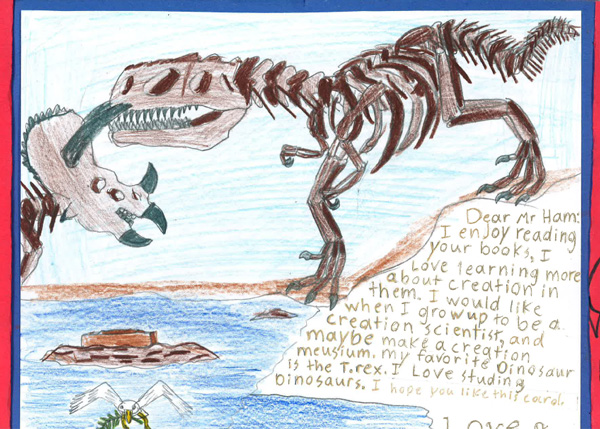
Leading young-earth creationist Ken Ham shared recently some of the cards he’s received from children.  Like the image here, these cards mostly included pictures of dinosaurs and adorably misspelled sentiments of support.  The cards give us outsiders a glimpse into the ways young people adopt the ideas of their home communities.

I Love Studing Dinosaurs

Source: Ken Ham’s Around the World Blog

Ken Ham calls his outreach “Rescuing the Children.”  Ham promised that his organization, Answers in Genesis, would continue to do “our best to reach more kids than ever to help raise up a generation that will stand on the authority of God’s Word, defend the Christian faith, and proclaim the gospel.”

For most evolution educators, this is precisely the problem.  Answers in Genesis is doing a good job.  Lots of children are learning that Biblical birds and dinosaur skeletons somehow roamed the earth together.  Thousands of children are learning an impossible science.

For those of us outside the circles of young-earth creationism, the mechanism by which these outlandish ideas are passed down can seem mysterious and even sinister.  But cards like the one above show the everyday, banal nature of creationist education.  Like non-creationist kids, creationist kids learn what they are taught.  They imbibe the culture of their homes, families, and churches.  There is nothing mysterious and sinister about the process, even if we do not think the ideas passed along are correct.

The lesson for evolution education is clear: pouring more mainstream science on people will not do the trick.  What is needed is a thoroughgoing cultural campaign that understands creationism on its own terms.

The Bible and Atlanta’s Cheating Teachers

What made them do it?  Those dozens of teachers in Atlanta indicted for cheating?  Do they need more Bible?

Some commentators have blamed the high-stakes testing regime itself.  As David Callahan wrote for the Huffington Post, the culture of testing pushes teachers and superintendents to doctor test results.  According to Sean Higgins of the Washington Examiner, Randi Weingarten of the American Federation of Teachers blamed America’s “test-crazed policies.”

Arch-creationist Ken Ham takes a different approach. The problem, Ham insists, is America’s Godless culture.  In a Facebook post yesterday, Ham indicted the schools themselves.  America’s public schools, Ham wrote, “take billions of dollars of your tax money for education,” but they fail to recognize the truths about human nature clearly explained in the Bible.  Most teachers, Ham argued, “are hatched from the same cultural eggs as much of the rest of society,” and that society kicked the Bible out of public life back in the 1960s.

As a result, Ham concluded, “it should NOT be a surprise to us when they try and cheat the testing system in order to make themselves look good!”

For Ham, the problem behind the Atlanta cheating scandal was not the way the tests encouraged teachers to lie.  The problem, instead, was the secularized culture of public life and public schooling.  Without the guidance of the Bible, teachers—like all Americans—will sink into the degrading morass of cheating and lying.


Gay Marriage and School Bathrooms

Will same-sex marriage turn public schools into orgies of sexual confusion?  Ken Ham of Answers in Genesis has connected the dots.

The Supreme Court is wrestling with two cases about same-sex marriage.

Conservatives have long insisted that same-sex marriage would lead to a breakdown in the value of marriage itself.  One commenter recently called same-sex marriage the threshold of an “abyss of nihilism.”

Ham’s analysis sexualizes that nihilism and brings it right into public schools.  Ham, America’s leading young-earth creationist, insists that same-sex marriage is only part of an “evolving sexual agenda.”  (Ham is a smart guy, so I am confident he chose that word—“evolving”—intentionally.)

In Ham’s recent piece, he argues that the next step after gay marriage will be a profound and aggressive attack on all traditional gender norms.  As evidence, he cites recent public-school guidelines in Massachusetts.  As we’ve noted on ILYBYGTH, these new school rules allow students to identify their own gender identity and require schools to respect those identifications.

As Ham writes, the trickiest part of this school rule has become bathrooms.  If a student was born a boy but identifies as a girl, Massachusetts schools must respect that choice. Ham worries about a boy who pretends to identify as a girl just to get access to the girls’ locker room.

Ham is not the first conservative thinker to make this connection between same-sex marriage and a sexual free-for-all in public schools.  But for those of us non-conservatives who try to understand conservatism in American education, Ham’s argument offers two important reminders.  First, schools are tied into every culture-war argument.  Though marriage laws seem relatively distant from education policy, conservative (and liberal) arguments against same-sex marriage often rely on the harmful effects gay marriage will have on children and schooling.  Second, for those outside the orbit of American creationism, Ham’s argument underscores the fact that creationism is an outgrowth of conservative Christianity, not the root.  Besides Ham’s use of the word “evolving” to damn the same-sex marriage “agenda,” this article does not talk about creationism or evolution.  Rather, Ham concludes that the main reason to oppose same-sex marriage and the abandonment of gender rules is more broadly Christian.  As Ham argues,

As Christians, we should affirm our children’s God-given genders and cultivate godly masculinity and femininity in them, rather than encouraging them to abandon the gender God gave them in the womb . . .

For Ham, as for many creationists, Christianity comes first.  Creationism is only one important element of the crusade.  Ham himself has often reminded readers of this fact.  Nevertheless, it is common for outsiders like me to pigeonhole Answers in Genesis as narrowly interested in establishing the case for a young earth.

As Ham’s recent argument proves, AiG’s sort of young-earth creationism has a much broader conservative agenda.