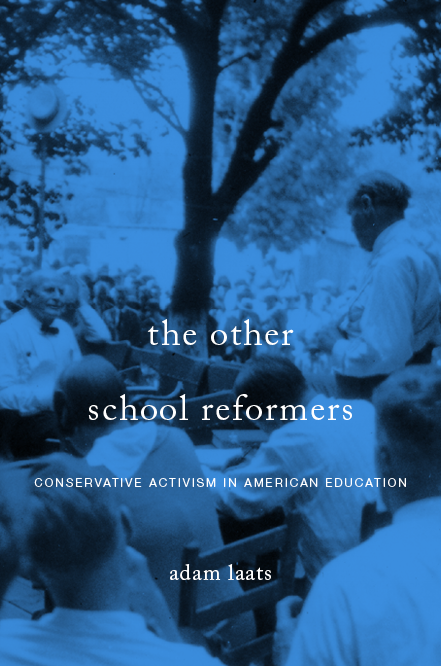
Revisionaries and the Experts

Thanks to all who came to last night’s screening of The Revisionaries at Binghamton University.  Despite some technical glitches, the discussion ranged widely from the meanings of science to the purposes of public education.

One of the most intriguing elements of the film and of our discussion was its theme of “experts.”

That was certainly not the only reason to view this documentary.  It tells the story of the 2010 textbook requirement hearings at the Texas State Board of Education.  As the film describes, the influence of the Texas market in defining the nation’s choices in public school textbooks has long been decisive.

Conservatives such as Don McLeroy and Cynthia Dunbar battled with folks such as Eugenie Scott of the National Center for Science Education, Ron Wetherington of Southern Methodist University, and Kathy Miller of the Texas Freedom Network.

In the fight over the 2010 textbook requirements, conservatives insisted on a science framework in which textbooks would include creationist-friendly criticisms of evolutionary theory.  They also battled to revise history standards to emphasize the influence of conservative heroes such as Ronald Reagan and Phyllis Schlafly, and to underscore the meanings of the United States as a profoundly “Christian Nation.”

In all these battles, Don McLeroy insisted on a populist argument, one with a long and storied tradition among conservatives.  Dr. McLeroy repeated as a sort of motto, “I disagree with the experts.  Someone has to stand up to them.”  To McLeroy, this strategy applied equally well to the scientists who promoted evolutionary theory as it did to the politicians who had moved American culture to the “Far Left.”

The distrust of “experts” has long been a powerful motivator in American politics and culture, of course.  Within the universe of conservative evangelical Protestantism, it has both theological and political taproots.  As I note in my 1920s book, the role of experts played a similar role for the first generation of American fundamentalists.

But this distrust of experts has also often been taken too glibly at face value as a bald anti-intellectualism.  The distrust of experts, as seen by McLeroy’s foes in The Revisionaries, can be interpreted as a dunderheaded insistence that knowledge is a bad thing.

But McLeroy and other conservatives have a more complicated position.  In fact, McLeroy and his allies cherished the status of experts, even as they claimed to be fighting against them.  In the evolution hearings, for instance, conservatives brought in two eminent intelligent-design experts from Seattle’s Discovery Institute.  In his presentation to the board, Stephen C. Meyer prominently displayed his expert qualifications, including a PhD from Cambridge University.

Similarly, McLeroy’s close ally on the board represented the tradition of conservative evangelical expert.  Cynthia Dunbar teaches at Liberty University, a school founded by Jerry Falwell in 1971 precisely to raise new generations of fundamentalist experts.  And Dunbar wielded her expert club with ferocious abandon.  During the history hearings depicted in The Revisionaries, Dunbar attempted to silence her opponents by reminding them that she taught political philosophy “at the doctoral level.”

The Revisionaries is a must-see for anyone interested in issues of cultural contests in America’s schools.  For those out there like me who teach college classes in educational foundations or history, ask your library if they will purchase a copy for classroom use.

Beyond what I’ve described here, the film includes gems like the awkward conversation between evolutionary anthropologist Ron Wetherington and McLeroy.  The two are able to be congenial, but they aren’t able to do more than disagree with one another smilingly.

Most intriguing, the documentary demonstrates many of the complicated intellectual traditions of American conservatism, including not least McLeroy’s insistence that he plans to combat the intrusions of experts, even as he relies on his own experts to make his points.



Faith and Football

Forget Tim Tebow.  The real story in the world of fundamentalist football is Liberty University. The fundamentalist Virginia school founded in the early seventies by Moral Majority frontman Jerry Falwell wants to become the face of conservative Christian college ball.

This isn’t news, but Bill Pennington offered a new look at the program in last weekend’s New York Times.

Pennington points out that a big sports program can signal the emergence of a religious school from sectarian obscurity, as happened with Knute Rockne’s Notre Dame, or a later generation’s Brigham Young University.  Pennington gets the dates wrong; Rockne pulled Notre Dame football to national prominence in the 1920s, not the middle of the century.  But the point still holds.  Football made Notre Dame an American story, not just a Catholic one.

Image source: Wikipedia

According to Pennington, Liberty is different.  The vision of both founder Jerry Falwell and current chancellor Jerry Falwell Jr. is of a team that competes with the likes of Alabama and LSU while remaining staunchly fundamentalist.  As Falwell Jr. told Pennington,

‘“We think there would be a vast, committed fan base of conservative, evangelical Christians around the country and maybe even folks who are conservative politically who would rally behind Liberty football,” Falwell Jr. said, smiling at the thought. “They would identify with our philosophy.”’   

In order even to have a shot at such elite play, schools need money.  According to Falwell Jr., that should not be a problem.  Thanks largely to an exploding online program enrolling over 80,000 students, Liberty has announced it will soon reach one BILLION dollars in net assets.

Could they make it happen?  In the world of big-time college ball—to paraphrase an old prayer—with money, all things are possible.

Pennington’s article is worth reading, especially for those interested in college football.  Those interested in the world of conservative Christian higher education will wish Pennington probed a little deeper.  The story of Liberty University in 2012, after all, is much bigger than just an ambitious football program.  As Karen Swallow Prior of the Liberty University faculty pointed out recently, the campus culture has been changing in other important ways as well.  In addition to a loosening of the dress code, students at Liberty have begun showing more diversity in terms of politics and culture, according to Prior.

Liberty watchers have to wonder: Did all these changes—a push for big-time ball, loosening of the dress code, broadening of the politics of the student body—did these changes result from the big on-line payday, or did these changes lead to that payday?  That is, did Liberty make itself the big winner in the new world of online higher education by broadening its appeal?  Or did the broadening happen after the money starting rolling in so fast, according to Falwell Jr., that “we can’t spend it fast enough”?

These questions aren’t new to the world of fundamentalist higher education, nor are they unique to Liberty.  In the 1920s, Bob Jones University also fielded intercollegiate athletic teams.  However, school founder Bob Jones Sr. quickly dropped the program.  Friends said Jones worried that sports would pull the new school too far from its central mission.  Enemies whispered that Jones feared having to accommodate any outside influence in his flagship university.

Liberty University will certainly wrestle with this same tension.  As any football fan knows, money drives success.  It will be difficult for Liberty to compete without putting athletic success first.  And it will be hard to do that without changing the focus of the school from the religion of Falwell to the religion of football.


The Evolution of Liberty University

First flip-flops, now College Democrats.  What is next for Liberty University?

Karen Swallow Prior commented recently on the changing face of the school founded by Jerry Falwell just over forty years ago.  Prior, chair of Liberty’s English department, notes the remarkable achievements of Liberty.  Since 1971, it has grown to almost 100,000 students (including online) and has almost hit one BILLION dollars in net assets.

Like other Protestant fundamentalist schools, Liberty was founded with the specific intention of educating conservative evangelical Christian students in an environment that encouraged their faith.

Prior argued in Christianity Today that the school has been evolving.  A few years back, it eased up its dress code, allowing students to wear jeans and sandals if they preferred.  As Prior put it, “Administrators knew that the university couldn’t meet the goal of its founder of becoming a ‘world class’ evangelical university by requiring its students to dress like Mormons on mission.”

More recently, Prior writes, the school has had to wrestle with the thornier question of student politics.  Might a school explicitly founded as a conservative institution allow an organization of College Democrats?  As has been the question for fundamentalist higher education since the 1920s, there is an enduring tension between growth and fidelity to mission.  As I’ve analyzed in my 1920s book and an article in History of Education Quarterly, fundamentalist colleges have struggled to understand themselves as either “world class” universities or intentionally provincial ones.  Can they escape from the “scandal of the evangelical mind” without abandoning their unique faith mission?

At Bob Jones University, for example, founded in 1926, students have had to pledge their fidelity to an iron-bound statement of faith.  They have also had to pledge that they will prevent the school from every wavering from its commitment to those principles.

Doubtless Liberty will continue to struggle with this tension.  As Prior explains,

“whether Republican, Democrat, or Libertarian, Liberty students seem to recognize that none of the political parties aligns consistently with their faith. And so, they seem less willing than preceding generations of students to put their faith in politics.”

In the News: Tebow in Fundamentalist New York

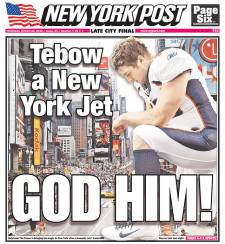
I know I’m not alone in hoping for some kind of Tim Tebow media blackout.  I was hoping the end of the football season, especially with the Broncos’ defeat, would bring some quiet to the Tebow-as-Christian-in-a-strange-land stories.  But Tebow’s move to the New York Jets brought a new round of media focus on Tebow’s style of loud public Christian-ness.
IMHO, the most interesting comment on the Tebow move came from Paul Moses at dotCommonweal.  Moses noted that the New York press tended to gasp at the incongruity of an extravagantly Christian celebrity in the extravagantly pagan Big Apple.

Moses pointed out,

The Times put it this way: “Tebow is also a somewhat incongruous fit: an outspoken Christian playing  in a city known for its extensive night life and a member of a  franchise made famous by the bachelor stylings of Joe Namath and  currently known for the profane speeches of its coach, Rex Ryan.”

And this, from the National Enquirer: “It is unclear how the pie-eyed pundit of the pigskin will respond to the multitude of temptations New York has to offer.”

Moses took such papers to task for assuming too much about life in New York City.  New Yorkers are a decidedly religious group.  Moses cited a Gallup poll from 1991 in which a majority of respondents–53%–said they prayed at least once a day.  The problem, Moses claimed, is that too many people equate Manhattan with the entirety of New York City.  In Manhattan, 17% of poll respondents claimed to be atheists.  In the Bronx, that number dwindled to 1%.

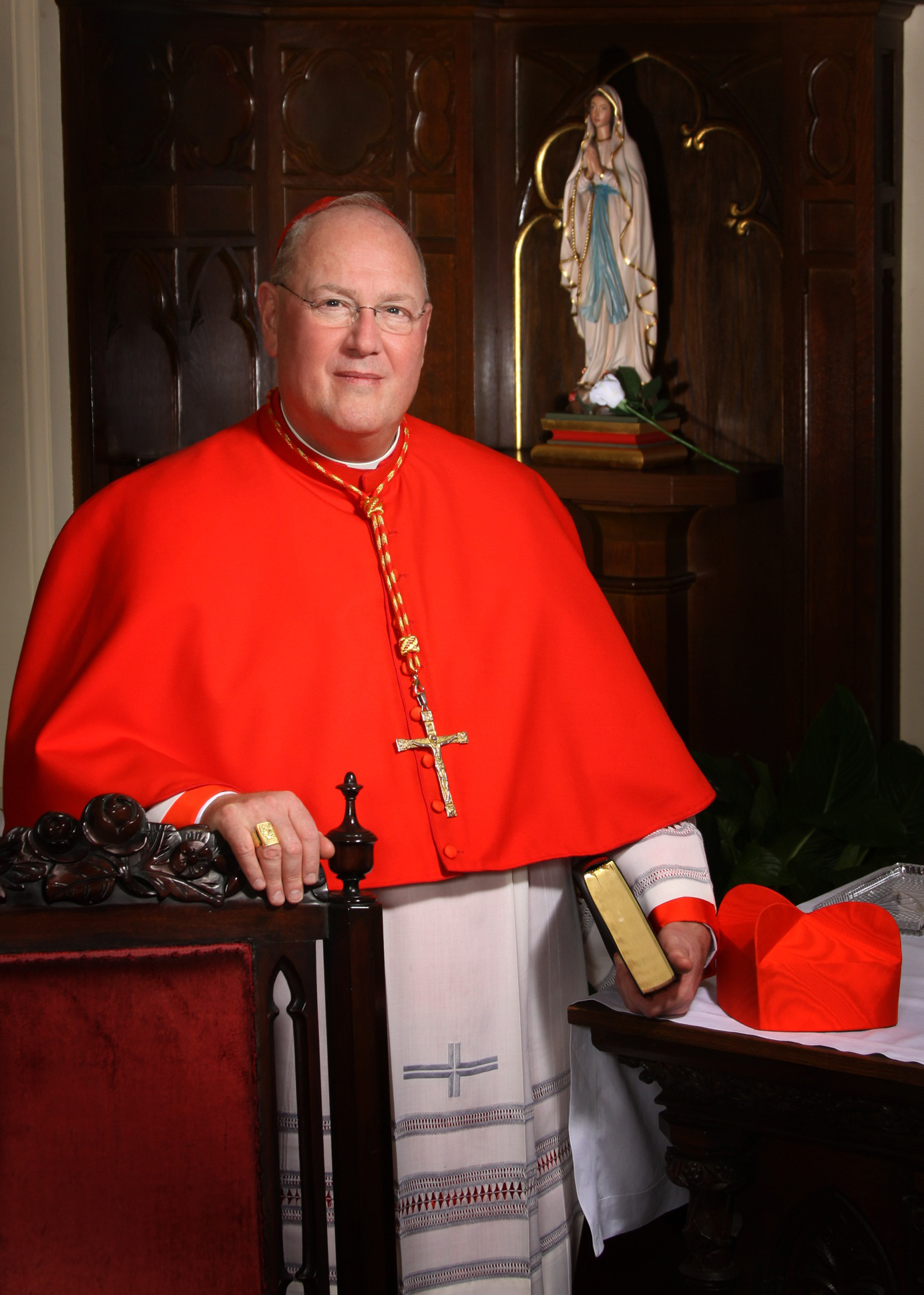
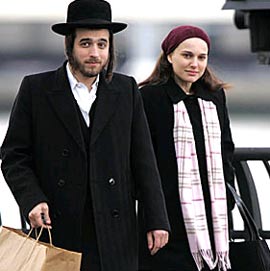
As we’ve pointed out here before, people who do not know much about Fundamentalist America often assume that religiosity goes up only with distance from big cities, education, and indoor plumbing.  It is just not true.  The myth might come from the association in the United States of conservative evangelical Protestantism with conservative religion as a whole.  But if we look at other conservative religious folks, New York City has as much of a claim to fundamentalism as anywhere else.  In the Catholic Church, for example, New York City is now home to genial Archbishop Timothy Dolan.  Dolan’s blog and very public presence inject a strain of conservative religiosity into life in the Big Apple.  And, of course, outside of Christianity, New York City is host to innumerable conservative religious groups.  The old joke about the hayseed who comes to New York and is surprised by the number of “New York Amish” demonstrates that New York has its own profound tradition of deeply conservative culture and theology.

Even within the bounds of conservative Protestantism, large urban areas have always served as strongholds.  True, someone wanting a Protestant fundamentalist education could go to Bob Jones University in lovely Greenville, South Carolina.  Or she could go to Liberty University in Lynchburg, Virginia.  But she could also head to Los Angeles to Biola University, or to Chicago’s Moody Bible Institute or Wheaton College.

The roots of this commonly held misperception, I think, come from the utter dominance of conservative evangelical Protestantism in some rural areas.  When folks from the big city drive around in fly-over country, they are shocked by the public dominance of this type of fundamentalism.  But such folks ought to look closer at their own cities.  Look for storefront Pentecostal churches.  Look for big cathedrals.  Look beyond the stereotypes of cities as home only to nightlife and paganism, and you’ll notice a deeply religious urban America.

There might be a few translation difficulties as Tebow  moves from the Bible Belt to the Big Apple, but there will not be any lack of fundamentalists ready to greet Tebow as he (if he?) makes his New York Jets debut.