Does THIS Explain the Football Fornicator?

It has stymied nerds for years now. How could so many white conservative-evangelical Protestants support Trump? He is hardly a moral model. Could a new term help explain Christian Trumpism, and other evangelical oddities such as Liberty University’s recent hire?
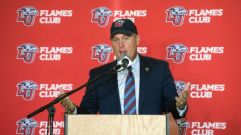
Freeze at Liberty

Victory at any cost?

Coming off a year of glorious victory, Liberty doubled down on its football team. Still pursuing its grand dream of becoming “the Notre Dame of the Christian world athletically,” Liberty brought on one of the best big-time coaches in today’s football scene.

There was only one problem. Coach Hugh Freeze was only available for a non-elite team like Liberty because he had been fired from Ole Miss for a “pattern of personal misconduct,” including using university resources to hire prostitutes.

Why would an evangelical university—supposedly devoted to conservative morals and buttoned-up lifestyle rules—shell out big bucks to hire a fornicator?

On one hand, the answer’s easy. Coach Freeze built up an impressive winning record at Ole Miss, including defeating Alabama two seasons in a row.

On the other, however, it’s a puzzle. As I described in Fundamentalist U, the selling point of conservative evangelical colleges has always been a safe moral environment, one in which students wouldn’t learn to smoke, drink, and have sex, much less believe mainstream science or liberal religion.

How are we to make sense of this phenomenon? …of supposedly values-driven evangelicals supporting anti-values driven celebrities?

Would it help if we called universities like Liberty something besides “evangelical?” Something that captured more clearly the real values of the school, including Trumpism, guns, and big-time sports?sutton tweet
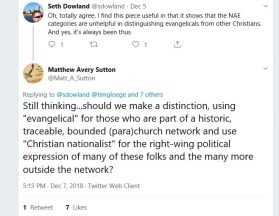
Recently, some historians have been debating the value of another term. Matthew Avery Sutton proposed “Christian Nationalism” for white conservative evangelicals who put their culture-war positions ahead of their evangelical theology. Professor Sutton asked,

should we make a distinction, using “evangelical” for those who are part of a historic, traceable, bounded (para)church network and use “Christian nationalist” for the right-wing political expression of many of these folks and the many more outside the network?

Calling schools like Liberty “Christian Nationalist” colleges instead of “evangelical” schools would go a long way toward clearing up any confusion about stories like that of Coach Freeze. It could fill in for the old “fundamentalist” label, now out of favor even among the most devoted fundamentalists. It could also help make sense of trends at conservative schools such as Hillsdale, which are now attracting a healthy enrollment from Catholic students. And it could explain where the financial support comes from for conservative flag-waving institutions such as the College of the Ozarks.

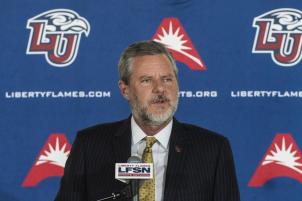
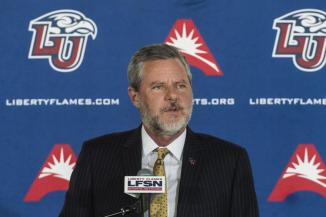
In short, using a term like “evangelical” to describe an institution like Liberty University seems inherently confusing. Under the leadership of Jerry Falwell Jr., the school has embraced a Trumpist worldview, in distinct contrast to the traditional moral values of conservative evangelicals, at least in the late twentieth century.

Calling it “Christian Nationalist U,” on the other hand, seems to fit. It doesn’t seem outrageous to hear that a “Christian Nationalist” school has hired a football fornicator. A “Christian Nationalist” school would obviously support Trump, whereas an “evangelical” school wouldn’t. A “Christian Nationalist” school would value football victory at any cost, while an “evangelical” school wouldn’t.
I Love You but You Didn’t Do the Reading

A chock-full week in evangelical higher ed with a heavy dose of teachers’ strikes. Thanks to everyone who sent in stories and tips:

Our lead story: The Master’s University struggles with the worst legacy of Fundamentalist U: The personality cult. At CHE.

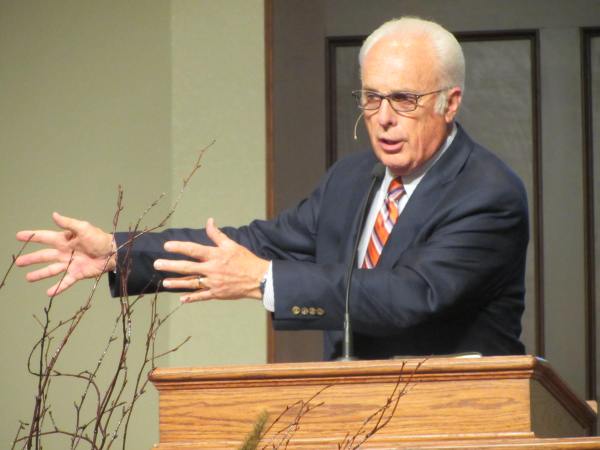
a group of reviewers acknowledged that Master’s is doing some important things right. Under MacArthur, they said, the institution has engendered deep loyalty from faculty, students, and donors. At the same time, the report depicted Master’s as an accreditor’s nightmare: an insular and oppressive institution where loyalty to the president and his church has sometimes trumped both academic and financial concerns.

John_F._MacArthur_1

Get thee behind me, accreditors.

How does a “Bible Belt Ivy” thrive? College of the Ozarks wows the number-crunchers at Forbes.

In remembrance of Pearl Harbor:

pearl harbor ng attack mapAre college faculty really as radical as conservatives think? Ed Burmila says not even close, at UW. HT: MM.

The American right is so heavily invested in the fantasy of radical leftist professors that no evidence can convince them otherwise. . . . If you have considerable time on your hands and wish to see just what kind of leftists run universities, go to the graduate school and propose unionizing Research Assistants, Teaching Assistants, and other itinerant quasi-employees. You’ll discover quickly that senior faculty — the same ones who can’t wait to show you their picture with Tom Hayden or some other talisman of progressive cred — turn into staunch capitalists in a hurry.

Not funny. Columbia students shut down comedian, at IHE.

Bolsonaro’s educational culture war in Brazil, at the Economist.

Tech and reform: Why does every generation think its old ideas are new? By Larry Cuban.

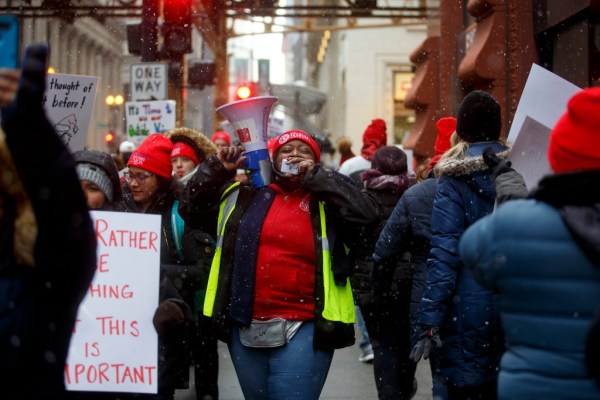
The first teacher strike at a charter school. What will it portend? At NYT.

chicago charter strike

…the wheel of “reform” spins back around…

Liberty U loves Trump, and hires a football coach with a record of hiring prostitutes, at ESPN.

The key to de-segregation? Minnesota’s new reform at Slate. HT: CC.

single-family zoning proved as effective at segregating northern neighborhoods (and their schools) as Jim Crow laws had in the South.

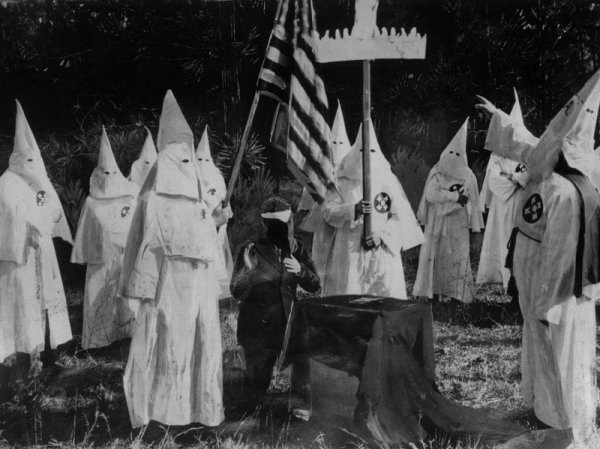
The author of one of the best books about the 1920s KKK explains the complicated history at NPR.

1920s klanHow can we teach about painful historical topics? How about one person’s story at a time, at The Atlantic.

Who Pays Tuition to Have Students Killed?

I’m sorry to hear about the death of American missionary John Allen Chau. I don’t want to argue over it—whether he died a hero, a “terrorist,” or a “self-important, arrogant, deluded, foolish . . . pest.” Instead, I want to point out that Chau’s life and death demonstrate the one way that “Fundamentalist U” is now and has always been radically different from mainstream higher ed.

north seintinel island

“Fields white unto harvest…?”

If you haven’t heard the story yet, here it is in a nutshell: Chau was a missionary working with an organization called All Nations. He had made several efforts to contact an isolated group of islanders in the Indian Ocean. The hundred people who live on North Sentinel Island are protected by the Indian government. They have had very limited contact with outsiders.

Chau hired some locals to take him near the island. Islanders paddled out to meet their boat and fired a volley of arrows at Chau, one lodging in his Bible. Chau took a solo kayak and paddled to the island. Later, locals saw islanders burying a body that looked like Chau’s.

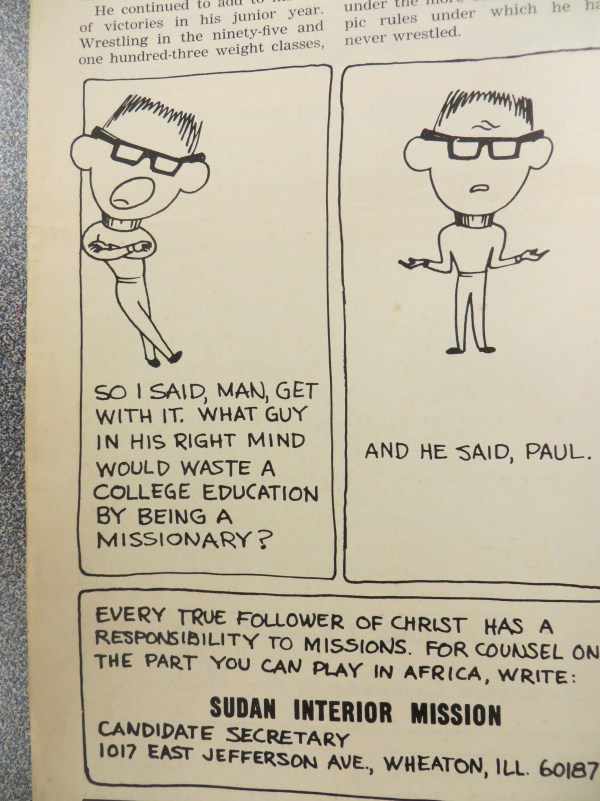
missions cartoon guy

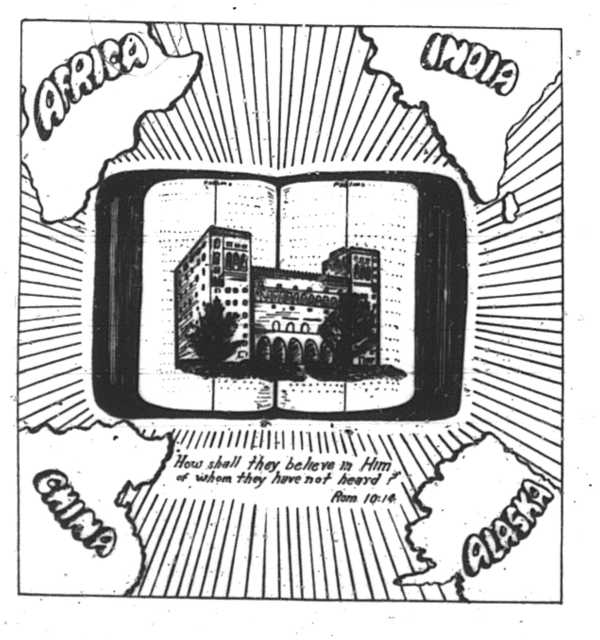
The mission: From Liberty University student newsletter, c. 1982

Clearly, the missionary impulse is alive and well. Chau wrote in his diary that he didn’t want to die, but he accepted the risks in his effort to spread the Gospel to the world.

But that missionary impulse hasn’t survived on its own. It has been nurtured and supported by organizations such as All Nations. It has also been taught and encouraged by evangelical colleges and universities. And this missionary focus, I argued in Fundamentalist U, is the thing that most sharply defines evangelical higher education from mainstream schools.

Mission centered

From Biola’s student paper, 1939.

In Chau’s case, it was Oral Roberts University. ORU celebrated the fact that its teaching had led directly to the death of a former student. As ORU put it,

Oral Roberts University alumni have gone to the uttermost bounds of the earth for the last 50 years bringing hope and healing to millions. We are not surprised that John would try to reach out to these isolated people in order to share God’s love. We are deeply saddened to hear of his death.

In most ways, evangelical colleges and universities look and feel a lot like mainstream schools. They promise to prepare students for careers. They promise to help shape students’ values. They promise to keep students safe.

When it comes to missionary work, however, evangelical colleges throw the higher-ed playbook out the window.

missionary cartoon ad

From the Moody Student, 1969.

For generations, evangelical colleges have maintained their focus on guiding students toward missionary careers. Especially among schools with roots in the Bible-institute tradition, the pressure on students to think about self-sacrificing missionary work was often intense.

One student who attended Moody Bible Institute in the 1920s was a case in point. His father was an atheist. His mother was Catholic. Neither of them wanted him to attend MBI. But he went anyway. And the central lesson he learned there was that he had to give his life to Jesus as a missionary. As he later remembered,

It dawned on me that I had a responsibility toward the Lord’s Great Commission (Matthew 28:18-20).  You see, you can’t be in the Moody Bible Institute very long before you’ll have to face that.

The dedication to sending young missionaries out into the world remained central to evangelical higher education throughout the twentieth century. To offer just one small example of the scope of these schools’ missionary efforts, consider a poll from Biola University in 1962. In that year, according to the student paper, 47% of its graduating class was heading out to full-time missionary work.

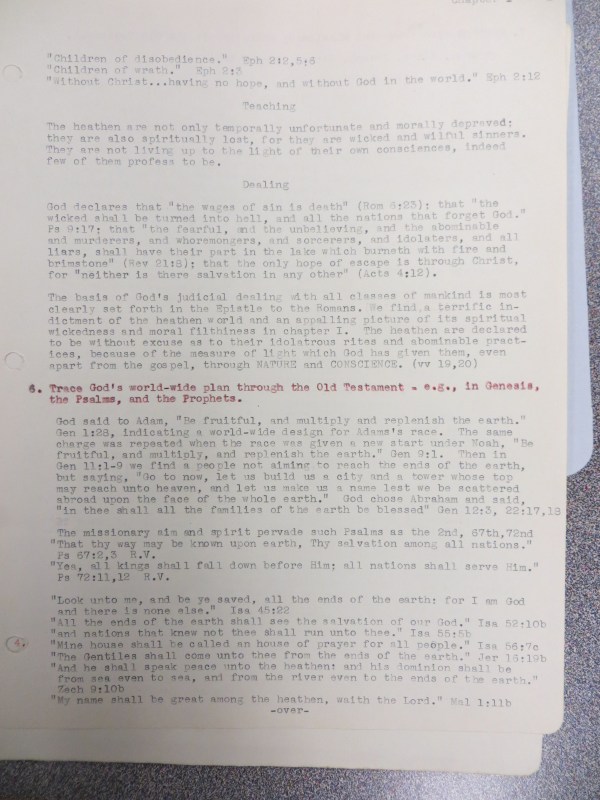
IMG_1919

Classroom notes, MBI, c. 1940s

This focus on missionary work—today and in the past—has been the thing that has made evangelical higher education most radically different from the mainstream. In addition to all the ways it has mimicked mainstream schools—with sports, careers, social life, and academics—“Fundamentalist U” also trained students to give it all up, to sacrifice themselves in missionary labor.

I Love You but You Didn’t Do the Reading

Frost on the pumpkins and the Brewers in the playoffs. What could be better? How bout another week full of ILYBYGTH-themed stories from around the interwebs?

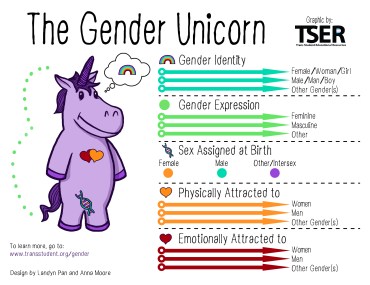
More teens are abandoning traditional gender categories, at CNN.

genderunicorn1

What do some conservatives have against the unicorn?

Why are tests so hard to kill? New Jersey struggles to get rid of its common-core tests, at NJ.com.

What color is your Jesus? Three-quarters of white evangelicals still support Trump. Three-quarters of black evangelicals oppose him, at Vox.

Going up for tenure? Don’t bother with public scholarship, says a new survey at CHE.

Why so many Catholics and so few evangelicals on SCOTUS? Gene Zubovich says it’s a matter of school history.

By virtue of their 19th-century separationist anxieties and their investment in institutions of higher learning, Catholics have become the brains of the religious Right in the US.

Moody Bible Institute picks a new leader after a rough year, at CT.

Jerry Falwell Jr. explains why evangelicals love Trump, at The Guardian.

Ever since I’ve known him, he’s been a good, moral person, a strong leader, a tough leader – and that’s what this country needs.

Kirk on campus. No, not that Kirk. A review of Turning Point USA’s Charlie Kirk’s new book about conservative campus dreams at CHE.

Dirty tricks, done dirt cheap: Arizona Republicans get busted trying to donate $39.68 to their Democratic rivals, posing as communists. At The Guardian.

Falwell Wasn’t Trying to Be Funny…

To be fair, it wasn’t the worst mistake he ever made. But Jerry Falwell Jr.’s recent goof has some complicating factors that make it hard to ignore.

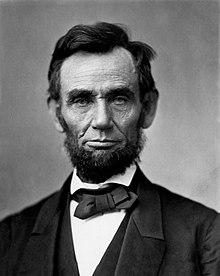
lincoln

Erm…actually, Jer…

As we’ve seen, Falwell has a rough track record in quotable quotes. As the president of a huge evangelical Christian university, he has in the past misquoted the Bible. That has to hurt.

In his recent interview with The Guardian, President Falwell compounded his errors. If it were someone else speaking, I would be tempted to think Falwell was making a subtle and hilarious gibe. In reality, though, I think he just got mixed up.

Here’s what we know: In the recent Guardian interview, Falwell lauded President Trump to the skies. Not only did Falwell support Trump for strategic reasons, he actually believed Trump to be a morally good person. As Falwell put it,

Ever since I’ve known him, he’s been a good, moral person, a strong leader, a tough leader – and that’s what this country needs.

That’s a difficult position for me to understand. I can understand backing a bad person who is fighting for your side. I can understand backing an immoral character who fulfills important promises. But I can’t understand how anyone would call Trump a “good, moral person.” Maybe some SAGLRROILYBYGTH can explain that one to me.

The point this morning, though, is different. In his encomiums to President Trump, President Falwell insisted that he and Trump were totally on the same page. As Falwell told the Brits,

I usually tweet something similar to what he tweets a day or two before him. We think alike.

And, apparently unintentionally, Falwell went on to prove his intellectual similarity to Trump by making a glaring historical error. I can’t tell for sure, but I think Falwell got confused about what century America’s Civil War was in. America had not been this polarized in a very long time, Falwell said.

not since the civil war. I don’t know where that takes you. I can’t imagine a war breaking out in a civilised society in the 21st century. But if this was the 18th century, I think it would end up in a war. It’s scary.

I hate to be this guy, but anyone could tell you that America’s Civil War happened in the 19th century, not the 18th.

I know, I know, it’s an understandable mistake, sort of. And I don’t think Falwell meant to be funny, but how hilarious would it be if he wanted to prove his similarity to the fact-averse Trump by insisting on making at least one glaring error per public appearance?

Higher Ed as a Weapon

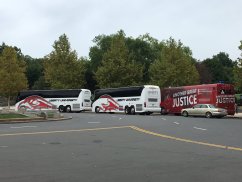
Looks like the tradition continues. As the Brett Kavanaugh hearings sweep over Washington DC like a brushfire, Liberty University is back to its old 1970s tactics. Turns out clean-cut well-dressed conservative Christian students are a potent political weapon.

liberty busses at kavanaugh hearing

From Jack Jenkins…

Here’s what we know: Jack Jenkins has reported that two Liberty University busses pulled up to the Kavanaugh hearings this morning. Presumably, Jerry Falwell Jr. is pulling a few pages from his dad’s political playbook.

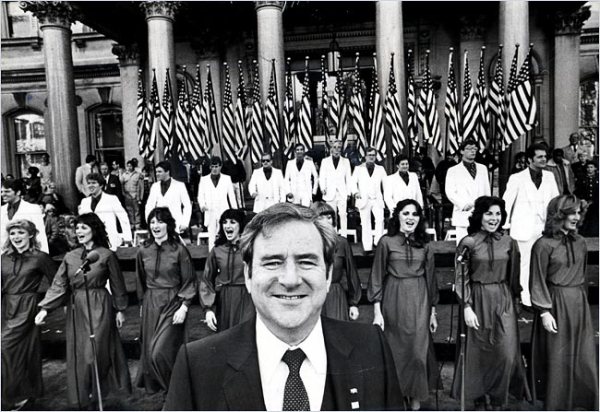
Back in the 1970s and 1980s, Jerry Falwell Sr. was fond of using Liberty University students to twist arms on Capitol Hill. Most famously, he sent his “I Love America” bus tour around to various state houses to sing and dance about America.

The goal was to attract attention to Falwell’s conservative policy plans. He hoped to get headlines and push politicians to get on the Liberty bus. Politically, that is.

That wasn’t all.

I didn’t have room to include much of this in Fundamentalist U, but Falwell Sr. employed students as smiling lobbyists. In early 1980, for example, he had students hand-deliver his “95 theses for the 1980s” to US Representatives.

falwell i love america tour

La la la…we love Americaaaaa

Charles F. Bennett, of Florida’s 3rd district, told Falwell that Bennett was delighted to receive the information directly from a

Fine young Christian student.

And Carroll Hubbard, of Kentucky’s 1st district, wrote to Falwell to say that he was posting the 95 theses on his desk. As Rep. Hubbard put it,

You are an inspiration to my family and me. 2 Chronicles 7:14.

For Jerry Falwell Jr., then, sending busloads of students to support Judge Kavanaugh is anything but a surprise.

I Love You but You Didn’t Do the Reading

No more wearing white, I guess. Around here, we’ve already had to turn on the heat. The interwebs stayed hot, though. Here is our weekly roundup of ILYBYGTH-themed stories:

Starving for Jesus: Wisconsin family kills one child, nearly kills another in Christian fast, at WSJ.

falwell on nike

Football, America, and God too.

Christian college drops Nike over anthem protests, at CHE.

Gresham Machen and segregationism at the old Princeton Seminary, at FM.

Wowzers, the big story: The inside resistance in the White House, at NYT.

Meanwhile, Trump explains the “great job” he’s doing to Bob Woodward, at WaPo.

Nobody has ever done a better job than I’m doing as president. (12:52)

Senator McCain’s legacy as a school reformer, at T74.

Great Books as the solution to campus protests, at CHE.

Both reactionary pundits mocking campus speech codes and the social-justice warriors they love to hate are complicit in reproducing the kinds of inequality that tribalism feeds on.

Is education a “fundamental right?” Jill Lepore reviews Justin Driver in The New Yorker.

Coming out to young-earth creationists, at BioLogos.

The politics of Christian crafts: Kristen Kobes Du Mez on “Hobby Lobby Evangelicalism.”

Will Liberty Get on the Ozark Train?

For those people who still think evangelicalism should primarily be defined by theological distinctions, consider the news: Yet another conservative evangelical college is considering dropping its Nike contract over the anthem-protest issue. How does theology explain that one?

falwell on nike

Football, America, and God too.

SAGLRROILYBYGTH will remember that the College of the Ozarks already announced its anti-Nike stance in the wake of Nike’s Colin-Kaepernick ad. They may also recall our point here at ILYBYGTH that such staunch knee-jerk conservative patriotism was not the exception, but the rule for evangelical universities in the twentieth century.

Some might say that COE’s uber-patriotism is just an odd outlier in the world of evangelical higher education. Today it looks like COE might have more company. According to President Jerry Falwell Jr., Liberty University in Virginia is considering scrapping its sponsorship deal with Nike. Unlike College of the Ozarks, Liberty is a cash-rich up-and-comer in the world of NCAA athletics.

As Liberty University’s Jerry Falwell Jr. told USA Today:

We’re exploring the situation. . . . If Nike really does believe that law enforcement in this country is unfair and biased, I think we will look around. If we have a contract, we’ll honor it, but we strongly support law enforcement and strongly support our military and veterans who died to protect our freedoms and if the company really believes what Colin Kaepernick believes, it’s going to be hard for us to keep doing business with them.

But if it’s just a publicity stunt to bring attention to Nike or whatever, that’s different. We understand that. We understand how marketing works. But they’re going to have to convince us that they’re not proactively attacking law enforcement officers and our military. If that’s the reason behind using this ad, we’re going to have a hard time staying.

For many Americans, Falwell’s defiant conservative patriotism makes sense. For a lot of people, it’s probably even admirable. But how is it part of evangelical religion?

In short, it’s not, if we try to define evangelicalism only by theological notions such as a reverence for Scripture and an emphasis on soul-winning.

But! If we understand American evangelicalism—the Falwell/Liberty kind, at least—as a conservative cultural mish-mash, including conservative ideas about religion, but also about race, the South, gender rules, sexuality, and so on, then Falwell’s aggressive militarism fits perfectly.

An Errant Evangelical

C’mon….we all know what he meant. But for the president of an evangelical university to make this sort of goof and leave it undeleted still surprises me for two big reasons.

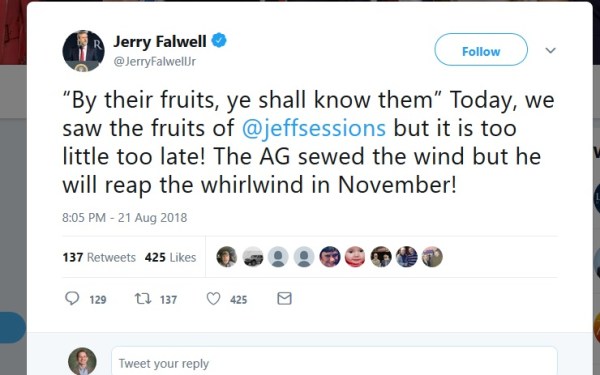
falwell sewed

“…by their tweets shall ye know them…”

Here’s what we’re talking about: The tweeters are aflutter about a statement by Jerry Falwell Jr. of Liberty University. Falwell blamed Attorney General Jeff Sessions for the recent legal hot-water of top former Trump aides.

Here at ILYBYGTH, we’re more interested in Falwell’s scripture goof. Of course, he didn’t mean anyone “sewed” the wind. He’s referring to Hosea 8:7, in which people “sowed” the wind.

On one hand, it’s easy to make a simply typing mistake, especially on Twitter. In this case, though, I’m really surprised Falwell has left it up, mostly because it’s not a simply misspelling. “Sewed” is a totally different word with a different meaning, implying that Falwell doesn’t understand what Hosea was talking about. In other words, it’s not only a misspelling, but a misquotation.

It would be different if Falwell had accidentally typed “sowd the wind” or “sowed teh wind,” but “sewed the wind” makes it seem like Falwell just doesn’t really know the Bible verse all that well.

And that makes me surprised to see it linger, for two big reasons.

First of all, among the conservative evangelical and fundamentalist public, nothing matters more in a university leader than deep knowledge of and reverence for scripture. This sort of uncorrected typo makes it look as if Falwell didn’t understand the gist of the chapter and verse. Or worse, he doesn’t care enough about fidelity to Scripture.

Second, Liberty University has always desperately wanted to win mainstream academic respectability. In recent years, they have spent bajillions of dollars to do so. For Falwell to leave this misquotation undeleted makes his school look even more like the anti-intellectual cloister it has often been accused of being.

I Love You but You Didn’t Do the Reading

You may still be on summer break, but here at ILYBYGTH International we are back to school. And that means back to reading headlines and crying in our coffee. Here are some of the stories that upset us this week:

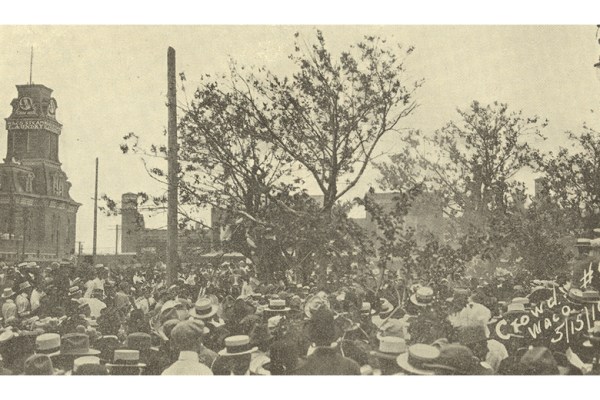
“The Lynching Industry:” W.E.B. DuBois’s 1916 account of a lynching, at Slate.

lynching crowd

The ugly historic truth…

The Maryland mess: Big-time-sporting unto death, at IHE.

Free college tuition? Or 2020 election scam? At Chalkbeat.

Americans aren’t the only ones who don’t know their history. Almost half of Russians are not aware of the 1968 invasion of Czechoslovakia, at the Guardian.

“This will go down in your permanent record:” Florida’s new hyper-surveillance of students, at Curmudgucation.

Suddenly, the same-sex rules matter at an Indiana Catholic school, at FA.

Colorado’s no-gay-wedding baker back in the courts, at RNS.

Banning Alex Jones: Steve Coll at the New Yorker.

It’s not that white evangelicals are supporting Trump in spite of their religion. Some Trumpists are making Trump their religion, says Alex Wager at the Atlantic.

Trumpism proposes a system of worship formed in direct opposition to bourgeois moral logic, with values that are anti-intellectual and anti–politically correct. If mainline Protestantism is a bastion of the educated, upper-middle class, the Church of Trump is a gathering place for its castoffs.

Higher education on the ropes this week:

Conservative Master’s University is in danger of losing its accreditation, at The Signal.

Evangelical journalists blast evangelical university’s censorship, at World Magazine.

Test score fever: Larry Cuban tells a 1970s tale of test nuttiness.

Wowzers: Teaching a flat earth, at FA.

Canadian evangelical university scraps its mandatory student rules, at CT.