Core Wars

What do conservative activists hate about the Common Core State Standards?

A recent essay by conservative commentator Stanley Kurtz in National Review points out some conservative objections.

As we’ve noted recently, conservatives share with progressives a fervent opposition to the CCSS, though usually for different reasons.  Everyone from Phyllis Schlafly to the Heritage Foundation has warned of looming implications for culture, politics, religion, and education.  For those of us trying to understand conservative attitudes toward American education, these diatribes against the CCSS are a good place to start.

Kurtz was responding to an article in the Washington Post about Tea Party objections to the new shared standards.  Obama officials, Kurtz complained, responded with deceptive statements and obfuscation.  In the end, Kurtz argued,

. . . the Tea Party is right when it accuses the Obama administration of nationalizing education standards through the back door. The Founders opposed that for a reason. Once de facto nationalization is achieved, parents will lose their ability to influence their children’s education. Leverage that can be easily exercised at local school-board meetings or through representatives in state legislators will be lost to unaccountable federal bureaucrats (like Lois Lerner), and worse, to the even less accountable private education consortia that are developing the Common Core. So if educators try to impose politicized curricula or “fuzzy” math, parents will have no recourse.

Kurtz’s “local control” argument echoes a long tradition among conservative education thinkers.  Most powerfully, California State Superintendent of Schools Max Rafferty pushed hard during the 1960s to combat increasing federal control.  Rafferty’s colorful prose often made the case more lyrically than I’ve seen it since.

In one speech from the archives,[1] Rafferty articulated a conservative position for local control that I suspect might still be appealing to today’s Tea Partiers.  As he told the California Small School Districts Association Convention on March 8, 1965,

You live and work in an out-of-the-way corner of this county.  A small town where the sky is still blue, where the roar and tension of freeway traffic has not yet penetrated; where a little boy can still run and play in open fields.  You’re there because you want to be.  You moved there deliberately a few years before because you liked that feeling of grassroots independence.  That unique sense of having an equal share in the controlling of one’s own destiny which has been the legacy of every American ever since the first little villages began to dot the New England countryside more than three centuries ago.  You’ve been happy there.  Your children are growing up clear-eyed and self-reliant with that indescribable look of quiet confidence which comes from life spent in a region where hills and trees are very real, very close at hand.  Where a neighbor is a lot more than someone who just happens to live close to you.  Suddenly, something goes wrong at your local school house, as things sometimes do.  Maybe it’s a new course of study which just doesn’t quite fill the bill.  Maybe it’s a neurotic old school administrator, we do run across one now and then!

No matter, you tell yourself, nothing can possibly happen in your community which can’t be solved by you and your neighbors, working and acting together in the traditional American spirit of mutual tolerance and good will.  But this time you’re wrong.  Shockingly, unbelievably wrong!  You and your friends try to arrange an appointment with your district superintendent to tell him of your problems and make your suggestions.  But you don’t have a district  superintendent anymore, in fact you don’t even have a district!  You try to contact your local school board, but it’s gone too!  A hundred miles away, a group of county or state officials meet once a month to decide the destiny of your children.  You don’t know any of them personally, in fact you never even heard most of their names!

But in our nightmare today, they tell you what your children will be studying.  They hire the teachers who will be molding the thinking and the behavior of your children throughout the years that lie ahead.  They decide whether or not the school bus is going to stop near your home or indeed if there is going to be a school bus at all.  Whatever they decide, you’re stuck with.

Rafferty worried about the Elementary and Secondary Education Act, the direct progenitor of No Child Left Behind.  As several of the commentators on Stanley Kurtz’s essay pointed out, the centralization of public schooling can be traced back through several generations of federal leaders, including President George W. Bush.
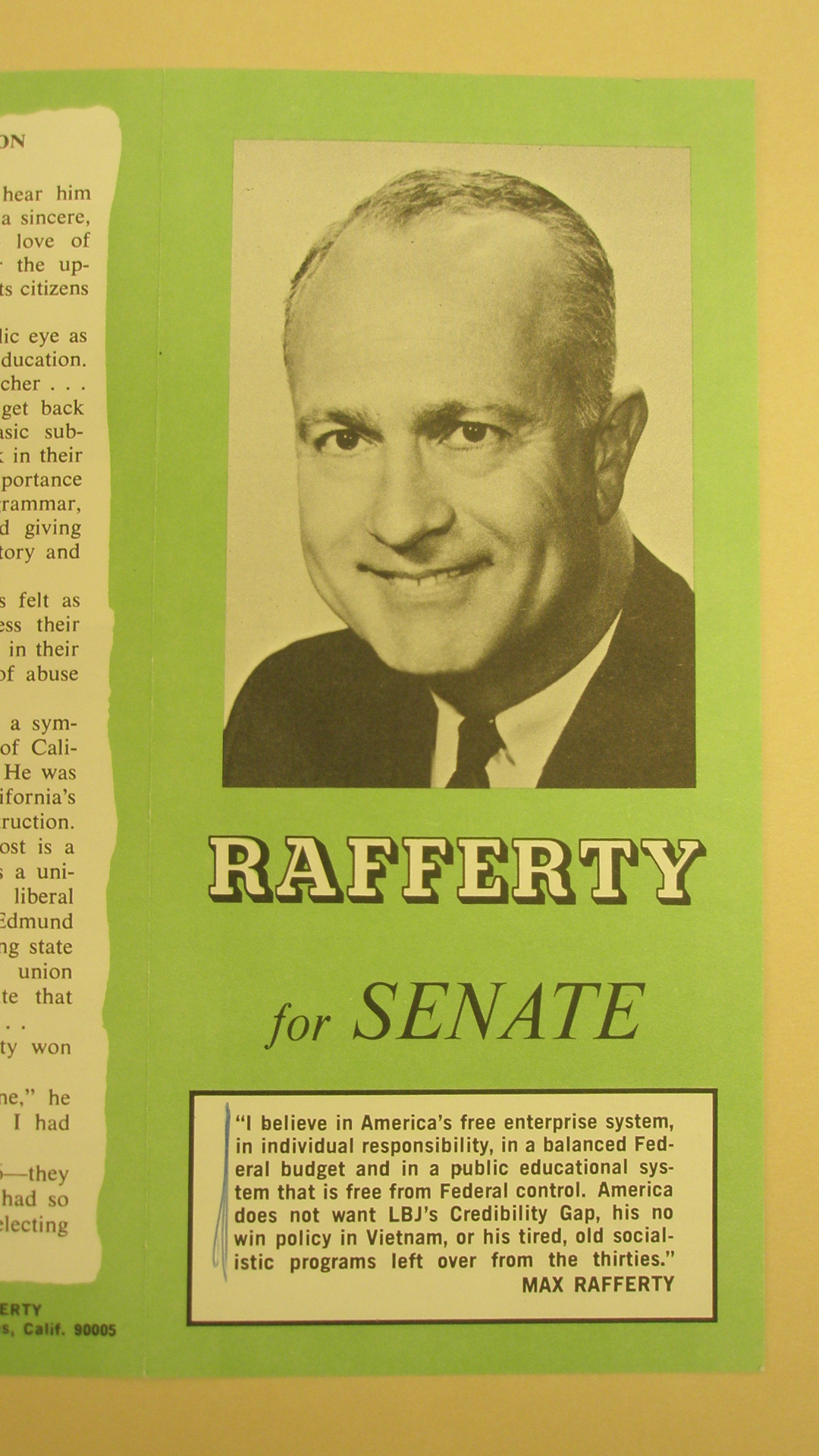
From the Hargis Collection.

From the Hargis Collection.

But that doesn’t mean that today’s version, the Common Core State Standards, will be greeted with anything but alarm among some sectors of conservative thought.


[1] This speech survives as a typescript in the Billy James Hargis Papers, University of Arkansas Mullins Library Special Collections, MC 1412, Box 48, Folder 2, Public Schools, 1950-1978 (1 of 2).  This collection of papers represents, IMHO, the best single-stop shop for any scholar hoping to understand the career of twentieth-century educational conservatism.  The Reverend Hargis was a leader in the Christian conservative movement in the second half of the twentieth century, and he was an avid collector of newsletters, correspondence collections, and other ephemera that shed a unique light on conservative thinking about education during the period.
 

Conservatives and the Common Core

What do conservatives think about the emerging Common Core State Standards?

As with any question, ask a hundred conservatives and you’ll likely get a hundred different answers.
However, some distinct themes have emerged in recent months.

First, many conservative politicians and activists object to the Common Core’s implications for the creeping expansion of government.  Some insist that the standards add another layer of inaccessible, distant, controlling, expensive central control.

Second, conservatives object that the new national standards chip away at parental control of children’s education.  With greater central control, parents and responsive local governments will lose that much more ability to control directly what goes in their local public schools.

Both of these are storied conservative protests against the trends in public education.

Before we examine these themes and their histories, let’s look at the CCSS themselves.  So far, forty-five states, plus the District of Columbia and Department of Defense schools have adopted these standards.  Supporters of the CCSS insist these are not imposed by the federal government, but rather created jointly by state education officials.  The reasons for such standards are many, according to supporters.  In the words of the CCSS Initiative,

“High standards that are consistent across states provide teachers, parents, and students with a set of clear expectations that are aligned to the expectations in college and careers. The standards promote equity by ensuring all students, no matter where they live, are well prepared with the skills and knowledge necessary to collaborate and compete with their peers in the United States and abroad. Unlike previous state standards, which were unique to every state in the country, the Common Core State Standards enable collaboration between states on a range of tools and policies.”    

Conservatives are not the only ones to dispute these claims.  Progressive critics (see one example here) often lament the new standards’ failure to consider adequately individual student situations.  Some progressives call the standards a greedy corporate power grab.  Others lament the goal of squeezing all young minds into a procrustean bed of regurgitative multiple-choice testing instead of pursuing the more difficult goal of authentic learning for real students.  Alfie Kohn, for instance, insisted that national standards would “squeeze the life out of classrooms” by mandating one-size-fits-all education, dictated by self-seeking corporate interests.

When conservative activists and pundits critique the CCSS, it is usually on different grounds.  Writing for the Heritage Foundation, for example, Lindsey Burke warned, “The push for centralized control over what every child should learn has never had more momentum.”  CCSS, which Burke called “national standards,” represented a “challenge to educational freedom in America.”  Implementation of the standards would be expensive, Burke pointed out.  Even worse, these standards reversed the proper structure of education.  Instead of more and more central control, Burke argued, “Education reform should give control over education to those closest to students.”

The Heritage Foundation’s Rachel Sheffield praised state lawmakers who pushed to exit the CCSS.  In Indiana, for instance, conservative state lawmakers have proposed a bill to put the CCSS on hold.  One of the requirements of Indiana’s Senate Bill 193, for instance, will be to include parent members on the standards committee.  Another will be to allow any parent to challenge their children’s standard-based high-stakes test results.

These themes—federal overreach and parental control—have long been central to conservative educational activism.

As we’ve noted, agitation against federal intrusion into the local politics of education has been an important element of conservative educational activism since at least the 1940s.  Though it might come as a surprise to some, before the 1940s many conservatives endorsed increased centralization of education policy, as Douglas Slawson has noted in his excellent book The Department of Education Battle, 1918-1932.

The second conservative worry about CCSS also has a long history.  Conservative pundits have argued for decades that parents need more control over their children’s education.  Back in the 1960s, conservative educational leader Max Rafferty insisted, “Children do not belong to the state. They do not belong to us educators, either. They belong to their parents and to nobody else.  And don’t you forget it.”  (Source: Rafferty, On Education, pg. 9)

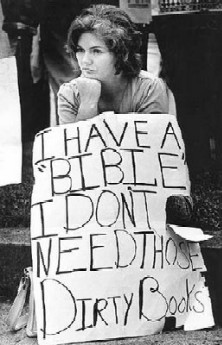
Note one protester's button: "Parent Power"

Note one protester’s button: “Parent Power”

These conservative concerns spanned the country and the decades.  As historian Ron Formisano noted in his landmark 1991 history of Boston disputes over forced busing, parents insisted on their fundamental rights to determine their own children’s educational careers.  As anti-busing leader Louise Hicks fumed, “If under a court order a child can be forcibly taken from his parents into unfamiliar, often hostile neighborhoods, then we shall have opened a pandora’s box of new, unlimited government powers” (pg. 192).

Similarly, President Reagan insisted in 1983, “I believe that parents, not Government, have the primary responsibility for the education of their children.  Parental authority is not a right conveyed by the state; rather, parents delegate to their elected school board representatives and State legislators the responsibility for their children’s schooling.”  (Source: Catherine Lugg, For God and Country, pg. 136).

Across the spectrum of conservative belief and activism, we hear similar echoes.  In 1989, for instance, creationist leader Ken Ham warned that “Most parents have left the training of their children to the church, school or college.”  No wonder, Ham argued, that children embraced anti-God theologies.

So when conservatives in 2013 warn that CCSS will undermine parental control, they draw on a rich tradition of conservative thought and activism.  Schools must remain on a tight leash, many conservatives have insisted over the years.  If allowed too much power, centralizing educational authorities will take over.


Plumbers and Teachers

What is a teacher? A hired hand?  Or an independent scholar?  A functionary enrolled to help parents?  Or a professional charged to form young minds as she or he best sees fit?

Students of conservative educational activism like me often list the same litany of complaints made by conservatives about public schooling in the past century.  Schools, conservatives often complain, must not warp their students’ minds.  Schools should teach patriotism.  Schools should teach respect for religious values and traditional notions of right and wrong.  Some conservatives believe schools must not teach atheism and call it science.

But there remains one hugely important conservative issue that rarely gets the same amount of attention: conservative concern with the overweening authority of teachers and educational experts.

As part of his recent series on education at Front Porch Republic, Anthony Esolen articulates this traditional conservative frustration.

Esolen frames the question in a provocative fashion: What if teachers were plumbers?

Here is one of Esolen’s scenarios:

“Jones pokes his head into the basement. He hasn’t done that in two years. He’s told himself again and again that they must know what they are doing, they are the experts and he isn’t, they are from the government, and he must mind his own business. But the devil gets into him.

“‘What is that?’

“‘What is what?’

“‘That – that tangle of pipes! Why so many? It’s a maze! It takes up half the room. In some places you can’t stand up straight. It’s like what happens to a hundred foot extension cord. The whole contraption is in knots!’

“‘I fail to see what you are so concerned about. Presumably you wanted us to do your plumbing. Well, so we have. We’ve done a great deal more than you expected.’

“‘But it’s leaking all over the place! Why didn’t you just do the simple but necessary thing? Why didn’t you do what I hired you to do?’

“‘Hired, Mr. Jones?’”

In the research for my current book about twentieth-century conservative educational activism, I’ve seen this argument repeated with a variety of emphases.  For generations, conservative activists have argued that schools and teachers have taken too much authority over children.

For instance, during the 1920s school controversies, William Jennings Bryan famously argued, “The hand that writes the paycheck rules the school.”

A generation later, in 1951, Ernest Brower, a conservative leader from Pasadena, California, complained to a state senate investigating committee that “progressive” education had seized too much control.  In their citizen investigation, Brower reported,

 “Well, you might liken public education, in Pasadena at least, and I think probably in other sections of the country as well, to a patient who is very sick, and so, naturally, the proper thing is to start looking for symptoms, and we found several symptoms of the disease. . . . we noticed there was a definite elimination of parental authority, undermining of parental influence.”

For Brower, as for Bryan and Esolen, this undermining of parental influence signaled the underlying “disease,” of which other educational problems were merely symptoms.

In 1968, conservative California school superintendent Max Rafferty agreed.  “Children,” Rafferty warned,

“do not belong to the state.  They do not belong to us educators, either.  They belong to their parents and to nobody else.  And don’t you forget it.

“Because if you do forget it and let the kids become wards of an all-powerful government, you won’t have to look forward with fear and trembling any more to that dread year 1984.  It will be here, considerably ahead of schedule.”

In 1980, free-market economist Milton Friedman lent his considerable influence to this central conservative notion.  “Parents,” Friedman wrote,

“generally have both greater interest in their children’s schooling and more intimate knowledge of their capacities and needs than anyone else.  Social reformers, and educational reformers in particular, often self-righteously take for granted that parents, especially those who are poor and have little education themselves, have little interest in their children’s education and no competence to choose for them.  That is a gratuitous insult.”

We could multiply examples of this sentiment almost endlessly.  From the early years of the Heritage Foundation’s work, Connie Marshner insisted,

“A parent’s right to decide the direction of his child’s life is a sovereign right, as long as the child is subject to his parent.  Educators have no business creating dissatisfaction with and rebellion against parental wishes.”

Similarly, Texas school watchdog Norma Gabler echoed this sentiment in the 1980s,

“Number one, my sons belong to my husband and I.  They do not belong to you and the state—yet.”   

For all these leading conservative intellectuals and activists, one foundation of schooling is that it is a service provided for families by educators.  It has long been a source of intense frustration that progressive educators presume glibly to arrogate total control over children’s lives.

As Professor Esolen reflected in his recent essay series, this arrogance is all the more exasperating when it seems utterly unaware of its own ridiculousness.  We would not accept the fact that a plumber would ignore our wishes and have his way with our pipes.  Why, Esolen asks—echoing generations of conservative intellectuals—why do we accept this brazen arrogance from teachers?

In the News: The Chicago Teachers’ Strike and the “Educrats”

As several commentators have pointed out, the Chicago teachers’ strike puts Chicago Mayor Rahm Emanuel in an awkward position politically. He has been gleefully endorsed by conservative Republicans such as VP nominee Paul Ryan.  Emanuel’s fight with the teachers’ union puts him on the side of union-busting GOP governors such as Chris Christie of New Jersey and Scott Walker of Wisconsin. 

In cultural politics, too, fighting with a teachers’ union puts Mayor Emmanuel in the company of decades, even generations, of conservative educational activists and intellectuals. As I discussed in an article in Teachers College Record a few months back, teachers’ unions have often been the primary villain in conservative versions of American educational history.

Free-market pioneer Milton Friedman, for example, blamed America’s educational woes on the increasing power of teachers’ unions. In Free to Choose (1990) the Friedmans explained that even well-meaning teachers and school administrators always want “greater centralization and bureaucratization” at the cost of worse schooling (pg. 157). Since the 1950s, Milton Friedman had argued that teachers’ unions invariably degraded education, since most teachers are “dull and mediocre and uninspiring” (Capitalism and Freedom, 2002 edition, pg. 96). Union control of school, Friedman believed, protected less talented teachers and led to less efficient, less effective schooling.

California State Superintendent of Public Instruction Max Rafferty argued that the choking tendrils of unions and educational bureaucracy had almost killed real education. “Education evolved,” Rafferty argued in 1964, “from a sparkling, beckoning opportunity into a more humdrum, sober-sided obligation. It became hedged about with legal requirements and equalization formulas, credentialing criteria and personnel-pupil ratios.” (What Are They Doing to Your Children, 1964, pg. 109).

In the 1980s, conservative educational thinker Sam Blumenfeld called the National Education Association “the Trojan Horse in American Education.” Educational experts, Blumenfeld noted—what he called “remote educational commissions in far-off universities” (Is Public Education Necessary, 1981, pg. 4), had long planned to discredit traditional values in the eyes of American schoolchildren.

For these conservative educational thinkers, teachers’ organizations epitomized all that was wrongheaded about American public education. For free-marketeers like Friedman, unions selfishly choked out all alternate ideas about schooling. For traditionalists like Rafferty, union bureaucracy forced a pernicious pablum down the intellectual gullet of America’s schoolchildren. For more extreme conspiratorial thinkers such as Blumenfeld, teachers’ unions carried out a long-standing plot to rob Americans of their patriotic and spiritual heritage.

And now Rahm Emanuel stands on their side. Emanuel will be gleefully supported not only by contemporary conservative politicians like Paul Ryan, but by generations of conservative educational activists and intellectuals.

Leftist Bias in the Academy?

Conservatives have long complained that American higher education faculty displayed an intellectually crippling ideological bias.  This has been called “anti-intellectualism,” but a more precise term would be something like “anti-professoriate.”  In a recent article in the Chronicle of Higher Education, the non-conservative sociologist Christian Smith of Notre Dame’s Center for Social Research argues that conservatives may be right.

The accusation of academic bias has been so durable in the intellectual world of Fundamentalist America that one is tempted to dismiss it as sour grapes.  For instance, in the 1920s, Presbyterian orthodox leader J. Gresham Machen finally left his beloved Princeton Seminary to start his own school, driven out, he claimed, by his colleagues’ growing intolerance of Machen’s Biblical orthodoxy.  Less intellectually gifted 1920s fundamentalists made similar charges, in more colorful language.  For example, Texas fundamentalist minister J. Frank Norris insisted in 1921 that the problem with America all started when some influential young Americans studied “in Chicago University where they got the forty-second echo of some beer-guzzling German Professor of Rationalism.”

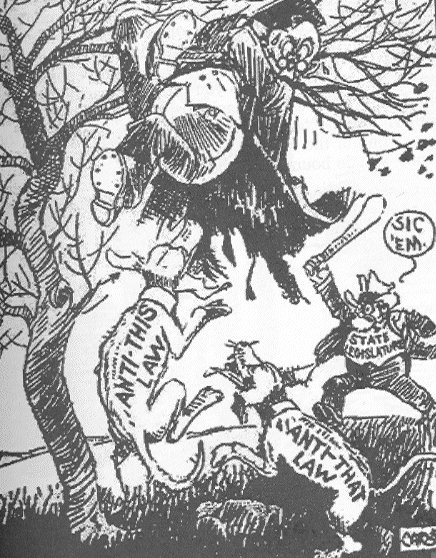
Around the time of the Scopes Trial, a cartoon in the Wall Street Journal captured this anti-professoriate feeling among fundamentalists:


Education in the Higher Branches

More recently, in the early 1960s, conservative California State Superintendent of Education Max Rafferty found the main culprit of America’s decline in the progressive, leftist orthodoxy promulgated in America’s institutions of higher education.  Rafferty insisted that colleges had created a new landscape of “temples . . . great universities which marble the land.”  These temples no longer pursued true intellectual endeavor, Rafferty claimed, but only passed along a deadened orthodoxy, “turning out swarms of neophytes each year to preach the gospel of Group Adaptation.  Their secret crypts and inner sanctums are the graduate schools.”

In the twenty-first century, small-f fundamentalist blockbust author Tim LaHaye agreed.  University faculties, LaHaye argued, had placed themselves hopelessly in thrall to the false idols of the cultural Left.  After his huge publishing success with the Left Behind series, LaHaye set out to create a new biblical hero.  In Babylon Rising (2003), LaHaye described the adventures of biblical archeologist Michael Murphy.  In Murphy, LaHaye hoped to create a “true hero for our times,” one who united unwavering biblical faith with scholarly acumen and a dose of two-fisted machismo.  In one telling scene, Murphy is confronted by his smarmy secular dean.  This little episode tells us a lot about continuing fundamentalist attitudes toward the professoriate.

“Hold it, Murphy!”

A bony hand grabbed Murphy by his backpack as he left the hall. “Dean Fallworth.  What a fine example you set for the students by monitoring my lecture.”

“Can it, Professor Murphy.”  Fallworth was as tall as Murphy but cursed with a library-stack pallor that would make some mummies look healthy by comparison.  “You call that a lecture?  I call it a disgrace.  Why, the only thing separating you from a Sunday tent preacher is the fact that you didn’t pass the plate for a collection.” 

“I will gratefully accept any donation you wish to make, Dean.  Did you need a syllabus, by the way?”

“No, Mr. Murphy, I have everything I need to get the university board to begin accreditation hearings for this evangelical clambake you’re calling a class.”

“Temper,” Murphy mumbled to himself.  “Dean, if you feel my work is unprofessional in any way, then please help me to improve my teaching skills, but if you want to bash Christians, I don’t have to stand here for that.”

“Do you know what they’re already calling this silly circus around the campus?  Bible for Bubbleheads, Jesus for Jocks, and the Gut from Galilee.”

Murphy couldn’t help but laugh.  “I like that last one.  I’m intending this to be a quite intellectually stimulating course, Dean, but I confess I did not post an I.Q. requirement for taking it.  The knowledge will be there, I promise you, but I will likely fall short of your apparent requirement that the only acceptable instructional method is to bore your students to an early ossuary.”

“Mark my words, Murphy.  Your hopes of this course surviving and your hopes of tenure at this university are as dead as whatever was in that bone box of yours.”

“Ossuary, Dean.  Ossuary.  We’re at a university, let’s try to use multisyllabic words.  If it doesn’t turn out to be legitimate, maybe I can get it for you cheap and you can keep your buttons in it.  Now, if you’ll excuse me, I have a new artifact to begin work on.”

In this vision of the world of higher education, only fundamentalists have remained true to the original mission.  Fundamentalist intellectuals, this line of reasoning goes, have retained their sense of inquiry and intellectual honesty.  They have not been seduced by the showy appeals of false science, such as evolution.  They have not been lulled by a peaceful-sounding pluralism that in practice degrades human dignity.  And they have not been willing to accept the hidebound leftist, secularist, evolutionist orthodoxy required of the mainstream academic.

Christian Smith’s recent article argues that this leftist orthodoxy is not merely a figment of conservatives’ imaginations.  His article bemoans the attacks on sociologist Mark Regnerus.  Regnerus published an academic article in which he concluded that children raised by same-sex parents have more emotional disorders as adults.  According to Smith, Regnerus followed the guidelines of academic research and publishing.  His conclusions may or may not be correct, but his work followed the traditions of peer review and editing.  Regnerus’ conclusions may be disagreeable to some, but his research methods stand above reproach.

Yet, according to Smith, the attacks on Regnerus demonstrate the problems with today’s left-leaning academy.  As Smith argues,

“The temptation to use academe to advance a political agenda is too often indulged in sociology, especially by activist faculty in certain fields, like marriage, family, sex, and gender. The crucial line between broadening education and indoctrinating propaganda can grow very thin, sometimes nonexistent. Research programs that advance narrow agendas compatible with particular ideologies are privileged. Survey textbooks in some fields routinely frame their arguments in a way that validates any form of intimate relationship as a family, when the larger social discussion of what a family is and should be is still continuing and worth having. Reviewers for peer-reviewed journals identify “problems” with papers whose findings do not comport with their own beliefs. Job candidates and faculty up for tenure whose political and social views are not ‘correct’ are sometimes weeded out through a subtle (or obvious), ideologically governed process of evaluation, which is publicly justified on more-legitimate grounds—’scholarly weaknesses’ or ‘not fitting in well’ with the department.” 

As we have argued elsewhere, this bias is often wrapped in a near-total ignorance about life in Fundamentalist America.  One of the main reasons for this blog has been to introduce the ideas and culture of Fundamentalist America to outsiders who don’t know much about it.  Like Smith, we do not have to actively defend conservative ideas in order to protest against this sort of myopic academic bias.  Rather, we can promote a true diversity of ideas in higher education.  We can push for a true university, one in which the universe of ideas can be discussed calmly, without fear of the vindictive witch-hunts Smith describes.

In order to do so, we need to actively separate the jumble of issues.  The question is not whether children of same-sex parents have a tougher time in life.  The question is whether we will allow that conclusion to be reached in academic journals.  The question is whether researchers will be free to follow their data wherever it may lead, or whether, as Smith concludes, academic life will be governed by a crippling and unnecessary Stalin-lite motto: “Play it politically safe, avoid controversial questions, publish the right conclusions.”


REQUIRED READING: Protester Voices

For those who hope to understand Fundamentalist America in the twenty-first century, a good place and time to start would be Kanawha County, West Virginia, 1974.

The raucous 1974-1975 school year in this county surrounding Charleston saw a burst of public controversy over the teaching in its public schools.  Protesters vilified a set of textbooks adopted by the school district.  At its peak, the protest and school boycott included a sympathy strike by the area’s miners and even a spate of gunshot attacks and the bombing of a school-administration building.  The fight in Kanawha County, as argued by both protesters and historians, can correctly be seen as the birthplace, or at least the midwife, of an emerging populist conservative movement.

The controversy has attracted its share of recent attention from scholars such as Carol Mason and journalists such as Trey Kay.

Thanks to the energetic activist Karl Priest, we now also have an account of the controversy written from a prominent member of the movement itself.  Priest’s 2010 book Protester Voices offers a view from inside the textbook protest movement.

Priest’s story is unabashedly partisan.  The tone and style of his book are those of a bare-knuckled culture warrior rather than those of a disinterested academic.  Priest has achieved a reputation as one of today’s leading anti-evolution internet brawlers.  In addition to his anti-evolution work, Priest is also currently active in Exodus Mandate.  This organization promises “to encourage and assist Christian families to leave government schools for the Promised Land of Christian schools or home schooling.”  Those who hope to explore the worlds of conservative Christian activism in twenty-first century America will soon run into the work of Karl Priest nearly everywhere they turn.  Indeed, when ILYBYGTH first starting imagining how intelligent, educated people could embrace creationism (see, for instance, here, here, here, here, and here), we were accused of being merely a front for Priest.

In his 2010 book, Priest takes other writers to task for their anti-protester bias.  He dismisses Carol Mason, for example, as someone who “concentrate[s] on the exception to the rule” (37).  The protest movement, Priest insists, must not be understood as an irruption of racism or vigilante violence.  The protesters themselves cannot fairly be dismissed as “wild-eyed ignoramuses” (xiii).  Such accusations, Priest insists, demonstrate the bias of left-leaning scholars more than the lived reality of the protest itself.  The leaders of the movement, in Priest’s view, “suffered financial loss. . . . [and] endured snide remarks and mocking.”  They did so in order to defend their schools and community against the imposition of taxpayer-funded textbooks that included aggressive racism and sexual depravity.  Priest defends the rank and file of this movement, also slandered mercilessly by other writers, as “Norman Rockwell Americans” (63).

Priest agrees with other commentators that this textbook controversy provided the launching pad for a new kind of conservative activism.  Kanawha County attracted national leaders such as Mel Gabler and Max Rafferty.  The fledgling Heritage Foundation sent legal advisers.  The 1974 protest, Priest claims, heralded the new generation of populist conservatism that continues in today’s Tea Party movement.

For anyone hoping to understand Fundamentalist America, this book is an important resource.  Not only does Priest’s account offer a staunch defense of the fundamentalist side of one of the most significant controversies of the late twentieth century, he also includes a reflection on the meanings of fundamentalism itself.  Though he prefers the term “Bible-believing Christian,” Priest insists that “Being a fundamentalist, contrary to what liberals have propagandized, is nothing to be ashamed of just by the attachment of the term” (3).

Traditionalist Teaching for Progressive Teachers? Lisa Delpit and Fundamentalism in Black and White

Fundamentalists don’t like progressive education.  They may not realize that they have some potential allies deep in the heart of the academic education establishment.

What do fundamentalists mean when they fight against “progressive education?”  For one thing, fundamentalists tend to pooh-pooh reading instruction that allows children to ‘discover’ reading on their own.  And they dismiss the notion that classroom teachers should put authority in the hands of students.  Also, fundamentalists often look askance at education professors who advocate soft-heading, child-centered classroom teaching that fails to deliver basic information and academic skills.

Generally, fundamentalists make these complaints from outside of the academy.  Some historians and other prominent academics—folks such as Arthur BestorRobert Hutchins,  or Arthur Schlesinger, Jr.—have critiqued the claims of progressive education, but most of the effective critics have worked outside of higher education.  But in the past generation, at least one prominent academic educator has critiqued “advocates of any progressive movement” who fail to consider the opinions of those “who may not share their enthusiasm about so-called new, liberal, or progressive ideas.”  The work of this world-famous educational activist is read at every school of education, especially ones in which teachers are trained to use progressive teaching methods.

Then why does she talk this way?  Because she framed the issue not as traditional and progressive, but as black and white.  Her name is Lisa Delpit, and her traditionalist critique of progressive education did not lead to her exclusion from the education academy.  On the contrary, she has received some of the academy’s most prestigious awards for her work, including a MacArthur “Genius” award in 1990 and Harvard Graduate School of Education’s Outstanding Contribution to Education award in 1993.

To be clear, Delpit demonstrated considerable differences from many other traditionalist education activists.  For example, she backs a multicultural approach to education, most conservative traditionalists do not.  (See the ILYBYGTH discussion of traditionalist critiques of multicultural education here, here and here.)  She supports reading in depth and excoriates rote instruction.

But she also pushes a traditionalist ideology of teaching.  She offers withering criticisms of progressive teachers’ justifications.  In one career-making speech and article from the late 1980s, Delpit castigated progressive educators for their misplaced softness toward students.  She cited with approval one African American classroom teacher who described her anger at white progressive teachers as “a cancer, a sore.”  This teacher had stopped arguing against progressive methods.  Instead, she “shut them [white progressive teachers and administrators] out.  I go back to my own little cubby, my classroom, and I try to teach the way I know will work, no matter what those folk say.”  Delpit suggested that a direct-instruction model matched more closely the cultural background of most African American students.  In one model Delpit described favorably, the teacher is the authority.  The goal is to teach reading via “direct instruction of phonics generalizations and blending.”  The teacher keeps students’ attention by asking a series of questions, by eye contact, and by eliciting scripted group responses from the students.  Such traditionalist pedagogy, Delpit noted, elicited howls of protest from “liberal educators.”

In a sentence that could come straight from such conservative traditionalist leaders as Bill Bennett or Max Rafferty, Delpit supported the notion of many African American educators that “many of the ‘progressive’ educational strategies imposed by liberals upon Black and poor children could only be based on a desire to ensure that the liberals’ children get sole access to the dwindling pool of American jobs.”

In another critique, Delpit argued that white, middle-class teachers hid their classroom authority in ways that were confusing to poor and African American students.  Teachers of all backgrounds, Delpit suggested, need to be more explicit about their power and authority in the classroom.  A good teacher, Delpit noted, was seen as both “fun” and “mean” by one African American student.  Such a teacher, Delpit’s interviewee argued, “made us learn. . . . she was in charge of that class and she didn’t let anyone run her.”

More important for fundamentalist activists, Delpit’s voice is not alone.  A call for traditional pedagogy and schooling seems to be gaining adherents among African American parents and educators.  We could look at the deep traditionalism of such prominent schools as the New York Success Academy Charter Schools.  Or we could probe the attitudes of those who run KIPP (Knowledge Is Power Program) Schools, which tend to serve significant numbers of African American students.  In a recent article about school “paddling” in USA Today, one African American school administrator confirmed that she believed in spanking “because I’m from the old school.”

The numbers indicate African American students tend to receive corporal punishment more often than students of other racial backgrounds, but don’t indicate the level of support for such punishment among African American teachers as opposed to teachers of other races.  There are some indications that African American parents tend to use corporal punishment more often than other groups.  This would support Delpit’s assertion that many African American students have different cultural expectations from other students when they get to school.  But the same study asserts that a huge majority of parents of other groups also use corporal punishment at home.  And, indeed, there is a lot of support for corporal punishment at school among white conservative activists.  But such support generally comes as part of a broader traditionalist, anti-progressive ideology of schooling.

Delpit’s argument is different.  She argues for traditional authoritarian teachers within a progressive, multicultural educational system.

What does this mean?  I’ve got a couple of reflections, and I’d welcome more.

For one thing, it tells us something about the current state of education scholarship.  Seen optimistically, we might conclude that the popularity of Delpit’s work proves that education scholars are willing to embrace a true diversity of opinion.  That is, education scholars might not be the petty intellectual tyrants some traditionalists accuse them of being.  To cite just one example, arch-traditionalist Max Rafferty in 1968 accused the “education bureaucrats” of only speaking to regular people “with that air of insufferable condescension.”  Such “educationists,” Rafferty charged, only listened to one another; they only hoped to turn America’s schools into something approaching a “well-run ant hill, beehive or Hitlerian dictatorship.”  Delpit’s example of progressive traditionalism might suggest that education scholars are more open to dissent than Rafferty and others have consistently charged.

In a less rosy light, though, we might conclude that this is yet another example of the ways the mainstream academy is hamstrung over racial ideology.  We might wonder if Delpit’s ideas would be welcomed as fervently if education scholars weren’t so terrified of being considered racially insensitive.  It helps, of course, that Delpit is a wonderful writer and powerful polemicist.  But it is hard to ignore the question: How warmly would a scholar be welcomed who trashed the idea of progressive pedagogy in general?  Not just for one group of students, but for students and schools in general?

One other point jumps out at us: we apparently need to be more careful when we talk about traditionalist education.  I’ll plead guilty.  I am most interested in those traditionalists who act out of what we can fairly call a conservative impulse to transform American schools and society.  Folks like Rousas Rushdoony, Max Rafferty, Sam Blumenfeld, Mel and Norma Gabler.  Groups like the Daughters of the American Revolution and the American Legion.  Activists from these groups have long believed that teaching must be made more traditional so that American society itself can reclaim some of its lost glory.  But there are traditionalists like Delpit who hope that schools will transform school and society in a vastly different way.

Perhaps we need to treat “educational traditionalism” the way we treat “evangelicalism.”  A lot of folks, scholars and normal people alike, tend to treat “evangelicalism” as if it were the sole domain of white, conservative folks such as Billy Graham and Jerry Falwell.  But religious historians are also interested in other forms of evangelicalism.  There have always been leftist evangelicals, for instance, as Raymond Haberski has recently noted.  And, of course, there has always been a strong evangelical tradition among African Americans.

Perhaps the most important notion to think about here is that we have more than one kind of educational traditionalism.  Bashing progressive education has long been the national pastime of educational conservatives.  For the last twenty-five years or so, such conservatives have been joined by an influential cadre of mainstream education scholars.

Further reading: Lisa Delpit, “The Silenced Dialogue: Power and Pedagogy in Educating Other People’s Children,” Harvard Educational Review 58 (Fall 1988): 280-199; Delpit, (1986). Skills and other dilemmas of a progressive black educator. Harvard Educational Review, 56(4), 379-386; Delpit, Lisa. (1995). Other People’s Children: Cultural conflict in the classroom. New York, NY: The New Press; Delpit, L & Perry, T. (1998). The Real Ebonics Debate: Power, Language, and the Education of African-American Children (Eds.). Boston, MA: Beacon Press; Delpit, L. & Dowdy, J. K. (2002). The Skin That we Speak: Thoughts on language and culture in the classroom (Eds.). New York, NY: The New Press; Delpit, L. D. (2012). Multiplication is for White People: Raising expectations for other people’s children. New York:The New Press.

Required Reading: Louis Menand and the Left-Leaning Ivory Tower

Louis Menand,  The Marketplace of Ideas: Reform and Resistance in the
American University.
  New York:  W.W. Norton, 2010.

Fundamentalists have long argued that America’s colleges and universities had been captured by a sinister left wing.  Now they have some evidence to back up their complaints.

Most often, those accusations branded mainstream American univeristies as hopelessly lost to pernicious non-fundamentalist ideas.  For example, Texas fundamentalist minister J. Frank Norris insisted in 1921 that the problem with America all started when some influential young Americans studied “in Chicago University where they got the forty-second echo of some beer-guzzling German Professor of Rationalism.”

This hostility among fundamentalists toward the professoriate was noted by one cartoonist in the Wall Street Journal around the time of the Scopes Trial in 1925.  In this cartoon, hillbilly fundamentalists sic their legislative dogs on a hapless professor.

In the run-up to that Scopes Trial, the greatest fundamentalist scientist of the 1920s, George McCready Price, informed William Jennings Bryan confidentially that evolutionists had fallen prey to a debilitating group-think.  Because they only listened to one another, Price insisted, such evolutionists had become “out of date,–behind the times,–and don’t know it.”

This outright hostility toward the academic classes continued throughout the twentieth century.  For instance, one pamphlet from the American Legion in 1930 warned that too many college professors saw their jobs as indoctrinating each new generation of young, impressionable minds.  In this author’s opinion, college professors did not try to authentically educate their students, but only saw their jobs as a chance to make new “teachers of communism and atheism out of them.”

In the early 1960s, conservative California State Superintendent of Education Max Rafferty found the main culprit of America’s decline in the progressive, leftist orthodoxy promulgated in America’s institutions of higher education.  Rafferty insisted that colleges had created a new landscape of “temples . . . great universities which marble the land.”  These temples no longer pursued true intellectual endeavor, Rafferty claimed, but only passed along a deadened orthodoxy, “turning out swarms of neophytes each year to preach the gospel of Group Adaptation.  Their secret crypts and inner sanctums are the graduate schools.”

More recently, fundamentalist blockbuster author Tim LaHaye agreed.  In the twenty-first century, LaHaye believed, university faculties had placed themselves hopelessly in thrall to the false idols of the cultural Left.  After his huge publishing success with the Left Behind series, LaHaye set out to create a new biblical hero.  In Babylon Rising (2003), LaHaye described the adventures of biblical archeologist Michael Murphy.  In Murphy, LaHaye hoped to create a “true hero for our times,” one who united unwavering biblical faith with scholarly acumen and a dose of two-fisted machismo.  In one telling scene, Murphy is confronted by his smarmy secular dean.  This little episode tells us a lot about continuing fundamentalist attitudes toward the professoriate.

“Hold it, Murphy!”

A bony hand grabbed Murphy by his backpack as he left the hall. “Dean Fallworth.  What a fine example you set for the students by monitoring my lecture.”

“Can it, Professor Murphy.”  Fallworth was as tall as Murphy but cursed with a library-stack pallor that would make some mummies look healthy by comparison.  “You call that a lecture?  I call it a disgrace.  Why, the only thing separating you from a Sunday tent preacher is the fact that you didn’t pass the plate for a collection.”
“I will gratefully accept any donation you wish to make, Dean.  Did you need a syllabus, by the way?”

“No, Mr. Murphy, I have everything I need to get the university board to begin accreditation hearings for this evangelical clambake you’re calling a class.”

“Temper,” Murphy mumbled to himself.  “Dean, if you feel my work is unprofessional in any way, then please help me to improve my teaching skills, but if you want to bash Christians, I don’t have to stand here for that.”

“Do you know what they’re already calling this silly circus around the campus?  Bible for Bubbleheads, Jesus for Jocks, and the Gut from Galilee.”

Murphy couldn’t help but laugh.  “I like that last one.  I’m intending this to be a quite intellectually stimulating course, Dean, but I confess I did not post an I.Q. requirement for taking it.  The knowledge will be there, I promise you, but I will likely fall short of your apparent requirement that the only acceptable instructional method is to bore your students to an early ossuary.”

“Mark my words, Murphy.  Your hopes of this course surviving and your hopes of tenure at this university are as dead as whatever was in that bone box of yours.”

“Ossuary, Dean.  Ossuary.  We’re at a university, let’s try to use multisyllabic words.  If it doesn’t turn out to be legitimate, maybe I can get it for you cheap and you can keep your buttons in it.  Now, if you’ll excuse me, I have a new artifact to begin work on.”

In this vision of the world of higher education, only fundamentalists have remained true to the original mission.  Fundamentalist intellectuals, this line of reasoning goes, have retained their sense of inquiry and intellectual honesty.  They have not been seduced by the showy appeals of false science, such as evolution.  They have not been lulled by a peaceful-sounding pluralism that in practice degrades human dignity.  And they have not been willing to accept the hidebound leftist, secularist, evolutionist orthodoxy required of the mainstream academic.

This trope has remained so ubiquitous among fundamentalist activists that is tempting to dismiss it as sour grapes.  In this sour-grapes line of thinking, fundamentalists attack the intellectual pretensions of college professors since those professors show universal disdain for the Biblical belief of fundamentalists.  Fundamentalist attacks, this argument goes, actually prove the intelligence and perspicacity of college professors.

Louis Menand’s new book suggests otherwise.  Menand, best known for his Pulitzer-Prize-winning Metaphysical Club, now takes aim at the sclerotic intellectual culture of American higher education.  Menand is no fundamentalist.  Nor does he have an axe to grind against the left-leaning cultural politics of today’s universities.  However, he does agree with fundamentalist critics that the professoriate encourages group thinking and intellectual conformity rather than innovative ideas and iconoclasm.

Unlike fundamentalist critics of higher education, Menand does not blame evolution, socialism, or secularism for this state of affairs.  Rather, Menand’s critique is more prosaic.  In order to become a tenure-track professor in the humanities, Menand points out, aspiring professors must endure years, even decades, of powerless apprenticeship.  Those who survive this ordeal do so not by bucking the intellectual party line but rather by honing their ability to locate and placate the institutionally powerful.

In Menand’s view, this leads to a dangerous state of affairs in which “The academic profession is not reproducing itself so much as cloning itself” (153).  Until and unless research universities find a new way to train the next generations of faculty, Menand frets, the trend toward intellectual conformity will accelerate.  [UPDATE: For a full review of Menand’s book, be sure to check out the H-Education list review commissioned by Jon Anuik:  https://www.h-net.org/reviews/showrev.php?id=33892 Thanks, Jon, for this notice.  –Editor]

Fundamentalists won’t be surprised.  For generations they have dismissed the protestations of the kept intellectuals at America’s universities.  Menand’s book should serve to give them support from outside their own ranks for their deeply held distrust of pointy-headed professors.

TRADITIONAL EDUCATION IIC2: TEACHING VALUES

Everyone wants America’s schools to teach values.  Progressive types tend to imagine schools that teach children the value of egalitarianism, of celebrating the rich mosaic of cultures that make up America. Traditionalists tend to imagine schools that train students in traditional cultural values.  As we have argued in earlier posts about the “Cult of Multiculturalism” (see here and here), traditionalists could argue that the values of progressive education aren’t real values at all.  Traditionalists might argue that the only real moral instilled by the progressive educational regime is a lamentable and decadent relativism.  According to this traditionalist argument, children are indoctrinated by progressive educators in the pernicious notion that there are no transcendent values, that all values must be welcomed equally.

Such traditionalists have insisted that America’s schools must instead lay out an explicit menu of true moral values for their students.  In its more sophisticated forms, this traditionalist argument has pointed out that we can distill a reasonable list of these values that does not simply impose traditional Christian values in public schools.  Rather, it is simple enough to create a short list of moral values that will incorporate the traditions of all cultures.

For example, writing in the 1960s, California School Superintendent Max Rafferty built his career, in large part, on his insistence that public schools must return to their original mission of instilling traditional moral values in children.  The problem with progressive education, Rafferty believed, was that it denied the obvious and inescapable truth that there are “positive and eternal values.”  In such an educational environment, which Rafferty believed had dominated America’s schools since the 1930s, this moral irresponsibility had drastic effects.  Not only did students fail to grasp obvious moral truths, but under the progressive educational regime,

the mastery of basic skills began insensibly to erode, knowledge of the great cultures and contributions of past civilizations started to slip and slide, reverence for the heroes of our nation’s past faded and withered under the burning glare of pragmatism.

In the place of time-tested values, Rafferty argued, progressives offered “such airy and ephemeral soap bubbles as ‘group dynamics,’ ‘social living,’ and ‘orientation.’”

Rafferty noted that such innovations meant both educational and moral failure.  It also ignored the wishes of the vast majority of Americans.  As Rafferty argued in 1964,

Parents, by and large, want what they have always wanted for their children.  They want them turned into civilized, patriotic citizens speaking and writing good English; able to succeed both in business and college; possessing at least a passable knowledge of our great cultural heritage; trained in such minimum essentials as reading, basic mathematics, spelling, grammar, history, and geography; and, above all, well enough grounded in habits of diligence, perseverance, and orderly thinking to enable them to prepare for adult life. 

Such values did not imply, in Rafferty’s opinion, that minority groups and non-Christians would be made to feel unwelcome in public schools.  Rather, Rafferty believed that everyone agreed on a few basic values that schools must impart.  For Rafferty, these included love of country, non-sectarian religiosity, and character traits such as bravery, honesty, thrift, and hard work.

Writing in the late 1960s, Rafferty noted with alarm that public schools had been divested of their traditional role as moral guardians.  As he wrote in 1968,

Parents pay us to introduce their children to the accumulated culture, wisdom and refinement of the ages, not to give them a mud bath in vice and suggestiveness.  They expect us to inspire in those children a love for the good, the true and the beautiful.

Anybody can pick up obscenity and irreverence on any street corner.  You don’t have to go to school to learn four-letter words and ugly racial slurs.  The schools are built and supported to fight against this sort of dry rot, not to go over to it and embrace it.

We teachers need to set standards, understand them and then uphold them.  And this we cannot do until we abandon an educational philosophy which holds that all standards are fictitious and all truths mere fantasy.

The problem with progressive education, in Rafferty’s opinion, was its “bizarre and even creepy” insistence that public schools must “uproot the ethical standards of 2000 years and to substitute for them the moral criteria of a pack of sex-starved alley cats.”

Max Rafferty’s unabashed insistence on traditionalist education for California did not take his career quite as far as he had hoped.  He ran for U.S. Senate in 1968, on an unapologetically conservative platform that included, in the words of one Newsweek article, “shooting looters, summary street courts-martial for other rioters, more capital punishment, abolishing most foreign aid, and escalating the Vietnam war (perhaps with nuclear weapons).”  Unlike other conservative California politicians, most notably Ronald Reagan’s successful bid for governor in 1966 and Richard Nixon’s win as President in 1968, Rafferty lost his election by a huge margin.  Nevertheless, his fulminations on the importance of including traditional values in America’s public schools won him a large and dedicated following among traditionalists.

William J. Bennett shared many of Rafferty’s beliefs about the importance of traditional values for America’s public schools.  As U.S. Secretary of Education in the mid-1980s under President Reagan, Bennett encouraged American schools to encourage “Moral Literacy.”  Bennett built his educational program around what he called the “Three C’s:” Content, Choice, and Character.  He insisted that teaching students traditional moral values was a necessary function of public schools.  Only by doing so, Bennett believed, could schools help young people develop their character, their unique individual moral quality.  Such moral values, Bennett argued, did not imply the imposition of one set of moral values on a culturally diverse American population.  They did not, as his critics allege, yearn for a return for an imagined past in which only the values of White European Americans were valued.  No, Bennett insisted in 1986, “there is a good deal of consensus among the American people about these character traits.”  Americans of all cultural backgrounds, Bennett believed, could agree that schools ought to teach such traits as “thoughtfulness, fidelity, kindness, diligence, honesty, fairness, self-discipline, respect for law, and taking one’s guidance by accepted and tested standards of right and wrong rather than by, for example, one’s personal preferences.”

Bennett worked during his tenure as Secretary of Education to encourage public schools to teach these values formally and explicitly.  He also published the phenomenally successful Book of Virtues to help parents, educators, and young people learn these time-tested standards of right and wrong.

More recently, two academics have attracted attention beyond the usual ranks of committed traditionalists with their concoction of a list of universal character traits that schools ought to be teaching.  Martin Seligman and Christopher Peterson claimed by 2004 to have distilled twenty-four universal values from their survey of moral thinkers from all cultures, from all periods.  As one New York Times article described their work, Seligman and Peterson “consulted works from Aristotle to Confucius, from the Upanishads to the Torah, from the Boy Scout Handbook to profiles of Pokémon characters.”  As we might expect, their list of character traits included some of Bennett’s and Rafferty’s favorites, including bravery and integrity.  They also include personal traits such as gratitude.  As many commentators have noticed, Seligman and Peterson also added a few that might surprise traditionalists, such as the need for “zest” among young people.

Most important for our discussion here, the notion that schools ought to do more than expose children to a variety of moral values has continued to attract vehement supporters among large numbers of parents, scholars, and educators.  According to these supporters, the fundamental presumption of progressivism—that schools ought to help students discover their own morality rather than imposing an external list of disembodied moral values—has proven to be both ineffective and morally indefensible.  Instead, schools must teach students actively and explicitly that they must practice a short list of traditional values.  They must be honest.  They must be charitable.  They must be kind.  They must be brave.  At times, of course, students may stumble and fail as they learn these traits, just as they might not master long division on the first try.  But one of the primary functions of schooling, in this traditionalist argument, must be to guide students toward learning these fundamental values.


FURTHER READING: Max Rafferty, What Are They Doing to Your Children (1964); Rafferty, On Education (1968); William J. Bennett, Moral Literacy and the Foundation of Character (1986); Martin Seligman and Christopher Peterson, Character Strengths and Virtues: A Handbook and Classification (2004).

IN THE NEWS: Santorum on America’s Educational History

This just in from the Republican presidential campaign trail: Rick Santorum knows what conservatives want to hear.  Not much of a surprise there; Santorum’s knack for positioning himself as the true conservative has led him to a surprisingly strong showing lately.

Of interest to ILYBYGTH readers, Santorum recently described his views on the proper nature of American education.  In doing so, he zeroed in on issues that have long resonated deeply with conservatives.

According to stories in the New York Times  and Los Angeles Times (here and here), Santorum outlined his thinking about the nature of public education in a speech on Saturday to the Ohio Christian Alliance in Columbus.

Santorum has already attracted attention as a homeschooler and advocate of government vouchers.  As his official website articulates, Santorum believes parental choice is one way to “restor[e] America’s greatness through educational freedom and opportunity.”

In Saturday’s speech, Santorum blasted the current “factory model” of education.  Today’s public schools, Santorum insisted, represented an “anachronism,” a period in which “people came off the farms where they did home school or had a little neighborhood school, and into these big factories . . . called public schools.”

Proper schooling, Santorum declared, should begin—and often end—at home.  Santorum appealed to a historical vision that is near and dear to the hearts of many American conservatives.  For most of American history, Santorum argued, even the Presidents homeschooled in the White House itself.

Where did they come up that public education and bigger education bureaucracies was the rule in America?  Santorum asked.  Parents educated their children, because it’s their responsibility to educate their children.

As I argue in an essay coming out this month in Teachers College Record,  this vision of the history of American education has been extremely influential among conservatives.  Since at least the 1950s, prominent conservative activists have based their prescriptions for healing American society on the notion that American education went wrong at a specific point in America’s past.  Of course, they also point out the corollary: conservative reforms can put it back on the right track.

Santorum appeals to a glorious educational past in which public schools had not yet tightened their stranglehold on educational opportunity.  This has been a common trope among conservative activists hoping to free traditionalists’ minds from the pernicious notion that education must look like today’s public education system.

Other common ideas that conservatives have insisted upon in their vision of American educational history:

  • schools started out as frankly religious institutions,
  • schools in the past did a better job of teaching more kids with less public money,
  • a set of notions known as “progressive education” ruined America’s strong tradition of real education, and
  • creeping state control led to ideological and theological totalitarianism in public schools.

On Saturday, Santorum indicated his agreement with these notions.  However, just as “progressive” educators have long fought over the proper meaning and function of schooling, so have conservatives.  In my TCR article I take a closer look at four leading activists since 1950:

  • Milton Friedman,
  • Max Rafferty,
  • Sam Blumenfeld, and
  • Henry Morris.

Each of these writers described a different vision of America’s educational past.  Like Santorum and generations of other conservatives, each agreed that the system had broken down.  However, also like Santorum’s unique insistence on the importance of Presidential homeschooling in the White House, each pundit laid out a unique educational past.

Anyone hoping to understand Fundamentalist America will be wise to listen to Rick Santorum this year.  He seems to have a knack for dishing out all the ideas Fundamentalists want to hear.