Reds Under the Bed? Christians Under the Couch!

Conspiracy sells.  Just ask Dan Brown.  But unwarranted anxiety about conspiracy also poisons our shared public life.

Source: The Guardian

Conspiracy hunting used to be a sport dominated by conservatives.  Think Joe McCarthy waving his sweaty lists of communist infiltrators.  In recent years, though, politicians and commentators have found a new subversive threat: the Religious Right.  A new book by former GOP functionary Mike Lofgren, for instance, warns of the ways his Republican Party was infiltrated and taken over by “stealthily fundamentalist” religious conservatives.

This kind of “paranoid style” has a long history in American public life.  Witches were fiendishly difficult to detect in seventeenth-century New England.  Scheming Catholics worried nineteenth-century WASPs.  Communists emerged as the primary subversive threat in America’s twentieth century.

Leaders of the Religious Right have often worked up convincing conspiracies of their own.  As historian William Trollinger has described, this tradition started with the first generation of American fundamentalists in the 1920s.  One of the most prominent leaders of that Scopes generation, William Bell Riley, finally blamed evolutionary theory on a far-reaching plot of “Jewish Communists.”

In 1926, as I describe in my 1920s book (now in paperback!), one of the new grassroots fundamentalist organizations, the Bible Crusaders, announced the root of the evolution problem.  “Thirty years ago,” the Bible Crusaders revealed,

“five men met in Boston and formed a conspiracy which we believe to be of German origin, to secretly and persistently work to overthrow the fundamentals of the Christian religion in this country.”

A generation later, writing in the magazine of Chicago’s Moody Bible Institute, one evangelical writer shared his experience with the famous progressive educator John Dewey.  This writer told a cautionary tale of secularist conspiracy, with a story of Dewey’s eighty-fifth birthday party in 1944.  Our evangelical witness had been invited to the celebration, the other guests unaware of his theological commitment.  Celebrating the life of the prominent progressive educator, the guests proudly recalled their efforts to transform America’s schools from Christian institutions to secular training centers.  “A generation has passed since that birthday gathering,” reported the evangelical spy to the MBI readership,

“and the plan has been immeasurably advanced by a series of court decisions that have de-theized the public schools.  As a result, American state-supported schools are as officially secular and materialistic as are their counterparts in Communist countries.  Are we awakening?”

Such warnings shouted by Christian conservatives have occasionally attracted enormous audiences outside of religious circles.  In the 1970s, Hal Lindsey’s Late Great Planet Earth became a runaway bestseller.  With his co-author Carole Carlson, Lindsey spun a premillennial dispensationalist reading of the Bible into a riveting tale of international conspiracy.  In the premillennial dispensational interpretation, popular among some conservative evangelical Protestants, the Antichrist will return in the guise of a savior, combining governments into a massive superstate.  What seems like secular salvation is quickly revealed as the ultimate cosmic conspiracy, dedicated to binding all of humanity to a Satanic anti-religion.

Image source: Wikipedia

These themes saw another burst of popularity in the late 1990s, when Tim LaHaye and Jerry Jenkins repeated Lindsey’s feat.  LaHaye’s and Jenkins’ Left Behind series fictionalized Lindsey’s tale, again turning a conspiratorial interpretation of the apocalypse into beach reading for millions of Americans.

These Christian conspiracies have not been without cultural cost.  Though LaHaye and Jenkins carefully included a righteous Roman Catholic Pope among their fictionalized true Christians, other Christian conspiracy theorists, like William Bell Riley, have been too quick to implicate anyone outside of their circle of conservative evangelical Protestantism.

The dangers from conspiracy theorizing are not limited to the conspiracies imagined by conservative Christians.  Overheated accusations about the threat from subversive groups have long posed a profound danger to our public life, as any blacklisted Hollywood writer or interned Japanese-American could attest.  The threat is not limited to false conspiracies.  Satan may not have inspired Salem’s witch troubles, but historian Ellen Schrecker has argued that the communist-hunters of the 1950s often targeted real communist conspirators, if in a clumsy and overly aggressive way.

Similarly, Lofgren’s ominous warnings are not spun of whole cloth.  Lofgren warns vaguely of the “ties” of many leading Republican politicians to extreme positions such as Christian Dominionism.  This theology, associated most closely with the late Rousas John Rushdoony, wants to establish Christian fundamentalist control over American political life.  As Lofgren emphasizes, such thinkers approve the need to act “stealthily.”

Lofgren did not make this up.  Dominionism exists.  Prominent Republican politicians such as Rick Perry and Michele Bachmann really do work with groups who support such notions.  But the way Lofgren and other commentators discuss such threats from the Christian Right distort the public discussion over the role of religion in the public sphere.  As with warnings about President Obama’s connections to the “terrorist professor” Bill Ayers, this kind of conspiratorial rhetoric encourages a no-holds-barred approach to politics.

After all, as Lofgren intones, the “‘lying for Jesus’ strategy that fundamentalists often adopt” gives anti-fundamentalists a reason to punch below the belt in their culture-war battles.  If they did not, the warning goes, they would be helpless before the wiles of the Christian Right.  This is the primary danger of such breathless exposes as Lofgren’s.  They build a shaky and fantastic argument upon a foundation of authentic examples in order to convince the convinced.  Activists swallow the outlandish examples without demur.  Such true believers do not consider the real complexities of their opponents, but rather paint a simplistic and terrifying image to shock and motivate their own side.

As with the real communist movement, the real world of American conservative Christianity is not such a simple place.  Nor is it so headline-grabbingly power hungry.  Consider a recent leadership poll by the National Association of Evangelicals.  This organization, an umbrella group for conservative evangelical Protestants, asked just over one hundred of its leaders if the United States constituted a “Christian Nation.”  Sixty-eight percent said no.  One respondent told the NAE, “I hope others will learn to love Christ as I do, but that will happen more authentically through the Church and individual Christians sharing the Good News and demonstrating the person of Christ through our words and actions.”

This kind of statement from a conservative Christian does not sell books.  What does sell is a cherry-picked catalog of statements by Christian leaders revealing their plans to take over American politics and public life.  It was easy enough in Cold War America to discover evidence of a world-wide subversive communist movement.  But as America learned from Senator McCarthy’s outlandish claims, there is a danger in stripping down the image of subversives to cartoonish bogeymen.

I am not a conservative Christian myself.  I do not hope to apologize for the excesses of some conservative Christians.  Indeed, I believe denunciations of the schemes of conservative Christians have some basis in fact.  But when they serve only to encourage anti-fundamentalists to fight dirty, they do more harm than good.  When such conspiracy-hunters ignore the complexities and ambiguities of their targets, they attack more than their real enemies.  They smear innocent bystanders and poison the political life of the nation.
The Bible in America: Thunderbolt, Part II: Schempp

If we listen to the voices of Fundamentalist America, we might conclude that public schools in America are terrible places to be.  Twenty years ago, John Morris of the Institute for Creation Research warned that public schools had become “aggressively anti-Christian.”  The problems, Morris declared, went beyond the obvious:

Open drug sales and use, ethnic gang wars, and student/teacher violence are easily recognized problems, but how about the more subtle attempts at “values clarification,” or the encouragement of experimentation in “sex education” classes, or the inclusion of homosexuality as a legitimate lifestyle, or easy access to abortions through school clinics.

Other conservative Christian activists agree.  Thirty years ago, Jerry Combee wrote,

the public schools have grown into jungles where, of no surprise to Christian educators, the old Satanic nature ‘as a roaring lion, walketh about, seeking whom he may devour’ (I Peter 5:8).  Students do well to stay alive, much less learn.

More recently, activists involved in the Exodus Mandate have warned that public schools “are no more reformable than Soviet collective farms. . . . Conservative school reformers are a lot like Civil War reenactors who specialize in Pickett’s Charge.  They never take the high ground; they never really win.”

This staggering decline in the quality of public schools began, many conservatives insist, when the US Supreme Court kicked God out of schools in 1962 and 1963.  In 1962, as we’ve seen, the court decreed that states could not impose a non-sectarian prayer in public schools.  More devastating to many conservative Christians, in 1963 the court ruled in the decision Abington Township School District v. Schempp that even Bible reading and the Lord’s Prayer had no legitimate place in those schools.

Despite what many outsiders might think, the world of conservative evangelical Protestantism in America is truly kaleidoscopic, to borrow the phrase of religious historian Timothy L. Smith.  Different schools of thought among Bible believers disagree vehemently on questions of politics, culture, and theology.  Ask twenty “fundamentalists” what the Bible means and you’ll get at least twenty different answers.  Yet when it came to the Schempp decision, a variety of voices from around this diverse world all agreed.  This decision meant not only that God had been kicked out of public schools, but that Christianity itself had been kicked out of American public life.

For instance, in the immediate aftermath of the Schempp decision, separatist Presbyterian fundamentalist Carl McIntire still hoped that concerted political action might overturn it.  McIntire helped organize “Project America” to press politicians to adopt a Constitutional amendment in favor of prayer and Bible reading in public schools.  At first, McIntire repeatedly stressed his feeling that huge majorities of Americans would support such an amendment.  After a bitter political fight, however, McIntire acknowledged that it was hopeless.  Writers in McIntire’s Christian Beacon began to emphasize the notion that their beliefs made them a beleaguered minority in American life.  In 1965 one writer warned that America was “moving farther and farther from its Christian heritage.”  Another predicted that soon mainstream Americans would resort to “repression, restriction, harassment, and then outright persecution . . . in secular opposition to Christian witness.”

Other evangelical voices made similar about-faces in the aftermath of Schempp.  Baptist fundamentalist publisher John R. Rice reflected that the relationship between evangelical faith and public schooling had changed drastically.  He recounted for his readers how things had been radically different in the not-too-distant past:

Once when I was engaged in revival services in the Second Presbyterian Church in Chattanooga, Tennessee, I was invited to speak in every high school in the city and in the principal grade schools, both white and colored, and was gladly received.  The only people offended were those involved in the few elementary schools where I could not come for lack of time. 

Such halcyon days, however, had been destroyed by the cowardly Supreme Court.  Worst of all, Rice concluded, the court seemed to have the support of “the public sentiment.”

This sense of a drastic and sudden shift in the relationship between evangelical belief and public life was widely shared among all different sorts of conservative evangelical Protestants in the aftermath of Schempp.  One writer in the Moody Bible Institute’s Moody Monthly, for example, concluded that evangelicals must retreat to play the role of God’s “witnesses and lights in a dark place” in mainstream American culture.

Similarly, the intellectuals at Christianity Today articulated their shock and dismay of the implications of Schempp. At first, the editors believed that America’s “devout masses” still supported school prayer.  As did other evangelicals, however, they concluded bitterly that “In the schools secularization has triumphed.”  Instead of relying on devout masses, the editors soon hoped only to energize the “believing remnant” in America to support Bible-reading and prayer in public schools.

As we’ll see in future posts, the Schempp decision might not have had the drastic impact many of these writers assumed at the time.  Nevertheless, the degree of unanimity among a wide variety of conservative evangelical Protestants is remarkable.  From separatist fundamentalists to more ecumenical neo-evangelicals, prominent voices all agreed that this momentous decision had done more than just kicked God out of public schools.  In their opinions, Schempp had forced a sudden recalculation of the role of Bible believers in all of American public life.

Coming soon: Thunderbolt, Part III: What thunderbolt?

The Bible in America: The Thunderbolt, Part I: Engel v. Vitale

Lots of fundamentalists feel that America has foolishly kicked God out of its public schools.  Try a simple Google search of “God kicked out of public school,” and you will find an endless collection of news alerts, opinion pieces, and videos from fundamentalists decrying the de-theized state of public education.

Many of these fundamentalist pundits insist that the start of the breakdown of public religion and morality was the US Supreme Court’s decision in 1962’s Engel v. Vitale.  In this case, the court ruled that New York State had no Constitutional authority to impose a short, bland, state-written prayer in its public schools.  The prayer mushed along in a no-man’s-land of interdenominationalism: “Almighty God, we acknowledge our dependence upon Thee, and we beg Thy blessings upon us, our parents, our teachers and our Country.”

Due to both the blandness of this prayer and its imposition by state authorities, though, most leading Protestant evangelicals at the time SUPPORTED the court’s decision.  As opposed to later conservatives who locate the start of America’s public decline at the precise moment of the 1962 anti-prayer decision, the majority of conservative evangelical Protestants in 1962 thought the court had made the right decision.  As I argue in an article appearing soon in the Journal of Religious History, leading evangelical and fundamentalist intellectuals in 1962 showed surprising unanimity in their approval of Engel v. Vitale.

For example, William Culbertson of Chicago’s Moody Bible Institute praised the decision.  “The public as a whole,” Culbertson argued,

“and Christians who sense the necessity for safeguarding freedom of worship in the future are always indebted to the Court for protection in this important area.  On the other hand, the case raised the ominous question of whether any kind of non-sectarian prayer or acknowledgement of dependence on God would be upheld by the Court.”

The editors of Christianity Today agreed that much conservative reaction to Engel had been “ill-informed and intemperate.”  Similarly, the National Association of Evangelicals commended the court’s decision.  Even the separatist fundamentalist Carl McIntire, who would soon become the pointman for conservative Protestant school activism, told a US House of Representatives committee in 1964 that he had originally supported the 1962 decision.

Not every conservative Protestant intellectual supported the Engel ruling.  Samuel Sutherland, president of Biola University, attacked Engel as pandering to a “very small, loud-mouthed minority.”  The decision was a sign, Sutherland believed, that the US was becoming “an atheistic nation, no whit better than God-denying, God-defying Russia herself.”

These days, with the benefit of hindsight, most prominent fundamentalist voices agree with Sutherland.  But at the time, conservative Protestants of many different backgrounds thought the court had done the right thing.

Coming soon: Thunderbolt, Part II: Schempp and the de-theization of America’s public schools.

FROM THE ARCHIVES: Bible in America: Bibles to the Backwoods

A few years back I stumbled across a remarkable Bible campaign.  Beginning in 1921 and continuing throughout the twentieth century, Bible evangelists based at Chicago’s Moody Bible Institute delivered Bibles, New Testaments, and tracts to underserved regions.  This campaign, which began as part of the Bible Institute Colportage Association and eventually became part of the Moody Literature Mission, delivered millions of Bibles and religious literature to the Southern Appalachian region, as well as the Ozarks, western logging camps, Louisianan Catholic schools, prisons, hospitals, and other venues in which missionaries thought people were hungry for the Word. 

            At the time, I focused my study on the missionaries’ use of Appalachian public schools as a distribution network for this religious literature.  I published some of my findings in an academic journal [“The Quiet Crusade: The Moody Bible Institute’s Outreach to Public Schools and the Mainstreaming of Appalachia, 1921-1966,” Church History 75:3 (September 2006): 565-593.]

            Looking over my notes as I thought about the meanings of the Bible in Fundamentalist America, I came across my collection from this research.  As usual, there was a lot more material than what I could use in the article. 

            This will be the last of these collected posts from BICA and MBI. See other posts from this series HERE and HERE.  Most of the material is available at the Moody Bible Institute in downtown Chicago.  The people there were very accommodating and friendly on my visits, and the archive is certainly worth a visit if you’re in the area. 

            I won’t argue that these materials somehow capture any single essence of fundamentalist attitudes about the power of the Bible.  That would be far too simplistic.  But I do believe that the attitudes toward the Bible expressed in these materials give a window into a commonly held fundamentalist vision of the nature of Holy Scripture.  As we’ll see, the Bible missionaries from Chicago believed the Word had a unique power.  The Gospels, to them—and, I argue, to many fundamentalists in the 1920s and since—meant more than just a collection of edifying religious messages.  As we’ll see, many of these Bible missionaries held a fundamentalist belief in the saving power of this powerful text. 

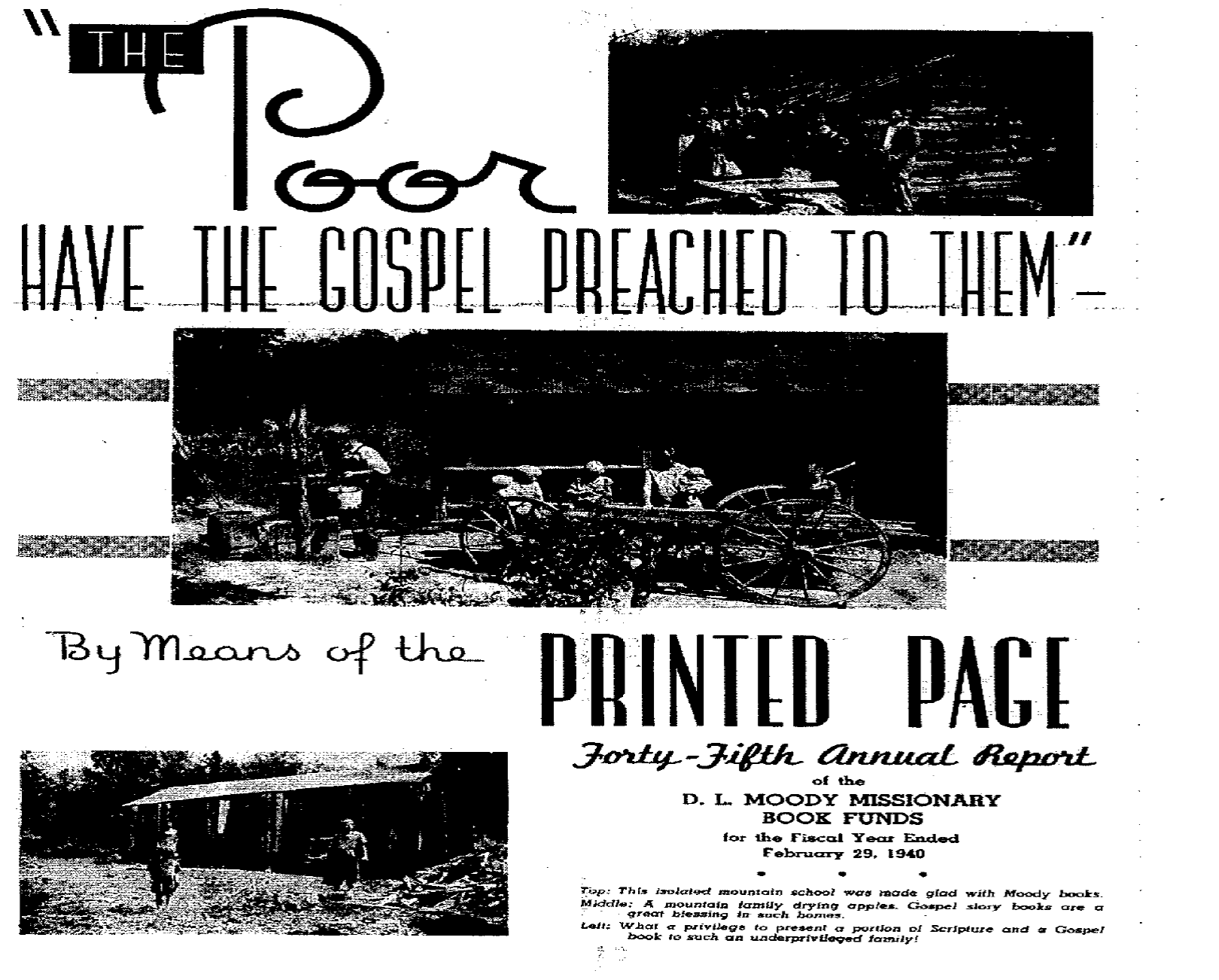
The inspiration for the Moody Bible Institute missionaries to deliver Bibles to the Southern Appalachian region came from the apparent lack of reading material of all kinds in the region.  In the 1920s, ‘30s, and ‘40s, the Chicago missionaries saw the “mountaineers” as particularly ready for literature outreach.  The reasons to send Bibles instead of humans were many.  First of all, Bibles were cheaper and easier to crate and ship.  Second, the Bible had a supernatural power to convert.  As one missionary proclaimed in 1921, the Gospels formed “the most unique, the most startling, the most compelling, and most unearthly message that has ever commanded God’s attention.”  No matter how talented a human missionary, he or she could not hope to compare with the words of the Gospel itself.  But another reason why Bibles made good missionaries was because the people of the region desperately wanted reading material of any kind.  Folks starved for reading material, the argument went, would eagerly read the Bible if only they could get one.  And by reading the Bible, they would be convinced by its supernatural power; they would embrace Fundamentalist Protestantism.  As one fundraising brochure from 1940 called it, this crusade could preach the gospel to the poor by using the “printed page.”

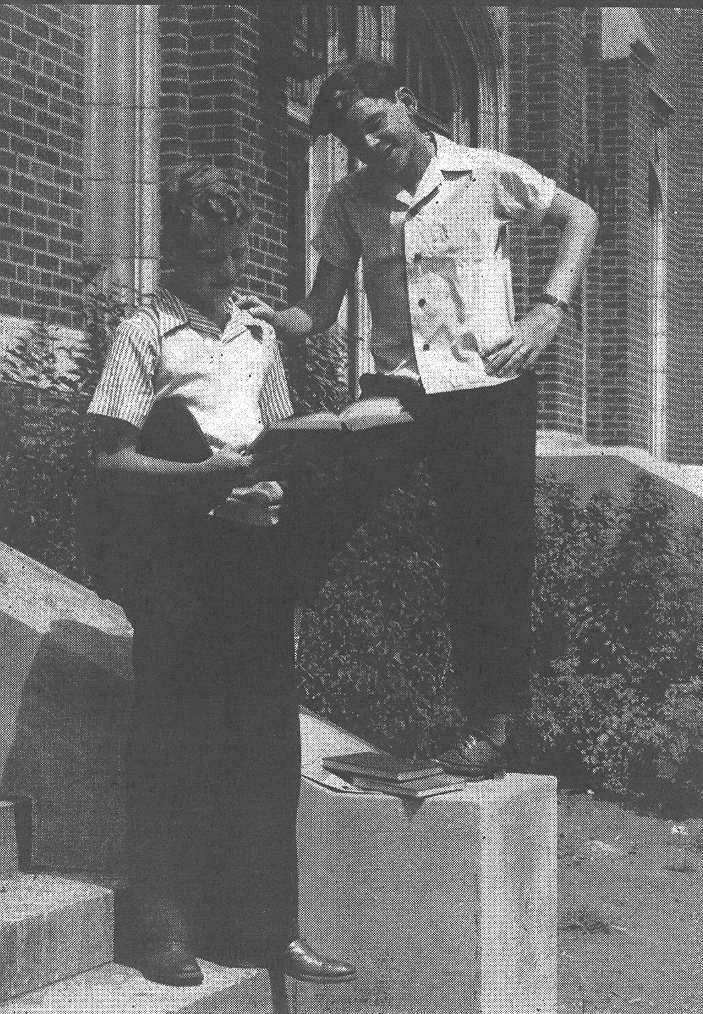
Many children from the region craved book ownership, it seemed, much more than they craved enlightenment.  Many of the Chicago book missionaries capitalized on that notion to satisfy young people’s lust for books with a healthy desire for the Gospel.  This picture of children in front of their log school was meant to show children’s appreciation for the Gospel.  It also shows, though, how much young people liked to have a book of their own.

These images from the Moody Bible Institute’s outreach tell us something about fundamentalist attitudes toward the Bible.  For many people, especially those without access to many books, the Bible served as both a religious text and a status symbol.  Both the Appalachian schoolkids and the Chicago Bible missionaries accepted this premise.  The Chicago missionaries played up this appeal by instituting a traditional Sunday-school Gospel-memorization strategy.  If schoolkids memorized a certain number of Bible passages, the missionaries would reward them with a Bible of their own.  Missionaries saw the lust for Bibles as a healthy desire for spiritual uplift.  Some of the schoolkids eagerly participated in the memorization program merely out of their desire to own books of their own.  They conflated their desire for ownership with their desire for salvation.

Also, this campaign shows us how evangelical Protestant missionaries in the early twentieth century tended to present their targets as different from themselves.  The missionaries may have been well-to-do—or at least middle-class—urban, Northern whites.  The folks they hoped to reach with their Bible outreach were consistently presented as something else.  Here, that other-ness was the “mountain” aspect of Appalachian life.  The little kids with their tiny log school, the farmers with their ancient wagon technology, or even simply the description of targeted populations as “The Poor,” all of these markers separated the missionaries themselves from those they hoped to reach.  As we’ve seen, by the middle of the twentieth century these Fundamentalist Protestant Bible missionaries had shifted their understanding of their targets.  Instead of consistently distancing their targets from themselves, by the mid-1940s these Bible missionaries presented their targets as white middle-class urban and suburban people.  This shift in Bible outreach tells us a great deal about the changing nature of Fundamentalist America in the twentieth century.  These Bible missionaries came to see themselves as reaching out in their own neighborhoods, to people like themselves. They no longer assumed that the only ones in need of soul-saving work were in far-away locations with exotic cultures.  Fundamentalist America came to see itself as working close to home.


FROM THE ARCHIVES: Bible in America: The Power of Books

A few years back I stumbled across a remarkable Bible campaign.  Beginning in 1921 and continuing throughout the twentieth century, Bible evangelists based at Chicago’s Moody Bible Institute delivered Bibles, New Testaments, and tracts to underserved regions.  This campaign, which began as part of the Bible Institute Colportage Association and eventually became part of the Moody Literature Mission, delivered millions of Bibles and religious literature to the Southern Appalachian region, as well as the Ozarks, western logging camps, Louisianan Catholic schools, prisons, hospitals, and other venues in which missionaries thought people were hungry for the Word. 

            At the time, I focused my study on the missionaries’ use of Appalachian public schools as a distribution network for this religious literature.  I published some of my findings in an academic journal [“The Quiet Crusade: The Moody Bible Institute’s Outreach to Public Schools and the Mainstreaming of Appalachia, 1921-1966,” Church History 75:3 (September 2006): 565-593.] 

            Looking over my notes as I thought about the meanings of the Bible in Fundamentalist America, I came across my collection from this research.  As usual, there was a lot more material than what I could use in the article. 

            For the next few posts, I’ll pull up various pamphlets, brochures, and other materials from this archival collection.  Most of the material is available at the Moody Bible Institute in downtown Chicago.  The people there were very accommodating and friendly on my visits, and the archive is certainly worth a visit if you’re in the area. 

            I won’t argue that these materials somehow capture any single essence of fundamentalist attitudes about the power of the Bible.  That would be far too simplistic.  But I do believe that the attitudes toward the Bible expressed in these materials give a window into a commonly held fundamentalist vision of the nature of Holy Scripture.  As we’ll see, the Bible missionaries from Chicago believed the Word had a unique power.  The Gospels, to them—and, I argue, to many fundamentalists in the 1920s and since—meant more than just a collection of edifying religious messages.  As we’ll see, many of these Bible missionaries held a fundamentalist belief in the saving power of this powerful text. 

The most powerful book, fundamentalists agree, is the Bible.  Among conservative Protestants, the Bible is often considered to have supernatural power on its own.  The Chicago book missionaries of the Bible Institute Colportage Association and Moody Literature Mission were no exceptions.  They believed the Bible could transform lives.  But the Chicago book missionaries also believed in the power of non-Biblical literature.  Especially as a counterweight to an expanding pulp press, Bible-friendly fiction could be an important way to save souls.  In this post, I’ll describe an example of each type of book that the Chicago book missionaries distributed.

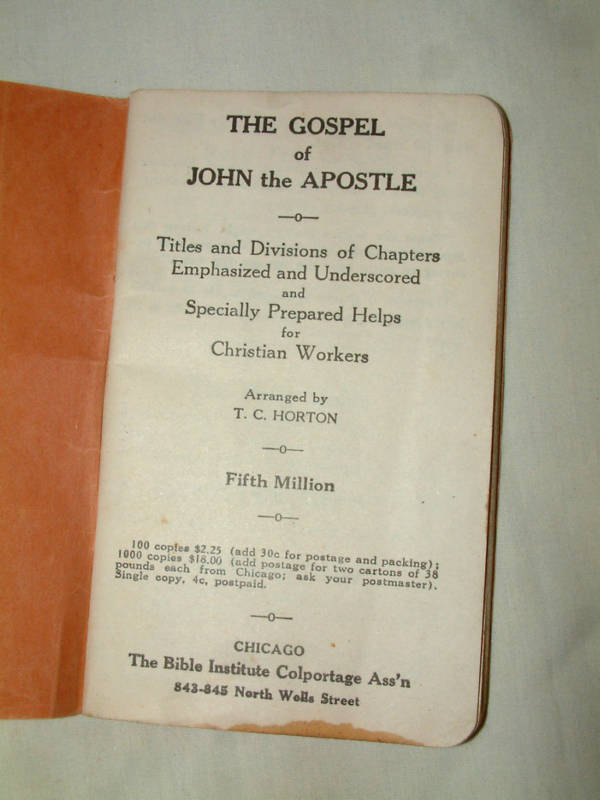
First, the Bible.  The most commonly distributed Bible book wasn’t the entire Bible, but rather a special edition of the Gospel of John.  This edition was edited by TC Horton in 1922.  At the time, Horton was at the peak of his career.  He was a minister and organizer in the Los Angeles area.  He was best known in 1922 as the editor of the Kings Business, the magazine of the Bible Institute of Los Angeles (now Biola University).

Horton’s attitude toward this little volume was clear from the verse on the front cover.  Sorry, it’s hard to read in this photo, but the verse says,

  Here is a little book for you!

                        Just take it, now, and read it through.

                        Page sixty-six, verse thirty-one,

                        Believe it, and the work is done!

If any curious reader followed this clue, he or she would find the following verse: “But THESE ARE WRITTEN, THAT YE MIGHT BELIEVE THAT JESUS IS THE CHRIST, THE SON OF GOD; AND THAT BELIEVING YE MIGHT HAVE LIFE THROUGH HIS NAME.”

In case readers didn’t follow the cover clue, Horton repeated the message on the inside cover.  Horton insisted that the Gospel of John was “the incomparable piece of English Literature.”  But it was not only good literature.  It was inspired by God in order specifically to convert people to Biblical Christianity.  If only people would read these words, Horton believed, their lives would be transformed.  As Horton insisted, this supernatural power was the reason why this Gospel “should be placed, as far as possible, in the hands of every man, woman, and child in the world.”

As we’ve seen, fundamentalists in America have embraced this mission.  In a campaign that sometimes seems bewildering to non-fundamentalists, Bible missionaries have worked to get people to see these Gospel words.

The files of the book missionaries shed some light on this attitude toward the saving power of Gospel words.  The first director of the Bible Institute Colportage Association, William Norton, told stories of the instant power of the words of the Gospel.  In 1921, Norton told a story of a man given a Gospel tract.  At first, the man ignored it.  “Coming to a hedge,” Norton related, “he stuck the tract into the hedge.”  However, thanks to the awesome power of the words of the Gospel, “it was too late; his eyes had caught a few words of the tract which led to his conversion.”  In another story from 1921, a vicious murderer found a copy of a Gospel tract.  “Through reading the Gospel of John this man saw the error of his way, changed his manner of living, and moved to the Bear Creek community in Scott County, Tenn.”

For Bible missionaries like the ones from Chicago, this power of conversion came from the power of the Gospels.  The words were inspired by God to lead to this kind of conversion.  It only made sense, then, to distribute those words as widely as possible.  This attitude toward the words of the Gospel has informed the outreach of Fundamentalist America in ways that remain bewildering to folks who don’t understand the impulse.  But if we can understand this book, these words, as inspired by God to lead people to salvation, we can understand something about the Fundamentalist desire to get these words in front of as many people as possible.  For the Chicago book missionaries, this meant delivering hundreds of thousands of copies of these tracts and Gospels to children across the nation.

Among fundamentalists, only the Bible had the kind of supernatural power that could lead people to instant conversion, merely by seeing the words.  But other kinds of books, too, could help.  The Chicago book missionaries also distributed hundreds of thousands of copies of short novels.  These books weren’t as powerful as the Bible, but they could still work to combat the trend toward sin in popular literature.  As one missionary warned in 1937, they needed uplifting books “during these difficult days when much pernicious literature is being widely distributed by religious cults, atheistic organizations and anti-Christian societies, whereby many are being deceived and destroyed.”

Back in 1921, William Norton had called these books “true-to-the-Bible literature.”  One of the most popular was Rosa’s Quest, originally published in 1905.

In this story, a poor girl is lost in a big city.  Her Christian mother had died, and just before she died she told Rosa to find her in the “beautiful land.”  Unfortunately, the girl lacked any Christian education.  She wandered around the city, rebuffed by nominal Christians who did not reach out to her.  Finally, a missionary on a city bus explains the Word of God to Rosa.  Rosa is converted, then adopted by a wealthy secular family.  In the end, Rosa converts all of her new family using the Gospel.

In the eyes of Bible missionaries, books like this did not have the same supernatural power as the Gospel itself.  They could not change lives simply by being read or heard one time.  But missionaries still reported that the books could help save souls.  One missionary in 1921 reported that the children she worked with were “very enthusiastic” about Rosa’s Quest.   One child from Madison County, Kentucky, wrote to the BICA to thank them for the free books, and noted that he felt “like little Rosa in Rosa’s Quest.  I have found the way to heaven.”  Another recipient wrote in 1937,

“FROM KENTUCKY: ‘In the year 1929, one of my friends loaned me some of your books entitled “Little King Davie,” “The Way Home,” “The Robber’s Grave,” “A Peep behind the Scenes,” and others.  I was thirteen years of age.  God definitely spoke to me through the books and gave me a peep behind the curtains which hid my heart.  In the same year I received a heart-felt experience from God, and also a call into His service.  I am now a missionary in the mountains of Kentucky.”

For the conservative Protestant missionaries of the Moody Bible Institute, books had power.  Some of them, if they contained the actual words of the Gospels, could have supernatural power.  Those words, distributed in books, tracts, and leaflets, emblazoned on billboards, eventually printed on Tim Tebow’s face, could change a life in an instant.  Other books, like Rosa’s Quest, merely provided information about how such change could happen.  They did not save lives the same way the Gospel could, but they kept young people from reading literature that could confuse them or lead them into sin.


In the News: Tebow in Fundamentalist New York

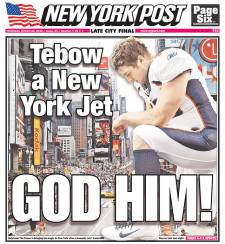
I know I’m not alone in hoping for some kind of Tim Tebow media blackout.  I was hoping the end of the football season, especially with the Broncos’ defeat, would bring some quiet to the Tebow-as-Christian-in-a-strange-land stories.  But Tebow’s move to the New York Jets brought a new round of media focus on Tebow’s style of loud public Christian-ness.

IMHO, the most interesting comment on the Tebow move came from Paul Moses at dotCommonweal.  Moses noted that the New York press tended to gasp at the incongruity of an extravagantly Christian celebrity in the extravagantly pagan Big Apple.

Moses pointed out,

The Times put it this way: “Tebow is also a somewhat incongruous fit: an outspoken Christian playing  in a city known for its extensive night life and a member of a  franchise made famous by the bachelor stylings of Joe Namath and  currently known for the profane speeches of its coach, Rex Ryan.”

And this, from the National Enquirer: “It is unclear how the pie-eyed pundit of the pigskin will respond to the multitude of temptations New York has to offer.”

Moses took such papers to task for assuming too much about life in New York City.  New Yorkers are a decidedly religious group.  Moses cited a Gallup poll from 1991 in which a majority of respondents–53%–said they prayed at least once a day.  The problem, Moses claimed, is that too many people equate Manhattan with the entirety of New York City.  In Manhattan, 17% of poll respondents claimed to be atheists.  In the Bronx, that number dwindled to 1%.

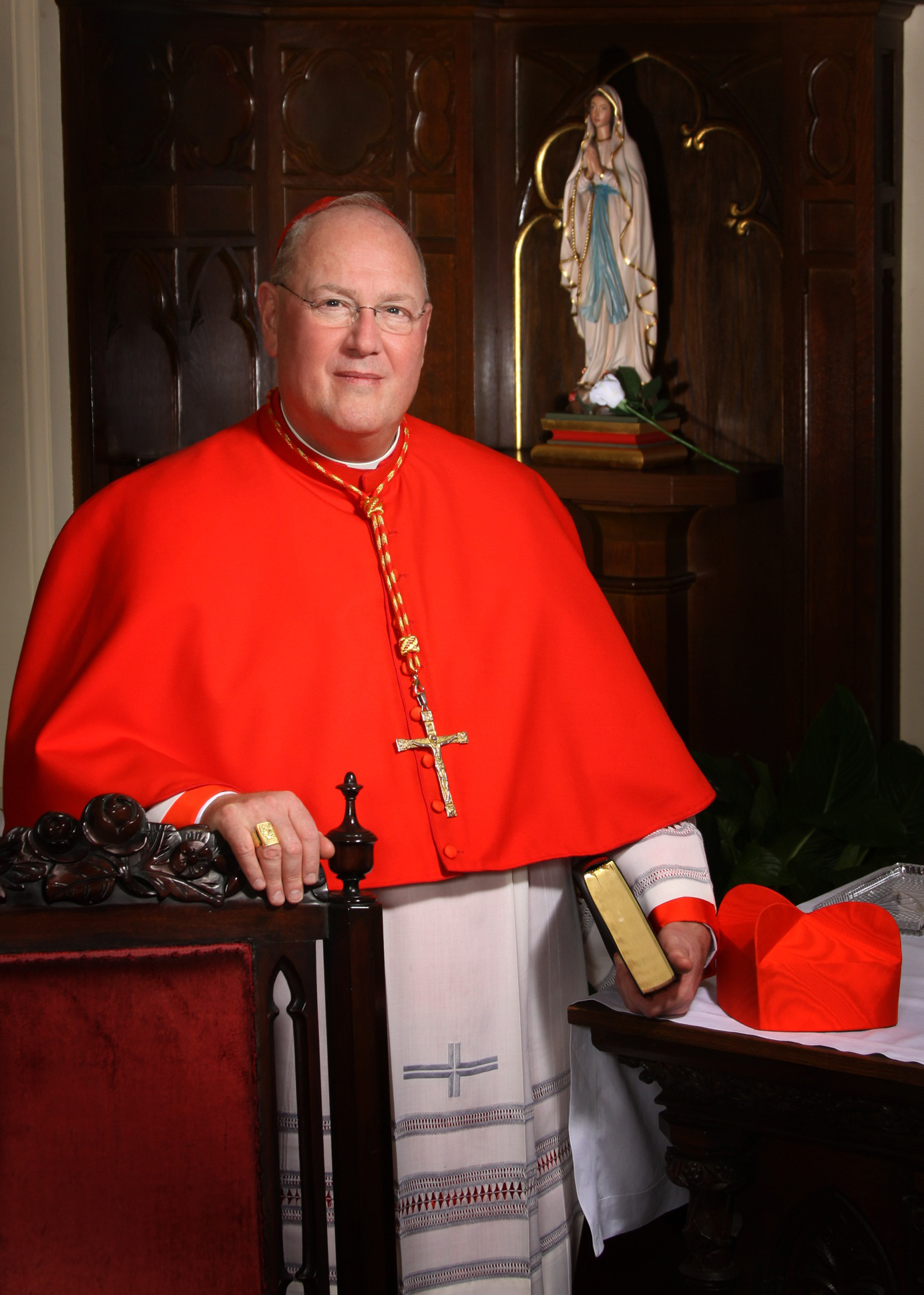
As we’ve pointed out here before, people who do not know much about Fundamentalist America often assume that religiosity goes up only with distance from big cities, education, and indoor plumbing.  It is just not true.  The myth might come from the association in the United States of conservative evangelical Protestantism with conservative religion as a whole.  But if we look at other conservative religious folks, New York City has as much of a claim to fundamentalism as anywhere else.  In the Catholic Church, for example, New York City is now home to genial Archbishop Timothy Dolan.  Dolan’s blog and very public presence inject a strain of conservative religiosity into life in the Big Apple.  And, of course, outside of Christianity, New York City is host to innumerable conservative religious groups.  The old joke about the hayseed who comes to New York and is surprised by the number of “New York Amish” demonstrates that New York has its own profound tradition of deeply conservative culture and theology.

Even within the bounds of conservative Protestantism, large urban areas have always served as strongholds.  True, someone wanting a Protestant fundamentalist education could go to Bob Jones University in lovely Greenville, South Carolina.  Or she could go to Liberty University in Lynchburg, Virginia.  But she could also head to Los Angeles to Biola University, or to Chicago’s Moody Bible Institute or Wheaton College.

The roots of this commonly held misperception, I think, come from the utter dominance of conservative evangelical Protestantism in some rural areas.  When folks from the big city drive around in fly-over country, they are shocked by the public dominance of this type of fundamentalism.  But such folks ought to look closer at their own cities.  Look for storefront Pentecostal churches.  Look for big cathedrals.  Look beyond the stereotypes of cities as home only to nightlife and paganism, and you’ll notice a deeply religious urban America.

There might be a few translation difficulties as Tebow  moves from the Bible Belt to the Big Apple, but there will not be any lack of fundamentalists ready to greet Tebow as he (if he?) makes his New York Jets debut.

FROM THE ARCHIVES: Bible in America: Bible Evangelism to the Crabgrass Frontier

A few years back I stumbled across a remarkable Bible campaign.  Beginning in 1921 and continuing throughout the twentieth century, Bible evangelists based at Chicago’s Moody Bible Institute delivered Bibles, New Testaments, and tracts to underserved regions.  This campaign, which began as part of the Bible Institute Colportage Association and eventually became part of the Moody Literature Mission, delivered millions of Bibles and religious literature to the Southern Appalachian region, as well as the Ozarks, western logging camps, Louisianan Catholic schools, prisons, hospitals, and other venues in which missionaries thought people were hungry for the Word. 

            At the time, I focused my study on the missionaries’ use of Appalachian public schools as a distribution network for this religious literature.  I published some of my findings in an academic journal [“The Quiet Crusade: The Moody Bible Institute’s Outreach to Public Schools and the Mainstreaming of Appalachia, 1921-1966,” Church History 75:3 (September 2006): 565-593.] 

            Looking over my notes as I thought about the meanings of the Bible in Fundamentalist America, I came across my collection from this research.  As usual, there was a lot more material than what I could use in the article. 

            For the next couple-few posts, I’ll pull up various pamphlets, brochures, and other materials from this archival collection.  Most of the material is available at the Moody Bible Institute in downtown Chicago.  The people there were very accommodating and friendly on my visits, and the archive is certainly worth a visit if you’re in the area. 

            I won’t argue that these materials somehow capture any single essence of fundamentalist attitudes about the power of the Bible.  That would be far too simplistic.  But I do believe that the attitudes toward the Bible expressed in these materials give a window into a commonly held fundamentalist vision of the nature of Holy Scripture.  As we’ll see, the Bible missionaries from Chicago believed the Word had a unique power.  The Gospels, to them—and, I argue, to many fundamentalists in the 1920s and since—meant more than just a collection of edifying religious messages.  As we’ll see, many of these Bible missionaries held a fundamentalist belief in the saving power of this powerful text. 

For many fundamentalist evangelists, the merest exposure to the words of the Gospel can have a saving power.  It can serve as an inoculant to sinful doctrines and sinful ignorance.  For example, one post-World War II brochure trumpeted its success in exposing students in public schools to the Word.  These students were described as “otherwise unreached boys and girls.”  By giving them Bibles, these missionaries proclaimed they had been “introduced to the way of salvation for the first time, with many of them accepting Christ as their personal savior.”

In the view of these fundamentalist missionaries, the dangers to these students—depicted as white, fairly affluent suburbanites—came from both ignorance and false doctrine.  This brochure warned of other missionaries: “Jehovah’s Witnesses, Mormons, Catholics and Seventh Day Adventists,” all of whom were “making devastating inroads among these gospel-hungry communities.”  In the view of these Bible missionaries, young people did not need anything beyond the Bible to be protected from this threat.  If these students could simply be exposed to the “true message of eternal life” from the Bible, missionaries would be able to “capture them for the Lord Jesus before they are ensnared by the evil one.”

There is a good deal here of interest for those who hope to understand Fundamentalist America.  As I write, the 2012 Republican presidential primaries are slogging along, with (Catholic) Rick Santorum fighting (Mormon) Mitt Romney and (Converted Catholic) Newt Gingrich for the vote of the Fundamentalist Faithful.  Romney’s Mormonism sometimes comes up as an issue for conservative Protestant voters.  We don’t see as much, though, about the threat of Santorum’s Catholicism.  We have wondered here about this “Fundamentalist Mystery.”  This brochure from sixty-odd years ago paints a very different picture of the relationship between fundamentalist Protestants and conservative Christians of other groups.  The relationship between the two has long been tense.  Some historians have argued that it was only the “pro-life” movement that emerged in the 1970s that brought the two together.  But there had been other rapprochements, with prominent Catholics such as William F. Buckley Jr. leading a broader conservative movement in the years after World War II that attracted many Protestants as well as Catholics.

In this Protestant brochure, written around the same time that Buckley began his long career as the intellectual darling of Fundamentalist America, Catholics, Mormons, Seventh day Adventists and Jehovah’s Witnesses are not seen as part of a broad conservative coalition, but rather as deadly, aggressive threats to the health of America’s unreached masses.

For those outsiders who hope to understand Fundamentalist America, another interesting lesson from this brochure is the perceived power of the Gospel among these literature missionaries.  This point is so central to this tradition that it usually went unremarked, but if we want to understand Fundamentalist America, we need to explore the meanings of this Biblicism in a little more detail.  First of all, we need to note that this tradition is strongest only in this segment of today’s broad Fundamentalist coalition.  Conservative Catholics, for example, don’t historically place the same emphasis on the miraculous power of Bible text.  For these Chicago book missionaries, however, the assumption was that the words of the Bible, especially those of the four Gospels, had the power to effect soul-saving conversions on anyone who read them.  The challenge, then, for the missionaries was only to get the Word out there.  If these white suburban schoolkids could somehow be persuaded or cajoled into looking at the Gospels, their souls would be saved.  Again, this assumption is so powerful among a segment of today’s Fundamentalist Americans that it usually goes without comment.  But it explains a good deal that is puzzling to non-fundamentalists.  So, for example, when people at sporting events hold up signs with Biblical chapter and verse—either as Broncos’ quarterback Tim Tebow or just as a guy in the bleachers—the hope is the same.  If they can simply convince people to look at John 3:16, the tradition goes, sinful or ignorant people will be eternally saved.  This is the impulse behind much of the fundamentalist effort to Biblicize public space.  If students in public schools can be exposed to the words of the Bible, they will be saved.  If billboards can proclaim the words of the Gospel, readers will be saved.  If court sessions can start with a Bible reading, sinners will be saved.  All of these goals only make sense once we understand the enormous power some Fundamentalists grant to the words of the Gospel.  The merest exposure is presumed to have eternal power.

Another interesting point about Fundamentalist America that this brochure reveals is its presumption about its readers.  This is a fundraising brochure that trades on its readers’ sense of duty.  The duty is to save as many souls as possible.  The public schools, in this brochure, present an “opportunity” to reach many imperiled young souls with only a small effort and expense.  The central point of this public-school campaign is that students in schools are likely to be reading.  Why not help make that reading material Biblical?  At least among this particular postwar Fundamentalist community, the missionaries did not need to explain that their readers should want to save souls.  Instead, the assumption was that Fundamentalists worked in contest with other spiritual missionaries—Mormons, Catholics, Seventh day Adventists, and Jehovah’s Witnesses—to capture as many souls as possible.

This Fundamentalist requirement to save souls helps explain some of the puzzle of Fundamentalism.  Many non-fundamentalists have complained about the aggressive nature of Fundamentalist America.  In the 1920s, for instance, famous atheist Clarence Darrow put it something like this, “I don’t mind them going to heaven their way, but I don’t want them to stop me going to hell my way.”  Other non-fundamentalists, these days, say they don’t understand why fundamentalists care if other people do things like marry same-sex partners.  Once we see the centrality of soul-saving outreach to the Fundamentalist tradition, we can get a better sense of the reason for this aggressive insistence on the morality of everyone, not only the Fundamentalist community itself.

Finally, this brochure shows us the ways some Fundamentalists starting seeing whitebread suburban America as the newest “mission field” for their outreach work.  In the nineteenth and early twentieth centuries, a lot of this outreach was directed away from mainstream middle-class American life.  Earlier fundamentalists assumed that the core of American middle-class culture was safely aware of the Gospels, safely educated and inoculated from the spiritual dangers of life.  Of course, some of those folks might still choose a life of sin, but at least they knew the saving message of the Gospels.  After World War II, some fundamentalists—like these Bible missionaries—began to see their role in American culture differently.  Their missionary outreach no longer had to be only to “outsider” groups, whether that be in sub-Saharan Africa, Latin America, Asia, among immigrant communities in big American cities or among isolated mountain families in places like the Southern Appalachians.

Instead, some fundamentalists started to see themselves as surrounded by a vast mission field.  Even in affluent white communities they began to see their role as one of outreach and salvation.  Much as later fundamentalists such as Jerry Falwell would complain that they were a minority group, so these postwar evangelists saw themselves as one missionary enterprise among others, competing for the souls of middle-class white kids in suburban public schools.


Backstory: Creation, Evolution, Science, & Religion

Everyone interested in the longer history of the creation/evolution controversy should check out a new podcast by the American History Guys at Backstory.  Too many folks–and I plead guilty to this as well–tend to start their study of the creation/evolution controversy at 1925.  This broadcast explores the longer history, including Thomas Jefferson’s attitudes toward the subject.

Be sure to check out the longer interview with Ron Numbers.  Anyone interested in the topic should get into Ron’s published books.  This interview is a good place to start.

Anti-Evolution I: Introduction

ANTI EVOLUTION: INTRODUCTION

“Evolution is the spiritual path to Sodom.”  That was the opinion of R.J. Alderman, of Alcolu, South Carolina, in any case.
Alderman penned his critique of the spiritual effects of evolution for the September 1922 issue of the Moody Bible Institute Monthly.  There are a lot of different reasons to oppose evolution, but this statement sums up some of the religious opposition to it, in 2011 as much as 1922.  For some religious folks, evolution is more than simply an idea to be considered, it is a threat to be destroyed.  It is not enough to simply say, ‘I don’t believe in evolution.’  That would be like saying, ‘I don’t believe poisonous snakes should be allowed near babies.’  Instead, people might say, ‘I will do whatever I can to prevent this dangerous notion from being propagated.  Not just for me and my family, but for everyone.’

To do any less would be to consign people to sin.  It would be to look the other way while people walked cheerfully and ignorantly down the path to Sodom.

Before I go any further, let me repeat: I am an evolutionist myself.  I don’t think evolution is the spiritual path to Sodom.  But in these posts, I’ll attempt to articulate anti-evolution arguments in a way calculated to make the most sense to evolutionists.
My goal in this and in all these efforts is not to convince or convert, but only to show that someone can hold these beliefs in good faith.  To demonstrate the fallacy of Richard Dawkins’ assertion that people who do not believe in evolution must be “ignorant, stupid or insane (or wicked, but I’d rather not consider that).”

In what follows, I won’t rely on Biblical scripture to make my points, even though that is the most important proof for many evolution opponents.  But since it is only convincing for those who are already convinced, I’ll put those arguments to one side.  I’m guessing that many anti-evolutionists won’t agree with the points I make here.  I invite them and pro-evolutionists to weigh in.  What’s wrong with these arguments?  What would be more convincing?