A Trip to a Catholic-School Science Fair

Science Fairs are great.  At their best, they allow students some freedom to experiment and learn on their own.  At their worst, they still provide hilarious examples of wacky adolescent science.  Recently, we saw a field report from the National Center for Science Education blog.  Peter Hess asked the question: What passes for “science” at a Catholic science fair?

In these pages, we’ve eagerly read reports from the field as science mavens visit various sorts of science fairs.  P.Z. Myers has argued that creationist students actively use science fairs to subvert the mind-numbing mental boundaries imposed by creationism.  Greg Laden visited a creationist homeschool science fair and found that some of the science was not bad.  At least not much worse, Laden thought, than the crappy science on display at non-creationist science fairs.

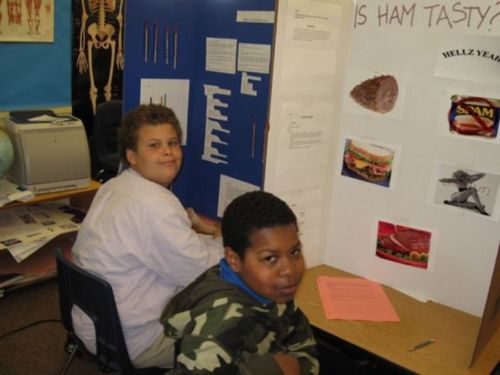
Cutting-edge science from a non-religious science fair...

Cutting-edge science from a non-religious science fair…

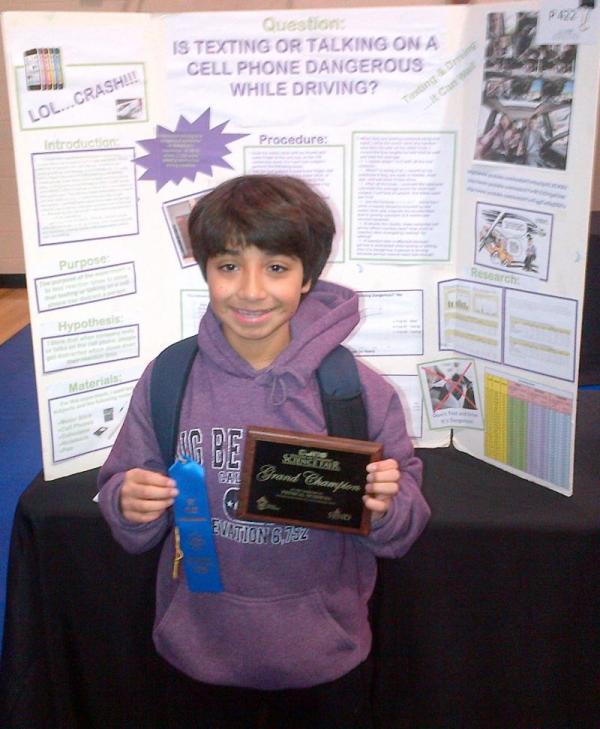
Hess found to his great relief that his kids’ Catholic school promoted mainstream science, without adulteration from theology.  Students came up with ambitious projects, such as measuring the distraction levels posed by cell phones and texting.

How distracted are drivers? This kid was not looking to the Bible for answers...

How distracted are drivers? This kid was not looking to the Bible for answers…

Hess also talked with some of the teachers.  Those teachers, too, did not see any conflict between Catholicism and teaching mainstream science in their classes.  One teacher offered an opinion that echoed the view of the late Stephen Jay Gould.  As middle-school teacher Joseph Nagel told Hess,

I sometimes consider science to be the constant investigation of the external world, a quest to analyze and understand the physical world, exclusive of human experience.  Religion I see as the eternal internal investigation, a search to explore and understand what lies within and between us, an examination of the human experience.  If science is our understanding of the world, religion is our understanding of us.  Maybe science is the ‘how’ and religion is the ‘why.’

Of course, different Catholic schools might have different approaches.  But my experience matches up closely with that of Hess.  I taught for a decade in Catholic schools in Milwaukee.  Though we sometimes had arguments about the novels we’d teach or the theology we’d teach, there was never any glimmer of controversy over the science we’d teach.

In fact, at least one of our science teachers also taught biology (or was it chemistry?) at a local public, secular community college.  When I asked him if he taught science differently at our Catholic school, he responded just as did the teachers Hess talked to: “Why would I?”


Holocaust Denial, Evolution Denial, and “Teaching the Controversy”

Should students learn to think critically in schools?  Should they learn about both sides of controversial issues?  This morning at the National Center for Science Education blog, Glenn Branch compares creationists’ fondness for “teaching the controversy” to an explosively controversial history lesson from California.  For those of us interested in conservative ideas about schooling, this recent flap again demonstrates the ways “conservative” and “progressives” have swapped sides on this issue.

In the Rialto (California) Unified School District, eighth-grade students were asked to evaluate the arguments for and against the existence of the Holocaust.  “When tragic events occur in history, there is often debate about their actual existence,” the assignment reads, according to the San Bernardino County Sun.

For example, some people claim the Holocaust is not an actual historical event, but instead is a propaganda tool that was used for political and monetary gain. Based upon your research on this issue, write an argumentative essay, utilizing cited textual evidence, in which you explain whether or not you believe the Holocaust was an actual event in history, or merely a political scheme created to influence public emotion and gain. Remember to address counterclaims (rebuttals) to your stated claim. You are also required to use parenthetical (internal) citations and to provide a Works Cited page.

When the story came out about ten days ago, some conservative pundits tried to use this as proof of the moral monstrosity concealed in the Common Core State Standards.  The standards, some said, pushed school districts into adopting such terrible ideas as Holocaust denial.

Glenn Branch asks a different question.  How is this example of teaching “critical thinking” any different from creationist attempts to have students evaluate evolution and creationism side by side?  In both cases, students are encouraged to look at evidence.  Students are prompted to evaluate arguments and come to their own decisions.

But in the case of Holocaust denial, one side of the balance sheet has been thoroughly discredited.  It is not morally or educationally appropriate to ask students to decide whether or not the Holocaust happened, critics insist.  One of the sources students were given in this assignment stated the following:

With all this money at stake for Israel, it is easy to comprehend why this Holocaust hoax is so secretly guarded. In whatever way you can, please help shatter this profitable myth. It is time we stop sacrificing America’s welfare for the sake of Israel and spend our hard-earned dollars on Americans.

Offering students these sorts of false, hateful lies as “sources,” critics say, demeans the idea of pushing students to think critically.  If creationists thought that students should really explore every side of every issue, even sides with no intellectual or moral legitimacy, Branch argues,

then they should have been enthusiastically supporting the Rialto assignment. It’s to their moral credit that they weren’t, of course, but it proves—as if proof were needed by now—that “teach the controversy” and the like are merely rhetorical legerdemain intended to distract the spectator from the intellectual hollowness of the proposals they are supposed to support.

To suggest that schools ought to “teach the controversy” when there is in fact no controversy among mainstream scientists, Branch concludes, is just as bogus as having students evaluate the claims of Holocaust deniers.

The historian in me can’t help but notice the flip-flop we’ve seen over the course of the twentieth century.  In 1925, it was the pro-evolution side who pleaded with America to consider both sides in public schools.  Most famously, Scopes-trial attorney Dudley Field Malone begged the nation to allow the teaching of evolution.  “For God’s sake,” Malone implored, “let the children have their minds kept open.”  Ironically, as historian Ronald Numbers pointed out in Darwin Comes to America (pg. 91), later creationists adopted Malone’s plea as their own.

This is one of the themes I’m working with in my upcoming book.  Back in the 1920s, it was the conservative side of school battles who protested that these were false choices.  In 1929, for instance, the staunchly conservative leader of the Daughters of the American Revolution warned DAR members that progressives sneakily insisted on teaching both sides of every issue.  Such choices, she warned, were false ones.  Even to ask the questions tipped students away from truth and morality.  As she memorably argued,

Flagrant cases of un-American tendencies have been brought to light and exposed.  Exotic theories are promulgated in the name of science.  Disdain for law and order, and contempt for our accepted form of Government are subtly injected into the teachings of history.  Such practices are defended by the advancement of the decrepit theory that both sides of the question should be presented to permit the forming of unbiased opinions.  This may be the proper system for the seasoned adult who presumably can, if he will, revoke his errors when faced with the consequences of an unwise choice.  With the young, the chances are too great, for there a dangerous inequality exists.  One does not place before a delicate child a cup of strong black coffee and a glass of milk; or a big cigar and a stick of barley candy; or a narcotic and an orange, and in the name of progress and freedom insist that both must be tested in order that the child be given the right of choice.  Instead, one carefully supplies only what will make for the development of the young body and assure its normal growth.  Why then apply the very opposite theory when dealing with the delicate and impressionable fabric of the mind? (Emphasis added.)

With this historical lens, it seems doubly apparent that the argument for teaching both sides of any tricky issue has always been politically popular among Americans.  If there’s a controversy, many Americans have always agreed, let children hear both sides.

Back in the 1920s, progressives and evolution educators tried to make this case.  Let children hear about socialism and evolution, progressives pleaded.  At least allow schools to teach the controversy.  Back then, conservatives made the case that one side of those ideas was not equal.  To offer students both candy and cigars to choose from, as our DAR leader insisted, was a false choice, a false controversy.

Today, the sides have switched but the argument has not.  One side argues to let children hear both sides of a controversial issue and decide for themselves.  The other side insists that only one side has any truth, any intellectual legitimacy.

Me personally, I agree that Holocaust denial and evolution denial ought not be offered as equals to better history and better science.  But I know many readers might disagree.  How can creationists defend the legitimacy of “teaching the controversy” when most scientists agree that there is no controversy?  Is it like offering children a choice between heroin and citrus fruits?  Milk and coffee?  Candy or cigars?


What If Stories, Part VII: Last but not Least

We always save the best for last, right?  Today at the blog of the National Center for Science Education, I make my case: How would the history of creationism be different without World War I?

For those who haven’t been keeping up, the NCSE has asked a handful of historians to give their best guesses.  How did World War I influence the development of creationism?  Of evolutionary theory?

We’ve read about creationism in Turkey and the Netherlands. We’ve read about the influence of the war on German intellectual life.  And about textbooks, the 1920s, and William Jennings Bryan.

So what did yours truly have to add to this discussion?  How do I think World War I changed the course of creation/evolution history?  You’ll have to read my post on the NCSE blog to find out.

What If Stories, Part VI: Evolution in Germany

As we approach the hundredth anniversary of the start of World War I, historians and journalists are asking how life might have been different if the Great War had never happened.

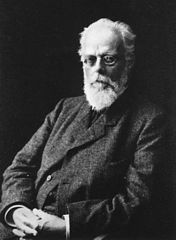
As the National Center for Science Education blog, historians and scientists are wondering how the history of evolution/creation might have been different.  Today, biologist Ulrich Kutschera argues that the war changed the way evolutionary scientists told the story of evolution.  Kutschera notes the work of German zoologist August Weismann, who forcefully and elegantly promoted evolutionary ideas in the years leading up to the war.

August Weismann, the Lost Answer?

August Weismann, the Lost Answer?

Without the war’s shattering effect on Germany and the world, Kutschera writes, Weismann’s legacy would have been very different.  It may have changed everything in the intellectual worlds of creationism and evolution.  How?  You’ll have to read the NCSE post to find out.


What If Stories, Part V: World War I as Game-Changer

What would the history of creationism have been like if World War I had never happened?  Today we read the most far-reaching argument yet in this series at the National Center for Science Education blog.

Much Less than 6,000 Years Ago

Much Less than 6,000 Years Ago

As ILYBYGTH readers are aware, we’ve been following this series of historians’ arguments.  The NCSE asked a tough question, and historians have offered different perspectives and ideas.  Today, Professor George E. Webb suggests that everything would have come out radically different if there had been no Great War.

What would have made such a difference?  You’ll have to read the NCSE post to find out the details.


What If Stories, Part IV: War and Creationism in Europe

How did World War I change creationism in Europe?  Check out part four of the National Center for Science Education’s series.

If you’ve been following the series, you’ve read what historians Ron Numbers, Taner Edis, and Adam Shapiro had to say.  How did World War I change the history of creationism in the USA?  In Turkey?  In textbooks?

In today’s post, Abraham C. Flipse of VU University Amsterdam puts in his two cents.  Flipse attracted attention a couple years ago with his history of creationism in the Netherlands.

Obviously, the devastation of the war was much closer to home in the Netherlands.  How would creationism’s history have been different in this “stronghold of creationism” if the war had never happened?

Read Dr. Flipse’s post to find out!

What If Stories, Part III: Schools, Scopes, and the War

What if World War I had never happened?  How would the history of creation/evolution controversies have changed?  That’s the question the folks at the National Center for Science Education blog are asking these days.  In today’s third post of the series, historian Adam Shapiro makes his case for a vastly different story without the Great War to stir the pot in 1914-1918.

Shapiro’s the right person to ask.  His recent book Trying Biology offered a smart new argument about the importance of textbook publishing in the history of creationism in the United States.

So how does Shapiro think World War I changed things in the world of American creationism?  You’ll have to read his NCSE blog post to find out.

What If Stories, Part Deux: War, Islam, and the Ottoman Empire

How would creationism have looked different if World War I had never happened?  That’s the question the National Center for Science Education is asking these days.

In the second post of the series, Taner Edis of Truman State University asks how creationism would have evolved differently in the Islamic world.  How did the cataclysm of the war change Muslim’s attitudes about evolution?  How did the war-time collapse of the Ottoman Empire change the course of creationism in the Islamic world?  Take a look at Professor Edis’ post to find out.

What If Stories: Creationism and World War I

Much Less than 6,000 Years Ago

Much Less than 6,000 Years Ago

What if World War I had never happened? As the centenary of the start of that cataclysmic war nears, the National Center for Science Education has asked a group of eminent historians (as well as yours truly) to speculate how things might be different.

The first post in the NCSE series was penned by the Dean of Creationism History, Ronald L. Numbers.* Numbers, the author of the definitive history The Creationists, argues this morning that World War I was central to the shape of the creation/evolution struggles that emerged in the 1920s. As Ron notes, this sort of “counterfactual” game is tricky for historians. There are so many factors at play, such a varied interplay of contingencies and possibilities, that academic historians tend to shy away from guessing what might have happened. Nevertheless, Ron makes a strong case that the 1920s would have looked very different—in terms of creationism—had there been no big war. But does Professor Numbers think there would still have been a creation/evolution battle in the 1920s without a war? You’ll have to read his full post to find out.

I’m looking forward to reading the rest of the posts in this series. My own humble offering will come at the end of the series, I’m told.

* Full disclosure: Ron was my PhD mentor at the University of Wisconsin and is still a personal hero and friend of mine.


The Missionary Supposition

Is evolution a religion?  Are its teachers missionaries?

That has long been the accusation by some conservative religious folks.  The godfather of today’s young-earth creationist movement, Henry Morris, insists that it is.

Given that history, it is with trepidation and full humility that I’ve argued recently in the pages of the Reports of the National Center for Science Education that evolution educators might learn something from religious missionaries.

I want to be as clear as I can about this: I do not think that evolution is a religion.  I do not think evolution educators should consider it their job to “convert” young people to an evolutionary worldview.

But I do think evolution educators have been plagued historically by an attitude that creationism is simply an absence of something, a lack of knowledge about evolution.  To be sure, thoughtful evolution educators have long avoided that trap.  The folks at the National Center for Science Education, for instance, have made a strong case that we need to understand creationism if we want better evolution education. 

The attitude of many evolution educators throughout history, however, has been that creationists must simply not know enough about evolution.  Once creationists hear the truth, according to this line of thinking, they will hop on board the evolution train.

Ironically, that understanding of creationism and evolution teeters perilously close to the attitude among many early religious missionaries.  The Bible, many Protestant missionaries believed, contained such powerful, supernatural power that it would be instantly embraced by heathens worldwide.  All missionaries had to do was spread the Word.  Indeed, this faith in the transformative power of Gospel text remains strong among groups such as the Gideons and the American Bible Society.

But most religious missionaries these days understand that conversion needs more than just the Gospel.  Many conservative Protestant missionaries insist that the home cultures of local groups must be studied thoroughly and lovingly by would-be Bible missionaries.  Without that sort of preparation, real missionaries insist, evangelization is a waste of time, and may even be what one missionary writer called “evangelical toxic waste.”

What do I suggest?  I argue in my RNCSE essay that evolution educators need to spend more time understanding creationism.  If we really want to teach evolution in the United States, we need to do more than just spread the word.  We need to spend time learning about the cultures that refuse to believe evolutionary theory.

We need to study history, anthropology, and religion in addition to biology, geology, and genetics.  Awkward as it might be to admit, one “-ology” that evolution educators have ignored to their peril is missiology.