The Handwriting on the Wall

Conservatives have been proven right!  About handwriting, at least.  A recent article in the New York Times suggests that teaching handwriting might be a good way to help students learn.

In the research for my upcoming book about educational conservatism, I kept coming across conservative complaints that schools were abandoning the traditional subject of handwriting, often called “penmanship.”

In the pages of the Pasadena Independent, for example, editor T.G. Wood complained in 1950 that “progressive” education fads had led to less learning of traditional subjects.  Parents were increasingly starting to wonder, Wood wrote acerbically,

why little Johnny puts two and three together and comes up with nine, why his penmanship shows little or no improvement, and why his reading is poor or backward.

An angry Pasadena reader agreed.  Back in the old days, one letter-writer explained, Pasadena’s schools had benefited from the work of teacher Albert P. Meub, “a penman of national note.”  Meub had tried to keep the subject of penmanship in the schools, the letter-writer complained, but to no avail.  The rush for progressivism in schools had led to the willy-nilly abandonment of traditional subjects such as penmanship.

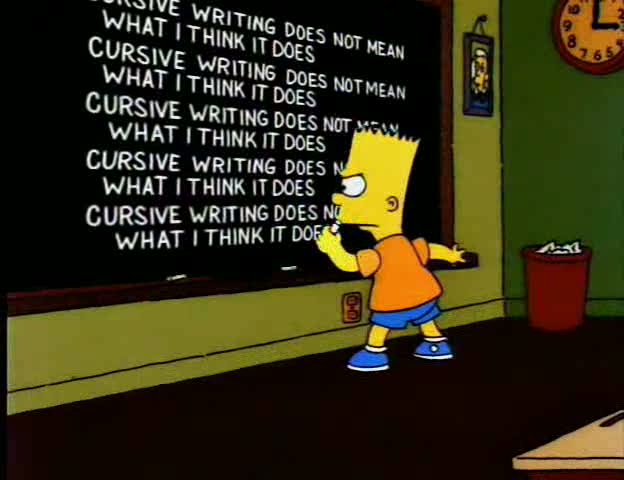
I can’t help but think of the Simpsons episode in which Bart’s new teacher asks him if he knows cursive.  “Well,” Bart replies, “I know hell, damn, and fart.”

Hell, Damn, and Fart

Hell, Damn, and Fart

According to the research review in the New York Times, both Bart and the children of Pasadena would have done better if they had spent more time learning to write by hand.  Some of the research compares writing by hand to writing by computer.  But some psychologists have also studied the difference between learning to write in cursive or by writing block letters.  Some think that students will do better when they learn cursive.

Why?

Karin James of Indiana University suggests that writing by hand helps students learn about the infinite complexity of letter variability.  Every Times-New-Roman “A” may look the same, but not every hand-written one.

Another study suggests that learning cursive may actually stimulate more brain activity and help fight language problems.

The crusty conservative editor T.G. Wood of the Pasadena Independent might have argued from his perch in 1950 that such studies only belabor the obvious.  Educational fads that abandon tradition out of a misguided trust in the superiority of the new and shiny will always lead young people astray.  Traditional education, conservatives have long insisted, has lasted so long for an obvious reason: It works.

ILYBYGTH in EdWeek: Progressive Education and the Conservatives Who Love It Too Much

Why do so many conservatives and creationists insist that they want more “critical thinking” in public schools?  In a recent commentary in Education Week, I argue that this trend is part of a longer tradition of anti-authoritarian education.

In the pages of EdWeek, I examine some of the new laws that have rightly been called “anti-evolution” efforts.  They usually are that.  They hope to introduce wiggle room in public-school science classes for creationist students and anti-evolution teaching.  A Virginia bill that recently died a lonely death in committee, for instance, would have insisted that students “develop critical-thinking skills, and respond appropriately and respectfully to differences of opinion about scientific controversies in science classes.”

I think, however, that the conservative impulse to encourage critical thinking among students goes even deeper than the evolution issue.  As I argue in the EdWeek commentary, several other legislative efforts in recent years have allowed students to opt out of school assignments that seem ideologically outrageous to students and parents.

Are these opt-out efforts “progressive?”  After all, they embody the anti-authoritarian ethos at the heart of progressive education.  But they do so for demonstrably conservative purposes.  Has the ideology of school dissent come full circle?

Progressive Education Hurts Poor Kids: E.D. Hirsch’s “Wealth of Words”

Progressive Education hurts poor kids.  For those familiar with E.D. Hirsch’s work over the past twenty-five years, that argument won’t sound new.

In a recent piece in the conservative Manhattan Institute’s City Journal, Professor Hirsch lays out his case for why progressive attitudes and policy toward vocabulary education inflicts the most damage on those it claims to help: students from families with fewer resources.

Hirsch, a literary critic and scholar, first came to fame with his 1987 book Cultural Literacy.  The book and Hirsch shared a public career somewhat similar to Allan Bloom and his Closing of the American Mind.  Though both authors identified as politically and culturally liberal, their books became favorites of cultural conservatives.  Like Bloom, Hirsch claimed that American education had “progressed” in woefully misguided directions.

In brief, Hirsch argued that every American ought to master a certain core of cultural knowledge.  Critics charged Hirsch of elitism and even bigotry.  Insisting on an exclusive body of important cultural knowledge, critics insisted, blocked out too many vital cultural voices, voices that had not made the canon but that represented authentic elements of the real American experience.

In Hirsch’s new essay, “A Wealth of Words,” he argues that the best way to improve life chances for all Americans is to insist on a rigorous and systematic curriculum of vocabulary improvement.  In a nutshell, here is the argument:

1.) College degrees represent the best single path to economic well-being.

2.) The verbal section of the SAT college-entrance exam is largely a vocabulary test.

3.) Therefore, to bring people out of poverty, we need to improve vocabulary education.

Most interesting to ILYBYGTH readers will be Hirsch’s idiosyncratic combination of an attack on “progressive education” with a progressive-sounding prescription for improved schooling.

Like nearly every conservative educational activist of the past fifty years, Hirsch takes progressive education to task for dumbing-down American education.  As I’ve argued in an essay in Teachers College Record, a variety of leading conservative educational activists—with very different ideas about education—all agreed that America’s educational system had been hijacked by progressivism.

In Hirsch’s telling, this progressive coup took place roughly one hundred years ago.  This “well-meant but inadequate” progressivism, according to Hirsch, included the following poison pills:

“optimism about children’s natural development, a belief in the unimportance of factual knowledge and book learning, and a corresponding belief in the importance of training the mind through hands-on practical experience.” 

Once these “progressive educational theories” took over school publishing and teaching, vocabulary education suffered bitterly, Hirsch argues.  In response, Hirsch calls for “an intellectual revolution . . . to undo the vast anti-intellectual revolution that took place in the 1930s.”  Most important, Hirsch believes, is the need to overcome the notion that schools should not teach factual knowledge.  For a century, the “progressive” notion that school should teach students how to learn, instead of mere facts, has come to dominate education policy.  That, Hirsch believes, is a terrible mistake.

For those familiar with the twentieth-century development of conservative educational activism, it is easy to see how Hirsch could have become a favorite of conservatives.  Educational conservatism has largely centered itself on the notion that schools must remain true to their traditional purpose; schools must dedicate themselves to transmitting knowledge from one generation to the next.

However, a closer read of Hirsch’s prescriptions might give some conservatives pause.  True enough, Hirsch calls for a renewed focus on teaching children a rich vocabulary.  He insists that an emphasis on “literacy” rather than good “literature” hurts the life chances of those students who need schooling the most.

But Hirsch also calls for a profound investment in government-run and tax-funded preschooling.  He cites French studies of intensive instruction for students as young as two.  Such intense schooling, Hirsch claims, will allow students from lower-income homes to match the educational opportunities of those from more affluent ones.  Furthermore, Hirsch dismisses the notion that improved vocabulary instruction will come from more time spent with word drill.  Instead, Hirsch advocates “domain immersion,” in which students learn vocabulary as part of an immersion in interesting and important reading.

Thus, in his goal and his method, Hirsch still sounds provocatively “progressive.”  Yet even in his outlet, the conservative City Journal, we can see that Hirsch still finds his most eager audience among conservatives.  In the end, this might come as no surprise.  No critic of progressivism is more appealing than one who comes from the progressive camp itself.  In education as anywhere, a whistle-blower can claim a certain credibility others cannot.

In his recent essay, Hirsch continues his long career as progressive education’s leading whistle-blower.  The best way, Hirsch insists, to determine whether any education policy will help poor kids is simple.  We do not need elaborate justifications of “pedagogies of the oppressed” or “dreamkeeping” teaching strategies.  All we need do, Hirsch argues, is ask one simple question: “Is this policy likely to expand the vocabularies of 12th-graders?”

Progressive Education for Christian Homeschoolers

More evidence that “progressive” and “conservative” labels just don’t fit when it comes to schooling: An interview with educator and filmmaker Micheal Flaherty of Walden Media in the conservative evangelical WORLD magazine.

Flaherty is best known for making films for a wide popular audience that include a healthy moral message. These are not niche “Christian” movies, but movies such as the Chronicles of Narnia series. Each film is based on a popular children’s book. In the longer interview, Flaherty describes the history of Walden Media. Nobody wanted to fund the project, until at last they met with a hearty welcome from conservative Christian Philip Anschutz.

Most interesting for us here at ILYBYGTH, Flaherty describes his reasons for homeschooling his three children. Though he is an evangelical talking to a conservative evangelical magazine, Flaherty doesn’t say he chose to homeschool to avoid sex ed, or Bible-hating, or evolution. Instead, Flaherty explains his thoroughly “progressive” reasons:

“We wanted to spend more time letting them read and not rushing them from bell to bell. We wanted to enjoy them and watch all of those lights go on—the first time they nail their multiplication tables or the first time they read a good book. At home we ask not, ‘What did you learn today?’ but ‘Tell me a great question you asked today.’ We want to keep it focused on the inquiry and on making sure the kids are asking the big questions.”

More evidence, if any were required, that slapping labels such as “progressive” and “conservative” around might only confuse things in today’s kaleidoscopic world of education.

Creationists: Sass Your Teachers?!?!

Apparently, that is the new strategy promoted by Indiana State Senator Dennis Kruse.

Sometimes, studying cultural battles over America’s schools seems like Yogi Berra’s déjà vu all over again.  But this one sounds new to me.

Thanks to the Sensuous Curmudgeon, we learn of Kruse’s new strategy.  Apparently, having failed to promote a two-models creation/evolution bill in the last legislative session, Kruse plans to offer a bill that will encourage students in Indiana’s schools to ask teachers to back up ideas with facts.

According to the Indianapolis Star, Kruse defended his plan as a “truth-in-education” measure:  “. . . if a student thinks something isn’t true, then they can question the teacher and the teacher would have to come up with some kind of research to support that what they are teaching is true or not true.”

Kruse’s new strategy comes on the heels of new rules in New Hampshire and Missouri that will allow every public school student to recuse himself or herself from curricular materials he or she finds objectionable.  As I’ve argued elsewhere, these laws just won’t work.  Ideology and theology and biology aside, the classroom implementation of such regulations seems utterly impossible.

As the Indianapolis Star reports, critics have pointed out similar flaws with Kruse’s plan.  Nate Schnellenberger, president of the Indiana State Teachers Association, argued that teachers could be asked to supply proof of everything, from evolution to the moon landing.  “It’s not workable,” Schnellenberger concluded.

The intention of such bills is clear: conservatives hope to protect students from indoctrination in ideas they find loathsome.  In Kruse’s case, he takes a weatherbeaten play from the old progressive playbook to make it happen.  If students can direct their own educations—challenging the classroom authority of their teachers on every point—then the chances of swallowing objectionable ideas decreases dramatically.

As in Missouri and New Hampshire, conservatives find themselves fighting for the old progressive dream: an individualized education for every child in public schools.  Will it work in Indiana?


Pluralism and Progressivism in America’s Schools

Is American public education progressive?  Do most teachers and administrators hope to use schools to instill a sense of individuality, of self-expression, in America’s youth?  Do public schools emphasize the individual construction of knowledge over the traditional emphasis on transmitting knowledge?  In general, I don’t think so, but many informed, intelligent people still assume that they do.

For instance, in this month’s First Things Ashley Rogers Berner makes a smart argument for more pluralism in American public education.  In her essay, she assumes that the ideological training of America’s public school teachers includes a decisive dollop of progressivism.

The primary reason for the stultification of American public education, Berner argues, is the system’s lack of real pluralism.  If we Americans could get over our irrational attachment to a model of public education in which only publicly run schools could receive significant public funding, then we could enjoy the fruits of a truly diverse system.

Her article is worth reading in its entirety, but in short, in her words,

“Lasting, structural change requires reframing ‘public education’ to mean publicly funded or publicly supported, not exclusively publicly delivered, education. This in turn requires a different political philosophy, a turn to a model of education based on civil society rather than state control.”   

In today’s educational culture wars, the first response to Berner’s argument is usually that such pluralism will essentially abandon those students who most need publicly run schools.  By leaching funding away to a universe of school options, those students and families who are last to scuttle away from the sinking ship of publicly administered schools will be left with even fewer resources to scratch together a decent education.

Berner and other advocates of greater diversity in public-funded schooling blame teachers’ unions for clinging to control at the expense of educational quality.  Defenders of our current funding model of public education respond (with varying levels of coherence) that the union model ought to be understood in a different way: Only if all families and teachers stick together, the argument goes, can public education be saved for all.  In this sense, advocates argue, it is a union-like argument.  With unity comes strength; privately run schools that accept public money amount to labor “scabs” that betray the cause of quality education for all.

I won’t make that argument here.  Instead, I’ll challenge Berner’s argument in a different way.  Berner insists that one killing flaw of the current public system is that it falsely purports to be ideologically neutral, while promoting a “progressive” worldview.  Berner calls this “schooling that is supposedly ideologically neutral but in fact reflects a progressive tradition strongly committed to beliefs and to an educational philosophy rejected by many Americans.”  To be fair, Berner notes that public schooling reflects a struggle between several visions of proper education, traditional vs. progressive as well as secular vs. religious.  She notes that two visions contend for ideological control of public education.  In her words,

“Today’s educators have often been trained in progressive pedagogies, but state legislatures are now asking them to teach a more prescribed curriculum and to participate in high-stakes academic assessments. This has caused a struggle in nearly every state.”

But she proceeds with an assumption that public schooling today has been captured by a progressive ideology.  As she puts it,

“American institutions, including public schooling, tend to reinforce individual autonomy and to discourage the habit of commitment. . . . An educational philosophy whose aim is self-expression is ill-equipped to foster attachment to liberal democracy.”

Her assumption that progressivism has maintained a powerful influence in public education in America is widely shared.

But as anyone who has spent any time in public schools can agree, traditional schooling practices and ideology dominate most public schools.  The notion that schools are primarily geared toward engendering a sense of “self-expression” among students does not hold.

This is more than an anecdotal observation, though I’d welcome responses from parents, teachers, and administrators who might agree or disagree.  More systematic research confirms it.  Political scientists Michael Berkman and Eric Plutzer argue in their book Ten Thousand Democracies that American school districts display a wide variety of ideological commitment.  And they conclude in Evolution, Creationism, and the Battle to Control America’s Classrooms that teacher beliefs often fit those of their surrounding community.  Conservative, traditionalist communities hire conservative, traditionalist teachers.

My own historical research confirms that the level of dominance of progressive ideology in America’s public schools is generally not as high as is often assumed.  To cite one illustrative example, consider the deeply and self-consciously progressive vision of one educational leader from the first half of the twentieth century.

Harold Rugg taught at the bastion of progressive education: Teachers College, Columbia University.  As a charter member of the “Frontier Thinkers,” Rugg helped lead the charge for a “reconstruction” of American public education along progressive lines.  After a conservative, traditionalist campaign eliminated most of Rugg’s textbooks from America’s public schools, Rugg retained his belief that progressivism would conquer.  In his 1941 That Men May Understand, Rugg argued that his progressivism

 “has already begun to shake the old and inadequate out of our educational system and to lead to the building of a new school to implement democracy.  Nothing save a major cultural catastrophe can now stop its progressive advance. It was utterly inevitable that workers in education would find the vast library of documented data produced on the other frontiers and use it in the systematic reconstruction of the schools” (pg. 293).

Rugg’s predicted transformation of public schooling never took place.  His progressive vision may have changed some outlines of public schooling, but by and large public schools remain dedicated to a deeply traditional model of education, one that views the goal of education as transmission of information to young people in order to prepare them to take their place in America’s hierarchical economy.

The closest observers of public education and progressivism have noted the tendency away from the promised land of progressivism.

Near the end of his singularly influential career in American education and thought, John Dewey concluded glumly that “repressive and reactionary forces . . . increasing in strength” had managed to maintain “the fundamental authoritarianism of the old education.”[1]  A generation later, historian Michael Katz asserted that public education had always been “conservative, racist, and bureaucratic.”[2]  Arthur Zilversmit, in his history of the successes and failures of Progressive education, agreed that most Americans held a “strange, emotional attachment to traditional schooling patterns.”[3] More recently, Michael Apple has argued that conservatives have mounted “a powerful, yet odd, combination of forces” that has won the central battle to define cultural and educational “common sense.”[4]

None of this has much impact on Berner’s central argument for greater pluralism in public funding for schools.  But the notion that progressivism has achieved the sort of domination its advocates hoped for misunderstands both American educational history and the current state of American public education.


[1] John Dewey, “Introduction,” in Elsie Ripley Clapp, The Uses of Resources in Education (New York: Harper and Bros., 1952); reprinted in Dewey on Education: Selections with an Introduction and Notes, Martin S. Dworkin, ed. (New York: Teachers College Press, 1959), 129, 130, 131-132.

[2] Michael Katz, The Irony of Early School Reform: Educational Innovation in Mid-Nineteenth-Century Massachusetts (Cambridge, MA: Harvard University Press, 1968), 3.

[3] Arthur Zilversmit, Changing Schools: Progressive Education Theory and Practice (Chicago: University of Chicago Press, 1993), 169.

[4] Michael W. Apple, Educating the “Right” Way: Markets, Standards, God, and Inequality, 2nd Edition (New York: Routledge, 2006), 4, 31, 53, 57.


Authority and Education

When is a school not a school?

According to Anthony Esolen, a school forfeits its rights to that name when it tries to abandon its authority over its students.

Esolen’s essay in Public Discourse is roughly a year old, but I came across it recently.  Esolen reviews Philippe Beneton’s Equality by Default and insists, among other things, that true education requires a submission of student to the authority of the teacher and the school.

For those of us struggling to understand the conservative tradition in American education, Esolen’s article is worth reading in its entirety.  Esolen articulates a position that has long been at the root of American protest against the excesses of progressive education.

True teachers must take on the burden of authority, Esolen believes.  This is not autocracy, but rather a humble assumption of responsibility for the formation of the young students in teachers’ care.  Such authentic, authoritarian teachers, Esolen argues,

“would no doubt have furrowed their brows to try to make the least sense of the educational patois of our day, which insists that school be ‘child-centered.’ It would be like asking a hymn to be ‘choir-centered,’ when the very purpose of a hymn is to bring the singers out of themselves, in devotion. So too the ‘child-centered’ classroom, if indeed it focuses on the tastes and habits of the children who happen to be there, mistakes both the nature of the child and the purpose of education. It ignores what the child, as a human person, most needs, and that is to give himself in love to what transcends his personality or his class or his age.”

Esolen articulates in this essay the philosophic core of traditionalist education.  Before we seek to reform our schools, Esolen argues, we need to clarify the true purpose of education.  “If the object is to produce an elite cadre of technicians,” Esolen argues, “. . . then I fail to see why people should support schools at all.”  True education, Esolen insists, consists of “the handing on of culture, against which the mass phenomena of our time, and the facile reductions of scientistic academe, array themselves in enmity.”

As I argue in the book I’m currently working on, tentatively titled The Other School Reformers, this notion has lodged squarely at the heart of conservative reform movements in American education throughout the twentieth century.  Though many activists and politicians could not express the idea as elegantly and coherently as Esolen does in this essay, conservative activists fighting against evolutionism, socialism, “sexualityism,” secular humanism, progressivism, and other perceived cultural problems in America’s schools usually based their protest on the notion that such doctrines fundamentally subvert the true purpose of education.

To cite just one example from the textbook controversy in Kanawha County, West Virginia, in 1974, conservative businessman and activist Elmer Fike defined the two sides in any education controvery as follows:

“The traditionalists perceive education as a process of teaching the child the basic knowledge and skills.  Since some indoctrination is inevitable, it should promote the accepted social attitudes and morals of the society in which the child lives.  The job of the schools is considered to be the transmission of the tradition of the parents to the children in order to preserve society. . . .The progressives claim to object to any indoctrination because it gives too much power to the agency that determines the thrust of the indoctrination and because it does not teach the child how to examine ideas critically.  They would prefer that the child be allowed to examine all philosophies with a minimum of guidance.  Thus, the child develops the ability to choose what is best and will not, as a mature adult, be easily misled or indoctrinated by demagogues who offer simple solutions.  The philosophy is most easily summed up by the statement, ‘Teach the child how to think, not what to think.’  The progressives also prefer a minimum of discipline and greater freedom for the student to decide what or how he will study.”

For Fike, as for Esolen and generation of conservative educational activists, the first goal of school reform must be a thorough examination of the true purpose of education.  At their core, battles over sex ed, prayer in schools, and evolution education often boil down to competing visions.  Are schools first meant to pass along the cultural inheritance of our civilization?  Or are they mean to train children to challenge all inherited notions?

FROM THE ARCHIVES: Fundamentalism vs. Communism, c. 1949

In the twenty-first century, it can be difficult to remember the menace once posed to Fundamentalist America by communism.  Of course, it was not only Fundamentalist Americans, but most Americans, who shared a strong anti-communism, at least since the 1930s.  As historian Ellen Schrecker has argued, anti-communism WAS Americanism.

It is too easy to limit our understanding of anti-communism to a narrow campaign against one political group.  In Fundamentalist America, the fight against communism took on a broad array of meanings.  “Communism” itself came to include a vast spectrum of purportedly anti-American ideas, including anti-theism, progressive education, declining manners, anti-capitalism, disrespect for tradition, and so on.  Not surprisingly, the fight against communism came to include such notions as support for more public religion.  It often included support for traditional families and social relationships.  It also included a fight for more traditional teaching, both in content and in method.

To cite just one example, as President General Anne Minor of the staunchly anti-communist Daughters of the American Revolution insisted in 1923, Americans “want no teachers who say there are two sides to every question.”  Teachers must teach a strict patriotic traditionalism.  They must tell their students the correct answer, with the correct social values, every time.  Those “progressive” teachers who waffle and squirm, who infect their students with a crippling moral relativism, would eventually create a generation of insipid, unpatriotic Americans unable to defend against the menace of communism.

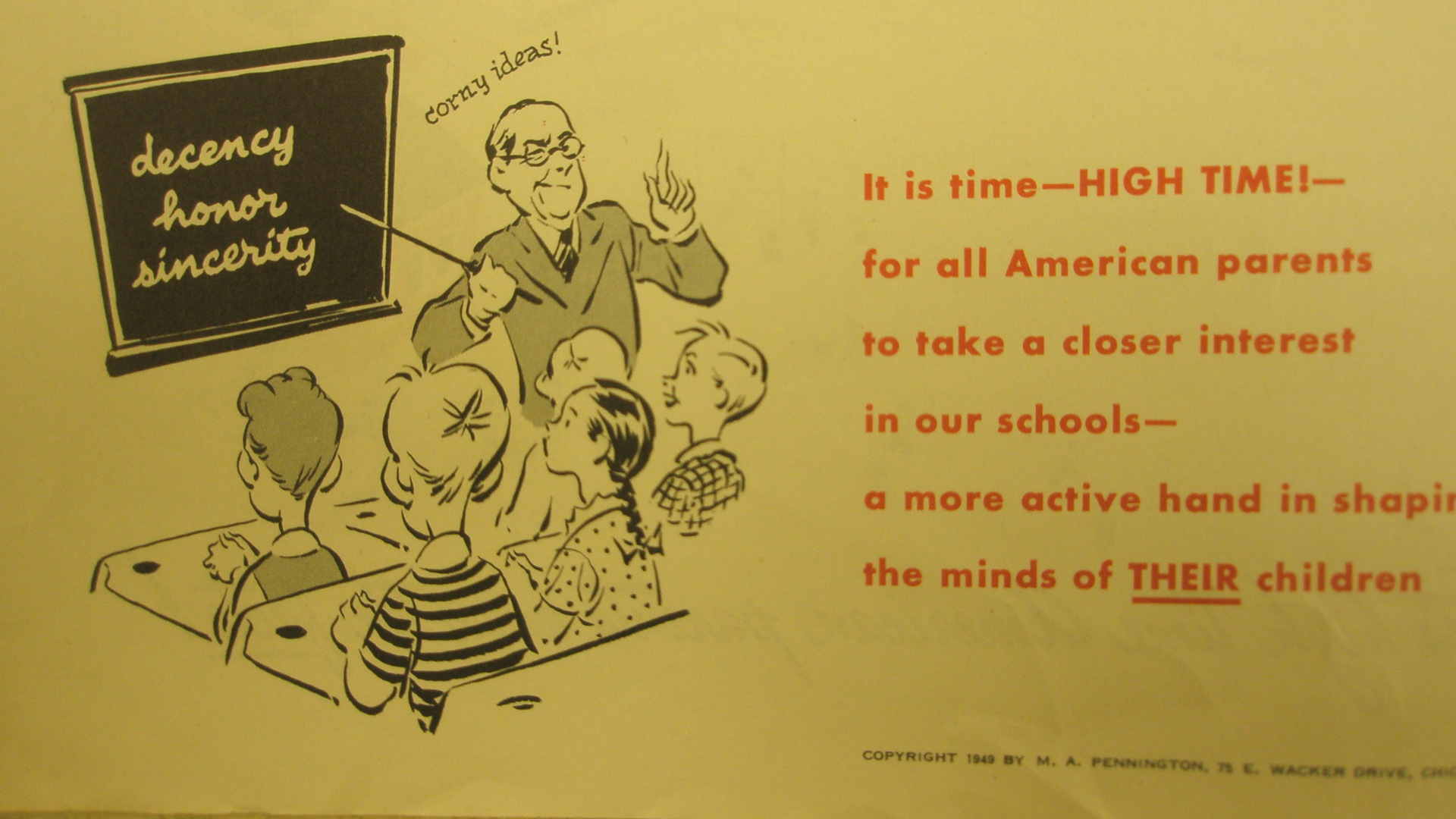
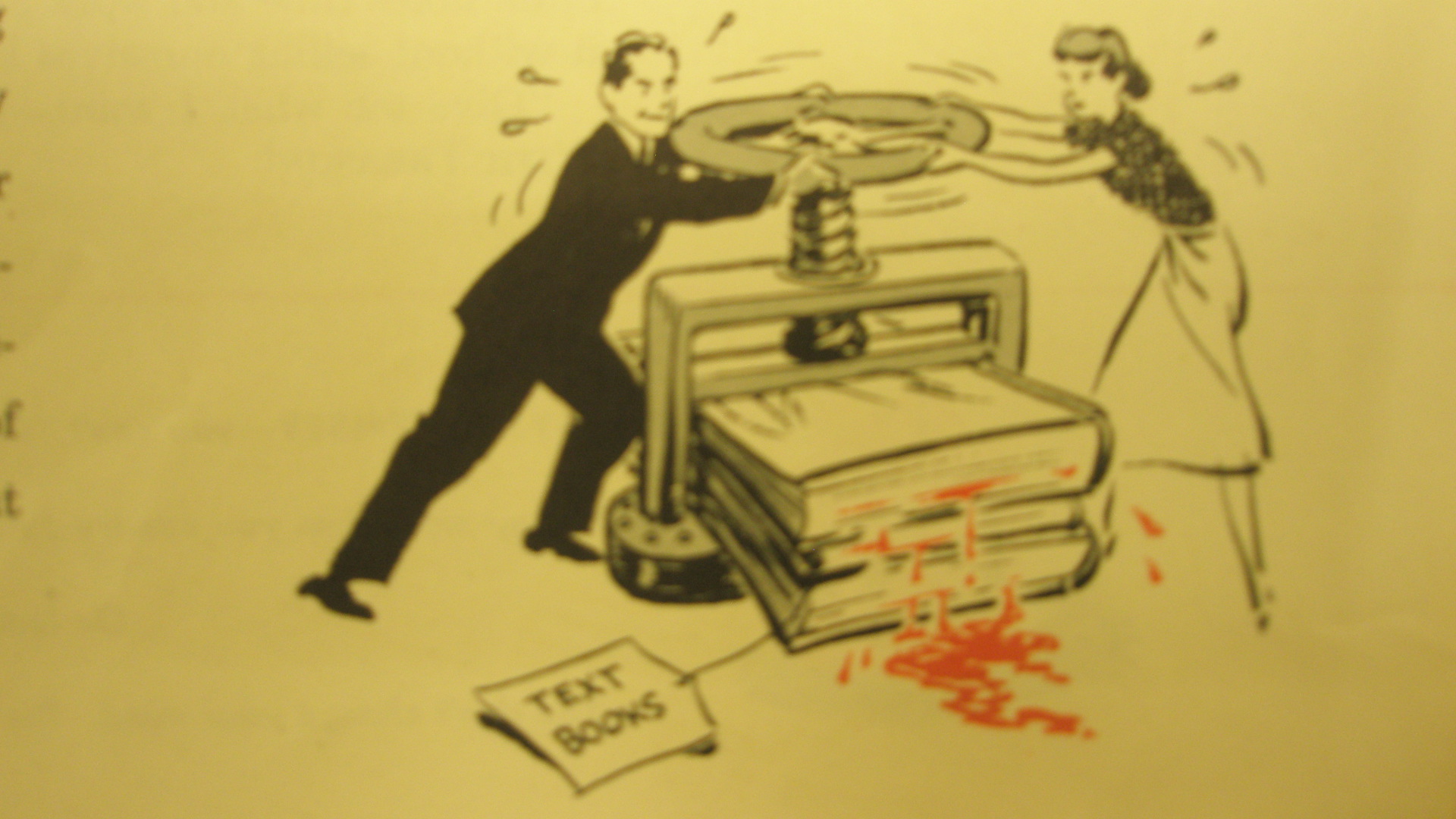
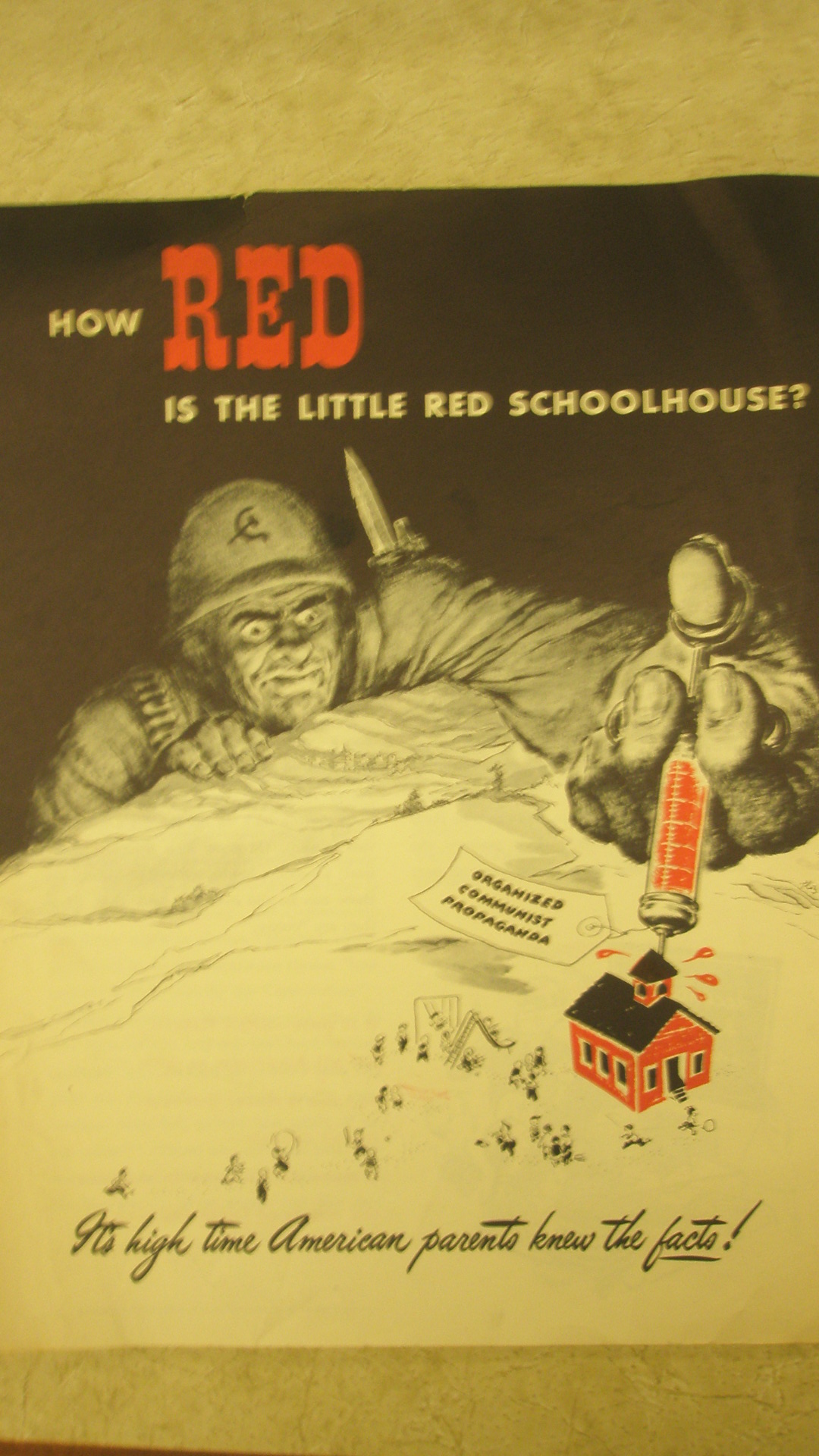
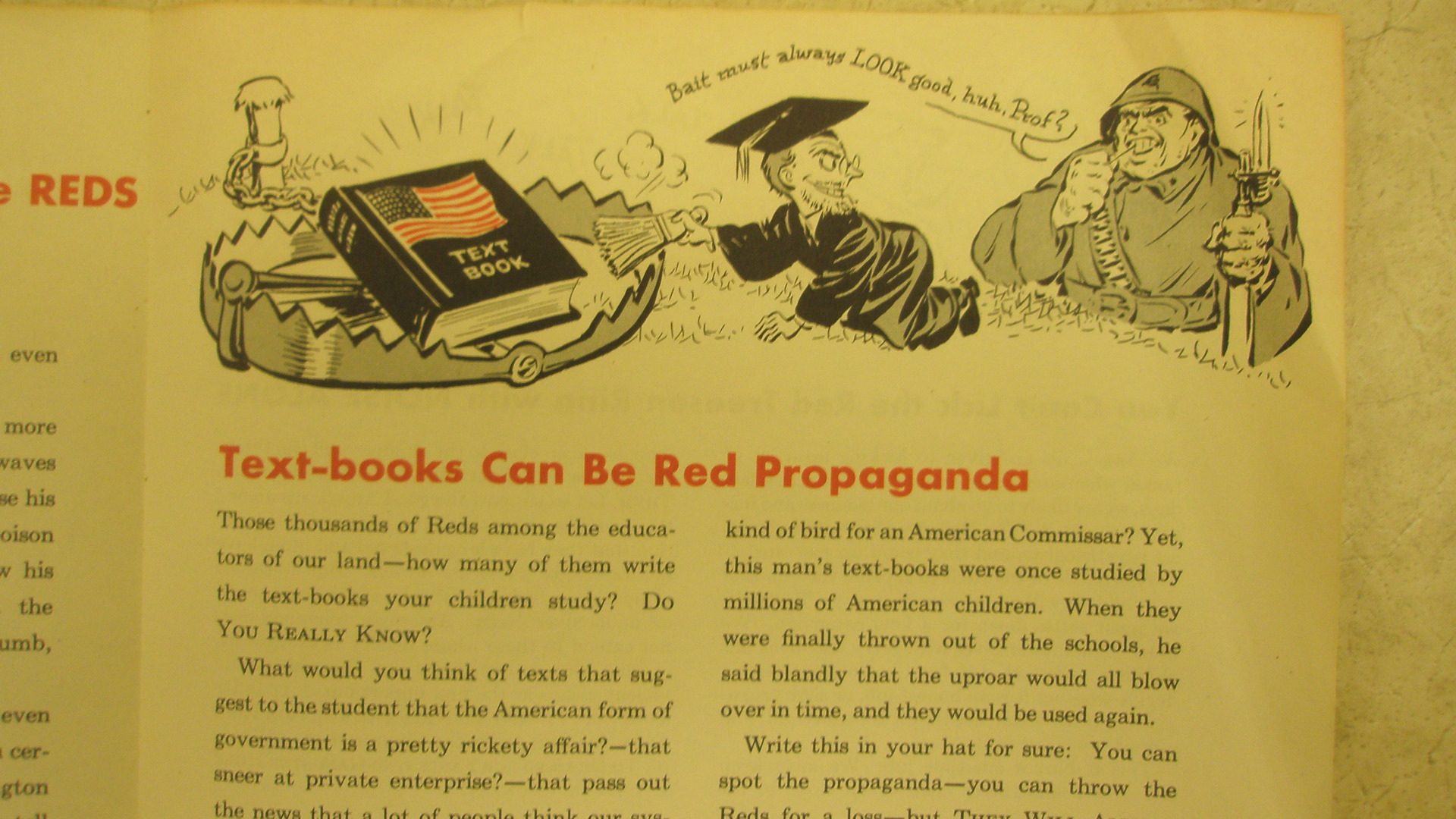
As always, a picture is worth a thousand words.  In this case, I’ll share some cartoons from an anti-communist pamphlet from 1949.  These cartoons demonstrate one common ideological thread in Cold War Fundamentalist America.  At the time, activists like the one who published this brochure felt that Communism threatened a two-pronged attack.  The danger included a military menace from Soviet Russia.  But it also meant internal subversion by dupes who did the work of the Red Army.  Intentionally or not, such subversive activity helped to weaken the resolve of America, making a communist takeover that much easier.

Further Reading: Ellen Schrecker, Many Are the Crimes: McCarthyism in America (Princeton: Princeton University Press, 1998); Jonathan Zimmerman, Small Wonder: The Little Red Schoolhouse in History and Memory (New Haven: Yale University Press, 2009).

This one shows the vast sweep of cultural ideology folded into the fight against communism. Not only must patriots fight communism, they must also fight to uphold traditional values.

Parents squeezing the “Red” out of textbooks.

As historian Jonathan Zimmerman has argued, the image of the “Little Red Schoolhouse” has long been a potent political symbol. In this cover image, the cartoonist makes a connection common in Cold-War anti-communism. “Reds” worked hard to subvert the Red Schoolhouse.

The scheming, bearded academic has long been an object of suspicion in Fundamentalist America. Here, he does the work of the Red Army.

Traditionalist Teaching for Progressive Teachers? Lisa Delpit and Fundamentalism in Black and White

Fundamentalists don’t like progressive education.  They may not realize that they have some potential allies deep in the heart of the academic education establishment.

What do fundamentalists mean when they fight against “progressive education?”  For one thing, fundamentalists tend to pooh-pooh reading instruction that allows children to ‘discover’ reading on their own.  And they dismiss the notion that classroom teachers should put authority in the hands of students.  Also, fundamentalists often look askance at education professors who advocate soft-heading, child-centered classroom teaching that fails to deliver basic information and academic skills.

Generally, fundamentalists make these complaints from outside of the academy.  Some historians and other prominent academics—folks such as Arthur BestorRobert Hutchins,  or Arthur Schlesinger, Jr.—have critiqued the claims of progressive education, but most of the effective critics have worked outside of higher education.  But in the past generation, at least one prominent academic educator has critiqued “advocates of any progressive movement” who fail to consider the opinions of those “who may not share their enthusiasm about so-called new, liberal, or progressive ideas.”  The work of this world-famous educational activist is read at every school of education, especially ones in which teachers are trained to use progressive teaching methods.

Then why does she talk this way?  Because she framed the issue not as traditional and progressive, but as black and white.  Her name is Lisa Delpit, and her traditionalist critique of progressive education did not lead to her exclusion from the education academy.  On the contrary, she has received some of the academy’s most prestigious awards for her work, including a MacArthur “Genius” award in 1990 and Harvard Graduate School of Education’s Outstanding Contribution to Education award in 1993.

To be clear, Delpit demonstrated considerable differences from many other traditionalist education activists.  For example, she backs a multicultural approach to education, most conservative traditionalists do not.  (See the ILYBYGTH discussion of traditionalist critiques of multicultural education here, here and here.)  She supports reading in depth and excoriates rote instruction.

But she also pushes a traditionalist ideology of teaching.  She offers withering criticisms of progressive teachers’ justifications.  In one career-making speech and article from the late 1980s, Delpit castigated progressive educators for their misplaced softness toward students.  She cited with approval one African American classroom teacher who described her anger at white progressive teachers as “a cancer, a sore.”  This teacher had stopped arguing against progressive methods.  Instead, she “shut them [white progressive teachers and administrators] out.  I go back to my own little cubby, my classroom, and I try to teach the way I know will work, no matter what those folk say.”  Delpit suggested that a direct-instruction model matched more closely the cultural background of most African American students.  In one model Delpit described favorably, the teacher is the authority.  The goal is to teach reading via “direct instruction of phonics generalizations and blending.”  The teacher keeps students’ attention by asking a series of questions, by eye contact, and by eliciting scripted group responses from the students.  Such traditionalist pedagogy, Delpit noted, elicited howls of protest from “liberal educators.”

In a sentence that could come straight from such conservative traditionalist leaders as Bill Bennett or Max Rafferty, Delpit supported the notion of many African American educators that “many of the ‘progressive’ educational strategies imposed by liberals upon Black and poor children could only be based on a desire to ensure that the liberals’ children get sole access to the dwindling pool of American jobs.”

In another critique, Delpit argued that white, middle-class teachers hid their classroom authority in ways that were confusing to poor and African American students.  Teachers of all backgrounds, Delpit suggested, need to be more explicit about their power and authority in the classroom.  A good teacher, Delpit noted, was seen as both “fun” and “mean” by one African American student.  Such a teacher, Delpit’s interviewee argued, “made us learn. . . . she was in charge of that class and she didn’t let anyone run her.”

More important for fundamentalist activists, Delpit’s voice is not alone.  A call for traditional pedagogy and schooling seems to be gaining adherents among African American parents and educators.  We could look at the deep traditionalism of such prominent schools as the New York Success Academy Charter Schools.  Or we could probe the attitudes of those who run KIPP (Knowledge Is Power Program) Schools, which tend to serve significant numbers of African American students.  In a recent article about school “paddling” in USA Today, one African American school administrator confirmed that she believed in spanking “because I’m from the old school.”

The numbers indicate African American students tend to receive corporal punishment more often than students of other racial backgrounds, but don’t indicate the level of support for such punishment among African American teachers as opposed to teachers of other races.  There are some indications that African American parents tend to use corporal punishment more often than other groups.  This would support Delpit’s assertion that many African American students have different cultural expectations from other students when they get to school.  But the same study asserts that a huge majority of parents of other groups also use corporal punishment at home.  And, indeed, there is a lot of support for corporal punishment at school among white conservative activists.  But such support generally comes as part of a broader traditionalist, anti-progressive ideology of schooling.

Delpit’s argument is different.  She argues for traditional authoritarian teachers within a progressive, multicultural educational system.

What does this mean?  I’ve got a couple of reflections, and I’d welcome more.

For one thing, it tells us something about the current state of education scholarship.  Seen optimistically, we might conclude that the popularity of Delpit’s work proves that education scholars are willing to embrace a true diversity of opinion.  That is, education scholars might not be the petty intellectual tyrants some traditionalists accuse them of being.  To cite just one example, arch-traditionalist Max Rafferty in 1968 accused the “education bureaucrats” of only speaking to regular people “with that air of insufferable condescension.”  Such “educationists,” Rafferty charged, only listened to one another; they only hoped to turn America’s schools into something approaching a “well-run ant hill, beehive or Hitlerian dictatorship.”  Delpit’s example of progressive traditionalism might suggest that education scholars are more open to dissent than Rafferty and others have consistently charged.

In a less rosy light, though, we might conclude that this is yet another example of the ways the mainstream academy is hamstrung over racial ideology.  We might wonder if Delpit’s ideas would be welcomed as fervently if education scholars weren’t so terrified of being considered racially insensitive.  It helps, of course, that Delpit is a wonderful writer and powerful polemicist.  But it is hard to ignore the question: How warmly would a scholar be welcomed who trashed the idea of progressive pedagogy in general?  Not just for one group of students, but for students and schools in general?

One other point jumps out at us: we apparently need to be more careful when we talk about traditionalist education.  I’ll plead guilty.  I am most interested in those traditionalists who act out of what we can fairly call a conservative impulse to transform American schools and society.  Folks like Rousas Rushdoony, Max Rafferty, Sam Blumenfeld, Mel and Norma Gabler.  Groups like the Daughters of the American Revolution and the American Legion.  Activists from these groups have long believed that teaching must be made more traditional so that American society itself can reclaim some of its lost glory.  But there are traditionalists like Delpit who hope that schools will transform school and society in a vastly different way.

Perhaps we need to treat “educational traditionalism” the way we treat “evangelicalism.”  A lot of folks, scholars and normal people alike, tend to treat “evangelicalism” as if it were the sole domain of white, conservative folks such as Billy Graham and Jerry Falwell.  But religious historians are also interested in other forms of evangelicalism.  There have always been leftist evangelicals, for instance, as Raymond Haberski has recently noted.  And, of course, there has always been a strong evangelical tradition among African Americans.

Perhaps the most important notion to think about here is that we have more than one kind of educational traditionalism.  Bashing progressive education has long been the national pastime of educational conservatives.  For the last twenty-five years or so, such conservatives have been joined by an influential cadre of mainstream education scholars.
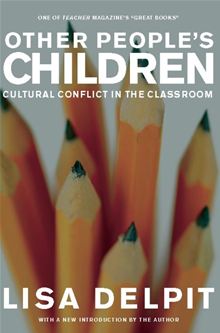
Further reading: Lisa Delpit, “The Silenced Dialogue: Power and Pedagogy in Educating Other People’s Children,” Harvard Educational Review 58 (Fall 1988): 280-199; Delpit, (1986). Skills and other dilemmas of a progressive black educator. Harvard Educational Review, 56(4), 379-386; Delpit, Lisa. (1995). Other People’s Children: Cultural conflict in the classroom. New York, NY: The New Press; Delpit, L & Perry, T. (1998). The Real Ebonics Debate: Power, Language, and the Education of African-American Children (Eds.). Boston, MA: Beacon Press; Delpit, L. & Dowdy, J. K. (2002). The Skin That we Speak: Thoughts on language and culture in the classroom (Eds.). New York, NY: The New Press; Delpit, L. D. (2012). Multiplication is for White People: Raising expectations for other people’s children. New York:The New Press.

TRADITIONALIST EDUCATION: CONCLUSION

What are schools for?  Why go to school?  For traditionalists, the answers to these questions call on some fundamental truths about human nature, culture, and youth.  In the traditionalist vision, progressives have deformed American education because they have operated with a radically inaccurate understanding of these basic truths.  To begin healing American schools, traditionalists could insist, we need to recognize a few of these central ideas:

  • People are not all the same.
  • Left to their own devices, people will not naturally choose to improve themselves.
  • Left alone, children will act viciously and often wallow in their own ignorance and slothfulness.

If we acknowledge these fundamental truths, traditionalists could insist, we will be able to think about schooling in a clear-eyed, practical, effective way.  We will recognize the genius of the cultural legacy we have inherited.  We will be able to see that the answers schools used for generations are better than the answers offered students in so-called progressive education.  In the traditionalist view, once we understand these important facts about culture, education, and youth, a few basic notions about formal schooling will become clear:

1.) School is for transmitting information to students.  New information; things they did not already know.  Not a chance for them to develop themselves as people.  That is the job of the family and church.  And not simply a way for them to explore their own lived experience; that’s fine for rich kids but it leaves the disfranchised disfranchised.

2.) School is a chance—not a guarantee but an opportunity—to improve one’s economic position.

3.) Schools must transmit values.  We can articulate those values without imposing traditional Biblical Christianity on the unwilling.

In a nutshell, the traditionalist idea of schooling can be based on much more than a vague nostalgia for the America of the past.  It can be more than just a knee-jerk insistence on a return to the Little Red Schoolhouse, to the good old days when we all walked ten miles to school, uphill both ways.  In its most compelling form, the argument in favor of more traditionalist education offers more than just a masked insistence on a return to schools dominated by Protestant theology or ruled by racial and class segregation.  At its best, traditionalist education can suggest a compelling argument about the nature of education.