Are Conservatives Secretly Racist?

No matter how much they may deny it, conservative intellectuals and activists these days are often accused of being secretly racist.  Influential African American conservatives such as Thomas Sowell, Clarence Thomas, and Ben Carson are accused of being suckers and “Uncle Toms.”  As an article in the New York Times argues, perhaps the racial strife in Ferguson, Missouri will give conservatives a chance to prove their anti-racist claims.

Is this the "conservative" side? ...

Is this the “conservative” side? …

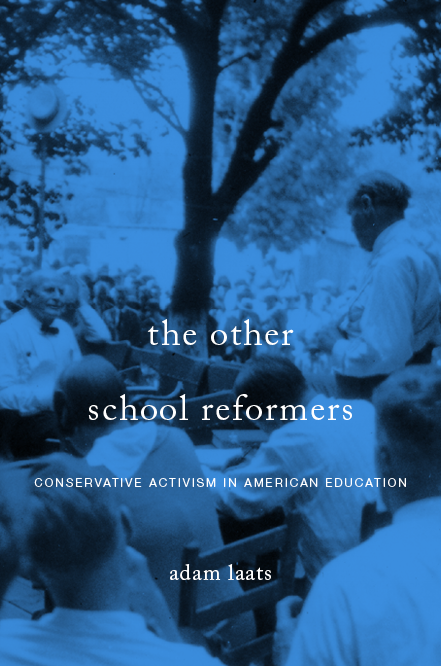
As I argue in my upcoming book, racial thinking among white conservatives as a whole has changed dramatically over the course of the twentieth century.  In the 1920s, school battles did not pit conservatives as the “racist” side against “anti-racist” progressives.  Indeed, in fights about evolution in the 1920s, mainstream scientists such as Henry Fairfield Osborn often supported the white-supremacist notions of writers such as Madison Grant.  White conservatives in the 1920s were mostly guilty of what we would call racism, but then again, so were white non-conservatives back then.

By the 1950s, mainstream conservatives had changed their thinking on racial issues dramatically.  First of all, the tumult over school desegregation led some conservative intellectuals such as William F. Buckley Jr. to support “states’ rights” over racial desegregation.  And in the massively resisting South, white resistance to desegregation often became coupled with a conservative anti-communism.

But outside the South, white conservatives often tried to insist that their opposition to school desegregation was not due to racism.  In Pasadena, for example, a progressive superintendent’s plan to desegregate the district met with ferocious opposition from conservatives.  But those conservatives insisted that they were not racist.  They insisted that their opposition to desegregation did not mean that they thought non-whites were inferior.

...Or is THIS the "conservative" side?

…Or is THIS the “conservative” side?

Similarly, in the school controversy that engulfed Kanawha County, West Virginia in 1974, white conservative activists insisted that they were not racist.  They opposed new textbooks that included passages from racial firebrands such as Eldridge Cleaver and George Jackson.  But, as conservative leader Elmer Fike put it,

The protesters do not object to authors because they are black, but they do believe convicted criminals and revolutionaries like Eldridge Cleaver should not be recognized.

Since then, mainstream white conservatives have worked hard to prove that their conservatism does not make them racist.  Does this new racial firestorm in Missouri give them a new chance to prove their sincerity?

In a recent article in the New York Times, journalist Jeremy W. Peters suggests it might.  Peters cites the nervousness of conservative leaders such as Rand Paul, Ted Cruz, and Erick Erickson.  All three conservatives, Peters notes, have spoken out against the massively militarized police response to the unrest in Ferguson, Missouri.  Peters says that this sort of conservatism marks a shift.  Since the late 1960s, conservatives have traditionally been the side of law and order.  These days, Peters wonders, conservatism might find itself embracing instead a renewed emphasis on limiting the power of government.  What conservative, Senator Paul might ask, wants to see a militarized police force bearing down on protesting citizens?

But the Missouri conflagration suggests another important question as well.  If conservatives really are the anti-racists many of them claim to be, this Ferguson situation might offer white conservatives a chance to side with African American conservatives as a united anti-racist conservative voice.  Legitimate protests against overweening government power could certainly rally conservative support, white and black.

And if conservative activists want to prove that they are not secretly racist, what better way to do so than to side with the protesting citizens of Ferguson, Missouri?
 

Conservative Christians: More Racist than Pro-Life

HT: JS

Historian Randall Balmer made the case recently in the pages of Politico that the Christian Right did not emerge as a response to loosened abortion laws.  Rather, the “real” roots of the New Right, Balmer argues, were in the defense of racial segregation.  Unfortunately, the argument looks more like punditry than history.

I’m a big fan of Professor Balmer.  In fact, I’m re-reading his book Mine Eyes Have Seen the Glory right now as I begin research for my next book.  And his Politico essay is certainly worth reading in its entirety.  But he makes more of a political argument here than a solid historical one.  If I were to offer a more precise headline, I’d suggest something far less catchy, but closer to the historical truth, something terrible like, “The Real Roots of the Christian Right: Not Biological Reproduction, but Cultural Reproduction.”

The Roots of Racist Academies?

The Roots of Racist Academies?

In other words, in the late 1970s, evangelical Protestants got involved in politics in big numbers because they were worried about preserving their status as a certain sort of favored class in American life.  This included things such as racial segregation, but to say that racial segregationism drove the movement is woefully misleading.  It was a broad sweep of issues, most urgently educational issues, that drove evangelicals back into politics in the 1970s.

Balmer makes the solid case that abortion did not spark the emergence of the New Christian Right.  The timing just doesn’t work.  In the immediate aftermath of the Roe v. Wade decision, evangelicals seemed largely indifferent to the issue of abortion.  For readers who find this hard to believe, a look at Daniel Williams’ book God’s Own Party will help.

What DID motivate conservative evangelicals, Balmer notes, was the increasing pressure on private religious schools from the IRS.  In the wake of decades of desegregation laws, the federal government had begun revoking tax exemptions from private schools that discriminated on the basis of race.  As Balmer correctly points out, this anti-federal animus motivated far more conservative evangelicals in the 1970s than did pro-life campaigns.

Nevertheless, Balmer’s conclusion doesn’t hold water.  “Although abortion had emerged as a rallying cry by 1980,” Balmer insists,

the real roots of the religious right lie not the defense of a fetus but in the defense of racial segregation.

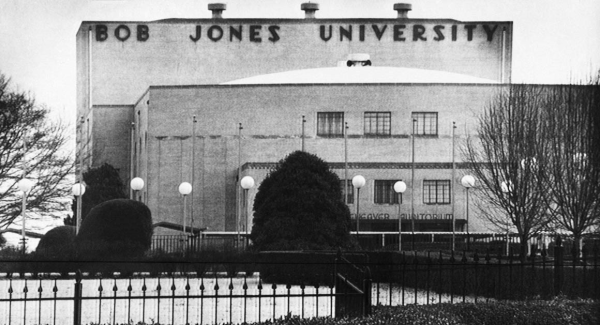
It is true that school segregation played a role in the rise of the evangelical private school movement.  And it is certainly true that Bob Jones University maintained a rigorous white supremacist position long after most other white conservatives had abandoned it.  But to argue that racial segregation somehow formed the “real roots” of the New Christian Right oversimplifies the historical realities.

Please don’t get me wrong: I’m no apologist for racism or for conservative evangelicalism.  I agree that many white conservative evangelicals, like other white Americans, had and have a shameful attitude toward racial equality and racial integration.  My argument is an academic one: If we want to understand the history of conservative evangelicalism, we won’t get far by insisting that racism was the “real root” of their political activism in the 1970s.

That sort of argument is sadly similar to attempts by conservatives to smear all Democrats by citing the radical words of leftists such as Saul Alinsky or Bill Ayers.  It’s not that some Democrats don’t sympathize or even follow Alinsky or Ayers.  But to say that such folks are the “real root” of liberal thinking is just not accurate.

To make a better historical case, Balmer should have argued that issues about schooling motivated evangelicals in the 1970s to get involved in politics.  Those issues included racial segregation, but they also included questions of school discipline, perceived drug use at schools, perceived immorality at public schools, and a host of other issues.  For all these reasons, a burst of new private schools popped up to serve conservative evangelical families.  And the defense of such schools drove many evangelicals into politics in the 1970s.

Were these schools “segregation academies?”  The history is clear, but not simple.  Certainly, some white evangelical parents—along with white non-religious parents—chose private religious schools as safe racist harbors in the days of school desegregation.  The timing proves it.  Though many evangelical parents may have cited 1960s Supreme Court rulings such as Engel v. Vitale (1962) or Abington v. Schempp (1963) as the time when public schools went to hell, the burst of private Christian schools did not happen until the late 1970s.

Not coincidentally, those were the years when large school districts came under pressure for the first time to desegregate by race.  But we commit an intellectual error if we conclude glibly that such schools ONLY represented racist havens.  I’ve wrestled with the question of “Christian day” schools and racial segregation in a book chapter a few years back.  Consider a couple of complicating factors.

The situation in Louisville, for instance, seems at first to confirm the hypothesis of racial integration as a primary factor in the growth of private evangelical schools.  After that city’s court order to bus children in 1974 as part of an ambitious desegregation plan, there was a spike in enrollment at the city’s existing Catholic and secular private schools.  In addition, a crop of new evangelical schools immediately opened to serve white families who did not want to bus their children.  One study found that most of the parents at these new evangelical schools identified desegregation as their primary reason for leaving the public schools.  Another academic study of Louisville’s desegregation history, however, suggests some important qualifications.  At two private evangelical schools that had existed for years before the 1974 court order, only one of sixty-eight fundamentalist families used the schools as a “haven” from busing.  Although whites fled from public schools to a range of private schools, this indicates that at least some of the existing evangelical schools did not take advantage of the surge of white interest in private education.

Another statistic that confounds glib conclusions about the primarily racial motivation for new Christian schools is that the largest recipient of white students fleeing from desegregation was not private evangelical schools but rather the booming suburban public high schools of the 1970s and 1980s.  Contrary to popular impressions, throughout the 1970s and 1980s, the numbers of students attending private schools nationwide dropped from 13.6 percent in 1960 to 9.8 percent in 1990.  Meanwhile, the proportion of white students attending public elementary and high schools nationwide increased markedly.  Those students, however, had moved mainly into suburban public schools.  For instance, the suburban schools surrounding Atlanta served ninety-eight percent of the area’s white students in 1986.

Throughout the twentieth century, conservative evangelicals cared deeply about education.  In the 1970s, savvy political organizers recognized that many evangelicals thought schooling had become threatened.  As Professor Balmer correctly points out, part of that perception came from the perceived “threat” of racial mixing in schools.  But that was only one element of the perceived danger to education.

The real roots of the Christian Right can’t be limited only to racism.  Rather, we will do well to understand how profoundly important educational issues were to the new political mobilization that swept evangelical America in the 1970s.

Charles Murray, Extremist?

No one doubts that scholar Charles Murray is controversial.  Best known for his book The Bell Curve, Murray ruffled feathers by asserting that some sorts of people are naturally less intelligent than others.  Though he denies every accusation of racism, Murray’s reputation has caused the administration of Asuza Pacific University to abruptly cancel Murray’s upcoming campus talk.

Has Murray’s reputation as a racist caused him to be seen as too extreme even by administrators at conservative Christian colleges?  The leaders of APU, for example, worried that Murray’s talk might be hurtful to “our faculty and students of color.”

Scholar?  Or Racist?  Can He Be Both?

Scholar? Or Racist? Can He Be Both?

After all, Murray has been labeled as a “white nationalist” by the Southern Poverty Law Center.  Murray, the SPCL charged, uses

racist pseudoscience and misleading statistics to argue that social inequality is caused by the genetic inferiority of the black and Latino communities, women and the poor.

For his part, Murray accuses Asuza Pacific of pusillanimity and closed-mindedness.  In an open letter to APU’s students, Murray challenged them to think for themselves.  Murray invited students to explore his website and read some of his publications.  The more you know about me, Murray suggested, the harder it will be for you to take these accusations of extremism seriously.  “The task of the scholar,” Murray told APU students,

is to present a case for his or her position based on evidence and logic. Another task of the scholar is to do so in a way that invites everybody into the discussion rather than demonize those who disagree. Try to find anything under my name that is not written in that spirit. Try to find even a paragraph that is written in anger, takes a cheap shot, or attacks women, African Americans, Latinos, Asians, or anyone else.

There is no reason, Murray concludes, why students should not listen to talks by “earnest and nerdy old guys” like Murray.

This cancellation of Murray’s talk raises key questions.

First of all, does the goal of intellectual diversity on college campuses include the inclusion of unpopular conservative ideas?  We’ve seen recently examples of speakers protested against at Montana Tech for their support of creationism, pro-life student groups at Yale being refused fellowship in a social-justice club, and Steven Hayward’s lonely life as a token conservative campus intellectual at Colorado.

Second, what does it mean that this cancellation comes from a relatively “conservative” campus?  APU is one of the oldest evangelical universities in the country.  No one could safely accuse the leadership of APU of pandering to the traditional secularist campus leftism run amok.  Yet this school’s leadership saw fit to cancel Murray’s speaking appointment due to worries about Murray’s reputation.

Finally, who decides which ideas are extreme?  By any measure, Charles Murray’s work has been part of recent mainstream American conversations about race, class, and society.  His 2012 book, Coming Apart, for example, was prominently reviewed by such leading publications as the New York Times, Wall Street Journal, and the New York Review of Books.  It does not make sense to suggest that Murray has only some sort of fringe status as a scholar.  Yet in this case, even a conservative Christian school saw Murray as too controversial to speak on campus.


Evolution Is Racist

Evolution is racist, says thinking-man’s conservative Rod Dreher.

But before we anti-creationists pull out our handy refutations of the Darwin-Hitler smear, take another look at Dreher’s real argument.

Dreher is no knee-jerk creationist.  He wants public schools to teach evolutionary science.  For that matter, he wants ALL schools to teach evolutionary science.  He explicitly rejects the simplistic equation of “Darwin” with “racism.”

But Dreher yet objects to the ways liberals hasten to conflate creationism with anti-scientism.  Too many liberals, Dreher argues, pick and choose from their scientific principles.  Just as do creationists, liberals begin with the notion of “forbidden knowledge,” of facts that may or may not be true, but in any case are too dangerous to be widely shared.

For Dreher, the implications of Darwinian natural selection are just such ideas.  Too often, the facts of genetic variation among humans have led all-too-fallible humans to a sinister conclusion.  As Dreher explains,

I flat-out don’t trust our species to handle the knowledge of human biodiversity without turning it into an ideology of dehumanization, racism, and at worst, genocide. Put another way, I am hostile to this kind of thing not because I believe it’s probably false, but because I believe a lot of it is probably true — and we have shown that we, by our natures, can’t handle this kind of truth.

The point, for Dreher, is not the crude creationist mantra that evolutionism leads directly to Hitler.  The point, rather, is that capital-s “Science” has and will be misused to justify humanity’s darkest impulses, just as Religion can be so misused.  Dreher’s point, as I understand it, is that those anti-creationists who smugly wave the flag of Science to discredit religious opposition unwittingly expose themselves as shamefully ignorant of the real issue.  As Dreher concludes,

liberals who love to put the Darwin fish on their cars and rail against fundagelicals who want to teach Creationism in public schools should be honest with themselves and admit that they don’t really want to teach Science and nothing but either. Their enthusiasm for just-the-facts science typically stops the moment science tramples upon one of their sacred principles.

Evolutionary theory may not be racist, in a simple sense.  But Dreher gives us an important reminder that any idea can be misused as a smear to discredit one’s opposition.


Fundamentalist Ducks

Okay, okay, I admit it.  I’ve been itching to write something about the recent Duck Dynasty culture-war imbroglio.  But until now there didn’t seem to be much worth saying.  One sentence said it all: Famous redneck shows ugly blind spot in racial issues and homosexual identities.  Didn’t seem like much more needed talking about.

For those of you who live in caves, bearded patriarch Phil Robertson ruffled feathers with recent ignorant and hateful comments about homosexuals and racial history.  In all his Louisiana life, he told a GQ reporter, he never saw an African American who seemed upset about lacking basic civil rights.  And homosexuals, he opined, should learn to prefer vaginas to men’s anuses.  After all, as Robertson concluded with invincible logic, “I mean, come on, dudes!  You know what I’m saying?”

Until today, everything I’d read about the scandal either defended Robertson’s right to his theology or attacked him for his hate.  But this morning I came across the comments of the brainy conservative Rod Dreher in the pages of Time.com.  For those not familiar with Dreher’s story, he moved back to his small-town Louisiana roots from a go-go New York media career after a family tragedy.

Dreher hit the nail on the head.  While Dreher doesn’t agree with Robertson’s positions, he remarked on the ridiculously excessive shock expressed by many media mavens.  Too many of those “culture-makers,” Dreher lamented,

are often every bit as parochial as those they condemn, but flatter themselves that they are the tolerant, cosmopolitan ones. I have lived in Manhattan, and I live once again in my tiny south Louisiana hometown. To paraphrase Solzhenitsyn, the border between narrow-minded and tolerant runs not between city and country, North and South, degreed and uneducated, but down the middle of every human community and every human heart.

. . .

The Duck Dynasty mess revealed that not all fundamentalists live in the Bible Belt, and that some of the biggest hicks live in Hollywood. The Duckman’s win is a score for authentic diversity and pluralism in the public square, and a victory for the right to be wrong without being ruined.

Hear hear.

When I began my current job as a university professor, I gave a talk about my dissertation research.  That work—which became my first book—concerned the first generation of American fundamentalists.  I soon realized that my tolerant, cosmopolitan university audience contained more than its share of Dreher’s hip hicks.  Not the entire audience, by any means, but certainly an influential group.  These culture-makers did not hope to understand fundamentalists; they did not seem interested in puzzling out the intellectual world I had tried to portray.  Instead, they only rushed to demonstrate their shock and horror at the ideas of people very different from themselves.

At the end of the talk, one member of my academic audience raised her hand and asked in a frustrated tone, “What is WRONG with these people?”  Heads nodded throughout the room.  The person who asked the question was not dumb, was not ignorant.  She was a prolific researcher and dedicated teacher.  In fact, she had worked throughout her career to make schools more inclusive for all sorts of students.  Yet she saw no contradiction in dismissing the thinking of a large percentage of Americans as “these people” out of hand.

Like Dreher, I don’t think Robertson’s comments are worth talking about, much less defending.  But the reaction to his comments can tell us a good deal about the current state of America’s intellectual myopia.   It serves as a sobering reminder of the widespread and unacknowledged ignorance among many Americans about what America is really like.


Racism Doesn’t Pay

What would this look like in the United States?

A story in today’s New York Times describes the court case against Japan’s Zaitokukai, in which the far-right group had to pay a hefty fine for shouting its racist ideology at a Japanese school.

Image Source: Wikipedia

Image Source: Wikipedia

The school apparently served young people of Korean ethnicity.  The far-right group protested outside the school, calling the children “spies and cockroaches.”

Is this sort of Asian race-baiting translatable?

In other words, what would this sort of racism look like in the United States?

Unfortunately, it is all too easy to see the woeful results of structural racism in America’s schools.  Schools are still often segregated by race.  Those with mostly African American students often lack the resources of schools for mostly white students.  And the educational legacy of white supremacy has often been part of America’s official educational policies, as historians such as David Blight have argued.

Even granting all that, however, I have a hard time imagining this sort of vicious race-baiting in any American city.  Maybe I’m naïve, but I can’t picture any group these days picketing a majority-African American school and shouting racial epithets.  Would the equivalent be something like the infamous Westboro Baptist Church rallies?  Even those, however, cling not to America’s racist past, but rather to an extremist religious vision.  I say again, I can’t imagine any large group shouting racist taunts at African American children.

Is this another case where my suburban liberal upbringing has left me painfully unaware of the realities of American schooling?


Do White Conservatives Hate Black People?

What is the connection between conservatism and school segregation?  A new “retro report” in the New York Times about the desegregation project in Charlotte, North Carolina assumes that “conservatives” obviously opposed desegregation.  Is that connection really as obvious as it seems?

The desegregation documentary describes Charlotte’s experience.  In the 1970s, Charlotte and surrounding Mecklenburg County became the focus of a newly aggressive court-ordered busing program.  Schools and school districts, the Supreme Court ruled, must do more to ensure racial balance in public schools.

The initial reaction in Charlotte was furious, but the program eventually became the poster child for busing.  So much so that a federal judge ruled in 1999 that the district had fulfilled its deseg obligations.  At least partly as a result, the Charlotte-Mecklenburg schools are now resegregated by race and income level.

For historians of race and education, the story is not news.  But for those of us trying to understand the meanings of “conservatism” in American education, the way it is told is important.  The New York Times piece includes comments by journalist B. Drummond Ayres Jr. In that “Reporter’s Notebook,” Ayres offers an explanation for the winning campaign to resegregate America’s schools.  As Ayres explains,

White parental anger was the most obvious cause of this rollback. But an equally important factor was the election of two conservative Presidents, Richard Nixon and Ronald Reagan. They did not oppose the nation’s move toward racial equality, but as conservatives they favored a slower, more measured approach to desegregation and underscored that approach by appointing staunch conservatives to the Supreme Court and lower Federal courts. Concurrently, Congress took a more measured approach to desegregation, too, as voters began sending more and more anti-busing conservatives to Capitol Hill. [Emphasis added.]

In this telling, “conservatives” have been the brake on the progress of racial desegregation.  Politicians who considered themselves conservative had a prescribed opinion toward school desegregation.

Is that a fair accusation?  Did conservatives as a rule really push for slower desegregation?  More interesting, how did conservatism come to be perceived as the side of white racial status-quo-ism?

In my current book, I explore two twentieth-century school controversies in which race and school deseg played leading parts.  The first took place in Pasadena, California, in 1950, the second in Kanawha County, West Virginia, in 1974.

In Pasadena, a “progressive” school superintendent added racial desegregation to his list of progressive reforms.  Conservatives kicked him out.  In Kanawha County, a new textbook series included provocative excerpts from black militants such as Eldridge Cleaver.  Conservatives boycotted to demonstrate their dissatisfaction with the books.

Each time, the conservative side became the side of anti-black racism.  But in each case, conservatives insisted they were not racist.

In Pasadena, for example, one woman stood up at a heated school-board meeting and denied all charges of racism.  She opposed the desegregation plan but said she could not be racist, since one of her closest friends was African American.

In Kanawha County, too, book protesters often insisted they were not racist.  Teacher and activist Karl Priest, for example, has insisted for decades that the conservative protesters embodied the true anti-racist position.

But evidence contradicts these conservative anti-racist claims.  In Pasadena, conservatives rallied political support based on opposition to race mixing in public schools.  Conservatives accused the progressive superintendent of raising taxes and dumbing down white schools by including students of other races.  If that’s not racism, what is it?

And in Kanawha County, as documentarian Trey Kay has shown, conservatives really did see the book protest as a race war.  Steve Horan remembered in 2010 that a rumor spread among white conservatives in 1974: African Americans planned to invade.  The men readied their guns.   Women and children took shelter in church basements.  If that’s not racism, what is it?

There seems to be at least some justification for journalists’ assumptions that “conservatism” stands staunchly opposed to racial integration in schools.

But it is also important to recognize the complexity of conservative attitudes toward race and schooling.  It is not enough to simply say that “conservatives” block school desegregation because they dislike black people.

The case of Kanawha County helps make this more complicated point.  Many of the conservative leaders of the protest, such as Karl Priest and Avis Hill, belonged to conservative churches with a thoroughly biracial membership.  If that’s not anti-racism, what is it?

And conservative leader Alice Moore built her anti-textbook arguments on the work of African American activist Stephen Jenkins.  Jenkins had argued that textbooks that included only violent writings by African Americans actually represented the true anti-black racism.  Those who wanted to oppose the depiction of African Americans as violent anti-American criminals, Jenkins argued, needed to oppose the wrong-headed push for “multiculturalism.”  If that’s not anti-racism, what is it?

Across the country, “conservative” anti-busing protesters made similar claims to be the true anti-racists.  In Boston, for example, as Ron Formisano has shown, “conservative” anti-busers in the 1970s accused “liberal” federal judge Arthur Garrity of being the true racist.  Garrity had ordered busing to achieve racial balance in Boston’s schools, yet he lived in the affluent lily-white enclave of Wellesley, where his children would attend all-white schools.  Who was the racist in that scenario?

Did conservatives oppose busing and forcible school desegregation?  In most cases, yes.

Will we understand conservatism in schooling if we explain that position as simple racism?  In most cases, no.

White conservatives seem, in many cases, to have been motivated by anti-black racism.  But in almost all cases, that racism was only one component of a complex conservatism that also included issues of school funding, textbook content, religious rights, classroom practice, and a host of other issues.

Calling it “racism” and walking away doesn’t do enough.  Ayres deserves credit for noting that leading conservatives often supported anti-racist policies.  Conservatives often insisted that they opposed forcible busing and forcible integration.  They did so as part of a complicated conservative worldview, one that looked toward the status quo–including but not by any means limited to the racial status quo–for support.

So did white conservatives hate black people?  Did conservatives oppose school desegregation out of disdain for non-whites?

In some cases, probably.  But it is not very useful to assume that such racist attitudes are the end of our discussion.  Rather, understanding the complex attitudes toward race among conservatives–as among Americans as a whole–requires a more careful understanding of a complex conservative ideology.