The OTHER Hobby Lobby Case

You’ve been following Hobby Lobby’s case for religious freedom before the US Supreme Court.  But did you know Hobby Lobby’s Steve Green has also prepared an ambitious Bible curriculum for use in America’s public schools?

According to Religion News Service, the school board of Mustang, Oklahoma has voted to use the Bible curriculum in its public schools.  Of course, despite some rumblings to the contrary, there is nothing unconstitutional about teaching the Bible in public schools.  The US Supreme Court’s ruling in 1963’s Schempp decision specified that the Bible can and should be taught in public schools, as long as it is not taught devotionally.  That is, children can learn about the Bible, about religion, but not be drilled in any particular religious belief.

But it often seems as if the folks who want to see more Bible in public schools have a decidedly devotional bias to their activism.  As Mark Chancey of Southern Methodist University found in his study of Texas Bible classes, a significant proportion of them end up teaching religion, not just teaching about religion.

In this case, no one questions Steve Green’s ardent religiosity.  As the Religion News Service article points out, Green has admitted in public statements that he hopes the Bible curriculum will show that the Bible is “good,” that it’s “true,” and that the Bible’s impact,

whether (upon) our government, education, science, art, literature, family … when we apply it to our lives in all aspects of our life, that it has been good.

It seems evident that Green hopes this Bible curriculum will lead students toward faith, at least incidentally.  For that reason, the Freedom From Religion Foundation has promised to “scrutinize” the Bible curriculum.

More evidence, it seems, of the uselessness of talking about “America’s public schools” in general.  Schools in some communities, such as Mustang, Oklahoma, may welcome evangelical Protestant curricula into their class schedules.  In other places, Green’s Bible curriculum will not be an issue.  Local school boards make decisions that fit with the cultural politics of their local communities.

 

…but God IS My Hero

“But God IS my hero.” That’s a dramatic reconstruction of what ten-year-old Erin Shead told her teacher in October. Her teacher had asked her to do a writing assignment about a hero. When Erin turned in an essay about God, her teacher told her she couldn’t write about God, she had to write about her personal hero.

Source: WRCB Chattanooga

Source: WRCB Chattanooga

The resulting kerfuffle pushed Tennessee lawmakers to pass the Religious Viewpoints Anti-Discrimination Act. According to this bill, which now goes to Tennessee Governor Bill Haslam for a signature to become law, students must be allowed to voluntarily express religion viewpoints “on an otherwise permissible subject in the same manner [the school] treats a student’s voluntary expression of a secular or other viewpoint.” In other words, students must be allowed to write about God as their hero.

Here at ILYBYGTH, we have to wonder if this sort of law might represent a powerful new conservative tactic in America’s ongoing educational culture wars.

Tennessee is not alone in passing this sort of school rule. Texas has such a law on the books. Missouri has a similar rule enshrined in its constitution. And Oklahoma is considering something along these lines.

Today, I’m not going to argue the merits of these sorts of laws. In short, though, I’m against them. As I’ve argued in places such as Education Week and the Washington Post’s Answer Sheet blog, these kinds of bills threaten to impose an utterly unmanageable free-for-all in our nation’s classrooms. IMHO. Other commentators, too, have worried that these laws will impose a renewed theocracy in public schools. If students can use class time to make religious statements, some worry that religious students might turn classrooms into religious battlegrounds. What if a creationist student insisted that she could answer questions about evolution with references to Genesis? What if a Muslim student made a speech in which he denied that Jesus was God? It’s not hard to imagine dicey situations these new laws might encourage.

Today, though, instead of arguing against these kinds of bills, I’d like to make a different point. It seems educational conservatives can win politically by protecting students from a perceived overreach by educational leaders. In the case of Tennessee, the senate bill passed unanimously. In the assembly, only two representatives voted against it.

Why did this bill have such overwhelming political support? Two reasons. First, there is not much new in these laws. Students already had the right to engage in self-directed religious activity in public-school classrooms. Erin Shead already had the right to write about God as her personal hero. Second, conservative educational thinkers and activists have long worried about school as a potential threat to young people’s faith. Anything that looks to support religious young people from what many people see as an aggressively secularizing public-school establishment will win political points among religious conservatives.

So liberal-leaning lawmakers can vote for these laws as mere clarifications of already-existing rules. And conservative-leaning lawmakers can promote these votes as an effort to protect religious youngsters from the sinister aggression of secularizing teachers and schools. Together, that is a powerful political coalition.

If I were a conservative activist, I would be watching very closely. Bills that underscore the religious rights of students in public schools have a powerful symbolic effect, if nothing else. And politically, they may be hard to stop.

Why shouldn’t conservatives push these sorts of school laws all over the country?


Charter Schools SHOULD Be Religious

H/T CS, JS, TK

Thanks to alert colleagues, I’ve been following the great series of articles in Slate about creationism and charter schools.  Most recently, we find a map of charter schools that seem to be teaching creationism.  According to this survey by Chris Kirk, plenty of tax-funded charter schools across the nation are teaching creationism.

But is there anything wrong with charter schools teaching creationism?

Don’t get me wrong: I think all students should learn the best science, even if they go to non-tax-funded schools or homeschools.  That should not be a legal requirement, but rather simply a goal for common education and citizenship.  In traditional public schools, we should demand a rigorously pluralist ethos.  No student from any religion or non-religion (or race, or gender identity, or etc.) should ever feel squeezed out due to his or her background.  And I don’t dispute Kirk’s accusation in this Slate piece that lots of charter schools are likely teaching creationism.  As Kirk puts it,

If you live in any of these states, there’s a good chance your tax money is helping to convince some hapless students that evolution (the basis of all modern biological science, supported by everything we know about geology, genetics, paleontology, and other fields) is some sort of highly contested scientific hypothesis as credible as “God did it.”

But let’s step back a moment and examine the real legal, educational, and constitutional issues here.  Let’s not forget that charter schools were created in order to offer more authentic diversity of educational models.  Should that diversity not include religious diversity?

According to a note in the Yale Law Journal a few years back, the proper line between religion and publicly funded charter schools is not as clear cut as journalists and policy-makers often assume.  In that 2008 piece, Benjamin Siracusa Hillman argues that charter schools ought to be allowed or even encouraged to include religious practices and beliefs.

Recent US Supreme Court decisions, Hillman argues (see esp. page 576), support a notion that school districts may legitimately include religious schools without violating the famous 1970 “Lemon Test.”  If a state or school district has a secular purpose in setting up schools—including even religious schools—those schools are more likely to pass constitutional muster.  The goal must not be to serve only one sort of religion.  Nor must school districts hope to exclude non-religious students, or students from other religious backgrounds.  Religious schools may fit into a broad charter school/voucher school network, the Court has suggested, as long as the first purpose is to improve education for all.

Hillman also analyzes the decision of a Michigan court in which parents sued a charter school for cramming religion into their publicly funded school.  The school, according to this federal court ruling, did no wrong in including religion, since it did not force students to engage in religious practice or adopt religious beliefs.

So can publicly funded charter schools teach creationism?  Or, even more provocatively, SHOULD charter school networks work to include schools that teach creationism?

The recent string of Slate articles implies that such practice ought to raise alarm bells.  But if we view creationism as an expression of a religious belief, it seems the rule is not quite so cut-and-dried.  Public school districts have much more leeway to include religious schools than many people seem to think.  Such ignorance can be politically useful.  For example, no one will mobilize to fight against teaching that might be perfectly legal and even desirable.  But some sections of our chattering classes might have better luck with breathless exposes of religion in publicly funded schools.


Jesus in Public Schools: In through the Back Door?

Is it okay for religious missionaries to use public schools as recruiting grounds?

Usually we say no.  But what about when the religious missionaries just want to help struggling districts?  What if they promise to leave the Jesus at the door and just provide social services to low-income students?

In the pages of Christianity Today we read of the public-school leadership of evangelical Don Coleman.  Coleman recently won election as chair of Richmond, Virginia’s school board.

For those of us who watch the intersections of public education and religiosity, ought we be concerned by Coleman’s attitude that “education is one of the greatest open doors for urban missions”?

According to the Christianity Today piece, Coleman supports a heavily intertwined church and state.  Local churches “adopt” students, in order to help students overcome significant personal problems.  Coleman wants local churches to become so helpful to schools in low-income areas that the public schools eventually welcome churches’ help.

The story raises some tricky questions.  Personally, I think a students-first approach is a good idea.  As Coleman says, “We don’t fight over prayer.”  Why can’t churches help struggling public schools?  Seems like a win-win.  Seems like someone would have to be pretty heartless to oppose helping a young woman go to college while the rest of her family languishes in jail.

But the underlying issues don’t seem any different from other school-church cases.  Constitutionally, public schools ought to be institutions in which all students are made to feel welcome, regardless of religious or non-religious background.  What about non-Christian students in Richmond schools?  Will they feel equally at home in schools “adopted” by evangelical Christian churches?  Or what about atheist students?  Ought public schools be places in which they have the gospel preached to them by outside missionaries?

Worst of all, we must ask if there is a racial or class bias at play here.  Richmond’s schools are heavily black and poor.  Would students in a more affluent or whiter school district be subjected to religious proselytization as part of their school day?  Or, if they were, wouldn’t activist groups such as the Freedom From Religion Foundation or the Americans United for the Separation of Church and State have more to say about it?


Conservatives: Keep Religion Out of Public Schools

Do American religious conservatives want more Jesus in public schools?  That’s usually the assumption, from Kountze, Texas to San Diego, California.

Recently in the pages of The American Conservative, Leah Libresco argued the conservative case against more religion in public schools.  When religion is used by the state, she points out, it puts religion in the service of the state, not vice versa.

One commenter pointed out the paucity of this sort of sentiment among religious conservatives in the past thirty years.  Fair enough.  But let’s not forget how common such notions were among religious conservatives, especially for those from the Baptist tradition, throughout American history.

For example, as historian Jon Zimmerman argued in his 2002 book Whose America, the battle over weekday religious education in public schools pitted conservative Christians against liberal Christians.  Both sides wanted more good religion in public schools, but they disagreed bitterly over the content of that religious education.  Conservatives and self-identified “fundamentalists” often made the case that no religion was better than false religion for public school students.

Similarly, we need to remember the response among conservative evangelicals to the Supreme Court’s anti-prayer ruling in Engel v. Vitale.  In that important 1962 decision, SCOTUS ruled that public schools could not lead students in even the blandest, most ecumenical prayer.  As I argued in a recent article in the Journal of Religious History, many conservative evangelical intellectuals were well pleased.

The National Association of Evangelicals approved of Engel.  So did Presbyterian fundamentalist Carl McIntire.  As William Culbertson of the Moody Bible Institute put it, “The public as a whole and Christians who sense the necessity for safeguarding freedom of worship in the future are always indebted to the Court for protection in this important area.”

For Culbertson as for the other conservative Protestants who agreed with him, it would be better for public-school students not to pray at all in school rather than for them to chant the pablum imposed by the New York Regents.  That Regents prayer, after all, offered only the thinnest gruel of religion; it crushed any orthodoxy in its well-meaning goal of ecumenicalism.  “Almighty God,” students prayed, “we acknowledge our dependence upon Thee, and beg Thy blessings upon us, our teachers, and our country.”

As Leah Libresco argues in her recent conservative indictment of public-school prayer, that sort of religiosity does not teach young people the religion of their families.  It only teaches them a confusing lesson about the vague existence of a higher power.  For religious conservatives, the words of a prayer matter.  Better by far to ban meaningless prayers from public schools than to embrace a state-directed vision of the Almighty.


Should Liberals Teach the Bible in Public Schools?

Usually, when we hear pleas for the teaching of the Bible in America’s public schools, they come from conservative evangelical Protestant activists.  Today, though, liberal scholar and friend of ILYBYGTH Mark Chancey makes the liberal case for teaching the Bible in public schools.  Do you buy it?

Chancey attracted attention a while back for his study of the ways public schools in Texas teach the Bible.  Too many of them, he concluded, teach a sectarian theology.  Too many public school programs, he found, don’t teach students about the Bible, but rather try to tell students what to believe about the Bible.

Recently in the pages of Religion & Politics Chancey outlined the ways the Bible should be taught.  He offered an eight-point outline of the ways good public-school Bible programs work.  Everyone interested in religion, he argues, should staunchly support the teaching of the Bible in America’s public schools.  To do it right, though, schools need to learn from the successful Texas programs he saw in his review.

What do good public-school Bible programs do?  Here are Chancey’s pointers:

  • They relied on resources informed by a broad range of biblical scholarship, not just the scholars of one particular religious community.

  • They informed students about the unique features of the Bibles of different traditions (Jewish, Roman Catholic, Protestant, and Eastern Orthodox).

  • They were intentional in exposing students to biblical translations associated with different religious traditions.

  • They were sensitive to the different ways various religious communities have interpreted particular passages and did not present one tradition’s interpretation as normative.

  • They recognized the importance of biblical texts as ancient historical sources without lapsing into a tone of assumed historicity.

  • They discussed the Bible’s moral and theological claims without presenting them as authoritative for the students.

  • They recognized that the Bible is not a science textbook.

  • They treated Judaism as a religion in its own right and not merely as the foil or background for Christianity.

I never learned squat about the Bible in all my public-school experience.  Part of that might be geography.  I grew up in the liberal heartlands of suburban Boston.  Chancey’s study focuses on the Bible teaching in Texas.  I know there are plenty of conservative religious folks in Boston, but the history and culture of Boston’s public schools differs in enormous ways from that of other regions.

I agree wholeheartedly that educated people should know about the Bible.  But here is a question for ILYBYGTH readers: should liberals push for more Chancey-style Bible education?  That is, should liberals encourage their local public schools to teach about the Bible, even as they don’t try to cram Biblical Christianity down students’ throats?  Or is that too eerily similar to mainstream scientists who might agree to teach “problems with evolution” in public-school science classes?

In other words, we might all agree that students should learn the real scientific debates about evolution, just as we might agree that students should learn about the Bible.  But the history of controversy over the teaching of evolution—just as with the history of controversy over the teaching of the Bible—has made it difficult if not impossible for liberals to support the teaching of scientific debates over evolution.  Too often, because of political meanings, teaching the “debate” over evolution has been code for teaching religious ideas in science classes.  Is the same true here?  If public schools attempt to teach about the Bible, would it tend to devolve into cramming religion down students’ throats?

Professor Chancey says no.


Guns and Bibles

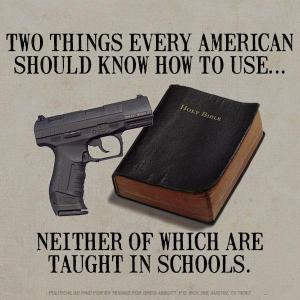
School needs more of both.  At least according to Texas Attorney General Greg Abbott.

In their continuing series of year-end quotations from conservatives, the Texas Freedom Network Insider publicized this gem from Abbott’s Facebook page:

Source: Greg Abbott

Source: Greg Abbott

For those of us who are trying to understand the intellectual world of educational conservatism, Abbott’s plea is a good place to start.  The give-and-take of comments that accompanied this eye-catching poster sums up lots of the perennial debate in school culture wars.

As one back-and-forth had it,

Person 1: Satan is having a POW-WOW in our country right now….the Anti-Christ is alive and well! WAKE UP AMERICA!!!

Person 2: Good they should not be taught in school. Bible is mythology and learn to shoot at a gun range.

Abbott’s call for more Bibles and more guns in schools may seem shocking to progressives like me, but it seems many conservatives want both.  Especially after each school shooting, we hear calls for more armed guards to protect the innocent.  And of course there is never any lack of tumult for increasing the use of Bibles with America’s public school students.

Here’s a question for all you readers out there: For those agree with Abbott’s call for more Bibles and guns in schools, which should come first?  That is, if you had to pick, which would improve schools more, guns or Bibles?

And for those who are shocked with Abbott’s post, here’s a very different question: what are you more scared of, more Bibles or more guns in public schools?


Does Wal-Mart Want More Jesus in Public Schools?

The Walton Family loves school vouchers.

For years, the heirs to the Wal-Mart fortune have pumped money into plans to privatize schooling in the US of A.  Most recently, we read that the Walton Family Foundation has donated six million bucks to the Alliance for School Choice.  Why?

The ASC has a track record of supporting vouchers.  Its enemies accuse it of being nothing but a front organization for “fundamentalist” schemes to re-religiousize public education.

Do the mega-rich Waltons hope to get more Jesus into America’s schools?

Readers of Bethany Moreton’s relatively recent book To Serve God and WalMart won’t be surprised to hear of the connection between conservative evangelical Protestantism and big-box retailing.  But even the most scathing critics of the Waltons’ educational policies have sometimes left out the religious angle.  Diane Ravitch, for example, blasted the Waltons for copying in education what Wal-Mart had achieved in retailing.  As she put it,

The foundation supports charters and vouchers, though it prefers vouchers. It seeks to create schools that are non-union and that are able to skim off students from the local public schools. In time, the local public schools will die, just as the Main Street stores died.

Other critics of the Waltons’ beneficence have focused more closely on the religious angle.  Americans United for the Separation of Church and State, for example, has long targeted both the Waltons and the Alliance for School Choice as leaders in the drive to sneak religion back into public schools through the back door of vouchers.  Rob Boston of Americans United, for instance, called ASC leader Betsy DeVos the “Four-Star General” leading a “Deceptive Behind-the-Scenes War on Public Schools and Church-State Separation.”

According to Boston, Devos is a “fundamentalist Christian and far-right political activist” with a sneaky goal: “nothing short of a radical re-creation of education in the United States, with tax-supported religious and other private schools replacing the traditional public school system.”

Here at ILYBYGTH, we have to ask the tricky question: what’s the relationship between free-marketism and Jesus?  Groups such as the ASC and the Walton Family Foundation seem committed to both.  In the realm of schooling, that means vouchers.  For many conservatives, vouchers seem to contain a triple promise.  They can weaken the grip of teachers’ unions by diverting tax money away from union-dominated public school systems.  They can bring more ol’-time religion into schooling by funding religious schools.  And they can give parents and families the magic wand of consumer choice.

It doesn’t seem as if there’s a logical or theological connection between these policy ideas.  That is, from my scanty understanding of Christianity, free-market principles don’t seem to be a central part of traditional evangelical theology.  Yet in school policy as in other areas, it seems Americans have historically connected capitalism with Christian virtue.

And there’s one other puzzle we need to suss out.  If these privatization campaigns are about both Jesus and capitalism, why don’t promoters mention either?  When the Alliance for School Choice tells us about itself, it does not mention religion or the panacea of the marketplace.  Why not?

For critics, this is all part of the ASC’s “sneak attack” on secular public schools.  The ASC wants more Jesus and more Milton Friedman, this line of argument goes, but wraps those goals in anodyne calls for more school choice for low-income families.  But why would conservatives try to hide their love for public religion or for capitalism?  Most conservatives make no secret of their goals.  Why would they hide their love for public religiosity or market-ism in this case?


Texas Charter School Promotes Religion

Doesn’t seem like news that publicly funded schools in Texas promote religion.  But this story from the New York Times has a twist you might not have expected.

Anyone who pays attention to this stuff might expect Texas public schools to be woefully (or wonderfully, depending on your POV) entangled with religion.  Whether it is preaching in the form of Bible classes, cheerleaders with Bible verse banners, creationism in the science textbooks, or just a general Long-Game style fight for more Jesus and less Devil, Texas schools have long seemed friendly to Jesus.  Texas’ conservative “Revisionaries” have worked long and hard to make public schools friendly for faith.

A recent story in the New York Times features a different sort of religious entanglement.  In this case, it is not a question of teachers leading Protestant prayers, or students protesting against learning evolution.

In this case, a charter school has been accused of using public money to promote the Jewish religion.

The San Antonio school, Eleanor Kolitz Hebrew Language Academy, teaches in Hebrew and has classes about Israeli culture.  Doesn’t seem to be a problem there.  Lots of publicly funded charter schools focus on a specific non-English language and culture.

But according to journalist Edgar Walters, the school has drawn attention as a potential church/state problem since the new charter school seems to be nothing more than a cynical reincarnation of an existing religious school.  Critics worry that religious schools are simply conducting a name change on paper in order to win public money.

School leaders insist they don’t teach religion.  But one board member admitted they have the same head of school and most of the same staff as they did when they were an explicitly religious school.  As a private Jewish day school, the Eleanor Kolitz Academy used no public money.  But now as a charter school in the same building with the same staff, they receive public funding.

Can religious schools reinvent themselves this way?  It does not seem paranoid to assume that things will go on largely as before at the Kolitz Academy.  It seems a little iffy for religious schools to simply make a name change to start raking in public moolah.


What Color Are Your Fundamentalists?

Who are the “fundamentalists” who hope to keep America’s public schools religious?

Some of us may picture a Saddleback-type white suburban evangelical, driving around in a Biblically-sized SUV, worrying in equal measure about sin and soccer.

New!  School Prayer Barbie!

New! School Prayer Barbie!

But as Peter Berger reminds us this morning on The American Interest, that image of conservative evangelicalism might represent the past more than the future.

Berger notes the dramatic effects of immigration on the nature of American Christianity.  New immigrants tend to be Christian, and their Christianity tends to lean conservative.  As Berger concludes,

Both in their theology and religious practice, non-Western Christians are more conservative. Their worldview is strongly supernaturalist: The spiritual world, both benign and sinister, is very close—the Holy Spirit, the Virgin and the saints, miracles of healing—but also the devil and other malevolent spirits. This supernaturalism is strongest in the Pentecostal and charismatic movements, but it is also very visible in Catholic and mainline Protestant churches. But non-Western Christians are also more conservative in their moral convictions—very little sympathy here for the feminism, let alone the agenda of the gay movement, that has become so prominent in mainline Protestantism in America—and, I suspect, would be more prominent in American Catholicism, were it not for surveillance and intervention from Rome.

The implication of all this is simple and exceedingly important: Immigration will strengthen the conservative forces in American Christianity.

In the future, the fight over religion in America’s public schools may have a very different tone.  Instead of a ring of white conservative suburbs around every ethnically diverse urban core, we may see a shift to immigrant-led demands for more vibrant religion in schools.  Instead of whitebread traditionalism resisting a multicultural liberalism, we might have an ethnically diverse group of conservatives battling to keep morals pure in public education.