What Went Wrong with America’s Schools?

Hell in a lunchbox. 

That’s where America’s public schools have headed, according to a recent essay by the Southern Baptist Theological Seminary’s President R. Albert Mohler Jr.

President Mohler makes an historical argument for the shocking, dangerous decline in American public education.  Does his case pass historical muster?

As I’ve argued in an essay in Teachers College Record (subscription required, but summary available), this historical argument about public education has been a mainstay of conservative thinking for at least fifty years.  Different conservative intellectuals have come up with different timelines and key events to explain the demise of high-quality, morally trustworthy public education.

Mohler echoes this intellectual tradition.

He argues that public schools began as locally controlled entities.  Beginning roughly a century ago, however, “progressive” reformers attempted an ideological coup.  Such folks, led by John Dewey, openly proclaimed their intention to turn schools into secular indoctrination camps.

Luckily, Mohler believes, such plans did not accomplish much until the second half of the twentieth century.  At that point, however, most schools were “radically transformed,” separated “from their communities and families.”

The results, Mohler warns, have been sobering:

Those who set educational policy are now overwhelmingly committed to a radically naturalistic and evolutionistic worldview that sees the schools as engines of social revolution. The classrooms are being transformed rapidly into laboratories for ideological experimentation and indoctrination. The great engines for Americanization are now forces for the radicalization of everything from human sexuality to postmodern understandings of truth and the meaning of texts. Compulsory sex education, the creation of “comprehensive health clinics,” revisionist understandings of American history, Darwinian understandings of science and humanity, and a host of other ideological developments now shape the norm in the public school experience. If these developments have not come to your local school, they almost surely will soon.

Is Mohler’s diagnosis correct?  Does his historical analysis match the record?

In this historians’ opinion, Mohler is guilty of cherry-picking and over-emphasizing.  It is demonstrably true that in the early twentieth century an array of school activists and intellectuals, clustered together under the amoebic heading of educational “progressivism” did try to implement wholesale changes in the nature of American public education.  It is also true that the US Supreme Court made decisions in the 1960s that could have revolutionary implications for the religious nature of public education.  Even more, it is true that leading organizations such as the National Education Association call for school policies that might dismay stalwart conservative Protestants. 

But contrary to Dr. Mohler’s conclusions, such historical facts do not add up to a public school system that “entered a Brave New World from which no retreat now seems possible.”

Historians have examined each of these important trends in American public education.  Arthur Zilversmit, for example, looked at the implementation of “progressive” education policies in the middle of the twentieth century.  In spite of earnest, well-funded efforts to revolutionize schooling, Zilversmit found, schools remained largely the same.  Why?  Zilversmit, sympathetic to the “progressive” project, blamed Americans’ “strange, emotional attachment to traditional schooling patterns.” 

How about the claim that the Supreme Court kicked God out of the public schools?  It is true that in 1962 and 1963 SCOTUS banned school-led mandatory Bible reading and prayer.  But as political scientists Kenneth Dolbeare and Phillip Hammond found to their surprise, most communities that prayed before the SCOTUS rulings continued to pray in public schools after them.  

Similarly, political scientists Michael Berkman and Eric Plutzer have argued that local school districts continue to function as local bureaucracies.  These “Ten Thousand Democracies,” according to Berkman and Plutzer, remain responsive to local demands and local values.     

This is bad news for President Mohler’s alarmist argument, but very good news for religious conservatives in the United States.  Most of America’s public schools remain closely connected to majority impulses in their local community.  Concerning hot-button culture-war issues such as prayer, evolution, and sex ed—not to mention broader notions such as school discipline, drug use, promiscuity, and general manners—local communities still control their local public schools. 

This local influence helps explain some stubborn trends that have long frustrated progressives like me.  Why, we ask, is evolution taught only spottily?  Why can’t public-school children learn honest, practical information about sex?  Why are public schools still home to coercive prayer practices?

These are all tough questions. 

But Dr. Mohler’s jeremiad raises even tougher ones:  If American public schools are so very conservative, why do conservative intellectuals deny it so forcefully?  Why don’t America’s conservative intellectuals trumpet the continuing traditionalism of American public education?
 

Do You See Christian Students Acting Strange Today?

Are some students at your local public school lingering around outside?  Holding hands?  Circling the flagpole?

More to the point: If they are, should we be alarmed?

That depends, of course, on your feelings about the thorny issue of religion in public education.

If you see students gathering around the flagpole today, they might be taking part in “See You at the Pole” Day.  According to the Christian Post, this tradition started in Texas in 1990.  Christian students met in prayer around their school flagpole.  The point, according to Doug Clark, director of field ministries for the National Network of Youth Ministries, is to encourage Christian students to come together to ask for God’s blessing on their role as missionaries in their schools.

Clark hopes to see somewhere between 1-2 million public-school students participating in the USA and around the world.  So don’t be surprised if you see some at your local school.

If you do, what does it mean?  For those of us who work for pluralist, inclusive public schools, do we need to be alarmed?  Is this an abrogation of a Constitutional separation of church and state?

I don’t think so.  Though twentieth-century SCOTUS decisions made clear that teachers and schools must not force prayer or Bible-reading on public-school students, they also made it very clear that the religious rights of students themselves must not be violated.  It can get tricky when students lead prayers that seem to have the support of the school administration, as in the recent flap in Kountze, Texas.  Students have every right to wave Bible signs, but they don’t have the right to imply that such mottos are the official dogma of a public school.

In this case, however, students are demonstrating the private nature of their prayer by meeting at the flagpole.  They are leaving the school building, not using any of the school’s bureaucracy to encourage the prayer.  Students’ rights must be protected as they engage in religious activity of any sort.

But what about the “missionary” aspect of this activity?  Students here are not just praying, they are specifically praying for inspiration, praying for the power to convert their fellow students to their faith.  Or at least that is the hope of adult leaders such as Doug Clark.  What about the rights of their fellow students, students of different religious faiths—or of no religious faiths—who might be targeted for missionary work?

Even here, too, we must not fear.  It may be unpleasant for a student to be approached for aggressive evangelical efforts.  But such unpleasantness is not a matter for outside interference.  If a student wants to talk to other students about faith, he or she has that right.  As long as it does not disrupt school activities, the right to make one’s self unpleasant must be protected.  As long as it does not imply that the school itself supports that evangelical effort, student missionary work in public school must be protected.

It certainly makes me personally uncomfortable to think that religious students might target my daughter for outreach efforts as part of her public-school experience.  But I recognize that such outreach efforts are part of other students’ rights.  As long as there is no bullying, no coercion, no disruption, and no implied or explicit support of such missionary work by the school administration, my daughter cannot be protected from other students’ free speech rights.

So, for those like me who want to be sure public schools are inclusive public spaces for students of all backgrounds, if you see groups of students gathering in prayerful huddles around your public-school flagpole, don’t be alarmed.  Students in public schools do not abandon their rights to publicize their religion when they walk through the schoolhouse door.


Yoga in School? Yes, No, Maybe So

Is yoga a religious practice?  Can it be taught in public schools?

Here at ILYBYGTH, we’ve been following the story in Encinitas, thanks to contributions from Natalia Mehlman Petrzela.  In that case, the judge said yoga was okay, in spite of the powerful argument made by religious studies scholar Candy Gunther Brown.

Today three evangelical writers weigh in at Christianity Today.  Can yoga be part of public education?

Laurette Willis says no way.  Yoga, she warns, turns children’s minds towards the “idols” of Hinduism and Buddhism.  Even if the practice is taught in a secular, physical way, it instills in young children “warm fuzzies” about Hindu imagery and theology.

Matthew Lee Anderson says, “It depends.”  If it is taught as physical exercise only, then it should be fine.  If it is used to proselytize for Hinduism, then no.

Amy Julia Becker says bring it on.  Yoga as physical exercise should be encouraged in public school.  What’s more, yoga as spiritual exercise should also be encouraged in public schools.  It is important for people of all religious faiths, Becker argues, to insist on the rights of children to engage in spiritual practice in public schools, as long as that practice is student-initiated and student-led.  Just as evangelical Christian students insist on their right to form public-school prayer groups, so evangelical Christian groups should insist on the rights of students of other religions to form their own spiritual groups.


Kicking Out the Christians: Duck Dynasty and “Facial Profiling”

Christians are a persecuted minority!

That’s the claim we hear over and over again from conservative religious folks.

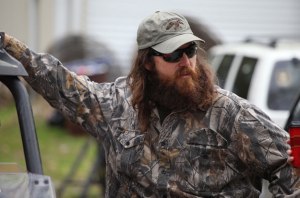
Today we get some surprising evidence that bearded holy men of the Christian faith really are punished unfairly.  Duck Dynasty star Jase Robertson was apparently kicked out of the Trump Hotel in New York City when an employee assumed he was homeless.

jase-robertson4

Robertson. Image Source: A&E

As the Christian Post reports, Robertson didn’t take the incident too seriously.  He called the episode a case of “facial profiling.”

It was not Robertson’s Christian faith, but rather his appearance, that apparently led to this embarrassing incident.  The big reality-show star didn’t make a fuss.  But other conservative Christians like the Robertson family have consistently complained that they are treated like despised minorities in American culture.

In 1980, for example, evangelical superstar Jerry Falwell called conservative Fundamentalists “the largest minority bloc in the United States.”[*]

These feelings among conservative Protestants have been especially strong in debates over public education.  Since the 1920s, conservative evangelical Protestants have complained that their rights have not been respected.  To cite just one example, in 1965 evangelical editor John R. Rice lamented the fact that conservative Christians were not only a minority, but a minority that had been consistently singled out for unique persecution.  “Why not have freedom in America as much for one minority as another?” Rice asked.  “Why not observe the rights of Bible believers as well as the rights of the infidels in the churches and infidels in courts or schools?”[†]

We have seen despised-minority rhetoric again and again in conservative calls to include creationism in public-school science classes.  In the early 1980s, creationists pushed laws that would include both evolution and creationism, in order to protect the constitutional rights of minority creationist students.  Laws such as Arkansas’ Arkansas’ Act 590 of 1981, for example, emphasized that such rules would “protect academic freedom . . . [and] freedom of religious exercise.”[‡]

Creationists have also often complained that their views are ignored out of an anti-scientific zeal to punish minority dissent.  In 1984, for example, creationist Jerry Bergman published his expose of anti-creationist persecution in American higher education.  Bergman himself claimed to have been denied tenure at Bowling Green State University solely for his religious beliefs.  “Several universities,” Bergman lamented,

state it was their ‘right’ to protect students from creationists and, in one case, from ‘fundamentalist Christians.’ . . . This is all plainly illegal, but it is extremely difficult to bring redress against these common, gross injustices.  This is due to the verbal ‘smoke-screen’ thrown up around the issue.  But, a similar case might be if a black were fired on the suspicion that he had ‘talked to students about being black,’ or a woman being fired for having ‘talked to students about women’s issues.’[§]

Kicking out a bearded Christian holy man from a fancy New York hotel won’t offer much clarity to this old dispute.  Jase Robertson himself did not seem at all offended that a hotel employee took him outside to a park when Robertson asked for directions to a bathroom.

Other conservative evangelical Protestants, however, have not laughed off this kind of thing so lightly.  In controversies about the nature of America’s public square, including its public schools, conservative Christians have consistently insisted that they had been treated like persecuted minorities.

It makes me wonder if Jerry Falwell was ever kicked out of a fancy hotel.


[*] George Vecsey, “Militant Television Preachers Try to Weld Fundamentalist Christians’ Political Power,” New York Times, January 21, 1980, A21.


[†] John R. Rice, “White Minorities Have Rights, Too,” Sword of the Lord 31 (3 September 1965): 1.


[‡] “Act 590 of 1981: General Acts, 73rd General Assembly, State of Arkansas,” in in Marcel C. LaFollette, ed., Creationism, Science and the Law: The Arkansas Case (Cambridge: MIT Press, 1983), 15.


[§] Jerry Bergman, The Criterion: Religious Discrimination in America (Richfield, MN: Onesimus Press, 1984), 43.

Yoga—Not for Public Schools


Does the Constitution allow US public schools to teach religion to children?

Only if that religion is not about the Bible, according to religion scholar Candy Gunther Brown.

Thanks to contributions from Natalia Mehlman Petrzela, we’ve been following a case from Encinitas, California.  Some parents complained that teaching yoga forced religion onto their children.  The program had been funded by the Jois Foundation, though classroom teachers developed the specific yoga curriculum on their own.  Recently, Judge John Meyer ruled that public schools may use yoga as an exercise program without violating the Constitution.  The school district, he decided, had sufficiently purged the religious heritage of yoga and engaged in yoga for sufficiently secular purposes.

One of the participants in that trial was Professor Brown.  In a recent interview at the Oxford University Press blog, Brown explains why she thinks Judge Meyer got it wrong.

As she testified at the trial, Brown explains why the yoga practices are inherently religious.  Such practices, in the vision of Ashtanga devotees,

will “automatically” lead practitioners to experience the other limbs and “become one with God,” in the words of Jois, “whether they want it or not.”

Brown argues that the practices in Encinitas would be—and indeed had been—perceived as religious by objective outside observers.  As she puts it,

EUSD teachers displayed posters of an eight-limbed Ashtanga tree and asana sequences taught by the “K. Pattabhi Jois Ashtanga Yoga Institute”; used a textbook, Myths of the Asanas, that explains how poses represent gods and inspire virtue; taught terminology in Sanskrit (a language sacred for Hindus); taught moral character using yamas and niyamas from the Yoga Sutras; used guided meditation and visualization scripts and taught kids to color mandalas (used in visual meditation on deities). Although EUSD officials reacted to parent complaints by modifying some practices, EUSD classes still always begin with “Opening Sequence” (Surya Namaskara) and end with “lotuses” and “resting” (aka shavasana or “corpse”—which encourages reflection on one’s death to inspire virtuous living), and teach symbolic gestures such as “praying hands” (anjalimudra) and “wisdom gesture” (jnanamudra), which in Ashtanga yoga symbolize union with the divine and instill religious feelings.

Furthermore, Brown charges, Judge Meyer ignored crucial evidence and even got his facts wrong.  School district teachers, Brown says, used Jois Foundation funds to take children to an Ashtanga conference.  Nor did teachers secularize the practice as much as Meyer implied.  Meyer stated in his decisions that religious terms such as the “lotus” position had been renamed with neutral names such as “criss-cross applesauce.”  But Brown points out that the term “lotus” appears 194 times in the spring curriculum guide.

So is yoga religious?

Brown makes a powerful case.  Simply because some teachers did not engage in the practice for primarily religious reasons does not make it a secular practice.  Simply because Judge Meyer did not think children would see the practice as religious does not make it so.

Atheists could pray for secular reasons, but teaching children to pray in public schools would not be constitutional.  Similarly, in other religious-dissent cases, the perception of religion has been decided by those who feel marginalized.  For instance, in the Schempp case (1963), the feelings of non-religious people that school prayer forced religion upon them carried legal weight.

The question forced upon us by Professor Brown is a good one: Do we allow yoga in public schools simply because we like it?  To be fair, do we need to recognize the dissent of conservative Christians who find the practice religious and therefore offensive?


Does Reading the Bible Make Children Violent?

Does reading the Bible lead to violent crime?  That’s the question nobody is asking these days.

Here at ILYBYGTH, we have to ask: Why not?

After all, it seems violent crime has been falling in the past few decades.  Those have been the decades in which American children no longer prayed or read the Bible in their public schools, officially at least.

Religious conservatives have long bemoaned the social dangers of kicking God out of public schools.  Is it only fair, then, to blame God for all the rapes, burglaries, and assaults that haven’t been happening lately?

That doesn’t seem like a comfortable suggestion for most religious conservatives.  Yet thoughtful conservatives must recognize that they have long warned about the dangers of removing traditional religion from public schools.  Some of those warnings, at least, seem to have been flipped on their heads.  Without mandatory Bible-reading in public schools, American society has grown noticeably less violent.

This is not what religious conservatives have predicted.

In 1942, for example, Bible activist W. S. Fleming insisted that more states must pass mandatory Bible laws for their public schools.  As I noted in my 1920s book, these mandatory Bible laws were a prominent but little-noticed element of 1920s educational culture wars.  Fleming, a former Chicago pastor and full-time activist for the National Reform Association, claimed that Bible laws for public schools would enable society to maintain basic morality.  Fleming pointed out that most states gave Bibles to prison inmates.  Why not skip the middle man, he asked, and deliver the Bibles to the schools?  If Ohio had followed this suggestion in 1925, he recalled, “as her neighbor, Pennsylvania, did, with the same result, more than half of her present 9,310 convicts would now be law-abiding citizens.”[*]

Two decades later, just after the Schempp decision by the US Supreme Court seemed to eliminate Bible reading from public schools, William Culbertson of Chicago’s Moody Bible Institute warned that the decision did not bode well for America’s public safety.  “No nation can turn its back on God without tragic consequences,” Culbertson cautioned.  “We have traveled a sorry road of unbelief in the less than two hundred years of our country’s history.  The Supreme Court decision—and our willingness in many cases to justify it—say plainly that a sorrier road may lie yet ahead!”[†]

Similarly, in the early 1980s, Donald Howard, creator of the Accelerated Christian Education curriculum and an energetic supporter of independent evangelical schools, preached a fiery jeremiad about the dangers of removing Bibles from public schools.  Because “the Bible by judicial review [had been] legislated out of the schools,” Howard warned, schools in the 1970s suffered from an array of terrible problems, including “X-rated textbooks,” 70,000 assaults on teachers in one year, violence, vandalism, alcohol and drug abuse, a profusion of “witchcraft and the occult,” and rampant deviant sexuality.  This lamentable situation, in Howard’s opinion, underscored the need for independent evangelical schools.  Only there, he argued, could students be safe from the perils of the now-Godless schools.[‡]

In the 1990s, prominent conservative intellectual William J. Bennett published his blockbuster Index of Leading Cultural Indicators.  This collection of worrisome statistics demonstrated, Bennett claimed, what happened when a society abandoned its traditional moral teachings.  Crime soared, despair ruled.  Though Bennett noted a dip in crime during the 1990s, he argued that since 1960 the trend was clear: less traditional morality meant more violent crime.

Less prominent conservatives, too, warned that schools without prayer and Bibles led directly to a wave of violent crime.  By “kicking God out of public schools,” Americans traipsed foolishly down the path to Sodom and Gomorrah.

Without prayer and the Bible, religious conservatives have insisted, public schools had turned into sin factories.  Young people did not learn to check their carnal instincts.  They killed and fornicated with abandon.

So what does it mean about Bibles in schools if violent crime has dropped precipitously in recent decades?

As reviewed in a fascinating article in this week’s Economist, violent crime has plunged in industrialized nations around the globe in the past twenty-five years.  As the article describes, talking heads have ascribed this happy circumstance to an array of possible causes: more abortions, fewer young men, better policing, even better violent video games.

Back in the 1950s, when the US Supreme Court had not yet “kicked God out of public schools,” violent crime skyrocketed.  To be consistent, we must ask: Did all that violent crime result from students reading the Bible?  Saying the Lord’s Prayer?  If conservatives predicted that removing Bibles from schools would cause more violent crimes, must they now acknowledge that the USA is a safer place without all that school Bible-reading?


[*] W. S. Fleming. God in Our Public Schools. 3rd ed. (1942; repr., Pittsburgh: National Reform Association, 1947), 90.

[†] William Culbertson, “Is the Supreme Court Right?” Moody Monthly 63 (July-August 1963): 16.

[‡] Donald Howard, “Rebirth of a Nation,” Facts About A.C.E. (Lewisville, TX: Accelerated Christian Education, n.d. [1982?]), 25.


UPDATE: Yoga Okay for Public Schools

When is a school prayer not a prayer?  According to Superior Court Judge John Meyer, once the “lotus” position has been transformed into “crisscross applesauce.”

As historian Natalia Mehlman Petrzela argued in these pages months ago, the fight in Encinitas, California over the teaching of yoga in public schools flipped some culture-war themes on their heads.  In this battle, conservative Christian parents fought against the use of religion in public schools.

Spearheaded by the National Center for Law and Policy, a conservative activist organization, Christian parents complained that teaching yoga amounted to promotion of a set of religious notions.

Judge Meyer ruled yesterday that the school district had stripped the yoga routine of its religious nature.  An objective observer, Meyer decided, would not perceive the practice as religious.  The program had been funded by a half-million-dollar grant from the Jois Foundation.  The judge found this entanglement “troublesome,” but not enough so to abandon the health program.

This kerfuffle resurrects some old school-prayer controversies in new ways.  First of all, does this case reveal a bias against Christian prayer?  That was the complaint of Dean Broyles of the National Center for Law and Policy.  As Gary Warth of the San Diego Union-Tribune reported, Broyles claimed, “If [the school practice] were Christian-based and other parents complained, it would be out of schools. There is a consistent anti-Christian bias in cases like this that involve schools.”  Could a case be made that non-Abrahamic religious traditions get more leeway in public schools?

Also, does this case open the door for a new spate of school-prayer policies?  In the early 1960s, the US Supreme Court ruled in Engel v. Vitale that school-sponsored prayers violated the Constitution.  The prayer in that case, however, had been composed by the State of New York as a broadly ecumenical prayer, one thought to offend no one.  Could this precedent open the door to a new sort of ecumenical school prayer?  A secular prayer?  If religious groups could argue the health benefits of a prayer and find a prayer practice sufficiently stripped of sectarian meaning, could Judge Meyer’s argument apply here?

Of course, as I’ve noted elsewhere about the Engel v. Vitale case, most evangelical Protestants supported the SCOTUS decision to ban a bland ecumenical prayer.  Would any conservative religious people want to include a prayer in public schools if that prayer had been secularized?  If Jesus on a cross had been transformed to “crisscross applesauce?”


Can Public Schools Be a “Mission Field” without the “Mission?”

Can Christian evangelicals do their thing in public schools?  Does the Constitution allow public schools to be used as a “mission field” for Christian service work?

Religion writer Tom Krattenmaker offered some thoughts yesterday about Christian missionaries offering service to local public schools.  But can their best intentions get past the fraught relationship between conservative evangelicals and the wall of separation between church and state?

Krattenmaker describes the work of Nicole Baker Fulgham, former Teach for America leader and author of Educating All God’s Children.

Fulgham and other young evangelicals hope to improve public education.  They argue that Christians can serve the poor and needy in their communities by making public schools better.  Such mission work, Fulgham argues, can leave out the proselytization and stick to the nuts-and-bolts issues of keeping the lights on and the hallways clean.

As Krattenmaker describes,

Fulgham and her work exemplify a new kind of evangelical engagement with public schools that is dedicated solely to helping kids rather than arguing over school prayer, evangelism, and other culture war flash points.

Krattenmaker thinks the approach has promise.  He describes efforts in which evangelical congregations “adopt” local public schools, cleaning up the grounds, providing free clothing to students, and generally making the school a better place without preaching or Bible thumping.

Krattenmaker admits that these are small, isolated efforts, but he has hopes this kind of thing can turn the culture-war tide.  As he argues, “These [evangelical volunteers] are people with whom nonreligious progressives and liberal people of faith can form partnerships and coalitions for the common good.”

Can it work?  Can Fulgham’s vision of servant leadership really thrive in public schools?

Logically, perhaps.  But given the history of conservative evangelical Christians and America’s public schools, my hunch is that suspicion will trump hope.

One problem is that Krattenmaker misunderstands or misrepresents the relationship between conservative evangelical Protestants and public schools.  Krattenmaker argues that evangelicals have abandoned public schools due to worries about secularism, sex ed, and evolution.

Some evangelicals have, but as a group evangelicals have never given up on reaching students for Christ in public schools.  And most “nonreligious progressives and liberal people of faith,” I’m guessing, will have longer memories than Krattenmaker recognizes.

In this century, to cite just one example, Marc Fey of the conservative Focus on the Family declared that public schools represent “one of the greatest mission fields in our country today.”[1]

Fey wanted to get Christians into public schools, too, but with the explicit intention of reaching students for Jesus.

This evangelical attitude toward public education has a long and powerful tradition.  Consider these words from a 1980s school-evangelism training manual from the evangelical group Youth For Christ:

There it looms—a huge, humming, hostile high school.  Hundreds, thousands of students, a professional corps of teachers and administrators, all busily turning the wheels of secular education.

To you, it’s a mission field.  It has masses of kids who need spiritual help, even though most of them don’t know it.  You and the Lord have decided to invade that field through the strategy called Campus Life.[2]

Youth For Christ’s public-school evangelism targeted public schools since the 1950s. As one participant remembered from an outreach project in suburban Chicago in the late 1960s,

There were 55 kids jammed into the classroom. We divided up into six groups.  They were desperately asking God, ‘Please use our lives.  Please, God, give me guts enough to talk to kids in the hall.’

They went out with this enthusiasm.  I can remember in speech class kids standing up and saying, ‘The greatest thrill in my life was when I accepted Jesus Christ as my own personal Saviour.’  I can remember Bruce’s brother standing up (his knees were beating a bass drum solo) and saying, ‘You know I have a pretty good police record with some of you kids in this room, but I want you to know that Christ has changed my life and it’s different now.’[3]

For teen evangelists like this, public schools represented an opportunity for service, as well. But that service was tied to the traditional evangelical goal of, well, evangelism.  And such explicitly evangelistic efforts will run into furious opposition in many American public schools.

Does this history mean that Fulgham’s service approach won’t work?  Not necessarily.  What it does mean, however, is that Christian evangelists who hope to get into public schools to help students will face hostility and skepticism from those outside the evangelical community.

Krattenmaker assumes too glibly that non-evangelicals will happily let bygones be bygones. I’m not so sure. 

There are few creatures more averse to controversy than public-school administrators.  Some may be willing to open their school doors to willing servants of any background.  But I imagine the history of public-school evangelism will prove a poison pill to outreach programs like the ones Krattenmaker describes. 


[1] Marc Fey, review of Reclaim Your School, Pacific Justice Institute website, http://www.pacificjustice.org/reclaim-your-school.html; <accessed 11 June 2013>.

[2] Campus Life Operations Manual, Third Edition (Wheaton, IL: Youth for Christ USA, 1988), 19.77.

[3] Quoted in James Hefley, God Goes to High School (Waco, TX: Word Books, 1970), 125.

Jesus and the Ivy League

Religious conservatives often insist that America’s colleges and universities used to be “our schools.”

For example, Protestant fundamentalist educational writer A. A. “Buzz” Baker pointed out in the 1970s that, although “it may come as a surprise to some,” most of America’s leading colleges “used to be ‘our’ schools.”[1]  Similarly, B. Gray Allison, a conservative evangelical from Louisiana, noted in 1968 as campuses nationwide roiled with cultural conflict that not only Harvard, Yale, and Princeton began with explicitly religious missions, but “even the early state-supported institutions had a concern for the perpetuation of what might be termed religious culture.”[2]

Over at the inimitable The Way of Improvement Leads Home, historian John Fea offers some evidence from the archives to back up those assertions.

On March 19, 1761, Fea reports, the College of Philadelphia’s (the future Penn) Board of Trustees approved some student rules that might warm the heart of twenty-first century religious conservatives.

Every student had to attend chapel.  Slacking off or not paying attention during prayer or Bible readings could call for punishment.

Plus, no sauntering!  Check out Fea’s full post here.


[1] A.A. Baker, The Successful Christian School: Foundational Principles for Starting and Operating a Successful Christian School (Pensacola, FL: A Beka Book Publications, 1979), 34.


[2] B. Gray Allison, “The American Campus as a Spiritual Force,” Christianity Today 12 (May 10, 1968): 5.


Valedictorian Prays at Graduation

May a high-school student pray at a public-school graduation?  No, at least not according to the US Supreme Court. 

But CAN a student do it?  Sure.  This week, valedictorian Roy Costner IV dramatically tore up his pre-approved speech and recited the Lord’s Prayer instead. 

As reported by a local TV station, the school district in Liberty, South Carolina had been feeling pressure from the American Civil Liberties Union to hew closer to the Constitutional line in the town’s attitude toward public religion.  They had warned Costner to keep his valedictory speech secular.  But Costner decided to flout their warnings.  According to Christian News, Costner recited his prayer as a protest against the school district’s recent decision to ban prayer at other official events. 

Many of the townspeople approved.  By the end of his prayer, the crowd’s cheers had grown loud enough to drown out Costner.  A few people interviewed by the local TV station also supported Costner’s decision.  “It was pretty impressive,” local man Brian Hoover noted.  “I thought the guy had a lot of nerve.”

Another local man agreed.  Logan Gibson told the reporter, “I think it took a lot of courage to do that and people were proud that he stood up for what he believed in.”