Can YOU Pick the Right Decade?

I guess I should see a doctor. Reading the news from Highland Park, Texas, I had a dizzying sensation of whirling around in time, not sure if it was 2014 or 1974. The Dallas-area controversy over school readings sounded so similar to one that happened forty years ago, I’ve come up with a reader challenge: Can you put the quotations below in the right decade?

Here’s some background: As I describe in my upcoming book, in 1974 Kanawha County, West Virginia was roiled by a ferocious controversy over a new set of language-arts textbooks. Conservative protesters worried that the books had an anti-American tone. They worried that the books promoted a vicious sexuality, an angry rebelliousness, and an unhealthy sense of anti-authoritarianism. Until the books were removed, parents boycotted the region’s public schools. It got ugly. Buildings were firebombed, cars and school buses were attacked, and two people were shot.

From Trey Kay, "The Great Textbook War."

From Trey Kay, “The Great Textbook War.”

This year, as the New York Times reports, an eerily similar protest took off in Highland Park, Texas. In that fancy Dallas suburb, a short list of books were pulled from school shelves. Parents had complained that the books promoted a precocious deviant sexuality. After counter-protests, the district’s superintendent put the books back in schools.

So here’s the challenge: Can you guess the right decade for the quotations below?  Each quotation comes from a conservative challenge to school textbooks.  And the bigger challenge: Can you figure out if this means we are trapped in a never-ending cycle of educational culture wars?

QUOTATION 1: The books include “seduction, rape, child pedophilia, whether oral sex is sex, premarital sex as normative, reincarnation, or that those in authority over them approve of foul language.”[1]

QUOTATION 2: “I found this book to be crass, vulgar, and indecent for students.”[2]

QUOTATION 3: Offensive textbooks are “negative, racist, impulsive, and in some cases right-down vulgar.”[3]

QUOTATION 3: “The book introduces ideas . . . such as beastiality [sic], and sexual penetration by an object, among others.”[4]

QUOTATION 4: “In all of these books . . . I’ve seen many references to God and to Christianity . . . and every time it’s been derogatory.” These books “ridicule Christianity again and again.”[5]

QUOTATION 5: “A child’s formal education should expose him to a broad spectrum of views, but explicit and vulgar writings are not warranted.”[6]

QUOTATION 6: One objectionable book “seeks to frighten children of authority figures, asks children to criticize their parents and invasion of privacy is almost commonplace throughout.”[7]

QUOTATION 7: The offensive books “dwell at length on the sexual aspects of human relationships in such an explicit way as to encourage promiscuity.”[8]

How did you do?  Could you place the conservative protests in the right decade?  Without cheating?

More important, what does it say about our continuing battles over proper education that these parent protests sound so similar?

**********************************************************************************************************

[1] From the NYT article, 2014

[2] From conservative committee member minority report, 2014

[3] June 13, 1974: conservative protester speaking at school board meeting in Kanawha County.

[4] From conservative committee member minority report, 2014

[5] Conservative leader Alice Moore, speaking at school board meeting, June 27, 1974.

[6] From conservative parent protest website in Highland Park, 2014

[7] Judith Casto, “3 basic Kanawha book objections evident,” [sic no caps] The Herald Advertiser [Huntington, WV], November 24, 1974, 41, 44.

[8] Elmer Fike, “Textbook Controversy in Perspective,” Elmer’s Tune, n.d. [fall 1974].


Don McLeroy’s Long Game

What do Phyllis Schlafly, Moses, and country/western music have in common? They all get happy shout-outs in new history textbooks in Texas.  Or at least, that’s what conservative education leaders wanted.  As Politico reported yesterday, new history textbooks in Texas are causing a stir.  But this time, it is liberal activists, not conservative ones, who are denouncing the textbooks as biased and ideological.

What Hath McLeroy Wrought?

What Hath McLeroy Wrought?

The new textbooks were written to satisfy new standards approved years ago by the Texas State Board of Education.  Back then, conservatives on the board, led by the genial Don McLeroy and the obstreperous Cynthia Dunbar, pushed through new standards that warmed the hearts of conservative activists.

No one who watched Scott Thurman’s great documentary about these Revisionaries can forget the moments when the SBOE debated including more country-western music and less hip hop.  More positive statements about Reagan and the National Rifle Association.  More happy talk about America’s Christian past and less insistence on the horrors of racial segregation.

The Revisionaries

The Revisionaries

As Don McLeroy said at the time, “America is a special place and we need to be sure we communicate that to our children. . . . The foundational principles of our country are very biblical…. That needs to come out in the textbooks.”

Now those changes in the Texas standards have shown up in new social-studies textbooks.  As Stephanie Simons reports in Politico, liberals have complained that the new texts are woefully biased.  In some spots, the books apparently knock Affirmative Action.  They pooh-pooh the benefits of taxes.  They imply that racial segregation was really not so bad.

For those who know the history of America’s educational culture wars, this seems like a drastic turnabout.  Throughout the twentieth century, conservative school activists complained that they had been locked out of educational influence by a scheming leftist elite.  Textbooks and standards, conservatives complained, had been taken over by pinheaded socialist intellectuals.

In one of the most dramatic school controversies of the twentieth century, for instance, conservative leaders lamented the sordid roots of new textbooks.  That battle took place in Kanawha County, West Virginia, across the tumultuous school year 1974-1975.  Conservatives were disgusted by the sex and violence embedded in new literature textbooks.  But some of them weren’t surprised.

Conservative leader Elmer Fike told readers that the textbooks were bound to be rotten.  In Fike’s opinion, conservatives didn’t even need to read the books.  As he explained,

You don’t have to read the textbooks.  If you’ve read anything that the radicals have been putting out in the last few years, that was what was in the textbooks.

As the Kanawha County battle ground on, California’s conservative celebrity schoolman Max Rafferty came to town.  Rafferty, too, told a crowd of West Virginians that they shouldn’t put any faith in textbook publishers.  Those publishers, Rafferty explained, only wanted to make a buck.  As he put it,

They have no particular desire to reform anybody, do anybody any good or find a pathway to heaven.

These days—in Texas at least—the shoe is on the other foot.  The conservative standards that the state adopted in 2010 have pushed market-conscious textbook publishers to come up with books that meet them.  And at least some conservatives are delighted with the success of their long game.  As conservative school board member David Bradley told journalist Stephanie Simon, liberals who complain about biased textbooks can lump it.  “They need to put on their big-girl panties,” Bradley crowed, “and go run for office.”


A Patriot’s History: The Movie!

What’s a patriotic conservative to do?  So often, history textbooks have been accused of peddling a leftist mishmash of America-bashing and skewed intellectual flag-burning.  As we’ve argued in these pages, for generations conservatives from the American Legion to David Barton have attempted to publish their own history textbooks that tell a more patriotic, more Christian story.

One of the most successful of those textbook efforts has been Larry Schweikert’s and Michael Allen’s 2004 A Patriot’s History of the United States. The book tells the story of the United States in a way that celebrates the triumphs and tragedies of America from a traditionalist patriotic viewpoint.  According to the book’s Wikipedia page, one reviewer from the Heritage Foundation wrote in 2005 that the book centered on a simple premise: “that there are principles and purposes reflected in American history that make this imperfect country worthy of our affection.”  Other reviewers had more hostile opinions.  David Hoogland Noon wrote in the pages of the History Teacher that this book was “written for an audience of the previously converted . . . hardly worth anyone else’s time.”

Via Andrew Palmer at Conservative Teachers of America we see that Schweikert is hoping to turn the book into a movie.  Schweikert has published a four-and-a-half minute trailer.  Tellingly, the dramatic intro promises the film will tell viewers “the history you always knew.”  In other words, the approach of Schweikert and Allen has been to confirm the traditional story of America’s greatness.  Not that this story has been one of unalloyed heroism, Schweikert and Allen might say, but overall the sweep of history has proven the United States to be the greatest nation on earth.

The choice of bits and pieces for this trailer tells us something about the movie’s approach.  First of all, it begins and ends with fireworks.  It includes scenic panoramas of cherry blossoms on the Mall in Washington DC, Ansel-Adams-like vistas of rocky outcroppings, and other traditional American eye candy.  As I watched, I took sketchy notes of some of the featured elements:

  • Happy colonists
  • Heroic suffering in the Revolutionary War
  • Heroic racing in wagons to settle the West
  • The Civil War
  • An Industrial Revolution with awesome achievement
  • D-day and Iwo Jima
  • Immigrants as ardent patriots
  • The Green Bay Packers!
  • Mount Rushmore
  • The Moon Landing
  • Martin Luther King Jr.
  • A jet in Vietnam napalming a field
  • Reagan calling on Gorbachev to tear down this wall
  • Baseball
  • The hockey “Miracle on Ice” of 1980
  • Lots of Fireworks.

Clearly, any movie trailer tells only part of the story.  This one certainly skews toward the positive elements of American history.  Unlike some academic histories, the story of the settling of the West is told as a heroic race to fill in land with settlers, not as the invasion of Europeans and the genocide of the native inhabitants.  As much as what was included, this trailer leaves out some important elements.  I saw no suggestion of race slavery, for example, nor of the systematic extermination of native peoples.

Will conservative teachers and schools embrace the film as conservatives embraced the book?  I don’t see why not.  In my experience, conservative intellectuals don’t want children to read patriotic lies about America’s past, but they do want children to read patriotic truths.  In the case of the American Legion’s 1926 textbook series, for example, as soon as the Legion leadership found out that the book was riddled with errors, the Legion pulled its support.  And as soon as David Barton’s book The Jefferson Lies accumulated accusations of inaccuracy, its original publisher yanked it.

My hunch is that the makers of A Patriot’s History would argue that they do tell the full story of America’s past.  The trailer, for example, did include clips of America’s troubling policy of napalming villages in the Vietnam War.  To be a success, I’m guessing, this film will have to convince conservative audiences of two things.  First, it must seem like a full and true history of these United States.  Second, it must make clear that this country—despite its historical blemishes—is the greatest nation on the earth.

The hard question remains: Would you want your kids to watch it?


Kopplin, Creationism, and Liberal Book Burnings

A network of charter schools in Texas uses religious textbooks.  Bad religious textbooks.

That’s the accusation leveled last week by anti-creationism activist Zack Kopplin in the pages of Slate.

For anyone who has looked at the textbooks cranked out by conservative religious presses, as I have, the charges sound true.  But does this sort of expose rely too heavily on shock value?  Does it really tell us anything about what goes on in those charter schools?  Or does it rely on the dangerous mentality of the book burner?

Kopplin’s investigation uncovered the dodgy content of books used by Responsive Education, a network of charter schools that claims 65 schools and a plan to open more in the coming year.  Kopplin, a young but seasoned activist, found textbooks rife with creationist-friendly ideas.  Moreover, the textbooks promote a religious vision of history and repeatedly promulgate half-truths and lies as historic fact.  The books take a questionable tone about homosexuality and seem to embrace a distressingly patriarchal vision of proper family life.  Worst of all, Kopplin argues, these textbooks are used in public schools, schools that ought to be open and welcoming to all students, not just religious conservatives.  These slanted textbooks are peddling fake science, bad history, and sectarian “values,” and they’re using tax money to do it.

Let me repeat: Kopplin’s charges ring true to me.  I agree that public schools must not push theology.  But as I finish up my current book manuscript about the history of conservative school activism in the twentieth century, I can’t help but notice the disturbing echoes of Kopplin’s crusade.  His anti-textbook campaign seems to revive the worst elements of wartime book burning.

Sound outlandish?  Let me offer some specific examples.

First and most worrisome, Kopplin relies on the tried-but-false McCarthyite tactic of guilt by association.  In his article, Kopplin points out that some ResponsiveEd schools might assign readings from the Patriots’ History of the United States, a skewed and partisan book.  To discredit the book, Kopplin notes that the book is beloved by conservative blabbermouth Glenn Beck.

More troubling, Kopplin tars ResponsiveEd schools with all the sins of every right-wing theocrat with whom they can be associated.  Consider, for example, Kopplin’s takedown of Oklahoma businessman and curricular contributor Tom Hill.  Hill, Kopplin charges,

is a follower of Bill Gothard, a minister who runs the Institute in Basic Life Principles, a Christian organization that teaches its members to incorporate biblical principles into daily life. IBLP is considered a cult by some of its former followers. Gothard developed character qualities associated with a list of “49 General Commands of Christ” that Hill adopted for his character curriculum. Hill then removed Gothard’s references to God and Bible verses and started marketing the curriculum to public schools and other public institutions.

The values taught by Responsive Ed can often be found word for word on Gothard’s website. The Responsive Ed unit on genetics includes “Thoroughness: Knowing what factors will diminish the effectiveness of my work or words if neglected.” The only difference is that Gothard’s website also adds “Proverbs 18:15” after the quote.

What does this really prove?  That some of the origins of ResponsiveEd’s curriculum can be tied to conservative evangelical Protestants?  Is that illegal?  Is that even worrisome?  After all, taken another way, Kopplin’s accusation can be taken as proof that ResponsiveEd’s curriculum has been DE-Biblicized.

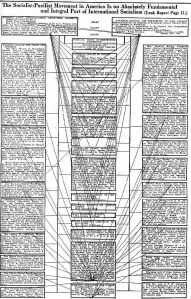
This sort of guilt-by-association has a terrifying history in American educational and political history.  Too often, left-leaning or liberal groups earned labels of “subversion” by association with communist thinkers or organizations.  Consider, for instance, the widely circulated “spider-web chart” used by patriotic activists in the 1920s, 1930s, and 1940s.  Any alleged association with leftist organizations, the chart accused, meant that organizations must not be trusted.

Image Source: Women's and Social Movements in the U.S.

Image Source: Women’s and Social Movements in the U.S.

In the late 1930s, a conservative campaign took off against a set of social-studies textbooks by left-leaning author Harold Rugg.  Time and again, those accusations were based on these guilt-by-association tactics.  Since Rugg taught at Teachers College Columbia, it was alleged, since he was a member of the Frontier Thinkers intellectual group, and since some members of that group had made statements or editorial decisions friendly to communism or Soviet Russia, Rugg was charged with treasonous intent.  His books were charged with all manner of subversive crime.  Just as anti-Rugg activists swung too wildly against Rugg’s books, so Kopplin seems over-ready to ban ResponsiveEd books based on questionable associations.

Another parallel between Kopplin’s article and earlier book-burning crusades is that Kopplin’s charges do not have much to do with actual classroom practice.  As Kopplin admits, he never actually witnessed the teaching in ResponsiveEd schools.  Rather, he relates that one classroom he looked at had the distinctive set up of an Accelerated Christian Education classroom.  Kopplin cites ILYBYGTH friend and guest writer Jonny Scaramanga as evidence that such classrooms teach terrible Bible-based schlock.

But here’s the problem: just as conservative book-burners in the 1940s gave too little thought to the ways Rugg’s textbooks might actually be used, so Kopplin does not offer any evidence about the actual goings-on in ResponsiveEd classrooms.  Anyone who has spent any time teaching knows that textbooks do not dictate classroom practice.  Take the most obvious example: What should we make of public-school classrooms that use the Bible as curriculum?  As religion scholar Mark Chancey has argued recently, the Bible can and should be taught.  But HOW it is taught makes all the difference.

I’m not saying that the ResponsiveEd curricular materials are wonderful.  But I am saying that jumping to conclusions about the practices at any school based mainly on textbooks is a fundamental mistake.

This is getting long, but here is one other creepy similarity between Kopplin’s article and earlier book-burning campaigns.  Like earlier campaigns, Kopplin’s charges have been passed along uncritically by allies seeking to discredit ResponsiveEd.  Intelligent, well-meaning critics such as Diane Ravitch, the Texas Freedom Network, and Americans United for Separation of Church and State have trumpeted the conclusions of Kopplin’s expose.

None of these liberal organizations seems troubled by Kopplin’s sketchy evidence or guilt-by-association tactics.  As an historian who has spent the better part of the last few years stuck in the anti-communist hysteria of the 1930s and 1940s, this knee-jerk boosterism alarms me.  For many patriotic book-burners in the 1940s, Elizabeth Dilling’s The Red Network served as a similar sort of convenient sourcebook for denunciation.  Too many conservative activists—even intelligent, well-meaning ones—repeated outlandish charges and baseless accusations from Dilling’s book.  The fact that a textbook author such as Harold Rugg showed up in Dilling’s pages served as proof positive for many school activists that his books must not be allowed in America’s public schools.

Creepiest of all, Kopplin’s language often echoes almost verbatim the language of 1940s book-burners.  For example, Kopplin engages in a sinister sort of hermeneutic when he says the following: “Some of Responsive Ed’s lessons appear harmless at first, but their origin is troubling.”

In other words, Kopplin admits that the books themselves might not be so bad, but since they came from conservative religious sources, we must automatically attack them.  This smacks too much of what political scientist Michael Rogin has described as “political demonology.”[1]

Consider some of the similar language from the 1930s/1940s anti-Rugg textbook fight.  One of the leaders of that anti-book battle, R. Worth Shumaker of the American Legion, told a correspondent that the dangers of the Rugg books only became clear if one went “back of the scenes.”  Reading the books themselves, Shumaker admitted, made them seem bland and harmless.  But once an earnest researcher discovered Rugg’s leftist connections, the slant of the textbooks became obvious.

Another American Legion activist agreed.  Hamilton Hicks admitted in a 1941 article that “intelligent people” could read Rugg’s book and find nothing wrong with them.  “Dr. Rugg,” Hicks accused, “is far too adept a propagandist to disclose his real purpose in any one textbook.”[2]  Just as Zack Kopplin warns that the ResponsiveEd textbooks might seem harmless until we understand their origins, so anti-Rugg activists admitted that Rugg textbooks might seem fine until their sinister backstory was uncovered.

We verge from activism to hysteria when we denounce textbooks for reasons other than the textbooks themselves.  If textbooks seem harmless, the first appropriate conclusion is that the textbooks are likely harmless.

So what is a liberal to do?  Kopplin makes an important point: public schools ought not cram dead science and bad history down students’ throats.  As organizations such as Texas Freedom Network have done, this situation calls for more rigorous examination.  What really goes on in ResponsiveEd schools?  They should not be allowed to use tax dollars to teach sectarian religion and false facts.  It is important for all of us to remember, however, the profound costs of over-hasty accusations.  Calling for book burnings is never an appropriate tactic.

Kopplin has made some serious charges.  So far, however, those charges have not been backed up by adequate proof.  More is at stake here than just one charter-school network.  If we veer into hysteria rather than activism, we repeat the worst mistakes of our history.


[1] Michael Paul Rogin, “Ronald Reagan,” The Movie and Other Episodes in Political Demonology (Berkeley: University of California Press, 1987), xiii.

[2] Hamilton Hicks, “Ours to Reason Why,” American Legion Magazine (May, 1941): 6, 51.

Nazis and Sex Crimes

What history should we teach to children? In the United States, conservatives tend to insist that history should be heroic, or at least not vicious and mean-spirited.  But for the losers of World War II, these questions have played out in different ways.

A couple of intriguing recent stories in the New York Times describe the culture-wars over history in Germany and Japan.  In each case, the ways schools and textbooks portray war history have raised hackles.

In Japan, one village refused to use the new triumphalist textbooks distributed by the central education ministry.  The new books, village leaders protested, presented a distorted story of the post-war Constitution.  New books whitewashed Japan’s violent and aggressive record, downplaying the number of people murdered in the rape of Nanking and disputing Japan’s policy of kidnapping women for use as military sex slaves.

In Germany, in contrast, young people have learned a great deal about the Holocaust and Germany’s collective culpability for its epochal crimes.  Camp survivors such as Laszlo Schwartz have become a central part of high-school education.

What about in the US of A?  History has been distorted by both right and left.  Politically motivated histories by conservatives such as David Barton or by the late lefty Howard Zinn have presented distorted visions of the nature of American history.

These debates have gone on for a long time.  As I argue in my upcoming book, conservatives have long offered alternative school histories.  In the 1920s, for example, the American Legion commissioned a patriotic textbook that promised to teach children a prouder story.

How are these American history disputes different from those in Germany or Japan?  In each case, it seems that national history itself has dictated the ways history has been taught.  In Germany, for example, de-Nazification proceeded fairly thoroughly and rapidly after the war.  No such purge took place in Japan, politically or culturally.  As a wartime winner, the United States never had any reckoning.  The closest parallel has been the long fight over Civil-War history, with southern partisans insisting on a heroic Confederacy.

Also different is the structure of schooling.  Japan and Germany both have central education ministries.  Issues of history in Japan, for example, are part and parcel of national politics.  One of the leading reasons for the new distorted history textbooks in that country, according to the New York Times, has been the ambitions of Prime Minister Shinzo Abe.  As one researcher told the Times, “Classrooms are one place where [Abe] can appease ultraconservatives by taking a more firmly nationalist stance.”

In the USA, in contrast, there has not been a central educational decision-making body.  As a result, perhaps, history fights have taken place at all sorts of political levels.  In the 1990s, the US Senate flexed its culture-war muscles by decisively rejecting a set of national history standards.  Conservatives in that battle protested that left-wing academic historians neglected traditional knowledge and morals in favor of fashionable but vapid trends.  More often, local or state textbook commissions air out the bitter battles over the nature of America’s past.

What did you learn in your school textbooks?  Do America’s children learn a distorted past?


Creationism in Texas: A Foreshortened History

Read it.  It’s good.  But be warned: this story has a fatal flaw.

Brentley Hargrove’s history of the Texas textbook wrangles is a helpful introduction to the recent round of textbook fights in the Lone Star State.

In the pages of the Dallas Observer, Hargrove introduces readers to the recent history of creationist influence in the selection of Texas science textbooks.  He offers the backstory of review-board members such as intelligent-design proponent Raymond Bohlin.

Hargrove takes the story of the Texas Textbook Two-Step back to the 1970s, when self-appointed watchdogs Mel and Norma Gabler wielded outsize influence on the adoption of books.

He describes the rise to educational power of creationist dentist Don McLeroy and the board membership of theologue Cynthia Dunbar.

This story is a must-read for everyone interested in today’s culture wars over education, not just in Texas but around the nation.  It joins films such as The Revisionaries and documentaries such as the Long Game in pointing out both the peculiarities of educational politics in Texas and the broader meanings Texas school politics has for all of us.

But as a historian of these school battles, I must protest against the foreshortened history Hargrove describes.  He gives a nod to the long history of cultural battles over education.  He mentions the nineteenth-century Bible wars that rocked America’s cities.  But then he skips from 1844 to 1961.  He leaves out the formative period of today’s educational culture wars.

As he puts it, since the nineteenth century,

the fear of secularism and modernity remains as potent as ever. Yet it wasn’t until the Gablers came along that this fear took shape in Texas and assumed power.

Now, that’s just not true.  I understand Hargrove is interested in the way these battles have developed over the past fifty years.  But the way they did so was decisively influenced by earlier generations of Texas activists.

To be fair, Hargrove’s historical myopia is widely shared.  In his Observer article, he quotes prominent sociologist William Martin.  “The Gablers,” Martin told Hargrove, “were the first people to have taken this on in such as systematic way.”

Even if we make allowances for the contemporary interests of journalists and sociologists, this sort of misrepresentation of the history of Texas’ school battles can’t be given a pass.

The tradition of conservative activism in which the Gablers, McLeroy, Bohlin, and Dunbar take part has direct roots in the 1920s battles in Texas and elsewhere.

As I argue in my 1920s book, anyone with even a passing familiarity with Texas history will recognize the historical importance of J. Frank Norris, for example.  In the 1920s, Norris established the activist precedent that later conservatives followed.  Norris fulminated against the directions of 1920s public schools in ways that McLeroy, Dunbar, and the Gablers would have appreciated.

And he had even more political pull.  In the 1920s, though a state-wide law banning the teaching of evolution failed in the Texas legislature, the governor ordered textbook publishers to remove any mention of evolutionary science from the state’s textbooks.

All well and good, you might say.  But does that pre-history have anything to do with today’s textbook fights?  If we want to understand the current moment, do we really have to go so far back?  Isn’t it enough to look to the Gablers and start there?

The school fights of the 1920s are of interest to more than just nitpicky academic historians like me.  Even if we want to start with the Gablers, we need to understand the formative school battles of the 1920s.  Mel Gabler was ten years old in 1925.  The content and structure of the schools he attended was decided by the activism of pundits such as J. Frank Norris and the pusillanimity of politicians such as the Governors Ferguson.

It was in the 1920s that America first battled over schooling in the terms that have remained so familiar ever since.  The issues and positions laid down in the 1920s have become the durable trench lines in American education.

As Gabler biographer James Hefley described, by the 1960s the Gablers had become

the cream of self-reliant Middle America.  They lived by the old landmarks, took child-rearing seriously, supported community institutions, sang ‘God Bless America’ with a lump in their throats, and believed that the American system of limited and divided governmental power was the best under the sun.

How did they get to be that way?  How did they become so confident that their vision of proper schooling and society must be fought for?  The Texas the Gablers loved had been defined by the activism of the 1920s and succeeding generations.  The vision of proper education that fueled the self-confident activism of the Gablers had been established as such in the controversies of the 1920s.

If we really want to understand what’s going on today, we need at the very least to acknowledge the longer history of these issues.  We need to understand that today’s fights grew out of earlier generations, and those earlier generations did not just spring up full-grown from the Texas soil.


Hamas, Textbooks, and a Real Educational Culture War

What does a real educational culture war look like?  A recent story in the New York Times describes the way the Hamas government in Palestine’s Gaza Strip has pushed its all-out war against Israel into its textbooks.

The militant Hamas government has produced new histories that glorify the role of Hamas, that denigrate Israeli land claims, and that teach a self-consciously heroic history to youngsters in the Gaza Strip.

Will these textbooks change the way the next generation understands the Palestinian/Israeli conflict?

The director of the research study about the Hamas textbooks thinks so.

As quoted in the NYT story, Daniel Bar-Tal, a professor at Tel Aviv University, explained,

When a leader says something, not everyone is listening. But when we talk about textbooks, all the children, all of a particular peer group, will be exposed to a particular material. . . . This is the strongest card.

Fair enough.  Textbooks matter.  As Professor Bar-Tal carefully put it, textbooks “expose” children to a certain perspective.   As we’ve seen in the American context, every conservative group from the American Legion to Accelerated Christian Education has attempted to introduce patriotic or religious textbooks that will transform schooling and culture.

But “exposing” children to a certain worldview is not the same as imposing that worldview on them.  Textbooks make up only one part of education.  As we’ve seen with evolution/creation battles in the USA, the way teachers use textbooks is significantly more important.  As political scientists Eric Plutzer and Michael Berkman argued, teachers function as “street-level bureaucrats,” making important decisions about what to teach and how to teach it (pg. 149, see also pps. 160-169, 219).

As the NYT article argues, Hamas certainly seems to understand this.  The education policies of Hamas have ranged far beyond altering textbooks.  Hamas sends morality police to patrol school campuses for proper behavior between boys and girls.  They have also made important structural changes in schools in the Gaza Strip.

Most of all, we see in this case the central importance of schooling and education in culture-war battles far beyond the shores of the United States.  It seems whenever two groups come into drawn-out conflict, schools become an important battleground.


What Do Conservatives Want from Public Schools?

We often hear of conservative attacks on this or that curricular item in public schools.  Conservatives want sex ed out.  They want evolution out.  They block this and they block that.

But many conservative school activists also have a strong idea of the kinds of things they want IN public schools.  The Texas Freedom Network Insider shared recently a review form from the Texas State Board of Education.  The questions asked by the SBOE tip readers squarely in the direction of conservative, traditionalist textbooks.

These Texas conservatives might take a page from their grandparents’ playbook.  In the 1920s and 1930s, conservative activists promoted their own textbooks in America’s public schools.  Tired of seeing books that bashed capitalism or traditional family values, conservatives in those decades took matters into their own hands.

The tactics from today’s conservative activists seem more modest.  As the TFN Insider points out, the review form used by the Texas SBOE asks reviewers to respond to “politically loaded” questions such as the following:

“Does this lesson present positive aspects of US heritage?”

“Does this lesson present unbiased materials and illustrations?”

“Does this lesson present generally accepted standards of behavior and lifestyles?”

“Does this lesson promote respect for citizenship and patriotism?”

“Does this lesson promote the free enterprise system?”

These questions hint at the kinds of things conservatives would like to see in textbooks and classroom materials.

Conservatives in Texas might find inspiration from their grandparents’ generation.  There’s nothing new about conservative hopes for textbooks that promote capitalism, patriotism, traditional lifestyles, and a good attitude about the USA.  But in the past, conservative activists did more than just ask reviewers to look for such things.

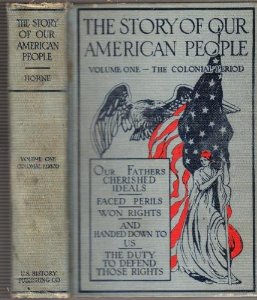
In the 1920s, for example, the American Legion sponsored a new textbook that promised to give students a patriotic yet accurate story of America’s roots.  When Charles Hoyne’s The Story of the American People appeared in 1926, conservatives lavished praise upon it.  The Klan-backed governor of Oregon, Walter M. Pierce, sent Hoyne a gushing letter.  Pierce called the volumes “the finest history of early America that we have ever had.”  Other conservatives agreed, calling the book a blessing to “the loyal and liberty-loving people of our country” and books that defended “the spirit of American patriotism.”

Unfortunately for Hoyne, for the American Legion, and for the conservatives who jumped to embrace the new textbooks, other readers had different opinions.  A Legion-appointed review committee found the books to be full of errors.  Writing in the pages of Harper’s, critic Harold Underwood Faulkner called the books “perverted American history.”

Image Source: Amazon.com

Image Source: Amazon.com

In the end, despite high hopes for schoolbooks that would finally put a positive—but accurate—spin on all things American, the Legion withdrew their support and Hoyne’s books went nowhere.

The National Association of Manufacturers had much more success producing capitalism-friendly school materials.  Starting in 1939, NAM sent educational literature and classroom posters to roughly 17,000 classroom teachers and school administrators.  Being savvy businessmen, the leaders of the NAM wanted to know if this investment was a good one.  They wanted to know if the pamphlets made people like capitalism better.  To find out, they hired pollster Henry Abt to survey the schools.  Abt reported that most of the teachers considered the NAM-produced books “primarily as an informational service; an authoritative source of economic and social data.”  From the NAM’s perspective, nothing could be better.  Students read NAM’s paeans to capitalism and took them as authoritative social science.

Perhaps the book reviewers in Texas might take a page from the lessons of the 1920s and 1930s.  If conservatives really want to see more conservative textbooks, they might have to publish them themselves.  Of course, they’d want to watch out for the Hoyne trap.  Any classroom materials must be more like the slick, glossy pamphlets and posters distributed by the National Association of Manufacturers.  Anything else will end up just an embarrassment.


Creationist Textbook Fight: A Progressive Victory?!?

Déjà vu all over again.  That might be the sensation for those of us who have followed Texas’ political battles over textbook content.  Recent politicking has demonstrated the continuing influence of creationists in textbook decisions.

But debate-watchers may not realize that these Texas-textbook headlines represent a progressive victory.

Here’s why: Back in the 1920s, states such as Texas adopted state-wide textbook adoption policies precisely in order to make the process more transparent.  Recent work by liberal watchdogs in the Texas Freedom Network demonstrates the long-term progressive success of those 1920s efforts.

Let’s start at the beginning.  As I describe in my 1920s book, debates over the content of Texas textbooks began way back.  In the 1920s, Texas officials insisted that textbook publishers produce “Texas” editions, with large sections on evolution cut out.  More than that, Texas officials demanded textbooks that ratified a Protestant-dominated vision of American history and culture.  Ever since, as I discuss in my current book, conservative activists such as the Gablers have been able to wield outsized influence on the textbook adoption process in Texas.

Yet this long history of conservative influence in Texas textbooks is not merely the story of conservative domination of Lone Star public education.

As Adam Shapiro argues in his excellent new book Trying Biology, progressives in the 1920s fought hard to ensure that these textbook decisions were made openly and publicly.  Previous textbook purchases had been made at the local level.  Sweetheart deals between publishers and school-district officials often left students with low-quality, high-priced textbooks.

Progressive reformers wanted more open discussion of textbook purchasing decisions.  In several states, including Texas, they passed state-wide adoption laws.  In Texas a state board selects a list of approved textbooks, from which districts can choose.  Those deliberations are public events, with legal requirements to share documents and content.

In a sense, therefore, recent headlines about creationist influence on textbook purchases represent a long-term victory for those early progressive reformers.  Liberal activists in the Texas Freedom Network have been able to monitor these deliberations.  The Texas board of education is legally required to provide public access to many of their discussions and debates.  As a result, concerned liberals and science-education types have been able to mount effective and informed protests over creationist influence.

Do progressives have a long history of winning culture-war battles in Texas?  Not really.  Conservative influence in Texas public education remains dominant, as Scott Thurman documented in his film The Revisionaries.  Indeed, the Texas Freedom Network has lamented the delays and obfuscations of conservative officials as the TFN has demanded access to public records.  Nevertheless, the TFN’s strong legal case—their insistence on access to those records—represents the hard-fought victories of earlier generations of progressive activists.


From the Archives: Conservatives, Historical Knowledge, and the Political Process

Guest Post by Kevin B. Johnson

How could American History bother conservatives?

Most people probably believe that sex education and evolutionary biology are the most contentious subjects taught in school.

But conservative activists have also targeted American history.  Why?  Because as historians such as Jon Zimmerman and David Blight have argued, America teeters on a culture-war divide in its understanding of its own history; a culture-war divide no less contentious than questions about sex and God.

Nowhere has this battle over the nation’s history been more bitter or grueling than in Mississippi.

A look at the record of conservative activism in the Magnolia State may shed some light on the continuing battle over the nature of history.  It also demonstrates the ways conservatives have scored their greatest successes.  In Mississippi, at least, conservatives managed to win by promoting one central idea: historical knowledge, properly understood, is static and unchanging.

As the Cold War split nations into the Free, Unfree, and Third Worlds, Americans began scrutinizing their communities in search of suspected communists and subversives. In Mississippi, these searches involved the content in state-approved social studies textbooks. Civic-patriotic organizations such as the American Legion, the Sons of the American Revolution (SAR), the Daughters of the American Revolution (DAR), and the Mississippi Farm Bureau Federation led the charge in exposing objectionable historical knowledge presented in social studies texts.

The civic organizations were not alone in controlling textbook content. In the 1940s Mississippi began providing students with schoolbooks; lawmakers also set up the State Textbook Purchasing Board charged with governing the screening and selection of all texts. In the Cold War context, however, many civic organization leaders believed the state’s education professionals were ill-suited for this job and challenged their role in screening school materials.

A few key figures spearheaded the effort to guard historical knowledge. Mississippi State College education professor Cyril E. Cain, for example, found reading and “doing” history to be a mystical-spiritual experience. In 1949, Cain learned about the California SAR calling for removal from that state’s schools the Building America textbook series. America and its democratic system was not part of a process, the SAR argued. Rather, American democracy had been built and perfected in comparison to rival governments.

Through the Mississippi Patriotic Education Committee, Cain called upon other conservatives guard against the historical knowledge contained in schoolbooks. He wrote to the state regent of the Mississippi DAR—Edna Whitfield Alexander, asking for collaboration between their two organizations “for the common cause of defending America” from textbook authors who espoused “alien ideologies.”

For the next twenty years, Alexander became the South’s preeminent textbook activist. She developed her organizational skills through the Mississippi DAR, which held significant power in the 1950s and 1960s. Many DAR members’ husbands served in state government or were the state’s business leaders; the DAR owned numerous radio stations throughout Mississippi. A segregationist society like other civic clubs, its members naturally opposed perceived egalitarian messages in textbook treatments of history, civics, and economics. History was the DAR’s domain and it held what they believed was magnificent power to order present-day society.

Gaining the attention of Mississippi’s leaders, especially Mississippi House Speaker Walter Sillers, Jr, by 1958, Alexander and DAR activists officially recorded their objection to the content in dozens of state-approved books.

The following are just a few examples:

“Laconic treatment of the South…did not mention Fielding Wright as Vice-Presidential nominee of the States Right party…praises Federal aid to education…Booker T. Washington picture is much later than Thomas Jefferson [sic]” –review of United States History, American Book Company, 1955 reprint.

“This slanted-against-the-South book makes no mention of the fact that Russia offered to help the North [during the American Civil War]” –review of The Making of Modern America, Houghton-Mifflin, 1953.

“…records a good bit of history—some of which we are not too proud, and conspicuously omits some of which we are very proud like religious freedom!” –review of Your Country and the World, Ginn & Company, 1955.

“…advocates creation of a state of social equality…” –review of Economic Problems of Today, Lyons and Carnahan, 1955.

“Formerly history was largely concerned with kings, monarchies, laws, diplomacy, and wars…Today history deals with the entire life of a people. So now were are told that history must change along with this changing world and George Washington, Valley Forge, and the U.S. Constitution are no longer worthy of recognition to be ignored so far as our children’s history books are concerned.” – wrote a DAR reviewer of The Record of Mankind, published by D. C. Heath, 1952.

The DAR, in addition, opposed books citing renowned scholars such as Henry Steele Commager, Charles Beard, Allen Nevins, Gunnar Myrdal, Arthur Schlesinger, John Hersey, in addition to Mississippi writers like Hodding Carter, Ida B. Wells, and William Faulkner.

These comments sent to Sillers demonstrate the DAR’s view of History.  In the DAR vision, History should be dominated by pro-South, segregationist, and patriotic biases. The reason for teaching history in the Cold War context, the DAR and others agreed, was to instill in school children loyalty to state and country.

The DAR, under Alexander’s leadership, began a concerted lobbying effort. In 1959, Alexander informed the Mississippi Superintendent of Education and head of the State Textbook Purchasing Board, Jackson McWhirter “Jack” Tubb, that “youth must be taught Americanism in its purest form if this Republic is to survive.”

The American Legion and the Mississippi Farm Bureau Federation became important DAR allies. These civic clubs conducted official studies of Mississippi’s approved books and found that many “cater to alien ideologies contrary to the Mississippi way of life.” Boswell Stevens, a Legionnaire and president of the state’s Farm Bureau, believed social studies curricula should cultivate among students adoration of quintessential American values like Jeffersonian individualism, capitalism, and patriotism.

During state elections in 1959, the lobbyist coalition collaborated by staging exhibits of objectionable texts in the lobby of the Robert E. Lee hotel in Jackson. After Sillers intervened the DAR moved the exhibit to the lobby of the state capitol in time for the 1960 legislative session.

Lawmaker-members of American Legion and the Farm Bureau dominated the Legislature, passing amendments to state laws pertaining to textbook screening and adoption. The amendment gave the governor, recently elected Ross Barnett, appointment power over the state’s education professionals on these important textbook screening committees.

These conservative victories were not unopposed, however.  Newspapers editorials considered the DAR efforts as a “witch-hunt” and the state’s teachers association believed that textbook reviews were best left to education professionals.

But politics—in this case, staunchly conservative politics—trumped the claims of journalists and teachers.  Conservative activists also managed to stymie complaints from academic historians. In 1975, for example, James W. Loewen and several co-authors of the history text Mississippi: Conflict and Change had to file a federal lawsuit against Mississippi for adoption of their revolutionary new textbook. Loewen even commented at the time that most of the state-approved books were merely “didactic chronologies.”

Loewen’s lawsuit demonstrated the deeply entrenched nature of conservative visions of History in Mississippi.  For decades, conservative activists had succeeded in establishing state sanction for their vision of History: a static, unchanging field of facts, uniquely useful for promoting patriotism and instilling a love for traditional Americanism.


Kevin Boland Johnson is a doctoral candidate in American history at Mississippi State University and a dissertation fellow with the Spencer Foundation. His dissertation, “The Guardians of Historical Knowledge: Textbook Politics, Conservative Activism, and School Reform in Mississippi, 1928-1988,” explores numerous education reform efforts designed either to constrain or improve public school social studies curricula. You can reach Kevin at kbj41@msstate.edu.