Is “Gay” the New “Black” at Evangelical Colleges?

It’s not a simple question, but there is a simple answer. A recent story from NPR about LGBTQ+ issues at evangelical colleges has people asking: Are today’s official anti-gay policies at most evangelical colleges the 21st century equivalent of their 1950s racist policies? Short answer: No.

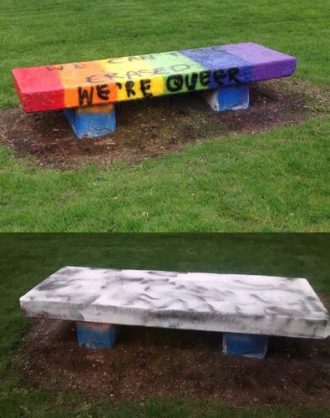
wheaton rainbow bench

It’s not easy. The rainbow bench at Wheaton was covered over…

As the article describes, many campuses such as Calvin and Multnomah send profoundly mixed messages about non-heterosexual identities among students. On one hand, students are carving out for themselves friendly spaces on evangelical campuses. They are finding emotional support among sympathetic faculty and fellow students.

This matches other reports, such as one from Liberty University a few years back. It is different at different schools, of course, but students have already introduced LGBTQ+ rights on most evangelical campuses.

On the other hand, most schools still have official rules banning non-married, non-heterosexual sexual expression. As the NPR article describes, people at evangelical colleges are often confused. The chaplain at Calvin, for example, put her position this way,

You’ve got those two values. . . . We love our LGBT people. We love our church of Jesus Christ. We love Scripture. So those of us who do this work are right in the middle of that space. We are living in the tension.

It’s hard not to ask: Is this just an updated version of the struggle over segregation and racism at evangelical colleges? As I argue in my recent book, evangelical and fundamentalist schools had a shameful racial legacy in the twentieth century. (For the record, so did non-evangelical schools.) Though many evangelical colleges had been founded as explicitly anti-racist or cross-racial missionary institutions, by the early twentieth century they had imposed rules and policies against interracial dating. They discouraged non-white applications.

Are today’s battles over sexual and gender identity just new versions of this old conflict? In at least one important way, the answer is a clear no. When evangelical activists fought against their schools’ racism in the twentieth century, they were able to pull from their own evangelical history to make their cases. At Wheaton College, for example, faculty activists such as James Murk and John Alexander were able to point to the incontrovertible fact that the school had been founded by Jonathan Blanchard, an ardent cross-racial Christian activist.

There is no similar history for LGBTQ+ activists to pull from. They can say—and they do—that loving all people is an essential part of their religion. But they are not able to pull from their own evangelical history to make their cases.

To be clear, I’m all for LGBTQ+ rights. I’m proud to work at a school where there can be no institutional discrimination based on sexual identity or gender identity. Speaking as an historian, though, I have to make the obvious point: It will be harder for LGBTQ+ Christians to stake their claims than it was for anti-racist white students.

HT: EC

Thanks, CHE!

No, no, no, not THAT Che. I mean the Chronicle of Higher Education. Peter Monaghan recently featured my new book in their pages.

CheHigh

urm…different CHE.

Monaghan put his finger squarely on several of the most important issues in the world of evangelical higher education.

For example, as Monaghan explains, the world of evangelical higher education is not somehow trapped in the past. As he puts it,

Many newcomers to the inner workings of fundamentalist Christian colleges are surprised to learn that the institutions consider themselves not just righteous but also thoroughly “modern.”

The differences between evangelical and non-evangelical higher education is therefore not as stark as some outsiders might think. As Monaghan concludes,

Like elite secular institutions . . . fundamentalist ones seek to thrive by “developing a niche that they can exploit,” selling themselves as “experiences” that transform young people. They describe themselves as hubs of academic endeavor, with prospectuses little different from those of their nonreligious peers. Leaders also promote their institutions’ distinguishing features, like size, location, and sports programs, aware that evangelical families want to provide their children with more than doctrinal guidance during their college years.

Almost makes you want to read the whole book, don’t it?

Bad News for Creationists

It’s no skin off my nose, but I can’t help but wonder what creationists will say now. And not just the more radical young-earth creationists, but all the dissenting scientists who insist for religious reasons that our species must have begun with two and only two ancestors in the Garden of Eden. As reported in the New York Times, the science of human origins is getting better and better. What will creationists do?

human history map

The science doesn’t come close to matching the Bible…

Here’s what we know: This weekend the New York Times profiled the work of Harvard’s David Reich. Dr. Reich and his team have plucked DNA from ancient human bones. Using new techniques, the team has been able to create new maps of human and other groups dating back tens or even hundreds of thousands of years. The ultimate goal?

Dr. Reich’s plan is to find ancient DNA from every culture known to archaeology everywhere in the world. Ultimately, he hopes to build a genetic atlas of humanity over the past 50,000 years.

Here’s the problem: for many creationists, even those who are willing to believe in an ancient universe and planet, the idea of a real, historic Adam & Eve is absolutely non-negotiable. As we’ve examined before in these pages, even creationists who accept the science of evolutionary theory in general balk at the notion of abandoning the Garden story. Even institutions such as Wheaton College that openly embrace evolutionary creationism shudder to advertise their faculty’s skepticism about a real historic Adam & Eve.

So what will creationists do now? Here’s my guess: The more radical young-earth crowd will simply dismiss the new discoveries in human origins as simply more fluff n stuff, more flawed conclusions from flawed pseudo scientists based on flawed assumptions. But among creationists who have embraced evolutionary science in its particulars, while insisting on the fundamental truths of divine creation as described by the Bible, each new scientific discovery will present a new challenge.you got some splainin to do

As the scientific evidence gets stronger and stronger for a complex, multi-site origin of the human species, creationists will have some splainin to do.

HT: HD

How Did Christian Colleges Become Racist?

People keep asking: Why are white evangelicals so racist? This week we see it in The Atlantic and at Forbes. At leading evangelical colleges—in the North anyway—there’s a big, obvious answer that this week’s pundits don’t mention.

Here’s what they’re saying:

  • Michael Gerson wondered what happened. At his alma mater Wheaton College in Illinois, a strident anti-racism among white evangelical leaders slipped away.
  • Chris Ladd places the blame on slavery and the lingering dominance of Southern Baptists. As Ladd writes,

Southern pastors adapted their theology to thrive under a terrorist state. Principled critics were exiled or murdered, leaving voices of dissent few and scattered. Southern Christianity evolved in strange directions under ever-increasing isolation.

The question should bother all of us, white or not, evangelical or not. Why do so many white evangelicals seem comfortable or even enthusiastic about Trump’s Charlottesville-friendly MAGA message?

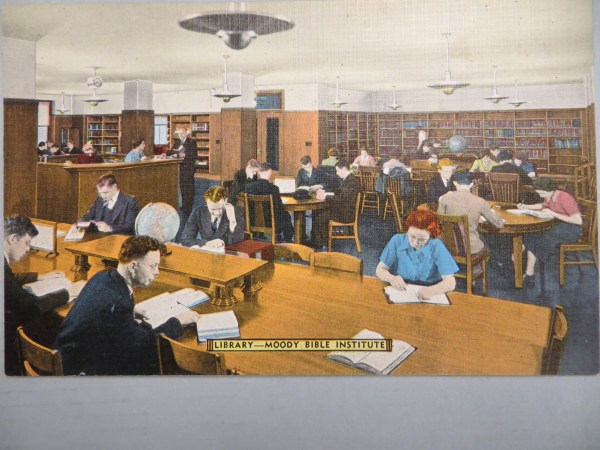
1940s postcard library

Not a lot of diversity, c. 1940s

Since neither Gerson nor Ladd bring it up, I will. At some of the leading institutions among white evangelicals, there is an obvious culprit. It’s not the political power of the slave state. It’s not craven lust for political influence. As I’m arguing in my new book about evangelical higher education, Christian colleges have always been desperate to keep up with trends in mainstream higher education. And those trends pushed white evangelicals to mimic the white supremacy of mainstream higher education.

Of course, evangelical colleges were happy to stick out in some ways. In the classroom, for example. Evangelical institutions of higher education have always prided themselves on teaching dissident ideas about science, morality, and knowledge. In social trends, too, evangelical colleges didn’t mind having stricter rules for their students about drinking, sex, and dress codes.

When it came to academic luster, however, fundamentalist academics in the first half of the twentieth century were desperate for the respect of outsiders.

At Gerson’s alma mater, for example, President J. Oliver Buswell quietly discouraged African American attendance in the 1930s. Why? There’s no archival smoking gun, but Buswell explicitly discouraged one African American applicant, suggesting that her admission would lead to “social problems.”

When we remember the rest of Buswell’s tenure, his reasons for discouraging non-white applicants become more clear. Against the wishes of other Wheaton leaders at the period, Buswell fought hard for academic respectability. He tried to decrease teaching loads, increase faculty salaries, and improve faculty credentials. As Wheaton’s best historian put it, Buswell

passionately believed that one of the best ways to earn intellectual respect for fundamentalist Christianity would be to make certain that Wheaton achieved the highest standing possible in the eyes of secular educators.

In the 1930s, that respect came from a host of factors, including faculty publications and student success. It also came, though, from limiting the number of African American students and the perceived “social problems” interracialism would impose.

Buswell and Wheaton weren’t the only northerners to impose segregation on their anti-racist institutions. Cross-town at Moody Bible Institute, leaders similarly pushed segregation in order to keep their institution respectable in the eyes of white mainstream academics.

Like other white evangelical institutions, in the late 1800s Moody Bible Institute was committed to cross-racial evangelical outreach. On paper, in any case. And MBI always remained so on paper, but by the 1950s the dean of students broke up an interracial couple. The dean was not willing to say that there was anything theologically wrong with interracial dating, but he separated the couple anyways, worried that public interracialism would “give rise to criticism” of MBI and its evangelical mission.

Why do so many of today’s white evangelicals seem comfortable with Trump and his white-nationalist claptrap? Why didn’t they hold on to the anti-racism that had animated white evangelicals in the past? Both Ladd and Gerson make arguments worth reading.

On the campuses of northern evangelical colleges, though, there was another powerful impulse. For evangelical college leaders, being a real college meant earning the respect of white non-evangelical school leaders. Between the 1930s and the 1950s, uncomfortable as it may be to acknowledge, mainstream white college leaders expected racial segregation. White evangelical college leaders weren’t more racist than non-evangelicals. They were just more desperate to seem like “real” colleges.

HT: DL, EC

Mumbling Toward Gomorrah

Which side are you on? That’s the question college administrators hate to answer. A few recent headlines make it clear that conservative evangelical college leaders continue to prefer mumbling through some of the touchiest issues they face. As I found in the research for my new book about evangelical higher education, it has always been thus.

baylor-header

What’s their position on homosexuality? …how much time do you have?

I was reminded of this dilemma when I came across a conservative lament about Baylor University in Texas. One outraged correspondent wrote to Benedictophile Rod Dreher to complain that Baylor had ditched its Baptist tradition. Officially, according to this American conservative, Baylor’s code of student conduct prohibits homosexual relationships. But as he or she described, it can be very difficult to actually find that rule spelled out. As s/he told Dreher, in order to find out that Baylor officially bans homosexuality,

You must start here Student Misconduct Defined https://www.baylor.edu/student_policies/index.php?id=32401 only to be redirected here for Sexual Conduct Policy https://www.baylor.edu/student_policies/index.php?id=32294 which says literally nothing, but directs you here: https://www.baylor.edu/content/services/document.php?id=39247. This tells you almost nothing but at least tells you sex is only allowed in marriage–but these days, who knows that means? The Baylor website basically says they understand marriage according to the 1963 Baptist Faith and Message but tough shit, we aren’t going to give you a link; you’re are on your own. I found it: http://www.baptiststart.com/print/1963_baptist_faith_message.html And it turns out that according to the Baptist Faith and Message, marriage is defined as being between a man and a woman. Whew! I’m tired already! Lots of link-chasing and more than a few logical inferences from different webpages are necessary to conclude that in fact, homosexual contact is prohibited by Baylor policy.

Baylor isn’t the only evangelical school to founder in the face of sex policy. SAGLRROILYGYTH may remember a recent case from Boston. Gordon College’s President D. Michael Lindsay set off a firestorm a couple of years ago when he reminded the Gordon community of Gordon’s long-standing policy against homosexual relationships among students. The Gordon community remains painfully divided over the question, with entire faculty committees resigning their leadership roles in protest over leadership decisions.

Now, I’m no evangelical. I’m not conservative. I wouldn’t send my child to a school that banned homosexual relationships, even if that school buried those rules deep in ivy. But as an outside observer, I can’t help but notice what so many school leaders have always known: Sometimes the best policy is mumbles. Anything else can blow up in your face.

After all, Lindsay at Gordon wasn’t changing any rules. He was not imposing a new, draconian policy. Rather, he was simply stating established Gordon rules. And that was enough to create an uproar. It would be difficult for other school leaders not to get the message. Time and time again, cautious school administrators and others can see the enormous benefits of mumbling. Of studied silences. Of intentional ambiguity.

Baylor considers itself a mainstream school, a powerhouse in both faculty lounges and football fields. The fact that its policy officially prohibits homosexual sex isn’t something it likes to promote.

Similarly, President Lindsay’s statement about student sex did nothing more than openly state the school’s longstanding policy, yet his statement has led to prolonged anguish for the Gordon community.

With stakes so high, it certainly seems to be in colleges’ best interest to maintain some flexibility in their official policies. This strategy is nothing new.

To describe just one example from my new book, in the 1960s Wheaton’s administrators faced a similar upsurge from the Wheaton community. Students wanted to revise the forty-year-old student pledge. The old rules against movies, alcohol, and card-playing—rebels insisted—reflected the college’s sad fundamentalist past. They insisted on more flexible rules in order to give them more moral responsibility.

In 1967, President Hudson Armerding agreed, sort of. He approved and announced a new set of guidelines for student behavior. From then on, instead of the old list of banned activities, students were expected to abide by the following rules:

                1.) Cooperate constructively in the achievement of the aims and objectives of Wheaton College and the responsibilities of citizenship in the community and nation.

2.) Exhibit Christian conduct, based on principles taught in the Scriptures, which will result in the glorification of God, the edification of the Church and his own growth in grace

3.) Observe, while under the jurisdiction of the college, Wheaton College’s ‘Standards of Conduct.’

4.) Take maximum advantage of the educational opportunities available to him by ordering his life so that he can live in harmony with both the academic and non-academic goals.

5.) Make full use of his God-given abilities so as to achieve maximum personal development.

6.) Continually evaluate his commitment to Christ and to the purposes of Wheaton College.

Armerding was a past master at mumbling through these questions. He could tell students with a straight face that he had heard their complaints. He really did approve a new approach.

Yet at the same time, President Armerding could tell conservative alumni and trustees that the new rules left the old ones in place. Students still had to abide by the old standards of conduct while on campus. He could look parents in the face, as he did in a 1971 chapel talk, and tell them that nothing had changed. As Armerding put it, Wheaton would never approve

a shallow permissiveness [that] conveys a distorted view of God who deals far differently with His children. . . . We believe that students should be disciplined and corrected and that this should be consistent with the teachings of the Word of God.

The questions in the 1960s and 1970s weren’t about homosexuality. But the strategies were the same. As do administrators at all types of colleges, many evangelical school leaders cherish the value of fuzzy, possibly two-sided rules.

The Prodigal College Returns

The trend seems clear: Michigan, Florida State, Texas State, Ohio State, and other big schools have banned fraternities. School administrators are scrambling to control dangerous drinking, deadly hazing, and horrifying sexual assault. I can’t help but ask: Have the fundamentalists been proven right?

blanchard hall

Do all paths lead back to Blanchard Hall?

A hundred years ago, after all, as I explore in my new book, fundamentalists founded their new network of evangelical colleges, institutes, and universities for two main reasons. First, they wanted an intellectual refuge. Mainstream colleges, fundamentalists universally agreed, had drunk the Kool-aid of evolutionism and materialism. At least as dangerous, however, were the behavioral norms that had come to prevail at mainstream schools.

In the 1920s, fundamentalist school leaders such as Charles Blanchard at Wheaton College in Illinois and Bob Jones at Bob Jones College in Florida promised their schools would protect students from both loose ideas and loose behavior.

At Wheaton, for example, fraternities were banned, along with smoking, drinking, cinema, dancing, and card-playing. The school posted spies outside the downtown movie theater to make sure Wheaton students weren’t sneaking in. At Bob Jones, students were prohibited from “loitering,” talking freely with members of the opposite sex, and absolutely anything that hinted of “jazz.”

For a century now, evangelical schools have been mocked as small-minded anti-intellectual “church colleges,” hopelessly out of touch with modern higher ed. They have also been attacked—often by their own students—as ridiculously controlling.

Back when he was a Wheaton student in 1966, for example, historian Mark Noll led the drive to reexamine the “Pledge.” It was simply not possible, students felt, for them to receive a decent college education if they weren’t allowed to make their own decisions. They were embarrassed to tell their friends at other schools that they weren’t allowed to go to the movies.

But who is embarrassed now? As leaders of secular colleges struggle to find ways to impose restrictions on student behavior, are they reverting to fundamentalist arguments of the 1920s? As Frank Bruni argued recently in the New York Times,

On a range of fronts, fraternities — and sororities — contradict our stated values and undercut our supposed goals for higher education, putting our inconsistencies and hypocrisies under a magnifying glass.

To ban them, though, or even to take real moves to enforce rules against certain types of student behavior, wouldn’t be as simple as it seems. As the first generation of fundamentalist college leaders lamented, a central principle of mainstream higher education has been the notion that students themselves must be in charge of their decisions.

To make any real change in the deadly culture at many frats, mainstream college leaders would need to make big changes in the way they see their role. Like fundamentalist colleges and their evangelical heirs, mainstream schools would need to insist on their roles as moral guardians.

Schools on a Mission

Why go to college? For most Americans, “college” is about a bunch of things all bundled together. People want to prepare for white-collar jobs. They want to watch football and engage in hijinks. They want to have an “experience” that they hear will shape the rest of their lives. In my new book about evangelical higher education, I’m arguing that fundamentalist and evangelical schools generally offered students all those things and more. In addition to training students to be lawyers, doctors, engineers, and teachers, “Fundamentalist U” prepared students for a unique sort of career that secular universities didn’t. And that focus changed things at evangelical schools in major ways.

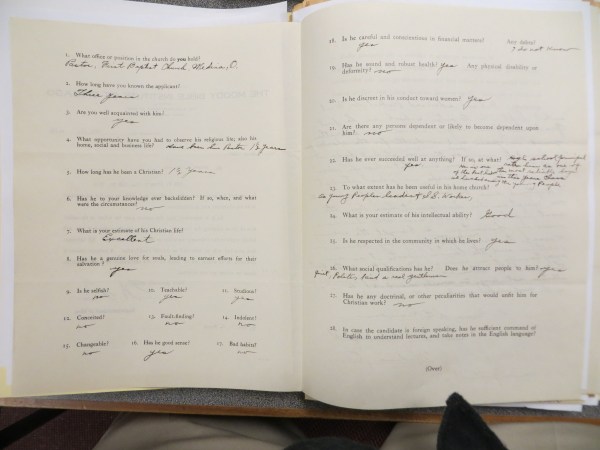
1930s application ref form

MBI reference form, c. 1930s. Note question number 8.

For many evangelical Christians in the twentieth century, the main point of going to college was to prepare for a career (or at least an experience) as a missionary. As one Biola student reported in 1940, she wasn’t sure what to do with her life. She had grown up as a missionary kid in China, but she hadn’t planned to go into missionary work herself. However, one day she felt a “call” to become a missionary after all.

How did she go about it? She knew she needed some training, so after diligent prayer and consultation with “the fundamental Church groups” in her area, she decided to enroll at Biola. For her, the entire point of a college education was to become a better missionary. College, in her way of thinking, was the place to learn how to “more perfectly tell [the millions of lost and dying souls in the world] of the matchless wonders of His grace.”

The focus on missionary work didn’t just change the way students decided to go to college and which college to apply to. Schools, too, put formal mechanisms in place to encourage missionary careers. On admissions forms, for example, schools asked about more than just grades and activities. As did the Moody Bible Institute, most schools wanted to know if an applicant “has . . . a genuine love for souls.” Wheaton, too, added extra admissions points if a student had a “demonstrated ability as an outstanding soulwinner.”

The focus on missionary preparation shaped schools in other ways, too. ALL colleges and universities tended to expand their bureaucracies after World War II. They formalized and systematized their admissions departments and alumni outreach bureaus.  In addition to these sorts of new departments, evangelical colleges also formalized their missionary training, by adding departments to help students pick the right missionary career path.

missions flier

Attention Liberty Students–your school will help you get to your mission field. C. early 1980s

One of the central themes of my book is that evangelical higher education experienced its own sort of evangelical existence—IN the world of American higher ed, but not OF it. In some ways, that is, evangelical institutions were shaped by the same sorts of forces that transformed the world of American higher education as a whole. In other ways—as in the focus on training missionaries—evangelical schools shaped those forces to fit their unique vision of proper higher education.

How Do You Know?

It might seem sloppy or even a little slapdash. Historians claim to know things about the past, but most of us don’t have hard-and-fast proof for the arguments we make. This morning I’d like to share one small example of the way the process works, at least in the case of my upcoming book.

I just finished reading John Lewis Gaddis’s Landscape of History with my graduate class. Gaddis is a leading historian of the Cold War. In Landscape of History, he argues that academic historians don’t try to make the same claims as social scientists. And that’s okay.Gaddis landscape
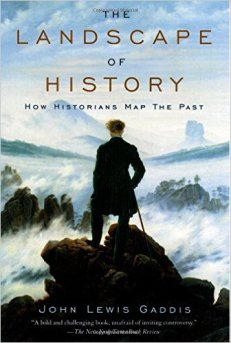
Gaddis uses a painting of a wanderer looking down on a fog-cloaked valley to illustrate his point. Historians can never be absolutely sure of their data; they are like the wanderer—looking into a distance that is cloaked and ultimately mysterious. Some social-scientists might object that the process makes claims it can’t back up with real data. Gaddis describes one such encounter:

Some years ago I asked the great global historian William H. McNeill to explain his method of writing history to a group of social, physical, and biological scientists attending a conference I’d organized. He at first resisted this, claiming that he had no particular method. When pressed, though, he described it as follows:

“I get curious about a problem and start reading up on it. What I read causes me to redefine the problem. Redefining the problem causes me to shift the direction of what I’m reading. That in turn further reshapes the problem, which further redirects the reading. I go back and forth like this until it feels right, then I write it up and ship it off to the publisher.”

McNeill’s presentation elicited expressions of disappointment, even derision, from the economists, sociologists, and political scientists present. “That’s not a method,” several of them exclaimed. “It’s not parsimonious, it doesn’t distinguish between independent and dependent variables, it hopelessly confuses induction and deduction.”

Gaddis liked the method anyway, and so do I. As I’m reviewing my research files for my upcoming book about the history of evangelical higher education (available for preorder now!) I came across a few items that didn’t make the final cut, but they do help illustrate the way I came to make the arguments I’m making.

One of the central arguments of the book is that evangelical and fundamentalist colleges have always been subjected to furious scrutiny from the national network of fundamentalists. There has always been a strong sense among the evangelical public that evangelical colleges must be held to a high standard of religious purity. Naturally, parents and alumni of every sort of college watch their schools closely. After all, they might be spending big bucks to send their kids there. In the case of evangelical higher education, even unaffiliated busybodies feel entirely justified—even compelled—to intrude.stenholm notes in controversial Kodon
Another key argument of the book concerns the feud between the fundamentalist and evangelical branches of the conservative-evangelical family. Beginning in the 1940s and 1950s, the fundamentalist network split into fundamentalist and new-evangelical camps. Some historians have called this a “decisive break” or an “irreparable breach,” but at institutions of higher education, it always felt more like a continuing family feud. At least, that’s the argument I make in the book.

How do I know?

As Professors McNeill and Gaddis insist, it is mostly a question of time. I spent long hours and days in the archives of various schools. I read everything. As I did so, ideas about these themes developed. As they did, I went back and reread everything. Did the idea seem to match the historic record? Over and over again, I noticed that school administrators fretted about the eternal and invasive fundamentalist scrutiny to which they were subjected. Over and over again, I noticed the tones of betrayal, hurt, and intimate outrage that characterized the disagreements between “fundamentalist” and “evangelical” schools.

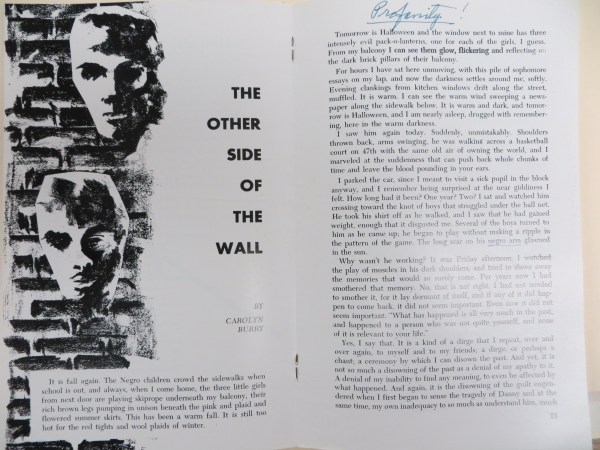
Not all the evidence made it into the book. One episode I do discuss is a controversial student publication from Wheaton College in Illinois. Back when he was an earnest evangelical student in the early 1960s, Wes Craven—yes, the Nightmare on Elm Street guy—was the student editor of Wheaton’s literary magazine. As part of his intellectual revolt against fundamentalism, Craven published two stories that he knew would ruffle fundamentalist feathers. In one, an unmarried woman wonders what to do about her pregnancy. In another, a white woman is sexually attracted to an African American man.

A quirk of the archives helped me see the ways the controversy unfolded. At the time Craven’s magazine came out, Gilbert Stenholm had been working at fundamentalist Bob Jones University for quite some time. He kept everything. His archive files are full of unique documents that helped me see how fundamentalist higher education worked in practice.

For example, he saved his copy of Craven’s controversial student magazine. His notes in the margins helped me understand the ways fundamentalists were outraged by their new-evangelical cousins. Along the edges of one story, an outraged Stenholm penned in one shocked word: “Profanity!” Elsewhere, Stenholm filled the margins with exclamation points.

What did this one-of-a-kind archival find tell me? It helped me see that fundamentalist schools like Bob Jones University had never really washed their hands of evangelical schools like Wheaton. For Stenholm, at least, the goings-on at Wheaton were always of intense interest. And it helped clarify to me the ways members of the far-flung fundamentalist community watched one another. They were always nervous about slippage—always anxious that trustworthy schools could slide into the liberal camp.

Stenholm’s outrage in the case of Craven’s student magazine didn’t make the book’s final cut, but this copy of Wheaton’s student magazine in Stenholm’s collection told me a lot. It doesn’t serve as the kind of “parsimonious,” independent-variable method that Gaddis’s social scientists would prefer. But taken all together, bits and pieces of archival gold like this one guided me to the argument I finally “ship[ped] . . . off to the publisher.”

I Love You but You Didn’t Do the Reading

Hard to believe another week has come and gone so fast. It has been difficult to keep tabs on all the ILYBYGTH-related stories out there. Here are a few that SAGLRROILYGYBTH might find interesting:

If you were the principal, what would YOU do? This South Carolina teacher got suspended for having her kids defend the Klan. HT: MM

Five Wheaton College students face charges in a violent hazing assault, as reported by the Chicago Tribune.

Ben Shapiro on the problem with college protesters, the “idol of self.”

What should a science booster-club leader do when a parent questions his religious beliefs? One story from the National Center for Science Education.

Did the right wing come from outer space? David Auerbach looks at the sci-fi roots of radical conservatism.Bart reading bible

“More…than just big hair and money.” An interview with John Wigger, author of a new history of Jim and Tammy Faye Bakker.

What are historians saying about Ken Burns’ and Lynn Novick’s new Vietnam War documentary? At HNN, Professor Bob Buzzanco offers a few criticisms.

What do standardized history tests tell us? Not so much, argues Sam Wineburg and his colleagues.

Why so few conservative professors? George Yancey says there’s more to it than self-selection.

A portrait of a culture-war powerhouse: Daniel Bennett on the history of conservative legal activists Alliance Defending Freedom.

Felony Football Assault at Fundamentalist U

The world of evangelical higher education is reeling at the revelations from Wheaton College in Illinois. Five football players have been charged with felony assault in a brutal hazing incident. The incident reminds us of the long tensions between aggressive, win-at-any-cost college athletics and the behavioral rules of evangelical colleges.

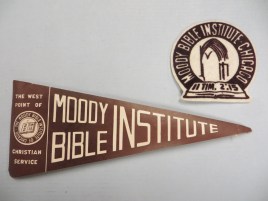
1940s MBI banner and patch
Rah rah.


It’s easy enough to forget nowadays, when big evangelical schools like Liberty are making their mark in the competitive world of college athletics. Since the beginning, however, as I detail in my new book, thoughtful evangelicals wondered if the pressures that inevitably accompanied sports success threatened the mission of their religious institutions.

The story from Wheaton is gruesome. A freshman football player was attacked in his dorm room by senior teammates. His wrists were duct-taped together and he was thrown into the back of a car. His teammates piled in on top of him, threatening him with sexual assault. As Chris Gehrz has pointed out, the language they used—crudely blaring that Muslims commonly engaged in bestiality and sexual aggression—points out the deep structural flaws that can cocoon students at evangelical schools. Even worse, Wheaton seemed to be willing to sweep this assault under the rug, letting the players keep playing after they performed some community service and wrote apologetic essays.

The victim ended up abandoned half-naked in a field with torn muscles in both shoulders. He immediately left the school.

Sadly, there’s nothing unique about this sort of brutal collegiate assault, done under the banner of team-building “hazing.”

Schools like Wheaton, however, have built their reputation as different sorts of schools, schools that hold their students to a higher standard of conduct. As long as there have been evangelical colleges and universities of this sort, however, there have been deep tensions about athletic programs. For many schools, hosting winning sports programs are an intrinsic part of being a “real” college.

Back in 1944, for example, one Wheaton student wrote home in excitement that the new sports program (it only started in 1939 at Wheaton) gave her school a tradition to embrace. As she prepared to head to the weekly football game, she told her mother that the game against rival North Central College was a big deal on campus. “You see,” she explained to her mother,

Wheaton is to N.C. what Army is to Navy, or Harvard is to Yale.

Even in the sequestered world of the Moody Bible Institute, students glowered at their relative lack of athletic success. In 1945, one student complained that MBI teams should earn more wins. In spite of their large student body and their good athletic facilities, this student wrote in the student paper, the MBI “A” team still lost at basketball to the Wheaton “Bs.”

There had always been anxiety about the behavioral implications of athletics. In its first years, for example, Bob Jones College (it became Bob Jones University only in 1946) fielded teams under the name the “Swamp Angels.” The school’s leaders soon canceled the athletic program, however. As Bob Jones Jr. later remembered,

We found the people were betting on our games, littering our campus with whiskey bottles.

Even in that first generation of evangelical higher education back in the 1920s, critics charged that school leaders cared more about sports success than soul-saving. The short-lived and ill-fated fundamentalist experiment at Des Moines University demonstrated this conundrum better than any other school. When Toronto’s fundamentalist firebrand T. T. Shields stormed into town and took over the school, he fired all the faculty and forced them to reapply. Every potential faculty member went through an intrusive personal interview regime to get their jobs back. The entire faculties of the science and math departments quit in disgust. But not the football coach. Observers quickly noted that the coach was welcomed back in spite of his open cynicism about evangelical religion. When asked if he had been converted, for example–“born again”—the coach reputedly sneered, “Yeah, lots of times.”bju banner

Even elite Wheaton can’t claim innocence about questions of athletic influence. As soon as it started its athletics programs in the 1930s, critics on and off campus charged that football coach Fred Walker was not an appropriate evangelical role model. Walker was accused of a non-Christian tough-guy approach to coaching, cussing at players and using foul language to belittle them. In spite of all the charges, Wheaton kept Walker on.

Even back then, the college wanted to be seen as a real college. It wanted students to think of Wheaton as more than just a dumpy second-rate church school. Part of the package, since the very beginning, was a game-winning athletics program.

The behavior of students and administrators in this recent assault are nothing new. They only remind us of the ever-present tension at evangelical colleges like Wheaton. Like every school, Wheaton gives its athletes too much leeway. The results are often criminal and catastrophic.