Jesus in Uniform

Can US military officers be required to sign a conservative evangelical statement of faith? That’s the question posed by the Wheaton College Reserve Officer Training Corps (ROTC) program. And it unearths broader questions about the proper relationship between the military and fundamentalist religion. Can fundamentalists serve as military chaplains?

Christianity Today reports on the investigation into Wheaton’s ROTC program. At Wheaton, faculty members above the rank of assistant professor are required to sign on to Wheaton’s conservative statement of faith. Recently, the Military Religious Freedom Foundation complained that ROTC officers at Wheaton, who are paid and appointed by the US government, are required to be “of Christian faith.”

According to the CT article, legal experts had differing opinions. One thought that the Wheaton rule passed constitutional muster, since the ROTC program required all professors at all schools to meet their schools’ policies. Another argued, in contrast, that the current situation represented an unconstitutional attempt to “Christianize” the ROTC program.
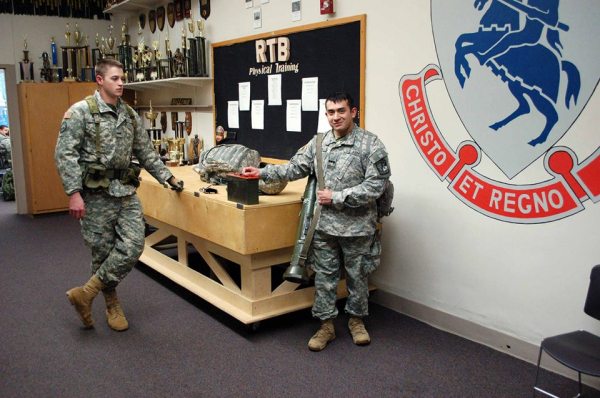
For Christ, Kingdom...and the Rolling Thunder Battalion?

For Christ, Kingdom…and the Rolling Thunder Battalion?

This report made me wonder about other military questions. In my recent trip to the archives of Bob Jones University, I discovered to my surprise that BJU had pursued an aggressive policy of finding spots for its seminary graduates in military chaplaincies. The fundamentalist school had used its considerable influence in the US government to grease the pipeline from the BJU seminary into military positions.

Now, I admit my vast ignorance about the role of chaplains in the US military. Most of what I know about a chaplain’s job comes from watching MASH. I earnestly invite those who know more to weigh in here. But the notion that BJU was sending its graduates into chaplain positions made me wonder.

As I understand it—and once again I freely admit that I don’t know much about it—the role of a military chaplain in the US armed services is to provide two things: religious services for those who desire them, and religious counseling for all.

Throughout the 1960s, at least, when significant numbers of BJU-trained ministers entered the chaplaincy, the school taught a rigid separatism. That is, a key religious tenet of BJU’s fundamentalist faith was that believers must not support the work of heretics. In the world of American fundamentalism, those “heretics” represented not only Jews, Muslims, and Catholics, but even liberal Protestants.

Perhaps the most dramatic example of this doctrine of separatism came with when the Bob Joneses denounced the headline-grabbing crusades of Billy Graham in the 1950s and 1960s. Graham agreed to co-sponsor those mass meetings with liberal Protestant groups. When enthusiastic attendees saw the light, they were sent to various churches to learn more about their new or renewed faith. And that was the problem for the leaders of Bob Jones University.

As they made clear time and time again, Bob Jones Sr. and Jr. never had a personal problem with Billy Graham. But in their opinion, sending new Christians to liberal Protestant churches meant sending them to hell. Real Christians, the Bob Joneses argued, could and should work with non-real Christians and other heretics on political issues. But they must not work together on religious issues, since endorsing heretics meant endorsing heresy.

With separatism such a guiding element of BJU theology, it seems to me that BJU-trained chaplains would be putting themselves in a very difficult position. If their jobs require that they respect the faiths of their military “flocks”—even if they don’t agree with those faiths—but their own faith requires that they DON’T respect those heretical faiths, what are chaplains to do?

I could see how some fundamentalist pastors would see their non-fundamentalist troops as a sort of “mission field.” That is, fundamentalist chaplains could see their goal as the ultimate conversion of non-fundamentalist soldiers. But that would put those chaplains at odds with the US military. As a governmental body, the military needs to respect all faiths (or no faith) equally.

On the other hand, I could see how some fundamentalist pastors might agree to respect the home faiths of their troops, whatever those faiths might be. But especially at the ferociously separatist Bob Jones University, that would put those chaplains in an equally untenable situation. They might be implicitly endorsing those faiths by working with non-fundamentalists on an equal basis.

Things are fuzzy enough in the world of religion and public schooling. These military questions raise an entirely new field of fuzz. Perhaps Wheaton College can make a case that its ROTC policy is constitutional. But how can fundamentalist pastors serve as military chaplains?

If Fundamentalists Hate So Many People, Why Do They Love Artists?

Why does the leading fundamentalist university in America also have one of its best private art collections? Not just a collection of Jack Chick cartoons, either, but a diverse collection of religious art from the greatest of European old masters? One writer recently called this bewildering. The answer lies in the misunderstood nature of fundamentalism itself.

This is not what fundamentalist art looks like at Bob Jones University.

This is NOT what fundamentalist art looks like at Bob Jones University.

In the pages of The Imaginative Conservative, Dwight Longenecker recently described his trip to the art museum on the campus of Bob Jones University. As Longenecker explained,

I thought the art gallery would be perhaps a small and preachy collection of kitsch Evangelical art: pictures of the rapture taking place, memorabilia of the Jones family or stilted illustrations of Bible stories. I was wrong. The Bob Jones gallery houses an astounding array of old master paintings, icons, antiques, sculpture and Biblical antiquities.

And Longenecker asks the right questions: How can a school famed for its rigid fundamentalism host such an eclectic display of non-fundamentalist art? How can Bob Jones Jr. denounce Jerry Falwell as “the most dangerous man in America” in 1980 due to his willingness to work with conservative Catholics, yet splurge on a collection of Catholic and Russian Orthodox art treasures?

Fundamentalist art, BJU-style.

Fundamentalist art, BJU-style.

One question Longenecker doesn’t ask is also vital: How can a university pay faculty and staff much less than going salary rates, while its leader travels across Europe, purchasing world-class art for a private gallery?

The answer lies in the history of fundamentalist higher education itself. As I’m exploring in my new book, beginning in the 1920s, fundamentalist colleges struggled to figure out how to remain fundamentalist. After all, too many religious colleges had slidden into liberalism and eventually into secularism. Harvard, University of Chicago, Duke…too many leading schools had begun with conservative religious intentions, only to drift into worldly liberalism and pluralism.

Different schools worked out different solutions. One leading college, Wheaton College in Illinois, eventually settled into a pattern. The board of trustees kept careful watch on the goings-on among students and faculty. But the wider fundamentalist world, too, constantly questioned Wheaton’s leaders about on-campus events and tendencies. Conservative evangelicals around the country felt a right and a responsibility to keep Wheaton safely orthodox.

Wheaton’s archives are full of this sort of fundamentalist scrutiny. To pick just one example, President Hudson Armerding received a short, scrawled note in late 1968 from a woman who had no apparent personal connection to Wheaton. She was not an alumna, not a parent of a student. She was just a concerned fundamentalist who worried about the school’s continuing conservatism. “Recently after a church meeting,” she wrote to Wheaton’s president,

a group of persons was discussing Wheaton College. Some said that your school now teaches ‘theistic evolution’ and has departed from the fundamentals of the Bible. Is this true? Would you please investigate your curriculum? Also—statements made were that [sic] the school allows ‘worldly practices’—movies, smoking, etc. Please reply. Thank you.

At Bob Jones College (it became Bob Jones University only in the late 1940s), on the other hand, the 1930s wrought a very different way of maintaining orthodoxy. During that period, the school’s founder, Bob Jones Sr., established a principle of “loyalty.” The school community would be guided and maintained in its fundamentalist rigor by unswerving loyalty to the school’s original fundamental purpose. Faculty would be expected to support the school fervently and unstintingly. As Bob Jones Sr. put it in one chapel talk,

We are not going to pay anybody to ‘cuss’ us. We can get ‘cussin’’ free from the outside. . . . We have never been a divided college. . . . We are of one mind in this school. We have not always had smooth sailing, but we have thrown the Jonah overboard. If we get a Jonah on this ship, and the ship doesn’t take him, we let the fish eat him! We throw him overboard. . . ‘United we stand, divided we fall.’ That is the reason that in this school we have no ‘griping.’ Gripers are not welcome here. If you are a dirty griper, you are not one of us. . . . God helping us, we are going to keep Bob Jones College a kingdom that isn’t divided and a house that stands together.

In practice, this expected loyalty to the school became an expected loyalty to the school’s leader. The Bob Joneses—Senior, Junior, then III—embodied the meanings of “fundamentalism” at the school. As outsiders have struggled to understand, this development allowed Bob Jones College to be more liberal in some matters, while still maintaining its status as a ferociously fundamentalist school.

For example, at the far less conservative Wheaton College, students were not allowed to put on plays until the 1960s. The worry of the broad fundamentalist community was that “worldly” drama might tarnish students’ religion.

But throughout its existence, Bob Jones University has encouraged students to dive into drama, especially the not-particularly-Christian work of Shakespeare. This may seem like a paradox, a mystery, but it is explained by the principle of loyalty at BJU. At BJU, the entire fundamentalist community did not debate whether or not Shakespeare was acceptable for fundamentalists. The leaders decided.

And once they decided, it became a principle of loyalty for faculty and community members to go along. One faculty member in the 1930s criticized the school’s policy of putting on Shakespearean dramas. Such worldly amusements, she argued, could not help guide the fundamentalist faith of BJC students. At a school like Wheaton, those arguments carried a lot of weight. But not at Bob Jones College. As Bob Jones Sr. later explained,

She walked around and said, ‘You know, I’m so concerned. They have drama at Bob Jones College, and I think we should have a prayer meeting.’ . . . that’s her privilege. You don’t have to love Shakespeare. . . . But she knew Bob Jones College loved Bill Shakespeare.

She was fired.

For many observers, this is the constant paradox of Bob Jones University. As Dwight Longenecker reports from his visit to the art gallery, the school combines an indefatigable insistence on rigid fundamentalism with an embrace of non-fundamentalist art that might shock even moderate evangelicals. From the worldly Shakespeare to the Catholic Old Masters, Bob Jones University has the ability to be less conservative about some things than more moderate schools.

Dwight Longenecker attributes this seeming paradox to the “eccentric and unique flair” of Bob Jones Jr., president of the school between 1947 and 1971. There’s truth to that, but only part of the explanation. At Bob Jones University, the loyalty/leadership principle allowed Bob Jones Jr. to indulge his taste for non-fundamentalist art and drama in ways that less conservative fundamentalist institutions could never have allowed.

This history matters for more than just the campus surprise of BJU’s beautiful art museum. The influence of BJU among fundamentalists is hard to overstate. Due to its extensive network of influential alumni and its powerful school-publishing arm, the meanings of “fundamentalism” at Bob Jones University can influence the meanings of fundamentalism nationwide.

And with so much of that meaning determined by the school’s leaders, the personality and taste of a leader such as Bob Jones Jr. can have an enormously outsized influence on fundamentalism in general.

MOOCing Jesus

Does online education work? A new survey of college faculty by Gallup for Inside Higher Education offers an unstartling new answer: It depends. Here at ILYBYGTH, we have a different question: Does online education work for conservative religious colleges?

After all, as I’m exploring in my new book, conservative religious colleges have always had a different goal from secular schools. Instead of just hoping to prepare students for careers and intelligent life, conservative schools have also intended to bolster the faith of their students. They have worried that any change might lead them into a slow slide into secularism. As a corollary, most conservative schools have maintained stricter lifestyle rules over students than secular colleges have. Conservative schools have insisted that classes be led faithfully, not just competently. But can they do this in online classes?

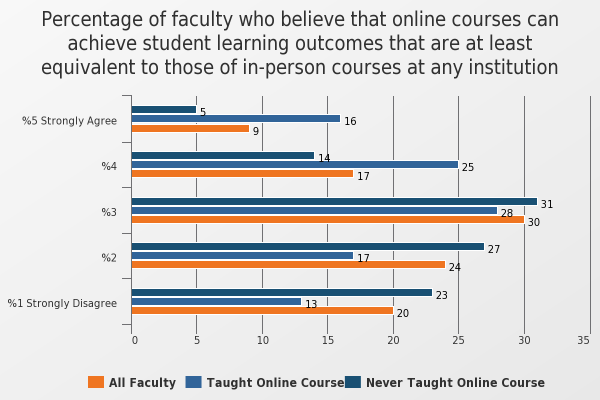
The survey of faculty for Inside Higher Ed includes some interesting points. [You can click to get the entire report, but you have to register.] In brief, faculty remain unconvinced that online education can deliver equal results to old-fashioned in-person classes. Online classes might do a good job—in some cases—at delivering content. But most faculty agree: there is something important lost when face-to-face interaction isn’t a leading part of university classes.

IHE CHART

Source: Carl Straumsheim, “Online Ed Skepticism and Self-Sufficiency: Survey of Faculty Views on Technology,” Inside Higher Education, October 29, 2014.

The survey specifically excluded some of the schools we’re interested in, what it calls “Bible colleges and seminaries.” And none of the questions included anything about student faith.

But no one interested in online higher education these days can ignore the fundamentalist elephant in the room. Liberty University, a school founded by Jerry Falwell in 1971, now claims almost 100,000 online students. In addition to standard online coursework, Liberty offers online spiritual help, too. Students can join online prayer groups and Bible blogs.

But this menu of religious fare does not seem to match the traditional goals of conservative religious colleges. At most schools, the faith of students has been the primary concern, not merely an additional click on a webpage. And most college administrators have been keenly worried about sliding into heterodoxy and secularism. In his brilliant 1994 dissertation about Wheaton College, historian Michael Hamilton explained this sentiment like this:

The paradigm that has dominated Wheaton through the [twentieth] century holds that colleges, more than any other type of institution, are highly susceptible to change, and that change can only move in one direction—from orthodoxy toward apostasy. . . . The very process of change, no matter how slow and benign it may seem at first, will always move the college in a secular direction, inevitably gathering momentum and becoming unstoppable, ending only when secularization is complete.

This mindset, I believe, is common among conservative evangelical schools. From Wheaton, to Biola, to Gordon, to more conservative schools such as Bob Jones and Liberty…all have worried that change will equal declension. All have been concerned, first and foremost, that novelty will lead faculty and students to abandon their faiths.

So here’s the question we wished Inside Higher Ed had asked professors at conservative schools: How can online education remain orthodox? How can the faith of students be preserved if student/teacher interaction is weakened?

And perhaps this is the toughest question for the folks at Liberty University: Has their wildly successful pursuit of online education changed their goal? Has Liberty abandoned its religious mission? Or, rather, could this massive online presence be compared to the televangelism of an earlier generation? Could the thousands of online students be seen as an enormous “mission field” for Liberty’s evangelical message?

From the Archives: I Miss Letterhead

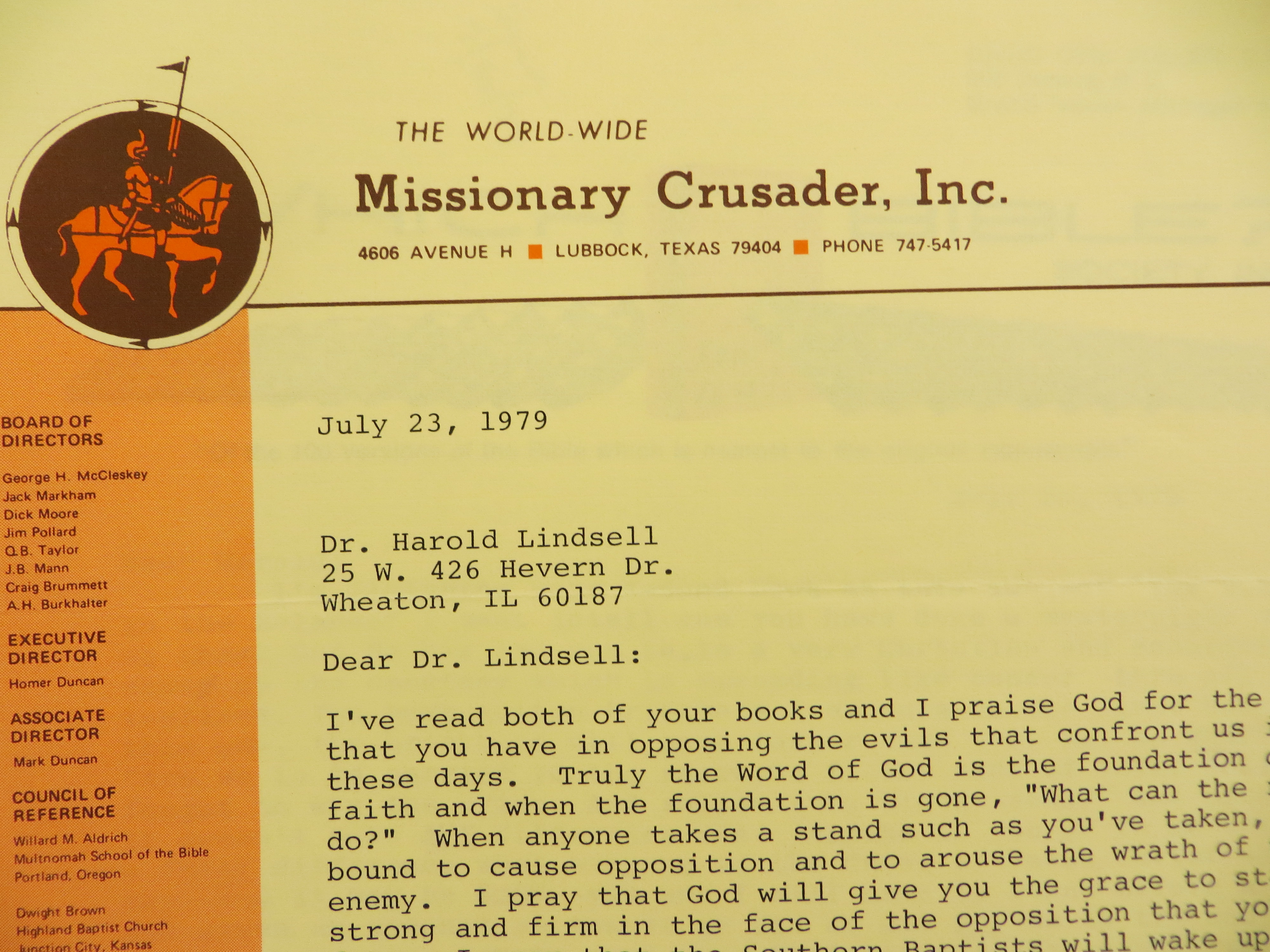
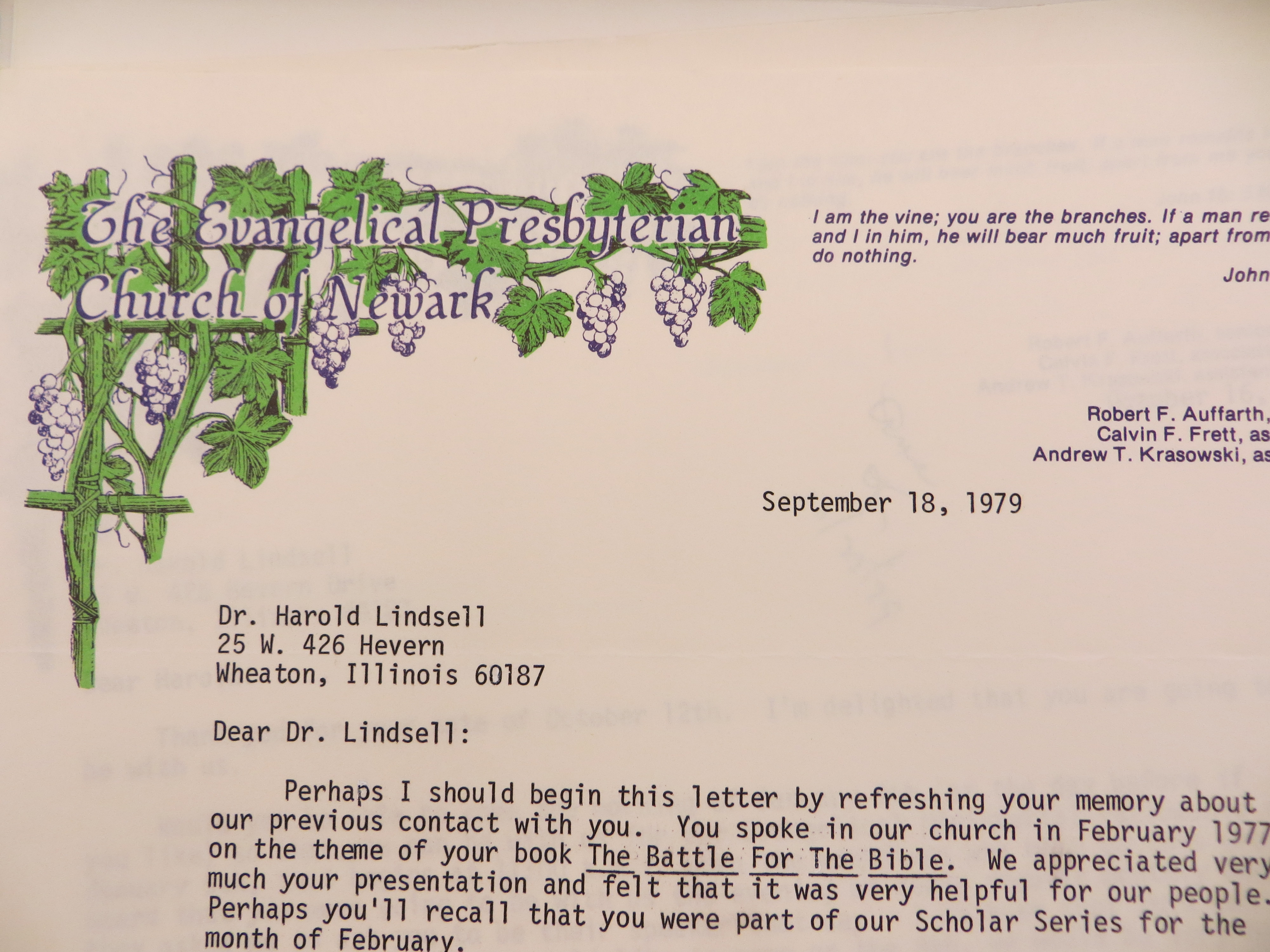
How old are you? Do you remember stationery with big, fancy letterheads? In my research this week at the Billy Graham Center Archives at Wheaton College, I’m digging through thick files of letters from the 1920s through the 1980s.

And so many of the letters come on pages with enormous, elaborate letterhead designs. Just for fun, I’ll share some of the best images from today’s work. These are mainly from a network of conservative evangelical institutions, dating from the 1940s through the 1970s.

c. 1955

c. 1955

letterhead from BGC 1letterhead from BGC 2letterhead from BGC 3letterhead from BGC 4letterhead from BGC 5letterhead from BGC 6letterhead from BGC 7

Hello, Wheaton!

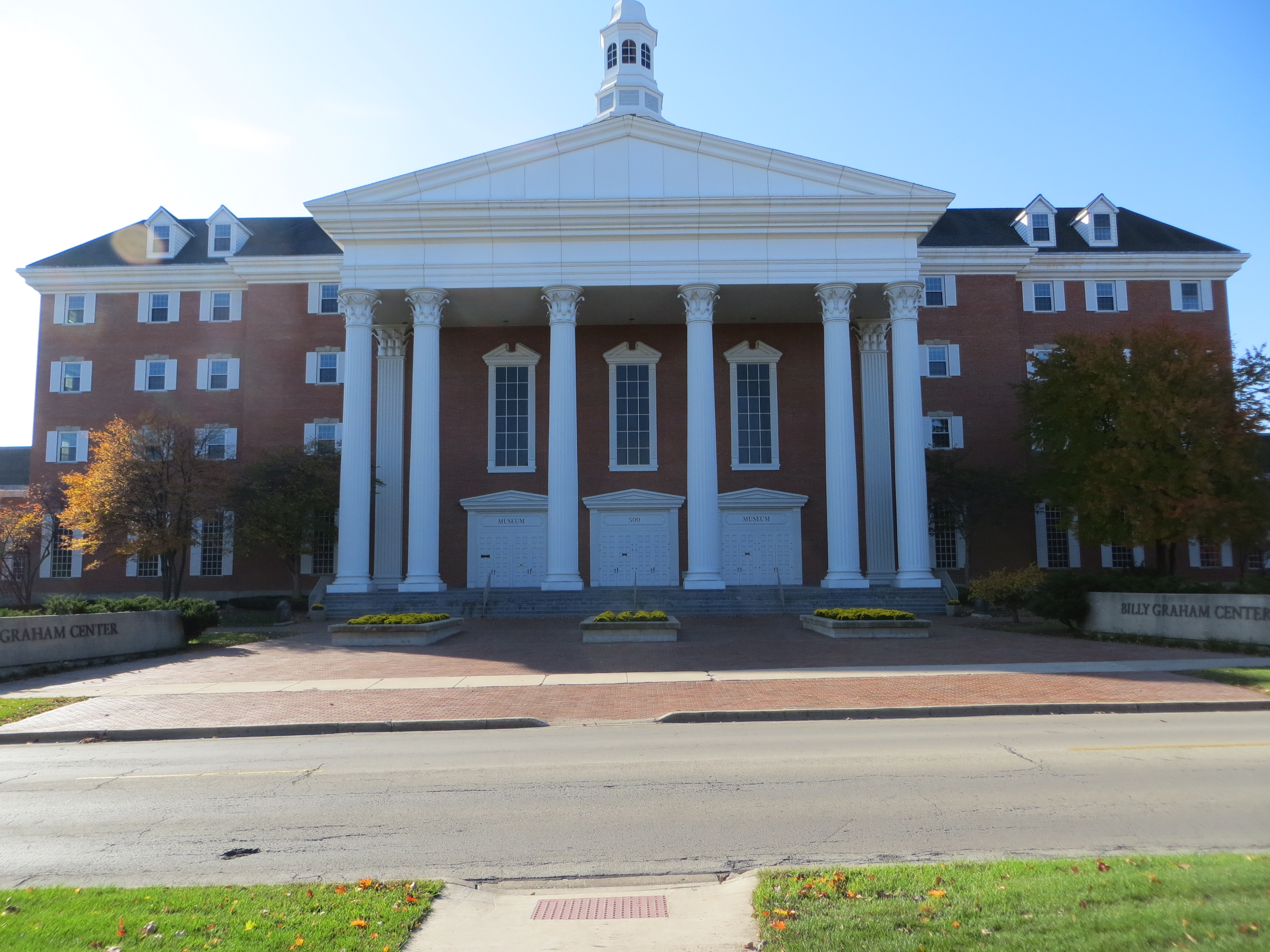
Rolled into sunny Wheaton, Illinois last night to start my research at the fabled Billy Graham Center Archives. Located on the campus of Wheaton College, this archive is like nerd Disneyland. The collections are beautifully organized and intimidatingly expansive.

I'll be here all week...

I’ll be here all week…

What am I doing here? It’s the natural first stop for anyone interested in the history of conservative evangelical colleges. The collections offer two great things. First, Wheaton College itself has been a leading fundamentalist/ evangelical college since the 1920s. It enjoys a unique and uniquely influential history as a leader in the network of conservative colleges. As leading historian Joel Carpenter put it, in the 1920s

There was only one college of thoroughly fundamentalist pedigree . . . that was neither just half-evolved from Bible school origins nor still waiting for the ink to dry on its charter.

That school, of course, was Wheaton. For my current research, I’ll need to dive deep into the history of Wheaton itself. What was life like for students in different decades? For faculty? I also have some specific questions about interesting episodes. For instance, why did Wheaton kick out its fundamentalist president in 1939? Why did the board of trustees add in 1961 a line to the statement of faith that Adam and Eve were real, historical people? What did Wheaton’s version of the “free-speech” movement look like in 1964?

But these archives offer more than just a look at the history of Wheaton itself. Since the school was such an influential leader in the field of evangelical higher ed, its leaders kept in constant contact with other school leaders. In their correspondence, I’ll be digging to discover the issues that motivated school leaders across the entire network of conservative evangelical colleges. This will include prosaic issues such as admissions and accreditation, but also uniquely evangelical issues such as determining which schools remained orthodox and which threatened to slide into liberalism and modernism.

Best of all, decades of work by the archivists at the Billy Graham Center has created an invaluable collection of oral history interviews. Some of these are available online and I’ve been reading them during the past weeks. But many more are only here at Wheaton. In these interviews, alumni of Wheaton and the rest of the conservative evangelical college network remember what life was like at these schools in the 1920s, 1930s, 1940s, and more recently. Why did they decide to go to Wheaton? Or the Moody Bible Institute? Or John Brown College? Or a ‘secular’ public university? Many of these interview subjects offer unique perspectives on what college life was like.

With such a vast collection, I need to pace myself. There’s no way to take it all in during one short visit. Instead, I’ll see what I can discover and make plans to come back soon.


Bryan College: Creationism Déjà vu All Over Again

It’s all over but the shouting.  That’s the news from Bryan College.  Thanks to the ever-watchful Sensuous Curmudgeon, we see that Bryan College has settled its legal dispute with two of its professors.  The creationist courtroom drama may have been avoided, but we are left with one question: If this is part of a predictable pattern at conservative evangelical colleges, can we learn a better way to handle each new episode?

Why can't we all just get along...?

Why can’t we all just get along…?

Two Bryan College professors, Stephen Barnett and Steven DeGeorge, have settled their lawsuit with the school, according to the local newspaper.  Readers may remember that the school abruptly changed its statement of faith to insist that Adam and Eve did not descend from another species.  Faculty members had to make a tough decision: Could they agree to the newly explicit language about humanity’s origins?  Barnett and DeGeorge argued that it was not fair—nor even legal—for the school to impose such a decision on faculty.  It appears they have decided to drop the lawsuit, though the terms of this settlement have not been made public.

Why did Bryan’s leadership feel a need to make such a change?  They were in a tight spot.  As I’ve argued before, leading young-earth creationists such as Ken Ham are able to wield outsized influence on evangelical colleges.  Even the whiff of suspicion that a school has abandoned the true faith is enough to drive away students and their precious tuition dollars.  At Bryan—and I’m claiming no inside knowledge here, just a historian’s best guess—the leadership felt obliged to shore up its orthodox creationist bona fides.

This tension is nothing new at evangelical colleges.  Perhaps the most startling example of the deja-vu nature of the Bryan situation is an eerily similar case from Wheaton College in 1961.  In that case, faculty such as Russell Mixter hosted a conference on origins.  Whatever actually occurred at that meeting, rumors flew that Wheaton had opened itself to the teaching of evolution.  As a result, anxious trustees rammed through a change to the obligatory faculty creed.  From then on, faculty had to attest to their belief in “an historical Adam and an historical Eve, the parents of the human race, who were created by God and not descended from lower forms of life.”

Back then, Mixter signed.  He was more interested in the broad outlines of what he called “progressive creationism” than the details of the Garden of Eden.  But the nervousness of the leadership at Wheaton was palpable.  In addition to the change in creed, the school took out big advertisements in evangelical magazines such as Christian Life that trumpeted Wheaton’s continuing creationism.

The stories are so similar that it is hard to believe they are separated by over fifty years.  And they lead us to obvious questions: Why do evangelical colleges have such anxiety about their reputations as creationist colleges?  Why do leaders feel such a compelling need to publicize their continuing orthodoxy?  And perhaps most important, if these controversies are so predictable, why is there no better way to handle them?

As historian Michael Hamilton has argued about Wheaton, “Anxiety about constituent response hangs over virtually every decision the college has made since 1925.”  The same could be said for Bryan and every other school that relies on conservative evangelical families for its student bodies.

Each of these schools’ identities, after all, relied on the notion that they have been “safe” alternatives to mainstream schools.  At the more conservative Bob Jones University, for example, founder Bob Jones promised a different sort of college experience.  In 1928, just a few years after the school was founded, Jones promised,

fathers and mothers who place their sons and daughters in our institution can go to sleep at night with no haunting fear that some skeptical teacher will steal the faith of their precious children.

And even though Wheaton College was a very different sort of evangelical school, this central notion was the same.  In the 1930s, Wheaton advertised itself as a “safe college for young people.”

This pledge means more than just institutional window-dressing.  For conservative evangelical schools, the issue of orthodoxy looms large.  This stretches beyond the issue of creationism.  As we see in cases such as the recent controversy at Gordon College, ideas about sexuality also prove intensely controversial.  If schools want to change their policies, or sometimes even to clarify existing policies, they risk sparking a no-holds-barred fight that might threaten the continuing existence of their college.

No wonder school leaders are nervous.

The most recent episode at Bryan seems to have limped its way off the public stage.  But not without resentment, bitterness, and feelings of betrayal all around.  So we are left with a few questions for the leaders of conservative colleges: If this is such a central organizing principle of conservative orthodox colleges, why do they seem never to learn?  Why does today’s controversy at Bryan copy the pattern of Wheaton’s in 1961 so exactly?  Is there no better way to handle this predictable tension?

Evangelicals and Homosexuality on the College Campus

Maybe President Lindsay feels better knowing that only high pressure can create diamonds. Because the leader of evangelical Gordon College is feeling intense pressure from two sides right now. On one hand, the school’s accrediting agency has threatened to take away its accreditation if Gordon does not revise its policy on homosexuality. On the other, the school’s conservative supporters insist the policy must stay in place. If history is any guide, it appears one group might make the crucial difference in this case.

Are all welcome?  MUST all be welcome?

Are all welcome? MUST all be welcome?

This Gordon-ian knot is one that all conservative evangelical colleges have tried to pick apart. Schools such as these are in a pickle: they need to remain intellectually respectable and financially viable, yet a decision either way threatens both intellectual consistency and the bottom line.

As I’m finding as I research my new book, similar schools have had a difficult time walking this line. In the 1930s, for example, Wheaton College leaders moved fast to bring Wheaton up to accreditors’ standards. As historian Michael Hamilton argued, the president at the time, Oliver Buswell, viewed accreditation as more than just a piece of paper. To Buswell, accreditation was the “one of the best ways to earn intellectual respect for fundamentalist Christianity.”

But college leaders such as Buswell were also under intense pressure to maintain both the appearance and the reality of theological steadfastness. Leaders needed to maintain the confidence of the evangelical community that their schools were not slipping into secularism. In 1929, for instance, Buswell withdrew from publication a controversial book he had written. Why? As he explained to a colleague, above all Buswell felt the need to keep “the confidence of fundamentalist leaders . . . in the administration of Wheaton College.”

Losing either accreditation or the respect of the “fundamentalist” community could mean a wasting death for an evangelical college. And the two have often pushed in opposite directions.

WWBD?

WWBD?

Much has changed since then, but President Lindsay at Gordon College finds himself coming under similar pressure from both sides. [Full disclosure: I worked with Michael Lindsay in the Spencer Foundation/National Academy of Education Postdoctoral Fellows program. I consider him a friend and colleague.]

For those who are just joining us, this story began back in July, when President Lindsay signed an open letter to President Obama about religious exemptions to an anti-discrimination law. Now, the question has become whether Gordon’s Statement on Life and Conduct violates the rules of its accrediting agency.

At issue is the Gordon ban on “homosexual practice.” The New England Association of Schools and Colleges has collaborated with Gordon in setting up a “discernment” group to examine the policy.  (As an aside, we could ask why only this part of the policy has come under investigation. After all, the Gordon policy also bans “blasphemy” and “profanity,” not to mention heterosexual sex outside of marriage. Doesn’t this impinge upon the free speech rights of potential students?)

For a host of reasons, the accrediting agency doesn’t care about blasphemy. But it is threatening to withdraw accreditation over the ban on “homosexual practice.” For Gordon College, loss of accreditation would have serious consequences. Its graduates would not necessarily be considered qualified for graduate school. Nor could they receive student loans backed by the federal government. Perhaps most important, though, loss of accreditation would be a symbolic slap in the face. Gordon would face the challenge of proving its continued intellectual respectability.

But that is not the only pressure facing Gordon right now. Just as President Buswell at Wheaton worried about both mainstream intellectual respectability and credibility within the world of conservative evangelicalism, so President Lindsay faces a double-sided threat.

Beyond accreditation pressure, Lindsay must consider the opinions of the far-flung community of conservative evangelicals. As one conservative pundit wrote recently in the pages of the Christian Post,

To Michael Lindsay, the gifted president of Gordon, and to the board of trustees, I remind you: Many eyes are watching you, knowing that the decisions you make could either strengthen or dishearten many other schools that will soon be put under similar pressure.

As this conservative writer worried, Gordon might be willing to “sell its soul” to maintain accreditation.  If it did, conservative students and parents might take their tuition dollars elsewhere.  But if it doesn’t it might lose accreditation.  Without that sort of mainstream credibility, students and parents might take their tuition dollars elsewhere.

So what is a conservative school leader to do? How can President Lindsay balance the pressure to reform with the pressure to hold fast to the faith once delivered to the saints?

In this case, there is a new wrinkle. Traditionally, alumni are one of the groups most likely to push school leaders to maintain conservative positions. Today, though, some Gordon alumni are hoping to convince Gordon to change its ways. A group of two dozen alums have published a letter encouraging Lindsay to remove any hint of anti-gay discrimination from Gordon’s policies.

In the past alumni have been one of the most vocal groups fighting any change at evangelical colleges. Conservative evangelical colleges have long been keenly aware of the pressures to modernize and secularize. Traditionally, alumni of these schools have been staunch foes of any perceived change, since any change could lead to an utter loss of the school’s steadfast character. Historian Michael Hamilton described this alumni attitude this way:

colleges, more than any other type of institution, are highly susceptible to change, and that change can only move in one direction—from orthodoxy toward apostasy. . . . The very process of change, no matter how slow and benign it may seem at first, will always move the college in a secular direction, inevitably gathering momentum and becoming unstoppable, ending only when secularization is complete.

In Gordon’s case, however, alumni—at least some of them—are pushing in the other direction. It is impossible to predict what will happen at Gordon. The board of trustees may decide this policy needs updating. Or they may not. And President Lindsay might decide that this language is a central part of the school’s evangelical character. Or he may not.

This case highlights the double pressure faced by conservative evangelical colleges. In a sense, they must serve two masters: the pressure to maintain a vague and shifting “respectability” with mainstream institutions; and the pressure to remain bastions of orthodoxy in a world hurtling headlong into secular mayhem.

College Christians Strike Back

Do evangelical Protestants need to boycott pluralist universities? That’s the plan this morning from Joe Carter at the Acton Institute.  To those aware of the longer history of conservative Christianity and higher education, this sounds like déjà vu all over again.

Carter is reacting to the latest round of de-recognition of Intervarsity Christian Fellowship. This time, the campuses of the California State University system will no longer accept IVCF as a full member of their communities.  At issue is the system’s newly enforced policy of non-discrimination.  No student organization will be allowed if it does not open its leadership ranks to all comers.  For IVCF, that’s a no go.  The organization insists that leaders must agree with its evangelical statement of faith.

This higher-education controversy has been going on for a while. Most prominently, as we noted in these pages, Tufts University de-recognized its campus IVCF chapter.  Other schools have followed suit.

De-recognition has consequences, but it doesn’t mean the organization is banned. Rather, a de-recognized group is not allowed free use of campus facilities for its meetings.  It is not allowed to take part in campus-wide recruitment fairs.  Perhaps most significantly, de-recognition sends a symbolic message that an organization is no longer part of a campus community.

How should evangelicals react? Joe Carter says they should go their own way.  As Carter puts it,

Colleges and universities are businesses that exist in a competitive educational market. A free market solution is to refuse to support the business’ “product.” In other words, Christians should refuse to attend schools in which their beliefs are “derecognized.” Similarly, alumni should refuse to provide donations to support a college or university that considers our faith not welcome on the campus.

We’ve seen this argument before. As I argued in my 1920s book, the first generation of fundamentalist leaders worried about the state of higher education.  At both pluralist and religious schools, fundamentalists charged, anti-Christian teaching and attitudes threatened the faith of young Christians.

Some leaders insisted that the only answer lay in the boycott. Evangelist Bob Jones Sr., for instance, opened his own college in order to offer fundamentalist parents an alternative.  As Jones remembered decades later in a private letter,

Going about over America in my evangelistic work, I ran into so many people who had lost their faith in schools, some of which were supposed to be Christian schools and that had at least been built with Christian money but that had compromised and brought religious liberals into the school; and young people had lost their faith. I kept one fellow from committing suicide because of what happened to him in a certain school that had been built with sacrificial gifts of Christian people but an institution that had gone modernistic.  I made up my mind there ought to be a certain type school somewhere in America, but I did not want to build it.  I was at the height of my evangelistic career and had open doors all over the world. . . . I went on to tell [his wife] that there is an idea going around that if you have old-time religion you have to have a greasy nose, dirty fingernails, baggy pants, and you must not shine your shoes.  And I told her that religious liberals were putting that over.  I said, ‘I want to build a school that will have high cultural and academic standards and at the same time a school that will keep in use an old-time, country, mourner’s bench where folks can get right with God.’

As a result, conservatives who agree with Joe Carter have a place to go. A network of evangelical colleges and universities offer alternatives to schools that might de-recognize Christian student groups.  Whatever one’s theology and preferences, from fundamentalist Bob Jones University deep in the heart of Dixie to evangelical Wheaton College just outside of Chicago; from Manhattan’s aggressive The King’s College to LA’s laid back academic Biola vibe.

If evangelicals really feel a need to boycott pluralist campuses, they have no shortage of Christian options.

I Hart Lyle Spencer

I want to shout it from the rooftops. I love this man!

Mr. Spencer, I Love You.

Mr. Spencer, I Love You.

Thanks to his Spencer Foundation, I’ll be able to spend the next year traveling to archives to research my new book. My grant from the Spencer Foundation will fund my trips to a variety of evangelical colleges. I’m looking forward to diving into the world-class collection at the Billy Graham Center Archives, for example.

My goal in this book is to explore the history of evangelical higher education in the twentieth century. What did schools such as Wheaton College, Bob Jones University, Biola University, Bryan College, John Brown University, and a host of others hope to teach their students? Most interesting, since the emergence of “fundamentalism” in the 1920s, how did these colleges try to teach their students what it meant to be an evangelical Christian in a rapidly secularizing America?

Naturally, these questions changed over time. In the 1920s, for example, the first decade of “fundamentalism,” evangelists and evangelical intellectuals struggled to define what it meant to be a “fundamentalist.” For Bob Jones, it meant eschewing many of the outward trappings of modern life as well as cultivating a Bible-first way of knowledge. For President Blanchard of Wheaton College, it meant more of a theological steadfastness.

By the late 1940s, the world of conservative evangelicalism had changed radically. I want to explore the ways these changes emerged on evangelical campuses. What would it mean for a family in 1950 to choose to send their sons or daughters to “evangelical” Wheaton instead of “fundamentalist” Bob Jones? Or to Biola instead of one of the growing crop of non-religious colleges, including my own beloved Binghamton University (founded 1948)?

Each new generation offers new topics. Moving into the late 1960s, conservative colleges experienced a very different “Sixties.” I’m interested in exploring the ways evangelical students and faculty developed a counter-counter-culture. And in the late 1970s, the emergence of a “New Christian Right” in mainstream American politics was both fueled and influenced by developments in evangelical higher education.

Central to all these investigations will be the experience of students and faculty at evangelical colleges. Luckily, the archives of all these schools have rich collections of their own students’ experiences. At the Billy Graham Center Archives, a host of oral history interviews also tracks the school memories of evangelicals from across the decades.

Thanks to the Spencer Foundation, I’ll be able to devote the next year to full-time research. For readers who are unaware of the Foundation, it is the best thing going in education research. I’m not saying that only because of my generous grant. Every academic knows about the Spencer Foundation’s programs, including its dissertation fellowship and its postdoctoral fellowship. In my case, a postdoc from the Spencer Foundation and National Academy of Education allowed me to complete two books, my 1920s book and my upcoming one about educational conservatism in the twentieth century.

So I say it with unabashed enthusiasm: I Love Lyle!


Christians CAN Think

Just because someone is a Christian, he or she is not therefore incapable of reasonable thought. That’s the argument recently from Provost Stanton Jones of Wheaton College. But is this true everywhere? Or only in the hallowed halls of Wheaton itself?

Jones was responding to a hatchet job from University of Pennsylvania English Professor Peter Conn. As we noted at the time, Conn accused Wheaton and other evangelical colleges of scamming their way into intellectual respectability. No school that demanded a faculty statement of faith, Conn argued, should be eligible for federal student aid. It was an intellectual and constitutional outrage.

In the discussion in these pages, commenters mostly took Conn to task for closedmindedness. Provost Jones takes a different approach. Not only are Wheaton faculty free to think and research, Jones writes, but they are actually freer than most faculty at non-religious schools. And their work will ultimately be more productive than that of their unfortunate colleagues at those schools.

Those researchers who fit in with the “contemporary intellectual tides,” Jones argues, might feel very free indeed at non-religious colleges. But for those who dissent, the “free” academic environment feels deadeningly constricting. A Bible-believing Christian professor, for example, might not feel entirely comfortable in a rigorously pluralist university like mine. “When we hire colleagues away from nonreligious institutions,” Jones asserts,

we often hear they feel intellectually and academically free here for the first time in their professional careers, because they are finally in a place where they can teach from and explore the connections between their intellectual disciplines and their religious convictions.

That’s not all. Jones uses the tools of postmodern academic life to undermine Conn’s attack. If “truth” is something we can only put in ironic quotation marks, we will be severely limited in our search for it. As Jones puts it,

Purely skeptical and unfettered inquiry is likely to simply chase itself in circles. Disciplined, rigorous, and self-critical inquiry grounded in a thoughtful understanding of one’s particularities can contribute to a vigorous and diverse intellectual marketplace.

Christian academics at schools such as Wheaton, Jones writes, are freer and more productive than their fettered colleagues at secular schools.

We should note, Jones only defends the rigor of academic work at his own school, Wheaton College. Conn’s attack was a broad-brushed condemnation of conservative Protestant colleges in general. Jones does not insist that other evangelical colleges offer conducive research homes for top-notch academics. I can’t help but wonder if this is mere oversight, or an unwillingness to vouch for the academic chops of evangelical higher education in general. Seems like Provost Jones is confident of the high-caliber intellectual firepower at Wheaton, but maybe not so sure of the strength of other evangelical schools.