Dynasties and Christian Colleges

Why do conservative Christian colleges pass from father to son?  That’s the question asked recently by Mark Oppenheimer in the New York Times.  He looks at the dynastic succession of school presidents at schools such as Liberty and Bob Jones.  But does Oppenheimer give short shrift to the history of the question?

It’s an intriguing line of inquiry.  Leading schools such as Liberty University, Oral Roberts, and Bob Jones University all have histories of passing leadership from father to son.  Sometimes this has worked well, Oppenheimer points out, but sometimes it has not.

Why have conservative schools constructed these sorts of dynasties?  Oppenheimer explains it as a sort of sectarian necessity.  Colleges such as Liberty and BJU started as outgrowths of the founders’ evangelistic efforts.  Those efforts included the creation of a sub-cultural identity.  Only a limited circle of true believers could be trusted to carry on the legacy.  As a result, Oppenheimer argues,

It would thus be a small band of insiders, versed in the particulars of the founder’s message, who would even be eligible to carry it into the future. That may be why, for example, the presidential search committee at Bob Jones University, while not seeking another Jones descendant, has stated “a preference for a B.J.U. graduate.”

Oppenheimer wisely consulted scholars such as Matthew Sutton and D. Michael Lindsay.  Lindsay warned not to read too much into this dynastic tradition at evangelical schools.  After all, the cases Oppenheimer cites make up only a handful, among hundreds of colleges.  And they are only at the “newer colleges.”

I have the greatest respect for President Lindsay as a scholar, school leader, and all-around nice guy.  [Full disclosure: Lindsay and I served together as postdoctoral fellows with the National Academy of Education.]  But in this case, Lindsay whitewashes the connection between legacy and Christian colleges.  And unfortunately, Oppenheimer lacks either the word count or the historical knowledge to push Lindsay on the issue.  It’s a shame.

After all, in contrast to Lindsay’s assertion, dynasties in evangelical colleges go way back.  And there seems to be some tentative connections we could suggest between the drive for orthodoxy and the family connections.  For example, the flagship evangelical school, Wheaton College, passed from father to son in 1882.  And though this might make today’s evangelicals uncomfortable, Charles Blanchard, son of founder Jonathan Blanchard, originally took the school in an explicitly fundamentalist direction.  To be fair, as I argue in my 1920s book, the meanings of “fundamentalism” as Blanchard the Younger understood them in the 1920s were significantly different than they became after Blanchard’s death.

There can be no mistake, however, in Charles Blanchard’s intention.  He wanted to align Wheaton College with fundamentalism, with orthodoxy, with the fight against modernism.

The question we still need to ask, though, is how much this drive for orthodoxy resulted from the dynastic structure of the college.  Did Charles Blanchard feel pressure to maintain his father’s orthodox legacy?  Did Bob Jones Jr.?  Jerry Falwell Jr.?

Oppenheimer asks a good question in this article.  But we wish he had the space and the background to push it a little further.

Ken Ham Is My Guidance Counselor

Why does Ken Ham care where you go to college? Where you send your kids?   Because “college” is more than just a collection of classes and academics. For religious conservatives as for everybody else, “college” represents a formative experience. The ideas one will encounter, the personal connections one will make, and the changes in one’s outlook and worldview all make the college years some of the most transformative in our lives.

In recent years, Ham, America’s (and Australia’s) leading voice for young-earth creationism, has established himself as the arbiter of creationist orthodoxy in college attendance. And his word carries weight in the world of evangelical higher education.

Recently, for instance, Ham warned readers at Answers In Genesis about the dangers of attending Calvin College. Students at that storied Christian school, Ham explained, were “being influenced . . . to undermine the authority of Scripture in many ways.” When faculty engage in evolutionary research and teaching that might turn away from Ham’s strict attitudes about knowledge and creation, Ham warns, students will too often abandon their creationist faith.

As a precaution, Ham offers readers a list of schools that adhere to the young-earth creationism taught by Ham’s Answers In Genesis ministry. To be safe, Ham warns, parents and students ought to stick with schools that have proven their fidelity to these ideas.

Ham’s anxiety over the crumbling orthodoxy in Christian higher education is nothing new. As I argue in my 1920s book, many of today’s evangelical schools had their origins in the founding decade of American fundamentalism. Back in the 1920s, religious schools often faced a choice between fundamentalist orthodoxy and modernist adaptation. Most chose modernism. The University of Chicago, for example, founded as a Baptist beacon of learning, became the leading voice for theological modernism, employing such folks as Shailer Mathews and Shirley Jackson Case. In contrast, a few Christian schools, most famously Wheaton College, sided with the fundamentalist movement.

Leading fundamentalists in the 1920s also founded a spate of new schools to embody their theological and cultural conservatism. Perhaps most prominently, evangelist Bob Jones Sr. opened Bob Jones College (now Bob Jones University) in 1926. The goal of this school was to form the fundamentalist character of young people while educating them in the best traditions of arts and sciences. In order to reassure parents that the school would never slide toward theological modernism or cultural liberalism, Jones and his allies established a rock-ribbed charter. This charter hoped to guarantee the continuing orthodoxy of the school. The charter’s second paragraph outlined that orthodoxy:

The general nature and object of the corporation shall be to conduct an institution of learning for the general education of youth in the essentials of culture and in the arts and sciences, giving special emphasis to the Christian religion and the ethics revealed in the Holy Scriptures, combating all atheistic, agnostic, pagan and so-called scientific adulterations of the Gospel, unqualifiedly affirming and teaching the inspiration of the Bible (both Old and New Testaments); the creation of man by the direct act of God; the incarnation and virgin birth of our Lord and Saviour, Jesus Christ; His identification as the Son of God; His vicarious atonement for the sins of mankind by the shedding of His blood on the Cross; the resurrection of His body from the tomb; His power to save me from sin; the new birth through the regeneration by the Holy Spirit; and the gift of eternal life by the grace of God.

Perhaps most notably, the next line specified that this charter “shall never be amended, modified, altered, or changed as to the provisions hereinbefore set forth.” Also remarkable, according to a 1960 reminiscence by Bob Jones Sr., at its founding BJU decreed that every graduating senior would pledge to monitor the school’s continuing fundamentalism. “Should the policy and conduct of the University ever, in my lifetime, deviate, in the slightest particular, from the letter or spirit of this Creed,” seniors would promise,

I hereby pledge myself to exert all my influence to affect a change in conditions; failing which, I will resort to such legal measures as the courts may offer to the end that the institution may be kept true to the University Creed and the original intentions of the founder.

Most evangelical colleges established similar creeds and many promised never to amend them. Not many others, to my knowledge, required such strict supervision by their alumni.

These days, Ken Ham has taken over the role of orthodoxy’s gadfly. In addition to his warnings about waverings from his definition of creationism at Calvin College, Ham has warned that other evangelical schools might be threatening the faith of their students. And Ham’s warnings carry weight.

In one recent episode at Bryan College, for example, Ham’s public worries about faculty orthodoxy led the school’s leadership to instigate a new sort of creationist orthodoxy pledge for faculty. From now on, faculty must publicly avow their belief in a real, historic Adam and Eve. As I argued at the time, the fallout from Bryan College’s policy shift might lead to a shake-up of faculty. More directly relevant, the furor at Bryan seems to testify to Ham’s influence. Worried that creationist parents might not send their students and their tuition dollars, Bryan’s leaders acted to shore up their image as a home of young-earth creationist orthodoxy.

Also intriguing, I must ask again if the drive to protect their reputations as safe theological and cultural havens has led some conservative evangelical schools to cover up incidents of sexual assault. Of course, these are very serious allegations, and I do not ask these questions lightly. I am certainly not accusing Ken Ham or the leadership of these schools of condoning sexual assault. But the drive to present a public face as a uniquely safe environment for fundamentalist students certainly puts undue pressure on college leaders. It is not unfair to wonder if such pressure might lead schools to downplay any cases that might threaten those reputations.

Outside the world of conservative evangelical Protestantism, colleges spend an inordinate amount of time and treasure to attract students. Flashy dorm rooms, high-visibility sports programs, celebrity faculty, and lavish campus lifestyles all hope to convince families to send their kids and their money to certain schools. The pressure on recruiters is intense.

There is a similar pressure on evangelical colleges. Influential voices such as that of Ken Ham are able to exert outsized influence by warning creationist families toward or away from certain schools. Without Ham’s imprimatur, conservative schools may lose the loyalty of students and families.

 

Lesbian, Feminist . . . Christian?

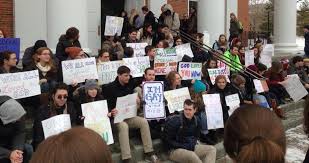
Student demonstrations aren’t big news.  But recently evangelical Christian students at evangelical flagship Wheaton College came out to agitate for, well, for coming out.

Student Demonstration at Wheaton

Student Demonstration at Wheaton

Wheaton College had invited Rosaria Champagne Butterfield to give a chapel talk.  Students protested that Butterfield’s message, her “train-wreck conversion” story, promoted damaging messages about homosexuality and Christian faith.

Butterfield attracted attention last year with her conversion story in the pages of Christianity Today.  As she told the story, she was a happy, moral, engaged citizen who happened to be a lesbian.  In her earlier career as a feminist academic, she pitied and pilloried evangelical Christianity for its anti-woman, anti-homosexual attitudes.  But after engaging with a local evangelical pastor and his family, Butterfield felt herself drawn to the faith.  She felt herself drawn to Biblical truths, to promising obedience before asking for understanding.  She fought against this conversion.  As she put it,

But the Bible got to be bigger inside me than I. It overflowed into my world. I fought against it with all my might. Then, one Sunday morning, I rose from the bed of my lesbian lover, and an hour later sat in a pew at the Syracuse Reformed Presbyterian Church.

As we’ve seen in these pages, the tangled mess of morality, sexuality, and Christianity has caused heartache and abuse, and college campuses often become the stage on which these questions find themselves played out.  Last month, Butterfield’s chapel talk at Wheaton College became the focus of a silent student demonstration.  Christian students at the evangelical school wanted the world to know that Christianity did not require “healing” from homosexuality.  Student Justin Massey told the student newspaper,

We feared that if no conversation was added to the single message of the speaker that students who are not very well informed were going to walk into chapel, hear the message, and have misconceptions confirmed or that students who are LGBT would be told that this story is the absolute way that things happen.

After the chapel talk, Butterfield met with student demonstrators.  The student newspaper published a short interview.  Butterfield explained that she was a feminist on issues such as equal pay for equal work, but that feminism as a “worldview” did not work.  She insisted that she viewed sexuality through a Biblical lens, one that condemned both homosexuality and homophobia as sins.

Students disagreed.  They thought Butterfield misinterpreted the Bible, and that her attitude gave a pass to the sorts of patriarchal sexual abuse cases that we’ve discussed in these pages.

For those of us outside the world of evangelical Christianity, the discussion was illuminating.  First of all, we see how both sides of the issue use the Bible to buttress their arguments.  Students at Wheaton did not lambaste Butterfield for making arguments based on an ancient book.  Rather, they insisted that Butterfield relied on bad interpretations of that text.  Also, we see, as the student protesters insisted, that there is “more than a single story” about sexuality in evangelical higher education.  Some of us were surprised recently to find that Christian professors do not universally condemn homosexual students.  Many of us, like Dr. Butterfield in her earlier life, assume that homosexuality is something on which evangelical Christians agree.  This story shows us the true complexity of sexuality in evangelical thinking.


Booze and Bibles

Have a cocktail with your Leviticus?

That’s the new option for faculty and hangers-on at Chicago’s storied Moody Bible Institute.

Image Source: Renew Chicago

Image Source: Renew Chicago

It represents only the newest iteration of an age-old story for conservative evangelical institutions: How much to embrace and how much to eschew contemporary cultural norms.

According to a story in Religion News Service, the downtown Bible institute will now allow faculty and staff to drink.  This is new.

The question asked by Sarah Pulliam Bailey is whether this represents a trend among leading evangelical institutions.  As Bailey points out, evangelical organizations such as Focus on the Family and Wheaton College have made similar changes to their lifestyle policies.

Bailey might also have mentioned recent changes at the more conservative Liberty University.

Such questions of cultural relevance and theological fidelity are nothing new at Moody Bible Institute.  As I argued in my 1920s book, President James M. Gray wondered at that time whether the new fundamentalist movement was a boon or a threat to the MBI’s evangelical mission.

In the end, President Gray and the 1920s MBI generation took a skittery position on fundamentalism.  Insofar as fundamentalism supported a firm insistence on the inerrancy and primacy of Scripture, it was all to the good.  But if the new fundamentalist movement took attention away from the primary goals of Bible knowledge and evangelical effectiveness, it was a threat.

Nor is the weightiness of the MBI’s internal debates about this issue unique among conservative educational institutions.  Many evangelical schools have a long history of struggle with questions of change and cultural consonance.  At Wheaton College, for example, President Charles Blanchard fretted throughout the 1920s about the meanings of modernism.  At that time, “modernism” among evangelical Protestants referred, first and foremost, to a theological movement.  Modernists in the 1920s hoped to bring church doctrine more in line with changing cultural norms.  Fundamentalists and their conservative allies, on the other hand, insisted on keeping true to traditional theological norms.

Blanchard, as did other evangelical educational leaders in the 1920s and since, experienced a good deal of anguish as he worked to guide his school through this cultural Scylla and Charybdis.  On the one hand, Blanchard, like Gray, did not want to truckle to fads.  On the other hand, neither leader wanted to insist on tradition merely for the sake of fuddy-duddy-ness.

The recent decision to allow drinking among MBI faculty represents a similar wrangling with contemporary cultural issues.  How much does a trenchant cultural Amishness contribute to true Biblical understanding?  And how much does it distract from MBI’s central goals of Biblical missiology?


Jesus Teaching Evolution

We’ve been hearing a lot in the last few days about 47% of Americans: Governor Romney’s comments about the 47% who don’t pay federal income taxes, or the 47% whom he assumes won’t vote for him. 

I’m more interested in the 46% of adult Americans who believe humans were created in “pretty much their present form at one time within the last 10,000 years or so.”  For believers in evolution like me, that number is hard to understand.  How can so many adults–almost half of whom hold college degrees–believe in this kind of young-earth creationism? 

As we’ve discussed here recently, this is not merely a question of shoddy science education.  Mere exposure to evolutionary science does not promise to increase the number of believers in evolution.  The important element seems to be the messenger of evolutionary science, not just the message. 

A brief autobiography this morning by evolutionary creationist educational writer Abigail McFarthing seems to confirm this notion.  McFarthing describes her upbringing as a youngster homeschooled into the tenets of young-earth creationism.  As she writes,

“In ninth grade, I went to public high school armed and ready for the fight I had been trained to expect. When my biology teacher taught evolution and required us to write an essay, I hi-jacked the essay topic and turned it into an apologetic for six-day creation. Because I was in ‘conflict mode,’ I was not ready to consider the arguments for evolution, or the possibility that Christians could actually accept it.” 

It was not until McFarthing attended the evangelical Wheaton College that she was brought out of conflict mode.  As she studied to become a high-school teacher, one of her evangelical Christian professors insisted, “‘Jesus is not going to be standing at the gateway of heaven . . . holding a clipboard in his hand and asking, “Did you believe in six-day creation? Did you believe in evolution?” He’s going to be asking the one question that matters: “Did you believe in ME?”‘” 

The goal of McFarthing’s new homeschooling curriculum is not to train students away from their conservative evangelical faith.  Rather, she describes her goal as “resilience.”  She wants young people to realize that they can be Christian and accept the evidence for evolution. 

I’m not advocating McFarthing’s curriculum.  I do not think that her evolutionary creationism will fit in public schools, nor does she suggest that it should.  The interesting point here is McFarthing’s story.  It seems to add one more bit of evidence to a growing pile.  The way to educate people about evolution is not simply to bash them over the head with scientific evidence.  As we noted recently, evidence alone does not convince.  Rather, for people like McFarthing, the messenger is more important than the message.

In the News: Tebow in Fundamentalist New York

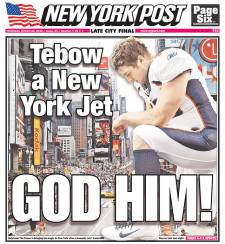
I know I’m not alone in hoping for some kind of Tim Tebow media blackout.  I was hoping the end of the football season, especially with the Broncos’ defeat, would bring some quiet to the Tebow-as-Christian-in-a-strange-land stories.  But Tebow’s move to the New York Jets brought a new round of media focus on Tebow’s style of loud public Christian-ness.
IMHO, the most interesting comment on the Tebow move came from Paul Moses at dotCommonweal.  Moses noted that the New York press tended to gasp at the incongruity of an extravagantly Christian celebrity in the extravagantly pagan Big Apple.

Moses pointed out,

The Times put it this way: “Tebow is also a somewhat incongruous fit: an outspoken Christian playing  in a city known for its extensive night life and a member of a  franchise made famous by the bachelor stylings of Joe Namath and  currently known for the profane speeches of its coach, Rex Ryan.”

And this, from the National Enquirer: “It is unclear how the pie-eyed pundit of the pigskin will respond to the multitude of temptations New York has to offer.”

Moses took such papers to task for assuming too much about life in New York City.  New Yorkers are a decidedly religious group.  Moses cited a Gallup poll from 1991 in which a majority of respondents–53%–said they prayed at least once a day.  The problem, Moses claimed, is that too many people equate Manhattan with the entirety of New York City.  In Manhattan, 17% of poll respondents claimed to be atheists.  In the Bronx, that number dwindled to 1%.

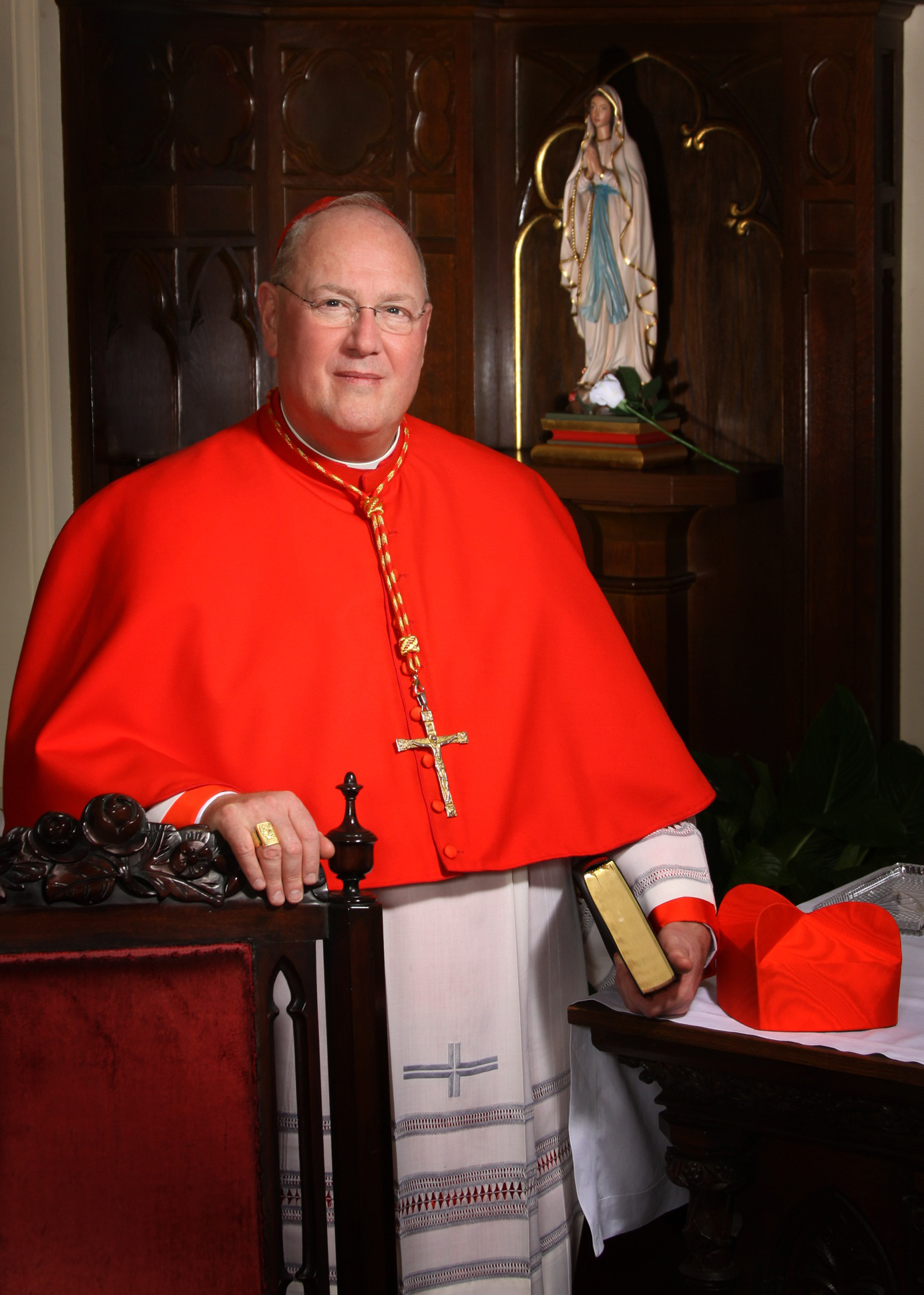
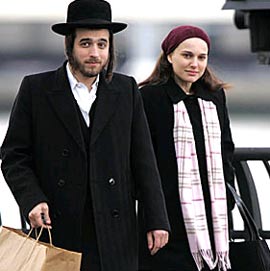
As we’ve pointed out here before, people who do not know much about Fundamentalist America often assume that religiosity goes up only with distance from big cities, education, and indoor plumbing.  It is just not true.  The myth might come from the association in the United States of conservative evangelical Protestantism with conservative religion as a whole.  But if we look at other conservative religious folks, New York City has as much of a claim to fundamentalism as anywhere else.  In the Catholic Church, for example, New York City is now home to genial Archbishop Timothy Dolan.  Dolan’s blog and very public presence inject a strain of conservative religiosity into life in the Big Apple.  And, of course, outside of Christianity, New York City is host to innumerable conservative religious groups.  The old joke about the hayseed who comes to New York and is surprised by the number of “New York Amish” demonstrates that New York has its own profound tradition of deeply conservative culture and theology.

Even within the bounds of conservative Protestantism, large urban areas have always served as strongholds.  True, someone wanting a Protestant fundamentalist education could go to Bob Jones University in lovely Greenville, South Carolina.  Or she could go to Liberty University in Lynchburg, Virginia.  But she could also head to Los Angeles to Biola University, or to Chicago’s Moody Bible Institute or Wheaton College.

The roots of this commonly held misperception, I think, come from the utter dominance of conservative evangelical Protestantism in some rural areas.  When folks from the big city drive around in fly-over country, they are shocked by the public dominance of this type of fundamentalism.  But such folks ought to look closer at their own cities.  Look for storefront Pentecostal churches.  Look for big cathedrals.  Look beyond the stereotypes of cities as home only to nightlife and paganism, and you’ll notice a deeply religious urban America.

There might be a few translation difficulties as Tebow  moves from the Bible Belt to the Big Apple, but there will not be any lack of fundamentalists ready to greet Tebow as he (if he?) makes his New York Jets debut.