Can Christian Colleges Say the R-Word?

Do conservative Christians encourage rape?  It’s a difficult thing to talk about, but it is a question these days at the center of discussions about conservatism, Christianity and higher education.  Most recently, blogger Samantha Field related the stories of students at Pensacola Christian College who had been punished by the school after suffering sexual assaults.  The accusations have attracted enough attention that PCC has felt obliged to make a public denial.  The school said it has been “harassed and victimized” by these accusations.  PCC, the school insisted, has always acted in accordance with the law.

This is not only an issue at Pensacola Christian College.  As journalist Kiera Feldman argued in a recent New Republic article, a similar culture of institutional arrogance prevails at Patrick Henry College.  And Bob Jones University has gone back and forth with its efforts to examine its own culture.  More broadly, Billy Graham’s grandson attracted attention a few months back for asking if evangelical Protestants had a worse record of dealing with sex abuse than did the Catholic Church.

These are difficult questions to ask.  For an earlier post about this issue, I’ve been called insensitive (fair, and I apologize again), ignorant (sometimes fair, sometimes unfair) and guilty of condoning or excusing cover-ups (utterly unfair).  What I asked was whether or not these accusations of institutional misconduct rely on stereotyped assumptions about conservative evangelical Protestants.  In other words, is there something specifically about the religion of these schools that is somehow to blame?  Or is it an institutional culture at these conservative schools that blames victims and excuses criminals?  Is there something about the Christian nature of these schools that promotes and excuses rape?  Or is this a question of institutional mismanagement?  Finally, we have to ask, is this whole thing somehow more aggravated at these schools than it is at secular or pluralist schools?

After reading more about these cases, it seems the attitude toward rape of school leaders really is wrapped up intimately with their institutional tradition, and maybe even with their theological tradition.  It seems this is more than just another case of fundamentalist-bashing.  In the past, I have defended young-earth creationists against accusations that they are guilty of criminal abuse.  I’ve chided secular journalists—with whom I’m generally sympathetic—for misrepresenting the claims of young earth creationists.  These cases from conservative colleges seemed to me, at first, to represent similar sorts of knee-jerk anti-fundamentalist stereotyping.  I didn’t try to cast doubt on the sincerity of the victims, to be clear, but I did ask whether the accusations against the schools unfairly tied belief in an inerrant Bible to cases of institutional misconduct.

I do not come from a conservative evangelical or fundamentalist background.  But for a living, I study conservative educational activism, especially the educational thinking of conservative Protestants in the United States.  I’m aware of the history of American fundamentalism, including the ways theology has been profoundly combined with hierarchical gender notions.  As I wrote in my 1920s book and as Margaret Bendroth argued in hers, in its early decades American fundamentalism relied on notions of male dominance and female submissiveness.

We know that all colleges these days are struggling with proper ways to handle sexual assault cases.  The charges against schools such as Patrick Henry College, Pensacola Christian College, and Bob Jones University suggest that the campus culture at these conservative schools makes that difficult task much harder.  It seems the fundamentalist culture of these schools has intensified the already brutal culture on many secular college campuses.

This does not mean that every fundamentalist condones sexual assault, of course.  This does not even mean that every student, faculty member, or administrator of these schools agrees with the overall school culture.  Nor can we even say with confidence that this culture is somehow a necessary outgrowth of the theology of the schools, rather than primarily a question of hierarchical, closed-off, inflexible administrative structure.  But it does seem that the dominant atmosphere of these schools needs to share blame in this aggravated culture of condoning and excusing sexual assault.

The best comparison, it seems to me, is the atrocious record of the Catholic Church with its recent sex-abuse scandals.  No one says that every Catholic—let alone every Catholic priest—is part of this scandal.  Nor do we even say with confidence that this is something caused directly by the theology of the Catholic Church.  And we can of course point out that far more non-Catholics committed sex abuse than did Catholic priests.  But such objections miss the point.  There was something profoundly wrong with the way the power structure of the church handled those cases.  It seems there’s a similar connection here between institutional structure and moral accountability.

Those few who might use these cases to suggest that Christianity as a whole is a rape-centered religion are just as wrong as they have ever been.  And we must remember that there is a wide variety in conservative evangelical colleges.  A culture that dominates at BJU, PHC, or PCC will be very different from the culture at other evangelical schools such as Wheaton.  But even remembering those important caveats, there is something deeply troubling with the institutional power structure in these fundamentalist schools.

What will colleges do to respond?  As I’ve argued elsewhere, these schools rely on their reputation as havens of religious orthodoxy in a secularized society.  As the first Bob Jones insisted when he founded Bob Jones College in the 1920s,

Fathers and mothers who place their sons and daughters in our institution can go to sleep at night with no haunting fear that some skeptical teacher will steal the faith of their precious children.

Today’s school leaders, no less than the founders, must be able to say confidently that students will be theologically and physically safe.  How can they reassure parents and future students that they have responded to these accusations?

Will Creationists Take Half a Loaf?: An Anthropologist’s Response

Guest Post by David Long

David Long is an anthropologist and science educator at the Center for Restructuring Education in Science and Technology at George Mason University.  He is the author of Evolution and Religion in American Education: An Ethnography, based on his PhD dissertation at the University of Kentucky.  The editors asked David to respond to a recent ILYBYGTH post: Will Creationists Take Half a Loaf?

Will historians and philosophers accept that they are not baking or dividing bread?

I conduct research on the American relationship toward science as it plays out in schools.   When I began doing this with professional earnest a few years ago, my intention was much the same as Adam Laats, and many others who work in this area.  Originally, it was my hope that anti-evolution attitudes could be something that we set aside in American life.  Like many scientists and science educators, my unexamined assumption was that knowledge of evolution—as a well-reasoned, scientifically supported argumentation about the state of biological affairs—was something unavoidable.   Science disclosed a truth, and as such public attitudes should come along.

We know this is not the case.  Publics are multiple and working towards different ends. As Adam Laats should know well, the purpose of public schooling in the United States has always been in contention, and there have always been dissenters.  Science as a topic of study has been champion, demon, and utilitarian tool depending on who is reading the message it presents.  More importantly, as I came to see clearly while going to college with creationists as they studied evolution, evolution doesn’t fit within a creationist understanding of the world.  Making it fit changes one’s beliefs.  While this point may prompt quizzical looks, it’s germane to understanding the position Laats and Siegel seem to be holding, and where the weaknesses of that position are.  The conversation I intend to invoke can range wildly across disciplines.  To rein this in, I’ll simply do my gadfly work by commenting on Laats’ assertions toward some better conversation.  Let’s begin:

~ Students in public schools must be taught the best science available. 

This seems like a no-brainer claim about how school should be, except:  We have never had and for the foreseeable future do not have anything close to a teaching force that either knows or is pedagogically effective at teaching “the best science available”. The Devil’s advocate would point out that those who arguably understand the ‘best’ are Ph.D. scientists at the edges of their field. The “best science available” is vast, excruciatingly detailed, and often simply hard to learn.  Scientists rely on science’s authority when looking at the claims of science far afield from their own specialty in ways not unlike the public. Also, what moral warrant do Laats and Seigel draw upon to claim that this ‘must’ be so?  Shouldn’t students have the best of every subject?  A better question for me is why do we not have it currently and how are historians and philosophers fixing this?  I agree with Laats’ intent, but underscore the fact that the pipeline of science teachers is not currently prepared to do so.  It seems odd then to listen to historians and philosophers about a problem whose ‘fix’ lies within science education.  The help is of course welcome, but what practical steps are they taking to improve the concrete situation?

~ Too many scientists and science teachers take this to mean that creationism must be purged from students’ minds. 

As commentary to Laats’ post attested, supported by Berkman and Plutzer, the teaching profession has already produced a pragmatic ‘fix’ to this problem by downplaying evolution where it prompts local political turmoil in schools. Teachers are not well paid, work under a current accountability regime of non-stop, high-stakes standardized testing, and for the science, technology, engineering, and math (STEM) subjects, have an incredibly high professional turnover rate.  Evolution education, from this point of view, is not job no. 1.

For scientists who decry what they perceive as an abandonment of reason in classrooms, the root of their perspectival problem lies in the legacy of positivism which the sciences carry.  The sciences have been fairly slow in acknowledging that the social landscape and playing field of civic discourse has moved on to one that’s strongly post-modern.  Leaving debates about evolution aside, there is likely a bigger issue of general ambivalence toward science which may pose a much greater threat to the health of the enterprise in the coming years.

~ Public schools should tell students nothing about what religious beliefs they should hold.

This statement simply doesn’t correspond with what a critical eye on the political and social content and implicit curriculum of schooling sees.  Many religious and political conservatives reject a form of schooling that has made the policy move to set God aside.  Laats’ and Seigel’s normative position in these regards doesn’t stop creationists from seeing it for what it is—a liberal ideal of church and state separation.  Being mute, or feigning toward a Jeffersonian ideal is a political position—one that tells some conservatives clearly that you are not one of them, nor on the same Godly educational mission.  It’s the same idea of being mute or not regarding marriage equality, abortion, school prayer, etc.  Normative values that we (Laats, etc.) hold aren’t value-neutral.  It also explains a lot of the reasons why many conservatives homeschool their children.

~ In short, the goal of evolution education should be for students to understand or know evolutionary theory, but not (necessarily) to believe it.

What is understanding and what is knowing?   These are epistemological questions.  For me, understanding “inhabits a domain of possibility” as Mark Wrathall describes it, in a way useful for thinking through the logic of many who reject evolution.  For creationists, they cannot imagine a way in which evolution could ever possibly work within the content of their day-to-day lives, for the damage it inflicts on the narrative content of their faith relationship. Seeing it otherwise—in the affirmative—is outside their current domain of possibility.  For those who have come to ‘know’ differently, they are no longer—as a matter of belief—creationists in the way Ken Ham or those like him would hope.  They also, as I show in my book, have incurred social costs in how this new knowledge works within their social lives.  Suddenly being affirmative toward evolution with Grandma and your Youth Group marks you as heretic.

A distinction like Laats and Seigel make may well be a red herring.  A majority of the creationists I have worked with as research participants were excellent test takers and understood the internal logic of evolutionary theory—they just rejected the facticity of it.   The distinction Laats and Seigel draw depends on an overly formal sense of rationalism, which has been shown by Jonathan Haidt and other motivated-reasoning researchers to not be an accurate description of everyday human reason.  The point: Would Laats and Siegel be satisfied with their above distinction if the U.S. were to become radically more creationist?—so much so that public schooling came to outlaw evolutionary theory? Refraining from interrogating belief is easy. Working with students to come to understand the epistemologies they’ve been raised with, and what mediating work those thinking styles do when examining the claims of science is hard.  It is hard work we can’t back away from.

The framing of Laats’ post is instructive, especially in light of my above criticism of historians and philosophers making expert recommendations toward a population that is mostly not listening.  We, through the varieties of American social life, bake the bread that Laats speaks of.  As a nation, we produce creationism as an output of religious tradition, as well as the science educators for whom Laats’ loaf is to be split. But it’s not a clean split—nowhere close to it.  Science teachers sometimes are creationists themselves.  Many more have sympathies far less divisive than the terms of the split.  Most importantly, do historians and philosophers carry moral weight such that they are the bread-breakers?


Will Creationists Take Half a Loaf?

Okay, so here’s a deal: If science educators in public schools agree to remain neutral about creationists’ beliefs, will creationists allow teachers to teach their kids evolution?

I don’t rule the world, but if I did, that would be my cure for our creation/evolution battles.  Let me try to spell it out in a little more detail:

I’m working on a short book with philosopher Harvey Siegel, tentatively titled Teaching Evolution in a Creation Nation: Historical and Philosophical Perspectives.  Why would we attempt such a thing?  It wasn’t our idea.  Our little book will be part of a series cooked up by historian Jon Zimmerman and philosopher Randy Curren.  What if, they asked, what if we could get philosophers and historians talking to one another about educational issues?

This past weekend, the authors of these books gathered for a workshop at New York University.  Harvey and I made our case.  The high-caliber intellectual firepower gathered around the table asked lots of difficult questions.  Hardest of all, IMHO, was the one above: Will Creationists Take Half a Loaf?

In essence, given the long history of cultural battles over the teaching of evolution and creationism, Harvey and I make the following argument:

  • Creationism may or may not be science, but it’s not the best science out there.  Students in public schools must be taught the best science available.  At this point in history, that means the modern Darwinian synthesis.  (Bear with me for a minute here.  I know we can argue about what we mean by this, or whether or not that is the best name for mainstream evolutionary theory.  But for the moment, for the sake of argument, let’s proceed.)
  • Too many scientists and science teachers take this to mean that creationism must be purged from students’ minds.  If we consider creationism to be a form of religious dissent, that sort of attitude among mainstream scientists seems both cruel and pedagogically ineffective.
  • Teachers in public schools, therefore, must teach evolution.  Real evolution, not watered down with bogus religiously inspired alternatives.
  • But teachers must not make any claims on the religious beliefs of their students.  If students acquire a reasonable knowledge of evolutionary theory, their teachers will have succeeded.  Full Stop.  Public schools should tell students nothing about what religious beliefs they should hold.
  • In short, the goal of evolution education should be for students to understand or know evolutionary theory, but not (necessarily) to believe it.

One of the big issues that came up in our weekend workshop was whether or not students and teachers could really walk this line between understanding and belief.  How practical is it to ask students to “know” something they don’t “believe?”  But let’s leave that aside for a moment.  The question I’d like to ask this morning is different.

Assuming teachers could embrace this goal of “understanding-not-belief,” do you think young-earth creationists would go for it?  That is, would creationists who hold ideas that differ radically from the mainstream scientific consensus agree to allow their kids to learn evolution, IF the public schools agreed not to meddle with their children’s religious beliefs about evolution?

Smart people are skeptical.  With good reason.  At the recent blockbuster debate between young-earth creationist Ken Ham and science popularizer Bill Nye, for example, Ham did not take the role of a religious dissident, but rather insisted that creationism meant superior science.  Creationists have always insisted that their beliefs are better science, not just a religious dissent from good science.

So I ask again: Will creationists accept public education that teaches real evolution—and only real evolution—in science classes, IF that education remains stubbornly neutral about related religious beliefs?

Bashing the Common Core

Is there a “conservative” attitude toward the new(ish) Common Core State Standards?  Though as we’ve noted, conservatives disagree, the session at the on-going Conservative Political Action Conference about the standards sounded like a bash-fest.

In the pages of The American Conservative, Gracy Olmstead offered a fly-on-the-wall report.  Conservative luminaries such as Phyllis Schlafly, Lindsey Burke of the Heritage Foundation, Robert Enlow of the Friedman Foundation, and Jim Stergios of the Pioneer Institute took the CCSS to task for centralizing education.

Such centralization, Schlafly warned, does not occur in an ideological vacuum.  With more control from Washington comes more “liberal propaganda,” Schlafly insisted, as she has done before.  Enlow warned that centralization introduced yet another level of government control, blocking parents from their rightful control of their children’s education.  And Stergios insisted that the CCSS claim to be “state-led” was laughable.

Did this CPAC panel define the only “conservative” position on the Common Core?  As Stergios noted, many conservatives like the core.  He thought that opinion was “ludicrous.”  But correspondent Gracy Olmstead disagreed.  She noted that the standards still attracted fans and foes from all political sides.

ILYBYGTH in EdWeek: Progressive Education and the Conservatives Who Love It Too Much

Why do so many conservatives and creationists insist that they want more “critical thinking” in public schools?  In a recent commentary in Education Week, I argue that this trend is part of a longer tradition of anti-authoritarian education.

In the pages of EdWeek, I examine some of the new laws that have rightly been called “anti-evolution” efforts.  They usually are that.  They hope to introduce wiggle room in public-school science classes for creationist students and anti-evolution teaching.  A Virginia bill that recently died a lonely death in committee, for instance, would have insisted that students “develop critical-thinking skills, and respond appropriately and respectfully to differences of opinion about scientific controversies in science classes.”

I think, however, that the conservative impulse to encourage critical thinking among students goes even deeper than the evolution issue.  As I argue in the EdWeek commentary, several other legislative efforts in recent years have allowed students to opt out of school assignments that seem ideologically outrageous to students and parents.

Are these opt-out efforts “progressive?”  After all, they embody the anti-authoritarian ethos at the heart of progressive education.  But they do so for demonstrably conservative purposes.  Has the ideology of school dissent come full circle?

Do YOU Need Evolution?

Our intrepid editor sat down this week with Prajwal Kulkarni, the genius behind Do I Need Evolution?  Praj agreed to offer some reflections on his recent career as culture non-warrior.

Does He Need Evolution?

Does He Need Evolution?

ILYBYGTH: Why do you care about creationism?

Praj: Thanks for agreeing to interview me Adam. I’m quite honored.

I actually care about creationists much more than I do creationism. They are real people, and many of them are among the smartest, kindest people I know. Also, contrary to popular belief, not all of them want creationism in public schools.

Ta-Nehisi Coates, one of my favorite writers, once described how he did not want more “positive” writing about black Americans. Instead he simply wants to portray them as complex human beings: “I do not wish it to show us “in a more positive light.”…I would have us depicted in all our rancid splendor–boastful and marvelous, rhythmic and self-interested, dumb, clear, hateful, and, on occasion, brave.”

I’m not suggesting an equivalence between media bias against Christians and African-Americans. But I do think we should have a similar goal for evangelical Christians. Creationists can be as complicated and contradictory as all of us, and they are not merely a problem to be solved. The media and scientific community, to put it mildly, do not realize this. I’ve spent a fair amount of time in various church communities. As I’ve gotten to know evangelical Christians as real human beings, I now see that rejecting evolution is not necessarily something to worry about.

Now that I’ve gotten that off my chest, let me finally answer your question about creationism. There are two big reasons I care about the issue.

First, as a (former?) scientist, I’m horrified at our irrational, unscientific arguments. Where did we get the idea that believing in creationism will prevent someone from becoming a doctor or a physicist? Scientific thinking and rationality cannot be modeled as an on-off switch, and suggesting otherwise is unscientific.

Second, I think creationism is really a proxy for deeper disagreements about public education, scientific literacy, scientific authority and expertise, democratic decision-making, religion, etc. I’ve always found those deeper philosophical issues fascinating, and I can’t think of another topic that touches on all of them so strongly.

ILYBYGTH: Can you tell us something about your intellectual background and education?

Praj: Growing up, I think there was an implicit expectation I would be a science person. Both of my parents are doctors, and pretty much everyone on my mom’s side of the family studied science in some way. But even when I was very young, I was attracted to philosophical issues. I also always had somewhat of an unorthodox streak in me. I remember arguing Hindu philosophy with family and friends.

At Penn State, I initially thought I would get a bachelors in engineering of some form and then work in industry. But I fell in love with a modern physics class at the end of my sophomore year. I did my undergraduate thesis in numerical relativity, one of the most abstract and theoretical branches of physics. I thought I wanted to do physics the rest of my life.

Pretty early in grad school, however, I realized that I did not want to do physics research my whole life. I started realizing that I’m much more of a breadth rather than depth person. And so I started studying policy and politics in my spare time. After grad school I worked in Washington, DC in science policy for two years.

I look at my current obsession interest in evolution and creationism as an extension of those previous interests in philosophy, politics, and policy.

ILYBYGTH: As a trained physicist, what’s your opinion on the relationship between “creation science” and “mainstream science?”

Praj: Oh boy…you just opened an ugly can of worms. Philosophers have been debating the “demarcation problem” (how to demarcate science from non-science) for literally thousands of years. You can spend a lifetime reading the scholarship. I’ve just spent several weeks myself!

The short, cop-out (but honest) answer is that I actually don’t find the question very interesting. I realize it’s the question for most people. But suppose tomorrow everyone agrees that creationism isn’t science. The deeper issues I raised above would still exist. That’s where the action is as far as I’m concerned.

But to not cop out and give a real answer…creationism is not science. I do think the science/not-science distinction is a lot more complicated than typically portrayed in the media (you can give yourself a headache reading the debates on naturalism), but that’s true for lots of issues. Since I don’t want to swim in afore-mentioned can of worm, I’m going to leave it at that for now!

ILYBYGTH: Okay, now for the hard one: If there is a creation/evolution culture war going on, aren’t you a traitor?  That is, doesn’t your work with DINE offer aid and comfort to creationists?

Praj: I really don’t think there should be a war. If there is one going one, I guess I’m a conscientious objector. I don’t view either creationists or scientists as the enemy, and it’s problematic to conceive of our fellow citizens this way.

And if I am giving aid and comfort to creationists, then I’m quite happy and proud of myself! I want everyone to be engaged in science and feel they are a part of it. A single belief doesn’t disqualify anyone. I find this with-us-or-without-us mentality is grotesque. Dick Cheney should not be our role model.

Do You Read the Bible? Why?

Do you read the Bible?  Regularly?  If you do, you’re in good company.  Or at least you have lots of company.  Results from a survey have been published by the Center for the Study of Religion in American Culture at Indiana University—Purdue University Indianapolis, fondly known as Ewee-poohee.

The survey-meisters attached Bible-related question to two large-group surveys, the General Social Survey and the National Congregations Study.  The authors suggested a few key findings:

*   There is a 50/50 split among Americans who read any form of
scripture in the past year and those who did not. Among those who did,
women outnumber men, older people outnumber younger people, and
Southerners exceed those from other regions of the country.

*   Among those who read any form of scripture in the past year, 95%
named the Bible as the scripture they read. All told, this means that 48%
of Americans read the Bible at some point in the past year. Most of those
people read at least monthly, and a substantial number-9% of all
Americans-read the Bible daily.

*   Despite the proliferation of Bible translations, the King James
Version is the top choice-and by a wide margin-of Bible readers.

*   The strongest correlation with Bible reading is race, with African
Americans reading the Bible at considerably higher rates than others.

*   Half of those who read the Bible in the past year also committed
scripture to memory. About two-thirds of congregations in America hold
events for children to memorize verses from the Bible.

*   Among Bible readers, about half had a favorite book, verse, or
story. Psalm 23, which begins, “The Lord is my shepherd…” was cited most
often, followed by John 3:16.

*   Bible readers consult scripture for personal prayer and devotion
three times more than to learn about culture war issues such as abortion,
homosexuality, war, or poverty.

*   There are clear differences among Bible readers consulting scripture
for specific reasons. Age, income, and education are key factors.

*   Those reading the Bible frequently consult it on culture war issues
more than two times the rate as those who read it less frequently.

*   Less than half of those who read the Bible in the past year sought
help in understanding it. Among those who did, clergy were their top
source; the Internet was the least cited source.

*   Among Bible readers, 31% read it on the Internet and 22% use
e-devices.

*   Bible reading differences among religious traditions followed
predictably the historic divides between Protestants and Catholics, and
between white conservative and white moderate/liberal Protestants.
However, reading practices defy some stereotypes about certain groups.

What can we take away from these headlines?  First, for those of us who don’t read the Bible regularly and who don’t really care about what the Bible might say about any given social issue, this report serves as a reminder that many Americans see the Bible very differently.  For instance, if I read the above numbers correctly, about a quarter of respondents told interviewers that they thought it was important to memorize chunks of the Bible.  Also, those who do tend to read the Bible also tend to use the Bible to prove points on social issues.  For example, I do not find the Bible to be relevant to the issue of gay marriage, but many Americans do.  Finally, we see yet another reminder that religious divisions do not neatly match political ones.  African Americans, for example, tend to vote Democratic.  Yet they also tend to read the Bible more often than other groups.

Yet moving past the headlines, we also see some confirmation in this report of stereotypes about the Bible.  For instance, the authors found that Bible-reading was much more common among old people than among the young.  Of those over 75, 56% reported reading the Bible in the past year.  Of those between 18-29, only 44% did so.  Also, Bible-reading was most prevalent in the South (61%) and least prevalent in the Northeast (36%).

Yet even the body of the report contains intriguing surprises.  For example, of those who said they consider the Bible the “inerrant Word of God,” a significant percentage did not read the Bible at all in the past year.  If we add in respondents who said they believed the Bible was the “divinely inspired Word of God,” we get an astonishing result: Those Bible-lovers made up 65% of the people who said they had never read the Bible in the past year!  That’s right: of the people who said they had not read the Bible in the past year, 50% still thought the Bible was divinely inspired, and 15% thought that the Bible was inerrant.  Clearly, Bible-reading does not correlate with theological convictions about the importance or status of the Bible.

And, of course, people read the Bible for all sorts of reasons.  It was no surprise to find that the most common reason people give for reading the Bible is prayer and personal devotion.  But large numbers of respondents also claim to read the Bible to find out how to make more money, how to heal themselves, and how to predict the future.  As the study concludes, these uses of the Bible correlate strongly to levels of formal education.  People who have gone to college tend to use the Bible less for these sorts of purposes.  As the authors put it, “those with less education read the Bible at twice the rate of someone with a college degree for the purposes of learning about culture war issues, health and wealth, and what the future holds” (24-25).

So what can this survey tell us?  The IUPUI researchers asked prominent scholars for their opinions.

As prominent historian of religion Mark Noll commented, one hoped-for result of this survey was to add needed complexity to public discussions about the Bible.  “These IUPUI surveys,” Noll suggested, “should bring sanity back into journalists’ reporting on religion, at least to the extent that they show how important non-political use of scripture continues to be in modern American life.”

Professor of African American Studies Sylvester Johnson added a different take-away message.  This survey, Johnson noted, demonstrates the persistence of “the dominant reality of biblical fundamentalism in Black churches.”  Many observers, Johnson said, have long attributed a social progressivism to African American churches that simply doesn’t match the cultural reality.

In any case, whether it is used as a symbol of cultural identity, a source of clues to the future, or a dusty tome on a shelf that is left alone to molder, Americans still care about the Bible.


Creation, Evolution, and College Marketing

Bryan College is having a rough time.  The school is experiencing angst as it wrestles with a new policy about the origins of humanity.  The leadership is insisting that members of the school community must adhere to a newly rigid position on origins.  All members of the college community, it seems, will be asked to sign off on a doctrinal statement recognizing that Adam & Eve represented the real, historical ancestors of all humanity.  Traditionally, faculty and students had been encouraged, or at least permitted, to embrace a relatively wide scope of Biblical opinions about the age of the earth and the historicity of Adam & Eve.

Some commentators have argued that this represents a false dilemma for Christians, or even that Bryan’s misery proves the failure of religion in the modern world.  But there is a simpler explanation.

Those familiar with the history of Bryan College can’t help but note the ironies here.  As I point out in my 1920s book, the founding of Bryan College was stymied by William Jennings Bryan’s unorthodox brand of conservative evangelical Protestantism.  Not only did the original Bryan not embrace the notion of a young earth, but Bryan was loud and proud about his postmillennial interpretation of Scripture.  For the growing fundamentalist movement in the 1920s, Bryan’s old-earth position was not remarkable or problematic.  Many leading fundamentalist thinkers in the 1920s had “liberal” positions about the age of the earth.  But Bryan’s postmillennial beliefs caused some worry.  Could “fundamentalists” be postmillennialists?  Such debates threatened to derail the funding of the new university in the 1920s.

Such arguments based on the history of Bryan College are relevant in today’s disputes.  The current leadership of the school insists that their new statement of faith is really only a clarification of their traditional creed.  Indeed, it would have to be, since part of that original charter stipulated that the creed could never be altered.

Faculty members at Bryan differ, however.  As we’ve noted in these pages, faculty members such as Bryan Eisenback have crafted innovative school curricula that hope to teach evolution to Christians in a Christian way.  As described in a recent article in Chattanooga’s Times Free Press, Eisenback has been accused of teaching both evolution and creationism.  As Eisenback described to the TFP,

In my view, God gave us science to learn about the physical world.  When people embrace that, science is our way of understanding God’s handiwork, so to speak, then science isn’t threatening. It becomes exciting.

As usual, Josh Rosenau of the National Center for Science Education offered a sensible argument in the pages of the TFP.  Bryan’s leadership, Rosenau noted, seemed to be staking out a hard-line position unnecessarily.  “The evangelical position,” Rosenau argued, “doesn’t have to be an outright rejection of human evolution. There are ways to be a Bible-believing literalist without being at odds with science.”

Less convincing was the cackling triumphalism of science pundit Jerry Coyne.  In the pages of The New Republic, Coyne argued that the mess at Bryan College resulted from a necessary clash between advancing science and retreating religion.  “Bryan is fighting a losing battle,” Coyne crowed,

but it will be a long battle. These vestiges of superstition, and of blind adherence to it, will eventually disappear as America becomes more secular. There will always be Biblical literalism, but I’m confident it will slowly wane. But it will wane not with the changing of minds, but over the corpses of its adherents, as the older generation dies off and the younger, exposed to secularism and doubt on the internet, begins to ask questions.

I’m an avid reader of Coyne’s blog, but I don’t see how his argument makes sense.  The “older generation” he refers to is many generations derived from the founders of Bryan College.  A pile of the corpses of adherents to Bryan College’s conservative theology would be too high for any young people to climb over!

Corpse imagery aside, there’s a more important point to be made here.  College presidents want most of all to see their institutions thrive.  As the Chattanooga TFP article makes clear, the problem at Bryan College started when prominent young-earth creationist Ken Ham accused the college of falling away from Biblical orthodoxy.  The leadership of Bryan College faces a worrying prospect.  What if conservative evangelical parents no longer trust the orthodoxy on tap at Bryan?  What if they no longer agree to send their children and their tuition dollars to the school?

More than nuances in Biblical scholarship or evolutionary theory, college presidents must consider such things.  The dangers to the bottom line from the condemnation of Ken Ham are real and substantial.  Unless the leadership acted to shore up the impression of orthodoxy, they must have worried that their institution would become just another failed small religious college.

Let me be clear: I have no inside knowledge of the goings-on at Bryan College.  But it seems as if the simplest explanation here is probably the right one.  Beyond keeping the faith true, college presidents must worry about keeping the lights on.  In today’s climate, a bad review from the likes of Ken Ham could easily spell the end of any conservative evangelical school.


Lesbian, Feminist . . . Christian?

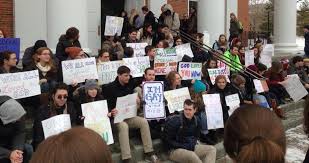
Student demonstrations aren’t big news.  But recently evangelical Christian students at evangelical flagship Wheaton College came out to agitate for, well, for coming out.

Student Demonstration at Wheaton

Student Demonstration at Wheaton

Wheaton College had invited Rosaria Champagne Butterfield to give a chapel talk.  Students protested that Butterfield’s message, her “train-wreck conversion” story, promoted damaging messages about homosexuality and Christian faith.

Butterfield attracted attention last year with her conversion story in the pages of Christianity Today.  As she told the story, she was a happy, moral, engaged citizen who happened to be a lesbian.  In her earlier career as a feminist academic, she pitied and pilloried evangelical Christianity for its anti-woman, anti-homosexual attitudes.  But after engaging with a local evangelical pastor and his family, Butterfield felt herself drawn to the faith.  She felt herself drawn to Biblical truths, to promising obedience before asking for understanding.  She fought against this conversion.  As she put it,

But the Bible got to be bigger inside me than I. It overflowed into my world. I fought against it with all my might. Then, one Sunday morning, I rose from the bed of my lesbian lover, and an hour later sat in a pew at the Syracuse Reformed Presbyterian Church.

As we’ve seen in these pages, the tangled mess of morality, sexuality, and Christianity has caused heartache and abuse, and college campuses often become the stage on which these questions find themselves played out.  Last month, Butterfield’s chapel talk at Wheaton College became the focus of a silent student demonstration.  Christian students at the evangelical school wanted the world to know that Christianity did not require “healing” from homosexuality.  Student Justin Massey told the student newspaper,

We feared that if no conversation was added to the single message of the speaker that students who are not very well informed were going to walk into chapel, hear the message, and have misconceptions confirmed or that students who are LGBT would be told that this story is the absolute way that things happen.

After the chapel talk, Butterfield met with student demonstrators.  The student newspaper published a short interview.  Butterfield explained that she was a feminist on issues such as equal pay for equal work, but that feminism as a “worldview” did not work.  She insisted that she viewed sexuality through a Biblical lens, one that condemned both homosexuality and homophobia as sins.

Students disagreed.  They thought Butterfield misinterpreted the Bible, and that her attitude gave a pass to the sorts of patriarchal sexual abuse cases that we’ve discussed in these pages.

For those of us outside the world of evangelical Christianity, the discussion was illuminating.  First of all, we see how both sides of the issue use the Bible to buttress their arguments.  Students at Wheaton did not lambaste Butterfield for making arguments based on an ancient book.  Rather, they insisted that Butterfield relied on bad interpretations of that text.  Also, we see, as the student protesters insisted, that there is “more than a single story” about sexuality in evangelical higher education.  Some of us were surprised recently to find that Christian professors do not universally condemn homosexual students.  Many of us, like Dr. Butterfield in her earlier life, assume that homosexuality is something on which evangelical Christians agree.  This story shows us the true complexity of sexuality in evangelical thinking.


C’est la Guerre…La Guerre Culturale

We hear it from time to time.  Scientists claim that only America suffers from widespread creationism.  Hip liberals fume that only America puts prudes and fogies in political office.  America’s culture wars seem to be uniquely American.  Or are they?

We read in The Economist about a recent education culture-war in France that seems as American as apple pie.  It seems France—the land of laid-back attitudes about sex and uptight attitudes about food—has more in common with the US of A than some people might like to admit.

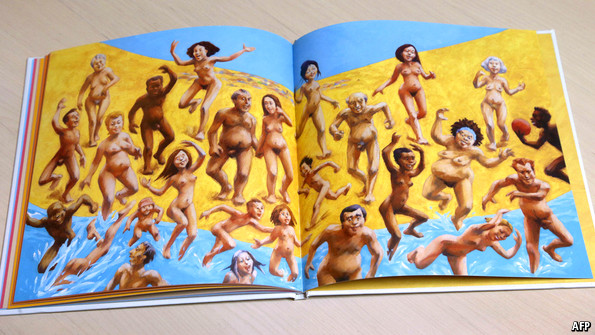
The recent flap follows the American pattern.  A new curriculum has riled cultural conservatives.  The new school materials, ABCD of Equality, hoped to instill ideas of gender equality in young people at a young age.  Books in the series, including “Jean Has Two Mummies” and “Daddy Wears a Dress,” hoped to teach students that gender and sexuality do not need hard-and-fast boundaries.  As often happens in this country’s culture-war politics, the book that sparked the most outrage was not even officially part of the curriculum, but rather part of a list of suggested additional picture-books on an affiliated website.  That book, “Everybody Naked!” showed page after page of, well, just what the title suggests.

Everybody Naked!

Everybody Naked!

In France, according to the Economist essay, a coalition of cultural conservatives objected.  Objections to the book series unite Catholic and Muslim traditionalists.  One conservative activist warned that such books represent a government attempt to “re-educate our children,” to make them doubt their religion and experiment with their gender and sexuality.  In clear echoes of West Virginia, conservatives called for a school boycott until the books were removed.  And, just as Patricia Polacco’s books have put mild-mannered librarians on the front lines of America’s culture wars, French conservatives have applied pressure on libraries to remove the offensive titles.

Of course, no two culture wars are exactly the same.  I doubt, for example, that any American sex educator would even suggest “Everybody Naked” for America’s elementary schools.  But in its broad contours, the kerfuffle in France demonstrates the international nature of culture-war politics.