Sit Down, Shut Up: Old School Teaching for New School Results

What’s the best way to teach children?

Get them to suffer.  Get them to fear.  Get them to obey.

That’s the message, anyway, of a recent essay by Joanne Lipman in the Wall Street Journal.

Lipman, of course, might put in another way.  In her words, she wants us to “revive old-fashioned education. . . . with strict discipline and unyielding demands.”

How should we do this?  Lipman offers eight guidelines.

We should understand that the highest levels of performance are helped, not hurt, by “a little pain.”  We need to get back to memorization.  Kids need to be allowed to fail, to understand that failure is a necessary aspect of improvement.  Plus, “strict” teachers do better than “nice” ones.  Also, creativity can be achieved through hard work.  Not by coddling, but by teaching “grit.”  Teachers need to get out of the habit of fulsome, unearned praise.  Last but not least, children need to experience stress in order to maximize their improvement.

Lipman claims scientific support for her platform, even though some of her cited studies don’t sound rock-solid.  Some have small sample sizes.  Just because something worked for a couple dozen students doesn’t mean it will be generally true.  Others have unconvincing methodologies.  One study, for instance, asked undergraduates about the stresses they had experienced in their lives.  Then the researchers dunked the students’ hands in ice water.  Those who had experienced stress, the study concluded, did not feel as much discomfort.

Such dubious science does not make me clamor to expose my daughter to more yelling at school.  But whether or not we accept the scientific rigor of Lipman’s sources, we cannot deny the political and cultural clout her argument for more traditional teaching has had over the decades.

In the 1920s, one leader of the influential Daughters of the American Revolution denounced innovations in classroom teaching.  Too many ‘modern’ teachers, President General Grace Brosseau lamented in 1929, thought that teaching consisted of presenting students with options.  Balderdash, Brosseau insisted.  Teachers must continue to deliver information to students in an authoritative way.  “One does not place before a delicate child,” Brosseau argued,

a cup of strong black coffee and a glass of milk; or a big cigar and a stick of barley candy; or a narcotic and an orange, and in the name of progress and freedom insist that both must be tested in order that the child be given the right of choice.  Instead, one carefully supplies only what will make for the development of the young body and assure its normal growth.

Schools, Brosseau insisted, must return to authoritative teaching.  Teachers must insist on hard work and dedication.  They must decide, instead of foisting all decisions off on immature children.

This traditionalist theme was taken up in the 1960s by the influential education pundit Max Rafferty.  Rafferty insisted that the only way to improve education was to return to traditional methods and content.  Young people need to memorize, to compete, to work hard, Rafferty claimed.

In his 1964 book What Are They Doing to Your Children, Rafferty offered a vision of “Education-In-Depth” that might delight Lipman and other contemporary traditionalists.  Children, Rafferty argued, must submit to sometimes-unpleasant processes.  “Before a child can learn to write creatively and imaginatively,” Raffferty believed, “he must submit to the discipline of learning the writing trade—the metaphor, the syntax, the verb conjugations, and above all the spelling.”

Schools must stress “subject matter,” not feelings.  They must give lots of homework.  They must teach the basics, such as multiplication tables.  Perhaps most of all, they must reverse the “progressive” poison by teaching children to “not be afraid of hard work.”

As I’ve argued elsewhere, Rafferty’s model still has influential admirers today.  Lipman does not seem to be one of them, at least not consciously.  She does not seem aware of the tradition of traditionalism in education.  My hunch is that she’d like to dissociate her call for “old-fashioned” education with some of the views of Rafferty or Brosseau.  Lipman might prefer to have her vision of traditionalism associated with rigorous social science than with the flag-waving patriotism and anti-communism of earlier traditionalists.

Nevertheless, Lipman and other fans of traditional discipline and memorization might be well advised to study their own history.




No More Talk: Popular Science Closes Its Comments

Why can’t we ever have a civilized conversation?

That’s the lament we hear all too often when it comes to issues such as evolution or climate change.

As science pundit Greg Laden noted recently, a new editorial policy at Popular Science shuts down conversation entirely.  The online version of the magazine will no longer be open to comments from readers.

Why?  Such comments, online editor Suzanne LaBarre explained, could have a negative impact on the way readers understand science.  She cited academic studies in which readers of hateful comments had changed their opinions about the scientific content of essays and articles.  “Trolls and spambots” had a negative impact on readers’ understanding of key scientific issues.

LaBarre concluded,

A politically motivated, decades-long war on expertise has eroded the popular consensus on a wide variety of scientifically validated topics. Everything, from evolution to the origins of climate change, is mistakenly up for grabs again. Scientific certainty is just another thing for two people to “debate” on television. And because comments sections tend to be a grotesque reflection of the media culture surrounding them, the cynical work of undermining bedrock scientific doctrine is now being done beneath our own stories, within a website devoted to championing science.

As a result, Popular Science.com comment forums will be closed.  Are such policies draconian?  Totalitarian?  Orwellian?  Is it a symptom of defeat among mainstream science popularizers that they can no longer accommodate disagreement?

Or, more chilling for those of us who want to see more and better science education in all sorts of institutions, could this new policy be a sign that mainstream academic science has been defeated at the popular level?  That is, is this new policy a sign that small-p popular science has become utterly unmoored from its connections to mainstream academic science?

When commenters, “cynical” or not, can close down the public conversation at such a storied institution as Popular Science, it demonstrates an epochal popular victory for non-mainstream science, whether that be creationism, climate-change denial, homeopathic medicine, or anything else.


What Went Wrong with America’s Schools?

Hell in a lunchbox. 

That’s where America’s public schools have headed, according to a recent essay by the Southern Baptist Theological Seminary’s President R. Albert Mohler Jr.

President Mohler makes an historical argument for the shocking, dangerous decline in American public education.  Does his case pass historical muster?

As I’ve argued in an essay in Teachers College Record (subscription required, but summary available), this historical argument about public education has been a mainstay of conservative thinking for at least fifty years.  Different conservative intellectuals have come up with different timelines and key events to explain the demise of high-quality, morally trustworthy public education.

Mohler echoes this intellectual tradition.

He argues that public schools began as locally controlled entities.  Beginning roughly a century ago, however, “progressive” reformers attempted an ideological coup.  Such folks, led by John Dewey, openly proclaimed their intention to turn schools into secular indoctrination camps.

Luckily, Mohler believes, such plans did not accomplish much until the second half of the twentieth century.  At that point, however, most schools were “radically transformed,” separated “from their communities and families.”

The results, Mohler warns, have been sobering:

Those who set educational policy are now overwhelmingly committed to a radically naturalistic and evolutionistic worldview that sees the schools as engines of social revolution. The classrooms are being transformed rapidly into laboratories for ideological experimentation and indoctrination. The great engines for Americanization are now forces for the radicalization of everything from human sexuality to postmodern understandings of truth and the meaning of texts. Compulsory sex education, the creation of “comprehensive health clinics,” revisionist understandings of American history, Darwinian understandings of science and humanity, and a host of other ideological developments now shape the norm in the public school experience. If these developments have not come to your local school, they almost surely will soon.

Is Mohler’s diagnosis correct?  Does his historical analysis match the record?

In this historians’ opinion, Mohler is guilty of cherry-picking and over-emphasizing.  It is demonstrably true that in the early twentieth century an array of school activists and intellectuals, clustered together under the amoebic heading of educational “progressivism” did try to implement wholesale changes in the nature of American public education.  It is also true that the US Supreme Court made decisions in the 1960s that could have revolutionary implications for the religious nature of public education.  Even more, it is true that leading organizations such as the National Education Association call for school policies that might dismay stalwart conservative Protestants. 

But contrary to Dr. Mohler’s conclusions, such historical facts do not add up to a public school system that “entered a Brave New World from which no retreat now seems possible.”

Historians have examined each of these important trends in American public education.  Arthur Zilversmit, for example, looked at the implementation of “progressive” education policies in the middle of the twentieth century.  In spite of earnest, well-funded efforts to revolutionize schooling, Zilversmit found, schools remained largely the same.  Why?  Zilversmit, sympathetic to the “progressive” project, blamed Americans’ “strange, emotional attachment to traditional schooling patterns.” 

How about the claim that the Supreme Court kicked God out of the public schools?  It is true that in 1962 and 1963 SCOTUS banned school-led mandatory Bible reading and prayer.  But as political scientists Kenneth Dolbeare and Phillip Hammond found to their surprise, most communities that prayed before the SCOTUS rulings continued to pray in public schools after them.  

Similarly, political scientists Michael Berkman and Eric Plutzer have argued that local school districts continue to function as local bureaucracies.  These “Ten Thousand Democracies,” according to Berkman and Plutzer, remain responsive to local demands and local values.     

This is bad news for President Mohler’s alarmist argument, but very good news for religious conservatives in the United States.  Most of America’s public schools remain closely connected to majority impulses in their local community.  Concerning hot-button culture-war issues such as prayer, evolution, and sex ed—not to mention broader notions such as school discipline, drug use, promiscuity, and general manners—local communities still control their local public schools. 

This local influence helps explain some stubborn trends that have long frustrated progressives like me.  Why, we ask, is evolution taught only spottily?  Why can’t public-school children learn honest, practical information about sex?  Why are public schools still home to coercive prayer practices?

These are all tough questions. 

But Dr. Mohler’s jeremiad raises even tougher ones:  If American public schools are so very conservative, why do conservative intellectuals deny it so forcefully?  Why don’t America’s conservative intellectuals trumpet the continuing traditionalism of American public education?


The Age of Pedophilia

Are we all Jerry Sanduskys?

That’s the accusation made recently by Anthony Esolen.

Pedophilia, Esolen charges, is not limited to the horrifying cases of the Sanduskys of the world.  Rather, we engage in pedophilia whenever we subordinate the welfare of children to the sexual gratification of adults.

In this logic, divorce is nothing but a socially acceptable form of pedophilia.  Having children outside of wedlock is pedophilia.  Worst of all are the “creeps” at Planned Parenthood (Esolen calls them “Planned Predators”) who teach young children a debased vision of sex.  These “pedophiles of the soul,” Esolen accuses, cruelly introduce

children to the delights of meaningless sex, with cartoons of talking penises and vaginas, of a girl bending over with a mirror to inspect her anus, or a boy in his bedroom abusing himself.

What is that, Esolen asks, if not pedophilia of the worst sort?  Indeed, such “credentialed spiritual pederasts” use the same strategy as old-fashioned child rapists.  They work to separate children from the influence of their parents.  In their sexually aggressive ideology, Esolen writes,

Parents are the enemy. The parents are kept in the dark. The parents are too benighted to know what is best. The parents—even such sporadically responsible parents as our generation has produced—wouldn’t know about how happy it is to be sexually free.

As Esolen must have intended, such accusations are profoundly disturbing.  There is nothing more heinous than real child molesters.  It seems to me to breach the bounds of public civility to accuse the sex-educators at Planned Parenthood of acting like nothing more than “the old man down the street, wheezing and giggling, who likes to show little kids pictures of people masturbating[.]”

But if Esolen’s extreme anger represents the feelings of a broad body of the American public, it certainly helps us understand why sex education has had such a troubled career in America’s public schools.  Indeed, as historians such as Jeffrey Moran have argued, sex ed has often been received with the violence and outrage that Esolen’s essay predicts.

Such outrage makes more sense if we understand the way Esolen hopes to redefine pedophilia.


Creationism and Climate Change

What do creationism and climate-change skepticism have in common?

A lot, according to the leading young-earth creationist organization Answers In Genesis.

This morning we see an argument from AiG’s Elizabeth Mitchell about the dangers of climate-change science.  Dr. Mitchell is responding to the recent report from the Intergovernmental Panel on Climate Change (IPCC).

Why do Christian creationists care about climate change?

Dr. Mitchell’s essay offers a few ideas.

First, Mitchell warns that climate-change science is based on “dubious sources.”  She asks if mainstream climate-change scientists might build their case on mistaken assumptions.  Skepticism about evolutionary science, it seems, bleeds over into suspicion of all mainstream science.  If mainstream science has been proven, from creationists’ perspective, to be a naked emperor, then its conclusions on every topic must be treated warily.

Second, young-earth creationists are committed to the idea of a young earth and, for many, a catastrophic global flood.  Arguments about the changing climate from outside the circle of young-earth creationists assume a much older earth.  Climate-change science must rest on such assumptions.  Young-earth creationists, then, have a keen interest in making climate arguments that insist on a short lifespan and a global cataclysmic flood.

Finally, we see an important difference in the issues of evolution and climate-change.  Dr. Mitchell, at least, takes a much more irenic position toward Christians who DO agree with the mainstream science of climate change.

Christians, Mitchell argues, must weigh the evidence and make up their minds about the science of climate change.  It does not do violence to scripture, she implies, to believe the mainstream science on this issue.  The most important issue, Mitchell concludes, is that

Whatever position a Christian citizen chooses to take, he or she needs to understand the present in the true light of biblically documented, scientifically affirmed history rather than uniformitarian assumptions about the earth’s past—and future.


War for the Core: Conservatives vs. Conservatives

Do conservatives like the new Common Core State Standards?

Yes and no.

And that tension has caused some consternation among conservative educational thinkers recently.

Writing in the Christian Post, Napp Nazworth has taken “several large international corporations” and “many Republican governors” to task for supporting the new educational standards.  At a panel discussion hosted by the Family Research Council, religious conservatives blasted GOP stalwarts such as Governors Chris Christie (NJ), Bill Haslam (TN), Rick Scott (FL), and others for “aligning their interests with those of international corporations.”

The article describes the lament of another faction of conservatives.  The Common Core Standards, conservative Glenn Jacobs worries, focus too much on “churn[ing] out young people who will be educated enough to work, consume, and pay taxes, but who are not encouraged to be creative, or to use critical thinking, or to develop anything remotely characteristic of those who possess superior minds and the ability to achieve great things.”

So what is a conservative to do?  Big-business types might embrace the promise of the new standards.  Traditionalists and religious conservatives, on the other hand, might lead the opposition.

Could inter-conservative squabbling lead to a real division in the decades-old conservative alliance?


Is This Child Abuse?

Arch-creationist Ken Ham wants to train up a spiritual army of young Christian creationists.  Does that count as child abuse?

I’m no creationist, but I just don’t think so.

Ham trumpeted the training of a new generation of young “soldiers” at an Answers In Genesis conference at Atlantic Shores Baptist Church in Virginia Beach, Virginia.  By teaching young people the truths of young-earth creationism, Ham claimed he was “preparing them for the spiritual war going on around us.”

Image Source: Answers in Genesis

Image Source: Answers in Genesis

This language of child soldiers makes me nervous.  Plus, I don’t like the notion that young people are being turned away from real evolutionary science by this sort of religion posing as science.  To me, this seems like another painful example of the ways faith has been tangled unnecessarily with real evolutionary science, resulting in bad science and tortured theology.

But it is child abuse?

Leading skeptics have called it that, folks such as physicist Lawrence Krauss and biologist Richard Dawkins.  They assert that cramming this false science down young people’s throats counts as abuse.

Let’s look at both sides of this argument.

Why might someone call this child abuse?

1.)    These young people are being told things are true, when they really aren’t.  They are being taught, to cite just one example, that dinosaurs and humans coexisted a few thousand years ago.  Worst of all, relationships of close trust between parents, teachers, and children are being exploited to promote the veracity of this false science.  Loving mothers, loving fathers, caring teachers tell innocent young people that this is scientific truth.  Ingenuous young people take their word for it.  Such deception is abusive.

2.)    In this essay, Ken Ham explicitly calls them soldiers—spiritual soldiers, but soldiers nonetheless.  This seems a terrible violation.  Young people should not be exploited as culture-war cannon fodder.

Why might defenders disagree?

1.)    There is no threat or coercion here.  Though it may come as a surprise to outsiders like me, Answers In Genesis makes it very clear that believing in a young earth and recent special creation are not required for Christian salvation.  In other words, Ken Ham and his colleagues do not threaten young people with terrifying visions of hellfire if the children don’t embrace creationism.

2.)    The parents and teachers seen here are apparently sincere in their belief that creationism is true.  They are trying to pass that truth to their children and pupils.  There’s nothing abusive in passing along the best knowledge to the next generation.

3.)    Though science pundits such as Bill Nye have argued against it, believing the young-earth creationism of Answers In Genesis will not hurt the life chances of these young people.  According to Gallup polls, nearly half of American adults share a belief that humanity has only been around for a few thousand years.  And as I’ve argued elsewhere, careers in science-related fields do not seem thwarted by a belief in young-earth creationism.  Consider the case of US Representative Paul C. Broun Jr. of Georgia.  Broun is a fervent creationist, a medical doctor, and a member of Congress.  Not a bad career!

Image Source: Answers In Genesis

Image Source: Answers In Genesis

Is it child abuse?  No.  And calling it that is irresponsible.  After all, there is real child abuse out there.  It is horrific and terrifyingly common.  Calling this sort of science/religion education ‘child abuse’ is only an ill-considered scare tactic.

Perhaps this argument could use some illustration from another religious tradition.  Consider the recent career of child abuse in the Catholic Church.  As we all know only too well, the despicable actions of some priests and prelates in that church have caused untold suffering.

But the abuse perpetrated by members of the Catholic Church does not extend to its anti-scientific teachings.  After all, the Catholic Church teaches young people that certain wafers and wine can magically transform into flesh and blood.  And then young people are taught to eat that flesh and drink that blood.  For outsiders like me, teaching children to engage in this sort of ritual cannibalism is creepy and anti-scientific.  It is also demonstrably false: the wafers and wine are always really just wafers and wine.  Nevertheless, it is not child abuse for Catholics to teach their children this mystery of transubstantiation.  Calling such teaching ‘child abuse’ would disrespect the real suffering that real child abuse has caused within the Catholic Church.

A similar logic may apply in this case.  The young-earth creationism peddled by Answers In Genesis is not true.  But it is sincerely believed by its adherents.  Teaching those ideas to young people is not child abuse.

Unfortunately, we can picture what real abuse might look like in similar cases.  As Billy Graham’s grandson has pointed out recently, evangelical Protestant organizations have also engaged in real child abuse.  They have conspired, just as did the Catholic hierarchy, to cover up that terrible real abuse.  We could imagine a scenario in which a Protestant organization such as Answers In Genesis called together thousands of children and abused some of them.

But that is not the case here.  This was an educational gathering.  To call it ‘child abuse’ makes a mockery of the all-too-real threat of abuse.


Who’s the Victim Here?

Is Craig James a bigot?  Or a victim of religious persecution?  Or both?

Can we liberals allow discrimination against bigots?  Or must we fight against discrimination in all its forms?

James has been in the news lately.  He was fired from his job as a Fox News sportscaster.  The reason?  In his run for the US Senate in 2012, James insisted that he would not support same-sex marriage.  Such marriages, James explained, were against his religion.

The Family Research Council, an organization of conservative religious activists, called the firing an example of religious persecution.  “What Fox Sports did,” the FRC warned,

is much worse than censorship. What Fox Sports is doing is demanding conformity on issues that aren’t even relevant to James’s job — then threatening his livelihood when he refuses. That’s not your garden variety viewpoint discrimination; it’s ideological terrorism. And it has to stop.

From the other side of the issue, the Texas Freedom Network defended the firing.  Intelligent people of goodwill can disagree, the TFN argued, if this is a case of religious discrimination.  But whatever we call it, the TFN blogged, it tells us something about the changing cultural climate.  “it’s worth considering,” the TFN pointed out,

that Fox Sports didn’t fire James because of his religious beliefs. They fired him because they thought his intolerant public statements about gay people would hurt their company.

I generally agree with the folks at the TFN.  However, this seems to me to be a very sketchy argument.  Would we defend a restaurant owner who refused service to ethnic minorities because he or she worried having them in the restaurant would hurt business?


Who Owns the Children with Guns?

Can a school tell parents what their kids can do outside of school?  On private property?

Conservatives say no.  But they seem to say no for very different reasons.

Conservative intellectuals argue that the state must not overreach.  The average conservative-in-the-street, however, seems to cling to ancient notions that children are not persons.  At least that’s the message we hear in one story from Virginia Beach.

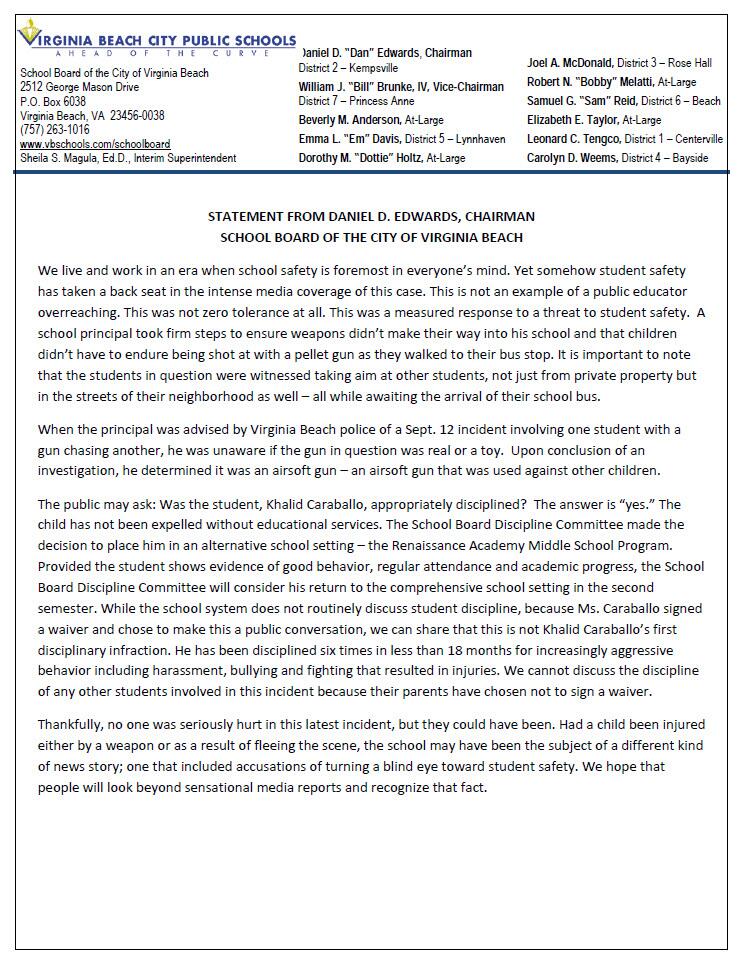
This is a story that has attracted its share of media attention.  According to NBC News, a school district suspended three middle-schoolers for shooting other students with toy pellet guns.  The students were not at school with the toy guns, but rather waiting for the school bus.

Virginia Beach School Board Chairman Daniel D. Edwards defended the decision.  “This is not an example of a public educator overreaching,” Edwards insisted in a public statement.

Conservative commentator Charles E. Cooke demurs.  In the pages of The National Review, Cooke blasts the school decision as a typical and terrifying example of “tyranny.”  School, Cooke insists, has no role in punishing students for something that occurred outside of school, on private property.  “In free societies,” Cooke argues,

schools are not designed to serve as a mandatory means by which the Bismarckian state may seek to shape the young, but instead to act merely as a service to which parents can choose to send their kids for basic education if they so wish.

Cooke’s essay illustrates this key tenet of conservative thinking, a central reason why today’s conservatives are so keen on educational issues.  Many American conservatives these days yearn for a smaller government.  School is one of the most commonly encountered faces of government.  As a result, school becomes the target of conservative ire.  Even more complicated, schooling for the young is mandatory.  Along with taxes, schooling is one of the most common ways government tells Americans directly what they must do.

This story also dishes up a very different example of the complicated ways Americans tend to think of children and schooling.  According to WAVY.com, one of the parents of the children involved insisted that her child was her property, at least until he got on the bus.  “My son is my private property,” Solangel Caraballo told the local TV station.  “He does not become the school’s property until he goes to the bus stop, gets on the bus, and goes to school.”

Caraballo’s outrage doesn’t come from the same intellectual tradition as that of Cooke’s.  Cooke worries about an overreaching state.  Caraballo, on the other hand, is perfectly willing to have the state assert ownership of her child, but only once the kid gets on the bus.  Until then, the kid is private property, wholly owned by his parents.

What are we to make of this kind of thinking?  If children are private property, what does that mean about their rights?  If they are not property, how can they be kept from voting (not until age 18 in the USA), or driving (not until @ 16), or drinking alcohol (not until 21)?  If they are not property, how can they legally be forced to attend school if they don’t wish to?  What sort of legal twilight zone do children inhabit, not fully legal persons, yet something different from a washing machine or a pair of pants?

Most important, how common is this kind of thinking?  How many Americans continue the ancient tradition of thinking of their children as their property?  Of thinking of their children as property at all, property that they can transfer to the control of the school?


Creationist NBC TV Station in Texas

Is creationism winning? If “the media” embraces creationism, is the writing on the wall for evolution education? Thanks to the SC for his sharp eye on all things creationist…