Battle Map!

Where have Americans fought over public schooling?

The libertarian Cato Institute has put together a clickable Battle Map to help readers locate educational controversies.  Readers can search by state, by year, or by the type of conflict.  The Cato folks broke down school battles into such categories as curriculum, freedom of expression, gender equity, human origins, moral values, racial/ethnic diversity, reading material, religion, and sexual diversity.

Of course, the folks at Cato aren’t just providing a nerdy public service for those of us interested in studying cultural controversies.  The point of this exercise, from Cato’s perspective, is to prove that public education “divides [people], forcing them into conflict over whose values and histories will be taught, and whose basic rights will be upheld . . . or trampled.”

To this outsider, Cato’s argument seems a little strained.  After all, just because many family dinners turn into shouting matches, does that prove that dinner is a bad thing?


MR or MRS Degree? Ask Jesus!

Looking for more than just an education?  For those who hope to find a life partner as part of their college experience, it seems like a Christian college might be the way to go.

In Religion News Service, Katherine Burgess reports on a recent Facebook survey.  According to those findings, of the top 25 colleges where men are likely to meet their spouse, all are Christian.  For women, sixty-four percent of the top 25 husband-finding schools are Christian.

Twelve of the schools that appear on both lists of top-25 are Christian:

  1. Faith Baptist Bible College and Theological Seminary,      Ankeny, Iowa
  2. Harding University, Searcy, Ark.
  3. Martin Luther College, New Ulm, Minn.
  4. Bob Jones University, Greenville, S.C.
  5. Brigham Young University, Provo, Utah
  6. Freed-Hardeman University, Henderson, Tenn.
  7. Maranatha Baptist Bible College, Watertown, Wis.
  8. Dordt College, Sioux Center, Iowa
  9. Baptist Bible College, Springfield, Mo.
  10. Oklahoma Christian University, Edmond, Okla.
  11. Kentucky Christian University, Grayson, Ky.
  12. Johnson University, Knoxville, Tenn.

This makes sense.

College, after all, is about much more than academics.  Where people go to school—especially when that school is strongly associated with a certain cultural identity—says a lot about who they are as people.

It also fits long-standing stereotypes about Christian schools.  As Jeff Schone, vice president for student life at Martin Luther College in New Ulm, Minnesota, told Burgess, “There’s a Lutheran boy for every Lutheran girl.”

Marlena Graves reflected on this syndrome recently in the pages of Christianity Today.  As a counselor at Cedarville University, Graves lamented the fact that so many young women seem to neglect their own personal growth in their race for a spouse.  “I can’t even count,” Graves wrote,

the number of times I’ve heard, “My mom and dad told me that if I don’t find a husband now when there are so many to choose from, then chances are slim that I’ll find one after college.”

This isn’t just true for Christians, of course.  As Charles Murray argued controversially in his recent book Coming Apart, those who attend elite schools tend to marry other people from those same elite schools.

In her Christianity Today piece, Graves quoted a letter to the Daily Princetonian by Susan Patton.  Patton gave Princeton women the same advice heard by so many young Christian collegians:

Smart women can’t (shouldn’t) marry men who aren’t at least their intellectual equal….there is a very limited population of men who are as smart or smarter than we are. And I say again — you will never again be surrounded by this concentration of men who are worthy of you.

Higher education, for many non-Christians as well as many Christians, seems to be seen as the place to find suitable life partners.  My hunch is that this trend is exaggerated at schools that attract students from self-identified subcultural or countercultural backgrounds.

This marriage tendency can help us understand the durability of cultural notions.  Why are so many Americans creationist, for instance?  It helps when creationist kids go to creationist colleges, marry other creationist kids and start creationist families of their own.


Bible Bullying and the Borders of Fiction

Is the Bible nonfiction?  Can public-school teachers call it fiction?  More important, can a teacher poke fun at a student who considers the Bible nonfiction?

Those questions are at the heart of a new lawsuit from Temecula, California.

According to The Christian Post, a middle-school teacher asked students to bring in a nonfiction book to read.  When one student pulled out a Bible, the teacher objected.  Worst of all, according to The Post, the teacher ridiculed the student for considering the book nonfiction.

An activist legal group, Advocates for Faith and Freedom, has sued the school district.  The Christian legal group wants the school district to add teachers to its bullying policy.

According to AFF President Robert Tyler, the teacher’s actions in this case represent just the tip of the anti-Christian iceberg.

In an interview with the Christian News Network, Tyler denounced public-school teachers’ tendency to bully Christian students.  “These days,” Tyler said,

there is no shortage of bullying against Christian students by teachers.  If a teacher were to take the same tone and tactic against a homosexual student based on the student’s sexual orientation, the teacher would be subjected to serious and significant discipline. But for some reason, these teachers feel that they have the ability to engage in this type of hostility and attempt to humiliate Christian students.

The exact boundaries of religious expression for public-school students have long been tricky to figure out.  Can self-funded cheerleaders display Bible messages at public-school football games?  Can students wear religious t-shirts?

But this case raises different questions, too.  Can teachers be bullies?  Can school districts use their existing anti-bullying policies to discipline teachers?

It seems like a difficult proposition.  After all, teachers in most schools have an explicit duty to manage the behavior of their students.  It would be bullying, in many cases, for one student to make another student quiet down.  But if a teacher makes a student quiet down, isn’t that just classroom management?

Couldn’t the Advocates for Faith and Freedom make a simpler argument?  Teachers certainly should not belittle students for their religious beliefs.  Why should the school district have to call it “bullying?”

Take a Trip to a Creation Museum

How do creationists do it?

How, that is, do creationists manage to maintain a belief in a 6,000-year-old earth and a real global flood?  How do they get their children to believe that all of humanity sprang from two people in Mesopotamia a few thousand years ago?

To outsiders like me, such beliefs seem so far outside the mainstream that I have a hard time understanding how creationists manage to stay convinced.

One thing that must help is an array of institutions to support young-earth creationist ideas.  It is easy enough for a family to raise children in that tradition, attending schools, reading books, and going to museums all safely within the intellectual boundaries of young earth-ism.

Science-education guru Randy Moore took a trip to a creation museum to describe one way this can work.  In the just-released issue of Reports of the National Center for Science Education, Moore describes his trip to the Creation and Earth History Museum, just outside of San Diego.

Image Source: Creation and Earth History Museum

Image Source: Creation and Earth History Museum

The museum was founded in 1992 by the Institute for Creation Research.  It has since been sold, but its new owners continue to operate it according to ICR beliefs.  Don’t confuse it, by the way, with the much larger and more lavish Creation Museum just outside of Cincinnati.  The young-earth beliefs of the two may be very similar, but Answers In Genesis’ Cincinnati museum looks and feels much more like mainstream science museums.

Still, for those who can’t make it all the way to Cincinnati, this San Diego attraction might achieve many of the same goals.

Moore walks readers through those beliefs in an even-handed and explanatory way.  Moore does not try to critique the science or religion on display.  Instead, he offers a much more useful blow-by-blow description of the kinds of ideas museum-goers will encounter.

What does this group of young-earth creationists believe?  The museum demonstrates the unreliability of radiometric dating and the voluminous evidence for a real catastrophic global flood.  Believers might find reassurance that the best scientific evidence supports their beliefs, regardless of rumors they may have heard to the contrary.

If you’re looking for mockery and witty barbs about the bad science on display, you’ll need to go elsewhere.  Moore has a different aim: to inform other science educators of the kinds of information young-earth creationists might be exposed to.

As always, Moore’s approach is the right one.  Mainstream science educators don’t need to hear another attack on the scientific demerits of young-earth creationism.  What evolution educators do need to receive, in massive doses, are unbiased glimpses of the worlds outside of mainstream science.

Without understanding creationism and creationists, mainstream science and mainstream science education will make little headway.  For those who can’t afford a trip to a creation museum themselves, Moore’s travelogue will be a handy introduction.


Conservatives: Flabby & Inbred

Rocky knew it.

When things get easy, people get weak.  The only way to win is to get mad, get hungry . . . get the Eye of the Tiger.

Take that, Liberal America!

Take that, Liberal America!

In a recent interview, Columbia’s Mark Lilla argues that conservatives lost their Eye.  Why?

Just like Rocky, conservatives in the 1970s and 1980s scored major successes.  Not by beating up Mr. T, in conservatives’ case, but by establishing dedicated intellectual institutions.  Those institutions could and did fund conservative research and thinking.

So what’s the problem?  According to Lilla, those plans worked only too well.  Conservatives, he argues,

created institutions that have easy sources of funding and never have to go out and argue with people who disagree with them. It’s made their world inbred, lazy, and self-satisfied. It gets harder and harder to find serious conservative books on the major issues of the day.

Following that Rocky logic, it seems the best tonic for conservative anomie would be a long winter stint out in the woods, working out with cinder blocks and being uncomfortable.


Thank God You’re Wrong

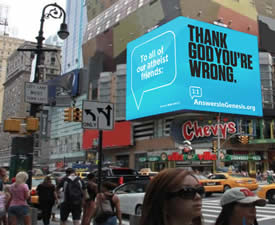
When in doubt, look to the heavens.  These days, your view might be blocked by a billboard from the young-earth creationist outfit Answers In Genesis.

Image Source: Answers In Genesis

From Times Square. Image Source: Answers In Genesis

If you look closely enough, you might see a clue as to why the creation/evolution debates have been so divisive for so long.

According to their press release, yesterday AIG rented billboards in high-visibility sites in New York’s Times Square and San Francisco’s Fisherman’s Wharf.  Soon similar billboards will hit the skies in Los Angeles.

The billboards announce, “To All Our Atheist Friends; Thank God You’re Wrong.”

Image Source: Answers In Genesis

San Francisco. Image Source: Answers In Genesis

AIG leader Ken Ham described the choice of wording.  AIG wanted to be “cordial and engaging,” he explained.  Though these high-profile billboards were an explicit response to Christian-bashing billboards posted by atheist groups, Ham said he wanted to take the high road.

Image Source: Answers In Genesis

An Atheist Billboard. Image Source: Answers In Genesis

“We are not angry at the atheists at all,” Ham wrote.  Instead, AIG feels “burdened” by atheists’ separation from God.

For those new to the creation/evolution debates, it might seem surprising that this latest publicity stunt does not mention creationism, dragons, or zip lines.  After all, AIG has had some success in the past with such creation-focused billboards.

But as Ken Ham repeats, creationism is not the main interest of his organization.  Rather, salvation is the point; creationism is merely the vital theme.

For those of us interested in conservative themes in American education, this distinction matters.

Many non-creationist commentators on the creation/evolution issue assume that if readers can be convinced of the scientific truths of evolution, the debate will be over.  Even the insightful philosopher Philip Kitcher seemed to fall into this trap in his book Living With Darwin.

These AIG billboards demonstrate the difficulty of the issue.  The young-earth creationists at AIG care a lot about creationism, but that is not their central concern.  Their central concern is salvation.  As long as evolution is seen as a threat to salvation, it will never be open to discussion and compromise.

More perspicacious religious minds understand this.  Francis Collins and the BioLogos Foundation set out to prove not only that evolution is true, but that evolution does not threaten salvation.  Without that focus on salvation, creation/evolution discussions will get nowhere.

These AIG billboards do more than attract attention in America’s big cities.  They demonstrate the true heart of the evolution/creation controversy.


Racism Doesn’t Pay

What would this look like in the United States?

A story in today’s New York Times describes the court case against Japan’s Zaitokukai, in which the far-right group had to pay a hefty fine for shouting its racist ideology at a Japanese school.

Image Source: Wikipedia

Image Source: Wikipedia

The school apparently served young people of Korean ethnicity.  The far-right group protested outside the school, calling the children “spies and cockroaches.”

Is this sort of Asian race-baiting translatable?

In other words, what would this sort of racism look like in the United States?

Unfortunately, it is all too easy to see the woeful results of structural racism in America’s schools.  Schools are still often segregated by race.  Those with mostly African American students often lack the resources of schools for mostly white students.  And the educational legacy of white supremacy has often been part of America’s official educational policies, as historians such as David Blight have argued.

Even granting all that, however, I have a hard time imagining this sort of vicious race-baiting in any American city.  Maybe I’m naïve, but I can’t picture any group these days picketing a majority-African American school and shouting racial epithets.  Would the equivalent be something like the infamous Westboro Baptist Church rallies?  Even those, however, cling not to America’s racist past, but rather to an extremist religious vision.  I say again, I can’t imagine any large group shouting racist taunts at African American children.

Is this another case where my suburban liberal upbringing has left me painfully unaware of the realities of American schooling?


Libertarians and the Common Core

What’s a libertarian to do?

Will new Common Core State Standards exert a deadly centralizing impulse on all types of school?  Will independent options winnow down as private schools seek to prepare their students for new standardized tests?

That’s the worry articulated recently by JD Tuccille in the pages of libertarian flagship Reason Magazine.

Tuccille pointedly refutes the canard that the new standards are some sort of sinister conspiracy to agglomerate educational power in the hands of distant federal agents.  The problem, he writes, is more banal.  New tests aligned with the standards will likely exert pressure on independent schools to match their curricula to those of the public schools.  As he concludes,

Under the circumstances, “Waldorf,” Montessori,” “traditional academy” and “IB” risk becoming Coke vs. Pepsi brand names peddling similar products—assuming they can even survive the transition costs.

Private and religious schools, while mostly exempt from legal mandates to adopt Common Core, are also under pressure to toe the line. Some that accept tax-funded vouchers are required to adopt the standards to continue in such programs. Others find that non-Common Core-compliant textbooks are becoming difficult to find. And the biggest motivation might be the move by college entrance exams to test for mastery of Common Core standards.

Of course, as Tuccille notes, parents can always exempt themselves and their children from this pressure by opting out of institutional schooling entirely.  But for those folks who value free choices in education, it does seem palpably evident that any success for standardization will represent a narrowing of those choices.


What Color Are Your Fundamentalists?

Who are the “fundamentalists” who hope to keep America’s public schools religious?

Some of us may picture a Saddleback-type white suburban evangelical, driving around in a Biblically-sized SUV, worrying in equal measure about sin and soccer.

New!  School Prayer Barbie!

New! School Prayer Barbie!

But as Peter Berger reminds us this morning on The American Interest, that image of conservative evangelicalism might represent the past more than the future.

Berger notes the dramatic effects of immigration on the nature of American Christianity.  New immigrants tend to be Christian, and their Christianity tends to lean conservative.  As Berger concludes,

Both in their theology and religious practice, non-Western Christians are more conservative. Their worldview is strongly supernaturalist: The spiritual world, both benign and sinister, is very close—the Holy Spirit, the Virgin and the saints, miracles of healing—but also the devil and other malevolent spirits. This supernaturalism is strongest in the Pentecostal and charismatic movements, but it is also very visible in Catholic and mainline Protestant churches. But non-Western Christians are also more conservative in their moral convictions—very little sympathy here for the feminism, let alone the agenda of the gay movement, that has become so prominent in mainline Protestantism in America—and, I suspect, would be more prominent in American Catholicism, were it not for surveillance and intervention from Rome.

The implication of all this is simple and exceedingly important: Immigration will strengthen the conservative forces in American Christianity.

In the future, the fight over religion in America’s public schools may have a very different tone.  Instead of a ring of white conservative suburbs around every ethnically diverse urban core, we may see a shift to immigrant-led demands for more vibrant religion in schools.  Instead of whitebread traditionalism resisting a multicultural liberalism, we might have an ethnically diverse group of conservatives battling to keep morals pure in public education.

Faith & Physics, Part I

ILYBYGTH is happy to welcome a new series of guest posts from Anna.  Anna blogs about her experiences leaving the fundamentalist subculture at Signs You Are a Sheltered Evangelical.  She holds an M.Sc. degree in Astroparticle Physics and currently lives in Virginia with her fiance Chelsey and a cat named Cat.

As a scientist, it’s a bit awkward for me to confess that I used to be a science denier.  I would never have classified myself as such at the time.  I would have called myself an intelligent, well-educated, critically thinking, aspiring physicist.  Yet I was a fervent believer in 6-day Biblical creation, I staunchly disbelieved global warming, I thought homosexuality was a conscious decision to rebel against God, and I was deeply skeptical of any sort of environmental preservation initiatives, even though I was a devoted nature-lover.  Yep, I was about as bad of a science-denier as they come.

Despite all of this, I cannot think too ill of my younger self for my ignorant beliefs.  Admitting them is uncomfortable, of course, but largely because of misunderstandings in the secular and science communities regarding these sorts of beliefs and the people who hold them.  The prevailing opinion is that science-deniers are stupid, uneducated, unable to think critically, and usually just too stubborn to admit they are wrong.  I certainly am not going to excuse my former beliefs, but  I also do not believe they were a result of stupidity, stubbornness or even a lack of research or study.  The truth behind them is much deeper and more complex than most of my peers realize.  This is why I am writing; I want to chronicle my transition from science-denier to scientist, hopefully helping others understand the anti-science mindset, the actions and attitudes that contribute to it, and the attitudes from my more science-savvy peers that made my transition either easier or harder.

If you are going to follow me on this journey, you will need to know who I am.  My name is Anna.  I am a mathematics instructor at a local career college and I also tutor students privately in higher-level math and physical sciences.  I currently hold a Masters Degree in Astroparticle Physics from Jacobs University.  I earned my Bachelors Degree in Physics from New Mexico Tech (where most of my transition occurred) and before then, I was homeschooled.

From kindergarten through 12th grade, I was taught at home with Christian-based curricula, and socialized in a staunchly fundamentalist Christian sub-culture.  TV and video games were off-limits in my home, secular music was all-but banned until I was 17 or so, and my internet useage was strictly monitored.  My world experience, therefore, was quite limited.  I often laugh among friends that I grew up in the 1800’s, not just because I had to wear ankle-length skirts and waist-length hair for much of my young life, but because community isolation like this was very common 100 years ago.  Indeed, being ignorant or skeptical of competing opinions and viewpoints would not have been considered closed-minded in an age before radio broadcasts, television, internet, cellphones, and national and international travel.  It would have been normal.  Human.  That is how it was for me.

That is not to say that I was unaware of differing opinions or viewpoints.  Rather, my sources for this information were almost exclusively biased.  If I brought home a book from the library that mentioned the Big Bang, my parents would sit me down and explain how the book was wrong.  If I saw an advertisement on a billboard that had a scantily clad woman posed on it, I would be told that it was a sign of the downfall of our nation and that it was wrong.  If I read an article in the newspaper that held a left-leaning political viewpoint, a discussion would be opened about how this viewpoint was wrong.  Without fail, ideas that fell outside of the realm of accepted ideas were dismantled, disproven, argued, or shown in a negative light.  A negative reaction to such ideas then became instinctual.  I lived in a never-silent echo-chamber of my subculture’s worldview.

And yet, through all of this, I was taught to think critically.  Most of my peers were as well.  The ability to rationalize, to argue and debate, to pursue knowledge, and to question authority was considered the peak of achievement and intelligence.  Public speaking and debate were cornerstones of Christian homeschooling culture.  “Never believe everything you read” was often on my mother’s lips.  “Always question.  Find things out for yourself.  Never take someone else’s word for anything.  Learn, grow, challenge.”  That was my mandate… a mandate that eventually led me to rejecting the views that my culture espoused.

Many of my secular peers begin to disbelieve my story at this point, which I find very frustrating.  The stereotypes about science-deniers, fundamentalists, and creationists run so deep that I have been called into question on my own life story.  Some people don’t want to hear that people like me, like my family, like my community can be intelligent.  They don’t want to hear that they encourage critical thinking and discussion.  They want to call into question my family’s motives.  “Obviously, they were just saying things like ‘question everything’ to make themselves feel better.  All they wanted was a mindless drone and a copy of themselves.  They were just lying to you.”

These comments are hard to swallow, because on one hand, I partially agree.  My parents and community leaders certainly did not intend for me to turn out the way I did.  And yet, I assert that they truly believed their motives were honest.  They WANTED me to think, to learn, to question.  They just honestly believed that all of that thinking, learning and questioning would inevitably lead me to validate their opinions.  And unfortunately for them, they were wrong.

And so, before I delve more deeply into the culture of fundamentalist education, before I discuss my studies on creationism, my meetings with Ken Ham, my awkward debates with my college peers, and my sloooooow deconversion from science-denialism, I have a request to make: please listen.  Please believe.  Please be open to seeing me and the people I knew outside of the ignorant-hateful-redneck stereotype.  My experiences and motivations were real, and much more complex than many people outside of that subculture realize.  I am telling my story because I am tired of others (on both sides) thinking they can tell it for me.  So, please respect me in that regard.  Thank you, and I hope you enjoy the ride!