Fundamentalist Science, Spock, and Oprah

What do Science, Spock, and Oprah have to do with each other?

They help explain the thinking of anti-religion activists such as biologist Jerry Coyne.  The way some atheists figure, since religion is not logical, it should have no impact on our deliberations.  Oprah doesn’t agree. But who wields more clout in our culture, Oprah or Jerry Coyne?  Or, to put it another way, who is the star of Star Trek, Spock or Capt. Kirk?

Fundamentalist Science is highly illogical.

Fundamentalist Science is highly illogical.

I love to read Professor Coyne’s blog, Why Evolution Is True.  He always makes intelligent arguments for the propriety of a scientific understanding of reality, and the dangers of “accommodationism” with religion.  Plus he has lots of pictures of cats and bugs.

Recently, two posts bumped up against each other that demonstrated the difficulties with Coyne’s approach to these issues, IMHO.  In one post, Coyne reviewed survey data that revealed the relative overabundance of atheism among America’s top scientists.  In the next, Coyne bemoaned the appearance of Oprah Winfrey as Harvard’s commencement speaker this year.  As Coyne pointed out, Winfrey has done a great deal to promote anti-scientific rubbish over her career.

Now, I’m no Oprah fan.  Nor am I particularly religious.  But I can’t help but notice that Coyne’s fundamentalist attitude about this subject fuels the bitterness of our continuing culture wars over the role of religion and science in the public square.  This kind of bitterness is both unnecessary and counterproductive.

Science-advocates such as Coyne promote a particular vision of science as rigidly opposed to religion.  Coyne often protests against truckling to religious thought among scientists and science educators, such as the folks at the National Academy of Sciences or the National Center for Science Education. As I’ve noted before, Coyne’s extreme view of the necessary divide between science and religion puts him at times on the side of extreme creationists.

But Coyne’s religion- and Oprah-bashing put him on the side of some other curious figures as well.  Most famously in pop culture, Gene Roddenberry created Spock as the Asperger’s First Officer to balance Kirk’s testosterosity.  Spock always argued for the rule of logic and was always trounced by Kirk’s shoot-from-the-hip style of emotional leadership.

Smarter writers, too, have explored this Spock/Kirk, Coyne/Oprah divide. Most famously, Dostoyevsky’s Ivan Karamazov concluded reasonably and logically that God could not exist.  However, Ivan could not handle Smerdyakov’s gruesome conclusion to that logic.  Nor could Ivan counter Alyosha’s loving-kiss argument.  Like Spock, Ivan’s blind reason could not cope with the complexities of human experience.

Truth may not be democratic.  But our society is.  It is a good thing to have smart people complain about the influence of thoughtless media-mongers like Oprah.  But those smart people must also recognize that Oprah—unlike the elite atheist scientists—has her finger on the pulse of the culture.  She knows what people find important. She knows what people find interesting.  Oprah’s imprimatur does not make an idea true.  But it does mean that the idea matters somehow.

Dismissing such things out of hand demonstrates an unnecessary Spock Syndrome.  Simply because ideas are illogical does not mean they are not true, in an important sense.
 

Does Jesus Love Shotguns? Liberty University and the Many Faces of American Conservatism

What do gun rights have to do with Jesus?

Nothing, right?

Then why did Liberty University offer a sweet scholarship to David Cole Withrow?

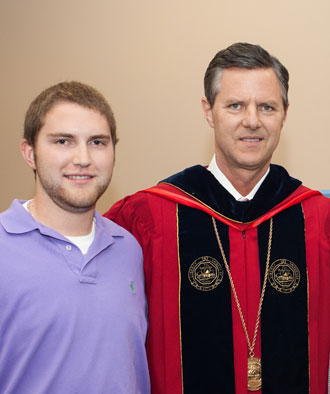
Here’s the latest, according to the Christian outlet World Magazine: Withrow had been punished for bringing two guns to his high-school campus in Princeton, North Carolina.  At first, it appeared he had accidentally left them in his truck.  As soon as he remembered his mistake, the story was first reported, Withrow informed school authorities of the guns.  In spite of the innocence of his mistake and his Eagle-Scout honesty in reporting the problem, school officials reported Withrow, who was charged with a felony and kicked out of school.  The story became a tempest in America’s culture-wars teapot.  Withrow became a symbol of an overreaching anti-gun governmental tyranny.  Since Withrow was wearing a Liberty University t-shirt in some public appearances, the University contacted him and offered him a full scholarship.

Falwell and Withrow

Falwell and Withrow; Image source, Liberty University

Turns out Withrow had known about the guns all along. According to World Magazine, Withrow admitted in court he had lied.  Nevertheless, Chancellor Jerry Falwell Jr. and Liberty University stand by their offer.  Withrow’s admission of dishonesty, Falwell announced, smacks of more heavy-handed state tactics.

So in the end, nothing really happened.  A conservative Christian youth will go to a conservative Christian college.

Why should those of us trying to understand the world of conservative educational thinking in America care about this story?

Because this story demonstrates the sticky web of connections between seemingly unrelated issues.  Liberty University was founded in the early 1970s by barnstorming evangelist Jerry Falwell.  The goal of the university was to produce new platoons of educated conservative Christians, ready to swing the United States back into the arms of its rightful Moral Majority.

This story demonstrates that the conservatism of Christian institutions such as Liberty University reaches beyond theology.  Liberty University may exist to teach students in a Christian environment.  But that environment also supports theologically unrelated notions, such as the rights of people to have and use guns, and the rights of people to be defended from an overreaching Obama regime.

As faculty star Karen Swallow Prior reported a while back, the broad cultural conservatism on Liberty’s campus may be relaxing a little. Students these days tend to wear less formal clothes, and some even started a Campus Democrat club.  Nevertheless, as Chancellor Falwell’s actions show in this case, Liberty still represents a bastion of an American conservatism that reaches far beyond Biblical interpretation.

What does Jesus think about shotguns?  I don’t know.  But the multifaceted ideology/theology/admissions policy on display in this story demonstrates the complexity of American educational conservatism.


Beautiful Women Want Creationism

From the Old News Department: Miss USA finalists are friendly to creationism.

I just discovered two-year-old footage from the Miss USA 2011 competition.  As Tanya Somanader broke the news at the time, almost all of the 51 contestants supported the idea of teaching creationism in public schools.

Alyssa-Campanella-Miss-California-USA-2011-is-crowned-Miss-USA-in-Las-Vegas

“They’re teaching what?!?!?”

The video interviews still make for compelling viewing.  I’m no big fan of beauty pageants.  I don’t know anyone who is.  But as I found out a while back, there has been a strange correlation between conservative religion and Miss America over the years.

As Tanya Somanader noted, only two candidates affirmed that evolution should be taught in schools as science, unalloyed by creationism or intelligent design. The rest of the candidates offered either a two-model answer or flat-out rejection of evolution for America’s schools.

Miss New York, for example, agreed that evolution should be taught in public schools, but so should religion.  Miss North Dakota offered a more relaxed answer.  “Sure, why not?” she said, “Evolution should be taught . . . I think it’s good that people hear both sides of, I guess, ‘the story,’ so to speak.”  Miss Oregon agreed.  “I think every theory of how we came to be here should get a shout out in education,” she answered.

These fence-straddling answers tell us something about the conservative cultural politics common among high-level beauty pageant winners.  More telling, they show us what national finalists think will be a winning answer to the question of evolution education.  Almost all of the finalists advocated a temperate-sounding compromise, one that welcomed all theories into the public school classroom.

Even those like Miss North Carolina who stressed the fact that they personally did not believe in evolution made irenic noises about allowing evolution to have some space in public education.

To some extent, this proves that elite beauty-pageant contestants are savvy politicians.  Gallup polls demonstrate that the overwhelming majority of Americans favor the teaching of both evolution and creationism in public schools.  By waffling on this important question, these Miss USA wannabes show their understanding of this diplomatic demilitarized zone in our continuing culture wars.  Of course, the two-model approach is horrifying to mainstream scientists and science educators.

Not all the Miss USA contestants took even this middle path, however.  Miss Kentucky, for example, concluded, “I just personally don’t think it’s a good topic for school subjects. At all.”  Even harsher, Miss Alabama declared, “I do not believe in evolution, I do not think it should be taught in schools, and I would not encourage it.”

Wrong Not Crazy

Are creationists crazy?  Dumb?  Ignorant?  Guilty of child abuse?

Of course, some creationists might be all or any of those things.  But in spite of the overheated accusations of some science advocates, creationists are not dumb or crazy BECAUSE of their creationism.  More to the point, assuming that creationists can only be crazy stops any authentic attempt to understand creationism.  In the long run, that sort of ignorance on the part of evolution educators hurts the cause of evolution education itself.

This is not a popular thing to say.  Creationists don’t like it because it suggests that many people think of them as idiots.  Many anti-creationists don’t like it because they take the idiocy of creationism as an article of faith.

When I made this simple point in the pages of the Chronicle of Higher Education a few months back, I was called an idiot and worse.

Recently, Josh Rosenau, Policy Director of the National Center for Science Education, emphasized this important idea in a talk to an audience at Santa Clara University.  Rosenau has argued this unpopular position before.

In his recent talk, Rosenau pointed out (minute 15 of the 45-minute video) that “Science Denial” may be wrong, but it is not irrational, nor is it antiscience.  People who do not believe in evolution often know about it.  People who do not believe in evolution have their own consistent, internally logical, socially supported intellectual community.  As Rosenau noted, creationism is often “driven by personal identity and deep, real, important concerns.”

Continuing kudos to Rosenau and the NCSE.  This message is often politically unpalatable, but it is the only way to make progress in these depressingly durable creation/evolution battles.  Name-calling and point-scoring only deepen the culture-war trenches.

Poem of the Week

If a picture is worth a thousand words, a good poem has to be worth a million, right?

We stumbled across this gem recently.  For those of us who are trying to understand educational conservatism in America, the sentiments expressed here go a long way.

“Buzzsawmonkey” left this poem as a comment on a recent essay by Stanley Kurtz in National Review.

The Red Faculty
—apologies to William Carlos Williams and “The Red Wheelbarrow”

so much depends
upon

a red prof
teaching

glazed eyed bored
students

to deride white
people.

Now, I realize the poem does not have much to do with Kurtz’s essay about the Common Core State Standards.  But it does sum up a good deal of conservative punditry about the lamentable state of American higher education.

I apologize for my ignorance if this poem has been around for a while.  It seems both too clever and too irrelevant to the essay it commented upon to have been used only in this context.  So please correct me if this is old hat.  This is my first sighting.

The skewed ideological environment of most college campuses has long been an article of faith among conservative activists and thinkers.  Long before William F. Buckley Jr. launched his career with his jeremiad about God and Man at Yale, conservatives warned about the terrifying intellectual bullying among once-hallowed quads.

In 1921, for example, William Jennings Bryan attacked the teaching at the University of Wisconsin.  In a scathing editorial, he sarcastically suggested the university post placards about the content of its curriculum.  “Our class rooms,” the warning could state, “furnish an arena in which a brutish doctrine tears to pieces the religious faith of young men and young women; parents of the children are cordially invited to witness the spectacle.”[1]

Neither the loquacious Bryan nor Buckley, however, managed to come up with as poetic an indictment as has Buzzsawmonkey.


[1] Bryan, “The Modern Arena,” The Commoner, volume 21:issue 6 (June 1921): page 3.

Core Wars

What do conservative activists hate about the Common Core State Standards?

A recent essay by conservative commentator Stanley Kurtz in National Review points out some conservative objections.

As we’ve noted recently, conservatives share with progressives a fervent opposition to the CCSS, though usually for different reasons.  Everyone from Phyllis Schlafly to the Heritage Foundation has warned of looming implications for culture, politics, religion, and education.  For those of us trying to understand conservative attitudes toward American education, these diatribes against the CCSS are a good place to start.

Kurtz was responding to an article in the Washington Post about Tea Party objections to the new shared standards.  Obama officials, Kurtz complained, responded with deceptive statements and obfuscation.  In the end, Kurtz argued,

. . . the Tea Party is right when it accuses the Obama administration of nationalizing education standards through the back door. The Founders opposed that for a reason. Once de facto nationalization is achieved, parents will lose their ability to influence their children’s education. Leverage that can be easily exercised at local school-board meetings or through representatives in state legislators will be lost to unaccountable federal bureaucrats (like Lois Lerner), and worse, to the even less accountable private education consortia that are developing the Common Core. So if educators try to impose politicized curricula or “fuzzy” math, parents will have no recourse.

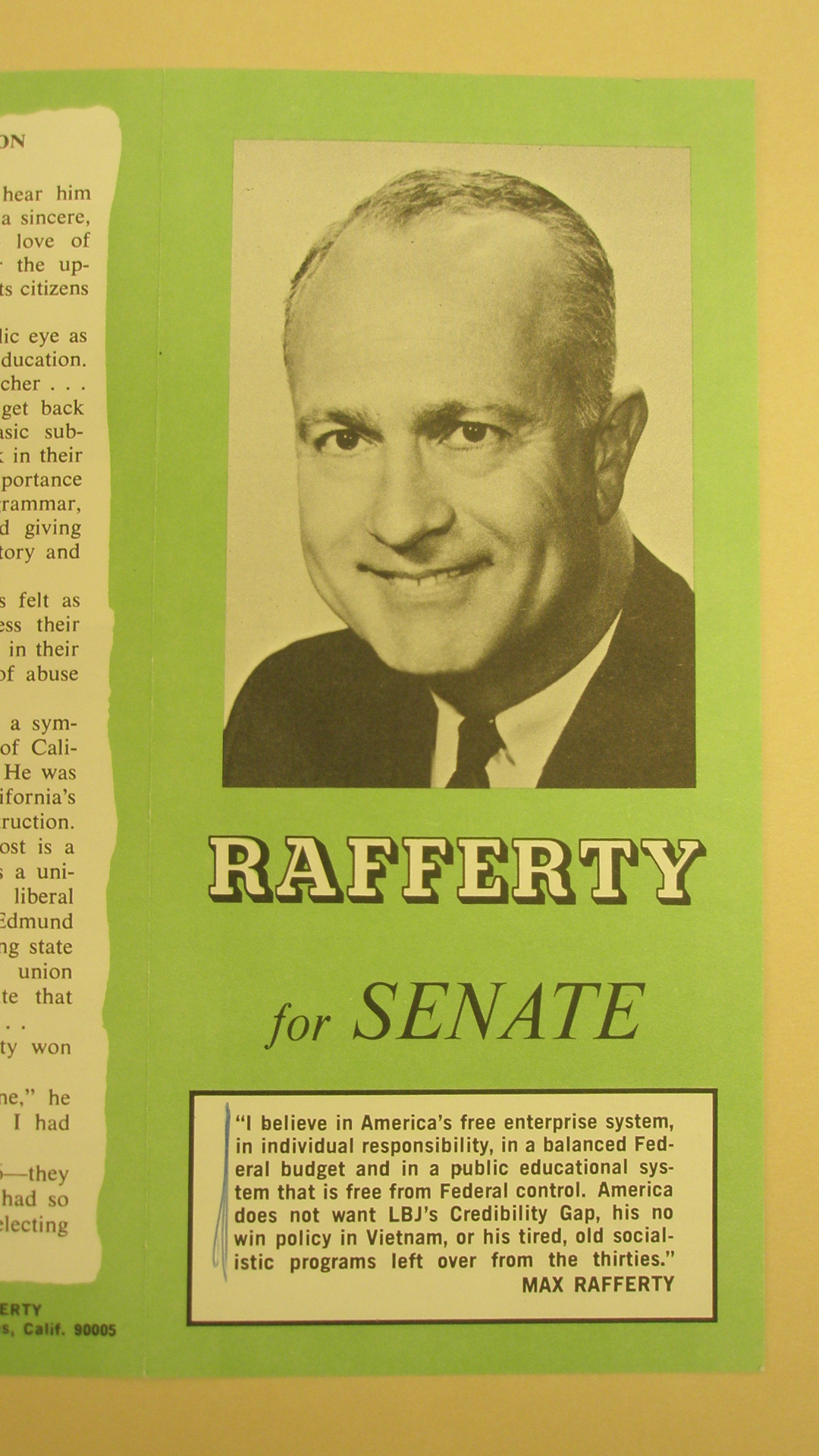
Kurtz’s “local control” argument echoes a long tradition among conservative education thinkers.  Most powerfully, California State Superintendent of Schools Max Rafferty pushed hard during the 1960s to combat increasing federal control.  Rafferty’s colorful prose often made the case more lyrically than I’ve seen it since.

In one speech from the archives,[1] Rafferty articulated a conservative position for local control that I suspect might still be appealing to today’s Tea Partiers.  As he told the California Small School Districts Association Convention on March 8, 1965,

You live and work in an out-of-the-way corner of this county.  A small town where the sky is still blue, where the roar and tension of freeway traffic has not yet penetrated; where a little boy can still run and play in open fields.  You’re there because you want to be.  You moved there deliberately a few years before because you liked that feeling of grassroots independence.  That unique sense of having an equal share in the controlling of one’s own destiny which has been the legacy of every American ever since the first little villages began to dot the New England countryside more than three centuries ago.  You’ve been happy there.  Your children are growing up clear-eyed and self-reliant with that indescribable look of quiet confidence which comes from life spent in a region where hills and trees are very real, very close at hand.  Where a neighbor is a lot more than someone who just happens to live close to you.  Suddenly, something goes wrong at your local school house, as things sometimes do.  Maybe it’s a new course of study which just doesn’t quite fill the bill.  Maybe it’s a neurotic old school administrator, we do run across one now and then!

No matter, you tell yourself, nothing can possibly happen in your community which can’t be solved by you and your neighbors, working and acting together in the traditional American spirit of mutual tolerance and good will.  But this time you’re wrong.  Shockingly, unbelievably wrong!  You and your friends try to arrange an appointment with your district superintendent to tell him of your problems and make your suggestions.  But you don’t have a district  superintendent anymore, in fact you don’t even have a district!  You try to contact your local school board, but it’s gone too!  A hundred miles away, a group of county or state officials meet once a month to decide the destiny of your children.  You don’t know any of them personally, in fact you never even heard most of their names!

But in our nightmare today, they tell you what your children will be studying.  They hire the teachers who will be molding the thinking and the behavior of your children throughout the years that lie ahead.  They decide whether or not the school bus is going to stop near your home or indeed if there is going to be a school bus at all.  Whatever they decide, you’re stuck with.

Rafferty worried about the Elementary and Secondary Education Act, the direct progenitor of No Child Left Behind.  As several of the commentators on Stanley Kurtz’s essay pointed out, the centralization of public schooling can be traced back through several generations of federal leaders, including President George W. Bush.

From the Hargis Collection.

From the Hargis Collection.

But that doesn’t mean that today’s version, the Common Core State Standards, will be greeted with anything but alarm among some sectors of conservative thought.


[1] This speech survives as a typescript in the Billy James Hargis Papers, University of Arkansas Mullins Library Special Collections, MC 1412, Box 48, Folder 2, Public Schools, 1950-1978 (1 of 2).  This collection of papers represents, IMHO, the best single-stop shop for any scholar hoping to understand the career of twentieth-century educational conservatism.  The Reverend Hargis was a leader in the Christian conservative movement in the second half of the twentieth century, and he was an avid collector of newsletters, correspondence collections, and other ephemera that shed a unique light on conservative thinking about education during the period.


Apocalyptic Academics: Conservatives and the Myth of Outrageous Schools

There it is again!

Today we find yet another example of conservative commentators lambasting the outrageousness of public education.  This firmly ensconced tradition of school-bashing doesn’t make much sense to me.  I would think conservatives would want to promote public education in America as one field in which conservative ideas and ideals have taken firm control.

Today’s example comes from the pages of Public Discourse, in an essay by Professor William Jeynes.  The opening paragraph highlights the terrible activism of public schools:

An inquisitive elementary school student asked his teacher, “Is it wrong to steal?” The teacher replied, “I don’t know. What do you think?” This incident in a major midwestern public school alarmed thousands of parents, and reminded myriad others why they value religious private schools: these schools are usually guided by a moral compass for academics and behavior that public schools patently do not offer.

This notion of vaguely outrageous teaching in America’s vaguely described public schools is a dominant theme of conservative talk about public schooling.

Browsers of conservative media hear about high-school students strip-searched during exams, or teachers rewarded for “stomping” on the American flag.

In all these stories, public schools and their teachers loom as out-of-control dictators, blasting away at traditional morality, patriotism, religion, and common sense.

Nor is this theme a new one among conservative pundits.

In the 1980s, for example, commentator Sam Blumenfeld warned readers that “the neighborhood school is controlled by a national educational and bureaucratic hierarchy completely insulated from local community pressures and answerable only to itself.”[1]

In the 1970s, US Representative John Conlan (R-AZ) worked hard to control what went on in public schools.  Debating House Bill 12851 in May, 1976, Conlan advised,

I think one of the things that perhaps the gentleman from Michigan is not aware of is that there is a significant current in education to teach children that there are no values, there is no right, there is no wrong, that everything is relative, and it all depends upon situational ethics.[2]

As I argued in my 1920s book, conservatives in that decade also insisted on the terrifyingly amoral or immoral dominance of public schools.  For instance, one well-funded insurgent group, the Bible Crusaders, warned that public schools had been taken over by a conspiratorial sect determined “to secretly and persistently work to overthrow the fundamentals of the Christian religion in this country.”[3]

In all these tellings, schools and teachers represent insidious threats to traditional values.  As with Professor Jeynes’ recent warning, a single example, often vague or imprecise, is used as proof of the continuing trend of public schools nationwide. For some reason, conservatives have long tended to exaggerate the perniciousness of public schools.

Of course, this is not only a conservative tendency.  Progressives, too, often hyperventilate over isolated examples of conservative influence in schooling.  As we noted recently, for instance, the specter of creationism often looms much larger in the progressive imagination than it does in actual schools.

In the face of such assertions of apocalyptic academics in public schools, more careful scholarship demonstrates that most teaching fits in with local community values.  Political scientists Michael Berkman and Eric Plutzer have noted that most teachers’ values match those of their school and district.[4]

Of course, there always are and always have been some teachers who flout local values.  But such events are newsworthy precisely because they are unusual.  In general, most teachers prefer to avoid controversy.  Most teachers, like most people, try to fit in.  The notion that teachers and schools are out to demolish the values of their students just doesn’t match experience.

Yet conservatives will presumably continue to trumpet examples of outrageous public-school teaching.  To a non-conservative like me, this does not make sense.  I would think conservatives would rather exaggerate the conservative nature of most public education.  These days, talk about public schooling is dominated by demonstrably conservative themes: privatization, competition, and union-bashing, to name a few.

Wouldn’t it make better strategic sense for conservatives to claim all of these as victories?


[1] Samuel L. Blumenfeld, Is Public Education Necessary?  (Old Greenwich, CT: Devin-Adair, 1981), 4.

[2] Congressional Record, May 12, 1976, pg. 13532.

[3] “The Bible Crusader’s Challenge,” Christian Fundamentals in School and Church 8 (April-June 1926): 53.

[4] Michael Berkman and Eric Plutzer, Evolution, Creationism, and the Battle to Control America’s Classrooms (New York: Cambridge University Press, 2010), 199-200.

Creationist Bogeymen

Say, did you hear what happened to Senator Kruse’s “Truth in Education” bill in Indiana?

Unless you’re a close personal friend of the Senator, I’m guessing you haven’t.  The career of bills like this one can tell us a thing or two about the cultural politics of creationism.

Senator Kruse garnered some headlines six months ago for his plan.  Kruse, the chairman of the Indiana State Senate Education Committee, promised a new law that would guarantee students’ right to challenge their teachers’ pronouncements.  The barely disguised goal was to allow creationist students to confront evolutionary teaching.

At the time, pundits and scribblers announced Kruse’s plan as the latest offensive in a creationist juggernaut.  Reporters noted the connections to Seattle’s Discovery Institute, the leading intelligent-design think tank.  Progressives lamented this latest power play by religious conservatives.  One commenter called the bill the latest effort to “march the education of American children toward the 19th century.”  Another explained Kruse’s new effort as an end run around evolution.

But here’s the problem: Kruse’s bill didn’t do any of those things.  It didn’t do anything.

Kruse’s bill died the quiet death of most legislation.  As House Bill 1283, Truth in Education went nowhere.  But no one reported on that. [**DOUBLE CORRECTION: First, HB 1283 was not introduced by Senator Kruse, but by Kruse’s ally, Representative Jeff Thompson.  Second, the National Center for Science Education, that tireless watchdog of all things creationism, did in fact report on the fate of HB 1283.  Thanks to Glenn Branch of the NCSE for calling our attention to it.]

To be fair, several of the journalists who talked about the looming threat of Indiana’s latest creationist bill wondered if the bill would ever get anywhere.  But a casual news reader could be forgiven for assuming that creationists pass laws like this all the time.  The news media’s hunger for the sensational feeds a skewed perspective on what is and is not legal in America’s schools.

This is not new.  In 1942 Oscar Riddle and his colleagues conducted a survey of high-school science teachers.[1]  They asked teachers if they taught evolution or special creation, and why.  Those answers were illuminating.  Over three thousand teachers responded to the questionnaire.  Those who claimed not to teach evolution gave a wide range of reasons.  One teacher from North Carolina explained that evolution education was “a taboo subject to most people” (73).  A Nebraska teacher said she avoided evolution education mainly due to “Lack of time.”  One California teacher added, “Controversial subjects are dynamite to teachers” (74).  In the stereotype-shattering department, another California teacher from a “large city” explained that he or she didn’t teach evolution because the “Fundamentalist beliefs of majority of our students may not be attacked (negro and Mexican)” [sic] (74).

Most relevant here, lots of teachers incorrectly believed evolution education was illegal in their states.  Since the 1920s, as I detail in my 1920s book, a handful of states really did pass anti-evolution laws or education-department rules.  But a significant percentage of teachers in the 1940s believed incorrectly that their states had also done so.

Why?  My hunch is that anti-evolution bills get much more attention than they deserve.  Any conservative religious lawmaker can earn quick points for introducing a bill destined to go nowhere.  This was the case in the 1920s, the 1940s, and it is the case today.  Senator Kruse’s bill did not change anything for any students in Indiana.  But it did contribute to a widespread notion that creationism is on the march all over the country.


[1] Oscar Riddle, F.L. Fitzpatrick, H.B. Glass, B.C. Gruenberg, D.F. Miller, E.W. Sinnott, eds., The Teaching of Biology in Secondary Schools of the United States: A Report of Results from a Questionnaire (Washington, DC: Union of American Biological Sciences, 1942).

Oh, Horror! Stephen King Plumps for Intelligent Design

Promoting his new book, Stephen King told NPR’s Terry Gross that intelligent design is the only thing that makes sense.  Not only that, but King promoted a particularly religious interpretation.

I choose to believe it. … I mean, there’s no downside to that. If you say, ‘Well, OK, I don’t believe in God. There’s no evidence of God,’ then you’re missing the stars in the sky and you’re missing the sunrises and sunsets and you’re missing the fact that bees pollinate all these crops and keep us alive and the way that everything seems to work together. Everything is sort of built in a way that to me suggests intelligent design. But, at the same time, there’s a lot of things in life where you say to yourself, ‘Well, if this is God’s plan, it’s very peculiar,’ and you have to wonder about that guy’s personality — the big guy’s personality. And the thing is — I may have told you last time that I believe in God — what I’m saying now is I choose to believe in God, but I have serious doubts and I refuse to be pinned down to something that I said 10 or 12 years ago. I’m totally inconsistent.

Eric Hedin and the Care and Feeding of Young Scientists

Scientists aren’t necessarily stupid.  Yet, as we’ve seen, some academic scientists demonstrate a curious ignorance or even proud self-delusion about important aspects of science and culture.

Perhaps the continuing kerfuffle over Professor Eric Hedin and Ball State University can shed some light on this puzzle.

The case began, it appears, with complaints by University of Chicago scientist and science activist Jerry Coyne.  Coyne complained that the teaching of Eric Hedin at Ball State University represented the indoctrination of students by a religious zealot. Professor Hedin taught a course cross-listed as “The Boundaries of Science” or “Inquiries in the Physical Sciences.”  True enough, Hedin’s reading list leaned heavily on old-earth creationism and intelligent design.  Worst of all, Professor Coyne argued, Hedin’s course proselytized for a specific sort of Christianity and called it science.  The university and department reluctantly agreed to investigate Hedin’s teaching.

Professor Coyne hoped the university would pressure Professor Hedin to stop his preaching.

Other leading science bloggers disagreed.  PZ Myers argued that Hedin’s teaching, though lamentable, must be allowed as an issue of academic freedom.  “If we’re going to start firing professors who teach things that are wrong,” Myers insisted, “we’re all going to be vulnerable.”

The debate between these science activists on the boundaries of acceptable university teaching might help us understand why so many scientists are so strangely unaware of the cultural context of their work.  Neither Professor Coyne nor Professor Myers seems to think that Professor’s Hedin course might actually be of value to the scientists-in-training at Ball State.  Myers defends the classes as a protection of Hedin’s rights, not the protection of student interests.

Is it not possible that such intellectual diversity could be a positive good?

In issues of race, the US Supreme Court has ruled that diversity is a legitimate goal of university admissions.  Racial diversity, in other words, is not only good for members of racial minority groups.  Diversity is good for everybody who wants to learn.

Does not the same principle apply here?

Of course, we would want to avoid the absurd extension of this principle.  We would not want to teach people things that were obviously not true only to give students some sort of intellectual workout.  But the ideas taught by Hedin are not the ravings of some isolated madman.  Rather, they represent an influential and important tradition in our culture.  Though these ideas do not qualify as representatives of mainstream science, they are nevertheless ideas about science.  Scientists should know about them.

Raising young scientists in an ideological or cultural hothouse produces fragile flowers.  It helps explain why so many smart people emerge from this training so remarkably dumb about important ideas.

If we looked into this question as one of encouraging intellectual diversity, we could shift the debate in useful ways.  Everyone can agree that students can benefit by being exposed to a diversity of ideas.  The question becomes, then, at what level and in what format should students learn about heterodox ideas?  What courses should count as requirements, and what courses should be elective?  Most important, where are the boundaries of acceptable diversity?  These are questions with which university faculties have long experience.

In my field, for instance, it would not make sense for introductory courses in American history to teach only a Marxist interpretation of the past.  Students from all sorts of fields take those introductory courses.  For many students, such a course may be their only collegiate exposure to American history.  It would not make sense for those students to learn that history is the unfolding of the class struggle.  But for history majors, students will benefit from having one or more advanced courses taught about specific interpretive traditions, whether or not the instructor is a Marxist.   Even though I do not think a Marxist interpretation is the best approach, I support the inclusion of such courses in university programs.  Not only to defend the teaching rights of professors, but more importantly, to ensure students experience a true diversity of intellectual approaches.

In the case from Ball State, it does not seem as if Professor Hedin’s religion-heavy course should be the ONLY exposure students have to science.  Nor should this course be taught as an introduction to science as a whole. But students who take a full course load of science classes could certainly benefit from considering such ideas.  Even if taught by an instructor who embraces the theological implications.  Other courses might study other aspects of science, and might usefully be taught by professors with strong intellectual commitments to a particular worldview.

Making the debate a question of when and how students encounter intellectual diversity is not as exciting as debating if religious ideas can be taught as science.  It is not as exciting as arguing whether professors have the academic freedom to teach heterodox ideas.  But it seems to me the most productive way to discuss Professor Hedin’s case.