Teen Rebels, Creationism, and the Real History of Kicking God Out of the Public Schools

The Abington School District v. Schempp (1963) case is not usually remembered as a case of teenage rebellion or creationist science.  But as the man at the center of the case recalled recently in the pages of Church & State, we can’t separate out such issues from the Bible, school prayer, or “The Man in the Gray Flannel Suit.”

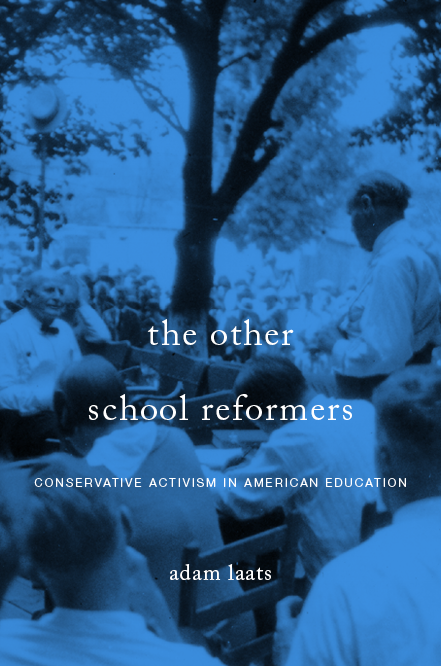
Image Source: Wikipedia

Image Source: Wikipedia

As I’ve written in these pages and in the pages of the Journal of Religious History, it is difficult to overestimate the importance of this case for American schooling, religion, and culture.  In its decision, the US Supreme Court decided that public schools must not mandate the recitation of the Lord’s Prayer or the reading of the Bible.  Among many religious conservatives, this decision has taken on enormous symbolic significance as the moment that the United States “kicked God out of the public schools.”  In reality, the decision specified that religion still belonged in public schools.  It was only teacher-led devotional religion to which the Court objected.

Ellery Schempp, who went on to a highly successful career as a physicist, remembered his teenage decision to contact the American Civil Liberties Union to protest his treatment in his Pennsylvania public high school.

As Schempp recalled, his protest came partly from principle, and partly from “teen rebellion.”  The sixteen-year-old Ellery resented being squeezed into a conformist mold.  Schempp recalled his lightbulb moment:

“It was one day when some kid read Genesis in 10th grade,” Schempp continued. “I thought, ‘This is nonsense; this does not fit with the science that I know.’ I began to pay more attention.

For those like me who hope to understand the meanings of conservatism and conservative religion in American education, Schempp’s memories offer two important reminders.

First, we must keep in mind that we cannot easily separate out issues such as Bible reading, prayer, evolution, sex ed, or progressive pedagogy.  For activists and pundits on both sides of these culture-war divides, there is no bright line dividing them.  In this case, we see that the young Schempp was offended both by the Christian heavy-handedness of his school’s policy and by the anti-science of Biblical creationism.

Second, we must never forget the hidden vector of school issues: youth.  In most cases, protagonists such as the young Schempp are not only activists, they are young activists.  In his memories, at any rate, Schempp protested against the implied coercion to become another cog in the soulless wheel of American corporate governance.  As Schempp recalled, “There was enormous pressure to conform as the greatest goal in life – to be ‘The Man in the Gray Flannel Suit.’”  Fighting against this conformist compulsion was just as important a motivator as any civil-liberties principle.

Of course, folks like me sometimes assume that all teen rebellion must push against revealed religion and social traditions.  But we must remember that teenage pushback often pushes back in a variety of directions.  As we’ve noted before, in some cases conservative young Christians rebel by embracing a much more radical young-earth creationism than do their moderate Christian parents.

In whatever direction young people rebel, the youthfulness of that protest must be part of our analysis.  We can’t forget that schools are full of a specific type of people—young people.  As such, they may have very different attitudes and perspectives than the rest of their families.  They may be more likely to protest against traditional religion, OR more likely to fight for more traditional religion.
Pay Your Enemies: The New Front in Campus Culture Wars

Can religious groups discriminate?  On college campuses, as we’ve noted, the issue often boils down to whether sponsored student clubs have the right to insist on restricting their leadership to students who share their faith.

Historian John Turner offers some thoughts on these continuing battles in a recent essay on The Anxious Bench.  As the author of the go-to book on Campus Crusade for Christ, Turner has some unique perspective to share on the issue.  As Turner concludes, “If universities actually believe in the diversity they attempt to promote, they have to make room for evangelical, Catholic, Muslim, and the many other student religious organizations.”

Also intriguing is the comment from “Marta L.”  As she points out, many campus groups object to having their student fees pay for groups to whom they are ideologically opposed.  Students at Texas A & M, for instance, did not want to pay to support an LGBT Resource Center.  If conservative groups want to be included in the diversity of campus life, Marta argues, they must be willing to enter into this community agreement.  Christian students, Marta says, must “be willing to fund groups that don’t represent them.”

She makes a crucial point.  It is one thing to welcome a true diversity of opinion to a university campus.  It is another thing to insist that every student pay for all of them.  In practice, a Catholic student group would likely fund groups that support ideas about contraception and abortion that are anathema to the Catholic Church.  Similarly, atheist or LGBT groups must pay for groups that explicitly discriminate against gays or the non-religious.

Can this be the new definition of diversity?  We must all agree not only to welcome, but to foot the bill for those with whom we fervently disagree?


Fear and Loathing in Fundamentalist America

Who hates whom?  Do “fundamentalists” hate the rest of us?

A new article about the hate-centric Westboro Baptist Church confirms what many of my secular, liberal friends and colleagues believe: fundamentalists hate.  Hate seems to be at the core of their fundamentalist identity.

But hate is a tricky thing.  Is it okay to hate the Westboro Church and its horrific tactics?  How about other fundamentalist groups?

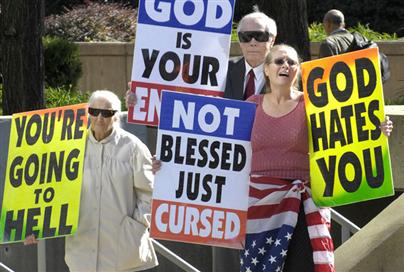
Image Source: Top Ten Unbelievable Westboro Baptist Church Protests

Image Source: Top Ten Unbelievable Westboro Baptist Church Protests

The hatefulness of the Westboro sect is hard to deny.  Writing in the Los Angeles Times, Jenny Deam offers a portrait of Westboro refugee Libby Phelps-Alvarez.  Phelps-Alvarez, granddaughter of Westboro founder Fred Phelps, shares a story of cultish indoctrination into the Phelps family business.  You’ve seen the images: soldiers’ funerals picketed by Westboro members holding up signs saying, “God Hates Fags” and the like.

As Deams’ story relates, Libby grew up with the family church.  She began picketing at age 12.  By her late teens, though, according to Deams, “Libby began to wonder: ‘Am I doing the right thing? Should I be telling people they are going to hell?’”

Eventually, Libby left her church and family.  But she seems strangely ambivalent about it. As Deams concludes, “Libby isn’t sure what she believes anymore. She no longer hates homosexuality, but her journey is far from complete: ‘Everyone thinks when you leave you do this 180. It doesn’t work that way.’”

Many other ex-fundamentalists take a much angrier tone.  For some, hating the haters has freed them to engage in their own brand of hatefulness.

Ken Ham has complained recently of vicious verbal attacks on him and his young-earth creationist ministry by groups of atheists.  Ham planned to speak at a Texas homeschooling conference, and Texas freethinkers posted their discussion about their planned response.

Most of their planning revolved around intelligent protests and information-sharing.  Vic Wang of the Houston Humanists made the intelligent point that their protests should not be against religion.  Rather, Wang argued, they should paint Ham as a specific sort of “extremist,” a “crackpot.”

Other speakers took an angrier tone.  “Sister Shayrah” equated creationism and conservative religion with child abuse.    She insisted that religious parents were free to teach their children their beliefs, but that no parent, in any sort of school, could be allowed to use religion as an “excuse for damaging or hurting or indoctrinating your child.”

Shayrah and other participants, such as Neely Fluke, noted that they had been brought up in the world of young-earth creationism and fundamentalist Protestantism.  That has left them angry.

I can’t claim to know what it is like to grow up in the world of fundamentalism.  Many of those who grew up that way, such as Jonny Scaramanga or “Forged Imagination,” have offered compelling insights into their feelings and transformations.

But whatever personal anguish or turmoil these folks may have experienced, it does not make sense in the cold light of cultural politics to use angry, confrontational language.  It doesn’t help.

Indeed, the beneficiary of this sort of anger seems to be Ken Ham himself. He has promoted this anti-Ham video on his blog and website.  As he says to his creationist readers,

Everyone needs to experience this video chat for themselves to get an understanding of the increasing intolerance and aggressiveness of many atheists against biblical Christianity. . . .

And let’s get churches in Texas aware of this intolerance by atheists and publically get out the word, including alerting the Christian media. Pastors should speak out about the increasing intolerance of atheists to their congregations. In fact, these video excerpts should be used by pastors across this nation to warn their flocks about the growing intolerance being directed at Christians and then equip their people to stand against these secular attacks. . . .

So, let’s use this video chat by atheists as a tool to offer some practical teaching about those people who oppose the Bible’s messages.

I can’t claim to know what it was like to be taught the doctrines of young-earth creationism or Protestant fundamentalism.  I understand that I might be angry if I had.  But like any political movement, venting too much spleen against our opponents only fuels the other side.  Hate may feel good sometimes.  It may feel righteous.  But it only digs deeper the culture-war trenches that have divided our country.


Can an Atheist Pray in Greece?

The US Supreme Court has agreed to hear a new public-prayer case.  At issue here is whether a town worked hard enough to include religious diversity in its public prayers.

The town of Greece, New York, outside of Rochester, has been accused of favoring Christianity in its pre-meeting prayers.  The Second Court of Appeals ruled in Galloway v. Town of Greece that the town meeting prayers had favored Christianity over other religions.

According to USA Today, the Arizona-based group Alliance Defending Freedom appealed to the US Supreme Court on behalf of the town.

SCOTUS decided in 1983’s Marsh v. Chambers that legislative meetings can be opened with a prayer, as long as that prayer does not favor one religion, denomination, or sect over another.   The Second Court of Appeals explicitly noted that this case does not challenge that precedent.  “We do not hold,” the court wrote, “that the town may not open its public meetings with a prayer or invocation.  Such legislative prayers, as Marsh holds and as we have repeatedly noted, do not violate the Establishment Clause.”

What is at issue here is whether or not Greece worked hard enough to include religious and non-religious diversity in its opening prayers. The original suit, brought by Americans United for Separation of Church and State, charged that the overwhelming majority of the prayers represented Christianity.

The court granted that the town had the intention to represent a proper diversity of religious beliefs, but in practice, most of the prayers implied that Christianity was the town’s religion.  As the court described, a permissible public-prayer policy must be

inclusive of multiple beliefs and makes clear, in public word and gesture, that the prayers offered are presented by a randomly chosen group of volunteers, who do not express an official town religion, and do not purport to speak on behalf of all the town’s residents or to compel their assent to a particular belief….

In other words, it is not enough for a town to allow a diversity of religion in public prayer.  According to the Second Court of Appeals, in any case, public meetings must work harder to dispel the perceptions of a “reasonable objective observer under the totality of the circumstances” that the town tips one way or another.

Will SCOTUS agree?  Or will they rule that it is enough merely to welcome a diversity of belief?

Which Religious Right? A New Islamic College for America

Whom do we think of when we think of religious conservatives in the United States?  Folks who want to censor and ban books?  Who want to get kids out of public schools and into religious one?  Who question the authority of mainstream science?

Most important for today’s post, who do we think of when we think of religious folks who start their own schools and colleges in order to pass along their religious traditions?

The obvious suspects, of course, are conservative Protestants, especially those from the evangelical tradition.  As I argued in my 1920s book, conservative evangelicals have worked hard throughout the twentieth century to save young people from pernicious ideas such as materialism and evolution.  They have founded influential schools and colleges in order to do so.

But in this century, we need to consider a new type of conservative religious school, the Islamic academy.

Recently, Religion & Politics featured an excerpt from Scott Korb’s new book about Zaytuna College, “the Nation’s first Muslim liberal arts college.”

As Korb notes in this excerpt, Zaytuna College has big plans.  Its founders hope to make Zaytuna “a place where . . . the text of the Koran could meet the context of American culture.”  Korb also argues that Zaytuna’s famous co-founder, Sheikh Hamza Yusuf, is best understood as “conservative.”

In some ways, Sheikh Hamza’s educational ideology seems to echo that of his Christian co-conservatives.  For instance, Korb points out that Yusuf works with his siblings to promote religious homeschooling.  He has warned fellow Muslims, “We absolutely must remove our children from state schools.”

Though Korb’s excerpt did not include this, Sheikh Hamza has also worked together with other religious-conservatives intellectuals to discourage the availability of pornography in hotels.  Sheikh Hamza has publicly critiqued arrogant mainstream science, science that purports to know more than it can reasonably justify.

In all these ways, Sheikh Hamza and his new college seem to parallel the thinking of conservative Protestants in the United States.  However, there are some important differences.  Look, for example, at the books he recommends.  Some are classics from the conservative canon.  Michael Behe’s intelligent-design polemic Darwin’s Black Box made the list, as did William Bennett’s Book of Virtues, Newt Gingrich’s To Renew America and John Taylor Gatto’s Dumbing Us Down.  Nothing most conservative evangelicals might not endorse.  But Sheikh Hamza’s reading list includes progressive favorites, including Howard Zinn’s People’s History of America and Paolo Friere’s Pedagogy of the Oppressed.

More important, history matters.  Korb points out that many journalists have been too quick to call Sheikh Hamza a “‘moderate’ or ‘progressive’ Muslim” due to Sheikh Hamza’s stern anti-terrorism.   Yet even a profoundly conservative Muslim educator in 2013 faces a very different educational landscape than that faced by conservative evangelicals in 2013, or 1973, or 1913.  Unlike conservative evangelical Protestants, conservatives of other traditions don’t have the common feeling of having “lost” public education in America.  For conservative Muslims, like conservative Catholics and other sorts of conservative religious folks, the public schools in the United States have historically been hostile institutions.  Not so for many conservative evangelical Protestants.  Throughout the twentieth century and continuing today, anyone paying attention can hear a lingering desire among conservative evangelicals to “Reclaim YOUR School.”

What will it mean to have a new conservative college in the United States?  One from a very different faith tradition?  Perhaps this will continue the broadening of “conservatism” in America.  As James Davison Hunter predicted so many years ago, perhaps our culture wars will continue to change into broad, diverse coalitions of the “orthodox” against those on the other side.


Jesus Rocks the Vote

Voting in the mayoral race in North Miami? Jesus wants you to vote for candidate Anna Pierre, according to Pierre.


Source: ABC News

Jesus has endorsed her, Pierre claimed. The registered nurse and creole pop singer insisted that Jesus gave her three signs of his endorsement. According to an ABC News story, this mayoral race in the city of 60,000 has included voodoo and violence.

“Whether or not you believe in Jesus or not,” Pierre promised, “once I’m elected mayor, I’m gonna be the mayor for everybody.”

Phyllis Schlafly Blasts the Common Core

Don’t do it, Phyllis Schlafly warned states recently. Don’t fall for the hoopla about the new Common Core State Standards.

Schlafly is often best remembered for her successful campaign to block the Equal Rights Amendment in the 1970s. But as historian Don Critchlow has argued, Schlafly’s career was about much more than just the ERA.  An examination of Schlafly’s activism can tell us much more about the changing face of “conservatism” in the twentieth century.

Image Source: Christian Post

Image Source: Christian Post

Now Schlafly has joined the chorus of conservative anti-CCSS voices.  As we’ve noted earlier here at ILYBYGTH, conservatives join many progressives in lambasting the new unified state standards, but usually for different reasons.

Writing in the pages of the Christian Post, Schlafly offers conservative parents and voters solidly conservative reasons to get up off the couch and take an interest in their local schools’ new curricular guidelines.  “Common Core,” Schlafly warns, “means federal control of school curriculum, i.e., control by Obama administration left-wing bureaucrats.”

The standards will not improve students’ academic performance, Schlafly argues. Nor will they achieve their trumpeted goal of making all students “college ready.”  Rather, these new standards represent only the latest left-wing drive to transform the United States into a “totalitarian government.” In Schlafly’s words,

Common Core means government agencies will gather and store all sorts of private information on every schoolchild into a longitudinal database from birth through all levels of schooling, plus giving government the right to share and exchange this nosy information with other government and private agencies, thus negating the federal law that now prohibits that.

Everything about the standards is “encrusted with lies,” Schlafly insists. The suggested content itself predictably indoctrinates students toward leftist ideas and policies. As conservatives have warned for decades, the suggested readings even veer into the “pornographic.”

So what is a conservative to do? According to Phyllis Schlafly, the new Common Core State Standards represent only the latest effort by leftist federal bureaucrats to seize control of children’s minds. Any red-blooded American must shudder at the implications.

Jonny Scaramanga Gives Us…Creation Rock!

Think creationism is a bunch of dweebs with thick glasses stammering as they refute mainstream science?  Think again!

UK former fundamentalist Jonny Scaramanga offers some priceless creation-rock videos today.  Jonny grew up with this stuff, but for secular folks like me, it is a revelation.

Geoff Moore and the DistanceCheck out Jonny’s guest post at Laughing in Purgatory, and, best of all, watch the video he saved for his own blog, Leaving Fundamentalism.  This video mixes “Smokin in the Boys Room” with “Take On Me.”

Thanks Jonny… Motley Crue + A Ha + The Genesis Flood = Wow.

Summer Reading List

Summer is here…or close enough.  What are people planning to read?  Seems like everyone and their brother are publishing their summer reading lists.  Hoping to beat Oprah’s 2013 list to the punch, here are a few from ILYBYGTH’s idiosyncratic dream library:

1.)    Jason Rosenhouse, Among the Creationists.

This is one I’ve been excited about for a long time.  Rosenhouse is an atheist mathematician with a familiar hobby.  For years he has traveled to creationist conferences and interacted with creationists and their ideas.  From the publisher’s description:

After ten years of attending events like the giant Creation Mega-Conference in Lynchburg, Virginia, and visiting sites like the Creation Museum in Petersburg, Kentucky, and after hundreds of surprisingly friendly conversations with creationists of varying stripes, he has emerged with a story to tell, a story that goes well beyond the usual stereotypes of Bible-thumping fanatics railing against coldly rational scientists. Through anecdotes, personal reflections, and scientific and philosophical discussion, Rosenhouse presents a more down-to-earth picture of modern creationism and the people who espouse it. He is neither polemical nor insulting, but he does not pull punches when he spots an error in the logical or scientific reasoning of creationists, especially when they wander into his own field, mathematics.

Right up my alley.  I’ve got the book on my table, top of my list.

2.)    Amy Binder and Kate Wood, Becoming Right: How Campuses Shape Young Conservatives.

As we noted here earlier, this book suggests that higher education is a more ideologically complicated place than many pundits suggest.  Many self-identified conservative intellectuals have panned the book as “patronizing.”  Bruce Bawer at Minding the Campus skewered the title as an example of “the insularity and obtuseness of the academic left.”  I’m looking forward to reading the book more carefully myself.  Do these criticisms hold water?

3.)    Charles J. Holden, The New Southern University: Academic Freedom and Liberalism at UNC .

For my next book project, I’m considering a look at conservative Protestant higher education through the twentieth century.  Holden’s new book examines the flagship “Southern” university in Chapel Hill during the formative decades between the World Wars.  As reviewer Wayne Urban noted in an H-Net review, Holden focuses on the ways UNC served as a bastion of “liberal” thinking and culture during these decades.  In my study of conservative evangelical Protestantism in the 1920s, I found that UNC did indeed often lead the charge for a politicized vision of what it meant to be both “intellectual” and “Southern.”  As I think about diving deeper into the world of “fundamentalist” university life, I hope Holden’s work will help broaden my understandings of the meanings of higher education in this period.

4.)    Hubert Dreyfus and Sean Dorrance Kelly, All Things Shining: Reading the Western Classics to Find Meaning in a Secular Age .

This title is not particularly new, nor is it focused tightly on the areas I usually read about. That’s why I think it will make good summer reading.  According to a gushing review in the New York Times, Dreyfus and Kelly begin with the assumption that “The gods have not withdrawn or abandoned us.  We have kicked them out.”  Since I spend so much of my time reading arguments for the continuing centrality of ferocious, doctrinal monotheism, this argument looks like an intriguing counterweight.

What else are people planning to read this summer?  Books from outside your usual “work” fare?  Books recommended long ago but put on the ever-growing “to be read” pile?

What do Pastors Believe about Origins?

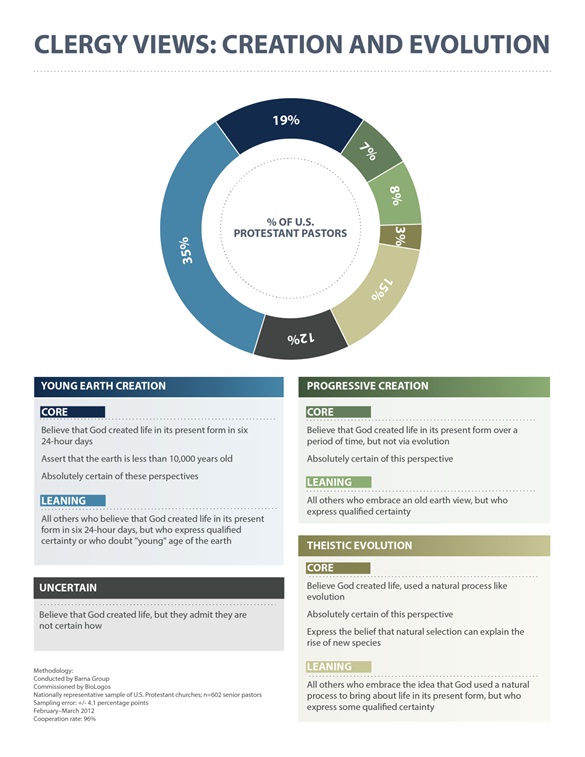
What do America’s professional Protestants think about evolution and creation?  Biologos has published the results of a survey of US Protestant pastors.

Those concerned with creationism and evolution have published many surveys of the ways evolution is taught in public schools.  Those surveys tend to focus on the ideas of high-school biology teachers.  Most recently, the work of Penn State political scientists Michael Berkman and Eric Plutzer offered a thorough nation-wide look at what biology teachers think and teach.

Source: Biologos Forum

Source: Biologos Forum

This survey, in contrast, asked 602 “senior pastors” for their views.  The results invite a few comments.

First of all, we should note that this is not a survey of religious Americans’ views about evolution and creation.  Rather, this is specifically a survey of a spectrum of US Protestant pastors’ views.  There were no leading Catholics involved, much less Muslims, Jews, Hindus, or any other religious group.  That matters.

Second, the numbers themselves make some interesting points.  We are not surprised by the majority (54%) who call themselves young-earth creationists.  We are surprised, though, by the strong showing for “uncertain” (12%) and the relatively weak showing for “theistic evolution” (18%).  Could these two answers be reasonably combined to form a much stronger bloc—nearly a third—of American pastors who take a theistic but uncommitted view of evolution?

Finally—for now, though the Biologos editors have promised to dig in more deeply to these survey results in the future—what about the striking Biologos note in its seventh point?  As the Biologos editors point out, a majority of pastors with young-earth creationist (YEC) beliefs agreed that publicly challenging those views might cost them their jobs.  In other words, for pastors with YEC beliefs, even a whiff of doubt or skepticism must be avoided.  This seems to confirm the accusations of anti-creationists.  If YEC pastors feel obliged to maintain their positions—feel dug in to YEC beliefs regardless of evidence or personal struggles—it seems fair to accuse YECs of closed-mindedness, obdurate clutching of YEC due more to social and economic pressure than to Biblical conviction.

Certainly, Biologos is not a disinterested party.  The organization hopes to promote “evolutionary creationism” or “theistic evolution.”  And my social-science chops, I’m afraid, aren’t sharp enough to offer a good critique of this survey methodology.  But if we take Biologos’ word for it, there might be a large number of YEC pastors out there who stick to their YEC guns for other reasons than Bible-based conviction.