Deneen on Bloom, Conservatism, and Multiculturalism

What does it mean for schools to embrace “multiculturalism?”

One of the sternest and most popular condemnations of the implications of multicultural ideology was Allan Bloom’s The Closing of the American Mind (1987).

Political philosopher Patrick Deneen recently evaluated the book and its legacy.  Deneen concludes that the book could have done much more to condemn the pernicious influence of “multiculturalism.”

As Deneen notes, Bloom explicitly refused the label “conservative.”  Nevertheless, his book became a favorite of those culture-war activists who battled over the cultural content of higher education.  Should colleges teach Plato, Locke, and Shakespeare?  Or should they instead teach Fanon, Derrida, and Gloria Anzaldua?

Bloom plaintively argued that American higher education had abandoned its central mission.   In order for young people to doubt, Bloom argued, they must have some ground from which to question.  They must understand themselves as inheritors of a cultural tradition.  Higher education, Bloom argued, had willfully denied its central role as caretakers of students’ souls.  Instead of teaching young people to explore and question Truth, higher education shamefully evaded its responsibility and taught students instead that Truth was an illusion.

It is easy to see how this argument endeared Bloom to many conservative activists.  Yet Bloom himself did not argue for any specific tradition.  He was not a religious man himself, nor did his book insist that any religion embodied the truth.  Rather, he argued that students must be recognized as yearning souls, rather than transformed into indifferent spiritual husks.

Deneen’s critique raises many intriguing points and is worth reading in its entirety.  Deneen wishes Bloom might have pursued the analysis of multiculturalism to its logical conclusion.  As Deneen writes,

The stronger case would have been to expose the claims of multiculturalism as cynical expressions from members of groups that did not, in fact, share a culture, while showing that such self-righteous claims, more often than not, were merely a thin veneer masking a lust for status, wealth and power. If the past quarter century has revealed anything, it has consistently shown that those who initially participated in calls for multiculturalism have turned out to be among the voices most hostile to actual cultures, particularly ones seeking to maintain coherent religious and moral traditions.

If Bloom could have seen the current state of American higher education, Deneen argues, Bloom would have seen that his 1987 book underestimated the scope of the problem.  In the late 1980s, Deneen believes, advocates of multiculturalism shared Bloom’s sense of the importance of curriculum.  These days, even that awkward defense of multiculturalism has been eclipsed by what Deneen calls “an age of indifference.”  The cultural left no longer insists on a left-leaning set of counter-readings.  Instead, Deneen points out,

not only is academia indifferent to whether our students become virtuous human beings (to use a word seldom to be found on today’s campuses), but it holds itself to be unconnected to their vices—thus there remains no self-examination over higher education’s role in producing the kinds of graduates who helped turn Wall Street into a high-stakes casino and our nation’s budget into a giant credit card. Today, in the name of choice, non-judgmentalism, and toleration, institutions prefer to offer the greatest possible expanse of options, in the implicit belief that every 18- to 22-year-old can responsibly fashion his or her own character unaided.

Whatever Bloom’s personal views, the notion that schools at every level must teach a set of core values has been and remains central to conservative thinking about schooling and education.  The central issue remains the question of the function of schooling.  Conservatives embraced Bloom the skeptic because he made a powerful argument in favor of school as a transmitter of cultural values.  “Multiculturalism,” in contrast, became a label for a very different vision.  For multiculturalists, the purpose of school was to help students overcome their inherited cultural values, clearing the way for a logical, tolerant, reasonable set of beliefs.

In the News: Dancing the Rights Away

The New York Times reports this morning on a strange crackdown in Cranston, Rhode Island.  Seems a father-daughter dance tradition had been taking place despite a state law and district policy against it.  In addition, Federal Title IX rules forbid any gender-discriminatory activities.  In this case, a single mother of a daughter objected to the dance.  Though the school had also organized a mother-son baseball game, the two events were ruled to be not similar enough to avoid charges of sex discrimination.

In the big scheme of things, this tempest on a dance floor seems like no big deal.  The mother attended the dance with her daughter, and the school district reminded dance organizers of their ban on gender-specific events.

But the story serves as an illustration of a few items of perennial interest to those trying to understand the conservative impulse in American education.  First of all, we see again that school policy does not always match school practice.  Most memorably, when the US Supreme Court ruled in 1963 that school-sponsored prayer and Bible-reading violated students’ First Amendment rights, many schools continued to sponsor prayers and Bible-reading regardless.  As political scientists Kenneth Dolbeare and Phillip Hammond found in their 1971 study, many towns and schools continued to pray and read the Bible without eliciting a whisper of controversy.

Even the district in Cranston, Rhode Island, had hung a “prayer banner” in its high school, according to the New York Times.

As in many other cases, we see in this disco scuffle the ways conservatives embrace such seeming government overreach as a culture-war cause.  In this case, Sean Gately, a candidate for State Senate, along with Cranston Mayor Allan Fung, have come out strongly in favor of father-daughter dances. Such politicians have publicized the ban and tried to associate it with their Democratic opponents.  As Gately told the NYT, “Having those little father-daughter dances and seeing her all dressed up in her pretty dress — it’s a very special moment.”  Gately said the ban “offended me as a father and a husband.”   In the end, Gately insisted, “Nobody is being hurt by a father-daughter dance.”   Fox News condemned the “political-correctness police” of the American Civil Liberties Union for stirring up controversy where none existed.  The ACLU, according to Fox, had objected to the dance tradition as perpetuating harmful gender stereotypes: fancy dances for girls, baseball games for boys.  Gately told Fox this was a case of the “local ACLU kind of bullying our school system.”

From the ACLU’s perspective, local school officials just don’t “get it yet,” as state ACLU director Steven Brown told the New York Times.  Gately would likely respond that Brown simply does not “get” that most Cranstonites have no problem with reinforcing gender stereotypes for their children.

Perhaps most important, this dance debate demonstrates the way schools are more often guided by tradition than by explicit policy.  According to the NYT, the district had banned this father-daughter dance years ago.  However, no one on the current Parent-Teacher Organization was aware of that policy.  They organized the “Me and My Guy” dance simply because they had done so in the past.

In dancing as in much else, these kinds of traditions tend to be more powerful than any policy, whether in Cranston, Rhode Island, or from the US Supreme Court.

Fundamentalists Against CATCH

The headlines say it all.  Concerned Women for America’s article announces, “New York City Schools: Reading, Writing, and Morning-After Pills.”  The Family Research Council denounces “New York’s Deadliest CATCH.”

The Family Research Council’s Take on “the Deadliest CATCH”

Sifting through the arguments from these prominent conservative organizations will give us some insight into what religious conservatives dislike about New York City’s Connecting Adolescents to Comprehensive Health (CATCH) program.  As the CWA headline suggests, the program expands the district’s free-condom program to include birth control pills and “morning-after” pills.  As ILYBYGTH has reported, the NY Board of Health has insisted that a very low rate of parent opt-out suggests that most parents find the program inoffensive.

Fundamentalists beg to differ.

Both CWA and FRC point out the absurdity of a school system in which parents must provide copious paperwork in order for schools to provide basic medicine for schoolchildren, yet those same schools will administer Plan B pills without parental notification.  As the FRC briefing notes, “The same nurse’s office that demands a parents’ note for aspirin will be in the position to administer high (and potentially dangerous) doses of hormones to children as young as 14 without so much as a permission slip.”

Such contradictions, both groups insist, indicate the plan is both dangerous and insidious.  “Suppose [a student] has severe side effects from the pill but is afraid to tell her parents?”  CWA’s Brenda Zurita asks.  “It’s late at night or perhaps a weekend, what will she do? Who will she call?. . . Let’s pray that no young girl will die due to complications she was afraid to tell her parents about after she was encouraged at school to hide her sexual activity from her parents.”

Also worrisome, according to both reports, are the results of increased sexual behavior among teen-age girls.  The FRC report cites a 2010 study that finds such birth-control medications increase STIs among young women.

According to the FRC, the root of this problem is an inverted understanding of the proper role between parents, children, and government.  The FRC describes the “Nanny State” ideology at play: “If moms and dads can’t be trusted to ensure that their kids are eating well, then they certainly can’t be trusted with decisions about sex and abortion. So the government takes away chocolate milk because it’s too fattening–only to turn around and give kids the morning-after pill, which can really kill.”

Concerned Women for America’s Zurita agrees.  This program, Zurita insists, is yet another example of an “out-of-control bureaucracy.” “It is frightening and tragic,” Zurita warns, “that there are parents who do not care what their children are doing, and with each example of government intruding between parents and children, this story is fast becoming the norm.”

Finally, CWA’s Zurita raises a powerful point.  The NYC Board of Health has claimed that a low parental opt-out rate means this program is not upsetting parents.  But as Zurita notes, many parents could simply be unaware of the program.  Since when do schools assume that every announcement sent home with students has been dutifully delivered to parents?  With non-controversial notices such as bad report cards, students are required to return parent signatures to prove that parents actually saw the notice.  But with a more profoundly morally complex notice such as this, the school district simply assumes that students shared the information with parents?

In the eyes of these fundamentalist activist organizations, something stinks with New York’s CATCH.

CS Lewis on Science and Evolution

Did Aslan evolve?

Aslan and friends. Image source: WikiNarnia

Not according to a new book about Narnia-creator C.S. Lewis’ philosophy of science. Editor John G. West pulled together a fascinating collection of essays in The Magician’s Twin: C.S. Lewis on Science, Scientism, and Society.

The Discovery Institute’s West hopes to claim Lewis’ legacy for the intelligent design movement; the essays argue that Lewis was profoundly skeptical of what Lewis called “error scientism.”

As evolution skeptic Tom Bethell notes in a review for American Spectator, some evolutionists have claimed Lewis as an ally. But the authors in The Magician’s Twin paint a very different portrait. Among Lewis’ intellectual protests against evolutionary thinking, Bethell argues, was a deeply held concern with Darwin’s naive progressivism.  A nineteenth-century optimism about humanity’s natural tendency to improve, Lewis believed, had been thoroughly discredited by both Christianity’s vision of original sin and the twentieth century’s horrors.

Intelligent design advocate Michael Flannery agrees that this collection of essays captures Lewis’ deep anxiety about the cosmological claims of naive evolutionism.  In a long review for Evolution News and Views, Flannery extols the essays for recognizing Lewis’ appreciation for medieval thought, Lewis’ denunciation of the plausibility of natural selection as an evolutionary mechanism, and Lewis’ worry about the anti-human and anti-Christian implications of evolutionary thinking.

C.S. Lewis remains one of the most popular Christian authors for Christian and non-Christian audiences alike.  His Screwtape Letters , not to mention his wildly popular Narnia books, keep Lewis a household name in all kinds of households.  Claiming Lewis’ legacy for the intelligent design movement would be a major coup for West and his co-authors.

For those of us trying to understand cultural conflicts over education, these essays offer key insight into the intellectual depth and range of the intelligent design movement.  Especially for those evolutionists who dismiss intelligent design as simply “Ken Ham warmed over,” this collection of essays will illuminate the very different tone, style, and intellectual ethos of the movement.

CATCH-ing Up and Opting Out

ILYBYGTH reported yesterday on a new pilot program in New York City high schools.  The program, Connecting Adolescents to Comprehensive Health, or CATCH, will expand the district’s condom-distribution program to include birth control pills and “morning-after” pills.

This morning, we read Catholic League President Bill Donohue’s denunciation of this “imperial edict” in an interview in the Christian Post.  “Whenever it comes to sensitive issues such as sexuality, the government must  always play an ancillary role to that of parents,” Donohue told the CP. “The provision  that parents can opt out smacks of governmental arrogance and must be resisted:  the government has no business eclipsing parental rights.”

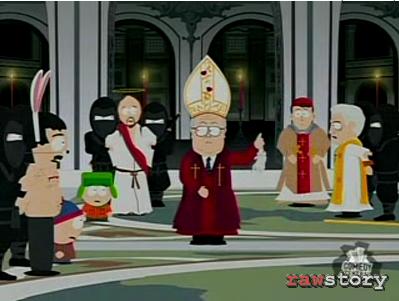
Bill Donohue as the Wild-Eyed Pope on South Park’s “Fantastic Easter Special”

I am usually no fan of

Bill Donohue.  I find myself siding more often with the South Park send-up of his public-morality campaigns.  But in this case, I find his criticism of CATCH more compelling than the lame defense offered by Chanel Caraway of the NYC Board of Health.  Since only 1-2% of parents had opted out of the program, Caraway told ABC News, “this suggests that parents are OK with the service being available to their children.”

Again, please don’t misunderstand.  I support the CATCH program and its goals.  I would want my daughter to be able to get free condoms and contraceptives at school if she couldn’t get them elsewhere.

However, Caraway’s opt-out argument demonstrates a frightening ignorance of America’s educational history.  In prominent cases such as Engel v. Vitale (1962) and Abington Township School District v. Schempp (1963), the US Supreme Court specifically concluded that “opt-out” provisions do not adequately respect families’ and children’s rights to be free of religious coercion.

As Justice Clark argued in his majority decision in Schempp, “Nor are these required exercises mitigated by the fact that individual students may absent themselves upon parental request, for that fact furnishes no defense to a claim of unconstitutionality under the Establishment Clause.”

I understand that this is a very different case.  Clark referred to the unconstitutionality of school-sponsored prayer.  It did not matter whether or not parents could opt out if the program defied Constitutional freedoms.  However, issues of sexuality are intimately connected to religious values for many students and families.  Could not a Bill Donohue argue that such state-imposed sexuality–even with an opt-out provision–denied some students their Constitutional right to free exercise of religion?  To assume that an opt-out clause defuses any potential complaint from conservative religious families seems ignorant at best, and, as Donohue put it, “imperial” at worst.

Traditionalism and Education

This morning’s column by David Brooks in the New York Times is sure to provoke some head-scratching.

Brooks points out the conventional division of contemporary conservatism into two constituent entities. He calls them “economic conservatism” and “traditional conservatism.” Economic conservatives are the free-market champions. They are the sort who cheered when Reagan described the nine most terrifying words in the English language as, “I’m from the government and I’m here to help.” Traditionalists, on the other hand, value localism, organic social structures, and community. They derive their ideas from the likes of Edmund Burke and Russell Kirk.

Those who follow the intellectual history of modern conservatism will scratch their heads that Brooks did not include other important types of conservatism, such as the Jerry-Falwell-style Moral Majoritarianism, the kind of conservatism that wants to regulate personal behavior and use government power to improve America’s morals. And where are the “tribal” conservatives, folks such as Rush Limbaugh who cling to “conservatism” largely as a form of in-group identity?

On the other side, people less familiar with the landscape of modern American conservatism might be surprised at Brooks’ evocation of an entirely different style of conservatism. Those unfamiliar with this traditionalist tradition might be shocked to hear of conservatives who oppose a pure laissez-faire approach to economics. Conservatives, as Brooks puts it, who want government to use a “subtle hand” to encourage family and neighborhood cohesion.

As Brooks notes, influential bloggers such as Rod Dreher at the American Conservative keep traditionalist conservatism alive and kicking. Brooks might also have included Patrick Deneen at Front Porch Republic in this survey.

Those of us most interested in the relationship between conservatism and education can explore Deneen’s exposition of traditionalist hero Robert Nisbet.  In 1953, Nisbet had lamented the increasingly universalist nature of higher education.  Deneen argues that such trends have only accelerated.  As Deneen noted a few years back,

“The modern university system has arisen with the consent of those on the Right and Left alike, particularly in its guise as the modern research university aimed toward the end of ‘creating knowledge’ and providing educations that allow our students to ‘succeed’ and to ‘solve problems.’ Both have actively assented to a national, and increasingly international educational system that becomes annually more homogenous and standardized (This is just as true of supposedly ‘conservative’ administrations, one of which gave us ‘No Child Left Behind’ and Margaret Spellings).”

The traditionalist solution, Deneen argues, is to restore some measure of true diversity to university life in America.  Instead of a spread of cookie-cutter colleges arrayed to produce skilled mechanics of a corporate juggernaut, institutions of higher education could instead strive to emphasize the particularities of their own local communities.  Elsewhere, Deneen has suggested that this particularity must embody not only a constrained localism, but also a truer conception of universality. 

As David Brooks suggests, much of the subtlety of this sort of traditionalism has been read out of today’s conservative discussions of education.  For those of us trying to understand conservative thinking about education, however, it is a useful reminder of the complexities of what Brooks calls “half of [the Republican Party’s] intellectual ammunition.”

Required Reading: Assemblies of God on Faith/Science

Can Pentecostals embrace science?  Can they find a way to love both God and Gould?

For those of us trying to understand the conservative vision of education from the outside, the newest edition of the Assemblies of God’s Enrichment Journal is a treasure trove.  This edition offers a series of articles for the denomination’s readers about the proper relationship between faith and science.  As General Superintendent George O. Wood explains, the dangers for young people in the church are stark.  He quotes “Mike,” who declared, “I knew from church that I couldn’t believe in both science and God, so that was it.  I didn’t believe in God anymore.”  Wood hopes that this volume will help Assemblies of God members negotiate a more profound and religious relationship between science and faith.

For those unaware of the distinctions among conservative Bible-based Protestant groups, the Assemblies of God, very briefly, is the largest denomination of Pentecostal believers, claiming 65 million members worldwide.  Pentecostalism, also very briefly, is a form of conservative evangelical Protestant belief that came into existence in the early 20th century.  It combines conservative Bible-based theology with an emphasis on baptism by the Holy Spirit.  Pentecostal services are typically vibrant, dramatic events that can include speaking in tongues and divine healing.  As historian Grant Wacker argued in Heaven Below (2001), the attraction of early Pentecostal churches derived from their combination of a powerful “primitivist” theology with a comfortable cultural “pragmatism.”

In an opening piece, Amos Yong of Regent University encourages Pentecostal readers to “work to overcome the history and culture of anti-intellectualism that persists in some segments of the Pentecostal church.”

Perhaps the most interesting section of this issue for those of us outside the conservative tradition is its forum on the variety of evangelical positions for the age of the earth.  Kurt P. Wise makes the case for a young earth, Hugh Ross for six long ages, and Davis A. Young for an old earth.

With each article, we see the very different intellectual playing field for evangelical intellectuals.  Among mainstream scientists, the first question is usually whether any new approach offers better insight into the natural world.  Among evangelical thinkers, the first question is whether any scientific approach offers better insight into the natural world while allowing Christians to maintain an authentic faith.

As Kurt Wise argues in his pitch for a young earth, “believers” enjoy a more promising guide to the natural world.  Wise insists, “We should look at the eyewitness account from God before we begin inferring the meaning of circumstantial evidence.”

Everyone interested in the creation/evolution debate will be well served by reading through these articles.  Some of the most fervent young-earth creationists such as Answers in Genesis’ Ken Ham have condemned such forums.  Any consideration of an old earth, Ham blasted in a blog post, results in a “dogmatic, intolerant stand against those who take the position we do at AiG.”

But for those of us outside of evangelical circles, an understanding of both the different evangelical views of science and the ways evangelicals construct their scientific arguments will go a long way to decoding the stubborn controversy over evolution and creationism.


Schools, Sex, and the War that Isn’t

Sex in our Public Schools is in the news again.  How about this for a headline: “No One Cares”?

It doesn’t promise to get a lot of readers.  But it seems the closest to the truth in this case.

Here’s the story: Thirteen public high schools in New York City will now dispense free contraceptives to high-school students, including the morning-after “Plan B.” As reported by the New York Times and the New York Post, the pilot program, Connecting Adolescents to Comprehensive Health, or CATCH, will supply students with free condoms, birth-control pills, and/or the morning-after pill.

According to the NYT, the new program has not caused any of the traditional controversy.  Only 1-2% of parents returned an opt-out form.  Yet the headlines from more conservative media have emphasized the outrageousness of the new program.  Glenn Beck’s The Blaze declared, “File this one under ‘controversial.'” Fox News’ headline announced, “Parents not told NYC schools dispensing morning-after pill.”

But is a program controversial if it doesn’t raise any controversy?  We are remined of Ben Justice’s terrific 2005 book The War That Wasn’t.  Justice examined nineteenth-century discussions in New York about religion and culture in public schools.  In most cases, Justice argued, “the warfare thesis” does not explain the way schools really work (9).  People usually resolve their disputes about schooling peacefully and even amicably.

That might be the case here.  However, simply because only a small minority of parents have opted out does not mean that most parents support the program.  It might simply mean that parents are not aware of the program.  Or that parents are not aware of their opt-out option.

After all, the fact that very few families complained about prayer and Bible reading in 1960s schools does not prove that such policies were uncontroversial.  It simply means that school policies often fly under the radar until enough parents and activists complain.  In this case, we might still get a public debate over the propriety of issuing birth-control pills to high-school students.  This certainly seems to be the hope of editors at The Blaze and Fox News.

Mommy, I Can Marry a Princess!

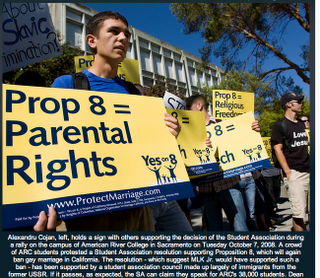
What is so frightening about gay marriage?  A TV ad from California’s 2008 battle over same sex marriage gives us a clue.  Gay marriage, to many conservatives, will ultimately tear families apart. 

For those of us trying to understand conservative, traditionalist, ‘fundamentalist’ culture in America, this TV ad offers some insight into conservative thinking.  Many of us are puzzled by conservative opposition to gay marriage.  Like Jonathan Rauch, it seems to me that a defense of traditional values should logically want to see as many people married as possible. 

Image source: A Collection of Odd

But for many conservatives, a redefinition of marriage will represent a cultural camel’s nose under the tent.  That is, if two same-sex partners are allowed to marry, then a slew of other cultural transformations will soon thrust themselves into mainstream culture.  Any opposition to these radical changes will soon be tarred as mere bigotry. 

In the same-sex marriage debate–as in so many cultural contests–schools and schooling play a central role.  For many conservatives, public schools often play the role of cultural contaminant.  Ideas such as evolution, secularism, moral relativism, and sexual liberation, in the conservative vision, are transmitted into cultural circulation by being injected into children at public schools.  Schools are used by progressive activists to subvert the proper relationship between parent and child.  Schools fill the heads of impressionable children with pernicious ideas about the nature of morality and values. 

We see a particularly striking example of this in California’s TV ads.  During the fight over California’s Proposition 8  in 2008, ads depicted a girl coming home from school, happily telling her worried mother that she learned she could marry a princess.  The ad warned ominously: without Proposition 8 parents would have no legal right to complain.

This ad plays upon a very commonly held notion about the flawed relationship between traditional values, families, and public schools.  In this vision, schools become the institution that transforms cultural change from a general trend to a problem within conservative families. Schools become intrusive agents warping the minds of children and turning those children against the dearest beliefs of their parents.  

I’m sympathetic.  I support gay marriage, evolution, pluralism, etc.  But I recognize that many of my well-meaning education colleagues really do envision public schools as a vehicle to transform children’s culture.  When cultural conservatives worry about camels’ noses, I believe they are smart to worry.  Progressives yearn ardently for a network of public schools as “change agents.”  Just as fervently as conservatives worry about the intrusive moral role such schools might hope to play.

Jesus Teaching Evolution

We’ve been hearing a lot in the last few days about 47% of Americans: Governor Romney’s comments about the 47% who don’t pay federal income taxes, or the 47% whom he assumes won’t vote for him. 

I’m more interested in the 46% of adult Americans who believe humans were created in “pretty much their present form at one time within the last 10,000 years or so.”  For believers in evolution like me, that number is hard to understand.  How can so many adults–almost half of whom hold college degrees–believe in this kind of young-earth creationism? 

As we’ve discussed here recently, this is not merely a question of shoddy science education.  Mere exposure to evolutionary science does not promise to increase the number of believers in evolution.  The important element seems to be the messenger of evolutionary science, not just the message. 

A brief autobiography this morning by evolutionary creationist educational writer Abigail McFarthing seems to confirm this notion.  McFarthing describes her upbringing as a youngster homeschooled into the tenets of young-earth creationism.  As she writes,

“In ninth grade, I went to public high school armed and ready for the fight I had been trained to expect. When my biology teacher taught evolution and required us to write an essay, I hi-jacked the essay topic and turned it into an apologetic for six-day creation. Because I was in ‘conflict mode,’ I was not ready to consider the arguments for evolution, or the possibility that Christians could actually accept it.” 

It was not until McFarthing attended the evangelical Wheaton College that she was brought out of conflict mode.  As she studied to become a high-school teacher, one of her evangelical Christian professors insisted, “‘Jesus is not going to be standing at the gateway of heaven . . . holding a clipboard in his hand and asking, “Did you believe in six-day creation? Did you believe in evolution?” He’s going to be asking the one question that matters: “Did you believe in ME?”‘” 

The goal of McFarthing’s new homeschooling curriculum is not to train students away from their conservative evangelical faith.  Rather, she describes her goal as “resilience.”  She wants young people to realize that they can be Christian and accept the evidence for evolution. 

I’m not advocating McFarthing’s curriculum.  I do not think that her evolutionary creationism will fit in public schools, nor does she suggest that it should.  The interesting point here is McFarthing’s story.  It seems to add one more bit of evidence to a growing pile.  The way to educate people about evolution is not simply to bash them over the head with scientific evidence.  As we noted recently, evidence alone does not convince.  Rather, for people like McFarthing, the messenger is more important than the message.