Adam Laats on Evos & You

Many thanks to DJ SupplyGuy for hosting a talk yesterday on his radio show “EVoS & You.”  DJSG presented some interesting questions and our short half-hour talk ranged from pen-dropping to ham-and-cheese sandwiches.

Some of the questions we wrestled with:

  • Why do so many Americans doubt evolution?
  • Why do smart evolutionary scientists seem so dumb about creationism?
  • How can evolution education do a better job?

Check out the show: Evos and You~2012_10_16_17_00_08.

“If You’re Planning to Have Sex…”

What should schools be teaching America’s young people about sex?  This is a question that has snarled culture-war arguments about public education for decades.  Sex ed proponents often insist that they can teach a morally neutral approach—just the facts.  This attitude is ridiculously oversimplified.  There is and can be no morally neutral approach to a subject that is so intimately wrapped up in religion and ethics.

Let me be clear at the outset: I personally believe public schools should teach a comprehensive curriculum in sexuality that includes discussions about both the mechanics and morals of sex.  But the common argument that sex ed can be done in a morally neutral fashion relies on a woefully naïve self-understanding.

This liberal tradition begins with a powerful argument in favor of public-school sex ed.  Many sex ed proponents make the strong case that sex is a potentially deadly game.  Since kids are going to do it, they need information to stay safe and avoid unintentional pregnancies.  With the prevalence of HIV and possible pregnancy, the argument goes, this is literally a life-or-death situation.  Refusing to educate young people about sex in a frank and open manner would be a nearly criminal malfeasance on the part of responsible public-school educators.  Yet due to dunderheaded conservative opposition, many sex educators feel, this vital information is often censored.

Perhaps the most famous example of this position was the beleaguered Mary Calderone.  As historian Jeff Moran described in Teaching Sex: The Shaping of Adolescence in the 20th Century, Calderone headed SIECUS, the Sex (later Sexuality) Information and Education Council of the United States beginning in 1963.  The stated goal of the organization, in gendered 1960s language, was “to establish man’s sexuality as a health entity.”  Calderone wanted sex to be understood as a positive thing.  “We must block our habit of considering sex as a ‘problem’ to be ‘controlled’,” she wrote in 1963.  Rather, Calderone argued, “Emphasis must be on sex as a vital life force to be utilized.”  In spite of the reputation Calderone gained as a wild-eyed sex maniac, Calderone remained relatively old fashioned.  She believed sex ed should encourage the ultimate goal of healthy marriages, for instance.  The SIECUS plan insisted it took a “moral-neutrality” approach.  It promised to deluge students with information, not preaching, about sex and sexuality.

Like that of SIECUS in the 1960s, the rationale of sex-ed advocates in subsequent decades has often gone as follows: sex educators in public schools do not encourage young people to have sex.  They merely suggest that if students are going to have sex, they must have the knowledge to do it safely.

For instance, as Laura Sessions Stepp has argued in recent days about a New York City program to provide the “morning after” pill to public-school students without parental consent, merely making information and even contraception available to young people does not encourage sex.

Whatever scientific evidence may suggest, however, proponents of sex ed in public schools often utterly misunderstand the thinking of religious conservatives.  It is difficult for those of us who support public-school sex ed to wrap our minds around the conservative position.  But if we are going to have respectful, productive discussions about sex ed, we must make the effort.

In short, for many religious conservatives, sex ed can never be a neutral message.  Having an adult, perhaps a teacher, stand in front of a group of young people and say, “If you’re going to have sex, here are some ways to do it safely,” suggests that having sex is a legitimate and respectable option for young people.  It encourages young people, some religious conservatives think, to think of themselves as people who might be having sex.

How can we make sense of this conservative position?  We might start with a few analogies.
For example, imagine a parallel situation in Family and Consumer Science, the class formerly known as Home Ec.  Imagine a teacher planned to inform students about the importance of kitchen hygiene.  “If you’re planning on making a ham-and-cheese sandwich,” the teacher might say, “here are some ways to do it safely.”

It is not difficult for us to imagine that a student from a Jewish background might not want to make a ham-and-cheese.  And, with our understanding of the goals and nature of public education, we can agree that such a student should never be forced to make a sandwich that breaks his or her religious rules.  Such a student could make something else.  Or he could be exempted from the class.  No big deal.  Simply because we do not share the student’s understanding of what may be offensive, we do not force the student to abandon that understanding.

In cases such as this, we should remember the words of former Chief Justice of the US Supreme Court Warren Burger.  In Thomas v. Review Board (1981), Chief Justice Burger argued that those who are not compelled by religious rules are not the ones who should decide whether or not those rules are reasonable.  “It is not for us to say,” Burger argued, “that the line [Thomas] drew was an unreasonable one.”

Granted, the case was not about public schools, or sex ed, but the principle remains important.  It is not the role of those who are not offended to declare whether or not certain ideas are offensive.

Perhaps another way to understand this case might be to imagine some permutations.  Consider, for example, how we would feel if a teacher told a class, “Now class, if you’re thinking about killing someone, here are some ways to do it safely.”  Clearly, when we agree that behaviors are beyond the bounds of morality, we agree that public-school teachers ought not be suggesting safe ways for students to engage in them.

That may be the position of religious conservatives.  If an action is entirely beyond the bounds of morality, the notion that young people need to be taught how to do it safely makes utterly no sense.  Simply broaching the topic implies that sex would be a legitimate choice for young people, a position their religion explicitly forbids.

So how can public schools provide information without offending conservative religious families?  It will make a start to understand the complaints of conservative parents as legitimate.  Just as we would not question a Jewish student’s aversion to making a ham-and-cheese, so we should not attack a religious student’s aversion to hearing about safer ways to have sex.  For many sex-ed liberals, myself included, this is a difficult pill to swallow.  It feels as if we are allowing some families to stick their heads in the sand, to restrict their children from hearing vitally important safety information.  Nevertheless, if we honestly respect the home cultures of students from conservative homes, we must allow them to draw the lines between offensive and acceptable.  We can never insist that our understanding of “morally neutral” must be accepted by those who disagree.


Required Reading: Evolution, Creationism, and the Battle to Control America’s Classrooms

For those who care about creationism, evolution, and America’s schools, stop reading this shine-ola and go get your hands on a copy of Michael Berkman’s and Eric Plutzer’s Evolution, Creationism, and the Battle to Control America’s Classrooms (New York: Cambridge Univ Press, 2010).  Not only is this the best “street-level” analysis about the way real teachers teach evolution and creationism, but the authors’ approach sheds light on schooling and culture far beyond the bounds of biology instruction.

Image source: Cambridge University Press

The same authors released some of their survey data in an article in Science in January 2011.  That National Science Foundation-funded survey of 926 high-school biology teachers from across the United States offered dramatic results.  A full 13% of respondents taught creationism or intelligent design in their public-school biology classrooms.  Twenty-eight percent taught recognizably evolutionary biology.  The rest, roughly 60%, muddled through in the middle, teaching neither or both evolution and creationism.  This book is built around the same survey responses, but it contains much more.

The authors argue compellingly that the evolution/creation deadlock involves three moving parts.  Berkman and Plutzer label these the procedural issues, the substantive issues, and the issues concerning the autonomy of teachers.  In other words, the tangle of evolution includes issues of who decides what gets taught, the science and religion involved, and the final decisions of teachers themselves.

Not surprisingly, these political scientists conclude that the real question here is political.  More than simply science, more than just religion, the contest is at heart “a political struggle over who decides, a question central to democratic politics” (31).

Perhaps the most attention-grabbing part of the authors’ Science article in January 2011 was the sheer volume of anti-evolution education that went on in American public-school biology classes.  As they argue in the pages of the book, their 13% number as a mark for the number of teachers who actively teach creationism or intelligent design is actually a lowball.  The real number may surge more toward 21% (138).

For those like me who want more evolution taught in America’s schools, Berkman and Plutzer’s findings may be profoundly disheartening.  For instance, in addition to the very high numbers of teachers who omit evolution, teach both ideas, or teach explicit creationism, the authors conclude that teachers don’t care too much about changing state standards in science (160).  Thus, while evolution promoters may work hard to improve those standards, the authors here suggest that actual classroom practice will likely not be much affected.

The most important factor in teachers’ choices about evolution education, Berkman and Plutzer conclude, remains teachers’ personal opinions.   Although some factors, such as a full-semester college course devoted to evolutionary biology, may tend to improve the quality and amount of evolution education offered by teachers, such changes pale in significance compared to teachers’ beliefs.  Dwarfing every other factor, if teachers don’t believe evolution, they don’t teach it (186).

Another powerful contribution of the book is the authors’ application of the notion that teachers function as what political scientists call “street-level bureaucrats” (149).  Like other such functionaries, teachers often teach what their communities want them to teach.  In the United States, despite the chagrin this causes among evolutionary scientists, large majorities want their public schools to teach both evolution and creationism, or even creationism alone (49).  This is true even among those American adults who agree that mainstream scientists have agreed on the veracity of evolution.  Berkman and Plutzer analyze a fistful of polls and surveys to conclude that, even among the 52% of adults who agree that mainstream science has embraced evolution, only 20% want only evolution taught in their local public schools.  You read that right.  Even when Americans acknowledge the scientific consensus in favor of evolution, they still favor teaching both evolution and creationism, or even creationism alone.

As “street-level bureaucrats,” teachers tend to fit in with their local communities.  Among the 926 teachers who responded to Berkman and Plutzer’s survey, most agree with the attitudes in their area.  For instance, among the 136 “most cosmopolitan” school districts, only 4% of teachers taught young-earth creationism.  On the flip side, among the 139 “most traditional” school districts, a whopping 37% of teachers taught young-earth creationism (198).

The book contains chapter after chapter of survey analyses like these.  If you’re like me, you’ll want to buy a copy to keep on your desk as a reference for all the different surveys and multivariate regression charts the authors include.  But the survey and polling data are not the only strength of the book.  Also extremely helpful is the authors’ sketch of the structure of the durable evolution/creation controversy.  As they point out, we will never make heads or tails of it if we understand it as mainly a scientific or religious dispute.  Those “substantive” issues are very important, but they are not the whole problem.  This is why, for instance, many mainstream scientists will insist that there is no controversy over the teaching of evolution.  They mean, of course, that the scientific community does not dispute whether or not evolution should be taught.  If we end there, however, we will remain hopelessly flummoxed over the nature of the continuing controversy.  Because, of course, there is a controversy.

The authors suggest two other important dimensions.  First, we need to get our heads around the “procedural” elements at play.  Where do decisions about teaching get made?  By courts, to protect minorities?  By legislatures, to represent majorities?  By professional bodies such as the American Academy for the Advancement of Science, to ensure superior expertise?  If we ignore these crucial questions we’ll never understand the nature of the impasse.

Also, Berkman and Plutzer inject a new element into these discussions.  Unlike the generations of historians, scientists, theologians, and political scientists that have preceded them, the authors emphasize the critical importance of the “autonomy of teachers” (29).  Teachers can and do consistently make daily decisions about the kind of instruction that goes on in America’s public schools.  Without looking at the impact of those decisions, we will never be able to wrap our heads around the true contours of this culture-war debate.

The authors conclude that these questions remain, at root, a fundamental “political struggle over who decides” (31).  This insight alone makes a significant contribution to stale discussions over the nature of evolution/creation.  Some of our brightest minds have foundered over this simple truth.  In a recent book, for instance, philosopher Philip Kitcher implies that the conflict has lasted so long primarily because the two sides have not adequately understood one another.  In Living with Darwin (2007), Kitcher writes, “detailed replies” to creationist challenges have calmed the controversy temporarily (3).  Yet, due to lack of understanding by creationists, Kitcher suggests “we shall not escape the cycle of controversy until it is completely clear what lies at the bottom of it all” (xi).  Clearly, Kitcher knows the science involved.  He knows the theology involved.  But his implication that a clear enough explanation will somehow clear the air ignores Berkman and Plutzer’s convincing point: this is not about understanding, this is about power.

No matter how brilliant and erudite Kitcher’s explanations of evolution, no matter how clear and cogent his arguments, Kitcher and his ilk will ultimately have little effect on the course of the creation/evolution debates.  Of the teachers who teach creationism in Berkman and Plutzer’s survey, 32% had completed a college-level semester-long course devoted entirely to evolutionary science, 55% held a bachelor’s degree in science, 13% held a graduate degree in science, and 49% had earned 40 or more college credits in biology courses.  It is not that teachers of creationism don’t know the evidence for evolution.  They simply reject it (186).  After all, how clear and convincing would an argument based on the Old and New Testament have to be to convince Kitcher of the truths of creationism?

For all its explanatory power, Evolution, Creationism, and the Battle to Control America’s Classrooms includes a few minor hiccups.  First of all, the authors insightfully note that the essence of the evolution/creation struggle has been a struggle for control of educational decisions.  But among the groups involved–“Federal judges, scientists, education policy makers, and teachers” (13)—the authors curiously omit parents as direct curricular decision-makers.  Since at least the 1920s, activists have insisted on the rights of parents to control the curriculum for their own children.  Recently, in places such as New Hampshire and Missouri, as I’ve argued in these pages and in the Washington Post’s Answer Sheet, state laws have changed the playing field.  These new laws have finally introduced what Berkman and Plutzer might call direct curricular democracy.  Not only can judges, scientists, policy makers, and teachers take part in this durable battle, but parents can and have successfully exerted their significant political influence.  The authors’ failure to include parents as interested and influential parties is a puzzling omission.

In addition, as political scientists, the authors overlook some simple historical errors.  They date the end of the American Civil War, for instance, to 1869 (66).  In a similar slip, they refer to the leading creationist Seventh-day Adventist Church as the Seventh Adventist Church (91).

But such minor quibbles do not detract from the overall argument.

The authors will likely continue to attract the most attention for their original survey data of biology teachers.  And those data are indeed compelling.  But far more important to understanding the nature of the creation/evolution debates are the authors’ arguments about the inherently political and deeply local nature of those debates.  They are not decided in state houses, but in school houses.  They are not decided in courtrooms, but in classrooms.


The Boss on Evolution

I don’t like Bruce Springsteen.  Nothing personal.  He may be a wonderful guy.  But I’ve never been a fan of his music or his careful no-sleeves New Jersey populism.

So I may be the last person to find out about Springsteen’s 1988 creation/evolution ditty, “Part Man, Part Monkey.”

Springsteen argues that the best evidence for evolution lies in his carnal, bestial sexual desires.  As far as I know, Springsteen’s lyrics may be the most popular comment on the 1925 Scopes Trial ever. As he sings:

They prosecuted some poor sucker in these United States

For teachin’ that man  descended from the apes

They coulda settled that case without a fuss or  fight

If they’d seen me chasin’ you sugar

Thru the jungle last night

They’d  a called in that jury and a one two three said

‘Part  man part monkey, definitely’

Springsteen, I’m sure, can get along just fine without my endorsement.  But his lyrics endorse a particular vision of the meaning of evolution that will make evolution educators howl.  In this song, evolution means that humanity came straight out of monkeys.  Evolution means, in this interpretation, that humans will remain animal-like.  As any evolution educator will tell you, this has been one of the most enduring popular misunderstandings of neo-Darwinian evolution.  Since Darwin’s Origin emerged in 1859, an understanding that “evolution” meant that humans had monkey grandparents has proven surprisingly difficult for evolution educators to overcome.

The Boss both embodies and promotes this vision of the meanings of evolution.  As he proclaims,

Well did God make man in a breath of holy  fire

Or did he crawl on up out of  the muck and mire

Well the man on  the street

Believes what the Bible  tells him so

But you can ask me  mister because I know

Tell them  soul-suckin’ preachers to come on down and see

Part  man part monkey, baby that’s me


The Evolution of Liberty University

First flip-flops, now College Democrats.  What is next for Liberty University?

Karen Swallow Prior commented recently on the changing face of the school founded by Jerry Falwell just over forty years ago.  Prior, chair of Liberty’s English department, notes the remarkable achievements of Liberty.  Since 1971, it has grown to almost 100,000 students (including online) and has almost hit one BILLION dollars in net assets.

Like other Protestant fundamentalist schools, Liberty was founded with the specific intention of educating conservative evangelical Christian students in an environment that encouraged their faith.

Prior argued in Christianity Today that the school has been evolving.  A few years back, it eased up its dress code, allowing students to wear jeans and sandals if they preferred.  As Prior put it, “Administrators knew that the university couldn’t meet the goal of its founder of becoming a ‘world class’ evangelical university by requiring its students to dress like Mormons on mission.”

More recently, Prior writes, the school has had to wrestle with the thornier question of student politics.  Might a school explicitly founded as a conservative institution allow an organization of College Democrats?  As has been the question for fundamentalist higher education since the 1920s, there is an enduring tension between growth and fidelity to mission.  As I’ve analyzed in my 1920s book and an article in History of Education Quarterly, fundamentalist colleges have struggled to understand themselves as either “world class” universities or intentionally provincial ones.  Can they escape from the “scandal of the evangelical mind” without abandoning their unique faith mission?

At Bob Jones University, for example, founded in 1926, students have had to pledge their fidelity to an iron-bound statement of faith.  They have also had to pledge that they will prevent the school from every wavering from its commitment to those principles.

Doubtless Liberty will continue to struggle with this tension.  As Prior explains,

“whether Republican, Democrat, or Libertarian, Liberty students seem to recognize that none of the political parties aligns consistently with their faith. And so, they seem less willing than preceding generations of students to put their faith in politics.”

Zimmerman on School T-Shirt Politics

Jonathan Zimmerman wants students in public schools to be able to wear any kind of t-shirt they want.

He asks a pointed question in this morning’s Inquirer about the Romney t-shirt controversy: What if Sam Pawlucy’s shirt had not supported Romney, but supported an anti-homosexual position?  In a similar case in 2007, a student was prohibited from wearing a shirt that proclaimed, ‘Homosexuality is shameful.’

I’m a big fan of Zimmerman, the reigning Pooh-Bah of American educational historians and the author of the best book out there on culture wars in public schools.  As he has argued for years, in this morning’s op-ed Zimmerman wants students to be given freer range to offend.  He asks in his Inquirer piece,

“Why should we assume that some people need special protection from distasteful speech? In the guise of defending minorities, these restrictions actually patronize them. And they make a mockery of Tinker, which emphasized the rights of students to exercise free speech, not to be shielded from it.”

As Our Man in Scotland commented yesterday about the Philadelphia t-shirt controversy, Sam Pawlucy would not likely have received such enthusiastic support if her shirt had not supported GOP candidate Romney.  Zimmerman agrees.  The point of free speech, Zimmerman argues, is not to protect speech with which we agree.  The point of free speech is to protect all forms of speech, even and especially those phrases that are offensive or controversial.

Romney Shirts and a Public School

You may have heard about this one by now: A teenager in the Port Richmond neighborhood of Philadelphia has complained that her teacher ridiculed her Romney t-shirt.  But have you heard that an up-and-coming politician plans to respond by bombarding the school with the Pledge of Allegiance?  There may not be a clear logical connection, but the emotional connection is clear.

The teenager, Samantha Pawlucy, complains that her teacher, Lynette Gaymon, made fun of her campaign t-shirt.  According to Pawlucy, Gaymon pointed and laughed at the shirt.  Gaymon allegedly told Pawlucy that such a shirt was just as ridiculous in their neighborhood as if Gaymon, an African American woman, wore a t-shirt in support of the Ku Klux Klan.  According to relatives, Gaymon was simply making a joke about the heavily Democratic voting patterns of Philadelphia.  Gaymon has apologized to the Pawlucy family.  Philadelphia Mayor Michael Nutter has met with both parties in the controversy, and, predictably, both Pawlucy and Gaymon have reported threats and harassment.

There is not much doubt in this case that Gaymon was out of line.  If she really ridiculed Pawlucy for wearing a Romney t-shirt, her actions were not only unconstitutional, but simply irresponsible teaching.  If, as her relatives assert, she was only making a joke about the slim chances Romney had for gaining votes in Philly, then she is at least guilty of making a joke in bad taste, to a student who didn’t find it funny.

But Gaymon has apologized for all that.

There is no question that a student in a public school is entitled to wear a political t-shirt.  There is no question in this case that teachers at public schools ought not make fun of students’ political beliefs.  Yet politicians and activists have been able to use this case to make strong public arguments about the proper nature of public education.

Dave Kralle, for instance, a candidate for the Pennsylvania State Legislature, has called for a rally this morning at Pawlucy’s high school.  Kralle wants Gaymon fired.  His call for a rally laments the fact that “We have been told there isn’t a single American flag at the school and the Pledge is NEVER recited.  This gives you an indication of how far our public education system has fallen.”

For Kralle and his supporters, the notion that a public school might not prominently display the flag or have students recite the Pledge of Allegiance is a clear sign of educational malfeasance.  Such an environment, Kralle implies, contributes to partisan jokes like the ones made by Gaymon.

We hope that this controversy dies down quickly.  But Kralle’s accusations that Pawlucy’s public school is un-American demonstrate some of the emotional wrappings of patriotism in public schooling.  Kralle’s seeming non sequitur might not make much sense, Constitutionally.  There’s no reason why a school that does not display the flag or recite the Pledge would have anything to do with a comment about a Romney t-shirt.  But Kralle’s rally makes a lot of sense emotionally.  For many Americans, public schools must embody the tradition of patriotism; public schools must exist to train young people in patriotic symbolism.  As Kralle complains, any school with no flags and no Pledge has “fallen.”

***UPDATE, TUESDAY EVENING, OCTOBER 9, 2012***

Cheering for Jesus in a Public School

Source: KNUE

Can they or can’t they?

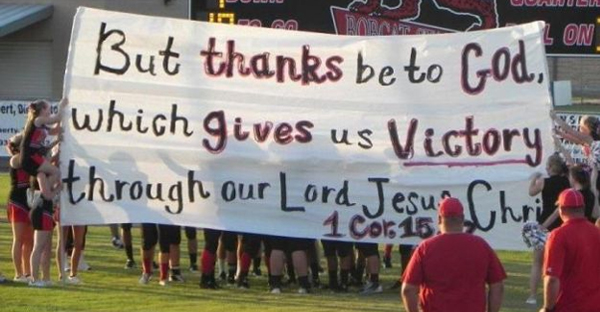
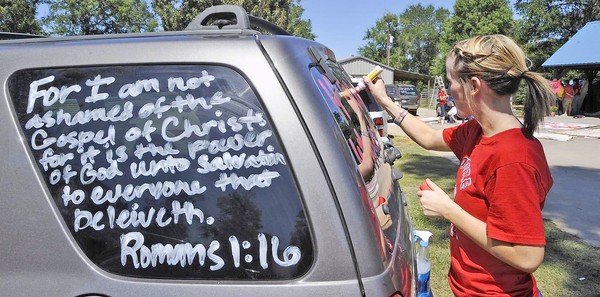
No one seems too sure of the situation in Kountze, Texas.  In this town of around 2,000, high-school cheerleaders have attracted attention for their religious banners at school football games.

In late September, the district superintendent banned the explicitly Christian banners, under pressure from the Wisconsin-based Freedom from Religion Foundation.

The cheerleaders sued.  The latest decision has been that the cheerleaders can continue to display the banners while the wheels of Constitutional justice grind along.

The case demonstrates the ferocious complexity of school-prayer rules and traditions.  The cheerleaders seem entirely oblivious to the Constitutional issues.  In interviews, they tend to hurt their own legal case by stating such things as “It’s our religion and we want to portray that.”  Or this gem about the complainants, “They can be offended, because that’s their right.”

There is not much doubt of the facts of the case.  The banners are obviously and designedly Christian.  They bear such Biblical phrases as the following:

“I can do all things through Christ which strengthens! Phil 4:13.”

“If God is for us, who can be against us? Romans 8:31.”

“But thanks be to God which gives us Victory through our Lord Jesus Christ. 1 Cor 15:57.”

Image Source: Los Angeles Times

The SCOTUS precedents in this sort of case are fairly clear.  The most obvious precedent is Santa Fe v. Doe (2000), the famous football-game-prayer case.  In that case, the Court ruled that a prayer at a high school football game, even when led by students, implies school endorsement of religion.

Lawyers in this case are keenly aware of the precedent.  The cheerleaders’ lawyers, therefore, emphasize the fact that this cheer group is not a school-sponsored organization.  They have no coach, they have no school-provided budget.  In essence, the cheerleaders claim that theirs is purely private speech.  If so, they would have a strong case for passing Constitutional muster.  Their lawyers have also cited the SCOTUS precedent of Tinker v. Des Moines, in which student protest-armbands against the Vietnam War were ruled protected free speech.

The school district has made the predictable counter-argument.  The cheer team, the district has argued, represents the school at a public function.  Cheerleaders must sign a “cheerleaders’ constitution,” which includes a pledge to represent the school well.  As district attorney Tom Brandt argued, “This is government speech. It’s on public property. The cheerleaders represent the school.”

This case also demonstrates the fact that public schooling in America is fractured into what political scientists Michael Berkman and Eric Plutzer have called “Ten Thousand Democracies.”   Regardless of SCOTUS decisions or state education policy, local school districts often support policies that represent the majority views of local communities.  Arguments in favor of such policies are usually framed in terms of the will of the majority.  As one of the cheerleaders insisted, “so far there hasn’t been any opposition to what we’re doing. Nothing but support.”  Such has been the case for much of the history of religion in public schools.  Local schools tend to endorse and embody local traditions.  Many of those traditions, like explicitly Christian prayer at football games, seem to imply an official endorsement of a particular religion.

It has often required outside intervention to draw attention to these continuing traditions.  In this case, that pressure came from Madison, Wisconsin, and the Freedom from Religion Foundation.

And school prayer has often, as in this case, proven to be enormously popular.  In this case, Texas Attorney General Greg Abbott has publicly supported the cheerleaders.  And the Facebook page set up in their support looks ready to top the 50,000 friends mark.

So, whether or not the Kountze cheerleaders can or can’t lead prayers at football games, they are.  Whether or not they will be allowed to continue will likely hinge on whether or not their activities are seen as school-sponsored, or private.

Rhee and Jesus in Public Schools

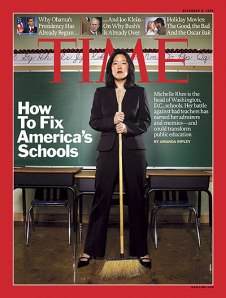
Michelle Rhee wants to get Jesus involved in fixing America’s public schools.

Image Source: Time Magazine

Rhee, the former chancellor of DC schools, has long been the darling of conservatives.  Her anti-union, market-based approaches to fixing public education have won her plaudits as America’s best hope for reforming sclerotic public education systems.

Along the way, Rhee has become the bete noire of educational thinkers such as Diane Ravitch.

Most of the Rhee talk has centered around conservative shibboleths such as vouchers, union-busting, and market-based reforms.

Recently, however, Rhee organized a meeting of religious leaders in Atlanta to discuss the possible roles of religion in reforming public schools.

Rhee’s willingness to talk with folks who want more religion in public schools may signal her broader willingness to engage with the traditional ‘other half’ of conservative school reform.

Among conservatives, free-market ideas and religious traditionalism have long rubbed alongside one another in any discussion of fixing public education.

Now Rhee seems eager to cross that bridge, too.

“Awash with the intolerance of enthusiasm:” Michael Ruse Takes on the New Atheists

I don’t think I’d like to be Richard Dawkins in a dunk tank.  The provocative and prolific New Atheist, though, seems to relish his role as cultural provocateur.  Dawkins is well known for his biting and vicious jabs against faith.  One of his most famous books derides “The God Delusion.”  In 1996, Dawkins told one audience, “faith is one of the world’s great evils, comparable to the smallpox virus but harder to eradicate.”  Elsewhere, Dawkins opined, “I think there’s really something very evil about faith.”

A recent article by philosopher of science and anti-creationist Michael Ruse takes Dawkins to task for being so fanatically religious in his atheism.  Ruse argues that the virulent anti-religion of Dawkins and his followers awkwardly conceals “the enthusiasm of the true believer, and this encourages a set of unnerving attributes: intolerance, hero-worship, moral certainty and the self-righteous condemnation of unbelievers.”

Ruse himself claims to be more atheist than Dawkins, more Darwinian.  Ruse has fought tirelessly against creationism in schools and culture.  Yet he insists that Dawkins’ brand of in-your-face atheism misses the point.  Instead of condemning religion as fit only for the ignorant or insane, as Dawkins likes to do, Ruse insists, “I think my religious friends are mistaken, but I don’t think they are stupid or crazy or ill or evil simply because they are religious.”

Though Ruse claims this is not a personal issue, his feelings have clearly been hurt.  Dawkins and allies such as Jerry Coyne have made it personal.  As Ruse complains,

“I, and others of my ilk, am reviled in terms far harsher than those kept for the real opponents like the Creationists. We are labelled ‘accommodationists’ for our willingness to give religion a space not occupied by science.”    

Ruse makes a powerful argument that the “enthusiasm” of the New Atheists resembles nothing so much as religious sectarianism.  But he strangely conflates the New Atheism of Dawkins and his allies with a far broader Humanist movement.  There are certainly connections, but it does not make sense to use the two terms interchangeably.

And, as Ruse must certainly be aware, his diatribe will likely be most celebrated by the very creationists he and Dawkins both condemn.  The notion that humanism itself is a religion has long been a central strategic point of conservative religious activists.  For example, in the early 1980s, evangelical Protestant theologian Francis Schaeffer condemned “humanism” as a set of ideas that placed humanity at the center of all things, and made humans the “measure of all things.” Fundamentalist school activists Mel and Norma Gabler similarly denounced humanism as “a religion with an anti-biblical, anti-God bent.”  And as blockbuster fundamentalist author Tim LaHaye insisted in his 1983 book The Battle for the Public Schools:

“Don’t be deceived into thinking that humanism is merely a philosophy.  That is a masquerade humanists have utilized for over three centuries to deceive millions in the Western world.  And don’t be duped into thinking that because religious people believe in God, those who do not believe in God are not religious.”(pg. 75).

My hunch is that Ruse would not relish the intellectual company.  All the more since such arguments about the essential religiosity of humanism have long been at the core of conservative strategies to transform public schooling.  Most famously in the 1980s case Mozert v. Hawkins County, religious conservatives had initial strategic success portraying humanism as a religion.

If humanism counts as religion, the argument went, then public schools have no Constitutional business promoting it.  Textbooks with an evolutionary perspective, books that promote a notion of material origins of humanity, schoolbooks that teach the primary importance of human reason, such things smack of government instruction in the religion of humanism.

Strange bedfellows.

As Professor Ruse notes in his essay, his anti-creationist credentials are impeccable.  Yet just as sectarian disputes among religious folks have provided some of the most profound and influential arguments against religion in general, so the clash between these atheistic Darwinists will likely provide the very best reasons to include more creationist-friendly ideas in public schools.