Art Attack in the Culture Wars

“Holy Rollin Poultry on a Cross” (2012), used with permission of Dreg Studios

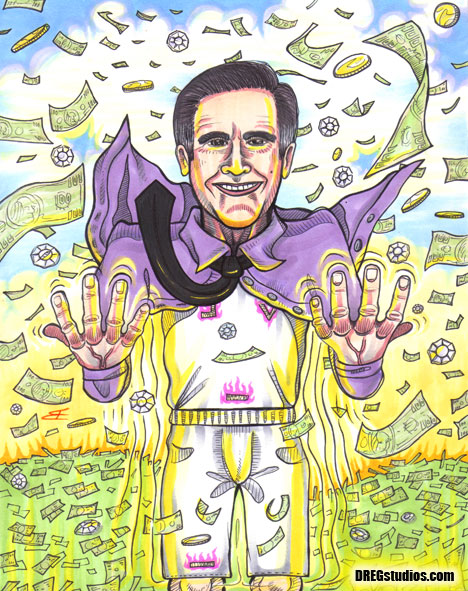
Jon McNaughton’s art is a favorite of the Tea Party set.  Brandt Hardin paints from the other side of the culture war trenches.  He has painted and written about such current topics as Chick-fil-A and traditional marriage, Tennessee’s continuing struggle with evolution/creation, and the power of Mitt’s money in conservative politics.

“Forty-six and 2” (2012), used with permission of Dreg Studios

As we noted about McNaughton, perhaps his popularity with conservatives is bolstered by an implicit appreciation for realistic art, for art that avoids distortion and irony.  If so, Hardin’s pop-surrealistic style provides a stylistic, as well as a cultural, counterpoint.

“Mitt Romney’s Magic Mormon Underwear” (2012), used with permission of Dreg Studios

In the News: Anti-Fundamentalist Hate Crime?

FRC President Tony Perkins.

According to a story from Religion News Service, Family Research Council President Tony Perkins accused the Southern Poverty Law Center of inciting a hate crime against them on Wednesday.  The irony is beyond painful.  The SPLC has long been a leading voice identifying and condemning right-wing hate violence.  Is Perkins’ accusation a mere stunt? Or does the SPLC have to acknowledge its role in this crime?

On Wednesday, Floyd Lee Corkins II allegedly entered an FRC office in Washington DC and shot unarmed security guard Leo Johnson in the arm.

FRC President Perkins blamed the SPLC for inciting this violent act.  Perkins claimed,

“Corkins was given a license to shoot an unarmed man by organizations like the Southern Poverty Law Center that have been reckless in labeling organizations as hate groups because they disagree with them on public policy.”

The SPLC has, in fact, accused the FRC of some despicable actions.  According to the SPLC, the FRC demonizes homosexuality.  FRC leaders, according to the SPLC, have publicly advocated the expulsion of all homosexuals from the USA.  The FRC, according to the SPLC, has also equated homosexuality with pedophilia.  These are not insignificant claims.

As Chris Lisee reported for Religion News Service, the alleged shooter had been an activist at some local gay-rights organizations.  Even more curious, he had been carrying a large bag of Chick-fil-A sandwiches.  The symbolism seems unmistakeable.  After all, given the recent culture-war dust-up over Chick-fil-A President Dan Cathy, a gay activist might not usually purchase fifteen sandwiches from the chain.  Fox News claims that just before opening fire,  Corkins said, “I don’t like your politics.”

So was this an anti-fundamentalist hate-crime?  Can the SPLC be held accountable?  The SPLC’s Mark Potok called the FRC claim “outrageous.”   Other gay-rights organizations quickly condemned the shooting.  Potok’s defense makes an important point.  The FRC shooting was a tragedy, Potok claimed, but Perkins was cynically taking advantage of this event to claim a “false equivalency” between the FRC and other victims of hate crimes.

Nevertheless, Perkins’ accusation raises important questions.  As we’ve seen with other recent culture-war violence, such as the deadly shootings at the Sikh temple near Milwaukee, the dangers of escalating America’s culture war are real.  Language that demonizes the opposition hurts us all.  The solution must be more along the lines of Matthew Lee Anderson’s and John Corvino’s response to the Chick-fil-A affair: we must talk to one another.  Openly, honestly, and even painfully and awkwardly, if necessary.  We don’t need to agree, and we must avoid the false solution of merely papering over our disagreements.  But we must also all agree–as most groups do in this case–that violence is not part of these discussions.

In the News: Paul Ryan and a WASP-free White House

Governor Romney’s announcement of Paul Ryan as his Vice-Presidential running mate has been heralded by some conservatives as a triumph.  Ryan is known for his commitment to restricting abortion and defending traditional families.  He is also the GOP’s leading voice for budget-cutting, even to the point of earning some censure from Catholic leaders.   But the pick has been seen as a play to conservatives, or, as we say here at ILYBYGTH, to voters from Fundamentalist America.

One unusual aspect of Romney’s decision is that it guarantees a WASP-free White House for at least four more years.  Of course, there’s nothing new about a WASP-free White House.  Barack Obama is African American Protestant, while Joe Biden is Catholic.  But no matter who wins in November, with LDS (Morman) Romney and staunchly Catholic Ryan, there will be no White, Anglo-Saxon Protestant in this race.

This matters for a couple of reasons.  First, it shows the way Fundamentalist America is changing.  Sixty years ago, asking conservatives to line up behind a non-Protestant candidate was political suicide.  In 1928 and nearly in 1960, it was tricky even for the Democrats to run a Catholic candidate.  These days, many different types of conservatives celebrate the Romney-Ryan ticket.  Ryan is seen as the “conservative” choice, not the “Catholic” choice.  Just as with the Protestant-free US Supreme Court, the fact that conservatives don’t seem to care about the non-WASPiness of this election tells us something about the changing nature of American culture.

It would be easy to be cynical about this.  We could attack Fundamentalist America for being hypocritical.  Here is how this argument would go: conservatives demand respect for “traditional values,” but they don’t ever clarify what those values are.  Since such things change within even one lifetime, the defense of “traditional values” is meaningless.  What last year’s traditionalist defends as a necessary part of American life, next year’s traditionalist insists was never part of traditionalist thinking.  In this case, traditionalist conservatives could be taken to task for shifting their “traditional values” without ever admitting it.  Sixty years ago, Catholics and LDS members were seen by many as outsiders, owing loyalty to a foreign potentate, in the case of Catholics.

A more sympathetic interpretation, however, is that this change from WASP to a more big-tent conservatism shows the healthy ways Fundamentalist America can change.  Fundamentalist America, in this line of thinking, is not the dinosaur it is made out to be.  It is a dynamic, thoughtful, fully contemporary way to be American.  As American culture broadens to welcome former outsiders such as Catholics and African Americans, so too does Fundamentalist America.

Christian Terrorism and the Milwaukee Shootings

Fundamentalist America scares people.  As ex-fundamentalists such as Jonny Scaramanga have argued, the small-f sort of separatist Protestant fundamentalism can easily be imagined to encourage violence.

A few days ago, Mark Juergensmeyer argued on Religion Dispatches that the temple atrocity in suburban Milwaukee should be considered an act of Christian terrorism.  Juergensmeyer argued,

“It is fair to call [shooter Wade Michael] Page a Christian terrorist since the evidence indicates that he thought he was defending the purity of white Christian society against the evils of multiculturalism that allow non-white non-Christians an equal role in America society. Like the Oklahoma City bomber, Timothy McVeigh, and the Norwegian militant, Anders Breivik, Page thought he was killing to save white Christian society.”

As well it might, Juergensmeyer’s claim ignited a storm of ferocious discussion about the nature of the killings and their relationship to Christianity.  Some commentators argued that the killer’s brand of white supremacy bore little relation to even nominal Christianity.  Others insisted that conservative Christianity promotes exactly this sort of violence.

ILYBYGTH readers will want to read through these comments.  The heat and anger of some of the writers shows how difficult it can be for outsiders to discuss Fundamentalist America calmly and sympathetically.  For instance, as one commenter argued,

“You guys – I’m referring to the giant festering mass known as Evangelicals/Teavangelicals/Fundamentalists – are abject subhumans, by
your own doing. Your blatant disrespect and disregard for the truth, science,
and intellectualism have made you, imo, the most dangerous demographic to
modern civilization on the planet.”

That’s strong language.  And while I think it would be denounced by many anti-fundamentalists, it still represents the kind of emotion lurking in the background of these kind of culture-war discussions.

The main point here is that people have been killed.  Our sympathies must start with them and their families.  But we must also resist the urge to use this horrifying act of violence to unleash even more hate.  As with other outbreaks of culture-war violence, such as the shootings of doctors who provide abortions or the murder of people due to their sexual orientation, this kind of murder sends a frightening signal.  In other places and times, as we’ve noted here before, “culture war” slides all too easily into regular, bloody war.

It is the job of all of us to contain and limit that violence, not encourage it.  When we live in a gunpowder factory, we must all watch out for anyone who drops lit matches.


Required Reading: The Big Tent of Creationism

Creationism ruffles feathers.  As the belligerent atheist Richard Dawkins memorably quipped, those who do not believe in evolution must be “ignorant, stupid or insane (or wicked, but I’d rather not consider that).”  There is comfort in Dawkins’ dismissal.  An insightful article in the most recent Christianity Today, however, probes deeper into the complexities of creationism.

I still remember my first introduction to the world of creation science.  I was a staunch outsider, having had little interaction with creationism until my mid-30s.  In graduate school, reading Ron Numbers’ The Creationists, I was astounded to learn that nearly 50% of American adults agree with a young-earth creationism, according to Gallup polls.  And one-quarter of those creationists have college degrees.

Much of my academic research has been devoted to puzzling out how such a thing is possible.  Since the 1920s (my Scopes book now available in paperback!), creationism has entrenched itself in schools, colleges, and alternative scientific organizations.  It has become a viable way for millions of Americans to understand the origins of life on Earth.

Glib dismissals like those of Richard Dawkins do not help us understand this cultural phenomenon.  What will help are thoughtful, sympathetic explorations like that of Tim Stafford in July’s Christianity Today.  In “A Tale of Two Scientists,” Stafford explores the lives and careers of two evangelical scientists, Darrell Falk and Todd Wood.  Falk is an evolutionary creationist, Wood a young-earth creationist.

Falk describes his falling away from his upbringing in the Nazarene Church.  As a graduate student, he had fallen in love with the beauty of genetics, and soon found himself estranged from the church.  When he watched his two daughters growing up, he knew he wanted to find them a church home like the one he had known.  He was worried about a cold reception from church members, but as a tenure-track scientist at Syracuse University, he looked for a church he could join.  At first, he was nervous.  As Stafford tells the story,

“Falk went alone, like a spy, into the church for a worship service.

“After the service, he found himself surrounded by friendly faces. They seemed delighted that he was a professor at Syracuse. Falk went home and told his wife, ‘We might have a church after all.’

“So it proved to be. Though the church certainly didn’t believe in evolution, and came to know that Falk did, they never bothered about it. ‘That church, God’s gift to us, built a bridge to us and welcomed us just as we were, gradual creation perspective and all.’ The pastor helped Falk as he found his way to a fuller, more robust faith, eventually asking him to teach a Sunday school class for young adults.”

Wood had a very different upbringing and career.  As he explains in the article, he never moved away from the assumption that the Bible’s description of a six-day creation tells the real story of the origins of life.  But that did not mean that he was somehow ignorant of evolution.  As Stafford writes,

“The first human genome sequence was published the year that Wood began graduate school, providing strong evidence for evolution. The DNA for chimps and humans was virtually the same. Traces of common origins were everywhere: Humans even possessed a broken version of the gene that lizards and birds use to produce eggs. Wood remained fully committed to a six-day creation—he says he never doubted it for a minute—because he saw no other way to read the Bible. But that didn’t keep him from recognizing that evolution had powerful attestation.”

The two men have very different ideas about the origins of life.  Yet they can both describe themselves as “creationists.”  And, unlike the harsh denunciations of critics like Dawkins, neither scientist is stupid, insane, or ignorant.  Rather, their relationships to mainstream science have been profoundly shaped by their religious beliefs.  This does not mean they have been brainwashed or indoctrinated.  Nor does it mean they are anti-science.  Rather, they came to very different conclusions about the need to reconcile science and religion, all within the big tent of creationism.

We do not have to agree with their conclusions in order to recognize the intellectual complexities of their positions.  If we hope to understand Fundamentalist America, it will help to dig deeper than Dawkins’ brand of simplistic denunciation.

Philip K. Dick and the Science Fiction of God

Does everyone else know the joke about the cat, the steak, and eating Jesus?

I came late to the Philip K. Dick party.  I suppose I had been vaguely aware of Dick’s work—maybe via Bladerunner—but I was fooled by the ‘science fiction’ label.  I like some scifi, but most of it leaves me pretty cold.

This year, I came across a reference to a posthumous publication of Dick’s unpublished theological rantings, Exegesis.  For someone like me, keenly interested in theological questions but utterly without religion, Dick’s meanderings came as a welcome bar-talk sort of theological seminar.

I picked up some of Dick’s novels.  I started with Valis, the fictionalization of Dick’s Damascus Road experience.   Apparently in real life, Dick experienced a beam of intelligent light.  The beam told him things he could not have known, such as the cause of his son’s vague health complaints.  What was this contact?  God?  LSD?  Psychosis?  Dick’s work seems like a steady stream of fictionalized meditations on all of these possibilities.  As apparently everyone knew but me, the label “science fiction” seems less apt than “theological fiction.”

The theme of divinity, insanity, and the fragility of humanity run through all the novels of the 1960s and 1970s that I’ve been reading this summer.  Here at ILYBYGTH we’ve been wondering lately about the Catholic mystery of transubstantiation.  Here is how Dick wrestled with the issue in his 1965 novel The Three Stigmata of Palmer Eldritch:

“Anne said, ‘What met Eldritch and entered him, what we’re confronting, is a being superior to ourselves and as you say we can’t judge it or make sense out of what it does or wants; it’s mysterious and beyond us.  But I know you’re wrong, Barney.  Something which stands with empty, open hands is not God.  It’s a creature fashioned by something higher than itself, as we were; God wasn’t fashioned and He isn’t puzzled.’

            “ ‘I felt,’ Barney said, ‘about him a presence of the deity.  It was there.’  Especially in that one moment, he thought, when Eldritch shoved me, tried to make me try. 

            “ ‘Of course,’ Anne agreed.  ‘I thought you understood about that; He’s here inside each of us and in a higher life form such as we’re talking about He would certainly be even more manifest.  But—let me tell you my cat joke.  It’s very short and simple.  A hostess is giving a dinner party and she’s got a lovely five-pound T-bond steak sitting on the sideboard in the kitchen waiting to be cooked while she chats with the guests in the living room—has a few drinks and whatnot.  But then she excuses herself to go into the kitchen to cook the steak—and it’s gone.  And there’s the family cat, in the corner, sedately washing its face.’

            “ ‘The cat got the steak,’ Barney said.

            “ ‘Did it?  The guests are called in; they argue about it.  The steak is gone, all five pounds of it; there sits the cat, looking well-fed and cheerful.  “Weigh the cat,” someone says.  They’ve had a few drinks; it looks like a good idea.  So they go into the bathroom and weigh the cat on the scales.  It reads exactly five pounds.  They all perceive the reading and one guest says, “Okay, that’s it.  There’s the steak.” They’re satisfied that they know what happened, now; they’ve got empirical proof.  Then a qualm comes to one of them and he says, puzzled, “But where’s the cat?”

            “ ‘I heard that joke before,’ Barney said.  ‘And anyhow I don’t see its application.’

            “Anne said, ‘That joke poses the finest distillation of the problem of ontology every invented.  If you ponder it long enough—’

            “ ‘Hell,’ he said angrily, ‘it’s five pounds of cat; it’s nonsense—there’s no steak if the scale shows five pounds.’

            “ ‘Remember the wine and the wafer,’ Anne said quietly.

            “He stared at her.  The idea, for a moment, seemed to come through.”

Get it?  I’m not sure I do.  But, then, I’m not sure I really know what the entire business of transubstantiation is all about.  Maybe it only makes sense if we are settlers on Mars.


Required Reading: Fifty Shades of Fundamentalism

When is a Fundamentalist not a fundamentalist?  When he or she comes from one of the many other conservative traditions in American religion.

One of the foremost dangers for outsiders like me who hope to understand Fundamentalist America is our tendency to oversimplify the nature of conservative religious folks.  Some commentators talk too blithely about the “Christian Right,” as if there was some secretive star chamber featuring the Pope, David Barton, Tim LaHaye, and a handful of other Jesus moguls, drinking soda pop and planning to take over secular society.

A new book by James C. Burkee helps to explain one of the other groups that has long contributed to the kaleidoscope of Fundamentalist America.  At Religion in American LifeJon Pahl offers a substantial review of Burkee’s Power, Politics, and the Missouri Synod: A Conflict That Changed American Christianity.

Why should those of us who hope to understand Fundamentalist America care about Burkee’s book?  Two main reasons.  First, the LCMS has long been an important element in conservative Protestant cultural activism.  Many of the leading creationists, for instance, come from within the LCMS tradition.  And this is a very different group than the sort of tent-revival, Billy Sunday, wave-your-hands-in-the-air kind of evangelical Christianity that many people associate with conservative theology in America.  In the 1920s, for instance, as I note in my Scopes book (now in paperback!), Missouri Synod Lutheran leader John Theodore Mueller pointed out that “after all has been said, there remains a sharp difference between Calvinistic Fundamentalism and confessional Lutheranism—a difference not in degree, but in kind.”  In addition to theological differences, the cultural differences of LCMS as a group of German immigrants–fiercely devoted to preserving both their religious and their cultural traditions–differs markedly from the sort of “take our country back” conservatism of many from the evangelical tradition.

If we outsiders hope to understand the real complexity of conservative religion in America, we need to spend some time with books like Burkee’s.  In addition, Pahl makes some points that are illuminating about the nature of conservative American religion in general.  One of the storylines in Burkee’s book is the desire among a core of the LCMS leadership to purge their institutions of what they saw as dangerous tendencies.  However, Pahl comments,

“By trying to “purify” an institution (and especially its Seminary—they are, after all, notorious places of rampant impurity), conservatives harmed, if not destroyed, it.  Purity, one might put it, is God’s prerogative.  Humans are too dangerous to be trusted with it—as the crucifixion of Jesus supposedly makes manifestly evident.”  

This example of the dangers of the impulse to purify could offer larger lessons about the career of conservative religion.  Since the start of small-f fundamentalism in the 1920s, conservative Protestants have sought to purify their institutions.  It has often led them away from the kind of cultural influence they originally hoped to achieve.  Even Pope Benedict has been said (perhaps unfairly) to desire a smaller, purer Catholic Church.  Burkee’s description of LCMS efforts in this direction could shed helpful light on this broader conservative impulse.

Burkee’s book also discusses the ways LCMS leaders connected a bundle of politically and culturally conservative ideas to their conservative theology.  As Pahl explains,

“A 20th century method of biblical interpretation (usually exercised in English, no less) became a political weapon, which in Otten’s discourse was wielded not only against historically-critical seminary professors, but also against advocates of civil rights, ecumenists, big government, the social gospel, feminists, and communists—'”liberals” all.'(59)” 

This, too, has been a common experience across the universe of conservative religion.  The big-F Fundamentalist tradition, after all, has been to combine religion, politics, and culture into a potent American identity.  Some of elements make very little theological sense, but a wealth of cultural sense.  For instance, what does short hair on men have to do with belief in an inerrant Bible?  Jesus wore it long, after all.  But in the American context, long hair on men means “hippie.”

For those of us trying to make sense of all these seeming contradictions, books like Burkee’s will be a big help.

Now in Paperback!

At long last, we have an affordable paperback edition of my 1920s book.  Buy it!!!!  My kid really does need a new pair of shoes.

Palgrave Macmillan is offering a 25% discount on its website.  Enter promo code “Conf2012” to get this edition for the low low price of $24.00.  Of course, you can also get a copy on Amazon for $26.40.

A warning, though: this book was a revision of my PhD dissertation at the University of Wisconsin.  It is targeted at a thoroughly nerdy audience.  I’m proud of it, but it represents academic writing with all of its hazards.  Even members of my immediate family have told me they enjoyed the first sentence very much.  After that it got a little dry.

But if you are interested in the long history of battles over religion, culture, and education in America’s public square, I can recommend the book without blushing.  There is not another book out there that explores all of the meanings of “fundamentalism” in the public school battles of the 1920s as well as this one.

In the News: Missouri Voters Pass School Prayer Amendment

This just in: Missouri voters overwhelmingly approved Amendment 2.  OzarksFirst reports that the Constitutional Amendment received over 80% support yesterday at the polls.

Those who’ve been following this story know that the amendment is largely symbolic.  It guarantees people in Missouri the right to pray in public–especially including public schools–as long as their prayers do not bother anyone else.  This right has already been established by the US Supreme Court.  The kinds of school prayer deemed unconstitutional by SCOTUS in the 1960s were those imposed by the state and led by a teacher or school official.  The right of students to pray on their own has never been constitutionally threatened.

However, politicians and activists have long insisted that SCOTUS kicked God out of public schools.  This amendment is meant as a sort of line in the sand.  Fundamentalist Missouri wants to make it clear that students may pray in public schools.  Some voters have surely been traumatized by horror stories of students being suspended for Christian statements.  Teachers such as Bradley Johnson in California have claimed persecution when they have not been allowed to display religious messages in their public-school classrooms.

These sorts of highly publicized skirmishes inspired Missouri’s move.  As the sponsor of the amendment Mike McGhee explained in a National Public Radio story ,

“We are a religious country, and we want to take our country back, and we want to pray to God, and we can gather around the flagpole and say something to Jesus in our minds and in our hearts and it’s going to be okay.”

As everyone knows, in culture-war battles, symbolism matters.  Political moves like Missouri’s Amendment 2 help marshal the sides, force people to declare for one or the other.  In Missouri, this has meant, for instance, the public support of Catholic bishops for the amendment.  As McGhee argued, Fundamentalist America feels a powerful need to “take our country back.”

Can students now pray in Missouri’s public schools?  Yes.  Could they have before this constitutional amendment?  Yes.  But that doesn’t mean the amendment isn’t important.  To observers like those at ILYBYGTH, votes like the one yesterday in Missouri demonstrate the continuing power of Fundamentalist America.

Transubstantiation: Faith, Science, and the Public Square

“Catholics are crazy.”

Why don’t we hear people saying that?  Richard Dawkins accused anyone disbelieving evolution of being “ignorant, stupid or insane (or wicked, but I’d rather not consider that).” Does he accuse Catholics of the same thing?  Or why don’t we hear skeptics comparing the Catholic liturgy to a Flying Spaghetti Monster?

After all, one of the central features of Catholic liturgical tradition and theology is at least as radically anti-science as any kind of young-earth creationism.  But nobody seems to mind.

For purposes of full disclosure, I must note: I’m a big fan of Catholicism.  As the saying goes, ‘Some of my best friends . . .”  But even close friends must acknowledge the elephant at the altar, the rigid anti-science that lurks uncomfortably at the heart of the Catholic Eucharist.

We’re talking here about the Catholic doctrine of transubstantiation.  In Catholic doctrine, when a priest completes a special ceremony over bread and wine, the bread and wine are literally transformed into the body and blood of Christ.  Not symbolically, but substantially changed.  Of course, to all outward appearances, the bread and wine maintain their accidental attributes.  The senses, and even the most careful scientific detection, will see/hear/taste them only as bread or wine.  But in substance they have been transformed into the Real Presence, the living body and blood of the Christ.  I’m no theologian, and I invite correction on this subject, but as I understand the doctrine, the substance changes while the accidental outward properties do not.  Thus, for example, my body has two hands.  But the substance of my body does not change if I cut off one hand.  It is still my body, though the accidental properties change.  With the bread and wine, the substance transforms into the actual substance of blood and flesh.  But the accidental properties remain the same.  It will not taste like blood or flesh.  (If it did, I imagine this issue might be a little more controversial.)  It will continue to have all the outward appearances, down to the microscopic level, of bread and wine.  Yet it will not be.

This is a profoundly antiscientific notion at the heart of Catholic belief.  Instead of believing in the clear evidence of their senses, Catholics are supposed to believe that they are eating and drinking real flesh and real blood.  This notion is at least as antiscientific as more controversial doctrines such as young-earth creationism.  After all, creationists are not asked to disbelieve their own senses.  They are not required to contest the scientific measurements of things.  Instead, young-earth creationists are told that they have a superior science worked out, a true science that accords with the version of creation described in the Bible.  Catholics, on the other hand, officially believe that bread tastes like bread, smells like bread, looks like bread, has all the chemical properties of bread, and yet is not bread.  That must be difficult to swallow, pardon the pun.  Yet we don’t hear any complaints against it or attacks upon it from skeptics and anti-fundamentalists.  Why not?

There are two obvious reasons.  First, this doctrine doesn’t impinge on the public sphere the way creationism does.  After all, if it somehow mattered what public schools taught about the nature of bread, wine, and liturgical practice, then we could expect the notion of transubstantiation to become more controversial.  When the nature of the substance of the Eucharist was part of a public debate, as in the time of Martin Luther, then the doctrine of transubstantiation was indeed intensely controversial.  These days, in subjects such as contraception and abortion, where Catholic doctrine impacts public policy, we do hear a great deal about the nature of Catholic belief.  Since the doctrine of transubstantiation remains important only within the religion itself, skeptics may feel no need to challenge its inherent antiscientific nature.  After all, much religious belief is antiscientific.

Second, even many Catholics don’t embrace this doctrine enthusiastically or aggressively.  Catholics are not forced to defend the anti-science of transubstantiation the way creationists are forced to defend their Bible-based anti-science.  Catholics are assumed to agree with this foundational theological premise, but they are not put in a position to defend it publicly.  Allow me to give one example.  At the Catholic Church I attend, during harsh flu seasons parishioners are asked not to drink from the communal chalice if they have symptoms.  That makes great scientific sense, but little liturgical sense.  If the wine had actually been transformed into the substance of Christ’s blood, it doesn’t seem right that the H1N1 virus could attach itself.  Perhaps a Catholic apologist would reply that such things as viruses are only part of the “accidental” features of the wine.  The point here, though, is that to many Catholic parishioners, at least at my church, the transubstantiated blood is still regarded as very similar to wine.

So are Catholics crazy?  Do they cling to anti-scientific notions?  Does the core belief of Catholicism mean that ideas taken on nothing but faith must trump all evidence of the senses?  And if so, why don’t anti-fundamentalists seem to mind?