Progressive Teaching for Christian Schools? The Classical Christian Approach

–Thanks to P.H.

We’ve been learning a lot lately at ILYBYGTH about the Classical Christian Education movement. Recently on First Things we read a thoughtful analysis of the state of the movement today.  Brian Douglas warns of some growing pains for the movement.  He highlights the need for schools in this tradition to keep their eyes focused on the big educational picture.

But first, a few words on the background of the movement: The recent Classical Christian Education movement can date its origin to a 1991 book by Douglas Wilson, Recovering the Lost Tools of Learning.  Wilson, a Reformed pastor, Christian educator and school founder from Moscow, Idaho, popularized the classical education formula of Christian and crime writer Dorothy Sayers.

The Association of Classical & Christian Schools now claims 229 schools.  The movement is affiliated with two colleges, New Saint Andrews and New College Franklin.

Such a booming educational movement quickly runs into some definitional problems, as Douglas notes in his essay.  Douglas warns of “five temptations” for the growing movement: mistaking the trappings of success for true success; focusing on uniforms, discipline, and Latin instead of the broader Christian mission; assuming that success relies on the schools rather than on God; failing to integrate the Bible into a classical curriculum; and assuming that school will be the most decisive influence on every student.

For those of us outside the movement, the most intriguing parts of Douglas’ essay concern the growing middle ground between “progressive” and “traditional” education.

As we have noted here before, some leading “progressive” educational thinkers have long advocated a more traditional, authoritarian classroom style.

Similarly, conservative Christian educators affiliated with Walter Fremont’s School of Education at Bob Jones University have long argued for a more “progressive” pedagogy.

Douglas articulates a vision for this energetic new educational movement that seems to combine the “progressive” emphasis on child-centered education with the “traditional” emphasis on evangelical Christian theology, student discipline, and a Trivium-based, great-books curriculum.

Indeed, if words such as “Christian” and “Bible” were replaced, Douglas’ nostrums could certainly find a home in many ferociously “progressive” education schools.

For instance, Douglas wants an education that “tends to develop thinkers defined by who they are instead of workers defined by what they do.”  Similarly, Douglas warns of an over-emphasis on classroom discipline: “focusing on order becomes hazardous when it overtakes the joy of experiencing God’s grace.  When this happens, students may learn to jump through the hoops, obey the rules, do the right things, but they do not learn to love God and others. . . . Creating a truly gracious classroom is much harder than creating an orderly classroom.”  To pick just one more well-turned phrase of Douglas’ that could just as easily have come from the progressive camp: “Education cannot be reduced to a formula, even if the formula is a good one.”

Douglas’ essay, and the development of the Classical Christian movement as a whole, suggest a broad middle ground in education.  Make no mistake: Douglas is ferociously Christian.  He does not suggest any watering down of the uniquely Biblical elements of good education.  However, when advocates of Christian education can agree with advocates of “progressive,” “multicultural” education about the most important factors of good schooling, it seems we might have some room with which to work.
 

Behind the Mask: A Halloween Guide to Telling Christians Apart

The prolific Russell Moore offers a light-hearted Halloween guide to help tell apart various types of evangelical Protestant.  For those of us outsiders trying to make sense of America’s conservative impulses, it is a handy resource.  After all, as Moore points out, there are huge differences between “fundamentalists” and “evangelicals,” between “Emerging Church evangelicals” and “confessional evangelicals.”

To start, Moore paraphrases John Mark Reynolds.  Reynolds had joked, “An evangelical is a fundamentalist who watches The Office.”

With Halloween in mind, Moore came up with the following handy guide to making sense of the kaleidoscope of American evangelicalism:

“An evangelical is a fundamentalist whose kids dress up for Halloween.

“A conservative evangelical is a fundamentalist whose kids dress up for the church’s ‘Fall Festival.’

“A confessional evangelical is a fundamentalist whose kids dress up as Zwingli and Bucer for ‘Reformation Day.’

“A revivalist evangelical is a fundamentalist whose kids dress up as demons and angels for the church’s Judgment House community evangelism outreach.

“An Emerging Church evangelical is a fundamentalist who has no kids, but who dresses up for Halloween anyway.

“A fundamentalist is a fundamentalist whose kids hand out gospel tracts to all those mentioned above.”

I know Moore was just joking around, but I appreciate the field guide.  After all, those of us outside the evangelical tradition tend to have difficulty hearing the different accents among evangelicals.

I cringe when I hear some of my fellow nones or theological liberals clump together all evangelicals into dismissive categories such as “Bible Thumpers,” “Holy Rollers,” or other pejorative terms.  We liberals would never speak in such stereotyped labels about other social groups, but it seems socially acceptable among some folks to use such stereotypes to belittle conservative Protestants.

Worst of all, some of the self-professed liberal folks with whom I interact don’t seem to understand that their stereotyping reveals their expansive ignorance of the complicated intellectual kaleidoscope of evangelical belief in America.

The Revisionaries

I don’t often wish I lived in a bigger city.  But with the limited release of a new documentary, I’m wishing I had a chance to see it.

The Revisionaries has been released in a few cities and film festivals.  According to its producer, this documentary focuses on the intellectual and political worlds of Don McLeroy.

A short review in the New York Times emphasizes the “startling” way conservatives such as McLeroy and Cynthia Dunbar injected partisan and sectarian ideas into the curriculum of Texas in 2009-2010.

As I noted in an article in Teachers College Record a little while back (behind a paywall, unfortunately, but the executive summary is public), Dr. McLeroy cared about more than just creationism.  As Russell Shorto pointed out in a New York Times article, McLeroy insisted that Texas schoolchildren be taught “two basic facts about man.  He was created in the image of God, and he is fallen.”  According to amendments proposed by McLeroy, Texas students should also learn more about Ronald Reagan’s “leadership in restoring national confidence”
and about the positive contributions to American history from such conservative icons as “Phyllis Schlafly, the Contract with America, the Heritage Foundation, the Moral Majority and the National Rifle Association.”

I am looking forward to seeing the film.  I have a couple of worries.  Though this morning’s NYT review insists that producer Scott Thurman is “admirably evenhanded,” the clips available on the film’s website suggest that the documentary is yet another breathless expose of the deeply conservative ideas of McLeroy and his allies.

I hope not.  I think those of us outside of the intellectual world of activists such as McLeroy and Dunbar will benefit from a sincere attempt to truly understand their worldview.  After all, it is a vision of American culture and education that is enormously popular.  Another piece of journalism or filmmaking that hopes simply to mock or deride those ideas won’t help at all.  We KNOW we don’t agree with these ideas.  We don’t need to be reminded that some people hold these ideas.  What is really interesting, in contrast, are the arguments folks like McLeroy might make to support their beliefs in a young earth.

So, for those in Pasadena, NYC, Denver, Sarasota, or other screening locations, make some time to check out the film.  Be sure to send your thoughts, reviews, and comments to us here at ILYBYGTH.  Out here in the boonies, we’ll only wait for the film to get around to our neck of the woods.

A Long Way from Texas…

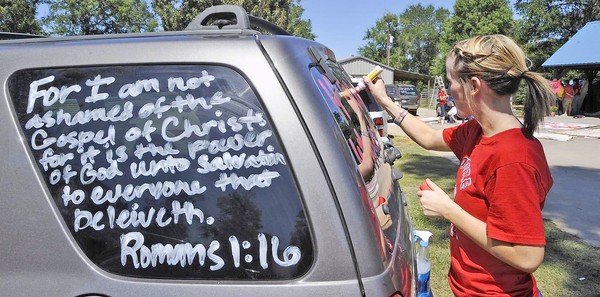
Can cheerleaders at a public school sport Biblical phrases on banners?

The cheerleaders in Kountze, Texas, think so.  So does the Texas Attorney General.  So do tens of thousands of Facebook supporters of the cheer team.

But an important part of this story is often being left out by coverage in some mainstream media outlets. Why?

We’ve reported on this story before.  In short, this group of cheerleaders sued when their school superintendent banned their religious banners from football games.  So far, the cheerleaders have been allowed to keep on cheering for Jesus at their games.

Recently, we’ve noticed a puzzling trend in the reporting about this story.  An editorial in yesterday’s New York Times, for instance, bemoaned the situation in Kountze.  “In this country — including in Texas — the Constitution does not leave religious freedom up to majority rule,” the editors insisted.

I agree with the NYT‘s basic position: the SCOTUS precedent in 2000’s Sante Fe ISD v. Doe speaks directly to this case.  Even student-led prayer, if sanctioned by the school district, implies an endorsement of particular religious beliefs by the government.  Though the Kountze cheerleaders insist that their banners represent purely private speech, this seems a stretch.

However, I’m puzzled by the way NYT coverage has left out a vital part of this story.  For those of us who want to understand the ways conservatism works in American education, whether it be about evolution, school prayer, sex education, or other issues, the skewed coverage in the NYT makes the job much harder.

Here’s the problem:  In yesterday’s editorial and in earlier reporting on this Kountze story, the NYT left out an important key player in the drama.  The NYT neglected to mention the role of the Freedom from Religion Foundation.  This Wisconsin-based group warned the school superintendent of its plans to sue over the banner issue.  Only then did the superintendent ban the cheerleaders’ religious practice.

The NYT misled readers with its description of the reasoning in Texas.  The editors described the case as follows:

“Those banners are not merely personal expressions of belief, but in that setting become religious messages endorsed by the school, the school district and the local government.       

“That’s why officials of the school district last month prohibited the banners at football games.”

But the way the story really played out, the school district only prohibited the banners under pressure.  In fact, as the Los Angeles Times reported, the school superintendent himself supported the cheerleaders.

If we hope to understand the dynamic, in this case or in the many other school-prayer cases in history and in the news, we must not omit such an important element.

Please do not misunderstand: I am not denouncing the Freedom from Religion Foundation.  I do not think that sectarian prayers belong at public-school events.  But I do want to understand these cases, and ignoring important elements such as the role of outside organizations leaves us unable to understand the situation.

As political scientists Michael Berkman and Eric Plutzer have argued in their books Ten Thousand Democracies and Evolution, Creationism, and the Battle to Control America’s Classrooms, teachers and school districts respond to local culture.  When communities want prayer and creationism in public schools, schools include prayer and creationism.

As Berkman and Plutzer proved with their survey of high-school biology teachers, the beliefs of those teachers usually closely match those of their local communities.

In the Kountze case, the school district, including even the superintendent who banned the banners, supports the cheerleaders.  As superintendent Kevin Weldon told the LA Times, the judge in this case “was in a pretty tough predicament, like myself. . . . I personally applaud the kids for standing up for their beliefs in such a bold way.”

If we hope to understand the ways issues such as creationism and school prayer play out in America’s schools, we can’t let ourselves miss the way schools, teachers, and school districts actually function.  Teachers, as Berkman and Plutzer insist, are “street-level bureaucrats.”  They represent majority opinion in their communities.  The same is often true for superintendents such as Kevin Weldon in Kountze.

None of this is new.  In the Scopes Trial in 1925, the prohibition of evolution in Dayton, Tennessee only became controversial when the American Civil Liberties Union became involved.  More recently, as political scientists Kenneth Dolbeare and Phillip Hammond demonstrated in the 1970s, US Supreme Court decisions about school prayer and Bible reading often have no discernable effect on school practice.  After the 1962 and 1963 Supreme Court decisions against the reading of the Bible and reciting of the Lord’s Prayer in public schools, Dolbeare and Hammond found that all the schools in their survey continued to pray and read the Bible.  Most important, those practices caused absolutely no controversy in the communities they studied.

If we hope to understand school prayer controversies, we can’t allow ourselves to leave out the role of key players such as the Freedom from Religion Foundation.  Perhaps the NYT editors hoped to avoid the old chestnut that only “outside agitators” brought about this sort of school controversy.  Whatever their reasons, they misrepresent the story and make it more difficult for outsiders like me to understand the nature of these school battles.

Cheering for Jesus in a Public School

Source: KNUE

Can they or can’t they?

No one seems too sure of the situation in Kountze, Texas.  In this town of around 2,000, high-school cheerleaders have attracted attention for their religious banners at school football games.

In late September, the district superintendent banned the explicitly Christian banners, under pressure from the Wisconsin-based Freedom from Religion Foundation.

The cheerleaders sued.  The latest decision has been that the cheerleaders can continue to display the banners while the wheels of Constitutional justice grind along.

The case demonstrates the ferocious complexity of school-prayer rules and traditions.  The cheerleaders seem entirely oblivious to the Constitutional issues.  In interviews, they tend to hurt their own legal case by stating such things as “It’s our religion and we want to portray that.”  Or this gem about the complainants, “They can be offended, because that’s their right.”

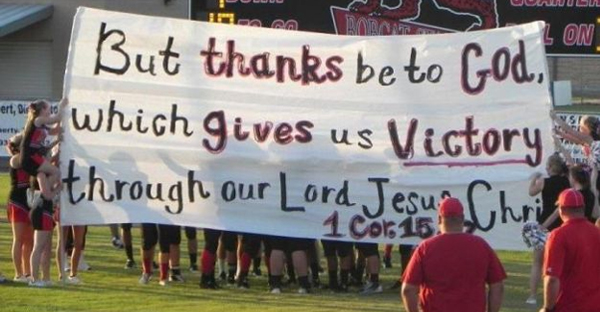
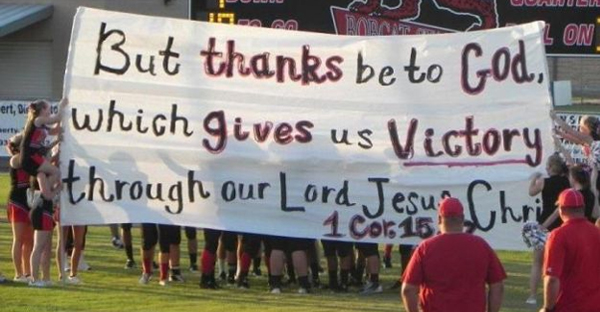
There is not much doubt of the facts of the case.  The banners are obviously and designedly Christian.  They bear such Biblical phrases as the following:

“I can do all things through Christ which strengthens! Phil 4:13.”

“If God is for us, who can be against us? Romans 8:31.”

“But thanks be to God which gives us Victory through our Lord Jesus Christ. 1 Cor 15:57.”

Image Source: Los Angeles Times

The SCOTUS precedents in this sort of case are fairly clear.  The most obvious precedent is Santa Fe v. Doe (2000), the famous football-game-prayer case.  In that case, the Court ruled that a prayer at a high school football game, even when led by students, implies school endorsement of religion.

Lawyers in this case are keenly aware of the precedent.  The cheerleaders’ lawyers, therefore, emphasize the fact that this cheer group is not a school-sponsored organization.  They have no coach, they have no school-provided budget.  In essence, the cheerleaders claim that theirs is purely private speech.  If so, they would have a strong case for passing Constitutional muster.  Their lawyers have also cited the SCOTUS precedent of Tinker v. Des Moines, in which student protest-armbands against the Vietnam War were ruled protected free speech.

The school district has made the predictable counter-argument.  The cheer team, the district has argued, represents the school at a public function.  Cheerleaders must sign a “cheerleaders’ constitution,” which includes a pledge to represent the school well.  As district attorney Tom Brandt argued, “This is government speech. It’s on public property. The cheerleaders represent the school.”

This case also demonstrates the fact that public schooling in America is fractured into what political scientists Michael Berkman and Eric Plutzer have called “Ten Thousand Democracies.”   Regardless of SCOTUS decisions or state education policy, local school districts often support policies that represent the majority views of local communities.  Arguments in favor of such policies are usually framed in terms of the will of the majority.  As one of the cheerleaders insisted, “so far there hasn’t been any opposition to what we’re doing. Nothing but support.”  Such has been the case for much of the history of religion in public schools.  Local schools tend to endorse and embody local traditions.  Many of those traditions, like explicitly Christian prayer at football games, seem to imply an official endorsement of a particular religion.

It has often required outside intervention to draw attention to these continuing traditions.  In this case, that pressure came from Madison, Wisconsin, and the Freedom from Religion Foundation.

And school prayer has often, as in this case, proven to be enormously popular.  In this case, Texas Attorney General Greg Abbott has publicly supported the cheerleaders.  And the Facebook page set up in their support looks ready to top the 50,000 friends mark.

So, whether or not the Kountze cheerleaders can or can’t lead prayers at football games, they are.  Whether or not they will be allowed to continue will likely hinge on whether or not their activities are seen as school-sponsored, or private.

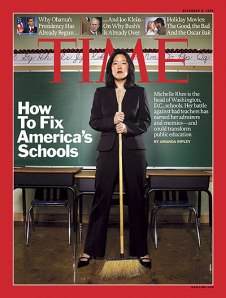
Rhee and Jesus in Public Schools

Michelle Rhee wants to get Jesus involved in fixing America’s public schools.

Image Source: Time Magazine

Rhee, the former chancellor of DC schools, has long been the darling of conservatives.  Her anti-union, market-based approaches to fixing public education have won her plaudits as America’s best hope for reforming sclerotic public education systems.

Along the way, Rhee has become the bete noire of educational thinkers such as Diane Ravitch.

Most of the Rhee talk has centered around conservative shibboleths such as vouchers, union-busting, and market-based reforms.

Recently, however, Rhee organized a meeting of religious leaders in Atlanta to discuss the possible roles of religion in reforming public schools.

Rhee’s willingness to talk with folks who want more religion in public schools may signal her broader willingness to engage with the traditional ‘other half’ of conservative school reform.

Among conservatives, free-market ideas and religious traditionalism have long rubbed alongside one another in any discussion of fixing public education.

Now Rhee seems eager to cross that bridge, too.

“Awash with the intolerance of enthusiasm:” Michael Ruse Takes on the New Atheists

I don’t think I’d like to be Richard Dawkins in a dunk tank.  The provocative and prolific New Atheist, though, seems to relish his role as cultural provocateur.  Dawkins is well known for his biting and vicious jabs against faith.  One of his most famous books derides “The God Delusion.”  In 1996, Dawkins told one audience, “faith is one of the world’s great evils, comparable to the smallpox virus but harder to eradicate.”  Elsewhere, Dawkins opined, “I think there’s really something very evil about faith.”

A recent article by philosopher of science and anti-creationist Michael Ruse takes Dawkins to task for being so fanatically religious in his atheism.  Ruse argues that the virulent anti-religion of Dawkins and his followers awkwardly conceals “the enthusiasm of the true believer, and this encourages a set of unnerving attributes: intolerance, hero-worship, moral certainty and the self-righteous condemnation of unbelievers.”

Ruse himself claims to be more atheist than Dawkins, more Darwinian.  Ruse has fought tirelessly against creationism in schools and culture.  Yet he insists that Dawkins’ brand of in-your-face atheism misses the point.  Instead of condemning religion as fit only for the ignorant or insane, as Dawkins likes to do, Ruse insists, “I think my religious friends are mistaken, but I don’t think they are stupid or crazy or ill or evil simply because they are religious.”

Though Ruse claims this is not a personal issue, his feelings have clearly been hurt.  Dawkins and allies such as Jerry Coyne have made it personal.  As Ruse complains,

“I, and others of my ilk, am reviled in terms far harsher than those kept for the real opponents like the Creationists. We are labelled ‘accommodationists’ for our willingness to give religion a space not occupied by science.”    

Ruse makes a powerful argument that the “enthusiasm” of the New Atheists resembles nothing so much as religious sectarianism.  But he strangely conflates the New Atheism of Dawkins and his allies with a far broader Humanist movement.  There are certainly connections, but it does not make sense to use the two terms interchangeably.

And, as Ruse must certainly be aware, his diatribe will likely be most celebrated by the very creationists he and Dawkins both condemn.  The notion that humanism itself is a religion has long been a central strategic point of conservative religious activists.  For example, in the early 1980s, evangelical Protestant theologian Francis Schaeffer condemned “humanism” as a set of ideas that placed humanity at the center of all things, and made humans the “measure of all things.” Fundamentalist school activists Mel and Norma Gabler similarly denounced humanism as “a religion with an anti-biblical, anti-God bent.”  And as blockbuster fundamentalist author Tim LaHaye insisted in his 1983 book The Battle for the Public Schools:

“Don’t be deceived into thinking that humanism is merely a philosophy.  That is a masquerade humanists have utilized for over three centuries to deceive millions in the Western world.  And don’t be duped into thinking that because religious people believe in God, those who do not believe in God are not religious.”(pg. 75).

My hunch is that Ruse would not relish the intellectual company.  All the more since such arguments about the essential religiosity of humanism have long been at the core of conservative strategies to transform public schooling.  Most famously in the 1980s case Mozert v. Hawkins County, religious conservatives had initial strategic success portraying humanism as a religion.

If humanism counts as religion, the argument went, then public schools have no Constitutional business promoting it.  Textbooks with an evolutionary perspective, books that promote a notion of material origins of humanity, schoolbooks that teach the primary importance of human reason, such things smack of government instruction in the religion of humanism.

Strange bedfellows.

As Professor Ruse notes in his essay, his anti-creationist credentials are impeccable.  Yet just as sectarian disputes among religious folks have provided some of the most profound and influential arguments against religion in general, so the clash between these atheistic Darwinists will likely provide the very best reasons to include more creationist-friendly ideas in public schools.


In the News: Dancing the Rights Away

The New York Times reports this morning on a strange crackdown in Cranston, Rhode Island.  Seems a father-daughter dance tradition had been taking place despite a state law and district policy against it.  In addition, Federal Title IX rules forbid any gender-discriminatory activities.  In this case, a single mother of a daughter objected to the dance.  Though the school had also organized a mother-son baseball game, the two events were ruled to be not similar enough to avoid charges of sex discrimination.

In the big scheme of things, this tempest on a dance floor seems like no big deal.  The mother attended the dance with her daughter, and the school district reminded dance organizers of their ban on gender-specific events.

But the story serves as an illustration of a few items of perennial interest to those trying to understand the conservative impulse in American education.  First of all, we see again that school policy does not always match school practice.  Most memorably, when the US Supreme Court ruled in 1963 that school-sponsored prayer and Bible-reading violated students’ First Amendment rights, many schools continued to sponsor prayers and Bible-reading regardless.  As political scientists Kenneth Dolbeare and Phillip Hammond found in their 1971 study, many towns and schools continued to pray and read the Bible without eliciting a whisper of controversy.

Even the district in Cranston, Rhode Island, had hung a “prayer banner” in its high school, according to the New York Times.

As in many other cases, we see in this disco scuffle the ways conservatives embrace such seeming government overreach as a culture-war cause.  In this case, Sean Gately, a candidate for State Senate, along with Cranston Mayor Allan Fung, have come out strongly in favor of father-daughter dances. Such politicians have publicized the ban and tried to associate it with their Democratic opponents.  As Gately told the NYT, “Having those little father-daughter dances and seeing her all dressed up in her pretty dress — it’s a very special moment.”  Gately said the ban “offended me as a father and a husband.”   In the end, Gately insisted, “Nobody is being hurt by a father-daughter dance.”   Fox News condemned the “political-correctness police” of the American Civil Liberties Union for stirring up controversy where none existed.  The ACLU, according to Fox, had objected to the dance tradition as perpetuating harmful gender stereotypes: fancy dances for girls, baseball games for boys.  Gately told Fox this was a case of the “local ACLU kind of bullying our school system.”

From the ACLU’s perspective, local school officials just don’t “get it yet,” as state ACLU director Steven Brown told the New York Times.  Gately would likely respond that Brown simply does not “get” that most Cranstonites have no problem with reinforcing gender stereotypes for their children.

Perhaps most important, this dance debate demonstrates the way schools are more often guided by tradition than by explicit policy.  According to the NYT, the district had banned this father-daughter dance years ago.  However, no one on the current Parent-Teacher Organization was aware of that policy.  They organized the “Me and My Guy” dance simply because they had done so in the past.

In dancing as in much else, these kinds of traditions tend to be more powerful than any policy, whether in Cranston, Rhode Island, or from the US Supreme Court.

CATCH-ing Up and Opting Out

ILYBYGTH reported yesterday on a new pilot program in New York City high schools.  The program, Connecting Adolescents to Comprehensive Health, or CATCH, will expand the district’s condom-distribution program to include birth control pills and “morning-after” pills.

This morning, we read Catholic League President Bill Donohue’s denunciation of this “imperial edict” in an interview in the Christian Post.  “Whenever it comes to sensitive issues such as sexuality, the government must  always play an ancillary role to that of parents,” Donohue told the CP. “The provision  that parents can opt out smacks of governmental arrogance and must be resisted:  the government has no business eclipsing parental rights.”

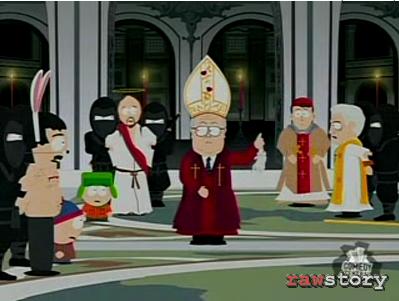
Bill Donohue as the Wild-Eyed Pope on South Park’s “Fantastic Easter Special”

I am usually no fan of

Bill Donohue.  I find myself siding more often with the South Park send-up of his public-morality campaigns.  But in this case, I find his criticism of CATCH more compelling than the lame defense offered by Chanel Caraway of the NYC Board of Health.  Since only 1-2% of parents had opted out of the program, Caraway told ABC News, “this suggests that parents are OK with the service being available to their children.”

Again, please don’t misunderstand.  I support the CATCH program and its goals.  I would want my daughter to be able to get free condoms and contraceptives at school if she couldn’t get them elsewhere.

However, Caraway’s opt-out argument demonstrates a frightening ignorance of America’s educational history.  In prominent cases such as Engel v. Vitale (1962) and Abington Township School District v. Schempp (1963), the US Supreme Court specifically concluded that “opt-out” provisions do not adequately respect families’ and children’s rights to be free of religious coercion.

As Justice Clark argued in his majority decision in Schempp, “Nor are these required exercises mitigated by the fact that individual students may absent themselves upon parental request, for that fact furnishes no defense to a claim of unconstitutionality under the Establishment Clause.”

I understand that this is a very different case.  Clark referred to the unconstitutionality of school-sponsored prayer.  It did not matter whether or not parents could opt out if the program defied Constitutional freedoms.  However, issues of sexuality are intimately connected to religious values for many students and families.  Could not a Bill Donohue argue that such state-imposed sexuality–even with an opt-out provision–denied some students their Constitutional right to free exercise of religion?  To assume that an opt-out clause defuses any potential complaint from conservative religious families seems ignorant at best, and, as Donohue put it, “imperial” at worst.

ILYBYGTH at RiverRead Books

…and you’re invited!  Everyone in the Binghamton area is welcome at a book talk I’ll be

giving at RiverRead Books in downtown Bingo.  Mark your calendars: September 20 at 6:30 PM.

I’ll be talking about the subject of my first book, Fundamentalism and Education in the Scopes Era: God, Darwin, and the Roots of America’s Culture Wars.  I’ll start by making my case for why we need to understand the 1920s if we hope to get a handle on today’s culture wars.  Then we’ll open up a discussion on any and all topics of interest to ILYBYGTH readers: the meanings of fundamentalism, the nature of the creation/evolution stalemate, the proper role for religion in public life, and so on.

So come on down!  Even if you can’t make this event, be sure to stop by RiverRead.  It’s a great place to buy books.