What Does School Look Like in Christian America?

Talking about education in general is like talking about sex in general. There are a few things that are usually true, but it’s only interesting once you get down to specific cases. A recent article in the Kokomo [Indiana] Tribune gives us a look at the way evangelical Christianity still dominates the public schools of Greenwood, Indiana. As tempting as it might be for pundits to say that the Supreme Court kicked God out of public schools in 1963, in reality God is still very much a fact of life in many American schools.

We need to remember, though, that this is not simply a time warp. A public school run by conservative evangelical Protestants today is profoundly different from the way that kind of school would have been fifty years ago, or a hundred years ago.

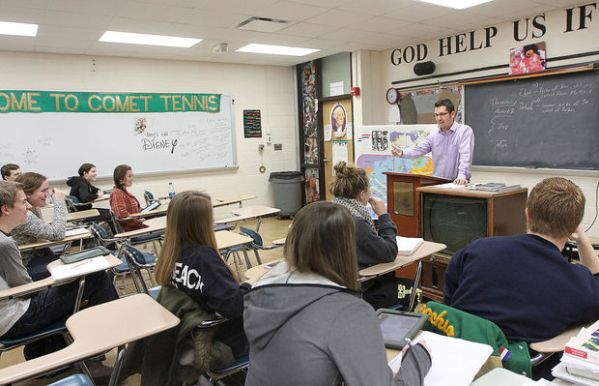
In Greenwood, it seems, the public schools are not just friendly to evangelical Protestantism. They are dominated by it. The Bible class, for example, is taught by the gregarious and popular Peter Heck. As the article notes, there is absolutely nothing wrong with teaching classes about the Bible in public schools. Constitutionally, the courses need to be taught about the Bible as an historical and literary document. They should not be taught devotionally, as a way for students to deepen their Christian faith.
What the Heck is going on here?

What the Heck is going on here?

Heck’s class seems to do the latter. On the day the reporter went in to observe, students were learning how to use the Book of Judges to consider ways that God could use anyone to accomplish His goals. The watchdog group Americans for the Separation of Church and State charged that Heck’s conservative religion influenced the message in his classroom. On his radio show, Heck blasted President Obama and articulated his support for the conservative group American Family Association.

If Heck allowed his conservative Christian activism to influence his teaching, he was not the only one. Karol Evenson told the Kokomo Tribune that she used the school’s Christmas pageant to help spread the Gospel. When she’s teaching about the birth of Christ, Evenson told the newspaper,

I just get real passionate about that when I’m teaching it, so it allows me to share things. A lot of times, I tell the kids, ‘I’m not asking you to believe, I’m hoping that you do and that you will, but I’m trying to get you to feel the music and what we’re singing about.’ A lot of the kids here do believe it, so when they are singing those pieces, it’s such a blessing for me.

At the highest levels, too, the district supports this sort of religious infusion in the classroom. Superintendent Tracy Caddell denied that the Greenwood schools taught any religious doctrine. But he admitted that he saw the teaching staff as

a community of Christians who also are teachers and educators, and I don’t think any of us leave our faith at the door because the bell rings. . . . Jesus Christ is my Lord and Savior and that doesn’t stop just because the school bell rings. . . . As a leader, I’m hoping that we’re promoting what people would call Christian values. However, we’re not promoting or teaching Christian doctrine. There’s a big difference.

As Professor Mark Chancey found in his study of Bible classes in Texas, this sort of attitude is not uncommon in America’s public schools. Nor is this new. In the aftermath of the Supreme Court decision in Abington v. Schempp (1963), in which prayer and Bible reading had supposedly been ruled unconstitutional in American public schools, political scientists Kenneth Dolbeare and Phillip Hammond found that many schools simply continued with their traditional prayers.

Depending on where you go to school, it seems, you might just get a dose of religion as part of your public-school day. Yet things have changed in the past fifty years. Back in 1963, I doubt the teachers and superintendents in towns like Greenwood would bother to say that they did not teach Christian doctrine. Back then, it is likely that a school like Greenwood High would not think twice about teaching Christian values.

Does that matter? I think it does. Fifty years ago, in places like Greenwood, the Bible teacher would not have the same pugnacious spirit as Peter Heck has today. On his radio show, it seems, Heck not only speaks from the perspective of a conservative evangelical Protestant, but assumes that his values are under attack. In his first book, Heck argues that “Christians Can Save America.”

Similarly, Greenwood’s superintendent acknowledged that his district flouted some of the norms of today’s secular culture. “Over time,” Superintendent Caddell told the Kokomo reporter,

we’ve gotten so worried about political correctness in this country that people have not had the opportunity to feel comfortable being a Christian in a public school. I think that’s sad, because that’s who you are.

The conservative Christians running public schools in Greenwood, Indiana—like Christians who do similar things in other American schools—are not simply trapped in the past. As I argue in my new book, in order to understand American education, we need to understand the ways conservative attitudes have shifted over the generations.

In Greenwood, at least, conservative school leaders understand that they are doing something outside of the norms. They just disagree with those norms.
OK: AP not OK

What does creationism have to do with the Continental Army? What does George Washington have to do with the Genesis Flood? This week the news from Oklahoma gives us an example of the ways conservative ideas influence every classroom, not just the science labs.

We will have more success understanding those ideas if we see them as part of a conservative notion of proper education. These are not just ideas about science, or the Book of Genesis, or George Washington at Valley Forge, but they combine all these things into a powerful educational impulse. As I argue more extensively in my new book, in order to make sense of any aspect of educational conservatism, we need to look at it as a whole, not just as a series of separate incidents.

First, let’s look at the goings-on in the Sooner State. Representative Dan Fisher has introduced a bill that will challenge the teaching of Advanced Placement US History in Oklahoma’s public schools. Why? As do many conservatives, Fisher believes that APUSH teaches a warped, slanted, leftist view of America’s past. The new APUSH framework, Fisher explains, emphasizes “what is bad about America.”

Fisher wants to blast progressive history out of Oklahoma's schools.

Fisher wants to blast progressive history out of Oklahoma’s schools.

Fisher is not alone. As we’ve explored in these pages, conservative activists have lashed out at the new APUSH framework. I’ve argued also that many conservatives see these AP standards as only the latest efflorescence of a vicious left-wing assault on real American history. These conservative notions about sneaky progressive subversion in history classrooms have a long history themselves, as I describe in the book. At least since the 1920s, conservative thinkers and activists have lambasted history curricula as hopelessly skewed. Children learn that the USA has been built on a legacy of greed and genocide. Children learn that traditional heroes such as George Washington and Thomas Jefferson have feet of clay, or worse.

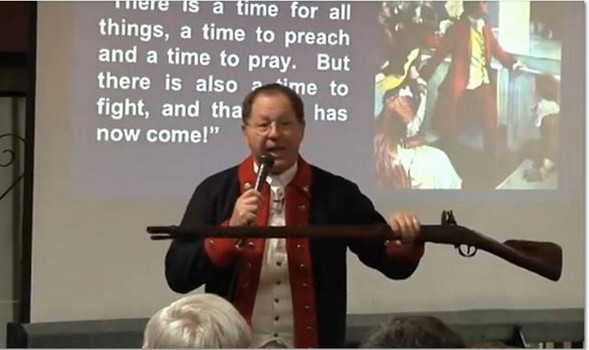
Representative Fisher, for instance, is a member of the Black Robe Regiment, according to the Tulsa World. As do many religious conservatives, this group ties together a romantic history of the United States with conservative attitudes about Scripture and religion. In those connections we catch a glimpse of the ways conservative thinking about education can link creationism with US History.

I want to be careful about what I’m saying here. I’m not arguing that there is some sort of vast underground conservative conspiracy connecting creationism with Fisher’s anti-APUSH activism. Nor am I saying that Fisher’s brand of religious conservatism is somehow the most real sort of conservative attitude about education. There are plenty of conservatives who will have no truck with this kind of religious and traditionalist interpretation of America’s past. But I do believe that deeply held attitudes about proper education fuel both creationism and Fisher’s sort of historical revanchism.

What’s the connection? At its heart, I suggest that this sort of conservatism springs from a notion that real education must come from a delivery of correct information from authoritarian sources to learners. That is, many conservatives—perhaps a better word would be “traditionalists”—believe that education must be a transmission of truth from top to bottom. That truth, if we back it up to its source, must come from God as the ultimate authority.

Perhaps this definition of proper education as the delivery of truth to each new generation seems unobjectionable. It is not. For about a century, educational thinkers have suggested that this “transmission” method is not good education. These “progressive” reformers have tried to impose instead an idea that students must construct knowledge on their own, not merely accept it or download it from authoritarian sources.

In the specific case of the new APUSH framework at issue in Oklahoma, historians have insisted that historical learning does not simply mean transmitting facts to children. And smart conservatives acknowledge that real education includes much more than just telling young people things that are true. But at its core, we might separate “traditionalist” from “progressive” ideas about education along these lines: Traditionalists think of education primarily as moving information from authoritative source to learners. Progressives think of education primarily as having learners construct knowledge.

With this sort of general attitude about education and knowledge, it’s easy to see the connections between creationism and the Continental Army, between George Washington and the Genesis Flood. For some religious conservatives, including apparently Representative Fisher of Oklahoma, knowledge about any subject must rely on traditional truths. Those truths have been delivered to us from on high. Proper education, in this mindset, consists of passing those truths along, not subjecting them to smarmy and self-satisfied criticism.

Jesus vs. Koch Bros. in Kansas

So…what IS the matter with Kansas? Last week in the Guardian, Sarah Smarsh offered a mistaken look at the way big money and big religion work together to erode public education in the Sunflower State.

The way Smarsh describes it, “extremist Christians” have been fooled into working with “fundamentalist capitalists.” They both want to privatize public schools, but for different reasons. Her article underestimates and misunderstands the long tradition of American conservatism. New histories, including my new book on educational conservatism in the twentieth century, have laid out the long roots of deep organic connections between religious conservatives and free-market conservatives.

Smarsh describes current education policy in Kansas as dictated from “that ancient place where the religious and the greedy mingle.” As she puts it,

Today, the religious right and wealthy free-marketeers both long to privatize a system that educates 50 million students, but for different reasons. One wants to make 50 million Christians; the other, 50 million paying customers.

As Smarsh explains, at its root this alliance of religion with capitalism results from a cynical conspiracy among the big-money folks. She quotes Rob Boston of Americans United for Separation of Church and State:

The unholy union, he told me by phone from his Washington office, begins with the money holders. “They look at the shock troops of the religious right, and they think, ‘How can we tap into that power? How can we get them to endorse our agenda of privatization?” Boston theorized. In matters of public education, which the religious right finds distasteful along moral lines, “they’re already more than halfway there.”

In reality, according to Boston, big-money folks like the Koch brothers don’t care about Jesus. They only want to get their paws on the public-school sector to weaken the influence of the government and strengthen private business.

I’m no Koch fan. Nor am I a conservative Christian. I do indeed find it believable that some big-money types have hoped to co-opt religious conservatives to get their votes. But to say that the alliance of conservative Christians with big-business is some sort of elaborate scam does not fit the facts.

Right fools left...

Right fools left…

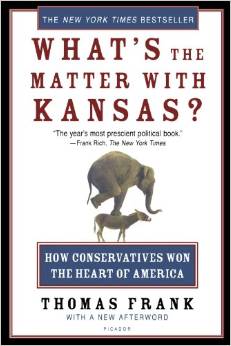
Just as Thomas Frank’s popular book What’s the Matter with Kansas did a decade ago, Smarsh’s argument resolves puzzling situations by resorting to conspiratorial explanations. Frank argued, roughly, that conservative schemers managed to convince working-class voters to vote Republican by waving the bloody shirt of abortion and gay rights. In essence, conservative strategists fooled people into voting against their own economic interests by emphasizing culture-war hot-button issues.

In Frank’s argument, conservative voters come off as dupes, conned into voting for Kansas Republicans because of an irrational attachment to pro-life ideas. Smarsh makes similar implications. Big business free-marketeers manipulate conservative Christians into fighting against public education, in this line of argument.

Let me be as clear as I can be: I don’t doubt that some libertarian business folks might HOPE to enact such a scheme, but the notion that conservative Christians are somehow rustic pawns of a corporate megalith are far too simplistic and Manichean.

Folks like Smarsh and Frank (and me, to be fair) have a hard time understanding how conservative Christians could support privatization, so they (we) jump to a false conclusion that big business has somehow fooled religious conservatives.

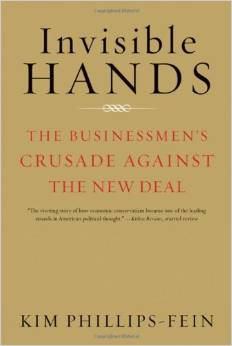
More careful historical treatments have noted the far more complicated connections between big business and evangelical Christianity. Kim Phillips-Fein, for example, looked at the roots of business conservatism in her 2009 book Invisible Hands. Phillips-Fein is certainly no fan of big business, but she describes the way industry leaders such as J. Howard Pew of Sun Oil dedicated much of their fortune to promoting evangelical Protestantism. This was more than a scheme or a scam. It was a long-term effort to promote conservative Christianity and big-business. It was an effort to bring both together for the good of both.

...or does it?

…or does it?

As I’ve found, too, many religious conservatives have embraced big business for reasons that Smarsh and Frank don’t seem to understand. Many religious conservatives have not been fooled into supporting capitalism, but rather see capitalism as an inherent part of their American Christian tradition.

In educational conservatism, at least, the deep organic connections between Jesus and capitalism were not imposed by any move of the sinister Koch brothers. Rather, religious conservatives themselves have long insisted that schools must teach both capitalism and Protestantism. Even a cursory familiarity with the writings of leading conservative activists will make these connections clear.

For instance, in a description of the decades-long educational activism of Mel and Norma Gabler, biographer Jim Hefley connected the dots (emphasis added):

The Gablers also began to grasp progressive education’s grand scheme to change America. They understood why the new history, economics, and social study texts trumpeted Big Brother government, welfarism, and a new socialistic global order, while putting down patriotism, traditional morality, and free enterprise. Simply stated, Mel and Norma realized that the Humanists in education were seeking to bring about the ‘social realism’ which John Dewey and other ideologues had planned for America.

For its part, big business also has a long tradition of pushing for more Jesus in public schools. The National Association of Manufacturers, for example, an industry group, offered in 1939 a new curriculum for schools nationwide. It was vital, NAM leaders argued, for schools to combine “the historical and spiritual foundations of the American system of government, free enterprise and religious liberty.”

I’ll say it again: I don’t doubt that tycoons such as the Koch brothers might hope to manipulate religious conservatives. But it hardly counts as manipulation to encourage conservatives to support a cause they already support.

When journalists such as Thomas Frank or Sarah Smarsh paint a conspiratorial picture of hapless religious conservatives taken in by evil-genius financiers, they do a disservice to those of us hoping to get a better understanding of the ways cultural politics really work in this country.

The Perfect Valentine’s Day Gift

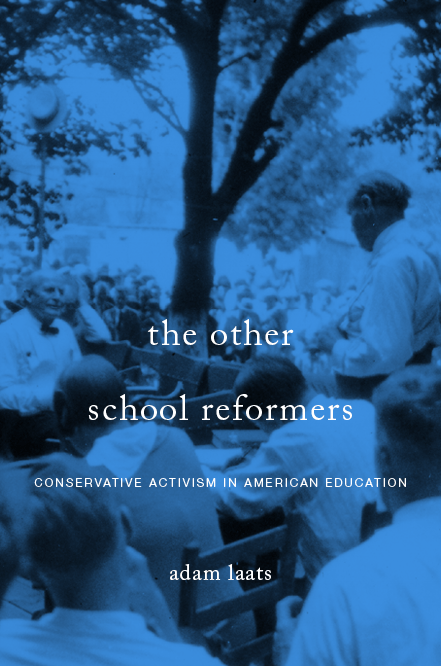
Nothing says “I Love You” more than a book about conservatism and education in American twentieth-century history. Looks like the timing will be perfect.

How to say "I Love You" (But You're Going to Hell)

How to say “I Love You” (But You’re Going to Hell)

My new book is slated for release in early February. Hard to know how it will be received, but one pre-reviewer has called it “a major rethinking of the history of American education.” Another has added, “it would be flat-out wrong to ignore this important book.” Pshaw. . .

For the sophisticated and good-looking readers of ILYBYGTH, the content might not be surprising. In this book, I try to figure out what it has meant to be “conservative” about education in the United States.  How have issues such as creationism, school prayer, and sex ed developed over the course of the twentieth century?  How are they related?  How have conservative attitudes and strategies changed?  How have they remained the same?

In the early days of my research, I had planned to explore the educational activism of leading conservative groups such as the American Legion and the Institute for Creation Research. I was stuck with two big problems, though.

First, the Legion and other conservative groups remained active throughout the twentieth century. How could I describe different conservatives without rehashing the chronology over and over again? I didn’t want to work from the 1920s to the 1970s in every chapter. What to do?

My second problem was one of definition. How could I choose which “conservative” groups to study? I could copy the method of leading conservative scholars such as Russell Kirk or George Nash and use my selection to make an argument about the definition of conservatism. Both Kirk and Nash picked their subjects to give a particular definition to conservatism. For both writers, being a true conservative has meant being a heroic intellectual battling waves of ignorance and knee-jerk leftism. But I’m no conservative myself, and I wasn’t interested in imposing a flattering (or un-flattering, for that matter) definition on American conservatism. What to do?

Luckily for me, I had some help. At a conference back in 2009, I was describing my research. One of the audience members suggested a new approach. Instead of picking and choosing which activists counted as “conservative,” instead of describing the activism of one group after another, why not do it differently? Why not let conservative activists define themselves? This leading historian suggested that I investigate events, not groups.

That’s what I did. I looked at the four biggest educational controversies of the twentieth century: The Scopes Trial of 1925, the Rugg textbook fight of 1939-1940, the Pasadena superintendent ouster of 1950, and the Kanawha County textbook battle of 1974-1975. In each case, conservative activists and organizations fought for their vision of “conservative” schools. By looking at controversies instead of organizations, I could let conservatives define themselves. And I could move chronologically through the twentieth century without rehashing the stories in each chapter.

Did it work? Now I have to let readers and reviewers be the judge. My goal was to explore what it has meant to be “conservative” in the field of education. I did not want to make the relatively simpler argument that conservatism has really meant X or Y. I did not want to give conservatives a heroic history they could draw upon. Nor did I want to give their enemies a catalog of conservative sins. I’m hoping readers think this approach has worked.

So if you’re looking for that perfect romantic gift, consider The Other School Reformers!

The Creationist Dream, Part II

What should public-school biology classes look like? A couple days ago, I shared an article from an evangelical magazine, c. 1967. It told a story of a creationist high-schooler who bravely stood up to her evolutionist teacher. As a result, the class put biology aside and had a spontaneous prayer meeting.

As one astute reader noted, it sounded like a fifty-year preview to the new film God’s Not Dead.

Whatever your beliefs about creationism and evolution, there was something dead wrong in the story. Something that just didn’t fit with the ways the creation/evolution battle really works. And this something was besides the hokey language and the Leave-It-To-Beaver creationism.

What was wrong? Was it

  1. No teacher really feels that gung-ho about teaching evolution?
  2. No student really cares that much about creationism?
  3. No parents would encourage their kid to publicly preach that way in a public school?
  4. There would never be that sort of religious revival in a public school? or
  5. A teacher would not likely be that clueless about the religious beliefs of her students?

Let’s take them one by one. In the story, the teacher was a mean-eyed evolutionist. She ridiculed creationist belief, while being stupidly ignorant of the fact that most of her students shared those beliefs. Could a teacher really feel that gung-ho about teaching evolutionism? Well, clearly the character was an utter caricature, but I think it is certainly possible for teachers in 1967 or 2014 to feel a passion for enlightening students with the truth of evolution. I would say that most teachers don’t feel this sort of mission, but some do.

What about number 2? Do any students really feel so intensely devoted to their creationist beliefs that they would risk public humiliation to express them in class? Just as with number 1, I think this would be unusual in the real world, but by no means impossible.

Would parents really encourage their kids to preach in a public school? Some would. Again, not likely in the same Richie-Cunningham tone presented in this story, but I don’t find it beyond belief that parents might want their children to stick up for their beliefs in public schools. Some parents likely encourage their kids to see their public schools as a sort of mission field. And there is a literature out there helping parents help their kids to evangelize properly in their public schools.

Could it work? As number 4 suggests, is this sort of religious revival beyond the possibility for a public school? Not at all. These days, for instance, public-school children are encouraged to meet at the flagpole of their schools one day in September. Just like in the story, this strategy promises “amazing transformations” of students and school culture.See you at the pole

So I agree with the sharp commenters who voted for number 5. It is possible, of course, that a teacher might have no idea that her students shared fervent creationist beliefs. But in general, that doesn’t happen much. As Michael Berkman and Eric Plutzer argued in their book Evolution, Creationism, and the Battle to Control America’s Classrooms, teachers tend to fit in with their communities. As they put it, “traditional districts and cosmopolitan districts tend to hire teachers whose training, beliefs, and teaching practices serve to reinforce or harmonize with the prevailing local culture.”

Peddling Ignorance? Or Pushing Knowledge?

Okay, so here’s the question: If a teacher or textbook tries to block children from getting knowledge, is that still education? Or is it instead the deliberate promotion of ignorance?

In the case of US History, conservative textbooks deliberately set out to block children’s understanding of the kinds of historical ideas kids might hear in public school. Does that count as education? How about if the textbook and teacher sincerely believe the truth of what they’re teaching instead?

Here’s why I’m asking: I’ve spent the last couple of days debating these questions with a group of high-power historians and sociologists at the annual meeting of the Social Science Historical Association in scenic Toronto. Just next to the Hockey Hall of Fame.

Our panel was convened by Winthrop University historian AJ Angulo.  It was chaired by Kim Tolley of Notre Dame de Namur University, and joined by Dan Perlstein of Berkeley and Karen Graves of Denison. Andrew Abbott of the University of Chicago offered comments. Professor Anjulo is editing a book about the historical construction of ignorance in American education. The rest of the group has contributed chapters.

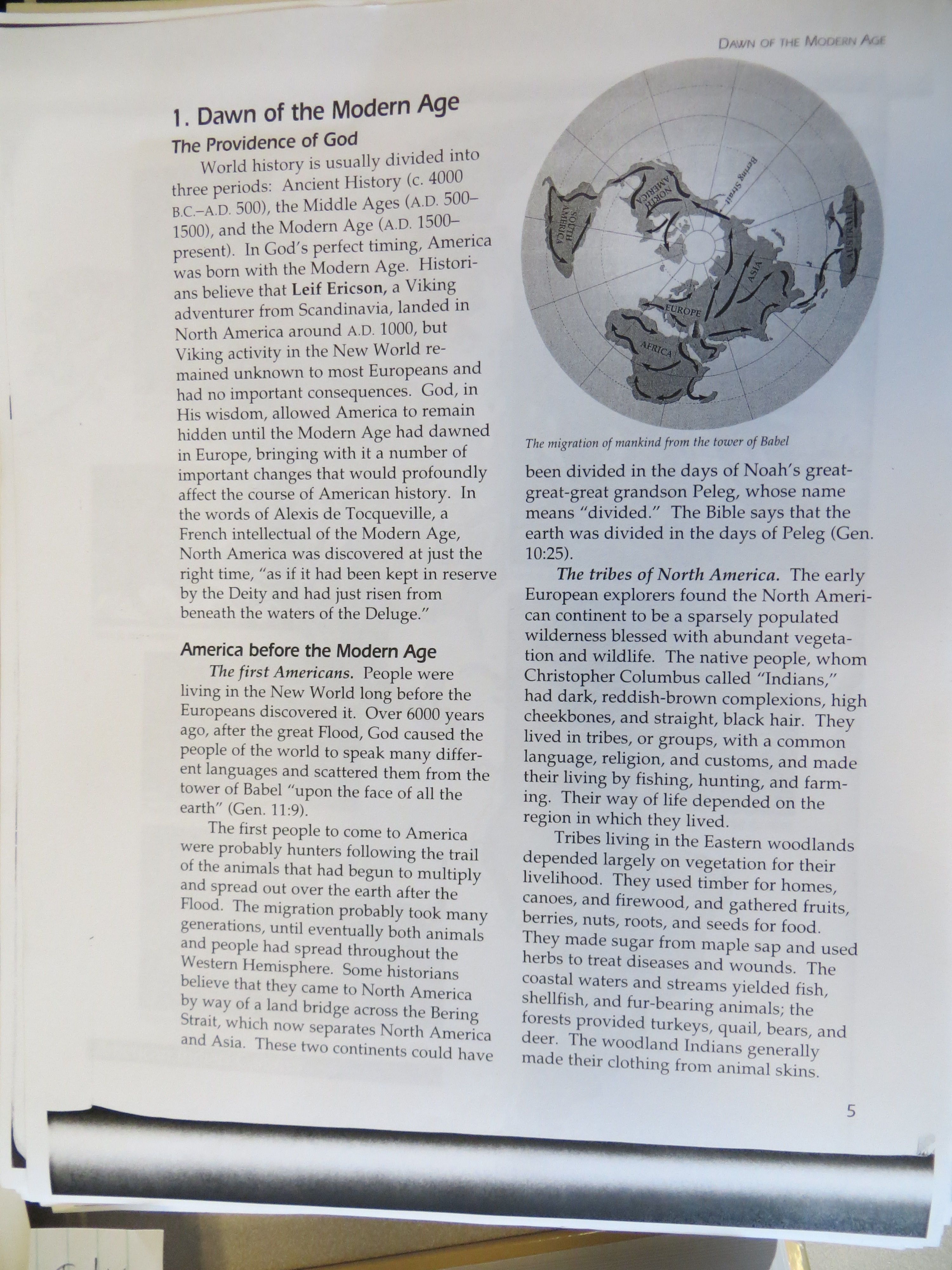
My chapter, and the subject of my presentation in sunny Toronto, concerned history textbooks cranked out by Bob Jones University Press and A Beka Book. Both publishers come from the firmly fundamentalist side of conservative evangelicalism. And each of them has produced textbooks that tell a very different story than the one you might find in a public-school textbook.

a beka babel big

A Beka on where Americans came from

a beka babel detail

The Babel argument, close up

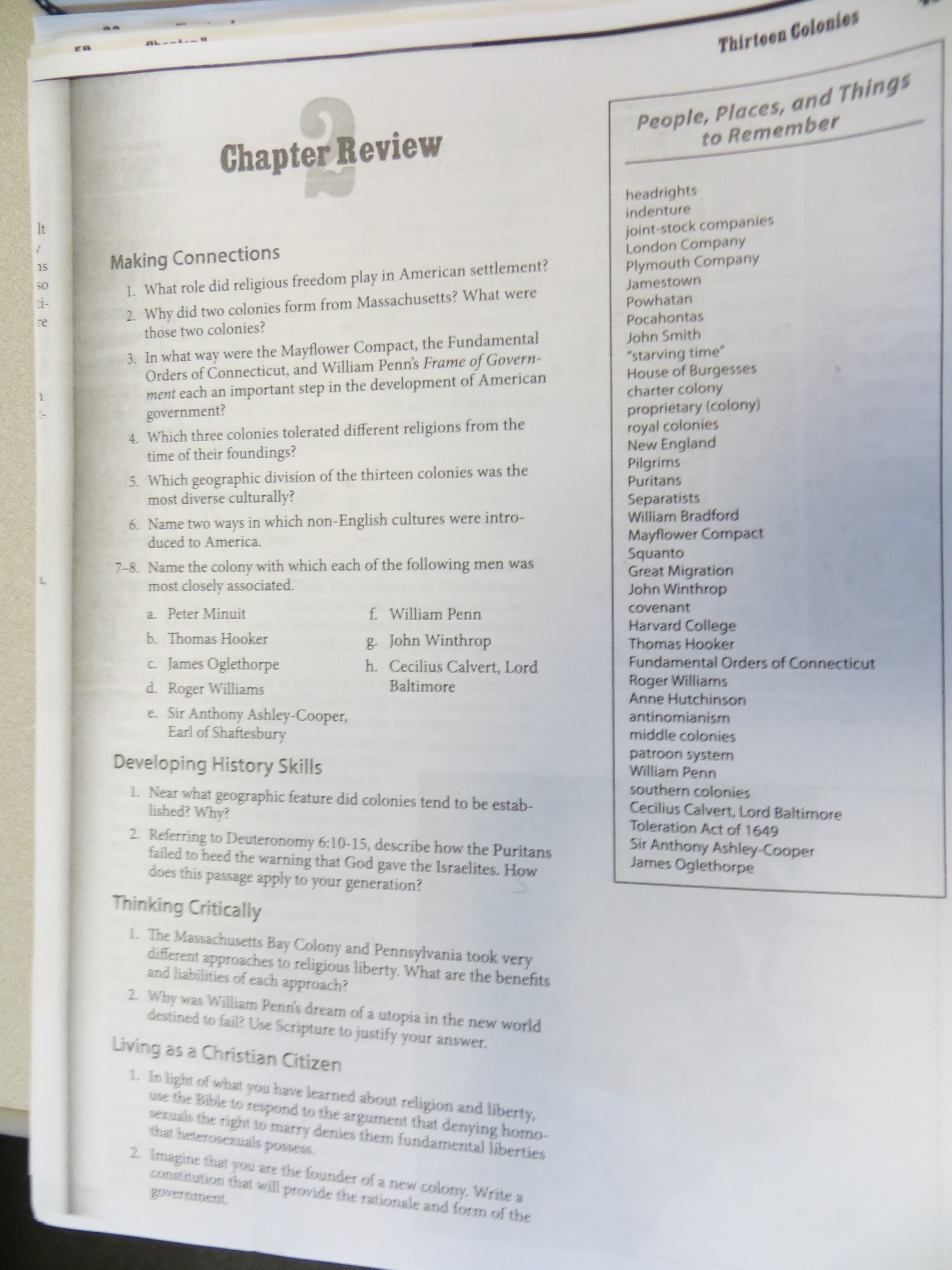
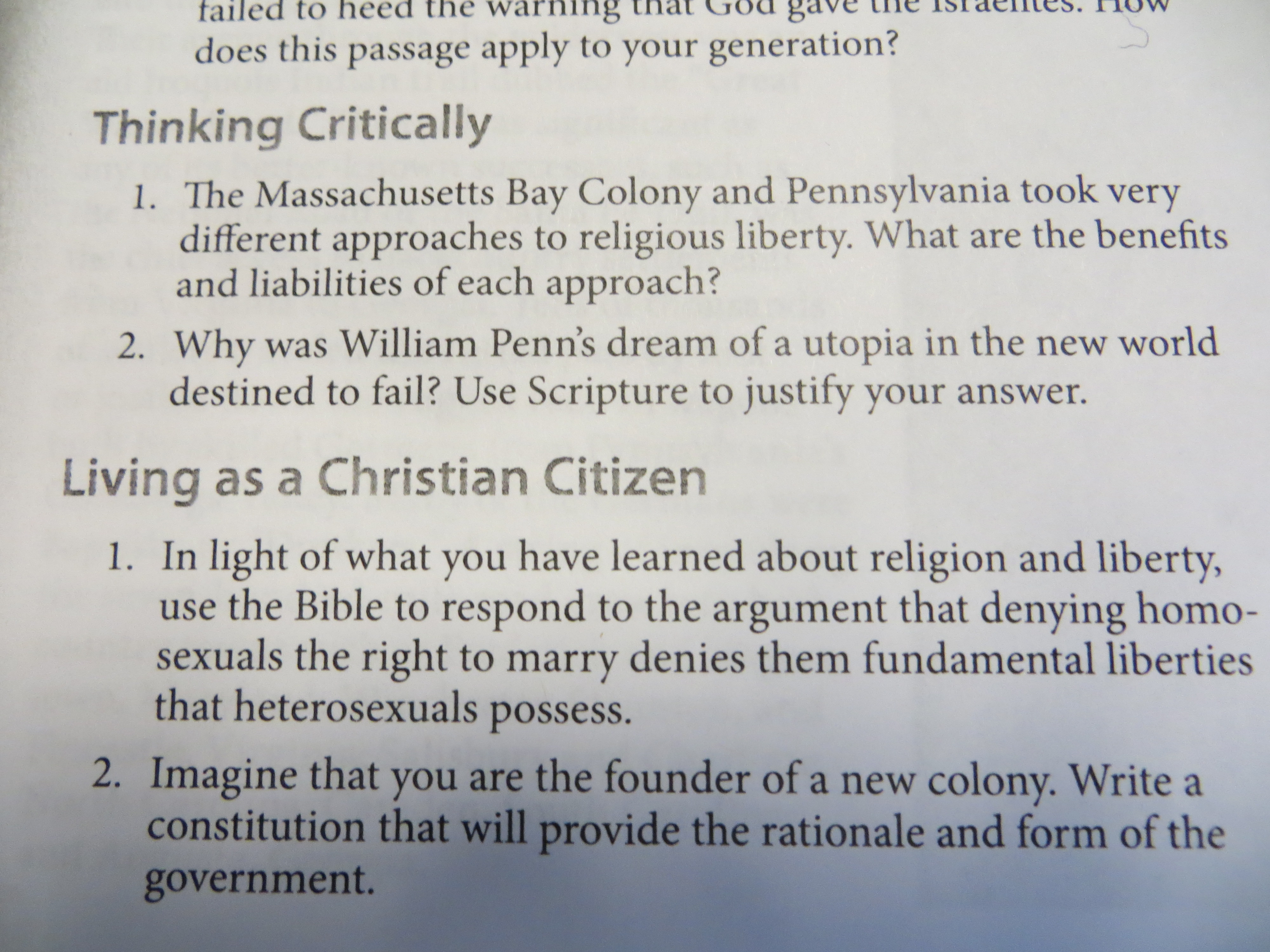
A Beka, for example, explains the origins of humanity in the Americas as the direct result of the collapse of the Tower of Babel. When that happened, people were pushed all over the earth, including into the Americas. And the BJU Press textbook asks review questions you would never find in any public-school history book: How does the early colonial history of the British teach lessons about the biblical morality of gay marriage in today’s world? What can Deuteronomy tell us about the Puritans?

No one doubts that these textbooks tell a very different history from the ones you’d find in a public school. History, in these tellings, is the unfolding of God’s plan over time. Human activity is but a scrabbling, either towards or away from the divine.

And the makers of these books have made no secret of their desire to replace mainstream historical thinking with conservative biblical interpretations. In other words, the entire point of these textbooks is to replace the histories kids might be hearing elsewhere with a profoundly biblical story.

As the faculty of Bob Jones University argued in a 1992 book, there is a “basic difference between Christian and secularist thinking about the human past.” Whereas mainstream or secular historians might hope to teach students to question sources and consider their own biases, BJU’s goal was different. The first goal of teaching history, they wrote, was to help a student “shore up his doctrinal beliefs and reinforce his Christian view of the world.”

BJU press review big

The main ideas, BJU-style

BJU press review detail

A close up: Living as a Christian Citizen

So does this count as the active construction of ignorance? Or is this, rather, simply a different version of what we usually call simply “education”? After all, kids come to public schools filled with historical knowledge, much of it bogus. Many of them get that knowledge from movies such as Forrest Gump. They think that history has been made up of Tom Hanks’ travels though time meeting famous people. Every good history teacher has to try to squeeze out those false historical notions and replace them with better ideas about history.

Activists such as Jonny Scaramanga might blast fundamentalist textbooks as near-criminal impositions of ignorance on hapless kids.  But these textbooks, we could argue, are doing the exact same thing as textbooks in public schools. They are trying to help children block out what they consider to be false knowledge with something they consider more true.

Can we call that peddling ignorance? Even if we think the history is wrong? Or do we have to admit that all education consists of an attempt to push out some kinds of knowledge to replace them with better kinds?

Were the Fundamentalists Right All Along?

Is it time for atheists to celebrate? ThinkProgress calls a recent federal court decision a “major win” for them. In that decision, Oregon’s Judge Ancer Haggerty declared that Secular Humanism deserved to be counted as a religion.

But isn’t that what fundamentalists have been saying for decades? Is this decision really a long-term win for conservative religious folks, who have long argued that secular humanism is a religion? If SH is a religion, it can’t be promoted in public schools. Will fundamentalists be able to use this court decision to demand SH-free textbooks and state standards?

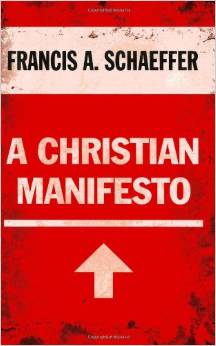
SH SchaefferI take a detailed look at this anti-SH school campaign in my upcoming book. The notion that SH functioned as a religion was popularized among fundamentalists by evangelical intellectual Francis Schaeffer. In his 1982 book A Christian Manifesto, Schaeffer defined SH as a religion that made the terrible error of denying God and making humanity the “measure of all things.”

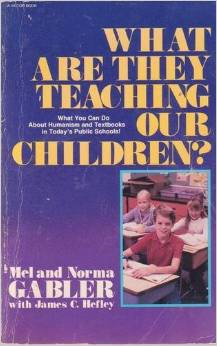
Mel and Norma Gabler, the school watchdogs who pushed Texas’ schools in profoundly conservative directions during the 1970s and 1980s, denounced SH as a “religion with an anti-biblical, anti-God bent.” Beginning with John Dewey in the 1930s, the Gablers believed, humanists had taken over schools and pushed leftist, amoral ideas on generations of schoolchildren. SH was not a neutral arbiter between religions, the Gablers argued, but rather a pernicious religion of its own. As such, it should not be allowed to do its damning work in public schools.SH Gablers

Tim LaHaye agreed. The blockbuster fundamentalist author argued in his Battle for the Public Schools (1983) that SH taught kids in public schools to be “anti-God, antimoral, antifamily, anti-free enterprise and anti-American.” By 1980, LaHaye wrote, humanism had achieved a “stranglehold” on the US government. As LaHaye put it,

Public education today is a self-serving institution controlled by elitists of an atheistic, humanist viewpoint; they are more interested in indoctrinating their charges against the recognition of God, absolute moral values, and a belief in the American dream than they are in teaching them to read, write, and do arithmetic. I call these people humanist educrats.

SH LaHayeThis claim among fundamentalists has become ubiquitous over the years. Conservatives insist that public schools are only interested in freezing out real religion. False religions, especially SH, receive special treatment. Kids in public schools, fundamentalists insist, are not actually in a neutral environment. They are, instead, effectively in an SH madrasah.

So here’s the $64,000 question: will last week’s federal court ruling fuel this fundamentalist fire? In coming years, will fundamentalist activist groups be able to prove their claims about SH and schools by citing Judge Haggerty’s argument?

It will help to look at the specifics of the case. In this case, an SH prisoner complained that he was being treated unfairly. He had demanded similar privileges for his SH group to those given to a list of religious groups. If Catholics, Shias, Sikhs and Druids could have special meeting times, Secular Humanists should too.

The judge agreed. In Haggerty’s words, “Secular Humanism is a religion for Establishment Clause purposes.” That is, as far as the Constitution is concerned, the government cannot favor any one religion over another. Judge Haggerty pointedly noted that his decision was in line with earlier court decisions that differentiated between Secular Humanism in general and organized groups of Secular Humanists who demanded equal treatment. It does not matter if SH in general is a religion. Those who claim equal privileges to religious groups deserve them.

So, in short, the judge did not decide that SH was or was not a religion. His decision was based on the notion that any religion or non-religion deserves equal treatment by the government. But here’s my hunch: For the coming few decades, fundamentalist pundits will refer to this case as proof that SH is a religion. They will ignore the niceties of Judge Haggerty’s decision. We might even see a re-do of the Mozert v. Hawkins County case from the 1980s. In that case, fundamentalist parents insisted that school textbooks pushed the religion of SH on their trusting children.

A new generation of fundamentalist activists might take heart from this decision. It is proof, fundamentalists might conclude, that they’ve been right all along.

Christianity Kicked Out of Public Universities

Ball State University doesn’t want any more attention. It has been the subject of a nationwide campaign by pundits who were shocked—shocked!—to hear that one professor spoke kindly of intelligent design. But my current work in the archives at the Billy Graham Center at Wheaton College shows me just how dramatically things have changed in the past fifty years.

You may remember the intelligent-design case. In mid-2013, Eric Hedin was accused of larding his class with religious content. The Wisconsin-based Freedom From Religion Foundation complained, and eventually Ball State’s president announced that religious ideas must not be taught as part of science classes.

Hedin’s use of religious themes became objectionable for two reasons. Mainly, observers complained that he was presenting religious ideas as if they were scientific. But Ball State University was also criticized as a public school using taxpayer dollars to favor one religious group.

According to Jerry Coyne, when Ball State President Jo Ann M. Gora made her announcement that religious ideas should not be taught as science, she emphasized both of these notions. Intelligent design should not be taught as science, Gora told the Ball State community, since

Intelligent design is overwhelmingly deemed by the scientific community as a religious belief and not a scientific theory. Therefore, intelligent design is not appropriate content for science courses.

But Gora specified that even if such religious ideas were taught as part of humanities courses, they must only be taught as ideas, not as dogma. That is, even non-science classes could not teach religious ideas as true, but only as history or literature. As Gora put it,

Discussions of intelligent design and creation science can have their place at Ball State in humanities or social science courses. However, even in such contexts, faculty must avoid endorsing one point of view over others. . . . As a public university, we have a constitutional obligation to maintain a clear separation between church and state. It is imperative that even when religious ideas are appropriately taught in humanities and social science courses, they must be discussed in comparison to each other, with no endorsement of one perspective over another.

Things have changed. As I’ve dug through the archives here at the Billy Graham Center, I’ve come across an intriguing historical coda to the Eric Hedin story. These days, professors at Ball State may not teach religious ideas as science. They may not even teach any single religious idea as history or literature.

But as late as 1957, Ball State University—like many other public universities—taught evangelical Protestantism explicitly and purposefully. Many public colleges, especially teachers’ colleges, had entire programs devoted to what was usually called “Christian Education.” In these courses, public-school students could learn the basics of evangelical proselytization, usually under the heading of learning to be “Sunday School” teachers. Most typically, students were women who hoped to begin or enhance their careers as part-time religious educators.

The current logo hints at this heavenly history...

The current logo hints at this heavenly history…

In some cases, today’s public colleges used to be religious or denominational schools. That doesn’t seem to be the case with Ball State. It claims to have always been part of the government system.

Not only did universities such as Ball State teach courses in spreading the evangelical Gospel to children, but they also accepted transfer credits from unapologetically fundamentalist seminaries. In my archival work, I’ve found several examples of students using their credits from the Winona Lake School of Theology to advance their degrees at public universities like Ball State and the University of Georgia. Even the state of California apparently accepted Winona Lake credits toward public-school teaching certificates.

At the time, Winona Lake School of Theology was a firmly fundamentalist summer school. It was going through an ugly separation from the Fuller Theological Seminary over Fuller’s alleged drift away from Biblical inerrancy. Now defunct, the Winona Lake school refused to go along as Fuller Seminary moved into a more ecumenical attitude.

And in 1957, teachers could use their credits from this religious school to complete their religious program in Christian Education at Ball State University. Though there is too much heated rhetoric about God being “kicked out” of American public education, this example shows us how things really have changed over the past decades.

In 2013, the president of Ball State had no problem announcing that her university must not favor one religion over another; as a public school it must not teach religion, though it can and should teach about religion. But as late as 1957, Ball State and other public universities found it unexceptional to teach entire programs in Christian evangelism. Ball State had no problem taking credits from a fundamentalist seminary, since both programs taught similar course content.

More evidence that we are not just replaying every old culture-war script. Things really have changed.

Shout at the Devil

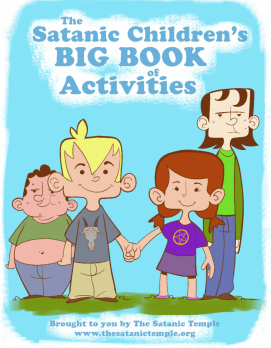
Can religious groups pass out religious literature in public schools? How about if the religion is Satanism, and the literature is The Satanic Children’s Big Book of Activities?

What's good for the goose...

What’s good for the goose…

Apologies: This news came out about ten days ago, but I’ve been wrapped up in book research and somehow missed it. Better late than never, right?

So here’s the story in a nutshell: In Orange County, Florida, the Satanic Temple has announced plans to distribute its children’s book in public schools. Why? Because evangelical Protestant groups plan to pass out Bibles and Christian literature.

According to the Satanic group’s announcement, the plan hopes to attract attention to the need for secularism. As in other high-profile cases—such as plans for a Black Mass at Harvard—the group insists it does not really worship Satan, but rather wants Americans to shake off their religious blinders.

As the temple’s spokesperson, Lucien Greaves, explained,

if a public school board is going to allow religious pamphlets and full Bibles to be distributed to students — as is the case in Orange County, Florida — we think the responsible thing to do is to ensure that these students are given access to a variety of differing religious opinions, as opposed to standing idly by while one religious voice dominates the discourse and delivers propaganda to youth.

Indeed, the book uses Satanic imagery to promote notions of pluralism and anti-bullying. The Satanic children are represented as the only ones able to use “patience and open-mindedness” to understand kids who are different. The smiling Satanic children in the book use “inclusive language” and “[spread] knowledge … to dispel fear and ignorance.”

All sounds pretty innocent, right? And, indeed, for secular folks, this publicity stunt might indeed seem to be what one journalist called “a hilarious response to a pro-religion court ruling.”

Spreading knowledge?  Or fueling fundamentalist fears?

Spreading knowledge? Or fueling fundamentalist fears?

Personally, I agree. This effort seems to make a powerful statement about the true possibilities of religious freedom in public schools. In other cases, we’ve seen parents protest against evangelical outreach to public schools. And we’ve wondered if Jesus-loving cheerleaders would really accept similar sorts of religious free speech from other religions. If public schools are really going to work, they don’t need to ban religion. But they can’t support just one sort of religion, either.

In the end, though, I can’t help but wonder if this sort of exposure does more harm than good to the very cause the Satanists claim to espouse. They came to Orange County in an effort to support the Wisconsin-based Freedom From Religion Foundation. The Satanists want to make the point that no religious literature should be permitted in public schools; no religious evangelists should be allowed to target public-school students.

As regular ILYBYGTH readers know, I’m an outsider to the world of conservative evangelical religion. But after having spent some time with conservative evangelicals and “fundamentalists,” I’m now wondering if the Satanists’ tongue-in-cheek deviltry might backfire. With this Florida campaign, the Satanic Temple is literally putting the devil on the side of the atheists. Conservative pundits can and will point to the Satanists’ efforts as evidence of the evil tilt of atheists.

So here’s the question: Is this Satanic Temple effort genius? Or self-destructive?

Does it make the point that “religious freedom” must really mean religious freedom for ALL religions? Or does it simply fuel conservative warnings that secularism is just a front for Satan?

Burning Bibles at Public Schools

Can a public school have Christian books in its library? Are religious books coming under fire? The latest story comes from Temecula, California. But religious activists have worried for generations that public schools have become aggressive book-burners.

In the current case, the Pacific Justice Institute has accused Temecula’s River Springs Charter School—apparently one of three schools in the Springs Charter School network—of anti-Christian bias. A parent complained to PJI that the school library had purged any book with a Christian bent. According to a report in Christian News, the parent told PJI that the librarian had been told to get rid of religious books. As conservative commentator Todd Starnes tells the story, the school librarian was instructed to remove “all books with a Christian message, authored by Christians, or published by a Christian publishing company.”

As Starnes concluded darkly,

The way I see it – book banning is just one step away from book burning. And I don’t mean to pour gasoline on the fire, but we all know what regime did that.

When the conservative activist group complained, the superintendent, Kathleen Hermsmeyer, responded that the school did not permit “sectarian materials on our state-authorized lending shelves.”

This episode reminds me of an extraordinary rumor I stumbled across in my research for my upcoming book on conservatism in twentieth-century American education. Investigating the 1974 school blow-up in Kanawha County, West Virginia, I found one conservative activist who insisted that the school district had recently removed all the Bibles from the schools. Even more shocking, this conservative reported that the secularizing zealots in charge of the public schools had dumped the Bibles unceremoniously in a dumpster. When pressed, this activist could not provide details or evidence for his story. He said he had heard it from another conservative leader.

But most important, the story seemed true and likely to him. As a religious conservative, he thought it was believable that a public school leader would purge the school of Bibles. And other conservatives at the time agreed.

We could take it even further back. In the 1925 Scopes Trial, anti-evolution celebrity William Jennings Bryan argued that public schools must ban evolution, since they already banned the Bible. That kind of argument has a good amount of gut political appeal. But it has one glaring problem: It just wasn’t true. In fact, as I noted in my 1920s book, Tennessee had actually passed a mandatory Bible-reading law in 1915. But as far as I could tell, no defender of evolution ever called Bryan on his mistake. On both sides, school activists in the past have believed that religious books had been kicked out of public schools.

Today’s story from California is more credible. In this case, the school leader admitted that the policy had been put into effect. Nevertheless, to this observer, it seems the case from Temecula will be another tempest in a teapot. The Pacific Justice Institute likely sniffed an easy win, since of course public schools are not under any legal compulsion to remove all Christian reading materials from their libraries. Indeed, the US Supreme Court has been very clear that public schools can and should teach about religions.

As Justice Tom Clark wrote in the landmark 1963 Abington v. Schempp decision, “Nothing we have said here indicates that such study of the Bible or of religion, when presented objectively as part of a secular program of education, may not be effected consistently with the First Amendment.” Indeed, Clark had just specified that public schools must not exclude religion from public schools, “in the sense of affirmatively opposing or showing hostility to religion.”

So it seems to me that Superintendent Hermsmeyer has indeed blundered. In a publicly funded school, there is absolutely no constitutional mandate to remove sectarian reading materials. The school itself must not preach any religion, but the library can and should be a place where students may encounter religious ideas.