Pre-Orders Now Available!

Want to be the first on your block to get your copy of The Other School Reformers?  Then pre-order your copy today!

Pre-order your copy today!

Pre-order your copy today!

As I was happy to announce recently, Harvard University Press will be releasing the book in early 2015.  But the pre-order just became available on sites such as Amazon.  The hardcover won’t be available until January 12, 2015, but if you pre-order today, you’ll be sure to WOW your friends and family by getting your hands on it first.

The Other School Reformers

Clear your calendars! We have a release date. The Other School Reformers will be hitting store shelves in February.  I know that’s a long time to wait, so I’m suggesting everyone dress up as their favorite conservative educational activist and camp out outside their local bookstore.

Coming January 2015.

Coming January 2015.

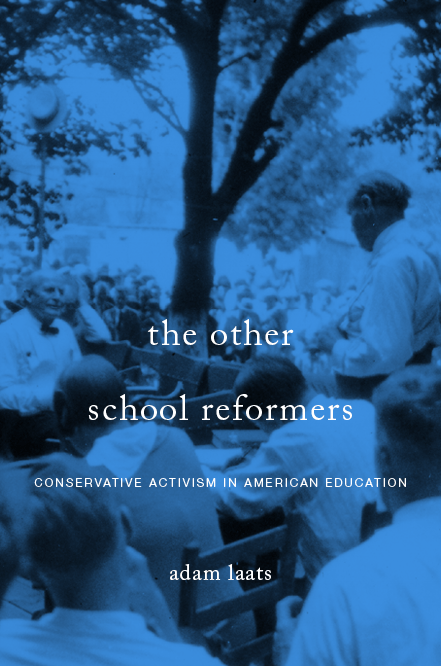
Thanks to the Smithsonian for this terrific cover image.  That’s Clarence Darrow (standing) facing William Jennings Bryan at the Scopes Trial.  In this book, I examine four epochal school controversies from the twentieth century.  In each case, I ask what conservative intellectuals and activists wanted out of schooling.  My goal is to find out what it meant to be “conservative” when it came to education.

The catalog listing just went up.  Here’s how the talented folks at Harvard University Press describe the book:

The idea that American education has been steered by progressive values is celebrated by liberals and deplored by conservatives, but both sides accept it as fact. Adam Laats shows that this widely held belief is simply wrong. Upending the standard narrative of American education as the product of courageous progressive reformers, he calls to center stage the conservative activists who decisively shaped America’s classrooms in the twentieth century. The Other School Reformers makes clear that, in the long march of American public education, progressive reform has more often been a beleaguered dream than an insuperable force.

Laats takes an in-depth look at four landmark school battles: the 1925 Scopes Trial, the 1939 Rugg textbook controversy, the 1950 ouster of Pasadena Public Schools Superintendent Willard Goslin, and the 1974 Kanawha County school boycott. Focused on issues ranging from evolution to the role of religion in education to the correct interpretation of American history, these four highly publicized controversies forced conservatives to articulate their vision of public schooling—a vision that would keep traditional Protestant beliefs in America’s classrooms and push out subversive subjects like Darwinism, socialism, multiculturalism, and feminism. As Laats makes clear in case after case, activists such as Hiram Evans and Norma Gabler, Homer Chaillaux and Louise Padelford were fiercely committed to a view of the curriculum that inculcated love of country, reinforced traditional gender roles and family structures, allowed no alternatives to capitalism, and granted religion a central role in civic life.

Almost makes me want to read it myself.  For me, the next steps will be to review and copy-edit the full manuscript next month.  Then in July I’ll put together the index, with help from a talented graduate student.

The OTHER Hobby Lobby Case

You’ve been following Hobby Lobby’s case for religious freedom before the US Supreme Court.  But did you know Hobby Lobby’s Steve Green has also prepared an ambitious Bible curriculum for use in America’s public schools?

According to Religion News Service, the school board of Mustang, Oklahoma has voted to use the Bible curriculum in its public schools.  Of course, despite some rumblings to the contrary, there is nothing unconstitutional about teaching the Bible in public schools.  The US Supreme Court’s ruling in 1963’s Schempp decision specified that the Bible can and should be taught in public schools, as long as it is not taught devotionally.  That is, children can learn about the Bible, about religion, but not be drilled in any particular religious belief.

But it often seems as if the folks who want to see more Bible in public schools have a decidedly devotional bias to their activism.  As Mark Chancey of Southern Methodist University found in his study of Texas Bible classes, a significant proportion of them end up teaching religion, not just teaching about religion.

In this case, no one questions Steve Green’s ardent religiosity.  As the Religion News Service article points out, Green has admitted in public statements that he hopes the Bible curriculum will show that the Bible is “good,” that it’s “true,” and that the Bible’s impact,

whether (upon) our government, education, science, art, literature, family … when we apply it to our lives in all aspects of our life, that it has been good.

It seems evident that Green hopes this Bible curriculum will lead students toward faith, at least incidentally.  For that reason, the Freedom From Religion Foundation has promised to “scrutinize” the Bible curriculum.

More evidence, it seems, of the uselessness of talking about “America’s public schools” in general.  Schools in some communities, such as Mustang, Oklahoma, may welcome evangelical Protestant curricula into their class schedules.  In other places, Green’s Bible curriculum will not be an issue.  Local school boards make decisions that fit with the cultural politics of their local communities.


…but God IS My Hero

“But God IS my hero.” That’s a dramatic reconstruction of what ten-year-old Erin Shead told her teacher in October. Her teacher had asked her to do a writing assignment about a hero. When Erin turned in an essay about God, her teacher told her she couldn’t write about God, she had to write about her personal hero.

Source: WRCB Chattanooga

Source: WRCB Chattanooga

The resulting kerfuffle pushed Tennessee lawmakers to pass the Religious Viewpoints Anti-Discrimination Act. According to this bill, which now goes to Tennessee Governor Bill Haslam for a signature to become law, students must be allowed to voluntarily express religion viewpoints “on an otherwise permissible subject in the same manner [the school] treats a student’s voluntary expression of a secular or other viewpoint.” In other words, students must be allowed to write about God as their hero.

Here at ILYBYGTH, we have to wonder if this sort of law might represent a powerful new conservative tactic in America’s ongoing educational culture wars.

Tennessee is not alone in passing this sort of school rule. Texas has such a law on the books. Missouri has a similar rule enshrined in its constitution. And Oklahoma is considering something along these lines.

Today, I’m not going to argue the merits of these sorts of laws. In short, though, I’m against them. As I’ve argued in places such as Education Week and the Washington Post’s Answer Sheet blog, these kinds of bills threaten to impose an utterly unmanageable free-for-all in our nation’s classrooms. IMHO. Other commentators, too, have worried that these laws will impose a renewed theocracy in public schools. If students can use class time to make religious statements, some worry that religious students might turn classrooms into religious battlegrounds. What if a creationist student insisted that she could answer questions about evolution with references to Genesis? What if a Muslim student made a speech in which he denied that Jesus was God? It’s not hard to imagine dicey situations these new laws might encourage.

Today, though, instead of arguing against these kinds of bills, I’d like to make a different point. It seems educational conservatives can win politically by protecting students from a perceived overreach by educational leaders. In the case of Tennessee, the senate bill passed unanimously. In the assembly, only two representatives voted against it.

Why did this bill have such overwhelming political support? Two reasons. First, there is not much new in these laws. Students already had the right to engage in self-directed religious activity in public-school classrooms. Erin Shead already had the right to write about God as her personal hero. Second, conservative educational thinkers and activists have long worried about school as a potential threat to young people’s faith. Anything that looks to support religious young people from what many people see as an aggressively secularizing public-school establishment will win political points among religious conservatives.

So liberal-leaning lawmakers can vote for these laws as mere clarifications of already-existing rules. And conservative-leaning lawmakers can promote these votes as an effort to protect religious youngsters from the sinister aggression of secularizing teachers and schools. Together, that is a powerful political coalition.

If I were a conservative activist, I would be watching very closely. Bills that underscore the religious rights of students in public schools have a powerful symbolic effect, if nothing else. And politically, they may be hard to stop.

Why shouldn’t conservatives push these sorts of school laws all over the country?


Do You Read the Bible? Why?

Do you read the Bible?  Regularly?  If you do, you’re in good company.  Or at least you have lots of company.  Results from a survey have been published by the Center for the Study of Religion in American Culture at Indiana University—Purdue University Indianapolis, fondly known as Ewee-poohee.

The survey-meisters attached Bible-related question to two large-group surveys, the General Social Survey and the National Congregations Study.  The authors suggested a few key findings:

*   There is a 50/50 split among Americans who read any form of
scripture in the past year and those who did not. Among those who did,
women outnumber men, older people outnumber younger people, and
Southerners exceed those from other regions of the country.

*   Among those who read any form of scripture in the past year, 95%
named the Bible as the scripture they read. All told, this means that 48%
of Americans read the Bible at some point in the past year. Most of those
people read at least monthly, and a substantial number-9% of all
Americans-read the Bible daily.

*   Despite the proliferation of Bible translations, the King James
Version is the top choice-and by a wide margin-of Bible readers.

*   The strongest correlation with Bible reading is race, with African
Americans reading the Bible at considerably higher rates than others.

*   Half of those who read the Bible in the past year also committed
scripture to memory. About two-thirds of congregations in America hold
events for children to memorize verses from the Bible.

*   Among Bible readers, about half had a favorite book, verse, or
story. Psalm 23, which begins, “The Lord is my shepherd…” was cited most
often, followed by John 3:16.

*   Bible readers consult scripture for personal prayer and devotion
three times more than to learn about culture war issues such as abortion,
homosexuality, war, or poverty.

*   There are clear differences among Bible readers consulting scripture
for specific reasons. Age, income, and education are key factors.

*   Those reading the Bible frequently consult it on culture war issues
more than two times the rate as those who read it less frequently.

*   Less than half of those who read the Bible in the past year sought
help in understanding it. Among those who did, clergy were their top
source; the Internet was the least cited source.

*   Among Bible readers, 31% read it on the Internet and 22% use
e-devices.

*   Bible reading differences among religious traditions followed
predictably the historic divides between Protestants and Catholics, and
between white conservative and white moderate/liberal Protestants.
However, reading practices defy some stereotypes about certain groups.

What can we take away from these headlines?  First, for those of us who don’t read the Bible regularly and who don’t really care about what the Bible might say about any given social issue, this report serves as a reminder that many Americans see the Bible very differently.  For instance, if I read the above numbers correctly, about a quarter of respondents told interviewers that they thought it was important to memorize chunks of the Bible.  Also, those who do tend to read the Bible also tend to use the Bible to prove points on social issues.  For example, I do not find the Bible to be relevant to the issue of gay marriage, but many Americans do.  Finally, we see yet another reminder that religious divisions do not neatly match political ones.  African Americans, for example, tend to vote Democratic.  Yet they also tend to read the Bible more often than other groups.

Yet moving past the headlines, we also see some confirmation in this report of stereotypes about the Bible.  For instance, the authors found that Bible-reading was much more common among old people than among the young.  Of those over 75, 56% reported reading the Bible in the past year.  Of those between 18-29, only 44% did so.  Also, Bible-reading was most prevalent in the South (61%) and least prevalent in the Northeast (36%).

Yet even the body of the report contains intriguing surprises.  For example, of those who said they consider the Bible the “inerrant Word of God,” a significant percentage did not read the Bible at all in the past year.  If we add in respondents who said they believed the Bible was the “divinely inspired Word of God,” we get an astonishing result: Those Bible-lovers made up 65% of the people who said they had never read the Bible in the past year!  That’s right: of the people who said they had not read the Bible in the past year, 50% still thought the Bible was divinely inspired, and 15% thought that the Bible was inerrant.  Clearly, Bible-reading does not correlate with theological convictions about the importance or status of the Bible.

And, of course, people read the Bible for all sorts of reasons.  It was no surprise to find that the most common reason people give for reading the Bible is prayer and personal devotion.  But large numbers of respondents also claim to read the Bible to find out how to make more money, how to heal themselves, and how to predict the future.  As the study concludes, these uses of the Bible correlate strongly to levels of formal education.  People who have gone to college tend to use the Bible less for these sorts of purposes.  As the authors put it, “those with less education read the Bible at twice the rate of someone with a college degree for the purposes of learning about culture war issues, health and wealth, and what the future holds” (24-25).

So what can this survey tell us?  The IUPUI researchers asked prominent scholars for their opinions.

As prominent historian of religion Mark Noll commented, one hoped-for result of this survey was to add needed complexity to public discussions about the Bible.  “These IUPUI surveys,” Noll suggested, “should bring sanity back into journalists’ reporting on religion, at least to the extent that they show how important non-political use of scripture continues to be in modern American life.”

Professor of African American Studies Sylvester Johnson added a different take-away message.  This survey, Johnson noted, demonstrates the persistence of “the dominant reality of biblical fundamentalism in Black churches.”  Many observers, Johnson said, have long attributed a social progressivism to African American churches that simply doesn’t match the cultural reality.

In any case, whether it is used as a symbol of cultural identity, a source of clues to the future, or a dusty tome on a shelf that is left alone to molder, Americans still care about the Bible.

 

“The Long Game” Is Coming to Binghamton

What do schools teach?  What SHOULD schools teach?  The problem is not that we don’t have an answer to this question.  The problem is that can’t agree on which answer is the right one.

Tomorrow night award-winning documentarian Trey Kay is bringing his latest radio documentary to the scenic campus of Binghamton University in sunny Binghamton, New York.  This work, “The Long Game: Texas’ Ongoing Battle for the Direction of the Classroom,” explores school politics in the Lone Star State.  As ILYBYGTH readers know well, those Texas politics tend to be more exciting versions of the sorts of school fights we hear all over the country: Can cheerleaders use the Bible at public-school football games?  Can textbooks preach a neo-Confederate vision of US History?  Can creationism and evolution jostle along side-by-side in public-school science classes?

long gameThe battles in Texas schools reflect our cultural disagreements over the proper form of public schooling.

Tomorrow evening, Trey will share an excerpt from his earlier documentary, “The Great Textbook War.”  Then we’ll listen to “The Long Game.”  Afterwards, we’ll benefit from Trey’s commentary, as well as that of world-renowned historian Jonathan Zimmerman of New York University.  Binghamton’s own Matt McConn, a recent émigré from Houston public schools, will also join the panel.

Unfortunately, we won’t be web-streaming the event.  But for all those who can make it to the Binghamton area, you are most welcome to attend.  The fun will begin at 6 PM, Thursday, February 27, in University Union room 120, on the campus of Binghamton University.  The event is free and open to the public.  Pre-registration has closed, but everyone is still welcome to come by without registration.

Are You a Camel Denier?

The authenticity of the Bible has received a new challenge, a new camel’s nose under the tent.  You’ve probably seen the headline: Two archaeologists have published their findings that camels did not likely live in Biblical lands at the time of Abraham, yet the Bible says they did.

One obvious conclusion is that the early books of the Bible were written long after the events they describe.  Conservative Protestants quickly disputed this implication.  Dr. Andrew Steinmann, a professor of Hebrew and theology at Concordia University-Chicago, insisted that this evidence merely proved the accuracy of the Old Testament.  Camels, Steinmann argued (according to an article in the Christian Post), were not described in the OT as widespread, but rather only owned by recent emigres from other areas.

As Gordon Govier aptly put it in the pages of Christianity Today, this archaeological dispute is only the “latest challenge to the Bible’s accuracy.”

Indeed, as historians of evangelicalism will tell you, the roots of what we think of as fundamentalism and its neo-evangelical offshoots came directly from an earlier generation of scholarly criticisms of the Bible’s accuracy.

In all the ruckus, nothing I’ve seen has been more poignant than the recent accusation by Julie Borg in World Magazine that the archaeologists amount to nothing more than cynical “Camel Deniers.”  She argues that plenty of secular research disproves their bitter and ill-conceived anti-Biblical argument.

So how about it?  Is this a new “denier” category to add to our culture-war lists?


What Does Your Kid Sing in the Bathroom?

In the pages of Christianity Today, Andrea Palpant Dilley makes the case for private Christian schooling.  Her best argument?  Thanks to her new Christian school, Dilley’s daughter now sings “Holy, Holy, Holy” while going to the bathroom.

Dilley’s being humorous, of course, but her main point is this: despite legitimate arguments among evangelical Christians over the proper type of schooling, a good Christian school can push young people in healthy Christian directions.  A good school can help turn their souls and minds to the beauties and challenges of living a faith-filled life.  Does a Christian school guarantee that each kid will grow up to be a good Christian?  No.  But it gives young people a different set of mental furniture with which to fill their young heads.  Instead of singing the Ninja Turtles theme song, Dilley’s daughter sings “Holy, Holy, Holy.”

As I’ve reviewed in some of my academic publications, the decision to send children to private Christian schools is not a simple one.  Many Christian schools have been accused of being nothing more than “segregation academies.”  In practice, though, the racial politics of private schooling includes complicated decisions about where to send our children.

We have a few academic studies of these sorts of schooling decisions.  One 1991 study from Stanford wondered why parents chose Christian schools.[1]  Not surprisingly, the question turns out to be remarkably complex.  School founders and parents offered a mélange of explanations for their choice of a private Christian school, from bad discipline at public schools to creationist belief.  Similarly, a 1984 study from Philadelphia found that parents had many reasons for choosing private Christian schools.[2]  Again, parents listed public-school factors ranging from “secular humanism” to drug use and poor discipline.

Moreover, as Dilley notes, some Christian parents insist their children should remain in public schools in order to provide needed moral backbone in struggling schools.  Fair enough, Dilley acknowledges.  But for her daughter, the “Christian-school bubble” was the right choice.  Though the family had to scrape together money for tuition, Dilley’s daughter is able to attend a school that includes authentic diversity.  More important to Dilley, a Christian school also lets Dilley’s daughter learn the rich heritage and faith of evangelical Christianity.


[1] Peter Stephen Lewis, “Private Education and the Subcultures of Dissent: Alternative/Free Schools (1965-1975) and Christian Fundamentalist Schools (1965-1990),” PhD dissertation, Stanford University, 1991.

[2] Martha E. MacCullough, “Factors Which Led Christian School Parents to LeavePublic   School,” Ed.D. dissertation, TempleUniversity, 1984.

Registration Is Open!

You are invited.

In a few weeks, Binghamton University’s Graduate School of Education will be hosting a terrific event.  Documentarian Trey Kay will be sharing his new radio documentary, “The Long Game: Texas’ Ongoing Battle for the Direction of the Classroom.”  You probably remember Trey from his award-winning documentary about the textbook battle in West Virginia, 1974-1975.  In his new work, Trey explores the themes so close to the hearts of ILYBYGTH.  Should schools teach creationism?  Should they teach sex?  If so, how?  And what sorts of history should public-school students learn?  Should students be taught that America is awesome?  Or that the United States has some skeletons in its closet?  There has been no place more interesting than Texas to see these politics in action.

long game

After the listening session, Trey will offer a few comments.  He’ll be joined by the world-famous historian Jonathan Zimmerman of NYU.  ILYBYGTH readers will likely know about Zimmerman’s books, including especially his seminal work Whose America.  In addition, BU faculty member Matt McConn will say a few words.  McConn is new to New York, fresh from a long career as a teacher and school administrator in Houston.

There will even be cookies.

So please come on down if you’re in the Upstate area.  It will take place on Thursday, February 27, at 6 PM, in room G-008 in Academic Building A, on the beautiful main campus of Binghamton University.

We’d love to have you.  The event is free and open to all, but registration is required.  To register, please go to the BU registration site.

I Know Who Will Win the Super Bowl

Call Vegas.  Bet the farm.  We know for sure who will win in this weekend’s Super Bowl.

First a note for readers outside the United States or for those ensconced in thick protective layers of nerd: The Super Bowl is a contest between football teams.  It is typically a hugely popular TV and social event.

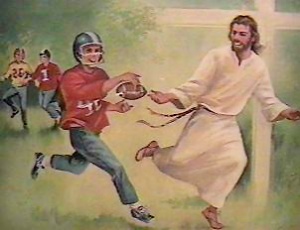
The winner this year has been proclaimed in advance.  No matter what happens on the chilly field, the winner will be… Jesus!

Image Source: The Biblical World

Image Source: The Biblical World

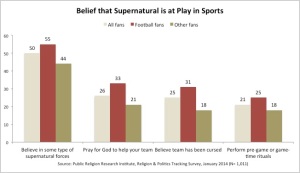
That’s right: no matter how the game goes, Americans tell pollsters they believe that Jesus will determine the outcome.  At least according to a recent report from the Public Religion Research Institute, a majority of Americans think that “some type of supernatural forces” will decide who wins the big game on Sunday.  More than a quarter of fans say they pray to God to help their team win.  And roughly a quarter of fans think their team has been cursed at one time or another.

Image Source: Public Religion Research Institute

Image Source: Public Religion Research Institute

Shocking?  Not really.  It seems to be just another piece of evidence that Americans are enormously religious.  And another warning to out-of-touch academics that their understanding of a liberal, secular society is woefully out of step with social realities.