Why Are Schools So Terrible?

Conservative intellectuals have long asked the question: What went wrong with America’s schools?

Of course, the question presumes that something HAS gone wrong.

We at ILYBYGTH don’t really care if America’s schools are terrible.  We’re more focused on dissecting conservative approaches to the question. How have different conservatives at different times offered different answers to this perennial question?

Now available free online is an argument I put together a few years back. The article appears in the pages of the storied Teachers College Record.

This article looks at the school-history visions of four very different conservative thinkers: Milton Friedman, Max Rafferty, Sam Blumenthal, and Henry Morris. Each of them agreed that public schools had become ineffective, even dangerous institutions. But the reasons they gave for that lamentable decline differed. Friedman, for example, blamed teachers’ unions and government control, beginning just after the American Civil War. Rafferty blasted the wrong-headed “progressive” takeover of the 1930s. Blumenfeld and Morris both looked further back, to a Unitarian coup at Harvard University variously timed either in 1805 (Blumenfeld) or in 1869 (Morris).

These conservative activists do not only differ in the timelines they gave for America’s educational decline, but also in their diagnoses and prescriptions. Friedman wanted a free-market solution. Rafferty hoped for clear-headed traditionalism. Blumenfeld wanted to scrap public education entirely. Morris hoped to heal schools with creationism.

In every case, these conservatives based their arguments about schooling on a historical vision. They are not alone. Activists of every political stripe use history to prove their points. In this essay, I outlined the ways a few prominent conservatives did so.

Classical Education and Conservatism

What is “classical” education?  Is it a “conservative” thing?

The Heritage Foundation recently published a video lecture by Leigh Bortins, founder and leader of Classical Conversations.

Readers of ILYBYGTH may remember a recent guest post from Patrick Halbrook about the thought of classical education inspiration Dorothy Sayers.

Bortins’ talk at Heritage did not focus too much on Sayers’ work, but rather on teaching homeschooling parents  a classical approach.  Those familiar with the themes of classical Christian education will notice that Bortins mostly assumes the age-graded breakdown of the Trivium, though she does talk us through it.

Her organization, Classical Conversations, claims over 62,000 students enrolled.  Bortins says her program has trained over 8,000 parents, as well as over 16,000 parents who have attended three-day practicums.

Bortins herself now hosts groups of college-age people (currently 19) in her home.  She teaches them in the classical model at her home.

Young people, Bortins insists, must be challenged in age-appropriate ways.  Monotony and repetition, she says, are the right way to teach young people.  Older students must move into questioning and using knowledge to improve themselves and their communities.

Too many contemporary education systems, Bortins argues, focus on basics such as literacy and numeracy.  Instead, education must keep its focus on big questions of virtue and personal formation.  Education, she says, has been turned too often into an industrial processing of young people.

The talk runs for about an hour and is worth your time if you’re interested in understanding the spectrum of conservative ideas about education.  Bortins takes her audience through some exercises relating to teaching with a classical model.  How do we define a common thing?  Bortins uses the example of the Washington Redskins.  What makes the Redskins different from other similar things?  What defines the team?

Parents can learn to engage their student-children in a set of guiding questions like this.  There is no mystery to it, Bortins believes.  Classical education, she says, will allow everyone to enter into all the great conversations from across human history.

Critics might complain that this educational model is literally medieval.  Students in this approach spend time defining, comparing, and disputing, just as young Europeans learned for centuries.

But knee-jerk characterizations of “conservative education” might be thrown off by Bortins’ emphasis on the educational value of the humanization and individualization of education.  Caricatures of conservative education often don’t have room to include Bortins’ emphasis on young people freed to sit under the stars and ponder their existence, young people learning to knit as a way to connect themselves to past generations of civilization.  Bortins’ take on good education revolts against an industrial model that treats young people like widgets.

Yet Bortins also insists on the value of free-market values in education.  She implies a Christian grounding to all true and proper education.  In the American context these days, that puts her in the conservative camp.

Of course, Bortins’ vision of classical education can’t be taken as the last word.  Other classical educators might differ in their definitions and approaches.  But Bortins’ talk gives us at least one prominent classical educator’s explanation of the promise of classical education.


Fundamentalism’s Roots: A Review

What does it mean to be a “fundamentalist?”

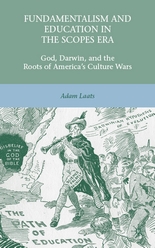
At his lively blog Leaving Fundamentalism, Jonny Scaramanga has offered a review of my 1920s book that puts this question squarely at the center.

Two Thumbs Up...

Two Thumbs Up…

As Scaramanga points out from his current work and from his personal life history, the term “fundamentalist” is often used as more of a bludgeon than a label.  People accuse each other of being “fundamentalist” about this issue or that.  People dither over whether this or that person is a true “fundamentalist.”

Scaramanga notes that unless and until we get a sense of the formative first decade of American fundamentalism—the 1920s—we’ll never wrap our heads around the contentiousness that has always been at the core of defining the term.  I agree entirely.

Best of all, he gave the book a thumbs-up.  As Scaramanga put it,

I was genuinely surprised how much I liked this book. I’m a longtime reader of Adam’s blog and he’s helped me out with research on numerous occasions, so I knew he’s an engaging writer and a top bloke, but I was still expecting to find this a dry, academic slog. Actually, I was riveted. Everything I’ve studied of fundamentalism makes so much more sense in the historical context this book provides. I’d recommend it to people with a casual interest in fundamentalism just as much as those with an academic interest.

Thanks, Jonny.  I don’t think I’ve ever been called a “top bloke” before.  A “top bloke’s” a good thing…right?

Faith & Physics, Part II

ILYBYGTH is happy to continue our series of guest posts from Anna.  In her first post, Anna described her shift from creation science to mainstream science.  Today she tells us a little bit about the way she learned her creationist science as a kid.  Anna blogs about her experiences leaving the fundamentalist subculture at Signs You Are a Sheltered Evangelical.  She holds an M.Sc. degree in Astroparticle Physics and currently lives in Virginia with her fiance Chelsey and a cat named Cat.

Creationist Curriculum

I am a conservative, anti-government-educator’s dream.  Because I was homeschooled, my family had the unique opportunity to control every aspect of my education completely.  Part of this included being taught with a Christian science curriculum that supported Biblical 6-day creation, denied Evolution, described scientific evidence for a global flood, and opposed modern environmental policies.  When I tell my secular peers this, the reactions of shock, horror, and amazement are often rather comical.  Very often, I am told that I must be remarkably resilient or intelligent to be able to make a successful science career for myself after being handicapped by my early education.  As much as I’d love to accept the accolades, I simply don’t see it that way.  My seemingly-bizarre education did not hamper me much at all, and in some ways, I must credit it for inspiring me to become a scientist in the first place.  Although I cannot defend the inaccuracies in the curriculum, I still have fond memories of it, and I can highlight both the shortcomings and successes of the book series.

My formal science education, I believe, started around age 10 or 11 (since I was homeschooled, I did not progress through formal grades, so it is sometimes very difficult for me to track the passage of time without these milestones to help.)  I was started on an A-beka book, which I remember little of besides loathing.  It was spiral bound with wire and the pages were made of cheap paper, meaning that they were constantly tearing out, scattering across the floor, and getting lost.  Besides that, the text itself was dry, the pages were cluttered with illustrations that illustrated nothing, and the quizzes (aptly named “brain drains”) never seemed to pertain to the actual text and would often quiz you in facts only found in the illustration captions.

For the rest of my pre-college education, I used Apologia‘s Christian-centered curriculum by Dr. Wile, and I loved it.  Over the years, I worked through Exploring Creation with General Science, Exploring Creation with Physical ScienceExploring Creation with Biology, Exploring Creation with Chemistry, Exploring Creation with Physics, and Advanced Physics in Creation.  I wish that I had a copy of some of these books still with me… especially the 1st edition of General Science and Physical Science (if anyone feels like getting me an early Christmas present… I won’t say no) because I recall those two books having the most absurdities in them.  Obviously, I cannot cover all of the curriculum in detail, but I can shed some light on the divergences from science that I recall.
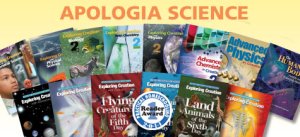
Image Source: Apologia

Image Source: Apologia

I have to laugh now recalling that one of the books (General Science, I think) had an entire chapter devoted to attempting to validate the Bible as an accurate scientific and historical record.  This would seem grossly out of place in any standard science text.  For a creationist, however, it is perfectly reasonable and, indeed, necessary to discuss this in depth.  I recall in my early years of college, seeing my peers and professors laugh at the absurdity of creationism.  “Scientists start with evidence and draw a conclusion from it.  Creationists start with a conclusion and draw evidence for it,” was posted on my professor’s office door.  I felt a little defensive.  “We all tend to accept conclusions that come from reputable, repeatedly-tested sources,” I thought.  “If the Bible were not reputable and repeatedly-tested, then obviously accepting claims from it would be absurd, but that is not the case.”  Much of my conviction on the validity of the Bible originated from the early Apologia texts.  It’s important to remember that Creationists do not see themselves as anti-science… they want to find compelling evidence for their claims.  As a result, I waded through a chapter discussing the accuracy of Bible translations, similarities between different Biblical manuscripts, refutations of Biblical contradictions, etc.  The purpose of this was to prove that the Bible could be reliably used as a basis for scientific theory.  To exclude this chapter would be grossly negligent if claims in the Bible are indeed the basis of your theory.  Even so, the whole conversation bored me; I wanted to learn science.

The Physical Science textbook spent an inordinate amount of time condemning modern environmental policies as fraudulent.  I recall the book passionately opposing the ban on CFC’s, claiming that the ozone hole was a scare tactic used by politicians to promote a hysterical agenda, and predicting that people would suffer from increased rates of infection now that medical tools could no longer be sterilized by the chemical.  These political discussions now irritate me more than any of the other inaccuracies in the books.  I had been raised when I was young in a very rural area and had developed a great love of nature.  I was fiercely protective of the environment, and all of the flora and fauna in it.  I wrote an article to my local newspaper about reducing litter when I was 11 years old or so which I was very proud to see published.  As such, it angers me in retrospect that I was taught so many lies about proper stewardship of the environment and that I believed them for so long.  I have never fully understood why Christian Fundamentalism is so opposed to environmental protection, and yet it seems to be a common theme.  Apologia science chose to start kids on that path early.

The Biology text book focused on disproving Evolution.  Of course.  In all honesty, as silly as 6-day-creation seems to me now, my Bible-based text book really did not deprive me of a decent education on evolutionary biology.  Because of the sheer amount of information I was provided with to refute Evolution I came away with a pretty darned good understanding of it.  I disbelieved it, of course, but once I came around to accepting true science, I was no further behind in understanding than any of my secular peers.  This is why the shock-and-horror response to my anti-evolution education makes me chuckle a little.  If one truly wants to argue effectively against an opponent, one must know his position at least as well as he does.  Thus, I truly believe that my anti-evolution text served me surprisingly well.

Now that I’ve discussed all of these lies, distortions, and absurdities, you might wonder how I can have a favorable memory of Apologia at all.  Well, for one, the books were very well written.  Their style was conversational, without sacrificing content.  The illustrations were meaningful and placed sparingly to complement the text, rather than cluttering the book.  Learning felt like learning… like you were truly on a road to discovery, rather than simply memorizing information for a test.  And, perhaps most awesome of all, if you emailed the author, he would email you back within 24 hours.  If I ever found myself confused by a concept or curious about some theory, I would write to him and eagerly await his response.  He was always friendly and informative with his replies.  Perhaps my enthusiasm over this simple email contact seems exaggerated but, remember, I was homeschooled.  I was almost entirely in charge of my own education by the time I reached higher sciences.  My mother did not have the education to help me in science or math, and none of the other homeschooling moms in my group were any better.  Whenever I was uncertain about something, I would have to figure it out myself.  Thus, having an authority figure to direct my questions to was amazing.  I felt like I was talking to a celebrity.  My childish enthusiasm aside, I think that it also highlights Dr. Wile’s admirable dedication to education.  It meant a lot to me at the time, and I still think back on it fondly.

Dr. Wile was one of my inspirations to become a scientist.  I loved his enthusiasm for the subject, I loved his dedication to the students using his books, and I wanted to emulate that.  Honestly, I still do.  As an instructor, I strive to let my enthusiasm show, to infect others with it, and to always make myself available to my students for questions and assistance.  But what about the science-denial?  It is still a bit difficult for me to look back on authority figures and members of my community that I looked up to and respected and wonder: are they just ignorant, or are they purposely deceptive?  How can a scientist be completely honest with him- or herself and still make the claim that ALL evidence points to a 6-day creation, without question or doubt?  I give myself a lot of grace for my early ignorance because I was young and had little access to any information outside of the pre-approved worldview that I was being fed.  But creationists like Ken Ham, Dr. Wile, and others have no such excuse.  So, without being able to see inside their minds, can I offer them the grace of assuming that they are truly honest in their seeking and have just been misled?  I think the answer is both yes and no, and it is greatly complicated by a wide array of cultural factors involved in the creation/evolution debate.  In order to begin to tackle this, I need to first discuss the factors and pressures that surround a creationist belief in the first place.  For that, however, you will have to wait for the next installment.


Should Adults Lie to Children?

I’ll say it: Lying to children is a vital part of a good education.

Adults lie to children all the time.  Santa Claus. Easter Bunny. Tooth Fairy. Daddy will eventually come home again…

But can such lies be considered “education?”  Our attitude toward this question might tell us a thing or two about the continuing culture wars over American education.

The question came up again in Professor Jerry Coyne’s review of Jonny Scaramanga’s Salon article.  For those of you who just joined the party, Professor Coyne is an irascible atheist and scientist.  He is an inveterate campaigner against creationism and delusional religionism.  Scaramanga is a recovering fundamentalist, blogger, and sometime contributor to these pages.  Scaramanga’s Salon article decried the repackaged fundamentalist curricula that are being taught in some publicly funded charter schools in Texas.

In response, Coyne thundered,

Adults have the right to be as stupid as they want, but I don’t think they have the right to tell lies to children. Those lies include not only religious dogma, but the antiscience attitudes that come with it. How sad that a group of bright and curious children can become ignorant, superstitious ideologues simply because they were born into the wrong families.

Professor Coyne is not the first science pundit to take this position.  In his 1964 anti-creationism book This View of Life, paleontologist George Gaylord Simpson blasted the lies that had thwarted evolution education.  “Even now,” Simpson argued,

a hundred years after The Origin of Species, most people have not really entered the world into which Darwin led—alas!—only a minority of us.  Life may be considerably happier for some people in the older worlds of superstition.  It is possible that some children are made happy by a belief in Santa Claus, but adults should prefer to live in a world of reality and reason.

But as anyone involved with education knows, adults lie to children all the time.  Doing so is a vital part of every good education.  Let’s look at a couple of examples.

1.) “This is what we believe.” 

Every education, in every culture, whether it means formal schooling, apprenticeships, or informal instruction, includes the passing along of central ideas.  Professor Coyne meant that adults should not tell young people things that are untrue.  But what if the adults believe it fervently?  Is that a lie?  Or, to complicate the matter, what if the adult isn’t sure if she believes it fervently, but is convinced that it will be good for the young person to believe?  For example, in the world of religious faith, an adult may have had serious doubts about her faith, but decide that a young person is not yet mature enough to consider those gray areas.  She might then tell young people that certain religious mysteries are simply truths, knowing that later the child will and should wrestle with the more complicated questions about it.

2.) “You can do this.”

This can be a flat-out lie.  Teachers and parents often work to inspire confidence in their children and students, even when the adults are very unsure of the truth of their statements.  Adults may have serious doubts that young people can, indeed, accomplish certain goals.  Yet the adults might tell the children that such goals are definitely, absolutely, 100% achievable.  It’s a lie.  But it is something good parents and teachers do.

3.) “I hate phonies.”

In our culture, many of the biggest truths are best understood through lies.  I’m no Salinger fan, but I still remember reading Catcher in the Rye in high school.  I remember Holden’s struggle with phonies.  It taught me important truths about the ways people interact with one another.  None of it was “true,” of course.  It was all fiction, all lies.  But my teacher taught me those lies.  And I’m very glad she did.

Our attitude about lying to young people can tell us a lot about our positions on key educational culture-war issues.  Professors Coyne and Simpson think it is not okay for young people to learn creationism or other religious falsehoods.  But that position doesn’t include room for the complexities of real education.  Adults lie to children all the time, for the children’s benefit.  Sometimes they do so deliberately.

But more often, adults tell children things that the adults think are true.  Creationists don’t set out to deceive their children; they hope instead to protect their children from the deceptions of mainstream science.

But what if we don’t agree that creationism is true?  Are those creationists guilty of lying to children?  Professor Simpson said yes.  Professor Coyne says yes.  Jonny Scaramanga, I’m guessing, would say yes.

I disagree.  Teaching children our core beliefs is not lying.  Even if I think those beliefs are untrue (and I do think young-earth creationist beliefs are untrue), parents who teach such things to their children are guilty of nothing more than educating their offspring.

There is no parental right more fundamental than that.


Gay Marriage Turns Children into Slaves

Will gay marriage lead to child slavery?

That’s the forecast implied recently by George Weigel in a recent column.

Weigel comments on a new bill proposed in Washington DC by the Council’s “most aggressively activist gay member.”  The bill would legalize surrogate child-bearing.  To Weigel, this arrangement treats both biological mother and child as mere commodities to be negotiated over.  As he laments,

The highest local legislative body in the federal capital is considering a bill that would commodify children as fit objects for sale and purchase—which is precisely what happened in Washington’s antebellum slave markets.

A tad histrionic, you say?

The liberal voice inside my head (and yes, I have several contending voices in there) shouts that this is just another cynical conservative attempt to demonize gay marriage.  Calling surrogate parenting a form of human trafficking is nothing but another bald-faced attempt to push irrelevant non-issues to the fore in the contentious discussion over gay marriage.

And I certainly believe that Dr. Weigel is trying to be provocative here.  But there is more behind Weigel’s accusation than just garden-variety demonization.

As we’ve argued repeatedly (see, for example, here, here, or here), questions of child ownership are central in every iteration of America’s blustery culture wars.

Schools have responsibility for children.  So do parents.  But who gets to make which decisions?

Some may assert that no one owns a child; a child is a person and therefore owns him- or herself.

But that sidesteps the issue.

Children, by definition, are not yet adults.  They are not able—legally or developmentally—to take responsibility for themselves.

Until they can, others must assume custodial roles.

When Dr. Weigel insists that non-traditional child-raising raises the specter of slave markets, he is walking a well-trod rhetorical path.

If children can’t quite own themselves, then questions about ownership will remain central to every culture-war discussion.


Battle Map!

Where have Americans fought over public schooling?

The libertarian Cato Institute has put together a clickable Battle Map to help readers locate educational controversies.  Readers can search by state, by year, or by the type of conflict.  The Cato folks broke down school battles into such categories as curriculum, freedom of expression, gender equity, human origins, moral values, racial/ethnic diversity, reading material, religion, and sexual diversity.

Of course, the folks at Cato aren’t just providing a nerdy public service for those of us interested in studying cultural controversies.  The point of this exercise, from Cato’s perspective, is to prove that public education “divides [people], forcing them into conflict over whose values and histories will be taught, and whose basic rights will be upheld . . . or trampled.”

To this outsider, Cato’s argument seems a little strained.  After all, just because many family dinners turn into shouting matches, does that prove that dinner is a bad thing?


What Went Wrong with America’s Schools?

Hell in a lunchbox. 

That’s where America’s public schools have headed, according to a recent essay by the Southern Baptist Theological Seminary’s President R. Albert Mohler Jr.

President Mohler makes an historical argument for the shocking, dangerous decline in American public education.  Does his case pass historical muster?

As I’ve argued in an essay in Teachers College Record (subscription required, but summary available), this historical argument about public education has been a mainstay of conservative thinking for at least fifty years.  Different conservative intellectuals have come up with different timelines and key events to explain the demise of high-quality, morally trustworthy public education.

Mohler echoes this intellectual tradition.

He argues that public schools began as locally controlled entities.  Beginning roughly a century ago, however, “progressive” reformers attempted an ideological coup.  Such folks, led by John Dewey, openly proclaimed their intention to turn schools into secular indoctrination camps.

Luckily, Mohler believes, such plans did not accomplish much until the second half of the twentieth century.  At that point, however, most schools were “radically transformed,” separated “from their communities and families.”

The results, Mohler warns, have been sobering:

Those who set educational policy are now overwhelmingly committed to a radically naturalistic and evolutionistic worldview that sees the schools as engines of social revolution. The classrooms are being transformed rapidly into laboratories for ideological experimentation and indoctrination. The great engines for Americanization are now forces for the radicalization of everything from human sexuality to postmodern understandings of truth and the meaning of texts. Compulsory sex education, the creation of “comprehensive health clinics,” revisionist understandings of American history, Darwinian understandings of science and humanity, and a host of other ideological developments now shape the norm in the public school experience. If these developments have not come to your local school, they almost surely will soon.

Is Mohler’s diagnosis correct?  Does his historical analysis match the record?

In this historians’ opinion, Mohler is guilty of cherry-picking and over-emphasizing.  It is demonstrably true that in the early twentieth century an array of school activists and intellectuals, clustered together under the amoebic heading of educational “progressivism” did try to implement wholesale changes in the nature of American public education.  It is also true that the US Supreme Court made decisions in the 1960s that could have revolutionary implications for the religious nature of public education.  Even more, it is true that leading organizations such as the National Education Association call for school policies that might dismay stalwart conservative Protestants. 

But contrary to Dr. Mohler’s conclusions, such historical facts do not add up to a public school system that “entered a Brave New World from which no retreat now seems possible.”

Historians have examined each of these important trends in American public education.  Arthur Zilversmit, for example, looked at the implementation of “progressive” education policies in the middle of the twentieth century.  In spite of earnest, well-funded efforts to revolutionize schooling, Zilversmit found, schools remained largely the same.  Why?  Zilversmit, sympathetic to the “progressive” project, blamed Americans’ “strange, emotional attachment to traditional schooling patterns.” 

How about the claim that the Supreme Court kicked God out of the public schools?  It is true that in 1962 and 1963 SCOTUS banned school-led mandatory Bible reading and prayer.  But as political scientists Kenneth Dolbeare and Phillip Hammond found to their surprise, most communities that prayed before the SCOTUS rulings continued to pray in public schools after them.  

Similarly, political scientists Michael Berkman and Eric Plutzer have argued that local school districts continue to function as local bureaucracies.  These “Ten Thousand Democracies,” according to Berkman and Plutzer, remain responsive to local demands and local values.     

This is bad news for President Mohler’s alarmist argument, but very good news for religious conservatives in the United States.  Most of America’s public schools remain closely connected to majority impulses in their local community.  Concerning hot-button culture-war issues such as prayer, evolution, and sex ed—not to mention broader notions such as school discipline, drug use, promiscuity, and general manners—local communities still control their local public schools. 

This local influence helps explain some stubborn trends that have long frustrated progressives like me.  Why, we ask, is evolution taught only spottily?  Why can’t public-school children learn honest, practical information about sex?  Why are public schools still home to coercive prayer practices?

These are all tough questions. 

But Dr. Mohler’s jeremiad raises even tougher ones:  If American public schools are so very conservative, why do conservative intellectuals deny it so forcefully?  Why don’t America’s conservative intellectuals trumpet the continuing traditionalism of American public education?


Who Owns the Children with Guns?

Can a school tell parents what their kids can do outside of school?  On private property?

Conservatives say no.  But they seem to say no for very different reasons.

Conservative intellectuals argue that the state must not overreach.  The average conservative-in-the-street, however, seems to cling to ancient notions that children are not persons.  At least that’s the message we hear in one story from Virginia Beach.

This is a story that has attracted its share of media attention.  According to NBC News, a school district suspended three middle-schoolers for shooting other students with toy pellet guns.  The students were not at school with the toy guns, but rather waiting for the school bus.

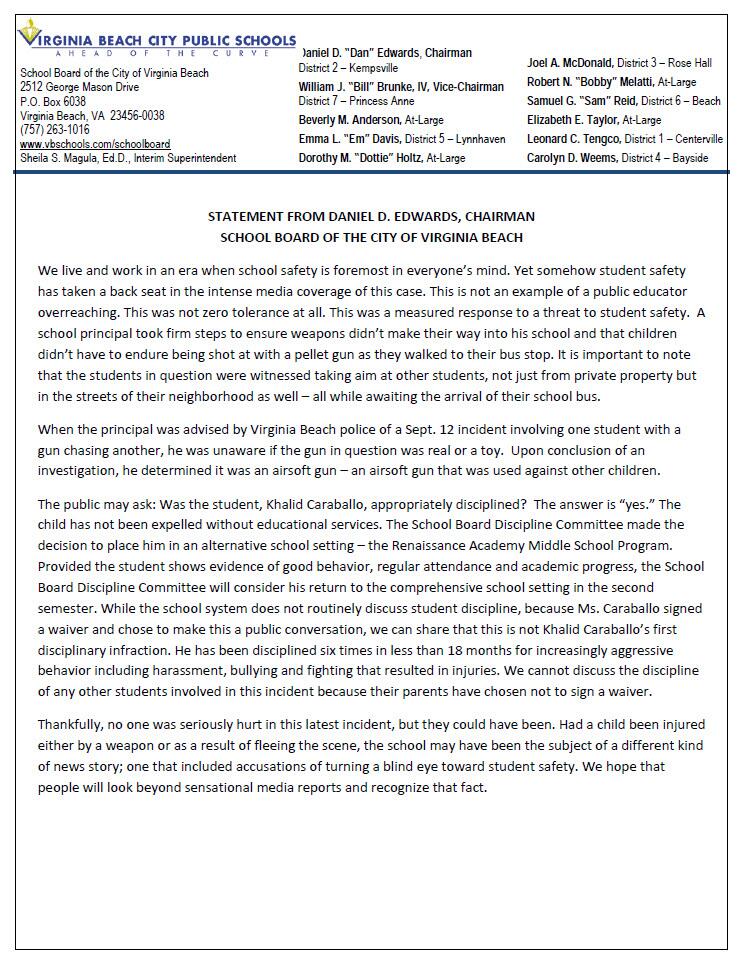
Virginia Beach School Board Chairman Daniel D. Edwards defended the decision.  “This is not an example of a public educator overreaching,” Edwards insisted in a public statement.

Conservative commentator Charles E. Cooke demurs.  In the pages of The National Review, Cooke blasts the school decision as a typical and terrifying example of “tyranny.”  School, Cooke insists, has no role in punishing students for something that occurred outside of school, on private property.  “In free societies,” Cooke argues,

schools are not designed to serve as a mandatory means by which the Bismarckian state may seek to shape the young, but instead to act merely as a service to which parents can choose to send their kids for basic education if they so wish.

Cooke’s essay illustrates this key tenet of conservative thinking, a central reason why today’s conservatives are so keen on educational issues.  Many American conservatives these days yearn for a smaller government.  School is one of the most commonly encountered faces of government.  As a result, school becomes the target of conservative ire.  Even more complicated, schooling for the young is mandatory.  Along with taxes, schooling is one of the most common ways government tells Americans directly what they must do.

This story also dishes up a very different example of the complicated ways Americans tend to think of children and schooling.  According to WAVY.com, one of the parents of the children involved insisted that her child was her property, at least until he got on the bus.  “My son is my private property,” Solangel Caraballo told the local TV station.  “He does not become the school’s property until he goes to the bus stop, gets on the bus, and goes to school.”

Caraballo’s outrage doesn’t come from the same intellectual tradition as that of Cooke’s.  Cooke worries about an overreaching state.  Caraballo, on the other hand, is perfectly willing to have the state assert ownership of her child, but only once the kid gets on the bus.  Until then, the kid is private property, wholly owned by his parents.

What are we to make of this kind of thinking?  If children are private property, what does that mean about their rights?  If they are not property, how can they be kept from voting (not until age 18 in the USA), or driving (not until @ 16), or drinking alcohol (not until 21)?  If they are not property, how can they legally be forced to attend school if they don’t wish to?  What sort of legal twilight zone do children inhabit, not fully legal persons, yet something different from a washing machine or a pair of pants?

Most important, how common is this kind of thinking?  How many Americans continue the ancient tradition of thinking of their children as their property?  Of thinking of their children as property at all, property that they can transfer to the control of the school?


A Conservative Takedown of Testing and Charters

Progressive education folks foam at the mouth when they talk about the new power of testing and charter schools.  Will conservatives join them?

We see recently a furious conservative condemnation of the current education “reform” mania. [The essay originally appeared last July in Crisis.]

Veteran history teacher Steven Jonathan Rummelsburg offered a conservative rationale for opposition to the Michelle Rhee/Waiting for Superman school reform crowd.

Those folks want to make public schooling more responsive.  They argue that schools should have more wiggle room to fire weak teachers; charter schools should be able to slash red tape to provide effective education for any child left behind.  Such reformers often also promise to hold teachers and schools “accountable” by mandating rigorous testing of students.  Such tests, the argument goes, will force teachers and schools to pay attention to the academic performance of all their students.

Progressive critics have teed off on this reform ideology for a while now.  Some have warned that charter schools are nothing but a capitalist scheme to siphon money away from public education.  And the mania for testing, progressives warn, represents a perversion of the promise of American public education.

Rummelsburg gives a different rationale for this same suspicion.  Placing hope in the panacea of charter schools, Rummelsburg argues, is a mistake.  Waiting for any kind of public-funded superman, Rummelsburg insists, misses the point.  The real responsibility for education must remain with the family, not with the government.  And standardized testing reduces the true goal of education to a series of bubbles filled in.

Rummelsburg doesn’t pull any rhetorical punches.  As he puts it,

Waiting for “Superman” illustrates how severely broken public education is and brings up the real issues of school reform and the voucher system. However, the “magic bullet” of charter schools is not the answer. A transfer of money and power from the dreadful public classrooms to charter schools is a bit like transferring the administrative duties of running Nazi death camps from the Germans to the Belgians, yet still the need for reform is beyond dire. However, reform is futile if the goal remains a high standardized test scores.

Ouch.  Will more conservatives join Rummelsburg’s condemnation of the current reform agenda?