Did Fundamentalism Make Her Do It?

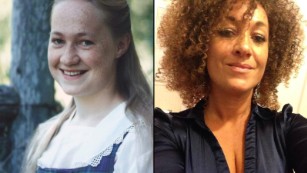
Okay, enough already about Rachel Dolezal and her weird tale of cross-racial activism. But before we let it go, let’s consider one new angle: Did Dolezal’s strange behavior result in part from her upbringing in an abusive fundamentalist homeschooling family?

A fundamental flaw?

A fundamental flaw?

That’s the charge leveled by the folks at Homeschoolers Anonymous. Worried that their coverage seemed to be excusing Rachel Dolezal’s behavior, they have since retracted their argument. (You can still read their original article here.) But it seems to me they raised an important question.

For those of us outside the world of fundamentalist homeschooling, Rachel Dolezal’s life history seems simply bizarre. Why did she list “Jesus Christ” as a witness to her birth? Why did she claim to have been beaten with a “baboon whip” as a child? Most important, why would someone go to such extreme and unnecessary lengths to alter her appearance and life history?

I do not want to excuse anyone’s actions, but I think Homeschoolers Anonymous has a right to point out Dolezal’s extreme evangelical upbringing. It doesn’t prove anything, but it adds background information.

The family was active in young-earth creationism. They apparently subscribed to the abusive philosophy advocated by Michael and Debi Pearl. Last year, Rachel Dolezal’s brother published a shocking memoir of their childhood. As HA summarized,

In his memoir, Joshua recounts growing up in the Dolezal’s conservative, Pentecostal home and church. He recounts a raging father, a mother with extreme suspicions of medicine and doctors, home-birthing with birth certificates listing Jesus as witness to the births, and much more.

Now, we need to add some of the usual caveats:

1.) Behavior that seems odd to secular folks like me does not equal child abuse.

2.) Many conservatives use corporal punishment in a loving, caring way.

3.) It does not excuse Rachel Dolezal’s apparent lies to point out her parents’ extreme beliefs.

4.) Homeschoolers Anonymous certainly has an axe to grind with this expose.

Even taking all those factors into consideration, however, knowing a little bit about Rachel Dolezal’s childhood helps me understand how someone might be driven to immoral extremes in order to separate herself from her past.

Nuf sed.

Phonics for Phundamentalists

How can conservative religious people save their children from a monstrously hypertrophied public school system? In the pages of the Christian Post, Paul de Vries offers a few suggestions to restore the educational prerogatives of conservative families and churches. Could they work?

De Vries, an evangelical philosopher and school leader, suggests a religious solution to angst over high-stakes Common-Core tests. In short, de Vries wants to “restore” the “prize-winning, God-ordained architecture of education that made our country great.” Instead of passing off education to the public-school system, de Vries writes, conservatives need to increase the educational role of the family and the church. Not only can this plan help students learn to read and cipher, but it will inject a dose of Christian morality and soul-winning into a woefully secularized system, de Vries believes.

He offers a menu of specific things conservative religious people can do to assert more control over education. For instance, churches can offer Saturday school in phonics instruction to all the kids in their neighborhoods. It would be a win-win. Young people would get better reading skills, which would help them in their education and standardized school tests. Churches would get more people to heaven, by using the Bible as the only textbook, instilling a deeper appreciation for the Christian Gospel in all the kids of the neighborhood.

Could it work? De Vries says that it does already. Calvary Baptist Church in Manhattan, one of the foundational churches of the fundamentalist movement in the 1920s, already runs a program like this.

Save Our Children from Jesus!

Save Our Children from Jesus!

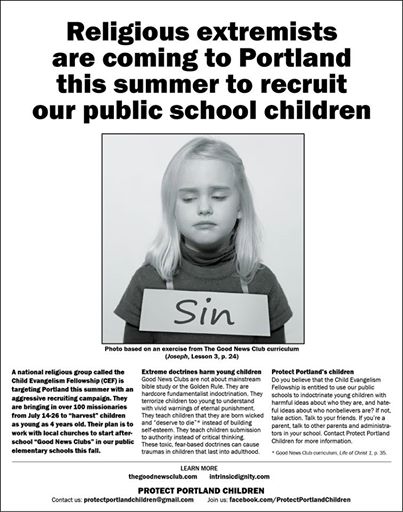
Elsewhere, though, religious add-on programs have run into trouble. In Portland, Oregon, for example, parent activists mobilized to spread the word about Christian attempts to spread the Word to children. As the sophisticated and good-looking regular readers of I Love You but You’re Going to Hell (SAGLRROILYBYGTH) may remember, in that case the Child Evangelism Fellowship promised to educate kids about God and phonics in fun-filled after-school programs. The CEF had the Supreme Court on its side, but non-evangelical parents promised to block access to unwary children.

Professor de Vries hopes that parents will want educational success badly enough that they’ll send their children to Saturday morning church-school. The phonics program, he hopes, will be an attractive lure for children who might otherwise never enter a church.

Required Reading: Rich Parents Are Better

You remember the old joke:

Q: What’s the best way to have a million dollars by the time you’re thirty?

A: Inherit ten million dollars when you’re twenty.

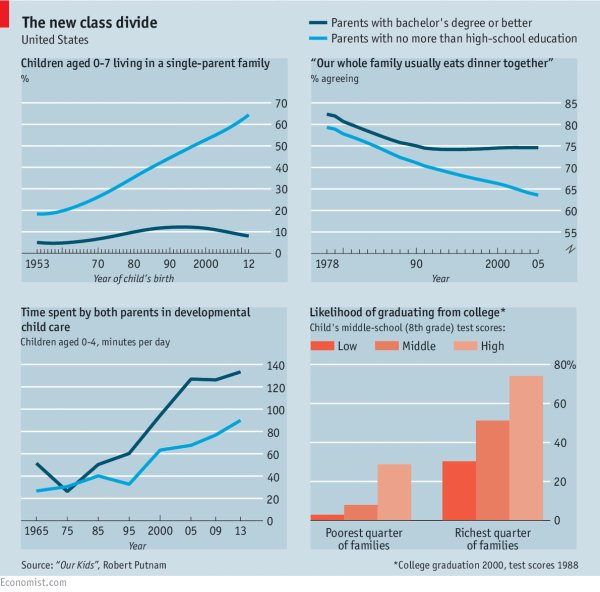
A new book by sociologist Robert Putnam underlines the traditional wisdom: The best way to succeed in life is to pick the right parents. According to reviews in The Economist and New York Times, Putnam amasses solid evidence to demonstrate that the class gap between rich and poor parents is huge and increasing.

Graphic inequality

Graphic inequality

The relationship between parenting and poverty has been a culture-war flashpoint for fifty years. As historian Andrew Hartman relates in his new book, back in the 1960s sociologist and sometime-senator Daniel Patrick Moynihan raised hackles with his study of the causes of African-American poverty.

The problem with too many “Negro Families,” Moynihan argued, was that a destructive anti-family culture had set in. Kids were no longer being raised in stable two-parent households. Fathers were absent or abusive. Mothers were overworked and under stress. The result, Moynihan concluded, was that poor families—especially African American poor families—could not raise successful children.

Critics charged that Moynihan attacked poor people, not poverty. He was accused of a new crime: “blaming the victim.”

The numbers in Putnam’s new book offer some sobering suggestions that Moynihan’s warnings were correct, but not just for African American families. The real divide, Putnam says, is not between black and white parents, but between well-to-do college-educated parents and not-well-to-do parents with less education.

Some of these statistics are truly mind-blowing. Consider, for example, that a poor eighth-grade student who does very well in school still has a worse chance of completing college than a rich eighth-grade student who does very badly in school. The numbers of children living with two well-educated parents has stayed relatively stable. The number of children in single-parent households has shot up among parents with no more than a high-school education.

Traditionalists and conservatives, no doubt, will point to Putnam’s work as more evidence in favor of traditional families. The best way to fight poverty, they might say, will be to encourage stable two-parent households.

Progressives and liberals, meanwhile, will point to these numbers as proof of America’s un-level playing field. Children of parents with fewer educational advantages need extra assistance from government in order to stand any sort of chance.

The long-standing dream of American education has been that education can lead to success. Since the days of Horace Mann, education has been offered as the key to the American dream. Putnam’s study offers more evidence that education is part of the structure of inequality, not the sledgehammer to demolish that structure.

Alert: Public Schools Teach Nihilism!

In the pages of the New York Times, philosopher Justin P. McBrayer repeated an age-old conservative fallacy: Our Public Schools Are Turning Our Children into Moral Monsters. Conservative intellectuals have seized upon McBrayer’s essay as more proof that they need their own conservative school refuges. But here’s the kicker: It’s just not true.

First, let’s clarify. Professor McBrayer is not writing as a conservative activist, it seems, but as a concerned citizen, parent, and philosopher. He notes that many of the college students he deals with seem to have little concept of moral facts. Why? Because, he concludes, “our public schools [are] teaching children that it is not true that it’s wrong to kill people for fun or cheat on tests.”

Scary! But not true. Let’s take a closer look at McBrayer’s argument. He admits that there is not any real evidence that college students these days are moral relativists. However, he asserts, “philosophy professors with whom I have spoken” have assured him it’s true. How does he know what’s going on in America’s public school classrooms? He took one (1) trip to his second-grade son’s classroom. He also looked at the Common Core standards.

From this scanty evidence, McBrayer makes sweeping claims about what’s going on in classrooms nationwide. He also uses this dog’s breakfast to insist that the moral attitudes of college students can be traced directly to this K-12 curricular problem. Why aren’t Americans more moral? Because The Public Schools Have Abandoned Moral Education.

Clearly, Professor McBrayer isn’t the first to make this sort of strained claim. As I argue in my new book, conservative educational activists have said similar things for nearly a century. The pattern is always the same. Texas textbook gadflies Mel and Norma Gabler, for example, claimed to have been minding their own business in 1961, when their son asked them to look at his textbooks. What they read, the Gablers later recalled, “set Mel on fire.” The textbooks, the Gablers concluded, were proof of “progressive education’s grand scheme to change America.”

In Pasadena in 1951, conservative activists became alarmed when one parent found a pamphlet under her daughter’s pillow: “How to Re-Educate your Parents.” Where did she get it? At school!

In 1938, American Legion activist Augustin Rudd found “to his utter astonishment” that his daughters’ textbooks mocked American values.

The problem with each of these claims, as with McBrayer’s, is that the goings-on in any school are not limited to readings and standards. What actually goes on in most classrooms is far more humdrum and traditional. Instead of making alarmist claims based on scanty evidence, it is important to dig deeper into the real practices of schooling.

That’s not easy to do, but scholars have been doing a lot of it for a long time. Perhaps the most relevant recent study might be Michael Berkman’s and Eric Plutzer’s look at teacher education in Pennsylvania. Berkman and Plutzer are well-known political scientists who have devoted a lot of attention to the ways evolution and creationism are taught in real schools. In their recent study, they found that most teachers-in-training are not activists; they are not classroom scientists. Rather, they are job-seekers who hope mostly to avoid controversy and prove their classroom competence.

In short, most public schools tend to reflect local values. They tend not to embrace bold challenges to the status quo. If people in any given school district seem to like evangelical Christianity, as we’ve seen recently, public schools will teach it, regardless of the Supreme Court or the opinions of academics.

Regardless of what standards say, teachers will tend to engage in what they see as common sense. Is it wrong to cheat on a test? Yes! Are there such things as right and wrong? Definitely.

Nevertheless, smart people like Professor McBrayer will likely continue to attribute America’s moral mayhem to K-12 classrooms, based on slim evidence. And conservatives will embrace those charges. In this case, conservative intellectual Rod Dreher has seized upon McBrayer’s charges. McBrayer’s indictment of public education, Dreher insists, proves the necessity of private schools. Only at conservative schools can real education take place.

Of course, I think there are plenty of problems with much of today’s public education, moral and otherwise. And I’m also mad because the New York Times won’t return my calls, even as it publishes flawed commentaries like this one. But in spite of all that, it is important to remember that schools are complicated places. It is not fair to blame our society’s moral morass on today’s curricular choices. Schools reflect our society’s values, they do not simply impose them on hapless children.

Homeschooling and Intolerance

What is the deal with homeschooling? It is really a plan to produce a private army of patriarchs, as some have suggested? Due to the fractured nature of homeschooling, it is very difficult to say anything accurate about homeschoolers as a whole. Thanks to the indefatigable Milton Gaither, we see this week a study that attempts to figure out if homeschooling really does lead to greater intolerance.

For those who are not familiar with his work, Professor Milton Gaither is an historian at Messiah College in Pennsylvania. In addition to his historical work on homeschooling, he also reviews all the new research about homeschooling on his must-read blog.Gaither homeschool

This week, Gaither reviews a study by Albert Cheng. In short, Cheng compiled data gathered from students at Biola University who had been educated in part at home. Cheng wanted to know if these homeschooled students were more intolerant than their public- or private-school peers.

Read Gaither’s full review for the deets, but the short answer is no. All other things being equal, homeschooled students at Biola were a bit MORE tolerant than school-schooled students. As Gaither points out, though, all other things are not equal. The difference in tolerance between homeschooled and school-schooled students was less than the differences between students from different social backgrounds.

In other words, homeschooling tends to make students in this sample more tolerant of people from other backgrounds, but the difference is not as striking as the differences between students from rich and poor families, white and black ones, boys and girls, etc.

What’s the upshot? Gaither concludes with some intriguing implications that you need to read in full. Do public schools make evangelicals less tolerant? Do students choose relatively liberal evangelical colleges like Biola because they are already more tolerant of differences? Can we say with any confidence that homeschooling, as such, does not tend toward intolerance?

The Perfect Valentine’s Day Gift

Nothing says “I Love You” more than a book about conservatism and education in American twentieth-century history. Looks like the timing will be perfect.

How to say "I Love You" (But You're Going to Hell)

How to say “I Love You” (But You’re Going to Hell)

My new book is slated for release in early February. Hard to know how it will be received, but one pre-reviewer has called it “a major rethinking of the history of American education.” Another has added, “it would be flat-out wrong to ignore this important book.” Pshaw. . .

For the sophisticated and good-looking readers of ILYBYGTH, the content might not be surprising. In this book, I try to figure out what it has meant to be “conservative” about education in the United States.  How have issues such as creationism, school prayer, and sex ed developed over the course of the twentieth century?  How are they related?  How have conservative attitudes and strategies changed?  How have they remained the same?

In the early days of my research, I had planned to explore the educational activism of leading conservative groups such as the American Legion and the Institute for Creation Research. I was stuck with two big problems, though.

First, the Legion and other conservative groups remained active throughout the twentieth century. How could I describe different conservatives without rehashing the chronology over and over again? I didn’t want to work from the 1920s to the 1970s in every chapter. What to do?

My second problem was one of definition. How could I choose which “conservative” groups to study? I could copy the method of leading conservative scholars such as Russell Kirk or George Nash and use my selection to make an argument about the definition of conservatism. Both Kirk and Nash picked their subjects to give a particular definition to conservatism. For both writers, being a true conservative has meant being a heroic intellectual battling waves of ignorance and knee-jerk leftism. But I’m no conservative myself, and I wasn’t interested in imposing a flattering (or un-flattering, for that matter) definition on American conservatism. What to do?

Luckily for me, I had some help. At a conference back in 2009, I was describing my research. One of the audience members suggested a new approach. Instead of picking and choosing which activists counted as “conservative,” instead of describing the activism of one group after another, why not do it differently? Why not let conservative activists define themselves? This leading historian suggested that I investigate events, not groups.

That’s what I did. I looked at the four biggest educational controversies of the twentieth century: The Scopes Trial of 1925, the Rugg textbook fight of 1939-1940, the Pasadena superintendent ouster of 1950, and the Kanawha County textbook battle of 1974-1975. In each case, conservative activists and organizations fought for their vision of “conservative” schools. By looking at controversies instead of organizations, I could let conservatives define themselves. And I could move chronologically through the twentieth century without rehashing the stories in each chapter.

Did it work? Now I have to let readers and reviewers be the judge. My goal was to explore what it has meant to be “conservative” in the field of education. I did not want to make the relatively simpler argument that conservatism has really meant X or Y. I did not want to give conservatives a heroic history they could draw upon. Nor did I want to give their enemies a catalog of conservative sins. I’m hoping readers think this approach has worked.

So if you’re looking for that perfect romantic gift, consider The Other School Reformers!

Does Homeschooling Work?

Can conservative Christian parents protect their children from the corrupt values of public schooling?  That’s the question asked by homeschooling parent Braden Hoelzle.  As reviewed by the peerless homeschooling scholar Milton Gaither, Hoelzle’s published findings don’t really offer us the solid answer we want.

First of all, for all of us interested in questions about homeschooling, Gaither’s blog is a must-read.  Professor Gaither reviews academic research into central questions and offers a quick summary of its value and contribution.

In this case, Gaither examines a 2013 article by Hoelzle.  Hoelzle wondered if homeschoolers can really pass along their values to their children.  He did so by interviewing four adults who were homeschooled.  For those four, the results were mixed.

Please read Gaither’s full appraisal, but in short, Gaither notes that we don’t get the solid research-based answers we want in this article.  Does homeschooling work?  Can parents pass along their values?  Maybe.  Sorta.  But this research doesn’t give us more than what Gaither calls “just four anecdotes.”

A Story We Should Care More About

Every new story about creationist teachers or praying cheerleaders gets lots of attention, but the news we should really care about involves the humdrum topics of taxes and school funding. As creationist hero William Jennings Bryan put it in the 1920s, “The hand that writes the paycheck rules the school.” In Alabama, conservatives passed a law allowing taxpayers to write their paychecks in a different way. Yesterday, the state Supreme Court started hearing arguments about this new conservative strategy. This story is one we should all follow as if it were interesting. After all, it promises to give an answer that no praying cheerleader ever could: Will conservative taxpayers be able to rule the school?

Don’t look at us: Study school-funding laws!

Don’t look at us: Study school-funding laws!

The Alabama Accountability Act allows taxpayers to divert their tax money away from public schools and toward private ones. Alabama is not alone. More than a dozen states have similar laws on the books. What the justices decide in Alabama might direct debate about these laws nationwide.

Of course, not all the laws are the same. As the National Council of State Legislatures reported, as of April 2014, 14 states had some sort of tax-direction law. In general, these laws allow people to shift some of their taxes to scholarship funding organizations (SFOs). Instead of the tax money going to the government, it goes to these organizations. In turn, the SFOs defray the cost of private school for selected students.

Why should we care? Some critics of these laws insist that the laws are intended to break down the wall of separation between church and state. By allowing students to attend private religious schools, some say, these laws use tax dollars to pay for religious indoctrination.

In Georgia, for example, enemies of that state’s law have worried that students will be sent to conservative schools.  At some schools, foes announce, students are forced to pray and banned from supporting homosexual rights.

Conservative supporters of the laws, such as the Virginia-based Institute for Justice, insist that these laws are the last best chance for low-income students. With tax-funded scholarships, low-income students will be able to escape failing public schools. The real issue, according to the Institute for Justice, is the “right of all . . . parents to send their children to the school of their choice.”

Historically, since the 1930s conservatives have agreed that public schools have been taken over by a grasping, out-of-touch academic elite. Any effort to weaken public schools and strengthen private ones has been seen by many conservatives as a win. As I argue in my upcoming book about twentieth-century educational conservatism, this notion has been both enormously influential and widely shared among very different sorts of conservatives.

Religious conservatives have insisted that secularizing “humanists” like John Dewey have taken over public education. Free-market conservatives have worried that the same power-drunk Keynesian economics that dominated public policy between 1930 and 1980 had turned public schools into intellectual cesspools. Patriotic conservatives fretted that sneaky subversion had become the public-school norm. And we can’t forget, of course, that white racial conservatives considered desegregated public schools to be worse than no schools at all.

This sort of tax-direction law is the most recent strategy conservatives have used to move students out of public schools. Will it work? We should all be riveted to the noises coming out the Alabama Supreme Court. Their decision could set a precedent other states will have to notice.

Salon Article Wrong on the Right

Do conservatives hate the Common Core?  Like anything in cultural politics, it all depends on what we mean by “conservatives,” “hate,” and “the Common Core.”  In other words, I understand that this is a tricky subject. But it is still painful to read writers like Gabriel Arana get the Right so Wrong.

As we’ve discussed in these pages, conservatives are anything but united about the new common standards.  Some old-schoolers such as Phyllis Schlafly blast the new standards as “control by Obama administration left-wing bureaucrats.”  And Catholic conservatives have worried that the new standards will rob students of the “the virtues necessary to know, love, and serve the Lord.”  Libertarians have bashed the core as the death knell of educational independence.  More colorfully, one conservative politician described the standards as the ultimate progressive “beer bong for American education.”  We could go on and on.  Conservative pundits and politicians have offered a vast treasure-trove of reasons to oppose the newish standards.

On the other side, thinkers have also offered plenty of conservative arguments in support of the core.  Karen Swallow Prior of Liberty University, for example, has suggested that “no one more than evangelicals” should understand the reason for effective literacy instruction.  Kevin T. Brady and Stephen M. Klugewicz argue that the new standards will serve to weaken the power of the political Left.  The new standards, these conservatives assert, will force left-leaning teachers and educational bureaucracies to embrace the rich cultural tradition of Jesus, St. Paul, Martin Luther, and GK Chesterton.  Nuts-and-bolts free-market conservatives also like the standards.  Chester Finn and Michael Petrilli, for example, think that these standards are the least-bad way to insure that America “knows how all its kids and schools are doing . . . [with] a rigorous set of shared expectations for the three R’s.”

It’s complicated.  I get it.  But that complexity only makes me lament all the more the simplistic description offered by Arana’s recent Common-Core article in Salon.  A few days ago, Arana offered this glib and breezy drive-by of conservative attitudes:

Education policy wonks on the right oppose the standards because they view it as a step toward nationalizing education — as a general rule, they prefer to keep control local. Tea Party types, on the other hand, fear they will eventually be used to teach kids about dangerous stuff like evolution. But since George W. Bush signed No Child Left Behind into law — the largest federal education initiative to date — Republicans have in principle been less opposed to federal involvement in education. A lot of the pushback from Republicans . . .  is about the Obama administration, which has enthusiastically supported Common Core.

Let’s take a look at the claims here:

First, “Education policy wonks” don’t like the standards?  It’s hard to think of any more wonk-y conservatives than Michael Petrilli.  And Petrilli, the author of Wonk-tastic articles such as “How School Districts Can Stretch the School Dollar” and “America’s Private Public Schools” is the Right’s most vocal advocate of the new standards.

Next, it is true that some conservatives worry that the Next Generation Science Standards will push more evolution into schools.  It’s also true that some conservatives have bundled their opposition to the Common Core with their opposition to evolution.  But what leads Arana to call this “Tea Party” opposition?  Some polls suggest that conservatives who identify as Tea Party members tend to deny evolution at higher rates than other members of the Republican Party.  But as Dan Kahan has pointed out, any statements about a shift in Republican attitudes about creationism overall must be tempered.  And behind it all, how often do “Tea Party” types talk about creationism, compared to their central interests in smaller government?

Last but not least, Arana is smart to point out that things might be changing.  But is he aware of the difficulties conservative politicians face when it comes to supporting the Common Core?  Jeb Bush, for example, supports the new standards but is always very careful to differentiate the standards from federal control.  In contrast to Arana’s claim, Republicans are not less opposed to “federal involvement in education.”  They MAY be less opposed to shared standards, but “federal control” still remains the third rail of conservative education policy.

So, again, I don’t bash Arana—or anyone—for not following every curve and wrinkle of conservative debates over the Common Core standards.  But if you open your mouth to deliver pearls of wisdom, it always makes sense to at least get the general outline right.

Traditional Education Is Not Illegal…or Is It?

Nobody thinks men should punch their wives and drag them through hotels. But plenty of traditional educators and parents DO think that corporal punishment is not only proper, but necessary.  The recent controversies in the National Football League seem to show that corporal punishment is now both illegal and morally abhorrent.  Does this mean that traditional education is done for?

In case you don’t follow sports news, Ray Rice of the Baltimore Ravens has recently come under fire for brutally punching his then-fiancee and dragging her face-down through a hotel.  [Warning: This video is disturbing.]  The leadership of the National Football League, too, has been accused of initially downplaying this horrific incident.

Perhaps due to all this attention, another NFL star has been punished severely for physically abusing his son. In this case, Adrian Peterson has been accused of beating his four-year-old son with a switch.  His team immediately deactivated him and now a warrant has been issued for Peterson’s arrest.

Please don’t misunderstand me: I am not a supporter of corporal punishment in any form. I would not allow my daughter’s school to use physical punishment on her and I do not think schools should use such punishment on any kids.

But I understand that lots of people do support corporal punishment. It has long been a fundamental tenet of traditional education that children must be disciplined, physically if necessary.  In the arguments of traditionalists, this is in the children’s best interest.

For example, arch-conservative school leader Max Rafferty argued in 1964 that American education relied on sensible corporal punishment.  As Rafferty put it,

Prior to 1930 school discipline was built around corporal punishment. It always had been.  Education had walked and in hand with the hickory stick apparently since time began, and virtually every teacher who ever lived took this state of affairs for granted.

In Peterson’s case, the grand jury did not disagree that corporal punishment was legal. Rather, according to the New York Times, the grand jury concluded that Peterson’s punishment was “not reasonable and did not reflect community standards of what was reasonable discipline.” It seems Peterson hit his son severely enough to leave cuts and bruises.

Again, I fully support the criminalization and condemnation of this kind of severe beating of a young child. But sometimes publicity can have a strange effect.  In this case, Peterson was accused of beating his son TOO SEVERELY, not of beating his son in general.  The grand jury specified that Peterson’s application of corporal punishment violated community norms, not that Peterson’s use of corporal punishment was itself illegal.

Nevertheless, I wonder if the take-away for many Americans will be that all forms of corporal punishment have been rendered illegal. So here’s my question: Will traditionalist parents and teachers now assume that corporal punishment in toto is illegal?  Immoral?