In the News: Public Schools and Public Christianity

Yesterday’s New York Times ran an article “exposing” the strong role played in some public schools by Biblical Christianity.

The article describes the evangelistic activities condoned and even promoted by several public schools.  At one school, a performer/evangelist bragged that hundreds of middle-schoolers had embraced the Gospel at an in-school rally.  You can still find his promo video of the event on Youtube.  At another school, a teacher preached the Gospel through a bullhorn as students arrived for school.  In another school district, teachers and administrators led a prayer service before a high-stakes standardized test.

It’s worth reading the article, especially for those who share the perspective of the article’s author that these questions of public Christianity in public schools had been settled since the mid-1960s.  Of course, more careful students of the culture wars will be able to point out a few problems with the article’s interpretation.

For one thing, the notion that these issues had somehow been settled with a couple of high-profile US Supreme Court cases is far too simple.  Those cases–Engel v. Vitale in 1962 and Abington School District v. Schempp in 1963–insisted that public schools could not mandate a prayer, have students read the Bible, nor have teachers lead students in the Lord’s Prayer, even if students could be excused.

As Kenneth M. Dolbeare and Phillip E. Hammond demostrated convincingly in 1971, those decisions often had neglible effect on actual policy and practice in real public schools.  These two political scientists studied five towns in the pseudonymous midwestern state of “Midway,” and they found that school practice after the Engel and Schempp decisions continued largely as before.  In schools where teachers and students had been praying and reading the Bible, they kept on doing it.  More surprising for the authors of the study, this utter evasion of the Court’s intent raised absolutely no controversy in any of the towns.

More careful students of the history of the struggle over the role of conservative Biblical Christianity in the public square will also likely wince at the author’s use of geographic stereotypes.  The author reports that these demonstrations of public Christianity remained powerful “in some corners of the country, especially in the rural South.”  This has long been the oversimplistic cultural geographic stereotype of fundamentalism.  In this case, it is puzzling that a careful journalist would still fall into this misleading stereotype.  After all, the article itself describes one of its cases from Baltimore, Maryland.  It defies even the simplest common sense to lump this major metropolitan area in with others as being some kind of backward corner of the country.

The notion that these “corners of the country” are the strongholds of Biblical Christianity largely results, in my opinion, from the idea that only those areas in which Biblical Christianity remains utterly dominant in the public sphere are important to this discussion.  Evidence piles up, though, that such conflicts over the role of conservative Christianity in public schools map much more completely over the rest of the country, including the North, the West, and in large cities.  Allow me to use a couple of examples.  In one of my first teaching jobs, in St. Louis, I worked briefly in a pretty rough public high school.  The student body was mostly from low-income families.  Students, faculty, and administration were all almost entirely African American.  I was surprised to find out that most of the teachers began their classes with a Bible verse and prayer.  It did not seem to be a controversial thing.  Students and faculty took it as the norm.   Beyond just my personal experience, more careful surveys of traditional religiosity in public schools have found that the stereotypical imagined geography of schools in the rural South as being the most congenial homes of public Christianity don’t hold up.  R.B. Dierenfeld, for instance, conducted surveys of public school religious practice, and found Bible reading the most prevalent in public schools in large cities.  It was equally strong in the Northeast and Southeast, and faded away in the West.

One final point: the tone of  the article’s author tended toward the incredulous.  The author seemed surprised that people “still” prayed in public schools.  The evangelists, on the other hand, seemed fully aware that they were evangelizing on hostile terrain.  Christian Chapman, along with one school’s principal, specifically hoped to reach students in purportedly “Godless” public schools, even if it meant the end of the principal’s career.  As Chapman suggested in the NYT article, students in public schools heard the hostile message of “evolution” every day.  Why shouldn’t they hear from the other side?
These days, this kind of discrepancy seems common.  Secular and pluralistic types often assume that religion has been banished from the public square.  Those battling to get more Jesus into public schools seem fully conscious that their mission has become subversive.


FURTHER READING: Kenneth M. Dolbeare and Phillip E. Hammond, The School Prayer Decisions: From Court Policy to Local Practice (Chicago: University of Chicago Press, 1971); R. B. Dierenfield, Religion in American Public Schools (Washington: Public Affairs Press, 1962).

Required Reading: Plantinga, Where the Conflict Really Lies

Required Reading: Alvin Plantinga, Where the Conflict Really Lies: Science, Religion, and Naturalism (New York: Oxford University Press, 2011).

For a quick preview of the book, see John Wilson’s interview with Plantinga in Christianity Today.

In this interview, Plantinga’s quiet insistence on the compatibility of Biblical Christianity with human evolution raises once more the old question: Do the LOUDEST people insist on the fact that evolution and biblical religion are incompatible, while the SMARTEST people find  lots of room for the two to agree?

As Plantinga puts it:

There’s no real conflict, [between religion and evolution] even though conflict has been alleged by people on the Right as well as on the Left. Richard Dawkins, Daniel Dennett, and a host of others claim that there is outright conflict between evolutionary theory and belief in such a person as God, who has created and designed the living world. At the other end, there are Christian thinkers, too—like Phillip Johnson—who think there is irreconcilable conflict between the scientific theory of evolution and Christian belief.

There’s no doubt in my mind that Richard Dawkins and Phillip Johnson are both smart people and terrific polemicists.  But in his other works, Plantinga’s brand of careful consideration and his thorough, quiet, deliberative method have resonated with me in a much more profound way. When in doubt, it seems to be a fairly reliable guide that the person with the greatest certainty is usually not the most careful, most dispassionate seeker of truth.

As Plantinga says in this interview, “to argue for it [the relationship between evolution and naturalism] properly is quite complicated; it’s hard to do in a brief compass.”  So maybe the best thing for all of us to do is to quit talking so much about it, and start with a more careful reading of books like Plantinga’s new one.

TRADITIONALIST EDUCATION Part II: VALUES…of what?

Formal education must include moral values.  In some subjects that fact is overwhelmingly obvious.  History and literature, for instance.  At the most basic level, the selection of literature reveals an entire worldview.  What counts as a good book?  Is it Holden Caulfield trying to pick his way through the field of phonies to discover an authentic life?  Or is it Abraham pulling Isaac up to the top of the mountain to fulfill God’s cruel command?

But such moral values are embedded in every subject, even those that seem to be mere delivery of information.  Some people might suggest that schools should simply teach students academic skills: reading, writing, arithmetic.  But what would such a value-free classroom look like?  Will women and girls be allowed to participate?  Will there be tuition?  Will there be an authoritative teacher at the front of the room dispensing knowledge, keeping order, and evaluating student work?  Or will it be a collective effort, each student responsible for his own learning?  Will students vote to decide policy?  The classroom and school structure dictate a comprehensive set of values, even when the subject matter is limited to such seemingly neutral subjects as geometry and plane mechanics.

Schooling these days is in a woefully chaotic moral condition.  Officially, most public schools are meant to be ruled by a value system of pluralism.  Not verging into the choppy waters of cultural relativism, in which all cultural values are deemed equal, pluralism hopes to insist on a moral code of tolerance and acceptance.  Every type of culture and belief will be celebrated.  Diversity will be embraced as the new path to moral relevance.

All well and good.  From the traditionalist perspective, however, pluralism has the crippling internal flaw of claiming to welcome all cultures, while in fact it often belittles or even criminalizes traditionalist beliefs.  Just recently, a spate of legal cases involving teachers’ religious views has illustrated this trend.  First, from the San Diego area, Bradley Johnson was ordered to remove large signs from his math classroom containing such slogans as “In God We Trust,” “One Nation Under God,” “God Bless America,” and “God Shed His Grace On Thee.”  The California Ninth Circuit Court of Appeals ruled that Johnson did not have free-speech rights to keep such signs in his classroom.  The Court reasonably concluded that such slogans, though they came from well-known songs or foundational historical documents such as the Declaration of Independence, created an atmosphere that unacceptably breached the wall of separation between church and state.  They implied that the school endorsed Judeo-Christian belief.

It seems as if that was exactly Johnson’s intent.  Johnson was not merely a patriotic teacher with a yen for big banners.  He was also the faculty leader of the school’s Christian Club.  When the school offered to replace his banners with reproductions of documents such as the Declaration of Independence, Johnson refused.  When another teacher suggested that his signs could shock students from other religious backgrounds and make them feel unwelcome, Johnson allegedly replied, “Sometimes, that’s necessary.” 

Johnson wanted to make the point that although his traditional religious message was prohibited, the district allowed other teachers to display messages from a wide array of other religions and value systems.  He conducted visits to the four other high schools in the district and found a wide array of displays to confirm his charge, including a Tibetan prayer flag, a John Lennon poster with the lyrics from “Imagine,” a poster of Malcolm X, and posters of Mahatma Gandhi and the Dalai Lama.

Johnson provoked this court case to make his point.  Schools, in his opinion, promoted every value system except that of traditional Christian patriotism.  Another recent teacher controversy came about more accidentally.  In Union Township, New Jersey, special education teacher Viki Knox came under fire for criticizing the school’s support of Lesbian, Gay, Bisexual, and Transgender History month.  The school had put up displays that celebrated prominent homosexuals.  Knox complained on her Facebook page that, although she loved those who were gay, her religious beliefs taught her that homosexuality was “against the nature and character of God.”  Furthermore, Knox argued that a public high school was “not the setting to promote, encourage, support and foster homosexuality.”

Now her job is on the line.  Not technically for her religious beliefs.  But she is accused of being unable to perform her duties—duties that include defending every student from bullying and harassment—because she does not agree with the moral values of the school.

Time will tell what lies in store for Ms. Knox.  But the story illustrates the cluster of values that public schools actively promote.  The large banner that offended Knox promoted the notion that all people have equal value.  It attacked the idea that homosexuals could or should be discriminated against.  For the record, I agree with those notions.  I think people have equal value and sexual orientation must not be used as grounds for discrimination.  The important point here, however, is that those values themselves discriminate against certain religious traditions.  They would make students from fundamentalist churches and families feel just as excluded as Bradley Johnson’s banners would make atheist students feel excluded.

Supporters of such pro-homosexuality values in public schools might argue that such students ought to feel excluded.  Students who do not embrace the equal rights and status of all fellow students, regardless of race, creed, or sexual orientation, must be forced to change their beliefs.  That is a tricky perspective.  Especially if, as did Knox and as do many other conservative Christians, religious students advocate love for homosexual students, but not for homosexual behavior.  Such religious folks do not suggest violence or even ostracism for homosexuals.  But they also do not recognize their sexual orientation as legitimate.  Can public schools force such traditionalists to change their religious beliefs?  Doesn’t that violate the wall of separation between church and state?

Finally, consider another recent court case that illustrates this bias of public schools and courts against traditional religion.  As I noted in a recent post,  we don’t have to merely imagine that anti-Christian statements by teachers might be treated with less severity than pro-Christian statements.  The California Ninth Circuit Court of Appeals, the same Court that ruled against Bradley Johnson, decided that James Corbett could not be held to account for statements that belittled traditional Christian belief.  In his Advanced Placement European History class, Corbett had created a hostile atmosphere for any student who might have believed in a young earth or in the special creation of humanity by God.  Corbett repeatedly ridiculed such belief.  Like the New Jersey posters supporting the notion that homosexuality must be celebrated, such an environment breaches the wall of separation of church and state, by attacking one set of beliefs.

Yet the Court let Corbett off the hook.  Corbett, they decided, could claim “qualified immunity” for offending religious students.

The wider picture is clear: Public schools do promote a certain set of moral values.  Most of those values are hard to argue with.  Who could deny the value of teaching young people that every person deserves equal respect, regardless of race, creed, gender, or sexual orientation?  Who could deny that students should learn to question their own belief systems; that schools must force students to learn to think deeply about such notions?  But we must also recognize that religious notions are embedded in those laudable values.  Students and teachers from traditionalist Christian backgrounds will feel excluded.  They will feel that public schools are hostile environments.

Public schools and school law have a very difficult time wrestling with these moral conundrums.  Their value system of pluralism and acceptance does not recognize itself as one system among others.  It claims, rather, to embrace and celebrate all cultures.  It is incapable, though, of embracing and celebrating any value system that insists on a set of immutable, transcendent values.  In America, that excludes a very large number of families.  It creates a hostile religious environment for all those who believe in the foundational truth of Biblical teachings.  Even worse, it does so while claiming to be opposed to the creation of a hostile religious environment for anyone.  Since it claims to be a neutral arbiter of moral values, it is incapable of easily recognizing its role as a moral agent.

Intelligent Design Defended

Who’s afraid of irreducible complexity?  As followers of the evolution/creation controversy are aware, the intelligent-design court case that won the most public attention was Kitzmiller v. Dover in 2005.  In that case, school board members introduced the intelligent-design textbook Of Pandas and People into the curriculum of the school district of Dover, Pennsylvania.  They required ninth-grade biology teachers to read a statement that evolution was only one way to understand the origins of life.  In the end, Federal Judge John Jones ruled against the use of intelligent-design materials in public schools, deciding in line with US Supreme Court precedent that if such curricular materials did not have a primarily secular purpose, they could not be used in public schools.

In a recent review of two new books defending the scientific legitimacy of intelligent design–or at least the scientific problems with neo-Darwinism–Howard Kainz of Marquette University celebrates the fact that even atheists can find holes in neo-Darwinism.  Are such books good news for religious anti-evolutionists?  Kainz seems to think so, but I believe the case is much more complicated.

First of all, the US Supreme Court and Judge Jones have not insisted that scientific arguments against evolution are not proper for public schools.  Rather, the “Lemon test” coming out of the Supreme Court’s 1971 ruling in Lemon v. Kurtzman stipulated three rules for testing the acceptability of public aid to religion in schools.  First, the government action must have a secular purpose.  It must not primarily advance or inhibit religion.  And it must not result in “excessive government entanglement” with religion.

The reason Dover’s intelligent-design curriculum did not pass the Lemon test was not because no scientists questioned the validity of the neo-Darwinist explanation of the origins of life.  Rather, the Dover curriculum was easily proven to be a strategic way for religious creationists to repackage their message in a way they thought might be more palatable to public schools.  The authors of the textbook at issue, for instance, Dean Kenyon and Percival Davis, left a paper trail in their various editions.  In earlier editions, the Biblical source of the authors’ ideas is far more prominent.  In reaction to the Supreme Court’s ruling in Edwards v. Aguillard (1987), the authors and their publisher consciously and explicitly toned down religious references to produce a cleaner, less explicitly religious textbook.  The same thing was true of the Dover school board members who introduced intelligent design into Dover schools.  It was not difficult for a reasonable observer to conclude that their motivations were primarily religious.  They hoped to advance religion, not to advance scientific understanding of the complexities of evolutionary theory among Dover’s ninth-graders.

The fact that “atheist” writers can find fault with neo-Darwinism, or that atheists can appreciate the notion of intelligent design, would not have had any impact in the Dover case.  Instead, a case will need to come before a federal court in which mainstream scientists themselves insist that the modern evolutionary synthesis must be taught as one explanation among others.

The second reason why books like these ought not be taken as a victory for religious anti-evolutionists is because they prove that the strongest critics of neo-Darwinism are not Bible believing creationists but rather mainstream scientists themselves.  As I’ve argued in other posts (see my anti-evolution imagined arguments against mainstream scientists’ “closedmindness” here and here; and my pro-evolution rejoinder here), creationists sometimes claim that the only reason they are not listened to by mainstream science is because of a vast evolutionist conspiracy.  If mainstream scientists only considered the weaknesses of the modern evolutionary synthesis, they insist, they would agree that neo-Darwinism can’t hold water.

But books like these demonstrate the fallacy of such notions.  The harshest critics of evolution are often evolutionists themselves.  Instead of asserting an intellectual totalitarianism to block all criticism of evolution, evolutionists are the most pressing critics of their own beliefs.  Their intellectual training pushes them to question all preconceived notions, even their own.


Mencken and “Extremism” in the 1920s

In lots of contemporary culture war battles, each side works hard to position the other as the side of “extremism.”  Pundits these days could learn a great deal from the American past master of such polemic positioning, H.L. Mencken.  I was tickled pink to be asked to write a review for H-Net of a collection of Mencken’s writings about the 1925 Scopes Trial in Dayton, Tennessee.  Like him or hate him–and I like him–it’s hard to dispute Mencken’s credentials as one of the most influential culture-war writers of the twentieth century.

Mencken’s dispatches from the Scopes trial, I believe, cemented in the American imagination the new stereotype of fundamentalism as an irruption of backwoods ignorance.  His intemperate critique of the nature of the American masses and their pathetic need for intellectual and theological certainty became the standard criticism of the fundamentalist persuasion for generations.

I invite everyone interested in the nature of American fundamentalism and in the history of the creation/evolution debates to read this new collection of Mencken’s Scopes writings.  For a brief taste, see my review on H-Net.

Jesus Loves Darwin

After my talk a couple of weeks ago at the EVoS seminar at Binghamton University, one audience member raised a great question.  If some creationists attack the teaching of evolution because they think it leads to atheism, why do some prominent evolutionists promote the idea that there is any necessary connection between evolution and atheism?  In other words, just because prominent evolutionists such as Richard Dawkins insist that evolution and atheism go together, why do we all have to agree?  Is it because leading creationists agree on this point?  Is there any room in there, this audience member asked, for Bible-believing evolutionists?

Since then, I’ve been in touch with Gregory Smith, a scientist at the College of William and Mary.  On his blog, Jesus Loves Darwin, Greg wrestles with just these questions.  How can a Bible believer who is also an evolutionist bring these beliefs into sync?

As Greg knows, there is a rich tradition of these explorations of theistic evolution.  For those ILYBYGTH readers curious to see some of his ideas, I encourage you to check out his blog!

Evolution and Creation: One Historian’s View

The Evolutionary Studies program at Binghamton University has published some audio from my talk last week about creationist thought and its history.  I’d like to thank the EVoS folks for the opportunity to address the seminar.  The interview beforehand and the questions and discussion afterward were very lively and provocative.  The students, faculty, and other audience members raised terrific points and mind-expanding challenges.

An audio recording of the talk, ‘Surely You’re Joking, Mr. Huckabee:” Creationism in Historical Perspective’ is available here via EVoS’ website.  You can also listen to a podcast of the interview with David Sloan Wilson’s students.  A sharp bunch!

Backstory: Creation, Evolution, Science, & Religion

Everyone interested in the longer history of the creation/evolution controversy should check out a new podcast by the American History Guys at Backstory.  Too many folks–and I plead guilty to this as well–tend to start their study of the creation/evolution controversy at 1925.  This broadcast explores the longer history, including Thomas Jefferson’s attitudes toward the subject.

Be sure to check out the longer interview with Ron Numbers.  Anyone interested in the topic should get into Ron’s published books.  This interview is a good place to start.

Agnotology and Education

Late-night comics must miss the days of Cheney and Rumsfeld.  Dick Cheney shot people and literally had no heartbeat due to a special kind of pacemaker. Donald Rumsfeld offered rhetorical gems during press
conferences, none better than the following from 2002:

[T]here are known knowns; there are things we know we know.
We also know there are known unknowns; that is to say we know there are some
things we do not know.
But there are also unknown unknowns – the ones we don’t know we don’t know.

Along these lines, although with pithier prose, historian of science Robert Proctor  has suggested a promising line of study, about the things we don’t know and the ways we don’t know them.  He calls the field agnotology, or the study
of ignorance.  Others have suggested different terms, such as agnoiology.  (See Tim Lacy’s discussion of the history on the US Intellectual History blog for more.)

In a recent collection of essays co-edited with Londa Schiebinger, Proctor laid out a three-part structure of agnotology.  In Proctor’s view, it will be helpful to differentiate between types of ignorance:

ignorance as native state (or resource), ignorance as lost realm (or selective choice), and

ignorance as a deliberately engineered and strategic ploy (or active construct).

Proctor and some of the other essay contributors are especially interested in the ways that ignorance can be a strategic ploy.  Proctor, for instance, describes the ways tobacco companies constructed plausible ignorance about the negative health impacts of smoking.  Naomi Oreskes and Erik M. Conway, in their contribution “Challenging Knowledge: How Climate Science Became a Victim of the Cold War,” explore the conspiratorial history of the George Marshall Institute and its quest to create ignorance about the causes of global climate change.

It seems to me the study of ignorance has another productive application in our thinking about the cultural and intellectual role of institutional education.  Notions of education usually include the implicit claim to be combating ignorance.  But in fact, some kinds of ignorance have long been part and parcel of educational goals.  In general, this has taken the form of certain types of information from which young people must be shielded.  This has a long and storied legacy.  Anthony Comstock, for example, made his career on protecting youth, women, and other “vulnerable” classes of people from exposure to lewd information.

In American schools, a Calvinist hangover has implicitly shaped ideologies of mandatory ignorance, especially for the young.  Pre-1857 editions of McGuffey’s Third Reader included a short anonymous selection that typified this tradition.  In the short dialogue, “Knowledge is Power,” the first speaker asserts confidently, “Knowledge is an excellent thing.”

An old man replies, “It may be a blessing or a curse.  Knowledge is only an increase of power, and power may be a bad as well as a good thing.”  The old man goes on to give examples that overwhelm the initial reluctance of his optimistic interlocutor: A horse without a bridle can wreck a barn. A pond without dams can flood a field.  A ship well steered goes faster, but if steered wrong, “the more sail she carries, the further will she go out of her course.”

The younger man is convinced.  Without tight control, such things can cause damage.  “‘Well, then,’ continued the old man, ‘if you see these things so clearly, I hope you can see, too, that knowledge to be a good thing, must be rightly applied.  God’s grace in the heart will render the knowledge of the head a blessing; but without this, it may prove to us no better than a curse.”

This short bit captures the powerful drive toward ignorance that long ruled the Reformed tradition in the United States.  Knowledge, in this view, was not a simple good.  It must be carefully examined and weighed before being pursued.  By itself, knowledge could be the sinful knowledge first banned for Adam and Eve.  It could be the knowledge of pernicious doubt and skepticism.  To become wise, in this tradition, meant remaining ignorant of such fields.

This tradition of mandatory ignorance has been enormously influential on American thinking about education and youth.  Throughout the twentieth and into the twenty-first century, the notion that ignorance must be actively promoted and defended among young people has proven culturally and politically powerful far beyond the circles of religious conservatives.  Knowledge about sex, violence, and—among certain circles—scientific topics such as evolution has been seen as an intellectual poison.  Building and defending walls of ignorance around such notions has been asserted as the primary aim of education.

For instance, in the 1920s, when the culture wars over the teaching of evolution first heated up, anti-evolutionists insisted that any chink in the armor of ignorance protecting young people would be worse than death.  In 1923, anti-evolution evangelist T.T. Martin demanded relentless defense of the ignorance of young people.  “Ramming poison down the throats of our children is nothing,” Martin accused, “compared with damning their souls with the teaching of Evolution.”

Other anti-evolutionists in the 1920s argued that this ignorance should only extend through children’s formative years.  By the time they reached college age, many thought, they could be safely allowed to know.  For instance, Alfred Fairhurst, a fundamentalist educator active in the 1920s controversies, had always argued that “in the colleges and universities [evolution] ought to be taught honestly and fully to the select few who have the ability to comprehend it in all its bearings.”

Similar arguments were made throughout the twentieth century about the importance of ignorance about sex for young people.  One of the most prolific fundamentalist writers about education and ignorance has been Tim LaHaye.  In his 1983 Battle for the Public School, LaHaye decried the fact that explicit knowledge about sex had been “jammed down the throats of our children.”  LaHaye described one passage of a sex-ed book:

thescene of intercourse portrays a naked father astride his equally naked wife,
intent on three areas of contact: lips, breasts/chest, penis/vagina.  The genital area offers an ‘inner’ diagram,
so that the child can perceive the mother’s vagina and uterus; the father has
inserted his penis into the vagina and is emitting sperm cells.

Such knowledge, LaHaye insisted, exemplified “this reckless policy of inflaming young minds with adult information.”  For LaHaye as for Protestant fundamentalists of the 1920s, this was not an undifferentiated insistence on ignorance, but rather a belief that certain types of ignorance must be maintained for young
people specifically.  As many conservative Protestants did not—and do not—object to the teaching of evolution
to older students, so LaHaye famously celebrated sex knowledge for some audiences.  In his 1976 book, The Act of Marriage, LaHaye promoted frank, explicit knowledge of sex for adult married couples.

This distinction between young unmarried people and married couples runs throughout current conservative Protestant thinking about sex education.  Ministries such as Joe Beam’s Family Dynamics promote knowledge about sex, but only within a traditional marriage.

For such Christian conservatives, knowledge as such is not dangerous, but the boundaries around knowledge must be vigorously defended.

The notion that young people must be protected from certain types of knowledge has powerful influence beyond the ranks of Protestant fundamentalists.  Recently, the US Supreme Court ruled in Brown v.
Entertainment Merchants Association
(2010) that the state of California could not ban violent video games for those under eighteen years of age.  The Court agreed that such a ban violated the game-makers’ First Amendment right to free speech.

Justice Clarence Thomas made a curious rejoinder.  In his dissenting opinion, he argued that California could ban violent video games because the founding generation believed in and rigidly enforced parents’ ability to severely curtail the outer bounds of knowledge accessible to their children.

Thomas argued that the founding generation demanded strong control over what young people could know.
He stated, “Adults [in the founding era] carefully controlled what they published for children.  Stories written for children were dedicated to moral instruction and were relatively austere, lacking details that might titillate children’s minds.”

Like LaHaye and the 1920s anti-evolutionists, Thomas insisted on the educational tradition of promoting, defending, and enforcing ignorance.  Certain topics, especially concerning sex, violence, and religiously charged notions such as evolution, must not be broached with young people.  There is an inherent danger, according to this line of thinking, in the merest exposure of young people to such forms of knowledge.  In this view, schools join parents as gatekeepers of such forbidden forms of knowledge.  The role of the school, parent, and society, is to become active purveyors of constructed ignorance for young people.


Meadows and the Missing Link

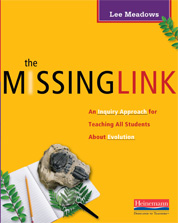
According to author Lee Meadows, (check out his blog here) the main goal of his evolution-education book is to get “resistant students [to] understand evolution, but they don’t necessarily have to accept it.” (xxi) His 2009 The Missing Link: An Inquiry Approach for
Teaching All Students about Evolution
promises to train teachers to seize the middle ground in the evolution culture wars.  It offers practical and specific ways to teach evolution to students who come from anti-evolution backgrounds.

Unlike other models, Meadows’ approach never waters down the science of evolution.  It does not attempt to teach “the controversy;” it does not teach a balance between creation and evolution; it does not teach evolution “lite.”  Instead, it teaches the science of evolution in a way that frankly recognizes student resistance to the notion.  It offers coping mechanisms for science teachers to deal with that resistance in a caring, thoughtful, respectful way.  It does not view that student resistance as a challenge to be crushed, but rather as a legitimate part of student identity.  For example, he speaks in helpful terms of “accommodation for resistant students.”  As Meadows argues, “Public schools must embrace diversity of all kinds, including students from all religious backgrounds.”  (xiii)  This tone shifts the
discussion from combat in classrooms to education.

The essence of Meadows’ strategy is nothing new to teachers.  He hopes to use an inquiry method to allow students to wrestle with difficult questions that might challenge their religious faiths.  By using student inquiry instead of teacher-led direct instruction, Meadows hopes to have science teachers avoid the charge of evolutionary indoctrination.
Students can gain an authentic understanding of central questions of evolution and science without feeling that such notions have been imposed by a hostile ‘secular humanist’ school.

In my view, that kind of inquiry learning is worth pursuing for its own sake, in all
classes.  When teachers, schools, and students can pull it off, it is a powerful and effective way to learn.  Of greater promise to the continuing controversies over evolution education, however, is Meadows’ sustained tone of caring for all students, regardless of their backgrounds.  It does not approach student creationist beliefs as a problem for science teachers to overcome.  Instead, it recognizes those beliefs as part of the young person for whom the teacher is charged to respect, care for, and educate.

This is not a philosophic tome, but a practical teaching guide.  It includes lesson plans and specific teaching strategies.  More important, perhaps, it is full of helpful reminders for eager
science teachers of how NOT to proceed.  It identifies the distinction between an evolutionary and supernatural worldview, for example, then warns:

You can’t resolve these tensions for your students, so please don’t try. It’s not our place as science teachers to impact students’ religious beliefs, even if we’re being “helpful.” That’ssomething that we must leave to their families and their spiritual leaders. (61)

Meadows’ approach will earn him some flak, inevitably, from both sides in the  creation/evolution debate.  Some mainstream scientists will undoubtedly protest that students should not be allowed to decide if they will accept evolution after they learn about it.  To many evolution-believers, that makes no more sense than asking students to decide if they believe in the Pythagorean Theorem.

From creationists, on the other hand, I can imagine Meadows will come under fire for teaching evolution as true, as fact.  And more, creationists might object that Meadows’ suggested methods simply sugarcoat evolution by pretending to care for creationists’ beliefs.  Better, some creationists might say, to honestly attack those creationist beliefs rather than to sneak in evolution education under false pretenses.  I can imagine creationists objecting that Meadows’ distinction between guaranteeing that students KNOW evolution but allowing them not to BELIEVE it is a false one.  It would never be suggested for other subjects.  For example, it is hard to imagine knowing that 2 + 2 = 4 without believing it.  And how could my child learn and know how to identify an indirect object without believing it?

It is a similar dilemma to those parents who object to explicit sex education in public school classrooms.  Since the first days of SIECUS in the 1960s, for instance, sex educators have insisted that they are not advocating sex.  Conservative parents, however, insist that merely by knowing how to use a condom, students have been hurt.  Those parents do not want their
children to know about condoms (or evolution) at all.  They vigorously dispute the notion that their children can learn something in school about such topics without that knowledge
causing fundamental harm.

I believe that these potential objections prove that Meadows is onto something.  When the more extreme elements on both sides attack, it suggests that Meadows is speaking to the great wide middle: Creationist parents who do not want their children attacked in schools;
creationist students who feel as if ‘school science’ is not for them; teachers who feel they can’t simultaneously care for their creationist students and teach those students something the students see as blasphemous; school administrators who need to reach out to parents and students while still encouraging evolution education in their science classes; and mainstream
scientists who want to see more authentic evolution education in American classrooms.

It is a tall order, but Meadows’ work promises something for everyone in this moderate middle.

For a taste of Meadows’ approach, you can read a chapter of his book at his publisher’s webpage.