Google Trends and Fundamentalist America

Fundamentalist America is aflutter.  One of Fundamentalism’s favorite sons made a big splash last week.

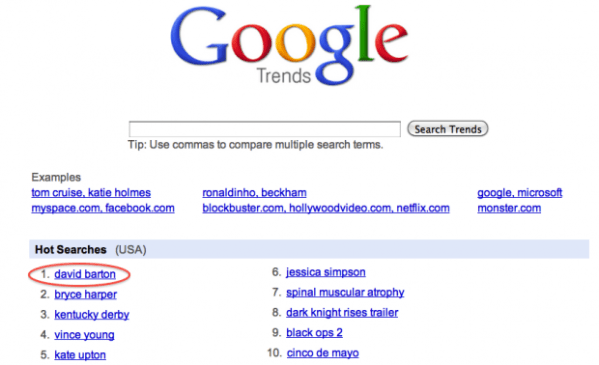
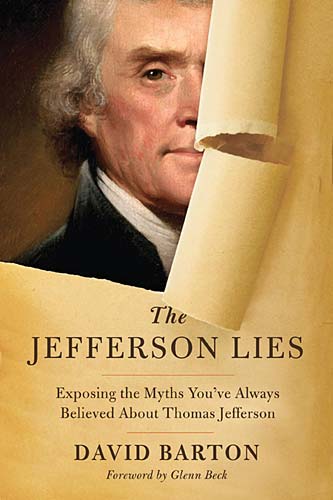
After David Barton’s appearance on Jon Stewart’s Daily Show to promote his new book The Jefferson Lies, the Beckite Blaze reported that the term “David Barton” had surged to number one on the list of trendy Google search terms.

When I followed up, I couldn’t confirm The Blaze‘s claim.  When I checked Google’s “Hot Searches” for May 2, 2012, Barton shows up as number nine.

The experience led to me tinker around a little bit with Google Trends.  Now, I know I need to apologize for my lateness at showing up to this party.  This is yet another example of the way I am far behind the times in finding out about the possibilities of the Google Mothership.

But I want to share a few of the interesting results for those outsiders interested in Fundamentalist America.  First, for those who are as backwards as I am, I’ll explain the premise a little bit.  Google Trends gives users a chance to find out how many people have Googled specific terms over time.  Today (May 5, 2012), many of the hottest search terms concern the recent death of Beastie Boy Adam Yauch.  In general, it seems as if the biggest topics in the daily news tend to attract the most Google searches.

But Google Trends also lets us see what people are googling over time.  If we want to understand what googling Americans are interested in, it gives us a chance to find out.  Now, I won’t make any claims that these results are definitive.  We can’t know very much about the intentions of googlers.  But there are still a few interesting results that I want to share, just to give everyone something to think about.

For example, I checked the trends for terms in tandem and got some interesting results.  For instance, “evolution” has trumped “creationism” by a long sight for the past several years.  On the other hand, comparing the google history of “Bible” and “Origin of Species” shows a huge tilt toward Bible googlers.    And, in the past few years at least, Jesus has almost always been comfortably bigger than the Beatles.  In fact, “Jesus” as a search term has held a comfortable lead over most other topics I could think of, including “David Barton,” “atheism,” and even “cats,” although “cats” seemed to hold its own pretty well.

What does all this tell us about Fundamentalist America?  Not much, really.  But it does demonstrate the enduring popularity of Christian terminology on Google.  Of course, people Google all sorts of different terms for all sorts of reasons.  Are there any other term comparisons that can tell us something about the nature and meaning of life in Fundamentalist America?

In the News: Tennessee Two-Step

Tennessee’s lawmakers recently passed a law that—according to supporters—will allow teachers to work with more academic freedom.  It will encourage students, supporters insist, to explore ideas beyond the surface.  Opponents argue that the new law is only a sneak-attack by creationists and intelligent designers.  The law speaks in the language of academic freedom, opponents say, only to mask its true creationist intent.

The law itself claims to want to “help students develop critical thinking skills.”  Since the teaching of “some scientific subjects, including, but not limited to, biological evolution, the chemical origins of life, global warming, and human cloning, can cause controversy,” the law asserts that Tennessee teachers need clarification and assistance in teaching such issues.  The law mandates that school districts allow and encourage teachers to teach such controversial issues.  The law states that “teachers shall be permitted to help students understand, analyze, critique, and review in an objective manner the scientific strengths and scientific weaknesses of existing scientific theories.”  Finally, the new law notes that this law “shall not be construed to promote any religious or non-religious doctrine.”

In presenting the issue as one of academic freedom, Tennessee lawmakers apparently hope to overcome constitutional objections that have overwhelmed other anti-evolution laws.  The inspiration seems to have come from the Discovery Institute, a think tank dedicated to promoting the teaching of intelligent design.  In 2007, the Discovery Institute offered a similar-sounding model Academic Freedom bill.

Tennessee is not the first state to enact such a law.  In 2008 Louisiana lawmakers passed a similar “academic freedom” law.  Even earlier, in 2001, then-Senator Rick Santorum inserted a non-binding note into the No Child Left Behind Act that recommended teaching a full range of ideas whenever “controversial issues” were taught.

The Tennessee law has attracted more than its share of journalistic attention because of the easy connection to the 1925 Scopes trial.  The editors of the New York Times, for example, began their objection to the Tennessee law by intoning, “Eighty-seven years after Tennessee was nationally embarrassed for criminally prosecuting the teaching of evolution, the state government is at it again.”

Nearly all the news coverage of the new law insists on connecting it to the famous 1925 trial.  Coverage in USA Today and the Huffington Post offer a sample of the way every journalist seems obliged to mention Scopes.

However, as perspicacious observers have noted, this new law represents something very different from the 1925 event.  Today’s laws demonstrate a remarkable shift in the strategy and nature of anti-evolution activism.  As Charles Haynes of the First Amendment Center pointed out, today “the curriculum shoe is on the other foot.”

Haynes is right.  The power in public schools has shifted decisively.  Anti-evolution activists today do not try to ban evolution from public schools.  Rather, anti-evolutionists these days struggle to insert wedges into school curricula.  They hope to create opportunities for teachers and students to question the scientific claims of evolution.  At the time of the Scopes trial in 1925, anti-evolutionists had a much different agenda.

In my book Fundamentalism and Education in the Scopes Era, (coming soon in paperback edition, pre-order today!), I explore the ways so-called “anti-evolution” laws in the 1920s included much more than simply the teaching of evolution or creation.  The laws themselves, including Tennessee’s 1925 Butler Act, usually preserved a special role for Protestant theology in public schools.  Other bills considered “anti-evolution” made much more sweeping claims.  In 1924, Representative John W. Summers of Washington successfully inserted an amendment banning “disrespect of the Holy Bible” among Washington D.C. teachers.  In a similar vein, one so-called anti-evolution bill in North Carolina (1927) actually would have banned any teaching that would “contradict the fundamental truth of the Holy Bible.”  A proposed bill in West Virginia cut an even broader swath.  That bill would have banned the teaching of “any nefarious matter in our public schools.”  In Florida, a 1927 bill hoped to prohibit teaching and textbooks that promoted “any theory that denies the existence of God, that denies the divine creation of man, or that teaches atheism or infidelity, or that contains vulgar, obscene, or indecent matter.”

These bills were about more than just prohibiting evolution. They asserted ideological and theological control over public schools.  Public schools, in the vision of these bill’s supporters, ought to do more than just ban evolution.  They ought to be purged of any notion that might challenge the traditional evangelical morality of students.
Today’s laws are also about more than the teaching of evolution, but in a very different way.  Rick Santorum’s non-binding rider to NCLB was more about making a statement about the nature of science, culture, and education than about transforming education.  It didn’t and couldn’t actually change the way teaching happened.  Some observers have suggested that Tennessee’s law will also not change a thing.

But such laws do change something.  For one thing, laws like the ones in Tennessee and Louisiana demonstrate the political power of anti-evolutionism.  These laws show that significant numbers of voters in those states agree with this kind of cultural statement against the claims of mainstream science.  Laws like these also tell us something about the ways schooling is controlled.  If mainstream scientists cannot simply decide what will be the best sort of science education, then we can see that schooling is not simply a neutral institution in which knowledge is disseminated.  Rather, laws like this show clearly that knowledge is political.  Schools do not simply teach what is true.  Schools teach what culture decides children should know.

Science and “The Question”

In a recent scathing review of Lawrence Krauss’ A Universe from Nothing, science writer John Horgan argues that science will never answer “The Question.”  That is, Horgan thinks that science–the way we usually understand science–will not be able to explain why there is something rather than nothing.

For those following the creation/evolution debates, “the Question” has long been a central bone of contention between creationists and evolutionists.  Creationists have always rested their arguments on the notion that science could not explain the fundamental creation of life ex nihilo.

As Horgan insists, one does not have to be a fundamentalist anti-evolutionist to doubt the ability of science to answer such fundamental questions.  In fact, Horgan concludes his review by warning scientists that they must not overextend.  If mainstream scientists claim to be able to answer “The Question,” Horgan warns, “they become the mirror images of the religious fundamentalists they despise.”

I imagine many of those fundamentalists will take solace from the fact that prominent scientists dispute Krauss’ ex nihilo argument.  There is a vibrant tradition among anti-evolutionists of following evolution debates among scientists.  Anti-evolution writers and activists have always used such debates to demonstrate to their audiences that scientists do not agree on the science of evolution.  As Ronald L. Numbers demonstrated in Darwin Comes to America and The Creationists, anti-evolutionists have long celebrated disagreements among mainstream scientists.  My hunch is that some pundits from Fundamentalist America will cite anti-Krauss arguments as evidence that science will never be able to answer “The Question.”

Lee Meadows and “Sensitive” Evolution

ILYBYGTH friend Lee Meadows, author of Missing Link: An Inquiry Approach for Teaching All Students about Evolution, has posted a great new short video: “Help!  I’m a biology teacher and I don’t really understand evolution.”

I know some ILYBYGTH readers disagree with Meadows’ approach to teaching evolution.  Some anti-evolutionists feel he goes too far in sugar coating a dangerous doctrine.  As an evolutionist myself, I appreciate his student-centered approach to the subject.  He argues that too many evolution educators–out of ignorance or spite–take a hostile approach to their anti-evolution students.  Meadows argues that they don’t need to.  Not only is it unethical, it is ineffective.

Whether you’re a creationist or evolutionist, it’s worth taking a few minutes to check out his thoughtful video.

In the News: A Fundamentalist Epistemology?

The New York Times yesterday ran some excerpts from a discussion on its philosophy series, The Stone.

ILYBYGTH readers should check out the exchange, since it is one of the few recent forums in which the issue of creation/evolution is given a respectful, intelligent back-and-forth.  It also centers on the notions of a Biblical understanding of knowledge.

In this dialogue, philosopher Michael P. Lynch and physicist Alan Sokal discuss the reasons why there has been no simple cut-and-dried solution to the creation/evolution debates.  In this snippet, Lynch insists–correctly in my opinion–that the issue is not really the science of evolution, but rather the source of epistemic first principles.  That is, how do we come to know something?  Fundamentalists will insist that the first source of knowledge must be Holy Scripture.  If we “know” something that contradicts the Bible, we can’t really “know” it, any more than we can “know” that a dog is a cat.  The reason for the evolution/creation “stalemate,” Lynch argues, is that the arguments have simply circled round and round one another, each arguing convincingly from its own perspective.

In response, Sokal offers what seems to me to be a very concise and cogent explanation of the non-fundamentalist position.  Fundamentalists, he argues, DO share the epistemic principles of non-fundamentalists, except for a few irrationally privileged categories.  Here’s a snippet from Sokal:

The trouble is not that fundamentalist Christians reject our core epistemic principles; on the contrary, they accept them. The trouble is that they supplement the ordinary epistemic principles that we all adopt in everyday life — the ones that we would use, for instance, when serving on jury duty — with additional principles like “This particular book always tells the infallible truth.”

But then we have a right to inquire about the compatibility of this special epistemic principle with the other, general, epistemic principles that they and we share. Why this particular book? Especially, why this particular book in view of the overwhelming evidence collected by scholars (employing the general epistemic principles that we all share) that it was written many decades after the events it purports to describe, by people who not only were not eyewitnesses but who also lived in a different country and spoke a different language, who recorded stories that had been told and retold many times orally, and so on. Indeed, how can one possibly consider this particular book to be infallible, given the many internal contradictions within it?

Lynch responds with a defense that might hearten intellectual fundamentalists.  Here is just a small selection:

The second reason we can’t rest content with the fact that some principles are widely shared is that some debates are over the priority of principles. Some people reject the idea that scientific reasoning should always trump more traditional methods of knowledge. Thus, believers in creationism typically don’t deny induction and abduction (coming up with the best explanation of the data) full stop. Rather they deny that these principles have priority everywhere. Imagine, for example, a dispute over these two principles:

(A) Abduction from the fossil and physical record is the only method for knowing about the distant past.

(H) Consultation of the holy book is the best method for knowing about the distant past.

The friends of (H) aren’t rejecting abduction outright: they are merely asserting that in some situations abduction is trumped by the more fundamental principle (H). So we can’t just call them out for using abduction in some cases and not in others. And obviously, we can’t travel back in time and use observation (another commonly shared method) to settle who is right and who isn’t about the distant past. What that shows is that debates over even very specific principles like these can end up grounding out — either the participants will end up defending their favored principles by appealing to those very principles (citing the book to defend the book) or appealing to other specific principles that the other side shares but gives a lower priority. So shared “natural instincts” and methods can’t always win the day, simply because the problem isn’t always about what is in common. The problem is about what trumps what.

The root cause of the discussion is whether or not there is a distinctive fundamentalist epistemology.  Lynch defends the notion (without embracing or defending the claims of that epistemology), while Sokal dismisses it.  In other words, is the fundamentalist, Bible-centric understanding of human knowledge a legitimately different way of knowing about humanity and the universe?  Or is it simply an overly complicated apologetic?  That is, do fundamentalists merely claim to have a different way of knowing when it suits their theological needs?


REQUIRED READING: The Long March against Evolution

Michael Lienesch, In the Beginning: Fundamentalism, the Scopes Trial, and the Making of the Antievolution Movement (University of North Carolina Press, 2007).

Want to make a mainstream scientist apoplectic?  Remind him or her that about half of American adults agree with the notion that the earth was created in six literal days, at some point in the past 10,000 years or so.  This idea is so utterly at odds with mainstream scientific understanding that it remains beyond the understanding of most of the other half of American adults.

Readers of ILYBYGTH will likely agree that these notions go beyond any narrow definition of scientific thinking.  In order to understand the durable cultural divide between evolutionists and creationists, we need to understand both evolution and creation as much more than mere scientific ideas.

I recently had the pleasure to review a book that furthers this understanding.  The review described its merits for an audience of educational historians, but Michael Lienesch’s In the Beginning should be required reading for anyone interested in the nature of the creation/evolution struggle.  A political scientist, Lienesch uses social-movement theory to make sense of the ways creationism has thrived in an intellectually hostile environment.

Fundamentalists might hope that creationism’s success is due to its God-given truth.  Evolutionists might insist, on the contrary, that creationism has thrived in the same way as have meth labs and Twinkies—Americans love dumb things that are bad for them.

Lienesch’s analysis presents a calmer and more sensible answer.  Creationism is more than just a scientific idea, more than just a theology.  It is a social movement, with all the attendant complexity.  As such, the social-science literature on social movements can go a long way toward making sense of the twentieth-century career of creationism.

Lienesch remains agnostic on the question of ultimate truth.  He is not much interested in the truth claims of either evolution or creation.  Rather, he explores the ways creationism—and I’m afraid it is the best word here—has evolved across the course of the twentieth century.

IN THE NEWS: A SOCIALIST JESUS AND A NEW EDUCATIONAL REALITY FOR NEW HAMPSHIRE

–Thanks to LC

Live Free or Die!  So every New Hampshire license plate proclaims, and a new law in the Granite State looks like it will move New Hampshire residents one step closer to making that decision.

A controversy arose in December, 2010, when two New Hampshire parents pulled their son out of his Bedford High School.  Their complaint was that the boy had been assigned Barbara Ehrenreich’s Nickel and Dimed in a personal finance class.  The parents complained that the book called Jesus Christ “a wine-guzzling vagrant and precocious socialist.”

I haven’t read the book, but for many people, them’s fightin words.  Predictably, the controversy drew national attention.  Glenn Beck’s website agreed with the New Hampshire parent that the school district made a terrible curricular decision.  The Huffington Post, not surprisingly, ran an article much more favorable to the school district and to Ehrenreich.

There’s not much in the story, in fact, that should raise eyebrows among ILYBYGTH readers.  As we are well aware, parents often complain about the curricular materials assigned in schools.  Conservative pundits encourage careful scrutiny of reading materials they suspect of anti-religious, anti-patriotic, anti-capitalist materials.

The best publicized case of this nature in the past generation was arguably Mozert v. Hawkins County [Tennessee] Board of Education.  In this case from the mid-1980s, conservative Christian parents objected to the content of their county’s reading series by the textbook publishers Holt, Rinehart and Winston.  The parents tried to convince a series of courts that the series promoted a vicious religious system, one they called “secular humanism.”  In addition, the parents claimed the books promoted a grab-bag of pernicious notions, such as witchcraft, extra-sensory perception, pacifism, and non-traditional gender roles.

There is nothing unusual about conservative parents objecting to the curricular materials their children use in schools.  What makes the Bedford, NH case so extraordinary is that it has led to a remarkable new state law.  Thanks to the publicity from the controversy, the New Hampshire state legislature passed House Bill 542, then recently overrode Governor Lynch’s veto.

According to the new law, in effect as of the recent veto override, parents may demand alternative course materials to any material they find “objectionable.”  The parent or guardian must pay for the new alternative materials, but the school district must locate them.  The parents may also remain anonymous and they do not have to reveal their reasons for objecting to the material in question.

This is new.  This is remarkable.  I have spent a good deal of my professional time in the past few years researching the history of conservative educational activism.  Across the course of the twentieth century, conservatives have had remarkable success in keeping America’s schools traditional.  They have challenged “progressive” pedagogy, the teaching of evolution, the restriction of traditional Protestant religion from public schools, and the removal of traditional patriotic themes from public schools.

Throughout all that time, however, even in the 1920s heyday of anti-evolution state legislation, there has not been to my knowledge a state law that allows parents to object to any material they may find offensive for any reason.  Parents have not had the nearly unlimited right expressed in this new New Hampshire law to demand alternative curricular materials without explanation or justification.

When Governor John Lynch vetoed this bill in July, 2011, he noted that the bill would be “disruptive” and that it would be “difficult for school districts to administer.”  More compelling, Governor Lynch decried the bill’s tendency to push “teachers to go to the lowest common denominator in selecting material, in order to avoid ‘objections’ and the disruption it may cause their classrooms.”

What effect will this remarkable new law have in New Hampshire?  My guess is: not much.  The new law will generally fall into the very wide category of laws that are on the books but unknown and unenforced.  That, after all, was the fate of the anti-evolution laws from the 1920s, until the US Supreme Court ruled them unconstitutional in the late 1960s.  However, like the case of anti-evolution laws, even in states that did not have such laws, a large percentage of parents and teachers will be influenced by anti-evolution public sentiment.  One large survey of evolution education in 1942 found that eight percent of biology teachers thought evolution education was illegal in their states, even when they taught in states that had not passed such a ban.

In short, this law will not change behavior too drastically.  But that is NOT because teachers and school districts will continue to teach controversial material.  Rather, the law itself will not change behavior since so many teachers and school districts are already bowed down by the weight of perceived public opinion.


From the Archives: Ralph Spitzer, TD Lysenko, and the Left-Wing Attack on Science

In any culture-war debate these days, we can count on a few predictable ideological combinations.  The conservative/traditional/Right side will fight for freer markets, smaller government, more patriotism, more traditional social mores, and greater public Christianity.  The progressive/liberal/Left side will fight for greater egalitarianism, more robust government, and multiculturalism.

One of the other relatively consistent ideological markers these days seems to be an attitude toward science.  Conservatives, whether they like it or not, are now the side of anti-science.  Whether it is evolution or human-caused climate change, the Right is now the side that is skeptical of the claims of mainstream science.  Of course, as with any issue in this culture-war minefield, we need to be careful to note that this does not mean that these culture warriors are necessarily against science as such.  Rather, many conservatives will adopt an attitude of profound skepticism toward the directions in which mainstream research-university-based science research has gone.  REAL science, they might insist, will confirm their claims.  But ‘science falsely so called,’ in the minds of many cultural conservatives, has come to dominate the academy and academic press.  They are not anti-science, these conservatives might insist, only anti-false science. To the person on the street, though, it is easy to conclude that the Right is the side that always opposes science.

During a recent stint with some 1940s newspapers, I came across a story that complicates those comfortable assumptions.  Ralph Spitzer’s story is a good reminder of the reasons why we need to keep these storylines complicated.  It points out the danger of assuming any necessary relationship between science and politics.  Spitzer was fired from his teaching job at Oregon State College (now Oregon State University) in 1949 for his political beliefs.  At the time, he joined a swelling number of higher-education faculty who had lost their jobs for affiliation with Communist- or purportedly “Communist-front” organizations.

But unlike Joseph Butterworth, Herbert J. Phillips, and Ralph H. Gundlach, all fired from the University of Washington for their Communist Party membership or sympathy, Spitzer was also fired for his opposition to mainstream science.

Oregon State President August Strand accused Spitzer of betraying not only America, but also science.  Strand alleged that Spitzer’s public comments in favor of the prominent Soviet scientist TD Lysenko pushed Spitzer outside the range of legitimate scientific discussion.  By endorsing Lysenko, Strand accused, Spitzer had denounced the mainstream science of genetics and natural selection.  Thus, Spitzer was fired not only for being a communist sympathizer, but for being a sympathizer of communist anti-science.

Historian David Joravsky has argued that the popular understanding of Lysenko’s argument has become something of a durable myth.  Most people remember Lysenko’s scientific regime, if they remember it at all, as an ideological attack on genetics.  According to Joravsky, some have remembered Lysenkoism as an attack on the capitalist assumptions of genetics.  This myth presents Lysenko as a totalitarian ideologue, refusing to acknowledge the truth of genetics, due to mental blocks derived from Stalinism.  Humans, according to the Lysenko myth, must remain malleable in nature.  They must be able to form themselves into new beings, pushing a neo-Lamarckian understanding of human heredity to the fore.  In other words, according this Lysenko myth, humans must not have heritable DNA, since we know from Marxism/Leninism/Stalinism that humans can be recreated by new conditions.  Changes made in one lifetime can be passed on to future generations.

According to Joravsky, the truth of the Lysenko affair was far less ideological.  In Joravsky’s reading, the real thing was not theoretical or even political, except in the grubbiest of senses.  “Not only genetics but all the sciences that impinge on agriculture were tyrannically abused by quacks and time-servers for about thirty-five years,” Joravsky argued.   This was not done out of an ideological demand that humans be understood to be perfectable, but only because of a “self-deceiving arrogance among political bosses.”  The whole thing was mainly “brutal irrationality in the campaign for improved farming.”

In 1948, the Soviet scientific establishment, after long years of back and forth debate between anti-Mendelian Lysenkoists and modern geneticists, finally prohibited the science of genetics altogether.  This was the decision that Spitzer lamely defended.

Before we look at Spitzer’s defense, however, we need to take a closer look at the Lysenkoist vision of science.  What did Lysenko himself say?

Lysenko in 1935 gained control over the new science of agrobiology.  He engaged in a series of big new programs.  Each suggested a quick agricultural fix, such as a way to plant wheat in cold and arid areas, or to grow potatoes in warmer climes.  Instead of becoming implicated in the inevitable failure of these panaceas, Lysenko moved on in each case to identify himself with a new type of problem and quick solution.  Those who demurred from his over-optimistic and unscientific solutions were in danger of being labeled “wreckers” for their anti-Soviet pessimism.

By 1945, Lysenko insisted that plants such as oaks would thin themselves.  Out of community feeling, Lysenko argued, the weakest would kill themselves.   Thus, no thinning by hand was required.  This notion effectively repudiated the modern notion of natural selection.  It embraced a thoroughly unmodern notion that organisms would pass along inherited attributes, a notion usually referred to as “Lamarckism.”  In this case, Lysenko and his disciples argued, in effect, that the inherited characteristics of plants and animals could be radically changed by changes in their environment.  Most famously, Lysenkoites insisted that rye could grow on wheat plants, given the right environment.  This could, Lysenko’s disciples insisted, instantly increase agricultural yields in cold, dry climates.  Furthermore, Lysenkoite science insisted that the fellow-feeling among oak trees allowed for a massive planting policy.  Peasants could scatter acorns and let the resulting clusters of oak trees thin themselves.  With very little cost, this policy would lead to a massive forestation of the Russian steppe, turning its dry cold climate into a moist, warm one.  Such grandiose promises made modern scientists nervous.  They did not see the evidence on which these claims were based, because in Lysenkoist science no such evidence was required.

Lysenko’s Soviet approach to science was not the idiosyncratic tyranny that some have taken it for.  It grew out of a long Russian tradition of skepticism toward European culture in general.  Like the nineteenth-century Panslavists, some Russian chauvinists, before and after the 1917 Revolution, insisted that Western culture, including Western science, did not fit the Russian or Soviet world.

For example, before the Revolution, soil scientist SK Bogushevski denounced western methods of science as inapplicable to Russia.  As with American creationists, this kind of Russian anti-science did not generally denounce the idea of science.  Rather, as with the “anti-scientists” in twentieth-century American conservative circles, Russian and Soviet anti-scientists denounced mainstream science as misguided.

For example, in the early Soviet era, President Kalinin of the Agricultural Institute told his faculty, “There must be barbarism so that, from this soil, democratic, simple science can emerge.”  Similarly, in an early telegram to Lenin, Stalin articulated a vision of an alternate, superior version of science.  Stalin had insisted the Navy attack a fortress.  Naval experts pooh-poohed the plan.  But it worked.  And after it worked, Stalin wrote, “The naval specialists declare that taking [the fortress] by sea subverts naval science.  All I can do is bemoan so-called science.”  This kind of attitude toward science—that the nominal scientific experts really did not know what they were doing—sounds very similar to the kind of science promoted by Biblical creationists in twentieth-century America.  Of course, the preferred model of science was different for American creationists than it was for Stalinist Lysenkoists.  For Biblical creationists, real science derives from Scripture.  For Soviet or Russian ideologues, real science derives from chauvinist Russian or Soviet ideology.  Having pure, correct science, in this view, did not mean deriving it from religious sources, but rather from indigenous Russian peasant wisdom.

Throughout his career, Lysenko called his version of science “Michurinism.”  Michurin had been an agricultural outsider, a fruit-tree breeder with distinctly original and anti-scientific ideas about science and agriculture.  His popularity resulted largely from his aggressive style.  In 1930 a Bolshevik literary magazine (October) promoted Michurin as a “people’s” scientist: the editors declared the needed goal to “Michurinize” the country:

to knock out sleepiness with punches, with demands, with insistence, with daring.  With daring to master and transform the earth, nature, fruit.  Is it not daring to drive the grape into the tundra!  Drive!  Drive!  Drive! Into the furrows, into the gardens, into the orchards, into the machines of jelly factories. . . .  Faster and faster, . . . faster comrade agronomists!

Clearly, this isn’t much of a scientific argument.  Nevertheless, it WAS a powerful cultural argument about science and the nature of science.  Outside of scientific circles, and outside of the Soviet Union’s sphere of influence, this departure from mainstream science did not win a lot of support.  But it did convince one cultural A-lister.  In 1951, Bertholt Brecht composed a long, remarkable poem in celebration of Lysenko’s anti-science.  (Thanks to Robert C. Conrad and Ralph Ley who translated it into English in Autumn, 1976 issue of New German Critique, pp. 142-152).          “The Rearing of Millet” lionized Lysenkoite science as the true Soviet science.  It made heroes of peasants in their pre-scientific “hut labs,” exploring ways to leapfrog over Western agricultural science with Soviet zeal and Stakhanovite exertion.  A few stanzas will suffice to convey the poem’s flavor:

It was ten times that of previous years.

All winter, huddled around the oven’s fire

They praised in the village Berziyev’s millet seed.

But the old man thought only of an even better kind.

Dream the golden if!                                        

See the beautiful sea of millet rise!

Sower, know

That they are already one: tomorrow’s deed and today’s surmise!

…. So let us always with newer skills

Change this earth’s effect and form

Happily measuring thousand-year-old wisdom

With the new wisdom one year old.

Dream the golden if!

See the beautiful sea of millet rise!

Sower, know

That they are one: tomorrow’s deed and today’s surmise!

Clearly, for Brecht as for much of the Soviet scientific establishment, something was going on beyond the boundaries of modern scientific endeavor.  A portion of Soviet scientists embraced “Michurinism” as science, not for scientific reasons, but for either pragmatic political considerations or excessive ideological zeal.  They dreamed that they could overthrow accepted scientific “wisdom/ With the new wisdom one year old.”

To be fair, these reasons did not get far outside of the zone of Soviet influence.  Not even Ralph Spitzer supported this kind of Soviet science.  Nor did Spitzer actually denounce modern genetics or the idea of natural selection.  Spitzer was not a geneticist or an agronomist.  Rather, he was a chemist, and his damning support for Lysenkoism came in a letter he wrote to Chemical and Engineering News.  In his letter, Spitzer took issue with an article that had dismissed Lysenko’s claims to superior science.  Spitzer contended that the Soviet Union’s Party control over science did not differ in essential ways from the financial control of basic research in the capitalist world.  In both systems, Spitzer argued, only that research could be conducted that won the support of influential higher-ups in the establishment.

In addition to Spitzer’s and Spitzer’s wife activism in favor of Progressive Party candidate Henry Wallace, this moderate level of support for Lysenko was enough for President Strand.  “I do not deny the right under the law to work for the Communist Party,” Strand conceded in a public statement after the firing, “but I do claim that the administration of the college has the right to terminate an annual contract.  We do not care to have Dr. Spitzer as a permanent part of the staff!”

For Strand, the issue was not one of science vs. anti-science, but rather Americanism vs. Communism.  Spitzer’s sin was not that he clung to an alternative notion of science, but rather that he defended the legitimacy of the Soviet method of funding science.

Beyond the sad result for Spitzer’s career, this brush with Lysenkoism in the American academy should be of interest to everyone interested in America’s creation/evolution debate.  There are at least four notable parallels between Soviet and American anti-science.

First of all, the crux of the Lysenko Affair, according to David Joravsky, was that between roughly 1935 and 1965, Soviet scientists could not safely dispute the scientific truth of the official ideological line.  Thus, Stalin’s nod of support in favor of Michurinism meant that all Soviet scientists who wanted to continue working had to at least offer lip service to the scientific truths of Lysenko’s ideas.

The outrage to mainstream scientists, in the cases of both Lysenkoism and American Biblical creationism, is that a political or religious source is given primacy over scientific discoveries.  For American creationists, the Bible lays down the orthodox line.  Whatever does not agree with it must not be scientifically true.  For Soviet scientists, especially in the high period of Lysenkoite influence between 1948 and 1952, whatever disagreed with Lysenko could not be officially recognized as scientifically legitimate.

Another intriguing similarity is the use of scientific-sounding language to buttress claims of scientific legitimacy by both Lysenko and Biblical creationists.  Lysenko famously used language that Soviet scientists found maddeningly vague.  He refused to offer scientifically valid evidence for his claims.  In its place, he dished out rhetorical gems such as the following:

The work of the Institute of Plant Breeding and Genetics (Odessa) is based precisely on the established facts of such an absolutely definite sequentiality of the connection of the development of the hereditary base in stages, and of the latter in organs and characters. . . .

These solitary bottlenecks will be overcome in the process of segregation of the heterozygote by means of a mutual replacement of the bad index of one form by the analogous good index of the second, and conversely.

Non-scientists can be forgiven for finding these kinds of sentences meaningless.  However, trained scientists also found them to be nothing but fluff.  Critics of American Biblical creationism make the same charge against the science-like rhetoric of prominent creationists.  In a recent article defending the notion that complex organs imply intelligent design, Jerry Bergman employed some scientific-sounding rhetoric:

Likewise, the left RLN has a different anatomical trajectory than one would first expect, and for very good reasons.  In contrast to [paleontologist Donald] Prothero’s claim, the vagus nerve (the longest of the cranial nerves) travels from the neck down toward the heart, and then the recurrent laryngeal nerve branches off from the vagus just below the aorta (the largest artery in the body, originating from the left ventricle of the heart and extending down the abdomen). The RLN travels upward to serve several organs, some near where it branches off of the vagus nerve, and then travels back up to the larynx.

I’m not commenting here on the validity of Bergman’s claims.  But I do want to point out that modern American Biblical creationists value this kind of tone, a clinical authorial voice that implies a thorough mastery of the latest in mainstream science.  Whenever mainstream scientists examine the scientific validity of such claims, however, they invariably conclude that there is no real science behind them.

Third, both Lysenko and American creationists tend at times to belittle the academic nature of mainstream science.  Lysenko argued that mainstream science did not care enough about practical results.  Such scientists, Lysenko insisted, waited too long to produce their findings.  They waited for experimental results while Soviet peasants starved.  “It is better to know less,” Lysenko famously quipped, “but to know just what is necessary for practice.”  Similarly, American creationists have tended toward a deep skepticism toward mainstream science.  In spite of what some critics have assumed, creationists have usually not presented themselves as opponents of science as a whole.  Rather, American creationists have tended to argue that mainstream scientists been led down an unscientific path.  Like Lysenko, American creationists have offered their science as superior to the kinds of immoral and impractical science coming of major research universities.

Finally, one important parallel between Lysenkoism and American Biblical creationism has been the effect of each on teaching.  Those interested in American creationism will not be surprised to hear that high-school textbooks in America have tended to downplay the importance of evolution.  For example, Ella T. Smith’s 1938 edition of Exploring Biology (Harcourt, Brace) informed readers that “Evolution is a fact.  Plants and animals do change and have been changing.” In this edition, she told readers that for humans, too, “The fossil evidence is conclusive that man himself did not appear suddenly on the earth in his present form, but has gradually developed from a much more primitive species.”  The results of political pressure on publishers can be seen in the next editions of Smith’s book.  In the 1954 edition of this book, Smith backed away from her calm assertion about the facticity of evolution.  She told readers that evidence “leads scientists to the conclusion that the plants and animals of today are the changed descendants of the plants and animals of the past.”  There was another word to describe that change, Smith included, “That word is evolution.”  But Smith tended to use the word “change” instead.  When she described “the modern point of view,” for instance, Smith gave a bland description of evolution: “Biologists agree today that plants and animals have changed in the past, and continue to change.”  Even that vague reference to evolution did not satisfy the powerful critics.  By the 1959 edition, long references to “evolution” in the indexes of earlier editions had been cut down to one line.  Smith’s 1959 edition informed readers only that “The history of living things is a long one.  Much of it is still unknown.”  A ten-page section on the history of evolutionary theory was eliminated entirely, and in its place Smith offered a brief suggestion that students do a report on evolutionary theorists such as Darwin, Alfred Russel Wallace, Lamarck, or Hugo De Vries.

A similar progression marked the development of high-school textbooks in the Soviet Union.  One prominent textbook, Osnovy Darvinizma, by MI Melnikov, removed all mention of chromosomes and genes from its 1941 edition, though Melnikov had been an ardent supporter of the science of genetics before then.  According to David Joravsky, secondary science education in the Lysenko era became “a mixture of natural history, old-fashioned Darwinism, and meaningless chatter about Michurinism.”  As the political strength of Lysenkoism increased, so did the proportion of textbook content devoted solely to Lysenkoist ideas.  It was only in 1966 after Lysenko had been deposed that secondary-school textbooks in the Soviet Union again included any measure of modern science.

Certainly, there remain enormous differences between the Lysenkoist critique of mainstream science and the creationist one.  For evolutionists and mainstream scientists, however, it is important to note that attacks on the legitimacy of their work can come from many different directions.  Ralph Spitzer’s academic leftism demonstrated just as much contempt for the impartiality of mainstream science as would the right-wing critique of science by any creationist.

For creationists, it must be of significant interest that the mainstream scientific establishment can be threatened so significantly by political regimes.  The ability of Lysenko to promote his vision of proper science for decades, despite the vociferous objection of the mainstream scientific establishment, must offer an intriguing glimpse into the possibilities of alternative science.

FURTHER READING: “Lysenko Theory Sets off West Coast Imbroglio,” Harvard Crimson, May 25, 1949; Tom Bennett, “The Spitzer Affair: President Strand and the Communist Threat,” The Oregon Stater (February, 1997): 21-25; “College Ousts Professor Over Theory,” Pasadena Star News, February 24, 1949, pg. 2; David Joravsky, The Lysenko Affair (Harvard University Press, 1970); Valerii Soifer, Lysenko and the Tragedy of Soviet Science (Rutgers University Press, 1994); Loren Graham, Science and the Soviet Social Order (Cambridge: Harvard University Press, 2002); Jerry Bergman, “Recurrent Laryngeal Nerve Is Not Evidence of Poor Design,” Acts & Facts 39 (2010): 12-14.



In the News: Conservatism a Category of “Diversity” at Iowa Law School?

This just in: Now being a “conservative” is a legally actionable category.  A story in yesterday’s New York Times tells the tale of conservative activist Teresa R. Wagner.  Wagner had applied for a job at the University of Iowa College of Law in 2006.  She was not hired, and recently she won the right to sue from the Eighth Circuit US Court of Appeals in St. Louis.  She hasn’t won anything yet, but the circuit court ruled that she had shown enough evidence that the decision not to hire Wagner was due to unconstitutional discrimination against Wagner’s political beliefs.

Apparently, the smoking gun here was a statement in 2007 by the school’s Associate Dean Jonathan C. Carlson.  Carlson said Wagner ought not be hired since most people at the school “despise her politics (and especially her activism about it).”

Wagner doesn’t dispute her fierce partisan politics. She has worked for the National Right to Life Commitee and the Family Research Council.

One thing that makes this looming lawsuit so interesting to all those interested in the culture wars is that the notion of conservatives as a special kind of persecuted minority has become such a large piece of the jigsaw puzzle of cultural conservatism.  As we have noted on other posts, creationists have complained about this prejudice for years.  Jerry Bergman, for instance, insisted that he was refused tenure at Bowling Green State University due to his religious beliefs.  Clifford Burdick was refused his doctoral degree at the University of Arizona.  He and his supporters have argued that he was only denied due to his religious beliefs.

Of course, these are very different cases.  Some mainstream scientists will find it perfectly appropriate to refuse tenure or a doctorate in science to someone who dissents from one of the basic premises of mainstream science.  At a law school, however, faculty can agree on basic principles, while holding different political ideologies.  In other words, it is not as if Teresa Wagner disputes the existence of the Constitution.

In any case, students of the culture wars will be watching the progression of this case carefully.  Even if the legal issues in play don’t technically mean much for other sorts of conservatives, a legal decision that conservatism should be considered a category of ‘cultural diversity’ will doubtlessly be used as a weapon in upcoming culture-war skirmishes.


TRADITIONALIST EDUCATION IIa: The Cult of Multiculturalism (cont.)

In an earlier post, we argued that the dominant ideology of public schooling speaks in the language of inclusion and tolerance, but it therefore must exclude and suppress any traditionalist notions of a single transcendent truth.  Fundamentalists have complained long and loud that such unacknowledged discrimination is at the heart of contemporary education.  They have appropriated the language of the twentieth-century civil rights revolution to appeal for their own rights as an aggrieved minority.

For instance, in 1984 the pro-evolution American Association for the Advancement of Science invited prominent creationist Duane Gish to a meeting between creationists and evolutionists.  When he arrived, Gish complained that he had not been afforded the equal treatment he had been promised.  The conveners of the “confrontation,” Gish claimed, had disingenuously told Gish that they had not had time to invite more creationists, but they had found time, he noted, to include more evolutionists.  Such unfair treatment, Gish complained, allowed biased evolutionists “to do what is done every day in practically every university in the United States.”  The evolutionists could dominate the proceedings and relegate the science of creationism to the role of the unwelcome outsider.  Gish protested against such unfair treatment by concluding, “I will proceed to take one of the two seats on the back of the bus reserved for the creationists in this meeting.”

Like other beleaguered minority groups, Gish implied, fundamentalists could not get a fair hearing in mainstream academic culture.  Other fundamentalist authors agreed.  Jerry Bergman, for example, complained that he had been refused tenure at Bowling Green State University merely because he held fundamentalist views.  He admitted that he had spoken with students about his beliefs, but not as part of his instruction.  He had talked with students about it, but to refuse him tenure for that reason, Bergman argued, was as if a “black were fired on the suspicion that he had ‘talked to students about being black,’ or a woman being fired for having ‘talked to students about women’s issues.’”  Those who might be expected to come to Bergman’s defense, he complained, such as the American Civil Liberties Union, did not, since “many members are intolerant, narrow-minded, anti-religious bigots.”  In Bergman’s opinion, “Not since Nazi Germany turned on the Jews has such widespread intolerance existed in a modern, ‘advanced,’ educated nation.”

Other examples of discrimination against fundamentalists and especially creationists in America’s pluralist schools have become legendary in fundamentalist circles.  One of the most well-worn sagas of intolerance in American higher ed among fundamentalists is the story of Clifford Burdick.  Burdick attracted attention among both creationists and evolutionists for two of his most controversial claims.  First, Burdick insisted that he had found evidence of pollen in layers of core samples that, according to an evolutionary interpretation, ought to have been laid down before any such pollen had evolved.  Second, Burdick found what he claimed were human footprints in rock layers that also included dinosaur fossils.

More relevant, though, Burdick and his supporters insist that he had been denied his PhD from the University of Arizona because of Burdick’s religious beliefs.   Burdick completed all his work for the degree, but one of his professors adamantly refused to grant a fair hearing.  The only reason for this hostility, Burdick claimed, was because that professor had found out that Burdick was a committed creationist.

Of course, the professors had a different explanation.  They found Burdick’s scientific work sloppy and incompetent.  More damning, Burdick—as he himself later admitted—could not answer many of the questions posed during his oral examination.  Even some relatively sympathetic creationists considered Burdick to be more of an intellectual liability than a persecuted martyr.

But COULD such discrimination play a role in the millions of minor decisions Americans make about one another every day?  Could fundamentalists fairly complain—even if stories like that of Clifford Burdick don’t hold water—that they are the targets of bigotry and unfair prejudice?  Consider the results of a 1993 Gallup poll, in which 45% of respondents admitted they had a “mostly unfavorable” or “very unfavorable” view of “religious fundamentalists.”  Or a similar Gallup finding from 1989, in which 30% of Americans admitted they would not like to have “religious fundamentalists” as neighbors, while only 12% said out loud they would not like to have African American neighbors.

Such poll results, one might object, do not fairly specify the meaning of “fundamentalist.”  The folks answering such questions might have objected to living next door to Osama bin Laden as much as they did to Jerry Falwell.  The 1993 poll, for instance, found that only 25% of respondents had a “mostly unfavorable” or “very unfavorable” view of “born-again Christians” in general.  And in the 1989 poll, even 24% of the respondents who identified themselves as “evangelical” said they would not want to live next door to a “religious fundamentalist.”  Even more befuddling, these polls merely ask respondents for their views of fundamentalists in general.  They do not shed much light on whether or not a creationist doctoral candidate can get a fair hearing before a committee of evolutionists, or whether a fundamentalist who opposed gay marriage can get a fair hearing before a school board staffed with people committed to equal status for gays, lesbians, and transgendered people.  But it makes a good deal of intuitive sense to suppose that those situations would be even more slanted against fundamentalists.  That is, if almost half of Americans don’t want fundamentalists as neighbors, think how much more strongly those people would feel about having fundamentalists as their children’s teachers.  If such respondents don’t even want fundamentalists living in the same neighborhood, think how unsympathetic they would be to fundamentalist worries that the public schools are indoctrinating their kids with ideas that break down their home morality.

We can’t know much for sure from such polls.  But taken as yet another piece of evidence, they suggest that some Americans tend to see bias against fundamentalism as a badge of honor.  They openly admit to this kind of bias, ironically, because they think it demonstrates a fashionable open-mindedness.  This kind of convoluted belief runs especially strong among the cultural left.  In some circles, it is fashionable to go to excessive rhetorical lengths to bash fundamentalists.  Consider the case of Timothy Shortell of Brooklyn College.  This case came to light in 2005 when Shortell was elected chair of the Sociology Department.  In a 2003 article published in the online journal Fifteen Credibility Street, Shortell used highly derogatory language to describe not just fundamentalists, but all people of faith.  As he put it:

On a personal level, religiosity is merely annoying—like pop music or reality television. This immaturity represents a significant social problem, however, because religious adherents fail to recognize their limitations. So, in the name of their faith, these moral retards are running around pointing fingers and doing real harm to others. One only has to read the newspaper to see the results of their handiwork. They discriminate, exclude and belittle. They make a virtue of closed-mindedness and virulent ignorance. They are an ugly, violent lot.

The phrase that garnered the most attention was Shortell’s “moral retards.”  Ouch.  To be fair, the bigotry and cruelty of Shortell’s comment caused the higher-ups at Brooklyn College to block his advancement to department chair.  Yet the fact that his hostile anti-religious beliefs did not disqualify Shortell in the eyes of his colleagues from taking on a leadership position speaks volumes.  Imagine if an academic writer had used such language to condemn any other social group.  He or she would likely be hounded from his or her position; he or she would become a social pariah as well.  Yet Shortell was not only accepted but lauded by his colleagues in spite of his use of such offensive language.

The National Association to Advance Fat Acceptance argues that “Fat discrimination is one of the last publicly accepted discriminatory practices. Fat people have rights and they need to be upheld!”  Fundamentalists might make a similar claim.  Like the plight of fat people, fundamentalists in American life have reason to complain that they are one of the few cultural groups that it is still considered socially acceptable to attack.  When nearly half of surveyed adults say that they would not want you as a neighbor; when your children in public schools are forced to repudiate central beliefs of their families and faith traditions; when every group in society except yours is apparently granted special rights and privileges to counteract the pervasive prejudice to which Americans are prone; these conditions make it difficult to deny fundamentalists’ claims of a unique form of cultural persecution.


FURTHER READING: Jerry Bergman, The Criterion: Religious Discrimination in America (Richfield, MN: Onesimus Press, 1984). Ron Numbers, The Creationists (2006); Duane T. Gish, “The Scientific Case for Creation,” in Frank Awbrey and William Thwaites, eds., Evolutionists Confront Creationists: Proceedings of the 63rd Annual Meeting of the Pacific Division, American Association for the Advancement of Science, Vol. I, Part 3 (San Francisco: Pacific Division, American Association for the Advancement of Science, 1984), 25-37; George Gallup, Jr., The Gallup Poll: Public Opinion 1993 and George Gallup, Jr., The Gallup Poll: Public Opinion 1989.