We Don’t Disagree about Evolution—We Just Hate Each Other

Why can’t we stop fighting about evolution and creationism?  As I put the final touches on my new book about American creationism, one obvious but counterintuitive point keeps presenting itself: Creationists love science and want their kids to learn evolutionary theory. So why the endless battle? This morning at Heterodox Academy, Musa Al-Gharbi makes some points about culture-war confrontation that help explain the problem.

ebenezer-exhibit

We all love science, we just hate each other.

Al-Gharbi reviews some of the literature on the futility of culture-war shouting matches. We might think a reasoned, sensible argument will convince anyone who isn’t absurdly prejudiced. It seems the opposite can be true. Studies have found that stubbornness and intractability can increase when people are moreintelligent, educated, or rhetorically skilled.”

Why? Intelligent, informed, sophisticated people are more likely to be committed to ideas and ideologies. They are more experienced at the kinds of mental gymnastics that can help justify and rationalize seemingly illogical positions.

What can be done? Al-Gharbi suggests three general suggestions for improving real communication:

#1: LOWER THE PERCEIVED STAKES OF THE DISAGREEMENT OR CONFLICT

#2: APPEAL TO YOUR INTERLOCUTOR’S OWN IDENTITY, VALUES, NARRATIVES, FRAMES OF REFERENCE WHEN POSSIBLE

#3 LEAD BY EXAMPLE. MODEL CIVILITY, FLEXIBILITY, INTELLECTUAL HUMILITY, GOOD FAITH IF YOU WANT OTHERS TO DO THE SAME

Could these suggestions help creationists and non-creationists talk to each other more productively?

Consider a few obvious points.

First of all, it may seem like a tired old idea to SAGLRROILYBYGTH, but some people out there still don’t get it. Creationists aren’t anti-science. Not even the most extreme sorts of young-earth creationists are. As we’ve seen in these pages, young-earth creationists spend millions of dollars to give their creation museums the look, feel, and intellectual heft of mainstream science museums.

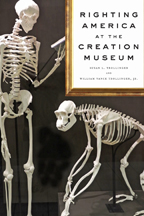
And, as trenchant critics Bill and Sue Trollinger point out, the Creation Museum doesn’t oppose science. To the contrary, the creationists at Answers In Genesis took pains to create something that looks like a “cutting-edge, state-of-the-art natural history museum.” In Kentucky, at least, radical creationists might not agree with me about the definition of good science, but they definitely love science itself.

righting america at the creation museum

We don’t have to agree with creationism to do a better job of understanding it.

Even when it comes to the science of mainstream evolutionary theory, creationists and non-creationists agree on big questions. Here at ILYBYGTH, we’ve heard from creationist homeschool moms who read Richard Dawkins to help teach their kids about evolution. And we’ve noticed ardent Texas creationists who want schoolkids to read the latest evolutionary science.

If we all want the same things—though maybe for different reasons—why do we keep fighting about evolution?

At least in part, we non-creationists need to take a good hard look in the mirror and see if we’ve been following Al-Gharbi’s advice. Have we tried to lower the perceived stakes of our conflict? Have we tried to really understand creationism and creationists? And have we spoken civilly and humbly to our creationist neighbors?

Too often, the answer is an angry no.

Consider just a few of the most famous examples.

Our most famous evolution mavens tend to speak angrily and ignorantly about creationism. They tend to do what they can to increase the stakes of our disagreements.

Richard Dawkins, for example, repeatedly blasts creationists as nothing but ignoramuses or worse. He tells anyone who listens that a profound understanding of modern evolutionary theory is the best way to cure religious people of their “god delusion.” As he promised about his book of that title, “religious readers who open it will be atheists when they put it down.”

It’s hard to imagine a better way to raise the perceived stakes in our creation/evolution disagreements than to insult all creationists and promise that evolutionary theory will lead them to atheism.

It’s not just the irascible Dawkins, though. The friendlier Science Guy Bill Nye also tends to muff his chances at better communication. In his recent book Undeniable, for example, Nye lambastes creationists as people “casting doubt on science and unbelievers.”

As we’ve seen, though, creationists love science. It’s the unbelievers they’re chary about.

What’s the takeaway here? When it comes to our creation/evolution battles, those of us who want more and better evolution education will be wise to avoid these sorts of unnecessary and unhelpful blunders. We should work hard to understand creationism better. We should try to build on our vast areas of agreement instead of focusing on the things we won’t agree about. And we should avoid preaching to our own choir with gratuitous and inaccurate insults of our creationist neighbors and friends.

Is Creationism Hate Speech?

It wasn’t about evolution or creationism. When a student group at the University of Central Oklahoma rescinded a speaking invitation for radical-creationist impresario Ken Ham, it wasn’t the biology or geology departments that had protested. Rather, it was women’s groups and LGBTQ+ organizations that objected to Ham. The controversy in Oklahoma points to a central problem for religious conservatives, one that all the bluster about “free speech” only obscures.

20171228_090906

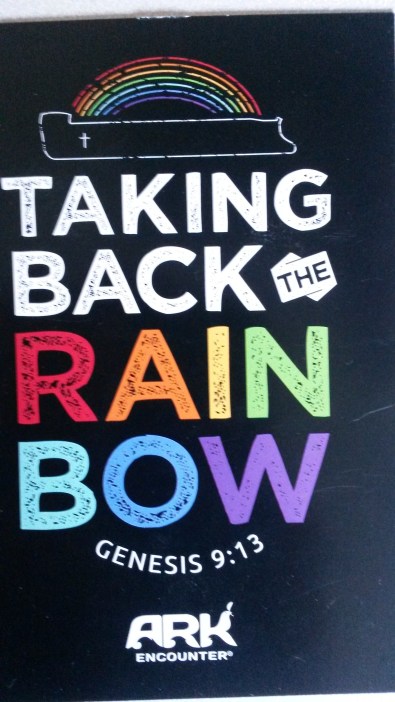
Ken Ham’s organization makes no secret of its anti-homosexuality opinions.

I’m no conservative, but if I were I would not care as much about college speaking invitations as I would about the much-more-important real reason why Ham’s talk was canceled.

Before we get into that, though, let’s clear out a few of the distracting issues. Ham has protested that he had a contract in place and that the university “reneged.” The university says no contract was in place, only an invitation. We can remain agnostic on that question—the central issue here isn’t one of legal contracts, but of moral and social commitments.

Let’s also remember that this case doesn’t involve creationism as a whole, but only one form of creationism. Ham’s organization promotes a specific young-earth version that I’ve been calling “radical” creationism. As I argue in my current book, too often pundits equate radical creationism with creationism as a whole. It’s always important to remember what creationism really is and what it isn’t. As a whole, creationism certainly can’t be equated with Ken Ham’s ideas. For now, though, let’s move on to the central issues in this particular case.

Ham insists that his free speech rights were denied. But were they? Ham still plans to give a speech in the same town, at a nearby church. No one took away Ham’s right to speak, only an invitation to appear at a university-sponsored event. To use an intentionally inflammatory analogy, pornography is not allowed in public-school libraries, but that does not mean pornographers have lost their rights to free speech.

Today, though, such questions of contracts and free speech rights are not what we’re going to focus on. Instead, let’s look at a tougher question. Let’s examine the confusing language at the center of this case. Ham has protested with justification that his banishment violates the university’s stated goal of “inclusivity.”

The local creationist pastor who had invited Ham to Oklahoma quoted angrily from the university’s policies:

UCO claims that it “is committed to an inclusive educational” environment, and in its “Campus Expression Policy,” the university declares that it “is committed to fostering a learning environment where free inquiry and expression are encouraged. The University is a diverse community based on free exchange of ideas.”

If the tax-funded university is committed to diversity and inclusion, the pastor asked, why did it exclude the different ideas of Ken Ham?

For its part, the university and affiliated student groups would likely explain (and for the record I’d agree) that “inclusivity” on a pluralist public campus must always exclude certain notions. Those who do not agree to the fundamental ideas of social equality can’t be included. If someone at an open public meeting refuses to let other people speak or to acknowledge other people’s rights as citizens, that person will be ejected. His or her rights to be included have always been premised on the condition that he/she recognize the same rights for all other members of the community. Whether you agree with it or not (I do), that exclusionary rule has always been central to the idea of “inclusivity.”

In the end, it was not creationist science that moved Ken Ham beyond the pale of civil speech, but rather his ideas about sexuality. As I was reminded recently on my trip to the Ark Encounter, a primary commitment of Ham’s creationist ministry is an insistence on the illegitimacy of homosexuality. In the eyes of Oklahoma protesters, Ham’s stance against same-sex marriage removes Ham from the circle of legitimate civic participants. By hoping to take away other people’s rights to participate equally in society, the argument goes, Ham has torn up the social contract and pushed himself out of the circle of civic rights, including the right to have his speech welcomed at a pluralist public institution.

If I were a radical creationist—and I’m not—I wouldn’t join Ken Ham and his allies in protesting about free speech rights. There is a larger issue that conservative Christians are losing—the right to have their ideas about sexual morality included in the list of legitimate opinions for public forums and institutions.

The free-speech issue, IMHO, is only a symptom of a much more profound loss by religious conservatives. In this case, Ken Ham didn’t have his rights to speak freely taken away. He still plans to speak in the same town. He is free to invite whomever he likes. He is free to say whatever he likes.

The big question, I think, is not whether or not radical creationists are allowed to speak freely. The big question, rather, is whether or not conservative Christian ideas about sexuality are still included in the list of legitimate political opinions. In this case, at least, they are not…not even in Oklahoma.

Why Don’t We Tell Children the Truth about Slavery?

A sad new report offers proof of something history teachers have long lamented: Most students don’t learn much about slavery in their history classes. This terrible failure of our school network isn’t just about slavery; it’s a profound and depressing fact about our schools: We don’t dare to tell kids the truth.

life-of-george-washington-junius-brutus-stearns

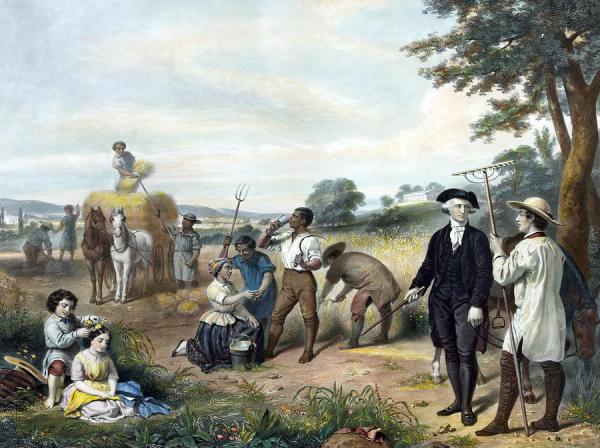
George Washington doing what George Washington did. Why is it considered unpatriotic to tell the children about it?

Why not?

The report on students’ knowledge about slavery comes from the Southern Poverty Law Center. The numbers are sadly predictable. Under a quarter of the students surveyed could identify the ways the Constitution gave advantages to slaveholders. Most teachers (over 90%) claimed to want to teach more and better information about slavery, but they reported feeling unsupported by textbooks and state standards.

Our national reticence to teach children the undeniable and important historical truth about slavery has long roots. Time and time again, history classes focus on a feel-good national story. As Yale’s David Blight puts it in the report’s preface:

In America, our preferred, deep national narratives tend to teach our young that despite our problems in the past, we have been a nation of freedom-loving, inclusive people, accepting the immigrant into the country of multi-ethnic diversity. Our diversity has made us strong; that cannot be denied.

And, as the reports’ authors note,

We teach about slavery without context, preferring to present the good news before the bad. In elementary school, students learn about the Underground Railroad, about Harriet Tubman or other “feel good” stories, often before they learn about slavery. In high school, there’s over-emphasis on Frederick Douglass, abolitionists and the Emancipation Proclamation and little understanding of how slave labor built the nation.

This fear of telling students ugly truths has a long history. As I noted in my book about educational conservatism, many of our culture-war battles about teaching US History pitted the bashers against the boasters. Conservatives wanted kids only to hear about America’s glories. Progressives wanted to teach that the US has always had plenty of moral flaws.

In the 1930s, for example, journalist and patriot Bertie Forbes attacked the popular textbooks written by Harold Rugg. Rugg hoped to introduce students to the real complexity of international relations. In Forbes’s opinion, such efforts would rob students of their patriotic fervor. As Forbes wrote in 1940,

If I were a youth, I would be converted by reading these Rugg books to the belief that our whole American system, our whole American form of government, is wrong, that the framers of our Constitution were mostly a bunch of selfish mercenaries, that private enterprise should be abolished, and that we should set up Communistic Russia as our model.

By and large, historically speaking, the Forbeses of the world have always won these fights. Schools primarily teach (and taught) students that America was a place they could love. Teaching too much or too frankly about slavery has always been seen as a dangerous and controversial effort.

It’s not only slavery that is ignored or misrepresented. As SAGLRROILYBYGTH are keenly aware, schools shy away from all types of controversial topics, even when the controversy is contrived.

berkman plutzer chart 2 better text color

From Berkman & Plutzer: Can we please not talk about it?

As Penn State political scientists Michael Berkman and Eric Plutzer found, only a minority of high-school biology teachers teach mainstream evolutionary theory and only mainstream evolutionary theory in their classes. The rest tend to mash together a mix of mainstream science and dissenting creationist ideas. Why? Because most teachers share the ideas of their local communities. If people want their kids to learn a variety of ideas about science, that’s what most teachers will deliver.

This has always been the case. In the 1940s, an enterprising scholar set out to discern how many teachers taught evolution. One teacher from California explained why he avoided the topic of evolution in class. As he put it,

Controversial subjects are dynamite to teachers.

And there’s the rub. Teachers will tend to avoid controversy. There’s no controversy among historians about whether or not slavery was a vital and decisive element in US history. There’s no controversy among mainstream scientists about whether or not mainstream evolutionary theory is a vital and decisive element in biology.

But broad segments of the population disagree. They don’t want their children to learn that America has historical flaws. They don’t want their children to learn that our species developed by a long series of minor changes.

Unless and until those things change, classrooms won’t improve. I heartily concur with the four-point action plan put forth by the recent SPLC report. It recommends the four following steps:

  1. Improve Instruction About American Slavery and Fully Integrate It Into U.S. History.
  2. Use Original Historical Documents.
  3. Make Textbooks Better.
  4. Strengthen Curriculum.

All good ideas. But they won’t be enough. Just like evolutionary theory, the history of slavery won’t be included in our classrooms until it is included in our day-to-day conversations. Until the country as a whole recognizes the importance of America’s ugly past, classrooms will continue to ignore it.

As we’ve seen time and again, we can’t use curriculum to change society. We need to change society and watch curriculum follow along.

Where’s the Beef?

I didn’t think it was all that complicated, but at least two smart people have misunderstood my complaint, so I’ll try to clarify. If SAGLRROILYBYGTH think I’m splitting hairs or being overly persnickety, I’ll shut my yap. But I don’t think I am and I don’t think the point is all that abstruse.duty_calls

Here’s what we’re talking about this morning: Last week, I wondered if evolution maven Jerry Coyne had a glitch in his code. He didn’t think protesters against Steve Bannon had a legitimate right to block Bannon’s appearance at UChicago. Coyne pooh-poohed protesters’ claims that the issue wasn’t really about free speech.

But I assumed—correctly it appears—that Prof. Coyne does reject some claims to free-speech protections. Prof. Coyne and I agree: Just because someone claims free-speech protection doesn’t mean they should get it. Some claims are bogus. Some are even harmful, at least potentially. The most obvious case is the perennial free-speech claim of America’s creationists. In state legislatures, bill after bill purports to protect the free-speech rights of creationist students and teachers.

Especially since we agree on everything, Prof. Coyne wondered what my beef was. As he put it,

Laats’s beef seems to be this: if I, Professor Ceiling Cat Emeritus, favor free speech on college campuses, why don’t I favor free speech in the classroom?

Coyne goes on to explain—and I agree with him as far as he goes—that creationist teaching in classrooms is not the same as controversial invited speakers on university campuses. However, he didn’t identify my beef correctly. Here it is: If Prof. Coyne doesn’t recognize the legitimacy of creationists’ claims to free-speech protections, why doesn’t he grant other people similar rights to un-recognize free-speech claims?

After all, Professor Coyne makes it clear. He says,

I do not recognize creationists’ desire to teach goddy stuff in the classroom as a “free speech” claim. [His emphasis.]

Coyne means, I think, that creationists can’t claim protection for their speech if it establishes a government religion unfairly, contra the First Amendment. By doing so, creationists give up any right to free-speech protection for their creationist teaching. The important point, IMHO, is that Prof. Coyne recognizes that some free-speech claims are faulty. Those claims are not legitimate and they do not deserve the protection they demand. Creationists insist on their right to free speech; they insist that their rights to be heard are often dismissed unfairly. In general, I think Prof. Coyne and I agree—we don’t lose any sleep over such creationist complaints, because we do not recognize them as legitimate claims to the protection of free-speech rights.

Which leads us to the main question again: If Prof. Coyne is willing to dismiss some claims to free-speech protection as illegitimate, why doesn’t he at least respect the anti-Bannon argument, even if he disagrees with it?

In other words, though I agree with Professor Coyne both that Bannon should be allowed to speak and that creationists should not be allowed to teach creationism in public-school science classes, I disagree with his glib dismissal of the arguments of the anti-Bannon protesters.

I think we need to acknowledge that there are real and important reasons why some intelligent, informed, well-meaning people refuse to recognize Bannon’s claims to free-speech protections. Further, there are good arguments to be made that a private (or public) institution has a responsibility to consider the implications of its speaking invitations. By inviting Bannon to speak, an elite university like Chicago is conferring on Bannon and Bannon’s ideas more than a touch of mainstream legitimacy. Blocking someone from speaking at the University of Chicago is not the same as blocking his or her right to holler on a street corner. I don’t think the Chicago protesters are hoping to shut down Breitbart; they are merely hoping to deny Bannon the enormous prestige of a Chicago speaking appearance.

Now, in this particular case I think the decision should swing in Bannon’s favor. But that does not mean that the anti-Bannon protesters don’t have a decent case to make. It does not mean that the UChicago protesters are “discarding one of the fundamental principles of American democracy because they don’t like its results,” as Prof. Coyne accused.

Some free-speech claims are bogus and don’t deserve to be recognized. The Chicago protesters and I merely disagree about the proper decision in this one particular case. They are not necessarily against free speech; they are disputing Bannon’s claim to free-speech protections; they are against their university recognizing Bannon’s legitimate status.

Does Jerry Coyne Support Creationism?

Okay, maybe I’m just mad because he poked fun at “humanities” types like me. But I can’t help wondering if Jerry Coyne’s love for free speech is really as consistent as he implies. Does Professor Coyne support creationist “free speech” laws for K-12 schools? Colleges?

Here’s what we know: Right-wing eminence gross Steve Bannon is planning to speak at the University of Chicago. Students and some faculty are protesting. Professor Coyne criticizes the protesters, calling their “tiresome” ideas “reprehensible.”

UChicago sit in

Protesting against unfettered free speech at Chicago…

I tend to agree with Prof. Coyne that almost all speakers should be allowed to speak on university campuses. We need a high bar to prohibit speech, especially for guest lectures at universities. There are exceptions. If someone is likely to directly incite violence, they shouldn’t be allowed to speak. Universities, moreover, are under no obligation to financially support disruptive tactics—the kind of intentional provocation used by the likes of Richard Spencer. That is, when speakers plan to cause riots in order to draw attention to themselves, universities are not obligated to pay for the show. That’s not about free speech, but simple administrative common sense.

White supremacists and Trumpy trolls aren’t the only ones pleading for their right to free speech. As SAGLRROILYBYGTH know, creationists these days demand free speech in schools. Many current school bills insist that they will give teachers “academic freedom” to teach ideas critical of mainstream evolutionary theory. Missouri’s 2015 bill, for example, promises the following:

Neither the state board of education, nor any public elementary or secondary school governing authority, superintendent of schools, school system administrator, or public elementary or secondary school principal or administrator shall prohibit any teacher in a public school system of this state from helping students understand, analyze, critique, and review in an objective manner the scientific strengths and scientific weaknesses of biological or chemical evolution whenever these subjects are taught within the course curriculum schedule.

I’ll say it: I don’t think this kind of “freedom” is good policy. Sponsors of bills like these, IMHO, are mainly trying to cram a wedge into public-school science classes. I’m suspicious of the “scientific weaknesses” that such bills hope to teach about. If they really wanted to teach the various disagreements about the details of evolutionary science, fine. Great, even. But in fact, teaching those “scientific weaknesses” usually means teaching creationist critiques of mainstream evolutionary science as a whole. Teachers in public schools should not consider themselves free to tell students that worse creationist science is just as good as better mainstream academic science.

“Academic freedom” creationist gambits are not limited to K-12 schools. A few years back, for example, Professor Eric Hedin won tenure at Ball State despite accusations that he taught creationism-friendly ideas.

Does Professor Coyne support free speech in cases like these? In the case of Eric Hedin, we don’t have to wonder. Coyne outed Hedin early and often. Coyne protested that no professor at a publicly funded university had the freedom to teach creationism-friendly ideas as if they were science.

In creationist cases, then, Professor Coyne agrees to strict limits on free speech. How does he choose which free speech to prohibit?

A few possibilities:

  • Professor Coyne might say that he only objects to tax-funded religious preaching, as when a public university pays Hedin’s salary.

But tax money supports lots of religious talk on public college campuses. At many schools, religious groups use tax-funded facilities as meeting rooms. They use tax-funded student lists to recruit possible converts and members. Moreover, nearly every decent public university teaches lots of classes about all sorts of religious ideas. Why single out this particular instance?

  • Professor Coyne might object that Hedin taught religious ideas as science.

Surely Prof. Coyne knows better than me how difficult it is to articulate a simple definition of “science.” Shouldn’t scholars have the freedom to explore those boundaries?

  • Professor Coyne might say that he is against schools paying salaries for the promulgation of bad ideas; he doesn’t want intelligent design afforded the prestige of appearing in a college class.

If so, he would be repeating the ideas of the anti-Bannon UChicago protesters and their ilk. They do not want to legitimize hateful trolls such as Steve Bannon by paying him to speak at Chicago. They do not want to afford Bannon the prestige of such an affiliation.

  • Professor Coyne might say that teachers should stick with the curriculum.

But I don’t think he would. The heart and soul of academic free speech is the freedom to explore ideas not dictated from above.

Or, even if Professor Coyne could convince people that Professor Hedin was a special case, a case in which a teacher falsely claimed the freedom to preach religion on the public dime, what would he say about other free-speech schemes out there, like the one in Wisconsin?

Lawmakers in Madison have proposed a law to protect free speech on campus. If a creationist student were told that his “speech” about a 6000-year-old earth was incorrect on an exam, he could complain to an ominously named Council on Free Expression.

I just can’t imagine that Professor Coyne would protect creationists’ freedom to equal status for their ideas. In fact, I’m hopeful he would join me in strident opposition to this sort of thing.

The point, in the end, is not that students, faculty, and outside speakers are all engaging in the same sorts of speech. When a professor teaches a class or a student writes an exam, they are obviously engaged in different sorts of speech than when an outsider comes for a one-off lecture. They’re not all the same, but that’s not the point. Rather, the central point is that some assertions of free speech are strategic manipulations. In the case of most creationist “free speech” bills, the true goal is to make creationism seem legitimate.

When I (and maybe Prof. Coyne would join me) argue against such creationist free speech laws, our motives and goals are not “reprehensible.” We are trying to protect a vital idea—that mainstream science and creationist alternatives are not merely equally valuable scientific understandings. Academic freedom for instructors and free speech for students doesn’t include the right to teach and preach worse science as if it were equal science. People are certainly free to speak their minds about creationism, but schools do not have to pay people to engage in that kind of speech.

Given all that, I don’t understand why Coyne is so quick to bash his Chicago colleagues. Sure, he may disagree with them, but he should recognize his own objections to some purported “free speech” claims. If he did, he would likely have a different take on the “reprehensible” actions of his Bannon-busting colleagues.

I’m Like a Creationist (and You Are Too)

SAGLRROILBYGTH know I’m no creationist. But this week I had an experience that I think is similar to what some thoughtful creationists go through. When it comes to questions of religion and public life, that is, sometimes the issue is not really the issue. I’m wondering this morning if everyone—creationist or non-creationist—has had similar experiences.

Here’s what I’m talking about: A new bill in Iowa’s state legislature would allow public schools to teach Bible classes. I’m all for public schools teaching about religions, including Christianity. It is clearly constitutional, as long as the teachers aren’t preaching any particular religion. And it is IMHO a vital part of a comprehensive education. How can we expect to teach US History, for example, without teaching about Puritan values? How can we teach literature without reading the Bible? Yet in spite of the fact that I support religious ed in public schools in theory, I oppose this bill and others like it.

Why?

My beef is not directly about Bibles. It’s really a question of trust. When it comes right down to it, I don’t trust the bill’s backers. I think they are hoping to sneak some old-fashioned Protestant devotion into their public schools. They SAY they want students to learn about the historical and literary impact of the Bible, but when they talk about their proposed classes, you can almost smell the revival-tent sweat.

According to the Des Moines Register, for example, one of the bill’s ardent supporters insists the Bible class would help students be better Christian Americans. As he put it,

foundational and historical American values did not spring from the cornucopia of ‘world religions,’ but specifically from the Judeo-Christian scriptures.

To my secular ears, that sounds a lot like a Wallbuilders-style evangelical power play.

Do I want more education about religion in public schools? Yes!

But this bill is not-so-secretly intended to preach a specific, conservative-evangelical religion. It is intended to have a religious impact on students, which public schools should never attempt.

How does this make me like a creationist? Simple. Many creationists have had similar experiences. Throughout the twentieth century and today, even the most radical young-earth creationists often want their children to learn about evolution. But they distrust the motives of public-school types who teach it. Many creationists worry less about evolutionary science than about the sneaky atheistic teachers who they think want to use evolutionary theory Dawkins style, to prove the ridiculousness of religious faith.

I found over and over again in the research for my new book about evangelical higher education that creationist schools promised to teach evolution, but to do it safely.

At Liberty University for example, in 1985 founder Jerry Falwell promised that all Liberty students would learn about evolution. As Falwell explained to potential enrollees,

You’ll learn all about evolution, but you’ll learn why you don’t believe it. . . . To our knowledge, we’ve never graduated an evolutionist.

Closer to home, right here at ILYBYGTH we’ve heard from creationists who are eager to teach their kids about evolution, if they can do it without cramming atheism down their throats.

Beyond these anecdotes, there seems to be solid sociological evidence that creationists like evolution, but worry about something else. In their study of religious people’s attitudes toward science, Elaine Howard Ecklund and Christopher Scheitle found that evangelicals tended to have more positive attitudes about science than the general population. But evangelicals also tended to think more often that scientists were out to get them. In other words, evangelicals—some of them, at least—like science itself, but they are suspicious of people who call themselves scientists.

So here’s my hunch: We’re all the same when it comes to these questions of religion and public life. Even when we support an idea in principle, we don’t support it in practice because we distrust its supporters.

For me, that means opposing Bibles in public schools, even though I ardently desire better religious education in those public schools.

For creationists, that means opposing the teaching of mainstream evolutionary theory alone in public-school science classes, even when they really want their children to learn evolution.

  • For all you creationists out there, am I off the mark?
  • And for my fellow non-creationists, have you had a similar experience?
  • Is the central issue not really Bibles or evolution…but TRUST?

Fundamentalists Were Right

For a hundred years, conservative evangelicals have told themselves that college is a dangerous place. As I argue in my new book about evangelical higher ed, the threat posed by mainstream schools pushed fundamentalists in the 1920s to invest in their own network of interdenominational schools, safe colleges for fundamentalist youth. A new study suggests that fundamentalist fears are still well founded.

20171226_121555

How today’s fundamentalists view college…

Back in the 1920s, fundamentalists loved to recount horror stories of college gone bad. As evangelist Bob Jones like to tell revival crowds in the 1920s, one Christian family he knew scrimped and saved to send their beloved daughter to a fancy college. What happened?

At the end of nine months she came home with her faith shattered. She laughed at God and the old time religion. She broke the hearts of her father and mother. They wept over her. They prayed over her. It availed nothing. At last they chided her. She rushed upstairs, stood in front of a mirror, took a gun and blew out her brains.

Other fundamentalist pundits shared an apocryphal letter from a damned college graduate. This letter, from 1921, told the folks at home,

My soul is a starving skeleton; my heart a petrified rock; my mind is poisoned and fickle as the wind, and my faith is as unstable as water. . . . I wish that I had never seen a college.

Back then, fundamentalists didn’t just rely on anecdotal evidence. They shared social-science evidence of the dangers of mainstream higher education, especially psychologist James Leuba’s 1916 study of college-student religiosity. The students he interviewed tended to grow less religious during their college years. The takeaway? College must be doing something to strip students’ faith.

20171226_121545

Those darn college professors…

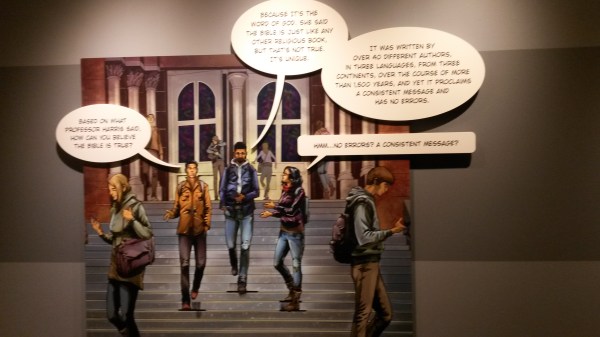
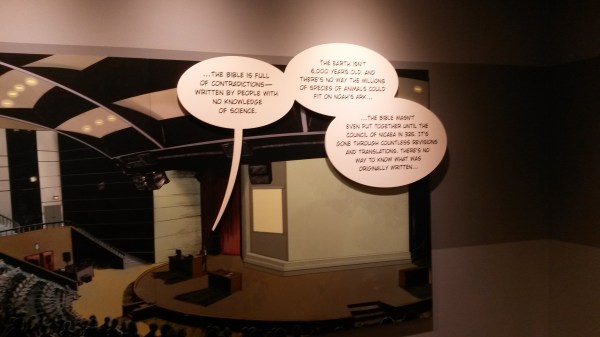
These days, conservative evangelicals are just as nervous as ever about college. On my recent trip to Answers In Genesis’s Ark Encounter in Kentucky, I was surprised to find a huge walk-through comic book illustrating the dangers of higher education.

And, over a hundred years after Leuba’s book, new research seems to suggest that mainstream colleges really do tend to water down student religiosity. The survey by the Interfaith Youth Core was most interested in the ways college students reacted to religious diversity. Along the way, they found that among 7,194 students at 122 colleges, religious activities as a whole tended to drop during the first year of college.

Forty-three percent of the freshman respondents said they had talked about religious ideas in high school, while only a quarter said they did in college. When it came to religious diversity, the numbers are even starker. Thirty-seven percent of respondents said they had attended a religious service of a different faith than their own in high school, but only 20% did in college.

College students also reported friendlier attitudes toward liberal ideas after a year of college, from 55% up to 63%. And a majority said they felt some pressure to change their religious ideas and that they tended to keep their religious ideas to themselves.

So while people like me might worry that students are not getting enough exposure to religious diversity, fundamentalists will likely worry more. Even if college students are shying away from other religions, they are also shying away from their own.

Creationists Understand[ing] Evolution

[Editor’s note: To SAGLRROILYBYGTH, Dr. Don McLeroy needs no introduction. As the genial conservative former head of the Texas State Board of Education, Dr. McLeroy is well known especially for his firm creationist beliefs. As I finish up my new book about American creationism, I reached out to Dr. McLeroy to ask him about his ideas. He graciously responded with an explanation and some questions of his own. He asked me, for instance, why I had so much confidence in mainstream evolutionary science. For the past few months, Dr. McLeroy and I have been reading key works together. He has explained to me why he finds some of Kenneth Miller’s work problematic and finds some convincing. I suggested a few of my favorite books, such as Edward Larson’s Evolution and Kostas Kampourakis’s Understanding Evolution. Dr. McLeroy read both and offered his explanation of why he found Dr. Kampourakis’s book ultimately unconvincing. I thought Dr. McLeroy’s critique of Understanding Evolution would be interesting to others, so I asked Dr. McLeroy for permission to publish it here. It appears below, unedited and unmodified by me.]

A critique of Kostas Kampourakis’ Understanding Evolution, Cambridge University Press, 2014

By Don McLeroy, donmcleroy@gmail.com

Kostas Kampourakis believes if you truly understand evolution—the idea that all life is descended from a common ancestor as a result of unguided natural processes—you will accept it and to this end he wrote his book. He does offer a unique contribution to the literature; besides an original discussion of “the core concepts of evolutionary theory and the features of evolutionary explanations,” (p. xi) he specifically concentrates on explaining why he believes evolution is hard to understand and why it has not won widespread acceptance. He emphasizes the conceptual obstacles to understanding evolution, how it is counter-intuitive and why there is so much religious resistance.

As for explaining the core concepts of evolution, his book succeeds; I do have a better understanding of evolution. However, I do not find his discussion of the conceptual difficulties of understanding evolution very compelling. The main obstacle for the evolution skeptic is the evidence doesn’t support it. And, if evolution is false, rejection of evolution is not counter-intuitive. However, he may be right; conceptual obstacles could play a major role in the evolution controversies. Only I think he has it totally backwards and the conceptual difficulties lie with the evolutionist inability to reject evolution.

Understanding core concepts

He devotes two chapters of his book to the core concepts of evolutionary theory: “Common ancestry” and “Evolutionary change.” They are unlike any other evolutionary explanations I have ever read. They are challenging, interesting and I enjoyed studying them.  One reason is because Kampourakis has an excellent imagination and he uses it to create “imaginary” examples to help illustrate evolutionary ideas. He has imaginary beetles, imaginary families, an imaginary Gogonasus man, imaginary slides with rolling balls, imaginary “Jons and Nathans,” and an imaginary pizza shop evolving into an imaginary cookie shop. These examples do help in understanding evolutionary concepts, but I am left wondering, why not use actual examples to illustrate these ideas? Are simple real life examples unavailable to explain evolution?

Kampourakis’ book, like every other evolutionary apologetic book I have read, leaves me a stronger skeptic. The first thing I do when I read a new book on evolution is to look for any actual evidence cited that supports evolution. These books all claim they have lots of evidence, but when I read the books I do not find it. Kampourakis agrees the first requirement of a good scientific theory is the “empirical fit or support by data.” (p. 209) He claims “The fact that we do not know some details yet, as well as that we may never know all the details, does not undermine how strongly evolutionary theory is supported by empirical data.” (p. 209) Therefore, how many actual facts do we see included in this book? He presents some biology but not much evolutionary evidence. Interestingly, I find more imaginary examples than actual examples. His strongest example is Neil Shubin’s Tiktaalik.

The conceptual difficulties

The unique purpose of Kampourakis’ book is to focus “on conceptual difficulties and obstacles to understanding evolution.” (p. 62) I find it interesting his goal is not for everyone to “accept” evolution but simply to “understand” it. Again, he seems to believe if only we could understand it, then of course, we would accept it.  I believe I do understand evolution. And, the more I understand it the more skeptical I have become. What amazes me is how many intelligent, educated people understand evolution and then accept it. Therefore, let’s examine the conceptual problem in reverse. The question would now be: What are the conceptual difficulties facing the evolutionist in ultimately rejecting evolution. I believe they are easily identifiable.

Not knowing they don’t have enough evidence

This brings us back to the key issue—the evidence. I believe the first and most significant conceptual obstacle in preventing the evolutionist from rejecting evolution is in not realizing how much evidence is needed to show evolution to be true. To illustrate, how much evidence has evolution presented to demonstrate how the myriads of biochemical pathways have supposedly developed naturally? Kampourakis’ book is completely silent on this issue. But, Kampourakis provides for more evidence for evolution by referencing a “Further reading” section at the end of his first chapter. Here he begins “There exist numerous books which present the evidence for evolution as well as the main processes. A nice book to start with is Jerry Coyne’s Why Evolution Is True, which provides an authoritative overview of evidence and processes. Another book with several examples and useful information is The Greatest Show on Earth: the Evidence for Evolution, by Richard Dawkins.” (p. 29) Therefore, based on Kampourakis suggestion, let us examine how well these two books explain the evolution of biochemical pathways.

In Dr. Coyne’s book, the only specific evidence he provides to demonstrate biochemical complexity is to hypothesize an imaginary common ancestor of sea cucumbers and vertebrates had a gene that was later co-opted in vertebrates as fibrinogen. (Coyne, ps. 131-3) Richard Dawkins presents even less evidence than Jerry Coyne. He describes the cell as “breathtakingly complicated;” stating “the key to understand how such complexity is put together is that it is all done locally, by small entities obeying local rules.” (Dawkins, p. 438) He also states some of the features of the cell descended from different bacteria, that built up their “chemical wizardries billions of years before.” (Dawkins, p. 377) These statements are not evidence. Click on the links associated with each picture to see what evolution must explain and decide for yourself how strong the evidence is for what Kampourakis’ experts present.mcleroy 1mcleroy 2mcleroy 3

In conclusion, Kampourakis, Coyne and Dawkins do not seem to be concerned about the lack of evidence supporting the evolution of biochemical pathways. And, this is only one small area evolution encompasses that needs explaining.

Not knowing how many just-so stories they tell

The second conceptual block the evolutionist faces in rejecting evolution is they don’t seem to realize or be bothered by how much they depend upon just-so stories in their explanations for how evolution actually happened. Kampourakis, to his credit, doesn’t spin too many just-so stories; he simply presents them as facts. Examine this table Kampourakis includes in his book (p. 172). These transitions are presented as facts, as the truth. Here, the conceptual block the evolutionist faces is the failure to ask the key question “HOW did this happen?” For example, can evolution answer these questions for the first four transitions?

  • HOW did repeating molecules arrive and HOW did these molecules become enclosed in a membrane?
  • HOW did these molecules become coordinated as chromosomes?
  • HOW did the RNA, DNA, and proteins develop protein synthesis and HOW did the genetic code information arrive?
  • HOW did the eukaryote cell arrive? Does the concept of endosymbiosis deal with enough of the complexities involved to assume the problem is basically solved?

kampourakis chartNot knowing the definition of science

Finally, the most foundational conceptual obstacle preventing the evolutionist from rejecting evolution is they have defined themselves into a box. Kampourakis, after a lengthy and excellent discussion of religion and how it relates to science concludes “Science is a practice of methodological naturalism: Whether a realm of the supernatural exists or not, it cannot be studied by the rational tools of science. Science does not deny the supernatural, but accepts that it has nothing to say about it. Science is a method of studying nature, hence methodological naturalism.” (p. 59) But, what if God really did create life? This would mean Kampourakis’ science would not be able to discover it. I find this an untenable situation for science.

The solution, as I see it, is to reject “methodological naturalism” and endorse “The National Academy of Sciences” definition of science. In its book Science, Evolution, and Creationism, 2008, the National Academy defines science as: “The use of evidence to construct testable explanations and predictions of natural phenomena, as well as the knowledge generated through this process.” (p. 10) This wording is excellent: it supports both a naturalist and a supernaturalist view of science. With it, science must only limit itself to “testable explanations” not methodological naturalism’s “natural explanations.” Now, the supernaturalist will be as free as the naturalist to make testable explanations of natural phenomena. Let the view with the best empirical evidence prevail. Unfortunately, with Kampourakis’ purely naturalistic view, he and his fellow evolutionists are trapped in a box with only naturalistic explanations; they then must accept naturalistic evolution.  As a Christian, I am free to accept or reject evolution. Kampourakis even documents leading Christian scientists who accept evolution by quoting Francisco Ayala and Kenneth Miller. (p. 46)

Conclusion

Kostas Kampourakis’ Understanding Evolution argues if you truly understand evolution you would come to accept it. For this to happen, he believes you just need to overcome conceptual obstacles standing in your way. I argue just the opposite; I believe if you truly understand evolution you will come to reject it. We agree though, for this to happen, you just need to overcome conceptual obstacles standing in your way.


Flipping the Culture Wars

“Which side are you on?” When Pete Seeger asked that question, he wanted to push vacillating leftists to the workers’ side. In today’s culture-war politics, one could be forgiven for being confused which side is which. As a recent commentary at American Conservative points out, the right used to be the side of stuffy censorship and outraged morals. Now that mantle has been claimed by the left.

The culture-war flip isn’t only in the world of art. During the twentieth century our creation/evolution battles experienced a dizzying reversal. In the 1920s, as I recount in my history of educational conservatism, conservatives wanted to ban evolutionary theory outright. Even more, many conservative activists had success in making their theocratic vision for public schools legally binding.

At issue in the Scopes Trial, for example, was Tennessee’s law against the teaching of human evolution. Back then, mainstream science activists were fighting merely to have evolutionary theory included in public schools.

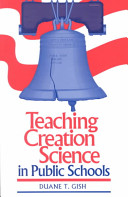
By the end of the twentieth century, the situation had flipped. As creationist pundit Duane Gish famously but incorrectly protested in 1995, at the Scopes Trial Clarence Darrow insisted “it was bigotry to teach only one theory of origins.” In fact, it wasn’t Clarence Darrow who said it, but Darrow’s fellow counsel Dudley Field Malone.

gish teaching creationism public schools

If you aren’t at the table, you’re on the menu…

But Gish’s sentiment was correct. At the Scopes Trial, evolution’s defenders insisted that all sides should be heard. By 1995, the tables had turned, and creationists merely wanted a seat at the table.

At American Conservative recently, Nick Phillips argued that the same culture-war flip has happened in the world of art. These days, we see progressive campaigners insisting that offensive images be banned. We hear of college protesters fighting to eliminate statues and paintings that portray sexist, racist themes. And Phillips asks,

We used to have a word for people who sought to enforce restrictions on the bounds of public discourse in order to insulate sacred norms from attack by non-believers. They used to be called “conservatives.” How did this happen? Why are leftists acting like conservatives?

Of course, this dynamic is as old as politics itself. Whoever has power works hard to keep it. Ideas that challenge the status quo are threats to whomever benefits from that status quo. When creationists appeal to our sense of fairness and inclusion, they have merely recognized that they can no longer simply legislate their vision. And when progressive art activists seek to ban images, they are demonstrating their feeling of proprietary control over the goings on in art houses and college campuses.

High Stakes Creationist Testing

Another day, another creationism bill in Alabama. So far, so snooze. But did you know—I didn’t—that some of today’s creationism bills and laws include sections on how to grade creationist test answers? And because they do, it makes no sense to me why creationists would support these bills.get fuzzy evolution

Here’s what we know: Creationism watchdog National Center for Science Education recently posted the news from Alabama. A new bill would allow teachers to teach both creationism and evolution as science.

Here’s the kicker: Students are allowed to choose either creationism or mainstream science. Whatever they choose, they can get credit on tests as long as their answers match what the teacher taught them.

Apparently—also news to me but not to the folks at NCSE—Kentucky has long had a similar creationism law on the books. Here’s the Kentucky language:

For those students receiving such instruction, and who accept the Bible theory of creation, credit shall be permitted on any examination in which adherence to such theory is propounded, provided the response is correct according to the instruction received.

Okay, now call me silly, but doesn’t this sort of law present a terrible dilemma for creationists? I understand why the evolution mavens at NCSE don’t like it, but I am surprised that Kentucky’s or Alabama’s creationists do.

After all, conservative evangelicals celebrated when SCOTUS agreed to ban bland, ecumenical school prayers in 1962, as I demonstrated in this academic article. They loved the idea of school prayer, of course, but they hated the idea that their children would be praying the wrong prayer in public school.

These laws seem to push the same buttons. Why would creationists fight for laws that hem them in theologically? Because creationism is so ferociously controversial, that is, how could creationists give the thumbs up to a law that tells children one form of creationist thinking?

As SAGLRROILYGTH are well aware, nothing peeves young-earth creationist impresario Ken Ham more than his rival creationists. How can Alabama’s creationists decide WHICH creationism schools should teach? How can creationists smile if their children come home from school mouthing different creationist visions from those of their church?