Homeschooling and the Common Core

Education folk these days are a-flutter with talk about the Common Core State Standards.

Recently, William Estrada of the Home School Legal Defense Association has warned about the implications for homeschoolers of such national curricula.

Without an historical perspective, it would be easy for readers of recent headlines to assume that conservatives have always opposed greater educational centralism.  After all, Ronald Reagan came to office on a promise to eliminate the then-new Department of Education.  Recently, Republican Presidential hopefuls such as Rick Perry, Michele Bachmann, and Ron Paul promised to fulfill Reagan’s plan.

Back in the 1920s, however, leading conservatives often made the strongest case for a federal department of education.  As I explored in a recent article in the History of Education Quarterly, the 1920s Ku Klux Klan hoped greater educational centralization would help Americanize immigrants and standardize Americanism education.  The main institutional opponent of such centralization in the 1920s, as Douglas Slawson’s wonderful book The Department of Education Battle, 1918-1932 points out, was the Catholic Church.  In that turbulent decade, social traditionalists, conservative Protestants, and many leading progressives all agreed that the nation needed greater centralization and increased educational funding.

By the 1940s, however, educational centralization had become a leading bugbear of anti-communist conservatives.  From the fringes of conservative anti-communism, influential pamphleteer Allen Zoll denounced federal aid to local schools as the central strategic goal of subversive communism.

Allen Zoll, They Want Your Child! (New York: 1949)

Allen Zoll, They Want Your Child! (New York: 1949)

In “They Want Your Child!” (New York: National Council for American Education, 1949), Zoll warned, “We had better stop smiling.  There IS a conspiracy.  The conspiracy against the American way of life, against everything that we hold dear, is probably the most completely organized, ruthless design against other people ever set in motion in all human history. . . . THE INFILTRATION AND CONTROL OF AMERICAN EDUCATION BECAME COMMUNISM’S NUMBER ONE OBJECTIVE IN AMERICA.  THEY WANT THE CHILDREN OF AMERICA.  THEY WANT YOUR CHILD.”  To Zoll and many of his readers, centralization of education meant that subversives could collect all the threads of education policy in their grasping claws.

Once the US Supreme Court began ruling in favor of school desegregation in the 1950s and against school prayer in the 1960s, the notion of greater educational centralization became anathema to wider and wider circles of American conservatives.  Centralization became associated purely with the long-standing enemies of traditionalist and conservative education: evolution science, progressive pedagogy, left-wing anti-racism, anti-patriotic politics, and secularism.

In his December 2012 brief, Will Estrada of the HSLDA made some of the traditional conservative arguments against greater educational centralism.  First, Estrada pointed out, states were pushed into accepting these common standards out of financial desperation, not out of any educational benefit.  President Obama’s Race to the Top funding, as Estrada noted, was often tied to adoption of common core standards.  Second, centralized education would decrease quantifiable student achievement, Estrada argued.  Scores on English and math tests would likely decrease after these standards were in place, at the cost of billions of dollars.  Perhaps most in line with the complaints of many American conservatives, Estrada warned that common standards weakened parental control.  “Top-down, centralized education policy,” Estrada wrote, “does not encourage parents to be engaged.”

Specific to homeschoolers’ interests, Estrada worried that centralized curricula would encourage greater pressure on homeschoolers to follow along.  If every college and every college entrance exam measured student achievement by success on common-core-linked tests, homeschool students would feel pressured to master that common curriculum.

Supporters of today’s Common Core State Standards argue that the standards will bring greater efficiency and equality to education in the United States.  However, the idea of centralization has had a checkered career among American conservatives.  Will Estrada of the HSLDA raised one voice in opposition to today’s centralization effort.
Pluralism and Progressivism in America’s Schools

Is American public education progressive?  Do most teachers and administrators hope to use schools to instill a sense of individuality, of self-expression, in America’s youth?  Do public schools emphasize the individual construction of knowledge over the traditional emphasis on transmitting knowledge?  In general, I don’t think so, but many informed, intelligent people still assume that they do.

For instance, in this month’s First Things Ashley Rogers Berner makes a smart argument for more pluralism in American public education.  In her essay, she assumes that the ideological training of America’s public school teachers includes a decisive dollop of progressivism.

The primary reason for the stultification of American public education, Berner argues, is the system’s lack of real pluralism.  If we Americans could get over our irrational attachment to a model of public education in which only publicly run schools could receive significant public funding, then we could enjoy the fruits of a truly diverse system.

Her article is worth reading in its entirety, but in short, in her words,

“Lasting, structural change requires reframing ‘public education’ to mean publicly funded or publicly supported, not exclusively publicly delivered, education. This in turn requires a different political philosophy, a turn to a model of education based on civil society rather than state control.”   

In today’s educational culture wars, the first response to Berner’s argument is usually that such pluralism will essentially abandon those students who most need publicly run schools.  By leaching funding away to a universe of school options, those students and families who are last to scuttle away from the sinking ship of publicly administered schools will be left with even fewer resources to scratch together a decent education.

Berner and other advocates of greater diversity in public-funded schooling blame teachers’ unions for clinging to control at the expense of educational quality.  Defenders of our current funding model of public education respond (with varying levels of coherence) that the union model ought to be understood in a different way: Only if all families and teachers stick together, the argument goes, can public education be saved for all.  In this sense, advocates argue, it is a union-like argument.  With unity comes strength; privately run schools that accept public money amount to labor “scabs” that betray the cause of quality education for all.

I won’t make that argument here.  Instead, I’ll challenge Berner’s argument in a different way.  Berner insists that one killing flaw of the current public system is that it falsely purports to be ideologically neutral, while promoting a “progressive” worldview.  Berner calls this “schooling that is supposedly ideologically neutral but in fact reflects a progressive tradition strongly committed to beliefs and to an educational philosophy rejected by many Americans.”  To be fair, Berner notes that public schooling reflects a struggle between several visions of proper education, traditional vs. progressive as well as secular vs. religious.  She notes that two visions contend for ideological control of public education.  In her words,

“Today’s educators have often been trained in progressive pedagogies, but state legislatures are now asking them to teach a more prescribed curriculum and to participate in high-stakes academic assessments. This has caused a struggle in nearly every state.”

But she proceeds with an assumption that public schooling today has been captured by a progressive ideology.  As she puts it,

“American institutions, including public schooling, tend to reinforce individual autonomy and to discourage the habit of commitment. . . . An educational philosophy whose aim is self-expression is ill-equipped to foster attachment to liberal democracy.”

Her assumption that progressivism has maintained a powerful influence in public education in America is widely shared.

But as anyone who has spent any time in public schools can agree, traditional schooling practices and ideology dominate most public schools.  The notion that schools are primarily geared toward engendering a sense of “self-expression” among students does not hold.

This is more than an anecdotal observation, though I’d welcome responses from parents, teachers, and administrators who might agree or disagree.  More systematic research confirms it.  Political scientists Michael Berkman and Eric Plutzer argue in their book Ten Thousand Democracies that American school districts display a wide variety of ideological commitment.  And they conclude in Evolution, Creationism, and the Battle to Control America’s Classrooms that teacher beliefs often fit those of their surrounding community.  Conservative, traditionalist communities hire conservative, traditionalist teachers.

My own historical research confirms that the level of dominance of progressive ideology in America’s public schools is generally not as high as is often assumed.  To cite one illustrative example, consider the deeply and self-consciously progressive vision of one educational leader from the first half of the twentieth century.

Harold Rugg taught at the bastion of progressive education: Teachers College, Columbia University.  As a charter member of the “Frontier Thinkers,” Rugg helped lead the charge for a “reconstruction” of American public education along progressive lines.  After a conservative, traditionalist campaign eliminated most of Rugg’s textbooks from America’s public schools, Rugg retained his belief that progressivism would conquer.  In his 1941 That Men May Understand, Rugg argued that his progressivism

 “has already begun to shake the old and inadequate out of our educational system and to lead to the building of a new school to implement democracy.  Nothing save a major cultural catastrophe can now stop its progressive advance. It was utterly inevitable that workers in education would find the vast library of documented data produced on the other frontiers and use it in the systematic reconstruction of the schools” (pg. 293).

Rugg’s predicted transformation of public schooling never took place.  His progressive vision may have changed some outlines of public schooling, but by and large public schools remain dedicated to a deeply traditional model of education, one that views the goal of education as transmission of information to young people in order to prepare them to take their place in America’s hierarchical economy.

The closest observers of public education and progressivism have noted the tendency away from the promised land of progressivism.

Near the end of his singularly influential career in American education and thought, John Dewey concluded glumly that “repressive and reactionary forces . . . increasing in strength” had managed to maintain “the fundamental authoritarianism of the old education.”[1]  A generation later, historian Michael Katz asserted that public education had always been “conservative, racist, and bureaucratic.”[2]  Arthur Zilversmit, in his history of the successes and failures of Progressive education, agreed that most Americans held a “strange, emotional attachment to traditional schooling patterns.”[3] More recently, Michael Apple has argued that conservatives have mounted “a powerful, yet odd, combination of forces” that has won the central battle to define cultural and educational “common sense.”[4]

None of this has much impact on Berner’s central argument for greater pluralism in public funding for schools.  But the notion that progressivism has achieved the sort of domination its advocates hoped for misunderstands both American educational history and the current state of American public education.


[1] John Dewey, “Introduction,” in Elsie Ripley Clapp, The Uses of Resources in Education (New York: Harper and Bros., 1952); reprinted in Dewey on Education: Selections with an Introduction and Notes, Martin S. Dworkin, ed. (New York: Teachers College Press, 1959), 129, 130, 131-132.

[2] Michael Katz, The Irony of Early School Reform: Educational Innovation in Mid-Nineteenth-Century Massachusetts (Cambridge, MA: Harvard University Press, 1968), 3.

[3] Arthur Zilversmit, Changing Schools: Progressive Education Theory and Practice (Chicago: University of Chicago Press, 1993), 169.

[4] Michael W. Apple, Educating the “Right” Way: Markets, Standards, God, and Inequality, 2nd Edition (New York: Routledge, 2006), 4, 31, 53, 57.


The Revisionaries Are Coming!

Good news for folks in the Binghamton, New York area!

We will be screening The Revisionaries for those of us who can’t travel to NYC or elsewhere to see it.  This documentary examines the intellectual world of Dr. Don McLeroy and his allies, c. 2010.  In that year, Dr. McLeroy used his control of the Texas State Board of Education to make some changes in the requirements for Texas textbooks.  Included in those changes were a renewed emphasis on the Christian nature of the Founding Fathers, a skeptical attitude toward evolutionary science, and a host of other conservative favorites.

For more on the 2010 Texas hearings, see Russell Shorto’s great article from a couple years back in the New York Times.

Or, for those in the scenic Southern Tier of New York, come on down to our free screening.  Thanks to Binghamton University’s Evolutionary Studies Program and its Graduate School of Education, we’re showing the film a few times in coming weeks.  All of the screenings will be free and open to the public.

The first showing will be on Monday, November 26, at 5 PM.  We’ll show the film on Binghamton’s Vestal campus, Academic Building A, G-008.  Yours truly will be leading a brief informal discussion before and after.

The campus will also be showing the film a few other times in coming weeks, details TBD.

The Revisionaries

I don’t often wish I lived in a bigger city.  But with the limited release of a new documentary, I’m wishing I had a chance to see it.

The Revisionaries has been released in a few cities and film festivals.  According to its producer, this documentary focuses on the intellectual and political worlds of Don McLeroy.

A short review in the New York Times emphasizes the “startling” way conservatives such as McLeroy and Cynthia Dunbar injected partisan and sectarian ideas into the curriculum of Texas in 2009-2010.

As I noted in an article in Teachers College Record a little while back (behind a paywall, unfortunately, but the executive summary is public), Dr. McLeroy cared about more than just creationism.  As Russell Shorto pointed out in a New York Times article, McLeroy insisted that Texas schoolchildren be taught “two basic facts about man.  He was created in the image of God, and he is fallen.”  According to amendments proposed by McLeroy, Texas students should also learn more about Ronald Reagan’s “leadership in restoring national confidence”
and about the positive contributions to American history from such conservative icons as “Phyllis Schlafly, the Contract with America, the Heritage Foundation, the Moral Majority and the National Rifle Association.”

I am looking forward to seeing the film.  I have a couple of worries.  Though this morning’s NYT review insists that producer Scott Thurman is “admirably evenhanded,” the clips available on the film’s website suggest that the documentary is yet another breathless expose of the deeply conservative ideas of McLeroy and his allies.

I hope not.  I think those of us outside of the intellectual world of activists such as McLeroy and Dunbar will benefit from a sincere attempt to truly understand their worldview.  After all, it is a vision of American culture and education that is enormously popular.  Another piece of journalism or filmmaking that hopes simply to mock or deride those ideas won’t help at all.  We KNOW we don’t agree with these ideas.  We don’t need to be reminded that some people hold these ideas.  What is really interesting, in contrast, are the arguments folks like McLeroy might make to support their beliefs in a young earth.

So, for those in Pasadena, NYC, Denver, Sarasota, or other screening locations, make some time to check out the film.  Be sure to send your thoughts, reviews, and comments to us here at ILYBYGTH.  Out here in the boonies, we’ll only wait for the film to get around to our neck of the woods.

Rhee and Jesus in Public Schools

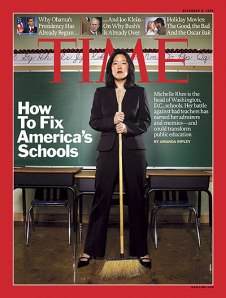
Michelle Rhee wants to get Jesus involved in fixing America’s public schools.

Image Source: Time Magazine

Rhee, the former chancellor of DC schools, has long been the darling of conservatives.  Her anti-union, market-based approaches to fixing public education have won her plaudits as America’s best hope for reforming sclerotic public education systems.

Along the way, Rhee has become the bete noire of educational thinkers such as Diane Ravitch.

Most of the Rhee talk has centered around conservative shibboleths such as vouchers, union-busting, and market-based reforms.

Recently, however, Rhee organized a meeting of religious leaders in Atlanta to discuss the possible roles of religion in reforming public schools.

Rhee’s willingness to talk with folks who want more religion in public schools may signal her broader willingness to engage with the traditional ‘other half’ of conservative school reform.

Among conservatives, free-market ideas and religious traditionalism have long rubbed alongside one another in any discussion of fixing public education.

Now Rhee seems eager to cross that bridge, too.

Traditionalism and Education

This morning’s column by David Brooks in the New York Times is sure to provoke some head-scratching.

Brooks points out the conventional division of contemporary conservatism into two constituent entities. He calls them “economic conservatism” and “traditional conservatism.” Economic conservatives are the free-market champions. They are the sort who cheered when Reagan described the nine most terrifying words in the English language as, “I’m from the government and I’m here to help.” Traditionalists, on the other hand, value localism, organic social structures, and community. They derive their ideas from the likes of Edmund Burke and Russell Kirk.

Those who follow the intellectual history of modern conservatism will scratch their heads that Brooks did not include other important types of conservatism, such as the Jerry-Falwell-style Moral Majoritarianism, the kind of conservatism that wants to regulate personal behavior and use government power to improve America’s morals. And where are the “tribal” conservatives, folks such as Rush Limbaugh who cling to “conservatism” largely as a form of in-group identity?

On the other side, people less familiar with the landscape of modern American conservatism might be surprised at Brooks’ evocation of an entirely different style of conservatism. Those unfamiliar with this traditionalist tradition might be shocked to hear of conservatives who oppose a pure laissez-faire approach to economics. Conservatives, as Brooks puts it, who want government to use a “subtle hand” to encourage family and neighborhood cohesion.

As Brooks notes, influential bloggers such as Rod Dreher at the American Conservative keep traditionalist conservatism alive and kicking. Brooks might also have included Patrick Deneen at Front Porch Republic in this survey.

Those of us most interested in the relationship between conservatism and education can explore Deneen’s exposition of traditionalist hero Robert Nisbet.  In 1953, Nisbet had lamented the increasingly universalist nature of higher education.  Deneen argues that such trends have only accelerated.  As Deneen noted a few years back,

“The modern university system has arisen with the consent of those on the Right and Left alike, particularly in its guise as the modern research university aimed toward the end of ‘creating knowledge’ and providing educations that allow our students to ‘succeed’ and to ‘solve problems.’ Both have actively assented to a national, and increasingly international educational system that becomes annually more homogenous and standardized (This is just as true of supposedly ‘conservative’ administrations, one of which gave us ‘No Child Left Behind’ and Margaret Spellings).”

The traditionalist solution, Deneen argues, is to restore some measure of true diversity to university life in America.  Instead of a spread of cookie-cutter colleges arrayed to produce skilled mechanics of a corporate juggernaut, institutions of higher education could instead strive to emphasize the particularities of their own local communities.  Elsewhere, Deneen has suggested that this particularity must embody not only a constrained localism, but also a truer conception of universality. 

As David Brooks suggests, much of the subtlety of this sort of traditionalism has been read out of today’s conservative discussions of education.  For those of us trying to understand conservative thinking about education, however, it is a useful reminder of the complexities of what Brooks calls “half of [the Republican Party’s] intellectual ammunition.”
