Jesus vs. Koch Bros. in Kansas

So…what IS the matter with Kansas? Last week in the Guardian, Sarah Smarsh offered a mistaken look at the way big money and big religion work together to erode public education in the Sunflower State.

The way Smarsh describes it, “extremist Christians” have been fooled into working with “fundamentalist capitalists.” They both want to privatize public schools, but for different reasons. Her article underestimates and misunderstands the long tradition of American conservatism. New histories, including my new book on educational conservatism in the twentieth century, have laid out the long roots of deep organic connections between religious conservatives and free-market conservatives.

Smarsh describes current education policy in Kansas as dictated from “that ancient place where the religious and the greedy mingle.” As she puts it,

Today, the religious right and wealthy free-marketeers both long to privatize a system that educates 50 million students, but for different reasons. One wants to make 50 million Christians; the other, 50 million paying customers.

As Smarsh explains, at its root this alliance of religion with capitalism results from a cynical conspiracy among the big-money folks. She quotes Rob Boston of Americans United for Separation of Church and State:

The unholy union, he told me by phone from his Washington office, begins with the money holders. “They look at the shock troops of the religious right, and they think, ‘How can we tap into that power? How can we get them to endorse our agenda of privatization?” Boston theorized. In matters of public education, which the religious right finds distasteful along moral lines, “they’re already more than halfway there.”

In reality, according to Boston, big-money folks like the Koch brothers don’t care about Jesus. They only want to get their paws on the public-school sector to weaken the influence of the government and strengthen private business.

I’m no Koch fan. Nor am I a conservative Christian. I do indeed find it believable that some big-money types have hoped to co-opt religious conservatives to get their votes. But to say that the alliance of conservative Christians with big-business is some sort of elaborate scam does not fit the facts.
Right fools left...

Right fools left…

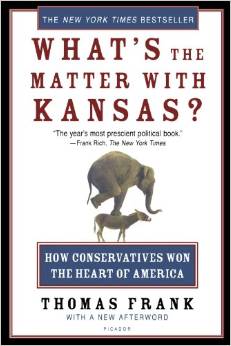
Just as Thomas Frank’s popular book What’s the Matter with Kansas did a decade ago, Smarsh’s argument resolves puzzling situations by resorting to conspiratorial explanations. Frank argued, roughly, that conservative schemers managed to convince working-class voters to vote Republican by waving the bloody shirt of abortion and gay rights. In essence, conservative strategists fooled people into voting against their own economic interests by emphasizing culture-war hot-button issues.

In Frank’s argument, conservative voters come off as dupes, conned into voting for Kansas Republicans because of an irrational attachment to pro-life ideas. Smarsh makes similar implications. Big business free-marketeers manipulate conservative Christians into fighting against public education, in this line of argument.

Let me be as clear as I can be: I don’t doubt that some libertarian business folks might HOPE to enact such a scheme, but the notion that conservative Christians are somehow rustic pawns of a corporate megalith are far too simplistic and Manichean.

Folks like Smarsh and Frank (and me, to be fair) have a hard time understanding how conservative Christians could support privatization, so they (we) jump to a false conclusion that big business has somehow fooled religious conservatives.

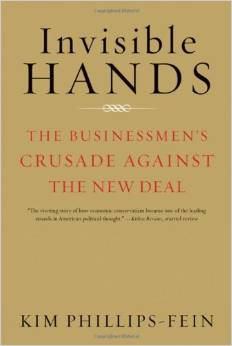
More careful historical treatments have noted the far more complicated connections between big business and evangelical Christianity. Kim Phillips-Fein, for example, looked at the roots of business conservatism in her 2009 book Invisible Hands. Phillips-Fein is certainly no fan of big business, but she describes the way industry leaders such as J. Howard Pew of Sun Oil dedicated much of their fortune to promoting evangelical Protestantism. This was more than a scheme or a scam. It was a long-term effort to promote conservative Christianity and big-business. It was an effort to bring both together for the good of both.
...or does it?

…or does it?

As I’ve found, too, many religious conservatives have embraced big business for reasons that Smarsh and Frank don’t seem to understand. Many religious conservatives have not been fooled into supporting capitalism, but rather see capitalism as an inherent part of their American Christian tradition.

In educational conservatism, at least, the deep organic connections between Jesus and capitalism were not imposed by any move of the sinister Koch brothers. Rather, religious conservatives themselves have long insisted that schools must teach both capitalism and Protestantism. Even a cursory familiarity with the writings of leading conservative activists will make these connections clear.

For instance, in a description of the decades-long educational activism of Mel and Norma Gabler, biographer Jim Hefley connected the dots (emphasis added):

The Gablers also began to grasp progressive education’s grand scheme to change America. They understood why the new history, economics, and social study texts trumpeted Big Brother government, welfarism, and a new socialistic global order, while putting down patriotism, traditional morality, and free enterprise. Simply stated, Mel and Norma realized that the Humanists in education were seeking to bring about the ‘social realism’ which John Dewey and other ideologues had planned for America.

For its part, big business also has a long tradition of pushing for more Jesus in public schools. The National Association of Manufacturers, for example, an industry group, offered in 1939 a new curriculum for schools nationwide. It was vital, NAM leaders argued, for schools to combine “the historical and spiritual foundations of the American system of government, free enterprise and religious liberty.”

I’ll say it again: I don’t doubt that tycoons such as the Koch brothers might hope to manipulate religious conservatives. But it hardly counts as manipulation to encourage conservatives to support a cause they already support.

When journalists such as Thomas Frank or Sarah Smarsh paint a conspiratorial picture of hapless religious conservatives taken in by evil-genius financiers, they do a disservice to those of us hoping to get a better understanding of the ways cultural politics really work in this country.

The Perfect Valentine’s Day Gift

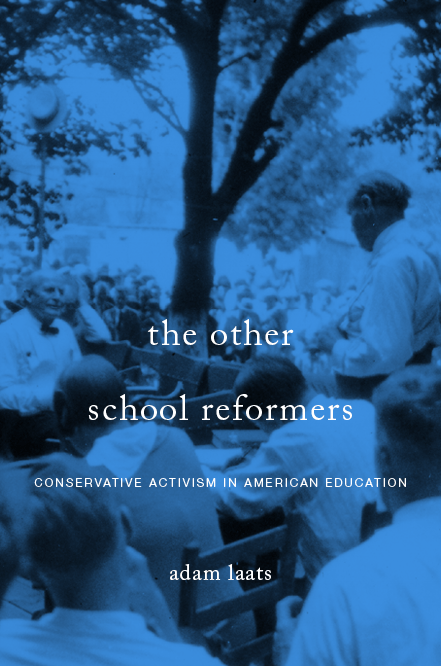
Nothing says “I Love You” more than a book about conservatism and education in American twentieth-century history. Looks like the timing will be perfect.

How to say "I Love You" (But You're Going to Hell)

How to say “I Love You” (But You’re Going to Hell)

My new book is slated for release in early February. Hard to know how it will be received, but one pre-reviewer has called it “a major rethinking of the history of American education.” Another has added, “it would be flat-out wrong to ignore this important book.” Pshaw. . .

For the sophisticated and good-looking readers of ILYBYGTH, the content might not be surprising. In this book, I try to figure out what it has meant to be “conservative” about education in the United States.  How have issues such as creationism, school prayer, and sex ed developed over the course of the twentieth century?  How are they related?  How have conservative attitudes and strategies changed?  How have they remained the same?

In the early days of my research, I had planned to explore the educational activism of leading conservative groups such as the American Legion and the Institute for Creation Research. I was stuck with two big problems, though.

First, the Legion and other conservative groups remained active throughout the twentieth century. How could I describe different conservatives without rehashing the chronology over and over again? I didn’t want to work from the 1920s to the 1970s in every chapter. What to do?

My second problem was one of definition. How could I choose which “conservative” groups to study? I could copy the method of leading conservative scholars such as Russell Kirk or George Nash and use my selection to make an argument about the definition of conservatism. Both Kirk and Nash picked their subjects to give a particular definition to conservatism. For both writers, being a true conservative has meant being a heroic intellectual battling waves of ignorance and knee-jerk leftism. But I’m no conservative myself, and I wasn’t interested in imposing a flattering (or un-flattering, for that matter) definition on American conservatism. What to do?

Luckily for me, I had some help. At a conference back in 2009, I was describing my research. One of the audience members suggested a new approach. Instead of picking and choosing which activists counted as “conservative,” instead of describing the activism of one group after another, why not do it differently? Why not let conservative activists define themselves? This leading historian suggested that I investigate events, not groups.

That’s what I did. I looked at the four biggest educational controversies of the twentieth century: The Scopes Trial of 1925, the Rugg textbook fight of 1939-1940, the Pasadena superintendent ouster of 1950, and the Kanawha County textbook battle of 1974-1975. In each case, conservative activists and organizations fought for their vision of “conservative” schools. By looking at controversies instead of organizations, I could let conservatives define themselves. And I could move chronologically through the twentieth century without rehashing the stories in each chapter.

Did it work? Now I have to let readers and reviewers be the judge. My goal was to explore what it has meant to be “conservative” in the field of education. I did not want to make the relatively simpler argument that conservatism has really meant X or Y. I did not want to give conservatives a heroic history they could draw upon. Nor did I want to give their enemies a catalog of conservative sins. I’m hoping readers think this approach has worked.

So if you’re looking for that perfect romantic gift, consider The Other School Reformers!

Holiday Reading List

Ho ho ho and all that. Like it or not, the holidays are upon us. For you nerds out there who, like me, view such breaks as a chance to catch up on our nerdy reading, I’ll share my plans for the next ten days.

Who's got time for presents?

Who’s got time for presents?

What are you reading these (holi)days?

BOOKS:

I’ve got three books on my desk. One new, one old, and one in the middle. First, I’m excited to read Christopher Rios’s After the Monkey Trial: Evangelical Scientists and a New Creationism (2014). Rios looks at the emergence of a network of creationist scientists after the 1920s. Next, I’ll be taking another whack at Virginia Brereton’s Training God’s Army: The American Bible School, 1880-1940 (1990). Over the years, I’ve read this book several times. As Brereton puts it in her introduction,

The fundamentalist movement was decidedly an educational movement and most fundamentalists were educators; education was implicit in their overriding objective, which was the evangelization of America and the world. To understand fundamentalists, then, it is absolutely necessary to examine their educational efforts.

Hear, hear! This time around, I’m reading it with an eye to my new book about evangelical higher education between 1920-1980. Last but not least, I want to spend some time with John Rawls’s A Theory of Justice (1971). This is one that I read many years ago as an undergraduate. For so long now I’ve been reading conservative writers and pundits, I feel a need to re-connect with this fundamental statement of liberal ethics.

Top of my stack...

Top of my stack…

ONLINE:

I’ve been putting off Ted Davis’s series at the BioLogos Forum for too long. Davis is the one of the best historians out there for those of us interested in creationism and evolution. His series, “Fundamentalists, Modernists, and Evolution” ran through the summer into this past fall. I meant to read them as they came out, but as usual I fell behind. Thanks to these holidays, I’ll finally take time to read them more carefully.

There have been a couple of longish articles recently about evangelical religion and higher education that I didn’t have time to read yet. In The Atlantic, Laura Turner noted the activism at evangelical colleges about the killings of Michael Brown and Eric Garner. I have high hopes that Turner does not assume that evangelical college students have never engaged in this sort of social activism before. As I’m discovering in my current research, there is a strong tradition at Christian colleges of left-leaning student activism.

Next up, an article that is doubly interesting for anyone who wants to understand evangelical higher education. Esmerelda Sanchez writes in Christianity Today about the experiences of Latina Pentecostals in higher ed. I’ve only read the teaser so far, but it looks as if Sanchez argues that as women, as Latinas, and as Pentecostals, those like her have faced special hurdles in the world of American higher education.

DISSERTATION:

At the far edge of nerdy, I’m looking forward to reading a newly completed dissertation. Just completed at the University of Delaware is Kevin Currie-Knight’s From Laissez-Faire to Vouchers: An Intellectual History of Market Libertarian Thought on Education in Twentieth-Century America. Aside from the peerless Milton Gaither, historians have not taken a close enough look at the libertarian tradition in educational thought in US history. I’m hoping Currie-Knight’s work addresses some key issues of the meanings of markets in the imaginations of ed reformers. For those who don’t have access to a university library, you can always get easy access to dissertations like this at your local public library. Most public libraries have access to interlibrary-loan services, and they can often get you a pdf of any dissertation lickety-split.

That’s my plan. As usual, I won’t be likely to get to all of this in the next week. I’ll try to read all I can as I breeze through the holidays, packed full of candy canes and booze.

What are YOU reading as we say goodbye to 2014?

A Story We Should Care More About

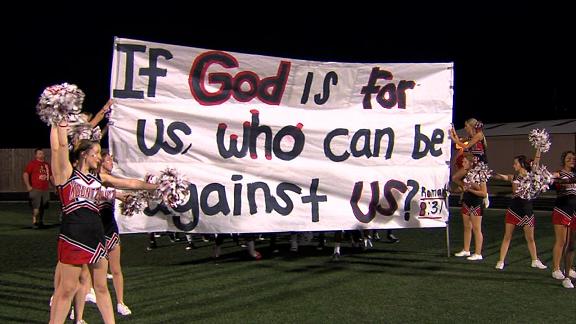
Every new story about creationist teachers or praying cheerleaders gets lots of attention, but the news we should really care about involves the humdrum topics of taxes and school funding. As creationist hero William Jennings Bryan put it in the 1920s, “The hand that writes the paycheck rules the school.” In Alabama, conservatives passed a law allowing taxpayers to write their paychecks in a different way. Yesterday, the state Supreme Court started hearing arguments about this new conservative strategy. This story is one we should all follow as if it were interesting. After all, it promises to give an answer that no praying cheerleader ever could: Will conservative taxpayers be able to rule the school?

Don’t look at us: Study school-funding laws!

Don’t look at us: Study school-funding laws!

The Alabama Accountability Act allows taxpayers to divert their tax money away from public schools and toward private ones. Alabama is not alone. More than a dozen states have similar laws on the books. What the justices decide in Alabama might direct debate about these laws nationwide.

Of course, not all the laws are the same. As the National Council of State Legislatures reported, as of April 2014, 14 states had some sort of tax-direction law. In general, these laws allow people to shift some of their taxes to scholarship funding organizations (SFOs). Instead of the tax money going to the government, it goes to these organizations. In turn, the SFOs defray the cost of private school for selected students.

Why should we care? Some critics of these laws insist that the laws are intended to break down the wall of separation between church and state. By allowing students to attend private religious schools, some say, these laws use tax dollars to pay for religious indoctrination.

In Georgia, for example, enemies of that state’s law have worried that students will be sent to conservative schools.  At some schools, foes announce, students are forced to pray and banned from supporting homosexual rights.

Conservative supporters of the laws, such as the Virginia-based Institute for Justice, insist that these laws are the last best chance for low-income students. With tax-funded scholarships, low-income students will be able to escape failing public schools. The real issue, according to the Institute for Justice, is the “right of all . . . parents to send their children to the school of their choice.”

Historically, since the 1930s conservatives have agreed that public schools have been taken over by a grasping, out-of-touch academic elite. Any effort to weaken public schools and strengthen private ones has been seen by many conservatives as a win. As I argue in my upcoming book about twentieth-century educational conservatism, this notion has been both enormously influential and widely shared among very different sorts of conservatives.

Religious conservatives have insisted that secularizing “humanists” like John Dewey have taken over public education. Free-market conservatives have worried that the same power-drunk Keynesian economics that dominated public policy between 1930 and 1980 had turned public schools into intellectual cesspools. Patriotic conservatives fretted that sneaky subversion had become the public-school norm. And we can’t forget, of course, that white racial conservatives considered desegregated public schools to be worse than no schools at all.

This sort of tax-direction law is the most recent strategy conservatives have used to move students out of public schools. Will it work? We should all be riveted to the noises coming out the Alabama Supreme Court. Their decision could set a precedent other states will have to notice.

School Politics Cracks the Race Wall

The unions like the one on the left...

The unions like the one on the left…

Who backs market reforms of schools? Conservatives, of course, and rich people. Oh, and African American voters. The race for superintendent of public instruction in California is suggesting a dramatic realignment of electoral politics. But those conservative dreams might not be warranted.

As we’ve explored in these pages (here and here, for example), white conservatives have long dreamed of shaking off their racist reputations. In school politics, it seems those efforts have finally begun to bear fruit.

It has not been easy. The conservative, or, to be more precise, the more conservative candidate for New York City mayor tried to woo non-white voters with similar school appeals. That candidate, Joe Lhota, blasted Bill de Blasio for his opposition to charter schools. Such schools, Lhota insisted, were the only educational hope for “minorities and inner city children, and children of immigrants.”

In New York City, it didn’t fly. But the race in California is much different. According to the San Jose Mercury News, one candidate for superintendent has cobbled together a coalition of super-rich backers and conservative voters, plus Latino and African American support.

That candidate, Marshall Tuck, is running neck-and-neck with the establishment choice, incumbent Tom Torlakson. Tuck’s success is built on his appeal to both the rich and the poor. The teachers’ unions have spent plenty to support Torlakson, but Tuck has still managed to outspend them, thanks to his deep-pocketed backers among the usually conservative California business elite.

Non-white voters like Tuck’s plan. According to a recent poll, Tuck leads by 38% among African American voters and 13% among Latinos. Why? One expert thinks that such voters want more charter schools, more vouchers, and less power for teachers’ unions.

Could this be the realignment conservatives have long been dreaming of? A chance to appeal to the conservative feelings among non-white voters? A chance to split off non-whites from the clutches of the Democratic Party and get them voting Republican on issues such as gay rights, abortion, and school choice?

After all, there have been similar epochal realignments in electoral politics. Most famously, FDR managed to convince African Americans to vote Democrat. Since the days of Abraham Lincoln, African Americans had been solidly Republican. Or, more recently, Reagan wooed “lunchpail” Democrats to the side of the GOP.

Could we be on the verge of a similar realignment? One in which conservative non-white voters ditch the Democrats in favor of the more conservative GOP? And if so, will school politics lead the charge?

There are a couple of things that should temper the hopes of conservative poll watchers. First, this California race is non-partisan. Both candidates are Democrats. So conservative African Americans and Latinos can vote for the more conservative candidate without abandoning the party of FDR and LBJ.

Second, though Tuck is the candidate with the more conservative positions, he’s not calling himself that. Instead, as with much of school politics, Tuck is calling his marketization plan the side of “school reform.” And his election fund, filled by mega-rich donors, officially calls itself “Parents and Teachers for Tuck.”

In this case, non-white voters seem to like the market idea that conservatives have long promoted. But they like it when it comes in a Democratic Party wrapper. They like it when it is called the progressive choice, not the conservative one.

Will non-white voters soon flock to the conservative banner? Maybe, but this race shows they might only do so if conservatism calls itself something else.

Salon Article Wrong on the Right

Do conservatives hate the Common Core?  Like anything in cultural politics, it all depends on what we mean by “conservatives,” “hate,” and “the Common Core.”  In other words, I understand that this is a tricky subject. But it is still painful to read writers like Gabriel Arana get the Right so Wrong.

As we’ve discussed in these pages, conservatives are anything but united about the new common standards.  Some old-schoolers such as Phyllis Schlafly blast the new standards as “control by Obama administration left-wing bureaucrats.”  And Catholic conservatives have worried that the new standards will rob students of the “the virtues necessary to know, love, and serve the Lord.”  Libertarians have bashed the core as the death knell of educational independence.  More colorfully, one conservative politician described the standards as the ultimate progressive “beer bong for American education.”  We could go on and on.  Conservative pundits and politicians have offered a vast treasure-trove of reasons to oppose the newish standards.

On the other side, thinkers have also offered plenty of conservative arguments in support of the core.  Karen Swallow Prior of Liberty University, for example, has suggested that “no one more than evangelicals” should understand the reason for effective literacy instruction.  Kevin T. Brady and Stephen M. Klugewicz argue that the new standards will serve to weaken the power of the political Left.  The new standards, these conservatives assert, will force left-leaning teachers and educational bureaucracies to embrace the rich cultural tradition of Jesus, St. Paul, Martin Luther, and GK Chesterton.  Nuts-and-bolts free-market conservatives also like the standards.  Chester Finn and Michael Petrilli, for example, think that these standards are the least-bad way to insure that America “knows how all its kids and schools are doing . . . [with] a rigorous set of shared expectations for the three R’s.”

It’s complicated.  I get it.  But that complexity only makes me lament all the more the simplistic description offered by Arana’s recent Common-Core article in Salon.  A few days ago, Arana offered this glib and breezy drive-by of conservative attitudes:

Education policy wonks on the right oppose the standards because they view it as a step toward nationalizing education — as a general rule, they prefer to keep control local. Tea Party types, on the other hand, fear they will eventually be used to teach kids about dangerous stuff like evolution. But since George W. Bush signed No Child Left Behind into law — the largest federal education initiative to date — Republicans have in principle been less opposed to federal involvement in education. A lot of the pushback from Republicans . . .  is about the Obama administration, which has enthusiastically supported Common Core.

Let’s take a look at the claims here:

First, “Education policy wonks” don’t like the standards?  It’s hard to think of any more wonk-y conservatives than Michael Petrilli.  And Petrilli, the author of Wonk-tastic articles such as “How School Districts Can Stretch the School Dollar” and “America’s Private Public Schools” is the Right’s most vocal advocate of the new standards.

Next, it is true that some conservatives worry that the Next Generation Science Standards will push more evolution into schools.  It’s also true that some conservatives have bundled their opposition to the Common Core with their opposition to evolution.  But what leads Arana to call this “Tea Party” opposition?  Some polls suggest that conservatives who identify as Tea Party members tend to deny evolution at higher rates than other members of the Republican Party.  But as Dan Kahan has pointed out, any statements about a shift in Republican attitudes about creationism overall must be tempered.  And behind it all, how often do “Tea Party” types talk about creationism, compared to their central interests in smaller government?

Last but not least, Arana is smart to point out that things might be changing.  But is he aware of the difficulties conservative politicians face when it comes to supporting the Common Core?  Jeb Bush, for example, supports the new standards but is always very careful to differentiate the standards from federal control.  In contrast to Arana’s claim, Republicans are not less opposed to “federal involvement in education.”  They MAY be less opposed to shared standards, but “federal control” still remains the third rail of conservative education policy.

So, again, I don’t bash Arana—or anyone—for not following every curve and wrinkle of conservative debates over the Common Core standards.  But if you open your mouth to deliver pearls of wisdom, it always makes sense to at least get the general outline right.

Paul Ryan’s Capitalism-Christianity-Conservatism Cocktail

Who cares about the poor? Congressman Paul Ryan says conservatives do.  After taking heat from Catholic and non-Catholic thinkers alike for his 2012 budget plan, Ryan issued a public mea culpa.  Now he says he wants his conservatism to include both capitalism and caring Christianity.  Will it work?

I'm a conservative, and I care.

I’m a conservative, and I care.

You may recall Ryan’s budget plans of 2012.  As a young darling of free-market conservatives, the Catholic Congressman from Janesville, Wisconsin offered a budget plan that would have slashed public spending.  As he moved into the role of the vice-presidential candidate for Mitt Romney, Congressman Ryan defended his vision as an application of the Catholic principle of “subsidiarity.”  The way Ryan used it, that principle meant that charity should begin at the local level, not be imposed from distant Washington bureaucrats.

With the presidential race of 2016 already heating up, Ryan has offered a heartfelt revision, what one journalist calls a “holy war” on poverty.  As Ryan explained, his new budget proposal will take a more caring approach—a more Christian approach—toward America’s least fortunate.  Conservatives, Ryan said,

can do a better job of describing how our founding principles, which are in perfect keeping with Catholic social teaching, can make a difference in everybody’s life — especially the disaffected and the displaced.

Ryan claims to have had a revelation. As he described it, he absorbed some wisdom from the folks at home. In 2012, he had been using the phrase “makers and takers” to describe the roots of America’s economic woes. At a county fair, Ryan was upbraided for his callous rhetoric by a local Democratic activist. As he remembered last month in the Wall Street Journal, the encounter forced Ryan to reexamine his approach.

that day at the fair was the first time I really heard the way the phrase sounded. Later, I thought about that guy from the Democrats’ tent, and eventually I realized: He’s right.

Who was a taker? My mom, who is on Medicare? Me at 18 years old, using the Social Security survivor’s benefits we got after my father’s death to go to college? My buddy who had been unemployed and used job-training benefits to get back on his feet?

The phrase gave insult where none was intended. People struggling and striving to get ahead—that’s what our country is all about. On that journey, they’re not “takers”; they’re trying to make something of themselves. We shouldn’t disparage that.

Of course, the phrase wasn’t just insensitive; it was also ineffective. The problem I was trying to describe wasn’t about our people; it’s a philosophy of government that erodes the American Idea.

As a result, now Congressman Ryan is offering a new vision of caring conservatism. His new budget plan, he promises, will bring a more effective approach on the fiftieth anniversary of the War on Poverty. As Ryan put it,

When you compare liberal progressivism’s promises with the future that conservatism can actually deliver, the choice is clear. The way forward I’m proposing fosters risk-taking, ingenuity and creativity. Instead of growing government, it grows the economy and offers everyone greater opportunity and prosperity. It can unwind the cycle of dependency and finally defeat poverty. And, perhaps most important, it protects our rights while offering a real safety net for those in need—without overpowering the private economy or our private lives.

We’ve seen this before, of course. When George W. Bush wanted to adjust his conservative brand in 2000, he called himself a “compassionate conservative.”  Now Congressman Ryan seems to be trying a similar strategy.

Will it work? Can conservative politicians marry conservative Christianity with free-market principles?  Can a good-looking young Congressman combine conservative desires for a smaller government with conservative traditions of Christianity?

Don McLeroy’s Long Game

What do Phyllis Schlafly, Moses, and country/western music have in common? They all get happy shout-outs in new history textbooks in Texas.  Or at least, that’s what conservative education leaders wanted.  As Politico reported yesterday, new history textbooks in Texas are causing a stir.  But this time, it is liberal activists, not conservative ones, who are denouncing the textbooks as biased and ideological.

What Hath McLeroy Wrought?

What Hath McLeroy Wrought?

The new textbooks were written to satisfy new standards approved years ago by the Texas State Board of Education.  Back then, conservatives on the board, led by the genial Don McLeroy and the obstreperous Cynthia Dunbar, pushed through new standards that warmed the hearts of conservative activists.

No one who watched Scott Thurman’s great documentary about these Revisionaries can forget the moments when the SBOE debated including more country-western music and less hip hop.  More positive statements about Reagan and the National Rifle Association.  More happy talk about America’s Christian past and less insistence on the horrors of racial segregation.

The Revisionaries

The Revisionaries

As Don McLeroy said at the time, “America is a special place and we need to be sure we communicate that to our children. . . . The foundational principles of our country are very biblical…. That needs to come out in the textbooks.”

Now those changes in the Texas standards have shown up in new social-studies textbooks.  As Stephanie Simons reports in Politico, liberals have complained that the new texts are woefully biased.  In some spots, the books apparently knock Affirmative Action.  They pooh-pooh the benefits of taxes.  They imply that racial segregation was really not so bad.

For those who know the history of America’s educational culture wars, this seems like a drastic turnabout.  Throughout the twentieth century, conservative school activists complained that they had been locked out of educational influence by a scheming leftist elite.  Textbooks and standards, conservatives complained, had been taken over by pinheaded socialist intellectuals.

In one of the most dramatic school controversies of the twentieth century, for instance, conservative leaders lamented the sordid roots of new textbooks.  That battle took place in Kanawha County, West Virginia, across the tumultuous school year 1974-1975.  Conservatives were disgusted by the sex and violence embedded in new literature textbooks.  But some of them weren’t surprised.

Conservative leader Elmer Fike told readers that the textbooks were bound to be rotten.  In Fike’s opinion, conservatives didn’t even need to read the books.  As he explained,

You don’t have to read the textbooks.  If you’ve read anything that the radicals have been putting out in the last few years, that was what was in the textbooks.

As the Kanawha County battle ground on, California’s conservative celebrity schoolman Max Rafferty came to town.  Rafferty, too, told a crowd of West Virginians that they shouldn’t put any faith in textbook publishers.  Those publishers, Rafferty explained, only wanted to make a buck.  As he put it,

They have no particular desire to reform anybody, do anybody any good or find a pathway to heaven.

These days—in Texas at least—the shoe is on the other foot.  The conservative standards that the state adopted in 2010 have pushed market-conscious textbook publishers to come up with books that meet them.  And at least some conservatives are delighted with the success of their long game.  As conservative school board member David Bradley told journalist Stephanie Simon, liberals who complain about biased textbooks can lump it.  “They need to put on their big-girl panties,” Bradley crowed, “and go run for office.”


Heavy Hitters Take on the Common Core, Sort of…

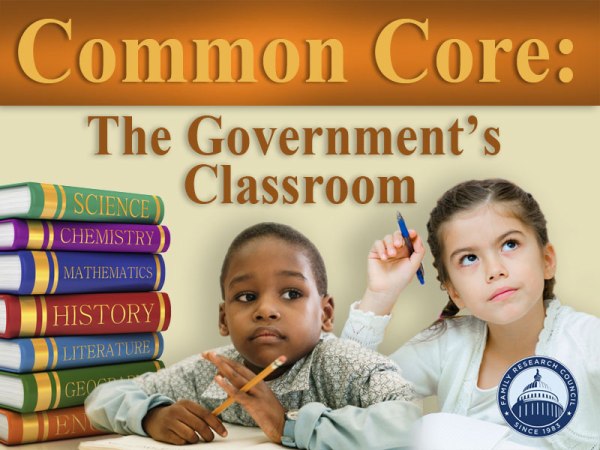
What is a conservative to think? Are the Common Core Learning Standards a threat? A blessing? As we’ve discussed recently in these pages, some conservative intellectuals have argued that the standards are a triumph of conservative activism. But tonight, the Family Research Council hosts a star-studded slamfest to explain all the reasons why conservatives should fight the standards. Yet it seems to me that this group will conspicuously leave out some of the most obvious reasons for conservatives to oppose the new standards.

They Are Coming for Conservatives' Children...

They Are Coming for Conservatives’ Children…

What’s the FRC’s beef with the standards? The name of tonight’s event says it all: “Common Core: The Government’s Classroom.” As have other leading conservatives including Phyllis Schlafly, Glenn Beck, conservative Catholics, and libertarians such as JD Tuccille, the heavyweights at tonight’s event will likely condemn the standards as another example of leftist government overreach.

For tonight’s roundtable, the FRC has assembled folks such as Louisiana Governor Bobby Jindal and University of Arkansas scholar Sandra Stotsky. Governor Jindal has taken the lead among conservative state leaders with his endless legal wrangling over the new standards. Professor Stotsky has become the academic leader of the antis. Her work with the standards’ development left her convinced that the Common Core was rotten. As Stotsky argued in a video jeremiad produced by the anti-Core Home School Legal Defense Association, the intellectual weakness of the standards presents as much of a threat as does the sneaky way they were introduced.

What is a conservative to think about the Common Core? Tonight’s video roundtable apparently hopes to convince more conservatives to fight it.

It will raise key questions about conservatism and educational politics. For example, from time to time, the anti-Core fight is tied to anti-evolution. As we noted a while back, Ohio’s now-defunct House Bill 597 pushed IN creationism as it pushed OUT the Common Core.

To this observer, it seems natural for conservatives to use the political muscle of creationism to fight against the Common Core. In some cases, conservatives have done just that, since the Next Generation Science Standards would likely push for more evolution and less creationism in America’s classrooms.

But this FRC event doesn’t mention evolution or creation. It doesn’t mention literature, history, or math, either, for that matter. Instead, the focus of tonight’s event seems to be on the federal-izing dangers inherent in the new standards.

But why not? Why wouldn’t the Family Research Council want to use every intellectual weapon at its disposal to discredit the standards in conservatives’ eyes? Maybe they will, of course.  The different panelists might emphasize different aspects of the standards.  One or some certainly might note the connection between evolution education and centralized power.  I’d love to watch and find out.

Unfortunately, I won’t be able to. If anyone has the time tonight to spend with this all-star conservative panel, I’d love to hear your thoughts…

Will the REAL Conservative Fan of the Common Core Please Stand Up

Are the new(ish) Common Core Learning Standards “conservative?” Some say yes, some say no. But even among those who say yes, we see a split. Leading conservative educational thinker Sol Stern offers one “conservative” vision of the Common Core, while Michael Petrilli gives another. And their differences can tell us a lot about the complicated world of conservative educational thinking.

Among some conservatives—some of them literally from an earlier generation—the new standards seem obviously objectionable, simply because of their provenance. Phyllis Schlafly, for example, emerged from the 1970s to bash the Common Core as a power grab by “Obama administration left-wing bureaucrats.” Some pundits from a newer generation agree. Glenn Beck and Michelle Malkin warn that the new standards are turning American kids into “guinea pigs.”

But among those conservatives who like the Common Core—or at least think the new standards are the least-bad option—we see different emphases. Both Stern and Petrilli agree that the new standards will offer a more rigorous academic experience. But Stern suggests that such rigor is the core of the conservative case for the Core, while Petrilli says that academic rigor is only one aspect of the conservative argument in favor of the new standards.

Writing in the pages of the New Criterion, Stern defends the Common Core as the best “chance of restoring traditional academic content to the classroom.” As Stern explains,

As a conservative, I remain convinced that, faults and all, the Common Core still presents a golden opportunity and a challenge for states and school districts to rethink what is taught in their classrooms. The Standards are more than just a list of learning objectives and skills that American students are expected to achieve by the end of each grade level. The most hopeful part of the new Standards is that they reject the instructional malpractice that prevents the public schools from fulfilling their historic mission of producing literate American citizens who know something about their country’s history and its republican heritage. Contrary to the conservatives’ complaints, the Common Core is, in fact, a document that the founders would approve.

Michael Petrilli does not disagree. He thinks the Common Core will indeed help re-introduce academic rigor to public schools. But as he argued a while back in the pages of the Weekly Standard along with co-author Chester Finn, the real score of the Core is elsewhere. As Petrilli tells the story, the road to the Common Core began back in the days of Bill Bennett, Reagan’s second secretary of education.

Petrilli argues that the new standards fulfill a generation-long conservative plan to make schools more measurable, more interchangeable. With such standards in place, free-market conservatives have thought, public schools could be freed from the dead hand of left-leaning teachers’ unions. Parents could be offered a market-friendly menu of charter schools and voucher-funded private schools.

In Petrilli’s words,

Standards do a good job of clarifying the public’s expectations for schools, and signaling to parents and taxpayers whether the campus down the street is educating its students poorly or well. But standards-based reform has never had a suitable answer for failing schools. It can identify them but has had little success turning them around.

Choice, on the other hand, is great at creating new school options, places that can replace the failures and give needy kids decent alternatives. Yet market-based reform needs reliable consumer information for it to lead to strong outcomes—information that standards and tests are excellent at providing.

We might describe this difference in conservative emphases as a difference between a “classroom” approach to conservative school reform and a “systemic” approach. Or maybe a “traditionalist” versus a “free-market” approach.  And, again, we don’t want to make these plans sound entirely exclusive.

But it seems as if Stern is arguing that the heart of “conservative” reform must be with an intellectual change in the way kids are taught. Stern excoriates pedagogical ideas such as “balanced literacy.” Instead, Stern celebrates the approach of anti-progressive E.D. Hirsch. Instead of looking at structural reforms, Hirsch and Stern wanted conservative reforms to begin in the classroom. Students needed to learn basic cultural information, to focus on “Core Knowledge.”

Petrilli, on the other hand, emphasizes a different approach. Academic rigor is important, Petrilli argues, but it is only one of the reasons for conservatives to support the Core. At least as important, Petrilli says, is the boost the standards will give to school choice. Without what Petrilli calls “true external standards,” it will always be impossible to introduce a true educational marketplace. After all, how can parents know what school is the best if there are not measures that compare schools in a fair way?

In any case, these conservative pleas in favor of the Common Core might be too little, too late. Recent polls have indicated plummeting popular support for the new standards. In spite of the smart arguments of intellectuals like Stern and Petrilli, parents might decide that these standards are just too iffy.