Does Anyone Actually Read the Index?

My eyeballs are beginning to chafe.  This week, I’m finishing up the index for my new book.  It’s a lot of work, even though I had a gifted grad student do most of the intellectual heavy lifting.

How the sausage gets made...

How the sausage gets made…

So now I’m wondering: Does anyone actually read the index?  I know professional academic historians do.  In fact, that’s one of the first cheap tricks we learn in our PhD programs.  We flip quickly to the back to see what we can glean from the index.  What are the book’s themes?  What are its main ideas?  Its blind spots?

But do any normal people read a book’s index?  Make no mistake, I’m compiling a kick-ass index, whether anyone ever reads it or not.  But I can’t help but wonder if readers will find useful my painstaking distinctions between “authoritarian teaching” and “traditional education.”

Coming soon...

Coming soon…

Will anyone care that I spent so many long hours in a stuffy library teasing out the nuances of “educational conservatism” as opposed to the broader category of “conservatism” in general?


The Movie that Will Save Our Children

A Florida lawmaker has offered a new definition of a summer must-see movie.  According to the Hollywood Reporter, State Senator Alan Hays has promised a bill that would force all public high-schools and middle-schools to screen Dinesh D’Souza’s America: Imagine the World without Her.

As I’ve argued elsewhere, D’Souza’s film seems to be another conservative exercise in shadow-boxing.  The film assumes that American history teachers are pushing an ideologically inspired hatred against the United States.  Historically, that just hasn’t been the case.  As I argue in my upcoming book, conservatives have exerted outsized influence over the kinds of history their kids learn in public school for decades.  The notion that schools have been taken over by a scheming cabal of sneaky progressive educators and historians just doesn’t match the historical record.

Nevertheless, it is a notion that resonates strongly with conservatives.  As Senator Hays put it,

I’ve looked at history books and talked to history teachers and the message the students are getting is very different from what is in the movie.  It’s dishonest and insulting. The students need to see the truth without political favoritism.

Ironically, Senator Hays’ plans might just prove the case.  As the Hollywood Reporter points out, Hays’ bill might actually pass, given the political landscape in Florida.  If it did, or even if it made a strong showing, it would demonstrate the continuing influence of conservative activism on public education.


Sneaky Subversion in Teaching US History

If standards and curricula seem balanced and fair, does that mean that subversives have done a good job of disguising their sneaky ideological poison? That has long been the accusation of conservative intellectuals. Leftist academics, conservatives have charged for decades, make their work seem neutral, while really injecting a biased and enervating leftism.

We see this tradition alive and well in conservatives’ recent attack on the teaching of US History. As I noted in an essay in History News Network, Dinesh D’Souza’s new film warns that leftist teachers have taught America’s kids to hate America.

Other conservative intellectuals take a similarly skeptical view of the new curriculum for Advanced Placement US History. Peter Wood of the conservative National Association of Scholars accused the new APUSH curriculum of insisting on a “worldview that emphasizes America as a place of European conquest, economic exploitation, and the struggle for basic rights against the power of the privileged.” Similarly, conservative activists Jane Robbins and Larry Krieger have warned that the new APUSH curriculum peddles a “consistently negative view of the nation’s past.”

Wood, especially, has offered examples of the sorts of negative attitude he critiques. One of the subtopics for the early period, Wood points out, depicts European settlers as devilish racists:

Reinforced by a strong belief in British racial and cultural superiority, the British system enslaved black people in perpetuity, altered African gender and kinship relationships in the colonies, and was one factor that led the British colonists into violent confrontation with native peoples.

But more important than the specific examples of egregious anti-American sentiments, Wood charges, is a more subtle attitude embedded within the curriculum. As he puts it, “Sometimes these concerns break out into overt emphasis but they are present throughout.”

Apparently unconsciously, these conservative critics are echoing a long tradition of conservative educational thinking. As I argue in my upcoming book, throughout the twentieth century conservatives warned that schools were being led in leftist directions, often by this same sort of sneaky subversion. The leftists were so sneaky, conservatives warned, that readers might not even notice their subversion.

In the 1939-1941 conservative campaign against Harold Rugg’s social-studies textbooks, for example, critics warned that unwary readers could be duped into thinking the books were balanced and fair. One coalition of conservative activists called the books’ leftism “extremely clever.” Instead of openly proclaiming their leftist bias, Rugg’s books led children “with gentle language and a pedagogic smile . . . through the successive stages of indoctrination.” These conservatives conceded that many readers might find nothing wrong with Rugg’s books. But that only meant, they warned, that the danger was that much greater.

This sort of obvious-only-to-the-initiated analysis of leftist bias seems a double-edged sword. On the one hand, it presents conservative intellectuals with a difficult task. They must convince readers that even seemingly balanced curricular material is secretly anti-American, secretly leftist. That’s a tall order. But when school subversion is embedded cunningly within seemingly neutral material, conservative intellectuals are able to explain why so many popular textbooks and curricula have prospered in spite of their leftist implications.

Are the new APUSH materials really biased? Try it. Read the new curriculum guide. Does it seem like a biased leftist document to you? Its makers didn’t think so. But does that prove that conservative intellectuals are paranoid? Or does it show, rather, that the educational establishment is so dominated by left-leaning academics that they don’t even notice their own bias?


Conservative College Cheapskates

Cheap college for all!  That’s the call of the conservative American Legislative Exchange Council (ALEC).  ALEC members will consider a proposal to mandate public university education for under $10,000.  So why is this a “conservative” idea?

The conservative group’s annual meeting agenda just came out.  Members will be asked to consider several model bills about education, including two that support expansion of charter schools.  No surprise there.  Many free-market conservatives, way back to the 1950s work of free-market guru Milton Friedman, have wanted to reform education by introducing market principles.

ALEC's Get-Together

ALEC’s Get-Together

But I’m puzzled by the higher-ed model bill.  ALEC proposes the “Affordable Baccalaureate Degree Act,” a model bill that will require public universities to offer cheaper college educations.  In the words of the proposed bill,

The Affordable Baccalaureate Degree Act would require all public four-year universities to offer bachelor’s degrees costing no more than $10,000, total, for four years of tuition, fees, and books.  The Act would require that ten percent of all public, four-year university degrees awarded reach this price-point within four years of passage of this act.

To achieve this price-point, universities would be instructed to capitalize on the opportunities and efficiencies provided by (1) web-based technology and (2) competency-based programs.

Simple enough.  There has been oodles of talk lately about the problem of burgeoning student debt.  This proposal would at least introduce a new way to talk about the price and value of college education.

I don’t know the history of ALEC’s model bill, but it looks to be modeled on a similar bill in Texas.  Two years ago, Texas Governor Rick Perry—a decidedly and self-consciously “conservative” politician—introduced a similar affordable-college law.

But here’s my question: What is “conservative” about this proposal?  I know there are conservatives and then there are conservatives, but ALEC has traditionally been a champion, in its words, of “Limited Government, Free Markets, [and] Federalism.”

On first glance, it isn’t clear how this college model bill would limit government or help free markets.  Isn’t the price of college education part of a free market?  Wouldn’t a government imposition of a price cap increase the role of government and decrease the fluidity of the free market?

Here’s my hunch: The key to understanding the “conservative” elements of these bills lies in two important words, “efficiencies” and “competency.”  As I argue in my upcoming book about the history of conservative activism in education, conservatives have long looked skeptically at the way higher education has been run.  Just as conservatives have often insisted that teachers’ unions exert an unhealthy stranglehold on K-12 schooling, they have also often insisted that higher education has been taken over by sclerotic bureaucracies and leftist ideologues.

By forcing colleges and universities to offer credit for “competencies,” free-market conservatives might hope to shatter the grip of college bureaucracies.  Too often, conservatives might argue, college rules have insisted that students spend a certain amount of time in seats, parroting back academic drivel instead of learning real skills.  If students can demonstrate competency in life skills—running a business, maybe, or opening a charter school—those “competencies” should get college credit.

Similarly, by promoting “efficiencies” in higher education, free-market conservatives might hope to force lazy and pampered college faculty to use new technology to deliver information and skills more quickly and cheaply.  Since public universities are funded at least in part by government money, forcing them to run more quickly and cheaply could be seen as crucial part of conservatives’ desire to slim down big government.

That’s my guess, in any case.  To those who know their higher-education history, though, it is surprising to hear cheap public education promoted as a “conservative” cause.  During the late 1960s and early 1970s, after all, accessibility and affordability were hallmarks of leftist activism in higher education.

Perhaps the best example of this is the history of City University of New York.  During the 1920s and 1930s, CUNY, especially City College of New York, was known as the “Ivy League of the Proletariat.”  Top students crowded into CCNY, especially Jewish students excluded from Ivy League colleges.  It was an elite institution, admitting only the most qualified students.  Back then, it was also free.  If you could get in, you could go.
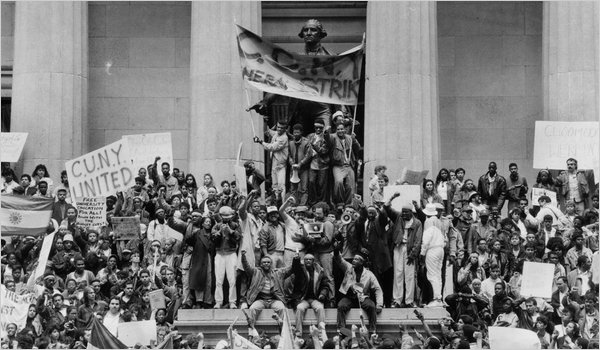
Do these CUNY tuition protesters look "conservative" to you?

Do these CUNY tuition protesters look “conservative” to you?

In the late 1960s, student activism forced a change in admissions policy.  To fight elitism and cultural prejudice, leftist activists pushed through an open admission policy.  Back then, it was leftist student radicals who called for cheap college for all.

Does ALEC’s model bill signal a shift?  Is it now a “conservative” cause to limit the cost of public higher education?


Teachers’ Unions: The Root of All Evil

Last week a California judge decided that bad teachers can be fired.  In his decision in Vergara v. California, Judge Rolf M. Treu dealt a severe blow to the power of teachers’ unions.  Not surprisingly, conservative intellectuals rejoiced.  For almost a century, conservative school reformers have insisted that teachers’ unions represent a double-headed threat.  But here’s my question: why do today’s conservatives only focus on one half of their traditional gripe against teachers’ unions?

In Judge Treu’s decision, he argued that ineffective teachers have a negative impact on students.  And since the poorest students suffer most, the judge concluded that the situation was open to judicial remedy.

In the pages of the conservative National Review, writers celebrated the decision.  One “liberal” pundit shared her horror stories of terrible teachers and school principals, protected and made more arrogantly despicable due to their union-backed sinecures.  Andrew Biggs suggested taking the California decision national.  Biggs offered a simple four-word phrase to rejuvenate the nation’s public schools: Fire the Worst Teachers.

Not every conservative intellectual liked the decision.  Frederick Hess of the American Enterprise Institute warned that the judge’s power-grab could spell out a future of terrible decisions by similarly activist judges.

But even Hess did not support the unions’ traditional role as the unpopular defender of teacher-tenure rules.  After all, conservative school reformers have for generations identified unions as the source of all that was rotten in America’s public-education system.

Perhaps most memorably, the late free-market economist Milton Friedman argued that the dead hand of teachers’ unions had strangled public schooling.  As I wrote a few years back in the pages of Teachers College Record, Friedman’s narrative of educational history pivoted on the development of teachers’ unions.  Most teachers, Friedman wrote, were “dull and mediocre and uninspiring.”  Nevertheless, beginning in the 1840s, Friedman believed, those teachers had captured control of America’s educational system.  Instead of working to improve education for all, teachers’ unions only worked for their own “narrow self-interest.”  The driving force of expanded public-education systems in the 1840s, Friedman argued in Free to Choose, was teachers’ selfish desire to

enjoy greater certainty of employment, greater assurance that their salaries would be paid, and a greater degree of control if government rather than parents were the immediate paymaster.

Today’s conservative complaints about the power of teachers’ unions owe a lot to Friedman-esque free-market critiques.  Schools suffer, free-market conservatives argue, when the market for good teaching talent is blocked by sclerotic union rules.  Instead of bringing in the best teachers, unions dictate a self-interested last-in-first-out rule that preserves seniority, no matter how incompetent.

But there is another reason why conservative intellectuals have long battled against the power of teachers’ unions.  Those unions, after all, have resolutely supported left-leaning or even frankly leftist social programs.

Perhaps the most dramatic example of this leftist tendency was the tumultuous history of New York’s Teachers Union.  From the 1930s through the 1950s, as Clarence Taylor has described in his great book Reds at the Blackboard, New York’s Teachers Union wrestled with questions of communism, reform, and subversion.  Again and again, the union suffered internal factional disputes, most famously the expulsion of the communist Local 5 faction.  And again and again, the union came under attack for harboring subversive teachers, most famously the purge of hundreds of affiliated teachers in the 1950s.  Throughout its history, though, the famous union supported left-leaning causes.  Internal factional disputes were not left versus right, but rather left versus left.

Even today, teachers’ unions often endure factional disputes on the left.  The militant Badass Teachers Association wants to push the more moderate American Federation of Teachers and the staid National Education Association to take more recognizably leftist positions.

Given all this history, why do conservative these days focus on the free-market angle?  That is, why don’t conservative pundits attack unions as islands of antiquated leftist ideology, instead of just attacking unions as inefficient and self-serving?

One possibility is that conservative school reformers these days take the tried-and-true school reform tactic of taking the politics out of education.  As historian David Tyack argued most memorably in his 1974 book The One Best System, school reformers always insist that their ideas are not about politics, but only about better schooling for all.  As Tyack showed, calls to “take the schools out of politics” never really want to take the politics out of schooling.  But reformers from every political background score more success when they appear to be impartial educators, interested in pedagogy, not ideology.

Is that what’s going on here?  Do today’s conservative intellectuals hope to eliminate the power of leftist teachers’ unions without making it look like a politically motivated hack job?  Do conservative pundits focus on the educational problems of teachers’ unions, instead of focusing on their left-leaning political positions, in order to make it look as if conservatives only want better schools for all?


The Files Are In!

Well, there’s nothing more to be done about it now.  I’ve just sent my final draft of my next book manuscript to the publisher.  There’s a sense of relief at being done, but also trepidation at the impossibility of further revisions.  After years of researching, writing, then revising, revising, revising, it’s hard to believe I won’t be able to keep tweaking and improving.

Pre-order your copy today!

Pre-order your copy today!

In general, though, I’m extremely pleased with the shape of the manuscript.  In a nutshell, I try to make the case that we’ve seen a potent tradition of educational conservatism in the United States, one that has had a decisive impact on the structure and content of schooling.  And, I argue, that tradition has not been recognized by historians or education scholars.

To make this case, I examine in four looooong chapters the four biggest school controversies in twentieth-century America: the Scopes Trial of 1925, the Rugg textbook controversy of 1939-41, the Pasadena superintendent ouster of 1950, and the Kanawha County textbook battle of 1974-75.  What did conservatives say and do in these controversies?  In each case, the attention-grabbing events attracted conservative participation from both locals and national leaders.  In each case, the issues prompted conservatives to articulate their visions of proper schooling.  To me, that’s the interesting question.

We’re still a ways from final publication.  The publisher will send me proofs in July.  At that stage, I’ll put together the index and fine-tooth-comb the proofs for any typos.  But I won’t be able to make substantive changes at that point, just minor corrections.

During these last weeks, as I’ve been going over the copy-edited chapter files, I’ve been very grateful for the careful work of the editor.  She or he pointed out some embarrassing errors on my part and I’ve been able to make changes in the argument.  Hopefully this draft is as crystal-clear as I can make it.

I’m looking forward to hearing what readers think of the book.  For that, I’ll have to wait until 2015.  The press will release the book on January 12, 2015.  Pre-orders are available!


Pre-Orders Now Available!

Want to be the first on your block to get your copy of The Other School Reformers?  Then pre-order your copy today!

Pre-order your copy today!

Pre-order your copy today!

As I was happy to announce recently, Harvard University Press will be releasing the book in early 2015.  But the pre-order just became available on sites such as Amazon.  The hardcover won’t be available until January 12, 2015, but if you pre-order today, you’ll be sure to WOW your friends and family by getting your hands on it first.

The Other School Reformers

Clear your calendars! We have a release date. The Other School Reformers will be hitting store shelves in February.  I know that’s a long time to wait, so I’m suggesting everyone dress up as their favorite conservative educational activist and camp out outside their local bookstore.

Coming January 2015.

Coming January 2015.

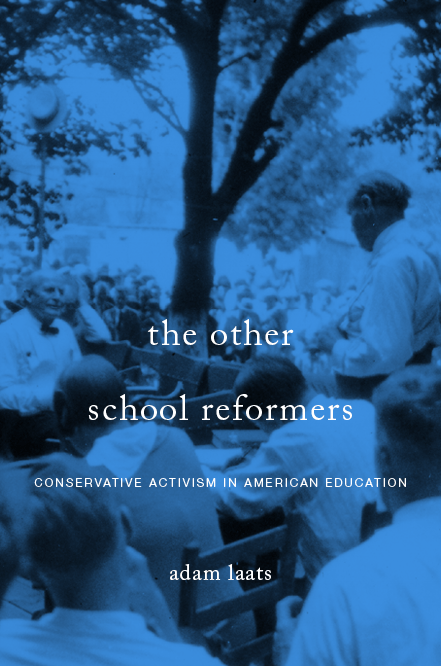
Thanks to the Smithsonian for this terrific cover image.  That’s Clarence Darrow (standing) facing William Jennings Bryan at the Scopes Trial.  In this book, I examine four epochal school controversies from the twentieth century.  In each case, I ask what conservative intellectuals and activists wanted out of schooling.  My goal is to find out what it meant to be “conservative” when it came to education.

The catalog listing just went up.  Here’s how the talented folks at Harvard University Press describe the book:

The idea that American education has been steered by progressive values is celebrated by liberals and deplored by conservatives, but both sides accept it as fact. Adam Laats shows that this widely held belief is simply wrong. Upending the standard narrative of American education as the product of courageous progressive reformers, he calls to center stage the conservative activists who decisively shaped America’s classrooms in the twentieth century. The Other School Reformers makes clear that, in the long march of American public education, progressive reform has more often been a beleaguered dream than an insuperable force.

Laats takes an in-depth look at four landmark school battles: the 1925 Scopes Trial, the 1939 Rugg textbook controversy, the 1950 ouster of Pasadena Public Schools Superintendent Willard Goslin, and the 1974 Kanawha County school boycott. Focused on issues ranging from evolution to the role of religion in education to the correct interpretation of American history, these four highly publicized controversies forced conservatives to articulate their vision of public schooling—a vision that would keep traditional Protestant beliefs in America’s classrooms and push out subversive subjects like Darwinism, socialism, multiculturalism, and feminism. As Laats makes clear in case after case, activists such as Hiram Evans and Norma Gabler, Homer Chaillaux and Louise Padelford were fiercely committed to a view of the curriculum that inculcated love of country, reinforced traditional gender roles and family structures, allowed no alternatives to capitalism, and granted religion a central role in civic life.

Almost makes me want to read it myself.  For me, the next steps will be to review and copy-edit the full manuscript next month.  Then in July I’ll put together the index, with help from a talented graduate student.

Eat a Meanwich, Michelle Obama

Kids don’t eat their vegetables.  No news there.  But new rules about school lunches have got some students and their parents up in arms against an overreaching federal government.

As described by the LA Times, the new rules mandate more fruits and vegetables for school lunches.  This seems like a good thing.  But as the LA Times editors argued recently,

the program is afflicted by rigid, overreaching regulations that defy common sense. Schools must provide items from five food groups, including a fruit and a vegetable, every day. Students must choose three items, even if they’re not hungry enough for all of them, and at least one must be produce. But fruits and vegetables rank as the least popular items, so requiring schools to offer one of each for each student practically guarantees that an enormous amount of fruits and vegetables will go to waste.

More colorfully, the editors at Twitchy compiled a series of student tweets about the new lunch rules. Be warned: these tweets include some harsh language, most of it directed at First Lady Michelle Obama. Obama, of course, has made healthy food one of her signature programs. One student memorably complained, “Sorry michelle obama but i dont wanna eat crusty ass broccoli for lunch at school.”

One mom complained, "This is sad!"

One mom complained, “This is sad!”

As historian Susan Levine demonstrated, the history of school lunch is fraught with the politics of poverty, influence, and agriculture. In their early days, powerful US Senators such as Richard Russell of Georgia promoted school lunches as a guaranteed market for struggling farmers. In the 1960s, federal policy-makers began to see school food as a way to address economic inequality in society. By guaranteeing meals for low-income students, it was hoped, school food could even the playing field somewhat.

So there’s nothing new about school lunch as a tool of social engineering. And there’s also nothing new about conservative outraged reactions. As Baylen Linnekin insisted in the pages of Reason recently,

The government’s efforts to pad school lunch enrollment numbers by expanding the program should be seen as what it is: a cynical attempt to avoid admitting failure. There’s nothing palatable about that.

Even here, though, it seems libertarian and/or conservative pundits will be on tricky terrain. Perhaps the new lunch program is unpopular. And perhaps the government has assumed an enormous role in the feeding of America’s children.  But who wants to be on the side of nixing fruits and vegetables?

Building the Machine: Conservatives Debate the Common Core

She’s in a hurry.

Balancing a crate of oranges in one hand, a purse and bag of groceries in the other, a stylish, affluent, and beautiful mom hustles to answer a call on her iPhone from a friend. “Calling to see if you’re going to the special PTA meeting,” the friend asks as creepy music deedles in the background, “the school is changing the tests next Spring . . . something about the Common Core Standards?”

That’s the opening of a new short film about the Common Core Standards produced by the Home School Legal Defense Association. The forty-minute film, Building the Machine, examines conservative arguments for and against the new standards. As we’ve noted in these pages [check out ILYBYGTH coverage here, here, or here, for instance], conservatives have wondered about the implications of these new standards. I’m told by watchful members of the ILYBYGTH community that the film has made a big splash among conservative homeschoolers. What are conservatives supposed to think about the new standards? What do they need to know about them?

The conservative HSLDA certainly wants to portray the CCSS in a negative light. As HSLDA leader Michael Farris makes clear in the documentary, he feels the standards make a fetish of centralization, systematization, and data collection. But the film gives ample time for pro-CCSS conservative intellectuals to make their cases.

Most prominently, Michael Petrilli of the conservative-leaning Fordham Institute tries to allay conservative worries. The standards, Petrilli argues, resulted from an open and public process. They were not imposed top-down by grasping central elites. Best of all, they will improve education. They will hold teachers, unions, administrators, and students to higher standards. Are they perfect? Not according to Petrilli. But they are the nation’s best shot at renewing academic rigor in public education.

Petrilli is joined by conservative standards-boosters such as Mike Huckabee and Chester Finn. But most of the screen time is devoted to CCSS dissidents Sandra Stotsky and Jim Milgram. Both were part of the original validation committee in charge of the standards, and both refused to sign off on the final product. Why? Both Stotsky and Milgram assert that the new standards are not offering the rigorous academic benchmark that they claim to be. And both insist that their dissent was swept under the rug.

The HSLDA documentary also features conservative critics from the Heartland Institute and Pioneer Institute. The new standards, conservative intellectuals complain, were crafted in a secretive manner, rammed through by the federal government, and do not make academic sense. By aiming at the broad middle, by promising to make all students “college and career ready,” these standards fail to prepare students for either college or careers. More troubling, the standards represent a dictatorial overreach by central government. Mega-rich donors such as Bill Gates greased the slide and snuck this project past the complacent American public.

Perhaps more than the messages delivered by the talking heads, the film’s fast-cut montages and sinister musical background send a clear message: Take your kids and run for the hills. We can’t all be as hip, rich, and beautiful as the mom in the opening montage. But the film makes it clear. All of us—beautiful moms and the rest of us alike—need to wake up and smell the Common Core.