From the Archives: I Miss Letterhead

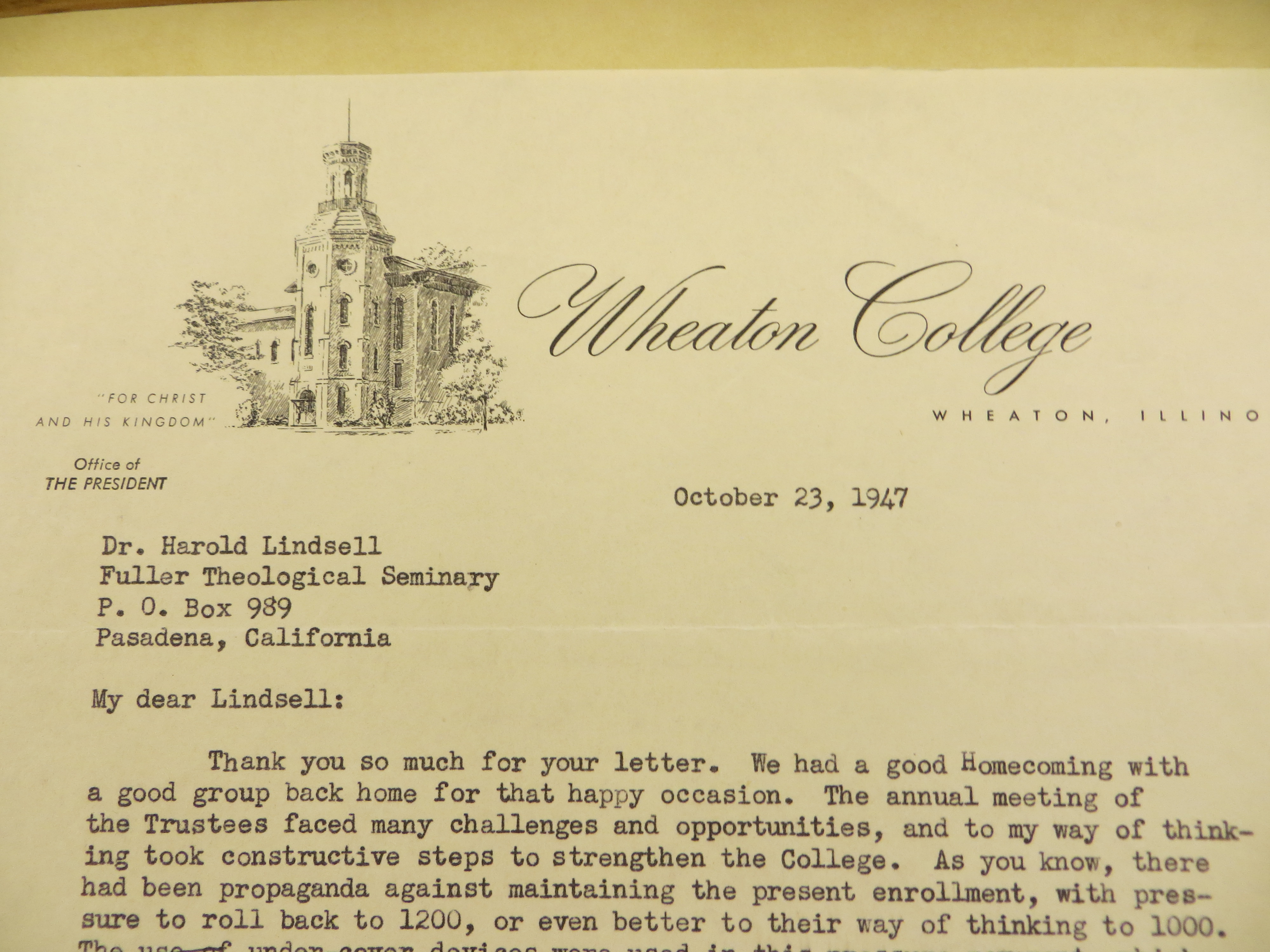
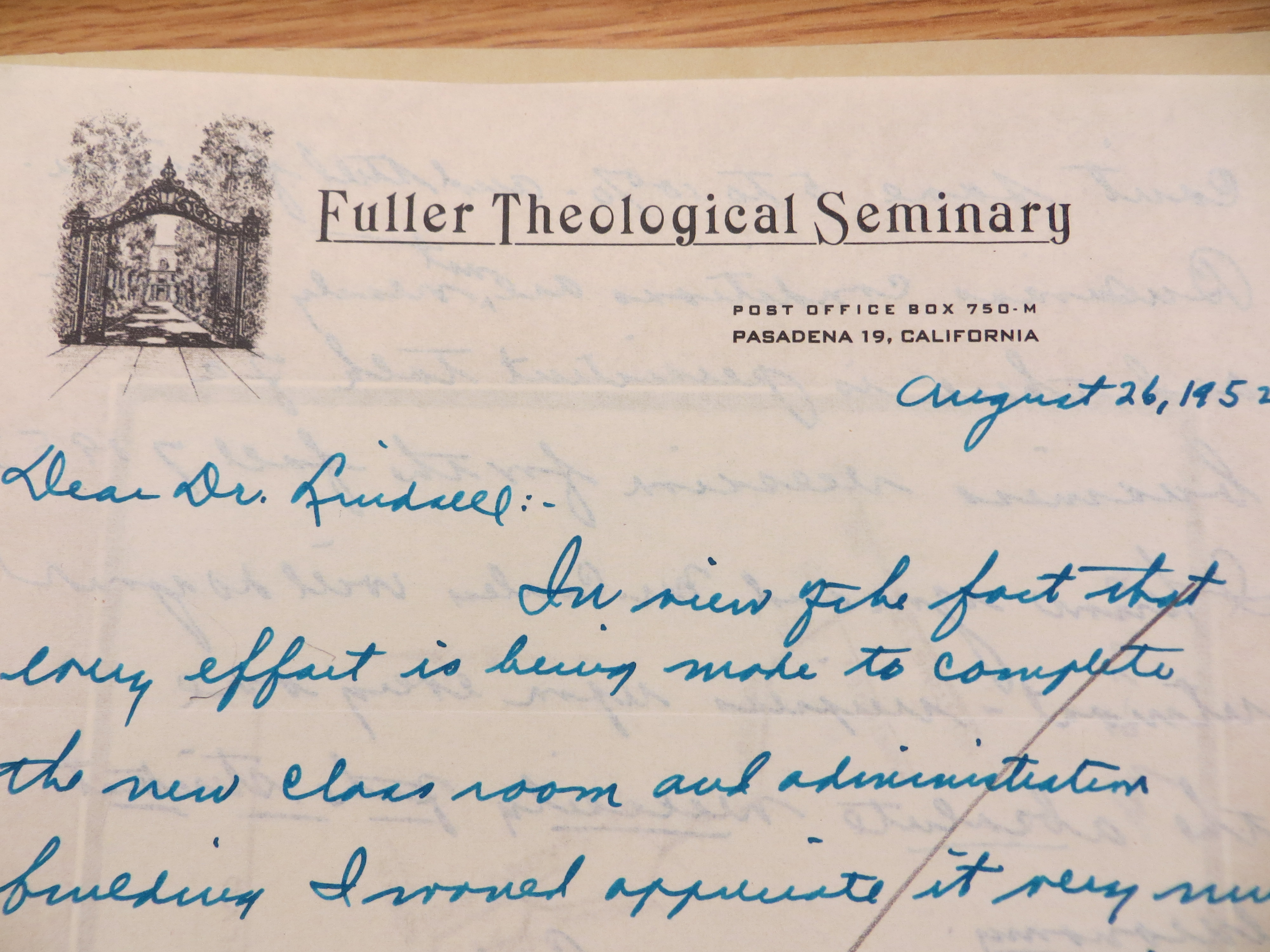
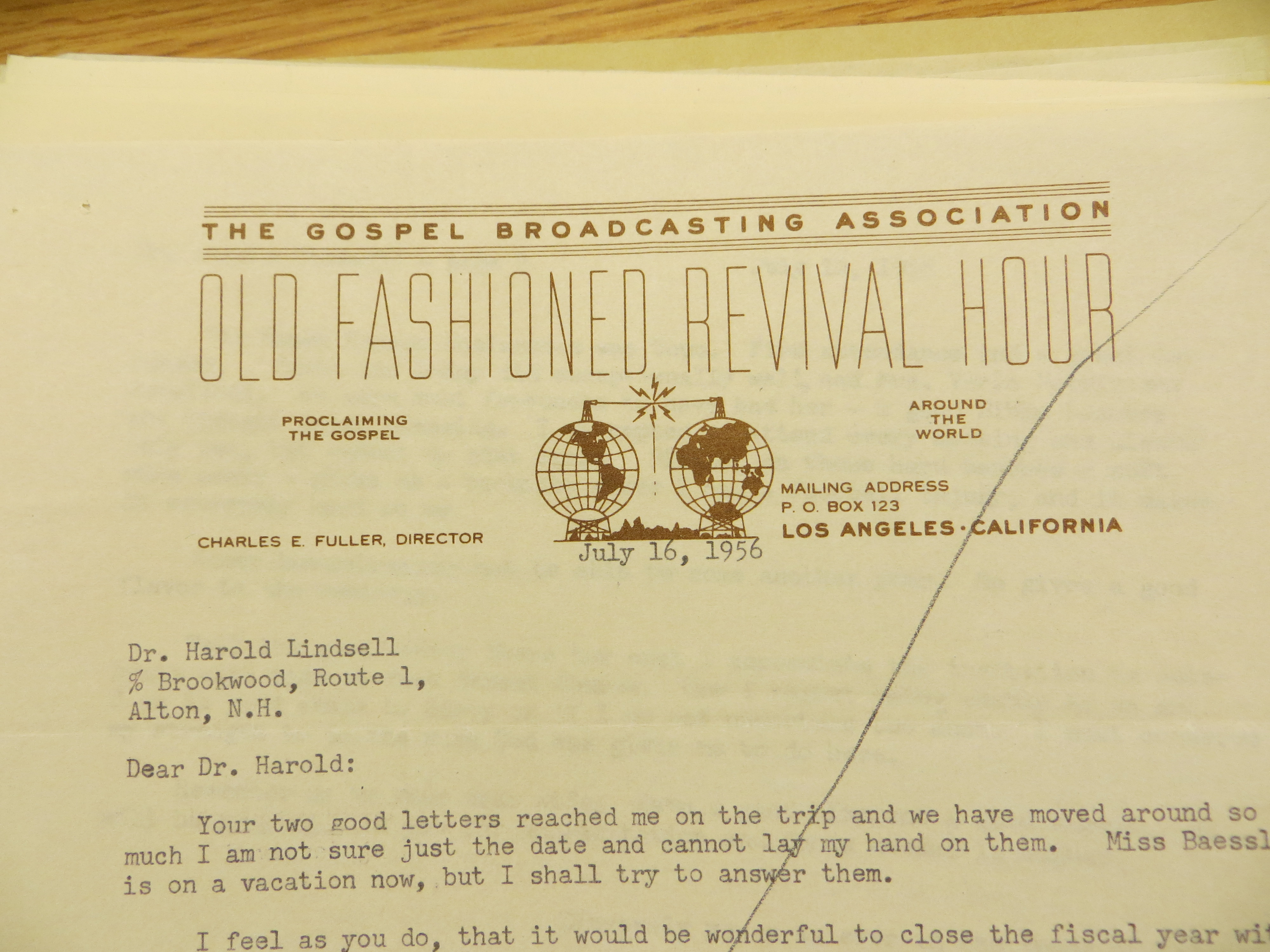
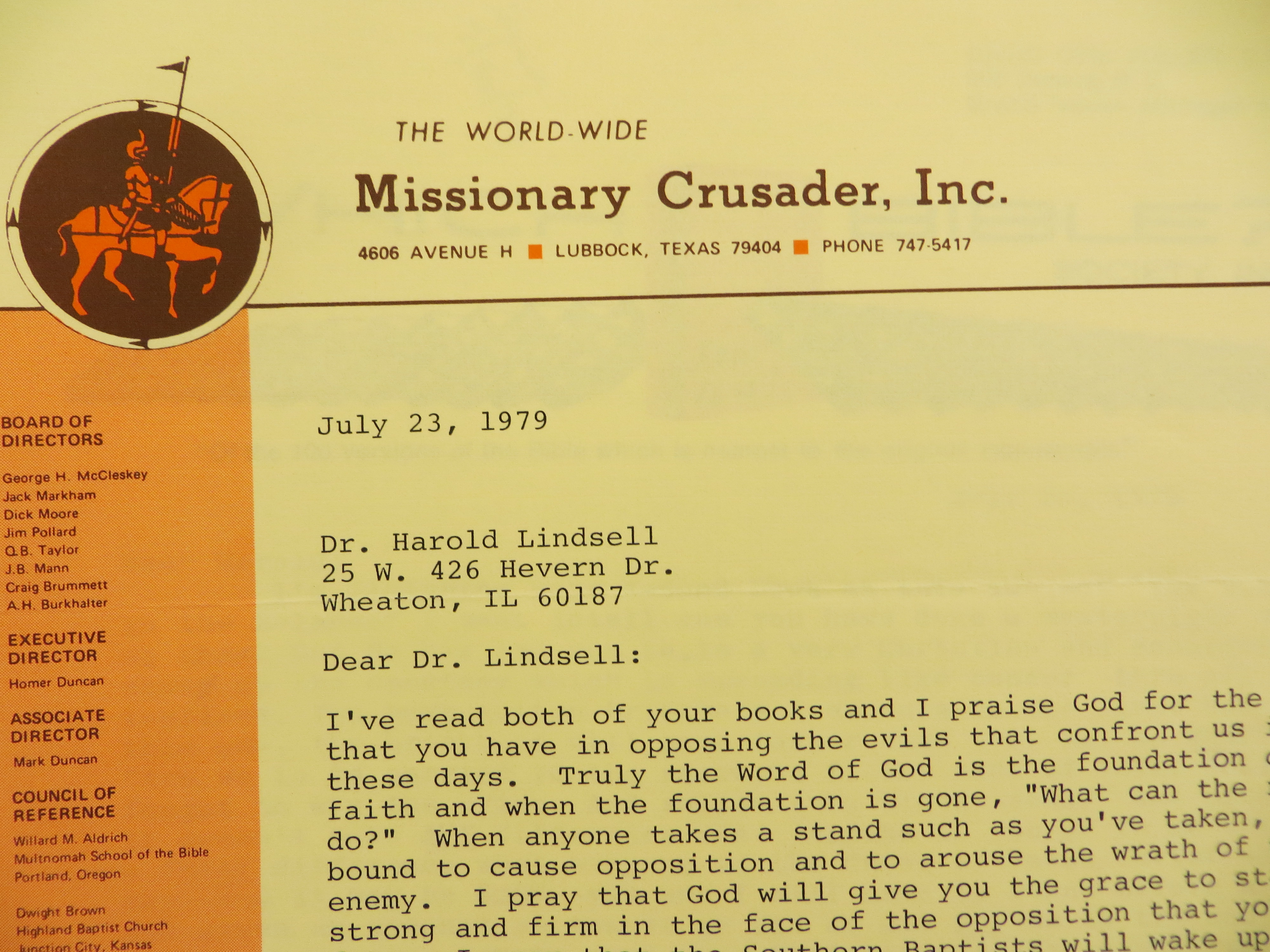
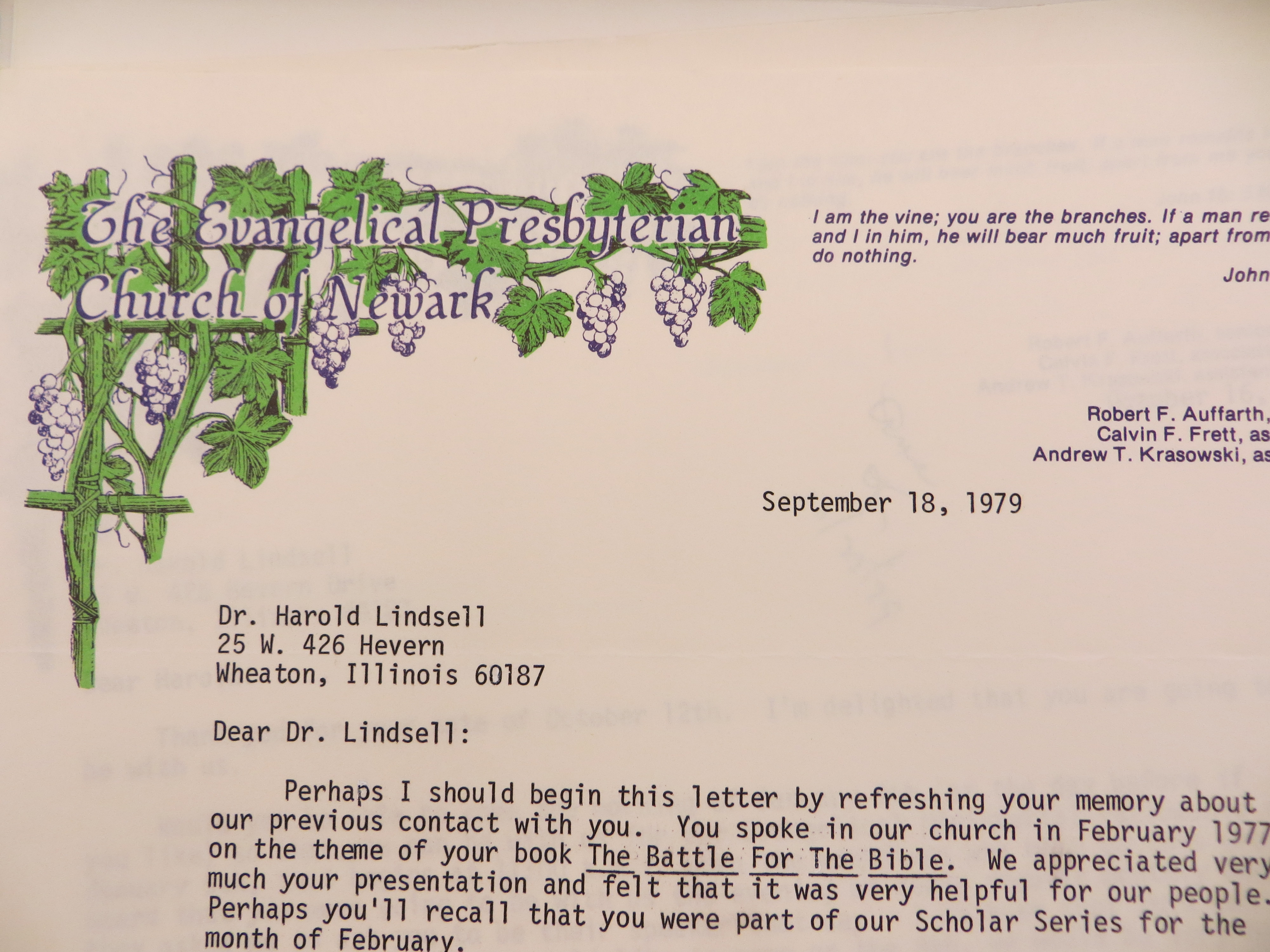
How old are you? Do you remember stationery with big, fancy letterheads? In my research this week at the Billy Graham Center Archives at Wheaton College, I’m digging through thick files of letters from the 1920s through the 1980s.

And so many of the letters come on pages with enormous, elaborate letterhead designs. Just for fun, I’ll share some of the best images from today’s work. These are mainly from a network of conservative evangelical institutions, dating from the 1940s through the 1970s.

c. 1955

c. 1955

letterhead from BGC 1letterhead from BGC 2letterhead from BGC 3letterhead from BGC 4letterhead from BGC 5letterhead from BGC 6letterhead from BGC 7

Hello, Wheaton!

Rolled into sunny Wheaton, Illinois last night to start my research at the fabled Billy Graham Center Archives. Located on the campus of Wheaton College, this archive is like nerd Disneyland. The collections are beautifully organized and intimidatingly expansive.

I'll be here all week...

I’ll be here all week…

What am I doing here? It’s the natural first stop for anyone interested in the history of conservative evangelical colleges. The collections offer two great things. First, Wheaton College itself has been a leading fundamentalist/ evangelical college since the 1920s. It enjoys a unique and uniquely influential history as a leader in the network of conservative colleges. As leading historian Joel Carpenter put it, in the 1920s

There was only one college of thoroughly fundamentalist pedigree . . . that was neither just half-evolved from Bible school origins nor still waiting for the ink to dry on its charter.

That school, of course, was Wheaton. For my current research, I’ll need to dive deep into the history of Wheaton itself. What was life like for students in different decades? For faculty? I also have some specific questions about interesting episodes. For instance, why did Wheaton kick out its fundamentalist president in 1939? Why did the board of trustees add in 1961 a line to the statement of faith that Adam and Eve were real, historical people? What did Wheaton’s version of the “free-speech” movement look like in 1964?

But these archives offer more than just a look at the history of Wheaton itself. Since the school was such an influential leader in the field of evangelical higher ed, its leaders kept in constant contact with other school leaders. In their correspondence, I’ll be digging to discover the issues that motivated school leaders across the entire network of conservative evangelical colleges. This will include prosaic issues such as admissions and accreditation, but also uniquely evangelical issues such as determining which schools remained orthodox and which threatened to slide into liberalism and modernism.

Best of all, decades of work by the archivists at the Billy Graham Center has created an invaluable collection of oral history interviews. Some of these are available online and I’ve been reading them during the past weeks. But many more are only here at Wheaton. In these interviews, alumni of Wheaton and the rest of the conservative evangelical college network remember what life was like at these schools in the 1920s, 1930s, 1940s, and more recently. Why did they decide to go to Wheaton? Or the Moody Bible Institute? Or John Brown College? Or a ‘secular’ public university? Many of these interview subjects offer unique perspectives on what college life was like.

With such a vast collection, I need to pace myself. There’s no way to take it all in during one short visit. Instead, I’ll see what I can discover and make plans to come back soon.


School Protests and Negative Nellies

Suburban Jefferson County is in an uproar. Teachers and students have taken to the streets. They’re protesting a move by conservative school-board members to modify the new Advanced Placement US History framework. Predictably, conservatives nationwide have rallied behind those school-board members. In ways today’s protesters might not recognize, conservative rhetoric in this case dredges up a long conservative tradition—the fight against excessive negativity toward America. In surprising ways for “The Party of No,” when it comes to educational attitudes, conservatives have often been the party of “Yes, Please.”

This Denver-area protest is not the first to result from the changing framework for the Advanced Placement US History class. Conservative pundits have attacked the changes as pernicious and short-sighted. As we’ve noted here at ILYBYGTH, those conservative concerns have a legacy all their own. Conservative intellectuals and activists have protested that the new framework depicts the main themes of US History as oppression and racism. Some conservatives have called for US History to be taught in more traditional ways, more patriotic ways.

In this case, conservative school-board members proposed a new look at the framework. The five-member board has a solid three-member conservative majority, and those three called for a reform that would emphasize “positive aspects” of US History, an emphasis on ideas that “promote citizenship, patriotism, essentials and benefits of the free enterprise system, respect for authority and respect for individual right.” In addition, conservative leaders want less emphasis on materials that “encourage or condone civil disorder, social strife or disregard of the law.”

In protest, district teachers called for an orderly sick-out. Teachers planned to call in sick to draw attention to both this change in curriculum and a proposed change to teacher pay. As word spread, students joined in. Soon, teachers and students alike took to the streets to protest any change in the history curriculum.

Predictably, conservative commentators huffed and puffed at the student protest. Gretchen Carlson of Fox News called the protesters “punks.” “How can being patriotic or learning about patriotism be a negative?” Carlson asked. “And what does it say about our young people and the teachers joining the protests that patriotism is now a negative?”

Writing in the pages of National Review Online, Ian Tuttle had a similarly dismissive attitude toward these “sign-waving baby barbarians.” Not only did the students expose their own ignorance with their hopelessly ironic protest signs, but their movement could not even count as legitimate social protest. Real protest, Tuttle fumed, was a vital patriotic legacy. This sort of display, in contrast, was only “self-indulgent grievance-mongering.”
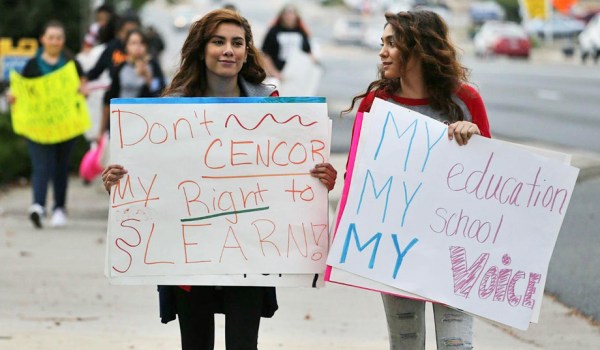
Maybe a little cencoring would be okay...?

Maybe a little cencoring would be okay…?

Back in Colorado, one of the conservative board members opined that the student protesters were being used as hapless “political pawns.” The real issue, he said, was the question of teacher pay. The teachers’ unions cynically exploited the naïve enthusiasm of students in order to line the pockets of union members.

There’s more going on here than just 1960s hangover culture wars. Beneath these specific worries about student orderliness and patriotism, there is a decided theme about the proper attitude schools and students should have toward American society in general. As I researched my upcoming book about conservative educational activism in the twentieth century, I came across this theme time and again. In addition to worries about political leftism and secularism in schools, conservatives have worried vaguely about a pervading sense of negativity in progressive school curricula. Sometimes this has had to do with the portrayal of America’s past, as in the current Colorado student protests. But sometimes it has been a broader complaint about a general negative attitude in school books.

In what follows, I’ll share three long examples from 1923, 1939, and 1970. In each case, leading conservative activists attacked the negativity of progressive educators. Just as in Jefferson County, conservatives in each case worried that students were being taught that America stunk, that life in general stunk.

First, a speech from April 16, 1923. In this speech, the leader of the National Society of the Daughters of the American Revolution warned of the creeping negativity and anti-patriotism of America’s teachers. Too many teachers, President General Anne Minor insisted, poured that negativity down the throats of trusting young schoolchildren.

Character and patriotism and obedience to law—there are the essentials of training in the schools. Do we find them everywhere? There are many who feel that there is a weakness of moral fibre [sic] in the teaching in many of our schools. And it is well known that there is an organized movement of many years’ standing among radicals to insinuate their doctrines into the schools and colleges all over the land….We want no teachers who say there are two sides to every question, including even our system of government; who care more for their ‘academic freedom of speech’ and opinion (so called) than for their country. Academic freedom of speech has no place in school, where the youth of our country are taught and their unformed minds are developed. There are no two sides to loyalty to this country and its flag. There is nothing debatable about allegiance to that flag and the Republic for which it stands. Freedom of speech does not give the right to teach disloyalty to our children and college youth. The teacher who does not wish to teach loyalty toward the land that employs him, has one good remedy. He or she may resign and go where disloyal opinions can find expression without harm to anyone. Guard well your schools, lest the life of the nation be poisoned at its source.

Years later, in 1939, a school-board member in Englewood, New Jersey lambasted the leftism and negativity of a popular set of textbooks. In this case, that conservative school board member was B.C. “Bertie” Forbes, the founder of Forbes Magazine. The textbooks at issue were a set of social-studies books by progressive scholar Harold Rugg. In this snippet, Forbes tells a story he repeated over and over again in his crusade against the Rugg books:

One of [a local teacher’s] pupils came to me, very much upset. In effect, he said that he had always regarded America and the American form of government as wonderful. But, he proceeded to relate that when the class had been asked to record their opinion as to whether ‘The people of the United States have a better government than have the people of any other county in the world,’ their teacher expressed disagreement with those young Americans who had replied, ‘Yes.’ According to this pupil she disabused their minds of any such idea. According to him, she told her young charges that the answer was ‘No’, that ‘there are several countries in Europe which have as good, if not better, forms of government than ours.’

At this critical time, when we are preparing to conscript our youths to become American soldiers, I cannot but question the wisdom of impregnating young minds with any such notion that our system of government is open to question.

If teachers of the Rugg books are seeking ‘subtly’, to use Professor Rugg’s own word, to convey such ideas to the coming generation, ideas which cannot possibly inspire them with veneration for their flag—which they are asked to salute every day—surely the parents of Englewood are entitled to learn the facts.

A generation later, in 1970, conservative activists Mel and Norma Gabler told the Texas State Board of Education that too many textbooks focused only on the negative. The Gablers went through the list of approved books, one by one. In each case, the Gablers noted the relentless negativity of the texts. In what follows, I’ll include a full long book-by-book quotation from the Gablers’ testimony:

This book contains some of the chilling, horror-type stories that seem to appeal to the morbid imagination of this age’s youth; but so much time spent thinking upon strangeness can make it almost seem normal. The characters in ‘The Jam’ are dope addicts. ‘The Hitchhiker,’ which follows, has an identical climax, both written to horrify. ‘The Birds’ was made into a Hitchcock movie, so is well-known, but in reading it there is so much more blood and gruesome detail that the reader feels the need to escape and cleanse himself from such horror. ‘Zero’ leaves the impression that it is normal for children to hate parents and for parents to be indifferent to the needs of children. Everything in the book is conducive to causing emotional instability in the impressionable mind.

This [Rebels and Regulars] is another very depressing book. As far as the language used, it is in keeping with the characters and plots of the stories, but not the sort of language the thoughtful parent would approve of in his children. There is throughout the book the undercurrent of ‘a cause,’ which gives a prejudiced viewpoint, always picturing the white man as the villain against different minority groups or individuals. Typical of the stories is ‘The Cyclists’ Raid,’ which is militant, lawless, defiant, and completely without consideration for the individual. . . . A whole semester of concentrating upon rebellion as pictured in these stories will have a negative effect upon an impressionable young person. It becomes more honorable to rebel than to obey laws or consider the rights of others. . . .

This book [Ways of Justice] indicates that justice is whatever an individual decides it should be. ‘Junkie Joe Had Some Money’ shows bullies getting away with murder because the only witness is intimidated. In ‘Manuel,’ a kindly act is rewarded with utmost cruelty, written in vivid detail. ‘Mateo [86] Falcone’ tells of a young boy who is bribed to reveal the hiding place of another, then his father kills him. Nothing here to indicate love or understanding is possible between parents and child. ‘Marijuana and a Pistol’ gives all the sordid details of a maladjusted youth who smokes ‘weeds,’ including the uncontrolled giggling and vomiting. ‘They Grind Exceedingly Small’ is a story about the person who has money, taking advantage of the poor, hard-working, underprivileged—indicating that all money and power are in the hands of the cruel, wicked, dishonest, and undeserving. . . .

Couldn’t half of the stories in this series tell about people living together in harmony, love, understanding, and helpfulness?

Is reality only negative? Does not reality also include the many acts of kindness between races that is evident across our nation? It must be remembered that qualities such as morality must be taught. They do not come naturally. Education without morality will result in a depraved society.

Our conclusion is that if these books do not contribute to rebellion, lack of respect for authority, sadism, violence, and disillusionment, they will most certainly defeat the whole purpose for studying literature in our schools; for there is absolutely nothing presented here that would open the wonderful world of the printed page to our youth and cause them to want to pursue reading for the pure joy of doing so!

In all these conservative protests, the notion that school materials must somehow be positive and patriotic takes center place. Whether it was in 1923, 1939, 1970, or today, conservatives have insisted that school materials do more than present the negative side of life. In today’s protest, the issue is the teaching of US History. And that has certainly been a central subject in these battles. But it was not only history that became controversial. As the Gablers pointed out, the negativity of the cultural left showed up in literature selections as well. As they asked so plaintively, “Is reality only negative?”  And, and President General Minor protested way back when, a pervasive, destructive negativity also showed up in teachers’ attitudes.

Again and again, conservatives have wanted students to learn positive messages. Conservatives have worried that too much negativity might produce a generation of cynics. In a sense, we might say that conservatives in schools have sometimes been the party of positivity.

From the Archives: Campus Rape in the 1930s

Do fundamentalist colleges encourage sexual assault?  It’s a terrible and difficult thing to talk about.  As we’ve seen in these pages, some alumni insist that fundamentalist schools force victims of sexual assault to blame themselves.  But we’ve also seen that sexual assault is not at all unique to religious schools.  As I continue the research for my new book about the history of evangelical colleges and universities, I’ve stumbled across a story that might shed light on these tricky questions.

Despot in Denver

Despot in Denver

The way we word the questions themselves is controversial: Are fundamentalist schools cults that pander to the lusts of authoritarian leaders?  Or do the strict sexual ethics of conservative evangelicalism help protect young women and men from predatory teachers and authority figures?

Critics of conservative evangelical colleges warn that that the pervasive “purity culture” of these schools leads directly to rape.  Bloggers such as Samantha Fields have accused fundamentalist colleges of blaming victims of sexual assault.  Journalists have blasted schools such as Patrick Henry College for fostering a rape-friendly environment.  Prominent evangelicals have suggested that the problem is not one of theology, but of an authoritarian institutional culture.  For example, Boz Tchividjian famously suggested that abuse can happen “in any culture, elevating leaders beyond accountability, leaving victims’ rights to their whim, and sidelining critics who challenge their rule.”

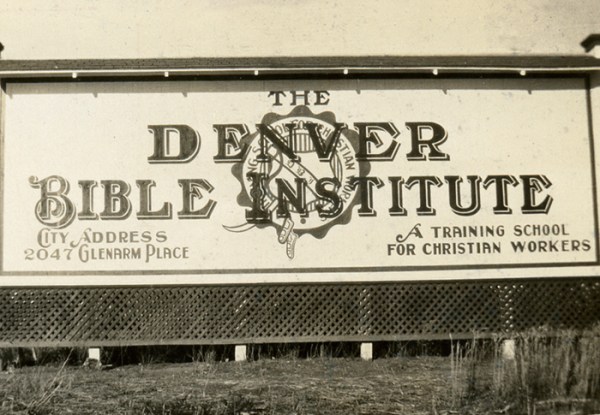
I’ve stumbled across a story from the 1930s that might illuminate the longer history here.  In 1936, a high-powered panel of fundamentalist leaders convened to investigate Denver Bible Institute (now part of Colorado Christian University).  At the time, DBI was led by charismatic founder Clifton L. Fowler.  Fowler wanted to join the Evangelical Teacher Training Association, and to do so ETTA demanded that rumors be cleared up.

Unfortunately for Fowler, an extremely disturbing picture emerged.  Fowler, the investigators concluded, ran DBI like a sex-crazed despot.  Students and faculty were pressured to declare lifelong commitments to the schools.  Married faculty members were pushed into pledging “continence.”  (I’m not sure what was meant by “continence” in this context.  Any suggestions?)  Students were encouraged to separate from parents and home churches.  Community members felt pressure to offer Fowler detailed confessions of their sexual sins.  And, yes, Fowler apparently routinely engaged in sexual activities with male students.

From one perspective, this historical episode might seem to confirm the dangers of authoritarian fundamentalist schools.  For as long as there have been fundamentalist schools, we might conclude, leaders have felt free to engage in predatory sexual practices.  Community members felt constrained by their own admitted sexual sinfulness from criticizing the dictatorial leadership.

On the other hand, as Michael Hamilton argued in his excellent 1994 dissertation, Fowler did not have a free hand to do as he pleased.  The accusations against Fowler forced DBI out of decent fundamentalist company.  Local fundamentalist churches cut off DBI.  The Evangelical Teacher Training Association would not let DBI join.  Fowler, in other words, was restrained in his behavior because of the network of fundamentalist schools and churches in which he worked.

As usual, history does not offer any pat solutions.  But this episode does demonstrate the long lifespan of these questions at fundamentalist schools.  It shows that school founders have always been accused of sexual predation.  But it also shows that fundamentalist leaders and communities worked hard to police their own ranks.

In this case, at least, both national leaders and local community members refused to look the other way.

FROM THE ARCHIVES: AL Take Manhattan

What do conservative activists want out of education?  Like progressive thinkers, most conservatives have historically hoped for more than just classroom solutions to educational problems.  Like progressives, the conservatives I’ve studied have imagined “education” as a broad-ranging, all-encompassing process for young people.

Coming soon...

Coming soon…

As I clean up my files for my upcoming book, I’ve rediscovered lots of archival documents and images that I couldn’t include.  Today, I’d like to share some of the material from the American Legion’s educational activism in the 1930s.  Like other conservatives, the leaders of the AL argued for an educational policy that encompassed far more than school reform.  Activists in the AL wanted to provide a wholesome intellectual and social atmosphere for young people in order to save them from the clutches of subversives, progressives, and anti-Americans.

American Legion activists in the 1930s thought that education could provide a wholesome moral defense against socialist and communist subversion.  Time after time, AL leaders exhorted local posts to engage in a range of activities to provide wholesome and patriotic activities for young people.  This included classroom work, but also ranged far beyond.

As the AL’s Americanism Handbook put it in 1930,

While the communist organizes his young pioneers, his youth movement in colleges, and so forth, let us do some organizing.  Let us organize Boy Scout troops, ROTC units and boys’ baseball teams, if you please.  Let us win and hold the confidence of our boys through such work.  While the communist scatters literature among the youth of the land to teach it disrespect for parental authority, let us preach the doctrine of love of parents and love of home.  While the communist ridicules the ethics of religion, let us teach its beauty and comfort and hope.  While the communist preaches its cowardly philosophy of dissipating the fruits of labor and capital, let us strive to inculcate the manly principles of energy, ambition and thrift in the hearts of our people.  While the communist, in the guise of the professional pacifist, spreads his doctrine to palsy the arm of our national defense, let us keep our people informed on matters pertaining to the need and necessity of national defense.

From a 1941 AL pamphlet

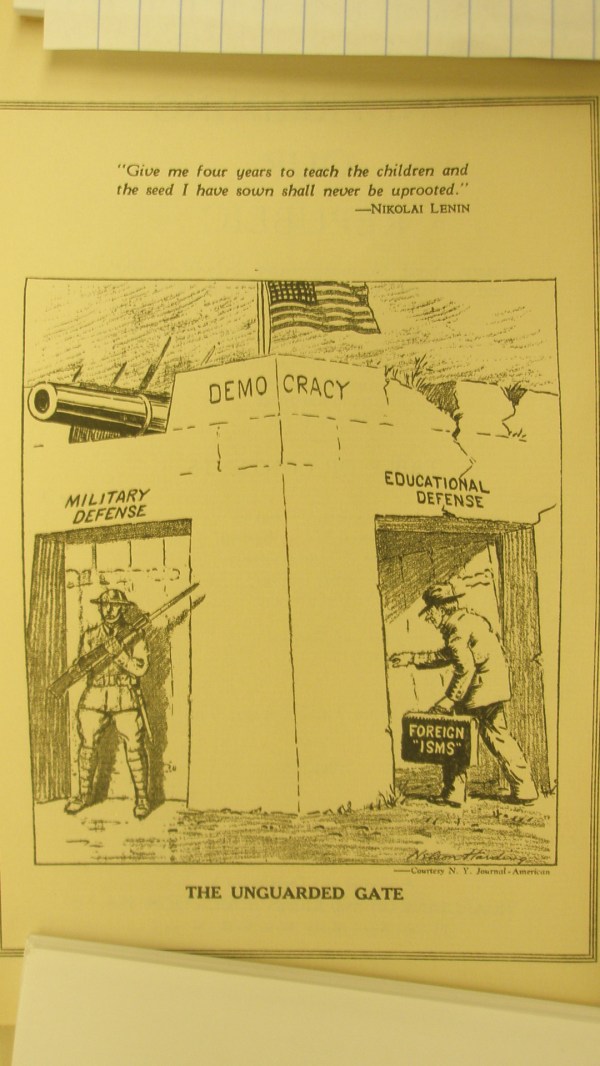
From a 1941 AL pamphlet. The original appeared in a Hearst publication.

The most active educational leader in the Legion during the 1930s was the AL’s Director of the National Americanism Commission, Homer Chaillaux.  In a suggested speech Chaillaux sent out to AL leaders around the country, he spelled out the AL’s broad educational philosophy.

First of all, the AL worked to fight subversion in the classroom.  As Chaillaux put it,

It is a well known fact that un-American groups, radical pacifists, communists and others operating under more or less misleading nom de plumes, are using the schoolrooms throughout the nation for the dissemination of their poisonous propaganda.  Therefore, we believe that it is only right and proper that organizations interested and engaged in the promotion of Americanism should be permitted to go into the classrooms with activities designed to build up a greater love and appreciation for the sacrifices made by our forefathers and for our form of government, and for the things which have made possible the growth of our nation.

But this was not only a schoolroom campaign.  Chaillaux described the wide-ranging activities carried on by the AL: ROTC programs, Boy Scouts, baseball leagues and other sports leagues, oratorical contests, essay contests, and Sons of the American Legion clubs.  In all its “Youth Activities,” Chaillaux explained, “the Legion seeks to coordinate the mind and the muscle through a group of activities designed to build physical and mental alertness.”

Chaillaux asked,

Does the Junior Baseball program aid in any way in counteracting communism and other un-American activities?  That question has been asked a number of times.  And the best answer, I believe, is found in a clipping taken from the “Gazette,” Gastonia, North Carolina, under date of July 31, 1934.  We quote the clipping herewith:

‘We in Gaston County know from four or five years experience what a valuable and beneficial movement this baseball program has been.  It had its beginning in Gaston County in the summer of 1929, the summer that the communist uprising had put Gaston County so unfavorably before the public.  Seeds of unrest and bitter partisanship had been planted here that spring by the agitators from the slums of New York and the classic halls of certain New York universities.  We had just gone through the sickening and humiliating trial of the gangsters accused of killing the chief of police here: The county was torn to pieces.

‘Along came this Junior Baseball, enlisted the boys from the textile settlement of the county and there began a movement which has been of the most wholesome influence in the county.  It has been the best insurance against a recurrence of similar troubles in the county.  These boys are learning how to be square and clean shooters, fair and above board in their play and in their dealings with each other and with their superiors.  From the Legionnaires who are sponsoring the movement, they are learning principles of Americanism that they will never learn from books.’

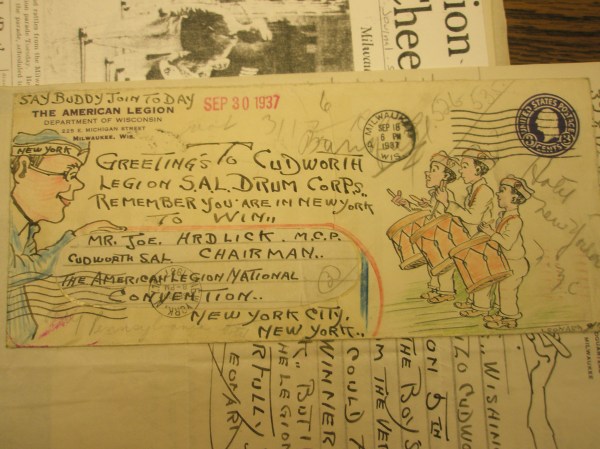
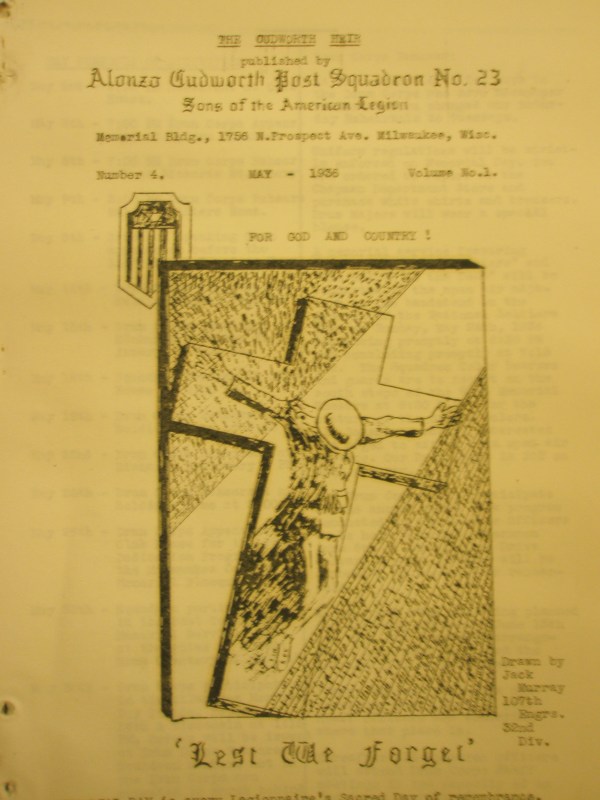
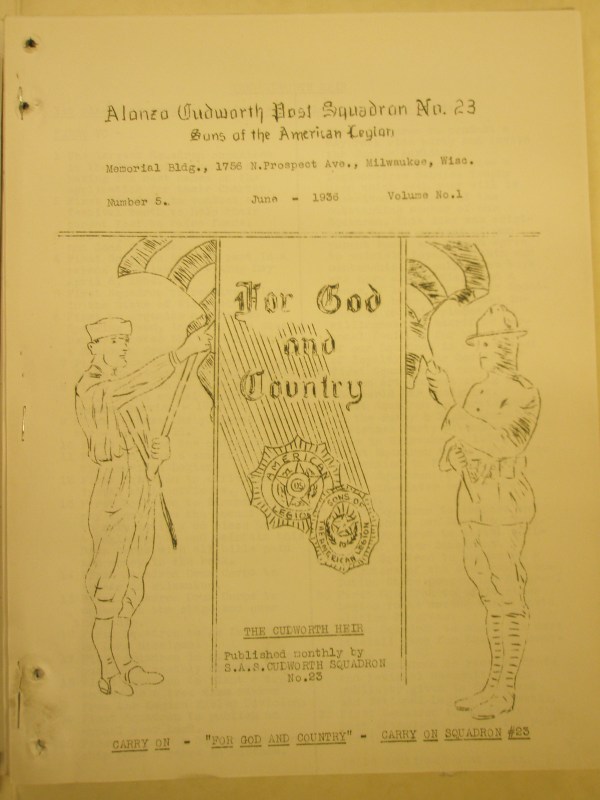
Local posts embraced these efforts.  And though it may seem heavy-handed and dictatorial, it seems as if many young people really did enjoy these subversion-fighting activities.  During my research, I spent some time in the files of one Joseph Hrdlick, an active member of an AL post in Milwaukee.  Lucky for me, Hrdlick kept copies of some of the youth activities in which his post engaged.  In Hrdlick’s papers, we find examples of a magazine the local Sons of the American Legion post produced during the 1930s.  We also see mementoes from activities such as the SOTAL marching band.  In this case, the Milwaukee boys marched all the way to New York City, a town not often revered among anti-communist activists.

It’s always hard to distill how the average person felt about these activities, but at least Mr. Hrdlick seemed sincere and enthusiastic in his efforts to help his young SOTAL minions.

If they can make it there...

If they can make it there…

A SOTAL newsletter

A SOTAL newsletter


A SOTAL newsletter

…another newsletter cover

Other AL archives from the 1930s contain similar gems.  In the Historical Society Archive in Madison, a hundred miles or so west of the Milwaukee collection, I found some examples of student work in AL-sponsored essay contests from the 1930s.

One winner from 1939, in her essay “What America Means to Me,” wrote these stirring words,

Just to look upon the map of America gives me a thrill! . . . America is a free country.  It is a haven for political refugees who could not find the freedom they desired in their homeland. . . . America is a land of opportunity, and yet—as there are in every country—there are those who will criticize and tear down our ideals and laws.  Their’s [sic] is a destructive criticism; hindering, instead of helping, our lawmakers.

This rhetoric sounds like precisely the sort of anti-subversive, patriotic, engaged attitude that the AL hoped to sponsor in young people nationwide.  Again and again, AL activists worked to reform the education of America’s youth.  They looked hard at classrooms, textbooks, and teachers.  But they didn’t stop there.  Like all sorts of educational reformers, these conservative activists worried about the end product of education.  Of course, they weren’t the only ones.  As I argue in my upcoming book, this sort of conservative activism formed a complex tradition throughout the twentieth century.

But in every case–whether it was the American Legion, the Daughters of the American Revolution, Pro America, the World’s Christian Fundamentals Association, or any of the dozens of local groups and individuals that campaigned for more conservative education in the twentieth century–the archives included far more fascinating tidbits than I could include in the three hundred pages I had to work with.

As I keep cleaning up my files, I’ll post other archival gems that didn’t make the final cut…

Does Anyone Actually Read the Index?

My eyeballs are beginning to chafe.  This week, I’m finishing up the index for my new book.  It’s a lot of work, even though I had a gifted grad student do most of the intellectual heavy lifting.

How the sausage gets made...

How the sausage gets made…

So now I’m wondering: Does anyone actually read the index?  I know professional academic historians do.  In fact, that’s one of the first cheap tricks we learn in our PhD programs.  We flip quickly to the back to see what we can glean from the index.  What are the book’s themes?  What are its main ideas?  Its blind spots?

But do any normal people read a book’s index?  Make no mistake, I’m compiling a kick-ass index, whether anyone ever reads it or not.  But I can’t help but wonder if readers will find useful my painstaking distinctions between “authoritarian teaching” and “traditional education.”

Coming soon...

Coming soon…

Will anyone care that I spent so many long hours in a stuffy library teasing out the nuances of “educational conservatism” as opposed to the broader category of “conservatism” in general?


Orange Is the New Blah…

Okay, I admit it. I’ve been watching Orange Is the New Black. And I like it. But one episode I saw the other night included a painful example of what I’ve been calling the “missionary supposition” of anti-religious folks.

Orange Is the New Hack

Orange Is the New Hack

First, a short introduction for those readers with better things to do: The show follows the prison career of a privileged woman as she serves her time. At first, I didn’t want to watch it. It sounded too much like the terrible genre of ‘brave excursions outside the gated community,’ ignorant self-righteous claptrap along the lines of Barbara Ehrenreich’s Nickel and Dimed.

But after a couple of episodes, I was hooked. The protagonist’s story of elite woe is not as central as I feared. Each of the incarcerated women has her own story and the show makes the most of each.

**SPOILER ALERT: The following contains info about the end of season 1. And some bad language.**

Just because I watch, though, I can’t help but protest some of the stupid blunders incorporated into the story. In a couple of episodes, the protagonist, Piper Chapman, goes a few rounds with fellow inmate Tiffany “Pennsatucky” Doggett. In the show’s depiction of Doggett and in Chapman’s high-handed attitude toward Doggett’s religiosity, we see the worst sort of anti-religious bigotry and ignorance.

Religious = Psychopathic

Religious = Psychopathic

I don’t have much of a problem with the show’s scathing depiction of conservative evangelical religion. We see this most frighteningly in the character of Doggett. Doggett is the unofficial leader of the charismatic Bible group at the prison. She leads deluded healing services and peppers her speech with Biblical references. Not only is Doggett portrayed as a snaggle-toothed, closed-minded, ignorant hillbilly with a heavy penchant for krazy, she actually only won her role as religious prophet by shooting an abortion-clinic worker out of petty spite.

Now, if this show wants to depict religious people that way, fair enough. It is embarrassingly biased, but if the show wants to take that kind of anti-conservative-religion slant, so be it.

But it’s harder for me to swallow the wildly ignorant understanding of religion from one unfortunate scene in the episode “Fool Me Once” [season 1, episode 12, about 55 minutes in]. Pennsatucky wants to baptize Chapman in the laundry sink. At that point, Chapman unleashes her real opinion about the whole thing. IMHO, the following scene demonstrates a terrible misunderstanding of the nature of religious belief, non-religious belief, and the nature of America’s culture wars, not just on the character’s part, but by the makers of this show:

Chapman: Okay, nope, see, I can’t do this. I’m sorry. I really want us to get along. I do. But I can’t pretend to believe in something I don’t. And I don’t.

Pennsatucky: Chapman: We’ve all had our doubts.

Chapman: No, see, this isn’t ‘doubts.’ I believe in Science. I believe in Evolution. I believe in Nate Silver, and Neil deGrasse Tyson, and Christopher Hitchens, although I do admit he could be kind of an asshole. I cannot get behind some supreme being who weighs in on the Tony awards while a million people get whacked with machetes. I don’t believe a billion Indians are going to hell, I don’t think we get cancer to learn life lessons, and I don’t believe that people die young because God needs another angel. I think it’s just bullsh*t, and on some level I think we all know that, I mean, [addressing other Christians] don’t you?

Other Christian #1: [sheepishly] The angel thing does seem kinda desperate…

Pennsatucky: [threateningly, to OC#1] I thought you was a Christian.

OC #1: [defensively] I am, but I got. . . some questions. . .

Whooch! Didja see that? Again, I don’t have a beef if this show wants to malign religious conservatives, if it wants to depict anti-abortion activists as cynical, stupid, self-serving sociopaths. It’s an awkward hack job, IMHO, but not as bad as the wildly ignorant fantasy depicted in the scene above.

As I’ve argued in the pages of the Reports of the National Center for Science Education, too many anti-creationists show this same sort of ignorant “missionary supposition.” They think, along with Piper Chapman and the makers of this show, that the truths of anti-religion are so blindingly obvious that any (thinking) religious person must secretly share them.

Now, to be fair, I should point out that I do (roughly) share those beliefs.  I believe in science.  I believe in evolution.  I like Neil deGrasse Tyson and I don’t think anyone is going to hell.  But just because I agree doesn’t mean I can stomach the weirdly ignorant assumptions in which those statements are wrapped.

When Chapman recites her sophomoric list of village-atheist taunts, the gathered Christians are only kept from agreeing by the bullying of their psychopathic religious leader. In this sort of atheist fantasy, the truths of science only fail to conquer when hearers are not free to acknowledge their obvious awesomeness.

This attitude mirrors nothing so much as the overweening confidence of early religious missionaries. Many Bible missionaries in the early part of the twentieth-century, for example, assumed that the truth of the Bible was so overwhelming that anyone who caught a glimpse of its pages must be supernaturally converted. As a result, Bible missionaries spent a great deal of time and treasure to distribute the Gospel around the world.

At Chicago’s Moody Bible Institute, for example, evangelists distributed printed tracts and gospels throughout the nation and the world, based on this assumption about the supernatural power of Holy Print. As William Norton of the MBI’s Bible Institute Colportage Association related in 1921,

A man was given a tract by the roadside; simply glancing at it, and coming to a hedge, he stuck the tract into the hedge; but it was too late; his eyes had caught a few words of the tract which led to his conversion.

In this understanding of salvation and conversion, some truths have such power that the merest exposure to them is enough to convert the unwilling. Ironically, folks at places such as the Moody Bible Institute have gotten much more sophisticated in their understanding of conversion, while self-satisfied atheists like the makers of Orange Is the New Black apparently have not.

Among conservative evangelical Protestants these days, the difficulties of missionary work are more thoroughly appreciated. As conservative Christian educator David Harley wrote in 1995, missionaries must begin with a “sensitive appreciation of other cultures.” Missionaries who try to plunk down in the midst of a non-Christian population and simply begin spreading Truth amount to nothing more than “evangelical toxic waste,” Harley argued.

Actual missionaries no longer think they can convert without effort. They no longer tell each other to shout out the Gospel and count on it to spread itself. Rather, religious people show a more nuanced understanding of the ways people change their minds.

But there still seem to be people out there so ignorant of other cultures that they think they can convert the heathen with a simple exposition of the Truth. Folks who think that by declaiming a few holy names, such as Christopher Hitchens and Neil deGrasse Tyson, the scales will fall from the eyes of the benighted Christian multitudes.

Pish posh.


The Files Are In!

Well, there’s nothing more to be done about it now.  I’ve just sent my final draft of my next book manuscript to the publisher.  There’s a sense of relief at being done, but also trepidation at the impossibility of further revisions.  After years of researching, writing, then revising, revising, revising, it’s hard to believe I won’t be able to keep tweaking and improving.

Pre-order your copy today!

Pre-order your copy today!

In general, though, I’m extremely pleased with the shape of the manuscript.  In a nutshell, I try to make the case that we’ve seen a potent tradition of educational conservatism in the United States, one that has had a decisive impact on the structure and content of schooling.  And, I argue, that tradition has not been recognized by historians or education scholars.

To make this case, I examine in four looooong chapters the four biggest school controversies in twentieth-century America: the Scopes Trial of 1925, the Rugg textbook controversy of 1939-41, the Pasadena superintendent ouster of 1950, and the Kanawha County textbook battle of 1974-75.  What did conservatives say and do in these controversies?  In each case, the attention-grabbing events attracted conservative participation from both locals and national leaders.  In each case, the issues prompted conservatives to articulate their visions of proper schooling.  To me, that’s the interesting question.

We’re still a ways from final publication.  The publisher will send me proofs in July.  At that stage, I’ll put together the index and fine-tooth-comb the proofs for any typos.  But I won’t be able to make substantive changes at that point, just minor corrections.

During these last weeks, as I’ve been going over the copy-edited chapter files, I’ve been very grateful for the careful work of the editor.  She or he pointed out some embarrassing errors on my part and I’ve been able to make changes in the argument.  Hopefully this draft is as crystal-clear as I can make it.

I’m looking forward to hearing what readers think of the book.  For that, I’ll have to wait until 2015.  The press will release the book on January 12, 2015.  Pre-orders are available!


Pre-Orders Now Available!

Want to be the first on your block to get your copy of The Other School Reformers?  Then pre-order your copy today!

Pre-order your copy today!

Pre-order your copy today!

As I was happy to announce recently, Harvard University Press will be releasing the book in early 2015.  But the pre-order just became available on sites such as Amazon.  The hardcover won’t be available until January 12, 2015, but if you pre-order today, you’ll be sure to WOW your friends and family by getting your hands on it first.

The Other School Reformers

Clear your calendars! We have a release date. The Other School Reformers will be hitting store shelves in February.  I know that’s a long time to wait, so I’m suggesting everyone dress up as their favorite conservative educational activist and camp out outside their local bookstore.

Coming January 2015.

Coming January 2015.

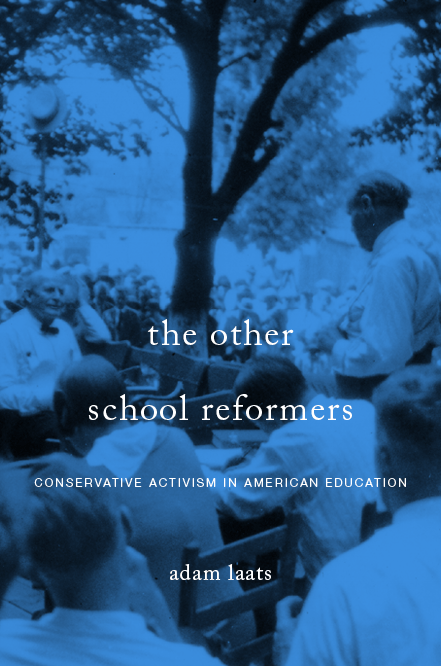
Thanks to the Smithsonian for this terrific cover image.  That’s Clarence Darrow (standing) facing William Jennings Bryan at the Scopes Trial.  In this book, I examine four epochal school controversies from the twentieth century.  In each case, I ask what conservative intellectuals and activists wanted out of schooling.  My goal is to find out what it meant to be “conservative” when it came to education.

The catalog listing just went up.  Here’s how the talented folks at Harvard University Press describe the book:

The idea that American education has been steered by progressive values is celebrated by liberals and deplored by conservatives, but both sides accept it as fact. Adam Laats shows that this widely held belief is simply wrong. Upending the standard narrative of American education as the product of courageous progressive reformers, he calls to center stage the conservative activists who decisively shaped America’s classrooms in the twentieth century. The Other School Reformers makes clear that, in the long march of American public education, progressive reform has more often been a beleaguered dream than an insuperable force.

Laats takes an in-depth look at four landmark school battles: the 1925 Scopes Trial, the 1939 Rugg textbook controversy, the 1950 ouster of Pasadena Public Schools Superintendent Willard Goslin, and the 1974 Kanawha County school boycott. Focused on issues ranging from evolution to the role of religion in education to the correct interpretation of American history, these four highly publicized controversies forced conservatives to articulate their vision of public schooling—a vision that would keep traditional Protestant beliefs in America’s classrooms and push out subversive subjects like Darwinism, socialism, multiculturalism, and feminism. As Laats makes clear in case after case, activists such as Hiram Evans and Norma Gabler, Homer Chaillaux and Louise Padelford were fiercely committed to a view of the curriculum that inculcated love of country, reinforced traditional gender roles and family structures, allowed no alternatives to capitalism, and granted religion a central role in civic life.

Almost makes me want to read it myself.  For me, the next steps will be to review and copy-edit the full manuscript next month.  Then in July I’ll put together the index, with help from a talented graduate student.