Can a Woman Teach a Man?

Does it count as un-biblical if a woman teaches a man in seminary classes?  That’s the question debated recently in the pages of Christianity Today.

The issue was sparked by a change in policy at Cedarville University.  The relatively new president, Thomas White, recently announced that only women may enroll in a Bible class taught by a female faculty member.  This has been part of a continuing shift toward greater conservatism by the new administration, which one journalist described as being “taken over by Southern Baptists.”

The question is one of a “complementarian” view of gender relations.  I’m out of my theological depth here, so I invite correction if I get this wrong, but as I understand it, a complementarian view in evangelical Protestantism suggests that men and women have different roles to fulfill in family and church.  Males are meant by God to be the head and women are meant to be helpmates.  Complementarians, I understand, insist that this is not a question of chauvinism or male supremacy.  Rather, both men and women are understood to be equal but different.  In church affairs, following a complementarian interpretation of 1 Corinthians 11:3 (“But I want you to realize that the head of every man is Christ, and the head of the woman is man, and the head of Christ is God”) only men should teach men about church doctrine.

For secular folks like me, this is a difficult cultural pill to swallow.  The core of my social morality is that people are equal.  Talk about “different roles” for men and women, or for different social groups, makes me extremely uneasy.  To folks like me, this sounds like just window dressing for traditional hierarchical domination.

Smart complementarians get this.  Evangelical writers have explained the subtleties of complementarianism and what one woman called the “holy beauty of submission.”

In conservative Christian colleges, the question is whether women can teach men theology.  At Cedarville, the new answer is no.  In the pages of Christianity Today, evangelicals debated the issue. Mind you, this debate seems to have been within the ranks of complementarian theologians.  Respondents did not argue that men and women should be seen as equal.  Rather, those who thought women should be allowed to teach men argued that colleges were different than church.  In church, they granted, women must not lead men.  But college was different.

Those who agreed with the Cedarville policy argued that schools should be logically consistent.  If women should not be leaders of men, then women should not be teachers of men.

To outsiders like me, this debate illustrates the deep cultural divide between conservative evangelical Christian colleges and pluralist ones.  Even the terms of this discussion are foreign to folks like me.  For many secular folks, even the idea of such a discussion seems horrifying.  Even to ask if women should be allowed to take on leadership roles seems like a terrible revival of traditionalist hierarchy.

Yet if we outsiders want to understand conservative thinking, we need to try to understand debates like this one, precisely because the terms of the debate are so far beyond the pale of our thinking.  For example, as Dorothy Patterson, the “first lady” of Southwestern Baptist Theological Seminary responded, when in doubt, go with God.  Though teaching in the university may be a complementarian “gray area,” Patterson conceded, it was better to stay on the theological safe side.  God, Patterson concluded,

is going to have far greater pleasure in seeing a male theologian in the classroom than in our seeing if we couldn’t put a woman in simply because she’s gifted.

Unless and until secular folks like me make an effort to understand the worldview behind statements like that, we’ll never understand conservatism.

 

Hell and Harvard

It looks as if Harvard will not host its Black Mass after all.  The school had planned to allow a Satanic group to perform its signature ceremony as a gesture toward inclusion and free speech.  Conservative reaction to the event tells us something about conservative ideas about higher education.

Naturally, many Catholics, conservative or otherwise, protested the plan.  The Black Mass, after all, is a deliberate inversion of the most sacred Catholic ritual.  According to some reports, Satanists in the Harvard mass boasted that they had acquired a consecrated Eucharistic wafer to mock and humiliate in their performance.  Harvard alumnus Father Roger Landry pleaded with Harvard president Drew Gilpin Faust to cancel the ceremony.  Harvard, Landry argued, would not allow a mock lynching in the name of free speech.  Nor would Harvard allow racist verbal assaults.

But other conservatives criticized the event for different reasons.  This sort of bizarre public performance, some conservatives argued, demonstrated just how deeply elite colleges have veered out of the cultural mainstream.  Schools such as Harvard, some conservatives say, have lost all sense of what is normal in real life.

In the pages of National Review, for instance, AJ Delgado did not attack Satanism.  But he did attack elite higher education.  The perverted reasoning that led Harvard to accommodate such a hateful attack on Catholicism, Delgado argued, demonstrated the ways “the Ivy League continually sinks to shockingly low depths.”

Oklahoma representative Rebecca Hamilton elaborated on this theme.  “Harvard,” Hamilton insisted,

and its little troupe of elite schools are not healthy for this country. They create a 1% that is disconnected from and hostile to the rest of us. They are, in many ways, predatory.

As I argue in my upcoming book, educational conservatives have long insisted that elite colleges had lost their way.  At times, historians have accused conservatives of being “anti-intellectual” due to this tradition.  But that’s not the case.  Conservatives in general are no more anti-intellectual than anyone else.  But throughout the twentieth century conservative activists and intellectuals specifically lamented the perverted ideas dominant at elite universities and institutions.

In the 1930s, for example, conservatives attacked schools such as Columbia University for coddling communists and subversives.  It was not “college” in general that had gone wrong, conservatives argued.  But elite schools in particular had strayed from educational tradition.  US Congressman Hamilton Fish, a founder of the American Legion and dedicated red-hunter, listed in 1935 the schools that had become “honeycombed with socialists, near communists, and communists.”  Watch out, Fish warned, for Columbia, New York University, City College of New York, the University of Chicago, the University of Wisconsin, the University of North Carolina, and the University of Pennsylvania.  Such elite schools had gone off the rails.

Harvard’s flirtation with Satanism seems to have confirmed this theme among conservative activists and intellectuals.  Higher education is a good thing, most believe.  But the kooky garbage on offer at elite schools such as Harvard demonstrates the problem with the upper crust of academia.


Dynasties and Christian Colleges

Why do conservative Christian colleges pass from father to son?  That’s the question asked recently by Mark Oppenheimer in the New York Times.  He looks at the dynastic succession of school presidents at schools such as Liberty and Bob Jones.  But does Oppenheimer give short shrift to the history of the question?

It’s an intriguing line of inquiry.  Leading schools such as Liberty University, Oral Roberts, and Bob Jones University all have histories of passing leadership from father to son.  Sometimes this has worked well, Oppenheimer points out, but sometimes it has not.

Why have conservative schools constructed these sorts of dynasties?  Oppenheimer explains it as a sort of sectarian necessity.  Colleges such as Liberty and BJU started as outgrowths of the founders’ evangelistic efforts.  Those efforts included the creation of a sub-cultural identity.  Only a limited circle of true believers could be trusted to carry on the legacy.  As a result, Oppenheimer argues,

It would thus be a small band of insiders, versed in the particulars of the founder’s message, who would even be eligible to carry it into the future. That may be why, for example, the presidential search committee at Bob Jones University, while not seeking another Jones descendant, has stated “a preference for a B.J.U. graduate.”

Oppenheimer wisely consulted scholars such as Matthew Sutton and D. Michael Lindsay.  Lindsay warned not to read too much into this dynastic tradition at evangelical schools.  After all, the cases Oppenheimer cites make up only a handful, among hundreds of colleges.  And they are only at the “newer colleges.”

I have the greatest respect for President Lindsay as a scholar, school leader, and all-around nice guy.  [Full disclosure: Lindsay and I served together as postdoctoral fellows with the National Academy of Education.]  But in this case, Lindsay whitewashes the connection between legacy and Christian colleges.  And unfortunately, Oppenheimer lacks either the word count or the historical knowledge to push Lindsay on the issue.  It’s a shame.

After all, in contrast to Lindsay’s assertion, dynasties in evangelical colleges go way back.  And there seems to be some tentative connections we could suggest between the drive for orthodoxy and the family connections.  For example, the flagship evangelical school, Wheaton College, passed from father to son in 1882.  And though this might make today’s evangelicals uncomfortable, Charles Blanchard, son of founder Jonathan Blanchard, originally took the school in an explicitly fundamentalist direction.  To be fair, as I argue in my 1920s book, the meanings of “fundamentalism” as Blanchard the Younger understood them in the 1920s were significantly different than they became after Blanchard’s death.

There can be no mistake, however, in Charles Blanchard’s intention.  He wanted to align Wheaton College with fundamentalism, with orthodoxy, with the fight against modernism.

The question we still need to ask, though, is how much this drive for orthodoxy resulted from the dynastic structure of the college.  Did Charles Blanchard feel pressure to maintain his father’s orthodox legacy?  Did Bob Jones Jr.?  Jerry Falwell Jr.?

Oppenheimer asks a good question in this article.  But we wish he had the space and the background to push it a little further.

Liberalism Leads to Campus Rape

Well-intentioned liberal rules—plus “binge drinking”—led us to an epidemic of campus sexual assaults.  That is the equation offered recently by conservative intellectual Patrick Deneen.  Deneen argues that the abdication of control by universities in the 1960s, meant to liberate students, has pushed the federal government to step in.

In recent days, we at ILYBYGTH have wondered about the connection between conservative Christianity and campus sexual assault.  Do overzealous reporters try to use uniformed bluster about “fundamentalism” to smear conservative religious peopleOr does there seem to be something peculiarly dangerous about authoritarian institutions such as fundamentalist colleges?

Professor Deneen has different concerns.  He notes the recent announcement by the federal government that it is investigating fifty-five universities for their handling of sexual-assault cases.  When universities and colleges fail to maintain the safety and security of their students, the Office of Civil Rights will step in.

As Deneen points out, this responsibility for the sexual morality of students used to be the responsibility of the universities themselves.  College graduates of a certain age may remember the elaborate rules that enveloped college-student social lives before the 1960s.  Female students at mainstream colleges—even at public institutions—often had to check in with “dorm mothers” at nine o’clock.  In every aspect of student life, the college took on the role of the parent.  In every way, the college acted in loco parentis—in place of the parent.

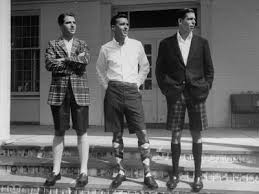
Of course, in the 1960s campuses in the US and around the world became hotbeds of political and cultural upheaval.  Students demanded more freedom, and they got it.  At many schools, in loco parentis rules were scrapped.  In many schools, indeed, core curricula were also scrapped in the name of freedom.  For instance, at my own beloved school, Binghamton University, students staged the “Bermuda Revolution.”  Not quite up to the office occupations and shotgun-wielding demands that rocked our neighbors at Columbia University or Cornell, but Bearcats managed to come together to protest strict student rules.  At Binghamton, the Bermuda Revolution brought students out to our Peace Quad clad in Bermuda shorts.  At the time, this was against the stern, traditional dress code that required shirts and ties for men and skirts and blouses for women.  As a result, the university changed those rules, giving students more freedom over their own lives.

Campus Revolutionaries, Binghamton Style

Campus Revolutionaries, Binghamton Style

One unintended consequence of this freedom is that more young people on college campuses have been exposed to sexual violence.  When students have more opportunity to drink alcohol and stay out late, more students find themselves in situations that lead to sexual assault.  As a result, the federal government has stepped in to investigate the way universities respond to charges of rape and sexual assault.

Professor Deneen argues that this tale of freedom gone awry can be seen as the history of liberalism in a nutshell.  As he puts it,

Longstanding local rules and cultures that governed behavior through education and cultivation of certain kinds of norms, manners, and morals, came to be regarded as an oppressive limitation upon the liberty of individuals. Those forms of control were lifted in the name of liberation, leading to regularized abuse of those liberties. In the name of redressing the injustices of those abuses, the federal government was seen as the only legitimate authority for redress and thereby exercised powers (ones that often require creative interpretations of federal law to reach down into private institutions) to re-regulate the liberated behaviors. However, now there is no longer a set of “norms” that seek to cultivate forms of self-rule, since this would constitute an unjust limitation of our freedom. Now there can only be punitive threats that occur after the fact. One cannot seek to limit the exercise of freedom before the fact (presumably by using at one’s disposal education in character and virtue); one can only punish after the fact when one body has harmed another body.

Conservative Christian colleges may have a unique set of challenges when dealing with the issue of sexual assault.  But Professor Deneen argues that sexual assault on other campuses has been a result of liberalism, not traditionalism.  Loose rules and permissive attitudes, Deneen notes, have led to an anything-goes culture.  The resulting “sexual anarchy” has left victims vulnerable to attack, with little recourse after the fact.


Was I Fair to Ken Ham?

Ken Ham complains that I was not precise enough.  I think I was.

Here’s the issue: On his blog today, leading young-earth creationist Ken Ham chided yours truly for saying “Ken Ham” when I really meant something like “conservative Christians.”  Ham was reacting to a recent post of mine in which I asked about Ham’s inordinate influence over some conservative Protestant colleges.  In that post, I noted Ham’s recent pronouncements about leading evangelical schools such as Calvin College and Bryan College.  I wondered if conservative schools had to bend over backwards to satisfy Christian critics like Ham.  Did schools like Bryan College have to toe the Ham line in order to maintain their support base among conservative evangelical Protestants?

Be More Precise, Please

Be More Precise, Please

Ham said I needed to be “more precise.”  Ham made the fair point that Science Guy Bill Nye often used the unfair rhetorical strategy of reducing all creationism to simply Ken Ham.  Of talking about creationism as if it were just a one-man crusade to bilk taxpayers and fool schoolchildren.

When it comes to Bill Nye’s language, I agree with Ham.  Bill Nye–with whom I generally agree–does not always seem to understand creationism.  In a recent post, for instance, I agreed with Mr. Ham that Bill Nye “Misse[d] the Boat on Creationism.”  I have also agreed with Mr. Ham that Mr. Nye’s use of phrases such as “Ham’s followers” is sneaky and unfair.

But in this case, I was not doing any such thing.  In my essay about Mr. Ham’s influence on conservative Christian colleges, I was talking precisely about the work of Mr. Ham and Answers In Genesis.  If I was incorrect about the influence of Ham in the recent controversy at Bryan College, I’ll apologize.  But I won’t apologize for mistakes I didn’t make.

Ham also notes that I expand my questions to include the state of conservative evangelical colleges and sexual assault.  As ILYBYGTH readers know, this is a question that has been bandied about here recently.  Those who are new to the blog will not be aware that we do not simply attack “fundamentalist” schools as rape havens.  Indeed, our recent string of commentary began with questions about a journalist’s unschooled presumptions about the nature of fundamentalism.  We do not assume that sexual assault is somehow unique to conservative religious colleges, but it does seem that there is a connection between the opaque authoritarian cultures of many conservative colleges and a culture that blames the victims of sexual assault.

The central point of interest to me, though, then and now, is whether and how Mr. Ham has come to wield such authority over conservative evangelical colleges.  In the case of Bryan College, at least, Ham’s worries led to changes at the school.  I can’t help but wonder if Ham’s say-so is of enormous influence at similar colleges and universities.  This is not a question about conservatism in general.  This is not a question about creationism in general.  This is a specific question about the influence of Mr. Ham’s Answers In Genesis ministry.


Does Fundamentalism Promote Sex Abuse?

Do conservative Protestant evangelicals have a problem with sex abuse? Does evangelicalism suffer from an overabundance of “Christian cesspools” of abuse?

I’ve been chastised for asking whether this is a specifically fundamentalist problem—that is, a problem of theology—or rather an institutional problem. That is, is it specifically fundamentalist theology and “purity culture” at fundamentalist schools that encourages rape and sexual assault? Or do we see the same sorts of systemic abuse in non-fundamentalist colleges and universities? At big football schools, for example, administrators protect rapists to protect the football program. Could “party culture” be just as conducive to rape and sexual assault as “purity culture?”

In an article about the sex-abuse travails at Bob Jones University, Boz Tchividjian says this is not a question of theology, but of “authoritarianism.” Tchividjian argues that church structures lend themselves to sex abuse, but that this sort of abuse could happen “in any culture, elevating leaders beyond accountability, leaving victims’ rights to their whim, and sidelining critics who challenge their rule.” Yet Tchividjian’s work has illuminated the gruesome world of sex abuse and rape in evangelical and fundamentalist institutions.

As Kathryn Joyce describes in a recent essay in American Prospect, Tchividjian’s anti-abuse group GRACE was called in to Bob Jones University in 2012 to investigate accusations of widespread institutional neglect of charges of rape and sex abuse. Tchividjian, grandson of evangelist Billy Graham and former law professor at Liberty University, has long campaigned for more transparency about sex abuse among evangelicals. In Joyce’s AP piece, Tchividjian made his case for the terrible evangelical record with sex abuse. “One study,” Joyce writes,

has found that 93 percent of admitted sex offenders describe themselves as religious. Offenders who report strong church ties abuse more often, with younger victims. That’s not because Christians are inherently more abusive, he said, but because they’re more vulnerable to those who are. Tchividjian repeated what one convicted sex abuser told clinical psychologist Anna Salter in her book Predators: Pedophiles, Rapists, and Other Sex Offenders: “Church people”—always looking to see the best in people, to welcome converts, to save sinful souls—are “easy to fool.”

“When something does surface, all too often the church leadership quiets it down. Because they’re concerned about reputation: ‘This could harm the name of Jesus, so let’s just take care of it internally.’

Tchividjian rattled off ways in which Christians’ openness can allow abuse to go unchecked: Perpetrators tend to use scripture to coerce, justify, and silence. If they’re clergy, they will exploit their positions; if they’re laypeople, they will take advantage of a church hungry for volunteers and rely on the trust given to members of a church family. “The reason why offenders get away with what they do is because we have too many cultures of silence,” Tchividjian said. “When something does surface, all too often the church leadership quiets it down. Because they’re concerned about reputation: ‘This could harm the name of Jesus, so let’s just take care of it internally.’

In case after case, Tchividjian and his colleagues unearthed terrible and terrifying stories of abuse and cover-ups. Of students like Katie Landry at Bob Jones University. When Landry reported her rape to Dean Jim Berg, Berg allegedly told her that there was a “sin in your life that caused your rape.”

Tchividjian says this is a question of organizational structure, not of theology. But his own work seems to make the case that fundamentalist culture seems particularly prone to this sort of victim-blaming. As in this story from BJU, it seems fundamentalist cover-ups have the ability to use theologically inflected language to cow victims into silence.

I’m certainly sensitive to charges of fundamentalist-bashing. Indeed, my first take on the recent spate of “exposes” of sex abuse at fundamentalist colleges was to wonder if this was just another attempt to dismiss dissenting colleges. But there does seem to be a connection between fundamentalism—both theology and culture—and this climate of sex-abuse cover-up. It might not generate higher numbers of abuse victims than other opaque institutions—ask anyone at Penn State, Florida State, or a host of other non-fundamentalist institutions—but it seems fair to say that fundamentalism has generated a sick culture of abuse.


Required Reading: Wal-Mart and Fundamentalist U

A recent exposé in the New York Times attacked Wal-Mart’s funding of charter schools. Conservative pundits defended Wal-Mart. But neither side took notice of a more profound tradition of educational activism by the leaders of the mega-retailer.

Historian Bethany Moreton, in her not-so-recent-anymore book To Serve God and Wal-Mart, describes a different sort of educational work by the founders and leaders of Wal-Mart. In addition to funding charter schools, the Waltons and Wal-Mart developed a network of fundamentalist colleges and universities that may have had far more long-term impact on American society and culture than any charter school.

How did capitalism, Christianity, and college combine?

How did capitalism, Christianity, and college combine?

The 2009 book garnered plenty of rave reviews from academic historians. I won’t try to offer a full review here, but if you’re interested, you can check out this one in Church History, or this one in the American Historical Review. Instead, I’ll sketch a few of Moreton’s points about the links between the Wal-Mart fortune and a network of evangelical colleges in the Ozark region. As I move into the research for my next academic book, a twentieth-century history of conservative evangelical colleges and universities, it seems clearer and clearer to me that these colleges have played a huge role in determining some of the basic culture-war landscape of recent United States history.

As Moreton describes, Wal-Mart and Walton money helped support some schools that desperately needed financial help. Especially close to Wal-Mart were the University of the Ozarks, John Brown University, and Harding University. Each of these schools embraced a Wal-Mart friendly combination of evangelical Protestantism and free-marketeering. And each benefited from substantial financial support from the Wal-Mart empire. Indeed, as Moreton relates, University of the Ozarks students joked that they should just change the name of their school to “Wal-Mart U” (pg. 144).

In the mid-1980s, as Moreton tells the story, with help from the Waltons, the faculty of the University of Ozarks spelled out the connections between traditional evangelical higher education and an intellectual embrace of the values of capitalism. In 1983, Mrs. Walton launched a series of “Free Enterprise Symposia” to trumpet the achievements—both moral and economic—of capitalism (pg. 154). A few years later, the faculty agreed that a new student concentration in entrepreneurship would include traditional courses in Old and New Testament, government, and liberal-arts electives. But the focus would be on business and the moral triumph of capitalism over “socialism/marxism” (pg. 155).

Students at these capitalist/Christian colleges embodied a very different sort of student identity from those of the hippies and leftists dominating headlines at other schools. For instance, Moreton describes one example of student activism at the University of the Ozarks in the late 1970s. Students joined with downtown merchants to encourage Christmas shopping. Students combined patriotic displays of red, white, and blue with traditional Santas to connect Jesus, America, and consumerism (pg. 143).

Wal-Mart also supported student organizations such as Students In Free Enterprise (SIFE). These pro-Christian, pro-capitalism student groups claimed to enroll 40,000 college students at 150 campuses nationwide. Together, SIFE bragged that it reached 100,000,000 people with its message of Christian free enterprise. Moreton described one example of that sort of student outreach by the SIFE chapter at Harding. Harding students tromped about the region with a student in a giant pencil costume. They spoke at schools, club meetings, and any other venue that would have them. Their message? Following the work of pundit Leonard Read, the students explained that worldwide capitalism managed to produce goods and services for all without central guidance. The humble pencil, for example, took materials and know-how from all around the world, bringing profit and uplift to all involved. Yet the invisible hand of the market accomplished this incredibly complex task without oversight from bumbling and greedy governments (pp. 193-197).

Leonard Read's Free-Enterprise Tale

Leonard Read’s Free-Enterprise Tale

As Moreton tells it, Wal-Mart’s college activism did not limit itself to the borders of the United States. In the late 1980s, the Waltons funded scholarships for students from Central America to study at colleges such as Harding, John Brown, and the University of the Ozarks. The goal was to train managers and workers in the pro-business, pro-Christian approach to big-block retailing and worldwide supply chains (pp. 222-247).

Moreton rightly emphasizes the centrality of higher-educational activism by conservatives such as the Waltons. Throughout the twentieth century, as I argue in both my 1920s book and my upcoming book on educational conservatism more broadly, the nature and purpose of higher education remained a central focus of American conservatism. As Moreton’s study reveals, the brains behind the Wal-Mart phenomenon took an active part in sponsoring the sorts of college and university “experience” that they thought would promote proper, traditional Americanism.

If I were to quibble with this book, I’d note that Moreton sometimes seems unaware of the longer, broader connections between pro-business groups and educational institutions. She describes what she calls the “national context of business colonization of education generally” (pg. 151) in the 1970s, but she doesn’t adequately note that the roots of that colonization go back into the 1930s, at least. Groups such as the National Association of Manufacturers, for example, actively conducted the same sorts of pro-business educational outreach that Moreton describes. A quick consult with Jon Zimmerman’s Whose America? would have helped Moreton flesh out the longer history.

But this sort of historian’s quibble does not detract from the importance of Moreton’s book. As the recent New York Times attack makes clear, conservative activism in K-12 education will always get plenty of attention. But the more profound cultural work of changing higher education may have much bigger impact on the nature of America’s culture wars. Who teaches the many conservative teachers in K-12 schools, for instance? Where do Christian executives learn to combine Jesus with Milton Friedman? Moreton’s look at the connections between Wal-Mart and higher education help illuminate the core intellectual premises of Christian capitalism.


Pre-Orders Now Available!

Want to be the first on your block to get your copy of The Other School Reformers?  Then pre-order your copy today!

Pre-order your copy today!

Pre-order your copy today!

As I was happy to announce recently, Harvard University Press will be releasing the book in early 2015.  But the pre-order just became available on sites such as Amazon.  The hardcover won’t be available until January 12, 2015, but if you pre-order today, you’ll be sure to WOW your friends and family by getting your hands on it first.

What Mormons Want Evangelicals to Learn in College

College is about fulfilling God’s mission.

That’s what Glenn Beck told the crowd at Liberty University the other day.  As Jonathan Merritt notes in Religious News Service, it is remarkable historically that Beck, a member of the Church of Jesus Christ of Latter-Day Saints—the Mormons—was invited to preach to the evangelical community of Liberty University.  Traditionally, as we saw in the presidential candidacy of LDS member Mitt Romney, evangelicals have looked askance at Mormonism.

As Merritt reports, Beck did not hide his LDS beliefs.  Rather, he flouted them, displaying Mormon relics such as Joseph Smith’s watch.

But that was not the only remarkable part of Beck’s talk.  Beck offered Liberty students a vision of the purpose of higher education.  You may have come here to help you get a job, Beck told the college crowd, but that’s not really what your education is for.  “You are at this university for a reason,” Beck reported.  What is God’s reason for higher education?  God did not say, Beck insisted, “I’m gonna send you down because you need to be . . . an accountant.”  [26:56]

The purpose of a university education, Beck told the audience, was not merely professional.  “You came to this university thinking, maybe,

I have to have an education to get a job.  You need this education from Liberty University because of your only true job.  The purpose that you were sent here for.  To magnify Him.  To bring Him to others.  To do what it is that you’re supposed to do.  To preserve liberty, the liberty of all mankind.

According to Beck, that sort of education is the true aim of education, whether students are LDS, Baptists, Mennonites, or whatever.  Life is a mission from God.  Higher education is simply further training for that mission.

Of course, Liberty University itself has a more ecumenical attitude toward the true purpose of education.  On Liberty’s website this morning, for instance, the casual reader is quickly reassured that Liberty certainly wants to train “Champions for Christ.”  But another of the four circulating mottos declares that Liberty “helps students and alumni find the right job or internship.”

Glenn Beck may be confident about the real purpose of Christian higher education.  But evangelical college students seem to want their college to walk both sides of the line.


The Other School Reformers

Clear your calendars! We have a release date. The Other School Reformers will be hitting store shelves in February.  I know that’s a long time to wait, so I’m suggesting everyone dress up as their favorite conservative educational activist and camp out outside their local bookstore.

Coming January 2015.

Coming January 2015.

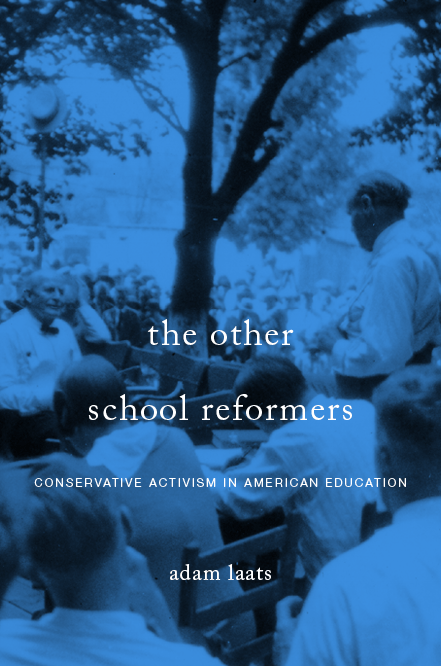
Thanks to the Smithsonian for this terrific cover image.  That’s Clarence Darrow (standing) facing William Jennings Bryan at the Scopes Trial.  In this book, I examine four epochal school controversies from the twentieth century.  In each case, I ask what conservative intellectuals and activists wanted out of schooling.  My goal is to find out what it meant to be “conservative” when it came to education.

The catalog listing just went up.  Here’s how the talented folks at Harvard University Press describe the book:

The idea that American education has been steered by progressive values is celebrated by liberals and deplored by conservatives, but both sides accept it as fact. Adam Laats shows that this widely held belief is simply wrong. Upending the standard narrative of American education as the product of courageous progressive reformers, he calls to center stage the conservative activists who decisively shaped America’s classrooms in the twentieth century. The Other School Reformers makes clear that, in the long march of American public education, progressive reform has more often been a beleaguered dream than an insuperable force.

Laats takes an in-depth look at four landmark school battles: the 1925 Scopes Trial, the 1939 Rugg textbook controversy, the 1950 ouster of Pasadena Public Schools Superintendent Willard Goslin, and the 1974 Kanawha County school boycott. Focused on issues ranging from evolution to the role of religion in education to the correct interpretation of American history, these four highly publicized controversies forced conservatives to articulate their vision of public schooling—a vision that would keep traditional Protestant beliefs in America’s classrooms and push out subversive subjects like Darwinism, socialism, multiculturalism, and feminism. As Laats makes clear in case after case, activists such as Hiram Evans and Norma Gabler, Homer Chaillaux and Louise Padelford were fiercely committed to a view of the curriculum that inculcated love of country, reinforced traditional gender roles and family structures, allowed no alternatives to capitalism, and granted religion a central role in civic life.

Almost makes me want to read it myself.  For me, the next steps will be to review and copy-edit the full manuscript next month.  Then in July I’ll put together the index, with help from a talented graduate student.