Fundamentalists Were Right

For a hundred years, conservative evangelicals have told themselves that college is a dangerous place. As I argue in my new book about evangelical higher ed, the threat posed by mainstream schools pushed fundamentalists in the 1920s to invest in their own network of interdenominational schools, safe colleges for fundamentalist youth. A new study suggests that fundamentalist fears are still well founded.
20171226_121555

How today’s fundamentalists view college…

Back in the 1920s, fundamentalists loved to recount horror stories of college gone bad. As evangelist Bob Jones like to tell revival crowds in the 1920s, one Christian family he knew scrimped and saved to send their beloved daughter to a fancy college. What happened?

At the end of nine months she came home with her faith shattered. She laughed at God and the old time religion. She broke the hearts of her father and mother. They wept over her. They prayed over her. It availed nothing. At last they chided her. She rushed upstairs, stood in front of a mirror, took a gun and blew out her brains.

Other fundamentalist pundits shared an apocryphal letter from a damned college graduate. This letter, from 1921, told the folks at home,

My soul is a starving skeleton; my heart a petrified rock; my mind is poisoned and fickle as the wind, and my faith is as unstable as water. . . . I wish that I had never seen a college.

Back then, fundamentalists didn’t just rely on anecdotal evidence. They shared social-science evidence of the dangers of mainstream higher education, especially psychologist James Leuba’s 1916 study of college-student religiosity. The students he interviewed tended to grow less religious during their college years. The takeaway? College must be doing something to strip students’ faith.
20171226_121545

Those darn college professors…

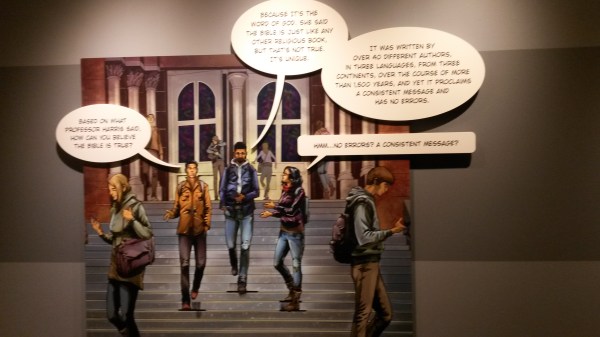
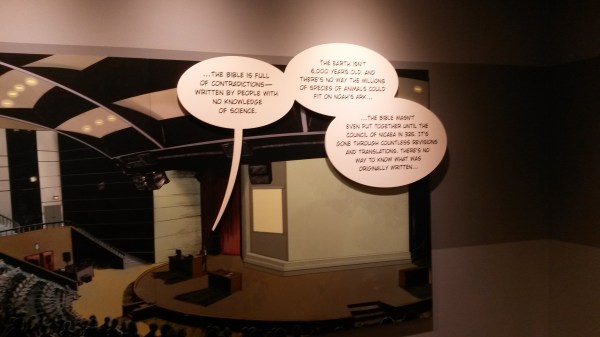
These days, conservative evangelicals are just as nervous as ever about college. On my recent trip to Answers In Genesis’s Ark Encounter in Kentucky, I was surprised to find a huge walk-through comic book illustrating the dangers of higher education.

And, over a hundred years after Leuba’s book, new research seems to suggest that mainstream colleges really do tend to water down student religiosity. The survey by the Interfaith Youth Core was most interested in the ways college students reacted to religious diversity. Along the way, they found that among 7,194 students at 122 colleges, religious activities as a whole tended to drop during the first year of college.

Forty-three percent of the freshman respondents said they had talked about religious ideas in high school, while only a quarter said they did in college. When it came to religious diversity, the numbers are even starker. Thirty-seven percent of respondents said they had attended a religious service of a different faith than their own in high school, but only 20% did in college.

College students also reported friendlier attitudes toward liberal ideas after a year of college, from 55% up to 63%. And a majority said they felt some pressure to change their religious ideas and that they tended to keep their religious ideas to themselves.

So while people like me might worry that students are not getting enough exposure to religious diversity, fundamentalists will likely worry more. Even if college students are shying away from other religions, they are also shying away from their own.
Betsy Devos: Progressive Champion?

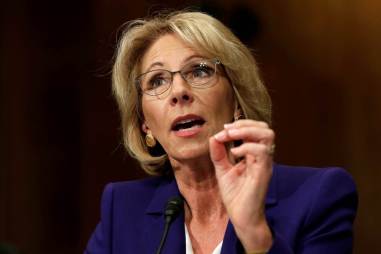
We could be forgiven for being confused. Ed Secretary Betsy Devos just delivered a rousing endorsement of progressive ideas about schooling and education. What gives?

SAGLRROILYBYGTH might be sick of all this—maybe it’s just too obvious even to mention. But since my years wrestling with the history of educational conservatism (you can read all about it here), I can’t help but obsess over the never-clear meanings of “progressivism” and “conservatism” when it comes to schools.

Betsy-Devoe

I hart progressive ed…or do I?

And now arch-conservative Queen Betsy just threw a Grand-Rapids-size rhetorical wrench into the culture-war works. If she’s talking this way, is there any meaningful way to differentiate the two sides? I think there is.

Here’s what we know: Secretary Devos delivered a prepared talk at the free-markety American Enterprise Institute. In her speech, she harped on progressive themes. Consider the following examples:

  • Progressives say: High-stakes testing is bad.

Quoth Queen Betsy:

As states and districts scrambled to avoid the law’s sanctions and maintain their federal funding, some resorted to focusing specifically on math and reading at the expense of other subjects. Others simply inflated scores or lowered standards.

  • Progressives say: Teachers have been disempowered.

Quoth Queen Betsy:

Most teachers feel they have little – if any — say in their own classrooms.

Quoth Queen Betsy:

we must rethink school.

  • Progressives say: Factory schooling is needlessly rigid and dehumanizing, yet it persists.

QQB:

Think of your own experience: sit down; don’t talk; eyes front. Wait for the bell. Walk to the next class. Repeat. Students were trained for the assembly line then, and they still are today.

  • Progressives say: Schooling should focus on the needs and experiences of every individual child.

QQB:

That means learning can, should, and will look different for each unique child. And we should celebrate that, not fear it! . . .

Our children deserve better than the 19th century assembly-line approach. They deserve learning environments that are agile, relevant, exciting. Every student deserves a customized, self-paced, and challenging life-long learning journey. Schools should be open to all students – no matter where they’re growing up or how much their parents make.

  • Progressives say: School must help make society more equitable. More resources must be dedicated to schooling for low-income Americans and students from minority groups.

QQB:

That means no more discrimination based upon zip code or socio-economic status. All means all….

We should hope – no, we should commit – that we as a country will not rest until every single child has equal access to the quality education they deserve.

What are we to make of all this intensely progressive-sounding rhetoric?

Some pundits pooh-pooh it. ILYBYGTH’s favorite progressive ed writer offers a perfect, pointed put-down: “poison mushrooms look edible.

It is not difficult, after all, to see how Secretary Devos’s endgame is different from that of most progressives. Unlike progressives, Queen Betsy’s final goal is an old conservative favorite, namely, the reduction of federal influence in public schooling. If Devos mouths progressive phrases, she also always returns to the same ultimate desire.

Consider these lines:

QQB:

  • federal education reform efforts have not worked as hoped….

  • The lesson is in the false premise: that Washington knows what’s best for educators, parents and students….

  • The lessons of history should force us to admit that federal action has its limits.

In the end, then, what we’re seeing here is the same old, same old. All sides in our hundred-years culture war have shifted tactics from time to time, while generally keeping the same long-term strategies.  As I argue in my book (and if you’re really lazy you can read a brief version of this in my short essay at Time), for example, in the 1920s, it was conservatives who pushed hard for an increased federal presence in local schools. Why? Because they thought it would force greater Americanization of immigrants and pinkos.

Devos’s canny adoption of progressive rhetoric is another example of this culture-war scheme. All sides tend to use whatever language best helps them achieve their long-term goals. They We tend to fight for any short-term goal that promises to bring them us closer to their our ultimate aims.

For Devos and her allies, the big picture is more religion, more privatization, and more tradition in public schools. Right now, they apparently think local school districts are the most likely governments to help achieve those aims. If bashing “factory models” and “inequality” will help achieve the ultimate goals, so be it.

Wait…ARE Creationists Just Dumber?

If you ask the Richard Dawkinses and the Bill Nyes of the world, creationism is a pretty simple problem. Those who won’t accept the evidence for mainstream evolutionary theory must be “ignorant, stupid, or insane (or wicked…)”. Those of us who know better have always pooh-poohed such simplistic science chauvinism. We argue instead that creationism is not mainly a question of knowledge, but of identity. A new study from the UK seems to challenge our assumptions. Maybe people who don’t accept evolution simply aren’t understanding it.

Here’s what we know: A group of researchers at the University of Bath studied over a thousand teenagers. Unlike studies in the USA, these teenagers showed a strong correlation between academic knowledge and acceptance of evolutionary theory. That is, students who understood evolution better tended to accept it more readily. Students who didn’t understand it as well tended to dismiss evolution or to say that both mainstream evolutionary theory and creationism could somehow both be true.

Here’s how the authors describe their conclusions:

before teaching, students with low acceptance had lower understanding of both evolution and of genetics; the low-acceptance students sat disproportionately in the foundation (rather than higher) science classes; low-acceptance students showed lower increments in the understanding of genetics; and student gain in the understanding of evolution correlated positively with gain in the understanding of genetics. We find no evidence either for a role for psychological conflict in determining response to teaching or that strong rejectors are more commonly of a higher ability.

We don’t want to jump to any grand conclusions of our own, but it seems for these students at least, better understanding and knowledge of mainstream evolutionary theory really did lead to greater acceptance.

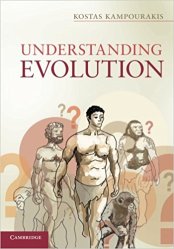
understanding evolution

T’aint natural…

Does this mean UK creationists just don’t get it? I don’t think so. But I think it does underscore the notion that mainstream evolutionary theory is not a particularly intuitive thing. It is difficult for us to comprehend central notions of deep time and population genetics. As people such as Kostas Kampourakis have pointed out in detail, our intuitions seem to point us away from a thorough understanding of concepts such as natural selection.

Are creationists dumber? No. For these students, though, a passing acquaintance with mainstream evolutionary theory apparently led them away from it, not toward it.

HT: VW

Crisis at Moody Bible Institute: The Curse of the Fundamentalists

The revelations coming out of Chicago are sad. Even sadder—for those who know the history of evangelical higher education—is that they fit squarely and depressingly into a century-old pattern. The nature of Protestant fundamentalism as established in the 1920s left schools like Moody Bible Institute in a treacherous position.

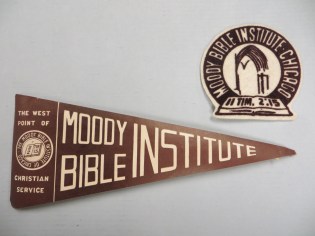
1940s MBI banner and patch

From happier times, c. 1940.

Here’s what we know: As Christianity Today has reported, the flagship Moody Bible Institute in Chicago has shaken up its leadership. The president, chief operating officer, and provost are all out. MBI officially thanked the three for their leadership, but the institute also acknowledged “widespread concerns over the direction of the school,” according to CT.

Many of those concerns were publicized by another ousted employee, Julie Roys. Roys had hosted a radio program on WMBI and she recently raised alarms at the financial and theological misdeeds of top MBI leaders. On her blog, Roys had pointed out that the leaders had made unwise and possibly shady financial arrangements. She also noted alumni complaints that the school had indulged liberal ideas.

I don’t have any inside knowledge of the goings on at MBI. As I argue in my new book about the history of evangelical higher ed, though, the pattern is familiar, and part of the DNA of evangelical higher education. In a nutshell, the fundamentalist movement in the 1920s attracted most of the Bible-institute movement. Flagship MBI became a reluctant leader of fundamentalism, along with other higher-ed institutions such as Wheaton College in Illinois and Bob Jones College in Florida (it moved twice, only becoming Bob Jones University in its current South Carolina location in 1947).

The nebulous nature of interdenominational fundamentalism left these institutions in a bind. Not as an accident, but as an inherent part of this conservative protest movement, there existed no higher (human) power that could set the boundaries of real orthodoxy for these schools.

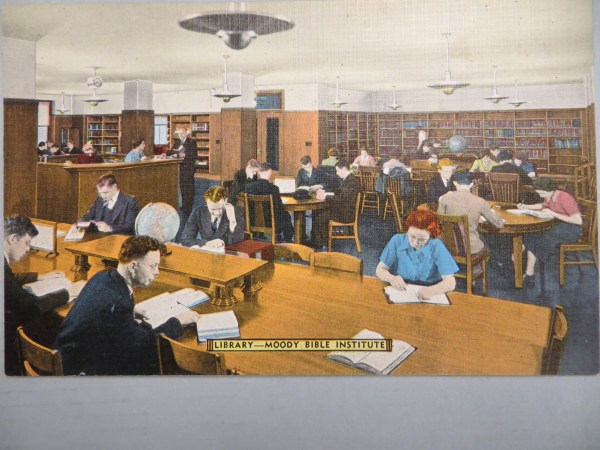
1940s postcard library

Getting those dispensations right…c. 1940s.

As a result, different schools figured out different ways to decide what was kosher and what wasn’t. Bob Jones College established a rigid authoritarian structure. True religion, at Bob Jones College, was what the Bob Joneses said it was.

Wheaton College adopted a more spread-out network of authority. They established a board of fundamentalist celebrities and donors to help guide the school. But they also hired a series of powerful, charismatic presidents to embody the school’s mission. In addition, Wheaton courted alumni to help fund and direct the school. Often, tensions among the various leaders resulted in mixed messages and confusing, conflicting arguments about what constituted proper evangelical religion. Larycia Hawkins’s experience is nothing new.  Just ask Russell Mixter or President Buswell, two stories I describe in detail in the book.

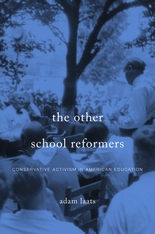
Cover art final

Read all about it…

MBI did something similar, and the results are evident in the recent controversies. Reliance on celebrity fundamentalists and in-group leadership structures has always plagued evangelical colleges. In today’s case, Left Behind author Jerry Jenkins is accused of receiving sweetheart financial deals and tweaking the school’s moral code. MBI’s leaders are accused of giving one another perks without opening their deliberations to the whole school community.

The accusations range beyond financial hanky-panky. MBI’s leaders are accused of winking at theological sloppiness, too, another pattern established in the twentieth century. In today’s MBI case, alumni have charged the top leaders with

trading the sure foundation of God’s Word and the mission of training men and women to know and teach the Gospel for the fragile foundation of the cultural tides of the day. . . . students around campus and on my floor were not acting in ways that showed their desire to love and know the Lord fully. . . . Moody has become not a unique place to study and know God’s Word, but instead a place infiltrated by liberal political stances and clichéd cultural buzzwords without a solid theological foundation.

Such accusations have a timeless ring in the world of evangelical higher education. Similar complaints have been lodged against school leaders in every decade of the twentieth century and the twenty-first. And though they always seem new, they are the predictable result of the uncertain goals of evangelical higher education.

Like all evangelical institutions, MBI is in an impossible situation. It exists as a school dedicated to a certain vision of eternal truth, yet it can only survive if it also changes periodically. For example, few members of today’s MBI community would encourage racial segregation on campus, but in the 1930s it was part of an MBI education. All schools need to change, but this can be difficult for evangelical schools that promise to be purveyors of God’s eternal Truth.

Too often, leaders at evangelical schools fudge this dilemma by making back-room decisions about changes, hoping the evangelical public does not complain too loudly. Every once in a while, however, influential board members, faculty, students, or alumni shout out a protest, like the one we hear today from Chicago.

It’s important to note, of course, that similar problems exist in non-evangelical institutions as well. Wherever charismatic leaders are allowed to make decisions without consulting concerned constituencies, abuse is predictable. Most often, in secular higher education, this has happened with high-profile athletic programs such as the ones at Penn State and Florida State.

The situation at MBI is sadly similar. Instead of a structure by which changes can be discussed and agreed upon, a closed-door group of influential leaders has felt forced to go ahead on its own. None of us should be surprised that structures like that lead to financial malfeasance or unpopular policies.

The Oprah-iate of the Intellectuals

Will she or won’t she? Oprah Winfrey’s speech at the Golden Globes has people talking about a Winfrey presidency. Here’s the ILYBYGTH question: Why aren’t progressive pundits talking about it? I think I know why—it’s a rare moment when conservatives and progressives agree on something.oprah president

For their part, conservative pundits have had a field day with the Oprah news. At National Review, for example, commentators have relished the story. They’ve asked if Oprah will ditch her Hollywood-lefty friends; they have gleefully pointed out that Oprah would be the Left’s Trump; they’ve champed at the bit to see Oprah fight against an establishment Democrat.

At American Conservative, too, Benedictine pundit Rod Dreher has wallowed in the idea of an Oprah papacy/presidency. President Oprah, Dreher crows, would be

the Pallas Athena of Moralistic Therapeutic Deism. She would be the goddess of the nation-state.

On the other side of the culture-war spectrum, there has been markedly less talk about an Oprah presidency. Sure, Rolling Stone wondered about it. And a few other progressive small-fry have opined. But big progressive outlets such as The Nation, Progressive.org, and ThinkProgress have maintained a studied silence on the issue.

Why? I have a hunch and I’d be happy to be better educated by SAGLRROILYBYGTH.

I think smart progressives agree with the conservative National Review crowd on this one. That is, they see Oprah as the Trump of the Left. An Oprah candidacy, progressive strategists might think, will force them into discussing non-issues such as Oprah’s wacky universe-embracing religious quackery.

After all, as Yale’s Kathryn Lofton has argued, Oprah has crafted more than a media empire. Her “gospel” has translated Oprah into something else.

And progressives want to talk about health care and tax plans, not enlightenment through elaborate poster-making.

Why Conservatives Should Love Obama

He did it! I don’t how it happened, but somehow President Barack Obama managed to accomplish one of the most dreamed-for educational goals of America’s social conservatives. During his presidency, that is, early teen sexual activity dropped significantly, according to the CDC.

I know, I know, it’s ridiculous to give Obama credit for something that merely happened to coincide with his time in the White House. But that’s what culture-war pundits do all the time. In this case, the numbers are pretty significant, and the cause is among those nearest and dearest to the hearts of American conservatives.

As I argued in my book about the history of educational conservatism, helping kids avoid the allure of premarital sex has always been one of the fondest educational dreams of social conservatives, especially conservative religious reformers. Why was evolutionary theory dangerous? If we taught children they were nothing but clever animals, they would certainly behave that way. Why was old-fashioned discipline important? Because children needed to learn to control their sinful, lusting nature.

I hate to do it, but let me quote myself here. When Alice Moore first joined the school board in Kanawha County, West Virginia in the 1970s, one of her first acts was to close down a progressive middle school. When I interviewed Moore I asked her about it. Here’s what I wrote in the book about Moore’s experience:

The school, Moore recalled, was not a proper learning institution. It had become a cesspool of unrestrained sloth and lust. The students, she recalled, did “whatever they wanted to.” As she walked in for her first inspection, a young couple stood in the doorway, wrapped in each other’s arms. She had to ask them to move out of her way, which they did only with notable resentment. Other students wandered around the school and neighboring fields, smoking and engaging in all kinds of sexual activity in nearby barns. When Moore asked the principal to explain this sort of behavior, he informed Moore that the school hoped to do more than simply transmit information to students; it hoped to transform them into agents of social change. Teachers should see their roles as co-learners, not as dictators.

This sort of progressive shibboleth exasperated Moore.

At the heart of warped progressive-ed thinking, Moore believed, was a mistaken notion of the nature of humanity. Lust needed to be schooled out of children, not winked and nodded at as a “natural” thing. Moore was not at all the only conservative activist to think this way. Consider William J. Bennett’s conservative index of cultural indicators. Bennett’s accusations were clear: Hippies had wrecked everything. Progressive attitudes in education had led to woeful increases in dangerous sexual activities among young people, in addition to crime, drug use, etc.

In short, for a hundred years now, educational conservatives have desperately dreamed of reducing the progressive dominance of “If it feels good, do it” attitudes among young people. And now, at long last, we seem to have some evidence that those dreams have come true, at least in part.

CDC teen sex chart 2

The  good news no one will holler about…

Here’s what we know: The excitingly named “Morbidity and Mortality Weekly Report” from the Centers for Disease Control notes significant declines in sexual intercourse among America’s 9th and 10th graders (roughly 14- and 15-year olds). As the authors state,

Nationwide, the proportion of high school students who had ever had sexual intercourse decreased significantly overall and among 9th and 10th grade students, non-Hispanic black (black) students in all grades, and Hispanic students in three grades. A similar pattern by grade was observed in nearly half the states (14), where the prevalence of ever having had sexual intercourse decreased only in 9th grade or only in 9th and 10th grades; nearly all other states saw decreases in some or all grades. The overall decrease in the prevalence of ever having had sexual intercourse during 2005–2015 is a positive change in sexual risk among adolescents (i.e., behaviors that place them at risk for human immunodeficiency virus, STI, or pregnancy) in the United States, an overall decrease that did not occur during the preceding 10 years.

Why? We don’t know. And of course I’m kidding when I give President Obama credit. There are some things we can confidently predict, however. First of all, I don’t think we’ll see pundits shouting about this good news. As we’ve lamented here at ILYBYGTH in the past, good news about America’s schools and youth just never gets headlines.

Second, the warped popular myths about America’s public schools will continue to dominate. Gallup polls make it startlingly clear: When people know public schools, they like them. But when they describe public schools in general, people call them terrible. The notion that America’s public schools are cesspools of drugs, sex, and sloth is not true, but it is very widely held. Similarly, this data about trends in youth culture will not likely change people’s assumptions about schools and youth.

Finally, this student data points out yet again that the common story about the history of American public education is just not true. Many of us assume that progressive types took over public education back in the 1930s. We think that since the 1930s (or maybe since the 1960s) public schools have been dominated by progressive educators from fancy teachers’ colleges and think tanks. It’s just not true. Throughout their existence, public schools have reflected the values of their local communities. When those communities change their ideas about sexual activity, so too do their local schools. Educational change hasn’t come from high-level meetings by New York leftists, but rather from more nebulous and  hard-to-trace shifts in social trends.

Why do more and more young people seem to be avoiding early sexual activity? I don’t know, but I’ll guess: It’s not due to any sex-ed curriculum they’re receiving in their Health classes. No, the change in reported sexual activity is more likely due to changes in our whole society about the allure of sexual intercourse. After all, as we like to say here at ILYBYGTH, schools don’t change society, schools ARE society.

What’s the Deal with White People?

The Roy Moore saga might (or might not) finally be coming to an end. Moore lost the Senate race and he might ride his horse into the sunset. The poll results from Alabama, though, give us some puzzles to think about. We might think we understand why so many white evangelicals voted for Moore. But some other groups just don’t make sense.

As we’ve argued in these pages, a central defining feature of white evangelical history over the past century has been what historian George Marsden called the “establishment-or-outsider paradox.” For many white evangelicals, as I explore in my new book about evangelical higher education, America has been both a shining city on a hill and Babylon.

As a result, white evangelical voters have been prone to cheer candidates like our current president who promise to make America great again. President Trump is not the first leader of questionable personal morality to win evangelical votes by pandering to white evangelical yearning to take the USA back to an imagined Christian past, to return the country to Winthrop’s vision.

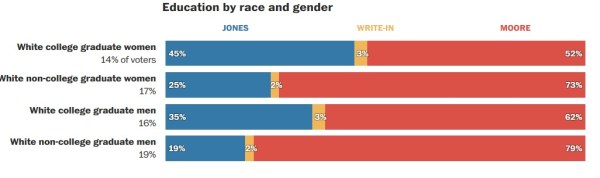
So I’m not too shocked to read that 80% of white evangelical voters in Alabama voted for Judge Moore. There is one result that befuddles me, though. A slim majority of white college-educated women also went for Moore. By a margin of 52% to 48%, this group voted for a man credibly accused of preying on teenage girls.

What gives?

We can even extend this question to the 2016 presidential election. The number of white evangelical voters who voted for Trump and Moore is very similar: 81% and 80%. While a slim majority of college-educated white women voted for Secretary Clinton over President Trump, Trump still claimed a surprising 45% of the college-educated white woman vote.

Can someone explain this one to me?Moore election results

Why do so many white college-educated women vote for these candidates? I have a feeling my cultural blinders are making it hard for me to understand this apparent truth about the American electorate.

The Headline No One Clicks On

I’ll admit it: I’m a monster. I recently asked my students to take on an impossible task. One of the big questions of our graduate seminar this semester was this: Is American public education “good?” Students came up with several ingenious, nuanced, and insightful answers. But they could be excused for struggling with the question. As recent headlines show, the question is impossible. How can we tell if public schools are doing well?graph from edweek 1

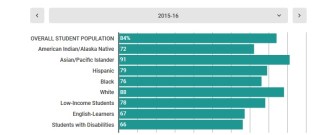
On one hand, we see news every day that should convince us. A report in EdWeek, for instance, reveals the amazing news that high-school graduation rates are up for the fifth year in a row. For all types of students.

Most other headlines about education, though, are pretty rough. We hear that the achievement gap among demographic groups is widening in New York City. We read that American students are losing their number-one spot in reading scores. Queen Betsy tells us that the terrible state of our public schools is “unacceptable. . . . inexcusable. . . . [and] truly un-American.”graph from edweek 2

What we’re looking at here is the old blind-scholars-and-elephant problem. If we look at graduation rates alone, we’d say public schools are doing great and getting better. But if we look at the disparities between different groups of students, we’d agree that the system is woefully unfair and racially biased.

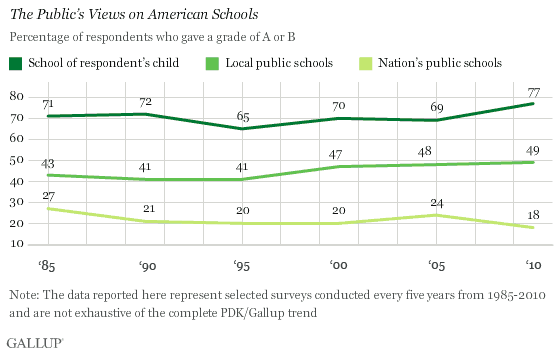
By and large, though, it seems hard to find good news, unless we avoid headlines and look at real schools and real teachers. The Gallup numbers show this consistently. When people describe the schools they know best, they’re very bullish. But asked about public schools in general, people are gloomy.

gallup people like their local schools

I can’t help but think headlines contribute to this situation. Talking about desperate crises appeals to our yen to confirm our fears. Talking about terrible schools allows us to blame the people we dislike for the current crisis. And much of the problem is due to deliberate culture-war obfuscation. In a recent speech, for example, Queen Betsy said,

A recent Gallup poll showed the majority of all Americans are dissatisfied with the overall education system in our country.

That’s true. But it hides the fact that bigger majorities of Americans are happy with the schools they actually have first-hand knowledge about.

We might say the same thing about our teachers. It’s easy to find headlines about bad teachers. Don’t believe me? Try googling “unprepared teachers.” If you have kids in school, you’ll be frightened by the results. But if people could spend a semester with the students in my department preparing to be teachers, they’d share some of my optimism and confidence.

Are there big problems with America’s public schools? Definitely. But we need to be careful with our questions if we want to get good answers.

Are there bad teachers out there? Sure. But the talent and energy going into the profession are overwhelming. It’s just not something we can cram into a clickbait-y headline.

Making Campus Conservative

Wowzers! Having apparently given up on appealing to anyone else, the House GOP has taken to playing Santa Claus to campus conservatives. Their new proposal for the Higher Education Act threatens to make conservative dreams come true.

According to Politico, the big story from the new bill is the sweeping change it will enact in federal student-loan policy. Here at ILYBYGTH, though, we’re more interested in the way it will redraw battle lines in higher-ed culture wars.

As we’ve discussed frequently, conservatives interested in higher education have fulminated ferociously about the recent spate of anti-conservative student protests. As I argued at HNN a while back, conservative legislative moves like the recent one in Wisconsin don’t actually plan to improve things, but rather hope to make political hay. The only effect, as someone once put it so wisely, will be to “write a vague sense of conservative outrage into the law books.”

Speech codes aren’t the only target of the new bill. It also throws a brontosaurus-sized bone to religious conservatives. As we’ve seen, evangelical groups such as Intervarsity have been de-recognized on many campuses. That means they can no longer use campus facilities. Unless they allow a more diverse group of people to be group leaders, they are no longer allowed to be official student groups.

The House bill promises to fix both problems. As Politico explains, the new bill would ban public colleges, at least, from enacting any sort of speech-restricting codes. Plus, no schools could de-recognize religious groups. As the bill’s language puts it, colleges could not deny

a religious student organization any right, benefit, or privilege that is generally afforded to other student organizations at the institution (including full access to the facilities of the institution and official recognition of the organization by the institution) because of the religious beliefs, practices, speech, membership standards, or standards of conduct of the religious student organization.

Will it work? Hard to say. As we all know from Schoolhouse Rock, there’s a long journey from bill to law. House GOP leaders might be willing to give up the evangelical-friendly parts of their bill to get the student-loan parts to succeed. Or they might scrap the provision about free speech to win on their sexual-assault rules.

Let My Children Go

Even the smartest conservatives don’t get it. There’s a big win for conservatives buried in the Senate’s tax plan. If it goes through, though, it will not prove the strength of conservative ideas, but rather the desperate strait they are in.

Before we dig into that, let me back up a little bit and tell a story. When my book about the history of educational conservatism came out, I did an interview with National Review’s John Miller. He wanted to know how twentieth-century conservatives had pushed for charters and vouchers.

9780674416710

Things are not always what they seem…

The problem was…they hadn’t. As I have argued elsewhere, when Milton Friedman first proposed charter schools in the 1950s, no one listened. The conservative push for charters and vouchers only gained real steam at the very tail end of the century.

By and large, conservatives didn’t want to escape from public schools in the twentieth century. Why not? It’s obvious: They still hoped to control them.

There were exceptions. After Brown v. Board in 1954, whites in the South massively resisted by privatizing public schools. And yes, the evangelical exodus from public schools took off in the 1970s. Then the second-stage flight from fundamentalist schools to fundamentalist homeschools began in the 1990s.

In the big picture, though, conservatives generally considered public schools their schools throughout the twentieth century. In the Reagan era, conservative intellectuals who cared about schools—most notably William J. Bennett—didn’t want to help conservative parents escape from public schools. Rather, Bennett thought the public schools themselves could be nudged in conservative directions. As we’ve seen lately, though, there’s a huge divide between today’s conservative thinking about public schools and Bennett’s. Most obviously, Bennett’s conservative dream for common state standards met with virulent conservative opposition.

What does any of this have to do with the Senate tax bill? The Senate version contains a clever sweetener for conservatives who want to remove their children from public schools. As reported in Quartz, their proposed tax bill will extend the use of 529 plans to K12 education. In the past, those programs allowed parents to squirrel money away for their children’s college expenses. Any earnings weren’t taxed, as long as the money was spent on tuition.

The new tax bill allows parents to do the same thing with private and charter schools. In effect, the new bill is a modest tax break for conservatives who want to keep their children out of the hands of the public schools.

I should add the usual clarification: SAGLRROILYBYGTH are sick of hearing it, but I’ll say it again. I am no conservative myself. I am deeply concerned about the two terrible tax bills currently under debate. The push to reduce and reroute funding for public education is a cruel and shortsighted effort. IMHO.

As a historian, though, I can’t help but notice that this is yet another example of the ways conservative dreams have deflated in the past century. In the 1920s, as I argued in my book about educational conservatism, religious conservatives hoped for nothing less than to legislate the theocratic control of public education.

These days, as this tax plan demonstrates, conservatives no longer hope to push public schools in conservative directions. Rather, conservative strategy consists of sneaking in tax breaks and incentives for parents who are trying to flee.