What Goes On in Medical School?

HT: MM

It’s probably nothing. But the latest in-your-face conservative pick by President Trump adds one more leg to the stool. Is there some reason why so many prominent radical creationists are medical doctors?
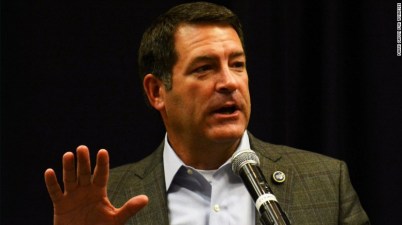
mark green

Creating a modern military….

Tennessee Senator Mark Green is only the latest. He is awaiting confirmation hearings to become Secretary of the Army. He’s already taking some heat for his official proclamations about gender and sexuality. In 2015, he delivered a fiery creationist sermon to a Cincinnati church.

For those of us who keep track of such things, Senator Green apparently emphasized two favorite notions of twenty-first century creationists. He insisted that the second law of thermodynamics militated against evolution. Since entropy increases over time, the argument goes, things won’t get more organized over time, but less.

As Green put it,

If you put a lawn mower out in your yard and a hundred years come back, it’s rusted and falling apart. You can’t put parts out there and a hundred years later it’s gonna come back together. That is a violation of a law of thermodynamics. A physical law that exists in the universe.

Green also embraced the “irreducible complexity” argument beloved by today’s intelligent designers. As articulated by biochemist Michael Behe, this argument points to some organic systems such as blood-clotting. If the entire process needs to be in place in order to confer any evolutionary benefit, the argument goes (roughly), then it makes no sense for it to have evolved in pieces.

We don’t want to argue the merits of these creationist arguments here. Our question this morning is different. In his 2015 Cincinnati sermon, Senator Green claimed to be an expert about the scientific weaknesses of evolutionary theory. On what grounds? Because of his work and training as a medical doctor.

It’s not much to go on, but there certainly seems to be a mini-trend involved here. Senator Green joins other prominent doctor/creationists in politics. Most obviously, Secretary Ben Carson rose to prominence as a young-earth creationist and pediatric neurosurgeon. Representative Paul Broun of Georgia, too, headed the House science committee, hated evolution, and claimed that his “scientific” education as a medical doctor had convinced him of the weaknesses of evolutionary science.

What is going on here? One might think that medical training would weed out creationist thinking. Most medical doctors, after all, study lots of biology. And, as the man said, nothing in biology makes sense except in the light of evolution.

Again, our sample of only three prominent doctor/creationists isn’t large enough to prove anything, but it does raise the question. Why do so many of our prominent creationists come from the field of medicine?

One answer would seem to be that medical doctors can claim the prestige of science without actually doing any pure scientific research themselves. They can claim to be experts, but they really are more interested in the mechanics of biology than the driving processes.

As anthropologist David Long found in his study of undergrad bio majors, it is very easy to study biology and remain a committed young-earth creationist.

Clearly, as the case of Senator Green reminds us, simply learning more biology will not convince people out of their creationist beliefs. Just like other prominent doctor/creationists, Dr. Green’s creationism is something besides a lack of knowledge about mainstream science.
Hoaxing at the End of the World

What happens when we can’t tell the intentionally preposterous from the incidentally ridiculous? Does it mean we’ve reached the end of our rope? When we can’t tell hoaxes from reality, it serves as yet more evidence that we don’t have any solid way to judge.

Most recently from my adopted home state of Wisconsin, we see the hilarious story of Chop & Steele. These two goofs pretended to be innovative fitness instructors. They went on local TV news shows to demonstrate their stupid workouts, including smashing Easter baskets, hitting each other with sticks and racquets, and doing a variety of things with tires. As Steele explained about one maneuver: “This one works your delts, your tris, your plaps.”

Work those plaps.

It was hilarious and obviously ridiculous. But the news shows couldn’t tell. They welcomed Chop & Steele as fitness experts. And now they’re mad. Chop & Steele are being sued for their fakery.

The local TV news shows aren’t the only ones who look idiotic. As SAGLRROILYBYGTH may recall, the academic world was embarrassed by a similarly ridiculous hoax twenty years ago. Professor Alan Sokal at NYU published a garbled nonsense essay in the journal Social Text. As Sokal explained later, his satire was an attempt to prove how ridiculous academic politics had become. The fact that his nonsense essay could be published, Sokal wrote, proved that “some fashionable sectors of the American academic Left have been getting intellectually lazy.”

No one likes to be goofed on. It seems, though, that when satire moves so close to reality, we’ve reached some sort of sad equilibrium.

Forget Benedict, It’s the DeVos Option

You’ve heard it by now: Rod Dreher is pushing a “Benedict Option” for religious conservatives. He wants the good people of America to pull back from mainstream society into purer enclaves. When it comes to our long-simmering creation/evolution debates, that sort of BO has never really been necessary. And Trump’s latest executive order makes it even less so. Why would creationists retreat when they’ve already won?

berkman plutzer REAL chart

Traditional schools, traditional teachers, traditional “science”

In case you haven’t seen it yet, President Trump has continued his charm offensive with America’s conservatives. In his latest executive order, he has promised conservatives something they have long yearned for: greater local control of public education. Ed Secretary Betsy DeVos will conduct a 300-day study into the issue. She is charged to find ways to limit the influence of the federal government in local schools.

As DeVos crowed, this order gives her

a clear mandate to take that real hard look at what we’ve been doing at the department level that we shouldn’t be doing, and what ways we have overreached. . . . And when it comes to education, decisions made at local levels and at state levels are the best ones.

Obviously, there are enough dog-whistles in there to win an Iditarod. Conservative activists have long yearned to shackle the federal education bureaucracy. As I argued in my book about the history of educational conservatism, since the 1930s conservatives have looked askance at federal control of local schools. Time and time again, distant experts have advocated more racial integration, more evolution, and more multiculturalism in K-12 schools. Time and time again, state and local officials have pushed back, fighting for more religion, more segregation, and more traditionalism.

In the specific case of evolution and creationism, creationists have always worried that outside control meant more evolution. Back in the 1920s, for example, anti-evolution leader William Jennings Bryan railed endlessly about the infamous influence of outside “oligarchs” on local schools. The local hand that wrote the paycheck, Bryan insisted, must rule the schools.

Bryan wasn’t alone. In North Carolina, anti-evolution activists blasted their university president for pushing evolution into their flagship public state university. President Harry Chase, they charged, was nothing but a “damn Yankee,” messing up local schools by importing “modernists, Darwinian apologists, and Northerners.”

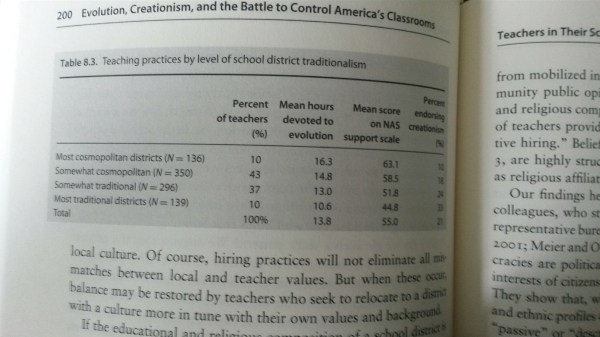
In the case of evolution education, though, creationists have always had the last laugh. Yes, conservatives have worried about the influence of outside experts. But in most schools, as political scientists Michael Berkman and Eric Plutzer found, local values dominate. Local attitudes were the most important factor, they found, in determining how much creationism was taught in public school science classes. As they put it,

Traditional districts and cosmopolitan districts tend to hire teachers whose training, beliefs, and teaching practices serve to reinforce or harmonize with the prevailing local culture (pp. 199-200).

In communities that favor creationism, teachers teach it. In communities that are on the fence, teachers mumble about it.

So why would creationists ever want to retreat to Benedictine purity? They have already won. And, as Secretary DeVos promises even greater local control, creationists have even more cause to celebrate. As young-earth activist Jay Hall put it recently, “we support the efforts of the new Education Secretary Betsy DeVos to promote school choice.”

More choice plus more local control equals more creationism.

So, though there are plenty of other reasons for conservatives to head for the hills, evolution education ain’t one of em. Local schools have always allowed local creationists to dictate the goings-on in most science classes.

And Secretary DeVos’ new local imperative seems destined to only make local creationist control stronger.

Helen A. Handbasket, America’s Schoolteacher

It can get weird. Sometimes, as a mild-mannered historian, I get a overwhelming sense of déjà vu. Sometimes stories from today’s headlines seem to shamble straight out of the past.

Case in point: As I warm my heels down here in sunny Florida, I got a little freaked out by the startling similarities of the letters in today’s local newspaper to those I uncovered in the research for my book about educational conservatism. Whatever the decade, it seems, people like to take potshots at teachers. Since the 1920s at least, it has been a popular national pastime to criticize the vast incompetence and presumed political chicanery perpetrated by our local teachers.

First, some background. SAGLRROILYBYGTH might have noticed a warmer, more humid tone in these pages lately. It’s due to the fact that I’ve been enjoying some family vacation time in sunny Florida. As a compulsive culture-war chatterer, though, I couldn’t just sit back and sip something. I cracked open the local paper, and 1949 jumped out.

Florida newspaper

Hello? It’s 1949 calling…

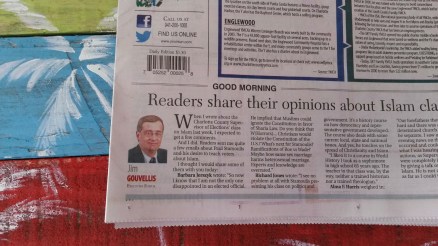
The story in the Charlotte Sun from Executive Editor Jim Gouvellis concerned a controversial recent event by local politician Paul Stamoulis. Stamoulis had given a series of lectures about the dangers of Islam. Some folks thought it was a good idea. Others thought it was a scary abuse of power by a right-wing ideologue.

Editor Gouvellis opened up the pages of today’s paper to letters from the community. The issue of political Islam was relatively new, but the tone of the letters was eerily similar to those I found in archives around the country, from the 1920s through the 1980s.

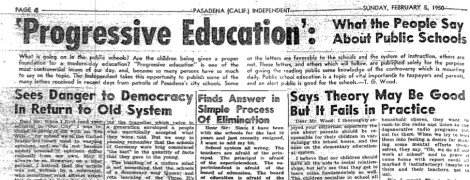
In particular, I was creeped out by the echoes from Pasadena’s school controversy between 1949 and 1951. Back then, an intrepid local newspaper editor tried the same thing. He asked for letters from the community. What did people think of their schools?

Pasadena indep

Nossir…I don’t like it.

The issues were different. Today’s Floridians are weighing in about the propriety of an elected official using public money to make inflammatory speeches. In Pasadena, parents were mad about the alleged misdemeanors of “progressive education.” You’d think the two things would have nothing in common.

But they do. Lots of people–wherever they live, whenever they lived–seem to assume that teachers are terrible. Public-school teachers, at least.

And to your humble editor, the tone and target of today’s letters seem shockingly similar to that of Pasadena, 1949. So similar, in fact, that I thought I’d try a little experiment. I’ll post below a clip from today’s Florida newspaper mixed in with a bunch from Pasadena, California, 1949.

Can you pick out the local one? Without cheating and clicking on the story link above?

  1. There is a growing feeling among parents that there is something amiss in our public schools.
  2. As for your comment and others’ regarding [XXX]’s lack thereof of a formal educational background, I do believe that perhaps we need more such “teachers” in our educational system today, based upon the misinformation being spoon-fed to our children by today’s so-called educators.
  3. Another claim that the teaching fraternity continually push forward is that they are grossly underpaid.  My observation is that in [XXX] this is untrue.  For nine months’ work and occasional brush-up courses in the summer they receive the same salary or better than competent office help receive for 11 ½ months’ work.
  4. I have personally felt that the modern school system of education is based on politics. . . . This larger percentage is easy prey to propaganda leaders and naturally look up to them, thinking the fault lies in themselves and not in the school system of education.
  5. In my opinion, the honorable school board is using our youngsters as educational guinea pigs.

Can you tell which one of these is today’s newspaper and which is from your grandparents’?

Why Do Schools Cover Up Rape?

Is it the “private” part? Or is it the “fundamentalist” part?

As SAGLRROILYBYGTH are well aware, we’ve gone back and forth in these pages about the troubled history of evangelical colleges and sexual assault. Leading fundamentalist institutions such as Bob Jones University have finally admitted to their own shocking denialism. At BJU and other fundamentalist schools, a cocktail of “purity-culture”-fueled attitudes and diehard loyalism fostered a legacy of abusive cover-ups.

As we see again today, though, fundamentalist schools are depressingly similar to non-fundamentalist schools when it comes to institutional cover-ups. Plenty of closed-mouth schools relegate the suffering of sexually abused students to secondary status.

In the New York Times, Alan Feuer relates the charges against Choate. Choate Rosemary Hall is an uber-elite boarding school in Connecticut. As Feuer reports, decades of student complaints about abusive teachers were hushed up. Predatory teachers were transferred or disciplined, but never reported or arrested.

choate

Idyllic? …or menacing?

It’s not that students didn’t complain. One student contracted herpes from her teacher. The school allowed the teacher to finish out the school year, then the teacher transferred to a different private school in Colorado. Another student was coerced into having sex with a teacher by threats of bad grades and bad college recommendation letters.

In one case, according to the outside report released last week, a student who accused his former faculty advisor was told that the situation was complicated. After all, grateful alumni had just donated hundreds of thousands of dollars to honor the teacher. Had the teacher been sexually aggressive with students? Maybe, the school’s alumni director wrote, but “his teaching did reach a lot of kids since 1944, and I’d rather let it go at that.”

The problem, it seems, ranges far beyond the insular world of fundamentalist schools. As Yvonne Abraham noted in the Boston Globe, “you have to wonder how parents could ever again entrust their children to this school — or any boarding school.” She repeats the central question from attorney Roderick MacLeish: “Do these schools have the moral authority to continue to exist?”

Of course, the details of every nauseating case are different. Catholic schools suffer from their antiquated celibacy rules for clergy and their ingrained institutional denialism. Football schools suffer from their anything-for-the-win tradition of hero worship. Private academies like Choate suffer from their addiction to alumni loyalty. And fundamentalist schools suffer from their slanted gender assumptions and us-against-them mindset.

The depressing truth, though, is that when it comes to sexual abuse, fundamentalist schools are more similar to than different from the rest of the school universe. Institutional loyalty trumps care of students. Complainers are hushed up. Abusers are talked to, not punished.

The problem is more deeply ingrained than any of us want to acknowledge. It lies at the heart of the way schools work. In addition to teaching and caring for students, schools have to control them in a variety of ways. Once students are in that kind of situation, the possibilities for abuse will always surface. From fundamentalism to football to financial contributions, schools have always had plenty of reasons to hush up allegations of sexual abuse.

Why do schools cover up rape? Two reasons. First, schools rely on taking power and authority away from students. If every student were allowed to accuse every teacher, the authority structure of schools would collapse. And second, schools are at heart self-perpetuating institutions. Like most institutions, they will tend to protect themselves first and their students later.

Are Christians Extra Post-Truth?

HT: HD, SD

Do you buy it?

I know a lot of SAGLRROILYBYGTH, unlike me, hail from evangelical intellectual backgrounds. And a lot of us have read and pondered Molly Worthen’s recent argument that evangelical Protestantism has midwived a “post-truth” culture. Is she right? Or is this merely true of every American intellectual subculture?

First, some of the usual disclaimers: I’m not neutral. I’m a big fan of Professor Worthen’s work. Her book about the twentieth-century history of the evangelical intellectual tradition is an absolute must-read for anyone interested in the history of American religion, politics, and culture.

I leaned on it heavily in my book about evangelical and fundamentalist higher education. Molly even kindly agreed to read and comment on my manuscript, helping me sharpen up my argument. So I’m biased.apostles of reason

But I think I can put that to one side to consider her latest broadside. What does she say? It’s worth your time to read the whole thing. To get our discussion going, however, here’s her argument in a nutshell:

Evangelicals like Rachel Held Evans were “taught to distrust information coming from the scientific or media elite because these sources did not hold a ‘biblical worldview.’”

At evangelical colleges, Worthen points out, faculty members have often been surprisingly free to teach evolution and biblical skepticism. Yet the deeply embedded evangelical suspicion of mainstream knowledge has led many of them to do “a little bit of a dance with parents.”

Evangelicals, Worthen argues, have long taught themselves to look askance at mainstream sources of information. When it comes to recent harrumphs over “post-truth” politics and charges of “fake news,” she writes, evangelicals find “nothing new.”

What do you think?

To my mind, Professor Worthen’s insight is valuable. Evangelical Christians have been taught for so long to be skeptical of mainstream truthiness that they certainly seem uniquely primed to jump on the post-truth bandwagon. And, as I’ve argued elsewhere, many of Trump’s post-truth themes have long been trump-eted (sorry) on the campuses of evangelical colleges and universities.

But I’m also a little stumped. Couldn’t we say similar things about ANY intellectual subculture? Since the Sixties, for example, left-leaning intellectuals have insisted on the untrustworthiness of mainstream news sources. It all came from “The Man,” after all.

So when I hear of a well-meaning neo-hippie doubting the truthiness of vaccinations, isn’t it the same thing as an evangelical doubting the truthiness of climate change? When I hear of an organcy Trader-Joe shopper turning up his nose at genetically modified crops, isn’t it the same thing as a fundamentalist pooh-poohing evolutionary science?

Is there anything here unique to the evangelical intellectual tradition? Aren’t we all just as guilty of creating a post-truth society?

Wait…WHY Was this Teacher Fired?

HT: MM

I know I’m not quick on the uptake, but usually I can follow the standard culture-war scripts. This story, though, has me confused. For the life of me, I can’t figure out what people didn’t like about this teacher’s activity. Or, to be more precise, I think I might get it, but I’m puzzled by the weird vagueness of this case.

Most intriguing, this seems to be more proof that our schools work with a hair-trigger sensitivity to lowest-common-denominator protests. Protestors don’t even need to explain their reasons, they only need to announce their stance as protestors.

Here’s what we know: According to Kristine Phillips in WaPo, a middle-school teacher in Hernando County, Florida, was fired after asking her students to complete a survey assignment. The questions asked students to rate their comfort level when encountering different types of people. How would you feel if a group of African American men walked toward you on the street? How about if a “Fundamentalist Christian” was your lab partner? What would you think if someone of your same sex asked you to dance?

how comfortable am i

Racist, sexist, anti-religious…is that it?

Now, I can think of a couple of reasons why different sorts of people would object to these sorts of questions for middle-school students. But no one involved seems willing to go beyond a vague and vacuous condemnation. It leads us to three tough questions:

  1. Why don’t they like this assignment?
  2. Why are they being so vague about it? And
  3. Do schools always ban first and ask questions later?

For example, one school district spokesperson explained, “In no way does this assignment meet the standards of appropriate instructional material.”

Why not? Does the school district object to the use of racial and ethnic and cultural stereotypes? Or does the district think students should not be asked to think about their reactions to homosexuality? Christianity? …what?

We can get a little better idea of the objections from one parent’s complaint:

How comfy are you if you see a group of black men walking to you on the street? That’s completely inappropriate. In no world, whatsoever, is that okay to question a child on.

She seemed most ticked about the use of racial stereotypes. And I get that. But I would also think that some conservative religious groups would be offended by the idea that their twelve-year-old sons and daughters would be asked to think about their own potential homosexuality.

So is it the generally “adult” material of the survey, including ideas about racism, gender, sexuality, and religion, that have parents and administrators spooked? Or is it more specifically the use of racial stereotypes?

We can’t help but notice, either, that both complainers used the word “appropriate” in their comments. Materials in middle-school, we might conclude, must remain appropriate. But to whom?

Here’s the thing that really has me intrigued. Time and again, in all sorts of schools from kindergarten through graduate school, teachers and administrators race to box out anything that anyone might accuse of “inappropriateness.” In this case, we hear from a few of the people involved who don’t feel any need to explain why they thought something was inappropriate. The accusation is enough.

Florida Christians Speak Up for Satan

Have you seen them? Conservative religious folks these days like to push new school laws that would protect students’ rights to be religious in public schools. And it has led to some pretty odd bedfellows.

These laws, often called Religious Viewpoint Antidiscrimination Acts, generally insist that students can’t be stopped from expressing their religious ideas in class assignments and school activities. Several states have passed or considered similar bills.

No one disagrees that students in public schools have every right to be religious. They can pray, wear religious symbols, and join religious clubs. These bills want to take those rights one step further. If cheerleaders in Texas want to hold up Bible-based placards, for example, these laws would protect their rights to do that. If valedictorians in Tennessee want to lead a prayer at graduation, these laws say that’s okay.

On my recent trip to sunny Gainesville, Florida, some of the edu-gators (ha) were talking about a similar new bill in Florida. The state Senate just approved it, and the House will be voting next week.

Opponents are dismayed. One high-school biology teacher worried that this bill would smash any protections against religious preaching in public schools. “Does this mean,” he asked,

That a teacher or school personnel can then talk about stuff like the age of the Earth and evolution from a religious perspective, and if someone was to try to counsel them not to do that, would that be discrimination against the teacher?

Americans United for Separation of Church and State shared similar worries.  As they argued,

A student, for example, could use every assignment that includes a class presentation as an opportunity to convince any non-believers in the class that they need to accept Jesus to achieve salvation. Alternatively, students in science classes could try to turn every class discussion into a debate about evolution vs. creationism.

Supporters of Florida’s bill put it in a different light. Senate sponsor Dennis Baxley said his bill “protects everybody.” He was especially concerned about students such as Erin Shead.  As SAGLRROILYBYGTH* may recall, ten-year-old Erin was asked to write about her hero. She picked God. Her teacher asked her to pick someone else.

In Florida, and around the country, conservative Christians are pushing these types of laws in order to clarify Erin’s right to admire God in class. But the Florida debate is producing some weird rhetoric. The selling point of these bills—at least one of them—is that they are not meant to push Christianity, but rather to protect students’ rights to practice any religion.

And one Florida activist isn’t shy about spelling out what that means. Pam Olsen of the Florida Prayer Network told Florida lawmakers that the bill wasn’t just a Christian power play. Everyone, she insisted, would be protected. As she put it,

That means Christian, it means Muslim, it means Jewish, it means the Satanic people. Because that is a religion now.

Okay, so, hrmmmmm…I can’t help but wonder what would happen if a group of Satanists really did speak out in favor of this law. Or if a group of Satanist students started a “prayer circle” at their local Florida public school.

Would the Florida Prayer Network support them?

*Sophisticated and Good-Looking Regular Readers of I Love You but You’re Going to Hell, of course.


What We Don’t Know about School Is Killing Us

If someone is running toward a cliff, what should you do?  You might grab them.  You might yell at them to stop.  If you had time, you might build a wall to block them from certain death.  What would a school do?  Make available a brochure clearly describing the dangers of falling off cliffs.

It’s a stupid analogy and I’m sorry about that.  But it is not too far from the truth about school and the dunderheaded way we Americans tend to think about the relationship between school and education.  People tend to think school is a place where students line up and receive necessary information.  They think that making information mandatory in school means that they have successfully educated the populace.  That’s not really how it works and our society’s ignorance about it is literally a life-or-death problem.

Here’s the latest example: According to Politico, several states have passed new laws mandating education in public schools about the dangers of opioid addiction.  No one doubts the dangers of such drugs.  Nor do we dispute the notion that government can and should take action to help solve the problem.  We don’t even argue that schools can’t play a central role.

Too often, though, even in these sorts of life-and-death situations, government officials think they can solve problems by simply cramming new mandatory topics into school curriculums.  They think that by mandating school-based classes about opioid addiction, they have successfully educated children about it.

Consider the efforts in Michigan, for example.  Like people in a lot of states, Michiganders are rightly concerned with the dangers of opioid addiction, especially among young people.  State Senator Tonya Schuitmaker has proposed a bill to introduce information about opioids into the state’s required health curriculum.  As she puts it, “Our youth, they need to become educated upon the addictive nature of opioids.”

Fair enough.  But Senator Schuitmaker and others like her seem to be stubbornly resistant to the depressing truth.  Putting information into mandatory school curriculums does not equal education.  Just passing a law requiring schools to deliver certain information does not mean that young people have been educated about it.

That’s just not how it works.

The evidence is obvious and irrefutable for anyone who bothers to look.

Consider the case from the world of sex education.  As Jonathan Zimmerman argued in his terrific recent book Too Hot to Handle, the AIDS crisis in the 1980s prompted a uniquely American response.  In Scandinavia, governments embarked on a broad program to encourage condom usage and discourage risky sexual behaviors.  In the United States, in contrast, governments mandated information about HIV be included in school health classes. zimmerman too hot to handle

It didn’t work.  And it won’t, because in spite of what so many of us think, school curriculums are not the same thing as education.  Where do people learn about sex?  Not—NOT—from their fifth-grade Gym teacher.  No matter how comprehensive a sex-education curriculum is, no matter how carefully a state legislature insists that sex-ed classes must include true information about HIV, most young people will learn far more about sex and HIV from other sources.

We could give more examples if we needed to.  As political scientists Michael Berkman and Eric Plutzer found when it came to teaching evolution in public schools, mandating evolution in state curriculums was not the most helpful factor.  Rather, teachers tended to teach what their community believed, no matter what the state-mandated curriculum included.

Evolution Creationism Berkman Plutzer

The same is true with the equally desperate problem of opioid addiction.  Simply cramming mandatory information about the dangers of opioids into health curriculums will not do anything to address the real problem.  It is the equivalent to the stupid analogy I started with: printing up brochures about the dangers of cliffs when someone is running straight toward one.  Mandating that those brochures be made available to every student in every public school.

This does not mean that schools cannot play a vital role in real education about the dangers of opioids.  Consider the much smarter example of West Virginia.  In that state, school-reform efforts take a much wiser view.  How are Mountaineer schools responding to the dangers of opioid abuse?  For one thing, they are paying for programs that will educate more drug counselors and encourage them to stay and work in West Virginia.  They are funding programs that help addicts deal with the full complexity of their addictions.  They are even rehabbing old schools and turning them into comprehensive treatment centers.

Such programs are much more expensive than simply mandating “coverage” of opioid information in public-school health classes.  But unlike fast-and-dirty curricular solutions, such programs actually stand a chance of helping addicts and potential addicts.

When it comes to life-and-death problems such as opioid addiction, simply insisting that schools add new curriculum is a cowardly and ineffective approach.  It only serves to let lawmakers brag that they have addressed the issue, when in fact they have done nothing at all.

DeVos’ Trump Card

Why, oh why, would anyone think Secretary Betsy DeVos was qualified to serve as leader of the Department of Education?  We see a hint this week from pro-DeVos protesters in Maryland.  Secretary DeVos is tapping into the most powerful impulse in American schooling.  Schools have always promised first and foremost to do something more important than readin, writin, and rithmatic, and DeVos gets it.

First, the background: Secretary DeVos teamed up with friendly GOP Governor Larry Hogan to visit a Bethesda elementary school.  They planned to read some Dr. Seuss to compliant little kids.

Recent Trump politics, however, turned the visit into a forum about Trump’s immigration policies.  As Politico reports, Governor Hogan attracted anti-Trump ire by insisting he would veto a school sanctuary bill for undocumented students.  Protesters blasted DeVos and Hogan for targeting immigrants.

Trump’s team, though, shifted the discussion to America’s primal fear about schooling.  Why should undocumented immigrants be rooted out of American schools?  Spokesperson Sean Spicer focused on the rape of a fourteen-year-old girl at a Maryland high school.  Her alleged attackers were in the country illegally, Spicer explained.

Secretary DeVos didn’t miss a beat.  Before she ventured out to visit another school, DeVos offered a public statement.  She didn’t talk about Dr. Seuss or the Common Core.  She didn’t talk about school vouchers or charter schools.  Instead, she talked about rape:

As a mother of two daughters and grandmother of four young girls, my heart aches for the young woman and her family at the center of this terrible crime.  We all have a common responsibility to ensure every student has access to a safe and nurturing learning environment.

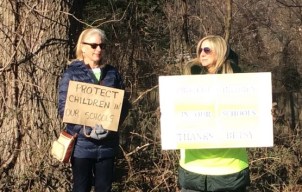
At least some of the Bethesda protesters thought DeVos hit the nail on the head.  While most of the signs protested against DeVos’s policies, at least two of the protesters agreed with her.  One sign read, “Protect Children in Our Schools.”  Another said, “Thanks Betsy.”

pro devos protesters

Safety First. Photo by Sonya Burke

For those Bethesda supporters and for DeVos fans across the nation, the most important job of schools is not teaching kids to read or to share.  Rather, the most important thing a school needs to do is keep children safe.

As I found in the research for my book about educational conservatism, no matter what the issue, conservatives were able to win when they built their arguments about children’s safety.  Because no one, of course, wants to put kids in danger.  So when anti-evolution protesters wanted to ban evolution, they compared evolution to poison.  When sex-ed protesters wanted to ban sex-ed, they compared sex-ed to rape.

Over and over again, protesters focused on safety.  And conservatives aren’t the only ones who win with this strategy.  These days, leftist college students and their faculty allies have scored terrific success in a seemingly quixotic campaign to ban controversial speakers from their campuses.  Pundits and professors have often been flabbergasted at the ways college administrators cave to such censorship.

Why is it so easy for protesters to ban ideas?  Because they appeal to administrators’ prime directive: Keeping students safe.  Listen to the odd apology given by Yale’s administration in the wake of the Christakis costume controversy.  Instead of talking about the politics of Halloween costumes, Dean Jonathan Halloway told student protesters,

Remember that Yale belongs to all of you, and you all deserve the right to enjoy the good of this place, without worry, without threats, and without intimidation.

First and foremost, no matter what the issue, safety wins.  As always, The Simpsons said it best.  In any discussion about schools or public policy, Helen Lovejoy could be counted on to wail, “Won’t somebody PLEASE think of the children?”  It didn’t have to be relevant.  It didn’t have to be helpful.  But Helen would always belt it out, because she knew she could never lose by harping on the safety of the children.

It’s funny because it’s true.  And Secretary DeVos knows it.  We can argue about vouchers and charters.  We can hem and haw about religion in public schools.  But no one—NO ONE—will ever win a political fight in these United States by saying that schools can be risky places for kids.