Who’s the Victim Here?

Is Craig James a bigot?  Or a victim of religious persecution?  Or both?

Can we liberals allow discrimination against bigots?  Or must we fight against discrimination in all its forms?

James has been in the news lately.  He was fired from his job as a Fox News sportscaster.  The reason?  In his run for the US Senate in 2012, James insisted that he would not support same-sex marriage.  Such marriages, James explained, were against his religion.

The Family Research Council, an organization of conservative religious activists, called the firing an example of religious persecution.  “What Fox Sports did,” the FRC warned,

is much worse than censorship. What Fox Sports is doing is demanding conformity on issues that aren’t even relevant to James’s job — then threatening his livelihood when he refuses. That’s not your garden variety viewpoint discrimination; it’s ideological terrorism. And it has to stop.

From the other side of the issue, the Texas Freedom Network defended the firing.  Intelligent people of goodwill can disagree, the TFN argued, if this is a case of religious discrimination.  But whatever we call it, the TFN blogged, it tells us something about the changing cultural climate.  “it’s worth considering,” the TFN pointed out,

that Fox Sports didn’t fire James because of his religious beliefs. They fired him because they thought his intolerant public statements about gay people would hurt their company.

I generally agree with the folks at the TFN.  However, this seems to me to be a very sketchy argument.  Would we defend a restaurant owner who refused service to ethnic minorities because he or she worried having them in the restaurant would hurt business?


Creationism on the Ropes

Is creationism taking over American education?  Nope.

Not at the Blue Ridge Christian School, anyway.

Readers may remember Blue Ridge for its fifteen minutes of fame last May, when a dinosaur quiz from the school attracted attention.


Image Source: Answers in Genesis

Image Source: Answers in Genesis


According to the Christian Post, the school is closing down.  After all the attention, school founders hoped to raise enough funds to stay afloat.  However, in spite of international attention, the school only raised $15,000 of the $200,000 it needed.

So is creationism taking over?  In this case, at least, it’s not even staying alive.


Climate Change in Schools? Not If Fox News Can Stop It

How do conservatives feel about climate-change curriculum for public schools?  The only good climate-change curriculum, they might say, is a dead climate-change curriculum.

We saw a telling example recently of this sentiment.  Fox News host Stuart Varney warned viewers recently that the Environmental Protection Agency was filling kids’ minds with all kinds of climate-change malarkey.  The watchdog Media Matters included Varney’s warning in a compilation of Fox climate-change riffs.  (It’s the first video clip on the MM page.)

Varney was reacting to a new set of climate-change lesson plans made available by the EPA.  Bad enough, Varney exclaimed, that such pernicious ideas had penetrated public education.  But even worse was the fact that such notions had been peddled by a bloated tentacle of the federal octopus.

The problem with this sort of federal overreach, guest Monica Crowley insisted, was that “We are paying for the indoctrination of these kids.”

The federal government ought not use taxpayer money to fund such controversial anti-science, Crowley warned.  The science itself was ridiculous, she insisted.  But worst of all was the fact that the federal government used taxpayer dollars to undermine proper public education.  As she concluded, “We wonder what kind of propaganda they’ll be teaching our kids, on our time.”

Host Stuart Varney agreed.  “And it is propaganda,” he insisted.  “On our time and our money.”

What can this sort of school jeremiad tell us about conservatism and American schooling?  I have two comments and I invite others.

First, we can see from this brief clip how climate change stands poised to become the new contentious science issue in America’s schools.  Conservative traditions of opposition to evolution education seem to be retooling for an eerily similar fight over the science of climate change.  Science-education activists such as those in the National Center for Science Education have warned about this for a while now.  Indeed, the NCSE’s Glenn Branch recently called climate change the “second front” in the culture wars over science education.

Second, Varney and Crowley offer us a near-perfect demonstration of a long tradition in conservative educational activism.  We might call this the “Not In My Kids’ School” (NIMKS) tradition.  Just as protesters have often fought against bad influences in their own back yards, so have conservatives often presented cultural issues as a threat to young people.  This rhetoric hopes to energize conservatives to fight against educational programs on the threat that such programs will soon be spreading their dangerous tentacles into schools everywhere.  Bad ideas are bad enough, the thinking goes.  But such notions are far worse, far more menacing, far more likely to mobilize activists, if such ideas can be portrayed as meddling with the minds of innocent young people.

Jesus, Measles, and the Fight against Science

Does Jesus want your children to get measles?

A recent outbreak at a Texas mega-church highlights the tangled connections between faith, schooling, and science.

The fight against evolution gets all the headlines, but as this story shows, the connections between religion, education, and science can get a lot more convoluted.

As journalist Liz Szabo reported in Religion News Service, Eagle Mountain International Church in Newark, Texas, seems to be ground zero for a recent measles outbreak.  Twenty-five people in all have been sickened, fifteen of whom have direct connections to the church.

A visitor to the church from an unnamed country in which measles are common seems to have sparked the mini-demic.  Pastor Terri Parsons has warned of the connections between vaccinations and autism, a connection mainstream scientists have decisively pooh-poohed.  However, Pastor Parsons has also now encouraged members of the EMIC community to get vaccinated against measles.

According to the RNS story, the infected young people are all home-schooled and apparently unvaccinated.

So does Jesus want children to get measles?  Of course not.

But skepticism runs deep among conservative Christians.  In this case, conservatives did not trust mainstream science’s claims that immunizations were a good idea.  Nor did they trust the state board of education enough to agree that all children of a certain age must get the measles vaccine.


An Age of Denial—of History

Attention, fellow followers of the evolution/creationism controversies!  Want to read

  • Hysterical exaggerations?
  • Misleading claims?
  • Willful ignorance?

Then look no further than the pages of the New York Times.

These aren’t the ravings of a fringe Bible-thumping creationist, nor are they the feverish exhalations of a Dawkins wannabe.
Rather, the New York Times recently ran a sadly mistaken opinion piece by physicist Adam Frank of the University of Rochester.

Professor Frank and I are on the same side of these debates.  We both want better evolution education in America’s schools at every level.
But Professor Frank engaged in some terrible punditry that even his allies must protest.  Frank made the tortuous claim that

Narrowly defined, “creationism” was a minor current in American thinking for much of the 20th century. But in the years since I was a student, a well-funded effort has skillfully rebranded that ideology as “creation science” and pushed it into classrooms across the country. Though transparently unscientific, denying evolution has become a litmus test for some conservative politicians, even at the highest levels.

Creationism is not Professor Frank’s only concern.  He also blasted America’s growing—or at least durable—disdain for climate-change science and vaccination science.  For those notions, Frank may have a point.  But his claims about creationism don’t pass the smell test.

Even on his own terms, Professor Frank muddles things.  He opens by acknowledging the fairly flat lines of American creationism illustrated by Gallup polls.  Since the 1980s, about 42-44% of respondents have agreed that God created humanity in pretty much its present form at some point in the last 10,000 years.

How, then, does it make any sense for Frank to conclude that his “professors’ generation [in the 1980s] could respond to silliness like creationism with head-scratching bemusement”?  Creationism in the 1980s was a roaring lion, pushing “two-theory” laws onto the books in states such as Arkansas.  Indeed, President Reagan swept into the White House based, in part, on his ardent support for creationism.

Frank’s personal experience with self-satisfied academic scientists in the 1980s who looked at creationism with “head-scratching bemusement” demonstrates the surprising cultural isolation of academic scientists more than it does any weakness of creationism in the 1980s.  As sociologist Elaine Howard Ecklund has argued, many scientists in elite academic settings these days show a surprising ignorance about conservative religion in America.  That may have been true of Frank’s teachers in the 1980s as well.  If they thought 1980s creationism posed no threat to mainstream science and science education, they certainly misunderstood the nature of American culture and politics.

More startling is Frank’s bizarre claim that creationism was a “minor current in American thinking for much of the 20th century.”  Such a statement reveals a breathtaking ignorance about the career of American creationism, indeed about American culture in general.

I don’t suggest that physicists such as Professor Frank need to take the time to read the excellent academic literature out there, such as Ron Numbers The Creationists, Michael Lienesch’s In the Beginning, or Jeffrey Moran’s American Genesis.  Though it wouldn’t hurt, especially if one is planning to spout off about the history of creationism in the pages of the New York Times.

But even if Frank only scanned through the Wikipedia entry on the Creation-Evolution Controversy, he would see that creationism has never been a “minor current.”  Creationism has always been embraced by leading figures; creationism has always had powerful political support.

So what could the good professor have been thinking?  How could an intelligent, informed commentator really believe that creationism has grown from inconsequential to insuperable between 1982 and today?

Perhaps Professor Frank believes that his claims are true if we look only at creationism “narrowly defined.”  That is, one could make the case that today’s sort of creationism did not exist for most of the 20th century.  This could hold some water.  After all, the sort of creationism we’re used to today is very different from that of the 1920s, 1930s, 1940s, and 1950s.  The 1961 publication of Morris and Whitcomb’s Genesis Flood heralded a new sort of creationist thought and belief.

If this is what Professor Frank meant, good for him.  But I don’t think it is.

After all, Frank does not claim that creationism has become powerful since the 1960s.  He seems to believe that creationism has escalated in political intensity since 1982.

Also, if he hopes to argue that creationism’s political power is stronger now than it has ever been, he can’t hide behind his faulty “narrow” definition of creationism.  In the first half of the 20th century, creationism—not the same creationism as today, but recognizably the same cultural and political impulse—ruled the ballot box in states across the country.  It did so far more powerfully than it has done since.

The claims of “early” creationism were far more strident than the claims of latter-day “creation scientists.”  Since the 1960s, most creationists have fought to include creationism alongside evolution in public-school science classes.  Earlier activists had much greater ambitions, hoping to ban evolution entirely.

So what can we make of Professor Frank’s anxious tut-tutting?

Frank’s misleading conclusions, I believe, result from a disturbing willingness to ignore the historical record and rely on flawed personal experience to make sweeping charges about the way America has changed over time.  The goal is to create a sense of hysteria, a sense that we are now approaching a crisis worse than any we have seen.

Such antics may make for good politics.  But they make for very bad policy-making.  Our thinking about creationism, education, and culture should be based on clear-heading thinking, not on false claims.

So, to set the record straight, let’s look at a few simple facts:

  • Is America in 2013 ferociously creationist?  Yes.
  • Do politicians truckle to creationists?  Yes.
  • Has America become more ferociously creationist since Professor Frank began his college career in 1982?  No.

It may be politically expedient to skew the history this way, but it doesn’t do justice to the facts.  In the end, this kind of misrepresentation hurts the cause of evolution education.  It depends on a false sense of crisis; it gives readers a misleading depiction of our current cultural situation.

America is not facing the strongest creationist surge in our history.  Education policy should not be based on hysterically misleading claims.  Rather, creationism today is powerful, just as it has been since before America landed on the moon, just as it has been since before America landed on Omaha Beach.

American creationism, in short, is not a sudden new challenge to mainstream science, but rather a durable tradition.  Science pundits such as Professor Frank must recognize this.


Kicking Out the Christians: Duck Dynasty and “Facial Profiling”

Christians are a persecuted minority!

That’s the claim we hear over and over again from conservative religious folks.

Today we get some surprising evidence that bearded holy men of the Christian faith really are punished unfairly.  Duck Dynasty star Jase Robertson was apparently kicked out of the Trump Hotel in New York City when an employee assumed he was homeless.

jase-robertson4

Robertson. Image Source: A&E

As the Christian Post reports, Robertson didn’t take the incident too seriously.  He called the episode a case of “facial profiling.”

It was not Robertson’s Christian faith, but rather his appearance, that apparently led to this embarrassing incident.  The big reality-show star didn’t make a fuss.  But other conservative Christians like the Robertson family have consistently complained that they are treated like despised minorities in American culture.

In 1980, for example, evangelical superstar Jerry Falwell called conservative Fundamentalists “the largest minority bloc in the United States.”[*]

These feelings among conservative Protestants have been especially strong in debates over public education.  Since the 1920s, conservative evangelical Protestants have complained that their rights have not been respected.  To cite just one example, in 1965 evangelical editor John R. Rice lamented the fact that conservative Christians were not only a minority, but a minority that had been consistently singled out for unique persecution.  “Why not have freedom in America as much for one minority as another?” Rice asked.  “Why not observe the rights of Bible believers as well as the rights of the infidels in the churches and infidels in courts or schools?”[†]

We have seen despised-minority rhetoric again and again in conservative calls to include creationism in public-school science classes.  In the early 1980s, creationists pushed laws that would include both evolution and creationism, in order to protect the constitutional rights of minority creationist students.  Laws such as Arkansas’ Arkansas’ Act 590 of 1981, for example, emphasized that such rules would “protect academic freedom . . . [and] freedom of religious exercise.”[‡]

Creationists have also often complained that their views are ignored out of an anti-scientific zeal to punish minority dissent.  In 1984, for example, creationist Jerry Bergman published his expose of anti-creationist persecution in American higher education.  Bergman himself claimed to have been denied tenure at Bowling Green State University solely for his religious beliefs.  “Several universities,” Bergman lamented,

state it was their ‘right’ to protect students from creationists and, in one case, from ‘fundamentalist Christians.’ . . . This is all plainly illegal, but it is extremely difficult to bring redress against these common, gross injustices.  This is due to the verbal ‘smoke-screen’ thrown up around the issue.  But, a similar case might be if a black were fired on the suspicion that he had ‘talked to students about being black,’ or a woman being fired for having ‘talked to students about women’s issues.’[§]

Kicking out a bearded Christian holy man from a fancy New York hotel won’t offer much clarity to this old dispute.  Jase Robertson himself did not seem at all offended that a hotel employee took him outside to a park when Robertson asked for directions to a bathroom.

Other conservative evangelical Protestants, however, have not laughed off this kind of thing so lightly.  In controversies about the nature of America’s public square, including its public schools, conservative Christians have consistently insisted that they had been treated like persecuted minorities.

It makes me wonder if Jerry Falwell was ever kicked out of a fancy hotel.


[*] George Vecsey, “Militant Television Preachers Try to Weld Fundamentalist Christians’ Political Power,” New York Times, January 21, 1980, A21.


[†] John R. Rice, “White Minorities Have Rights, Too,” Sword of the Lord 31 (3 September 1965): 1.


[‡] “Act 590 of 1981: General Acts, 73rd General Assembly, State of Arkansas,” in in Marcel C. LaFollette, ed., Creationism, Science and the Law: The Arkansas Case (Cambridge: MIT Press, 1983), 15.


[§] Jerry Bergman, The Criterion: Religious Discrimination in America (Richfield, MN: Onesimus Press, 1984), 43.

Call Me, New York Times

Did you see it yet?

All of us who follow creation/evolution debates have likely read by now the “Room for Debate” essays in the New York Times the other day.

The jumping-off point, it seems, was Virginia Heffernan’s recent claim that she is a creationist.  The editors asked contributors, “Is it really so controversial to believe in biblical creationism?”

Each essay is short and pithy.  Certainly worth your time.  They include fourteen cents altogether, two each from an evangelical physicist, a liberal theologian, an evangelical apologist, a Muslim pundit, a political scientist, a law professor, and a theologian/environmentalist.  All in all, an interesting and idiosyncratic collection of opinions on the subject.

But here’s my beef: Where is education in all these voices?

Other scribblers, I’m sure, will ask other questions.  For example, where is atheism?  Or any sort of strong argument that it is, indeed, a big problem to believe in biblical creationism?

The editors would not have had to work hard to find a good atheist to contribute.  Even outside the big names such as Jerry Coyne or PZ Myers, plenty of articulate atheists could have offered a strong opinion about the dangers of believing in biblical creationism.

More directly relevant to readers of ILYBYGTH, where is the voice of education?

IMHO, the issue of “biblical creationism” would not be nearly as controversial if Americans did not have to decide what to teach in our public schools.

As Professor Giberson noted in his piece, “The brouhaha about ‘biblical creation’ is really a proxy war about the reality of meaning in the world.”

Well put.  But that proxy war is fought primarily in boards of education, in classrooms and PTA meetings, in state textbook meetings, and in thousands of other school-related battlefields.  The evolution/creation controversy is not primarily an issue simply of scientific or theological disagreement about epistemology and ontology.  There are plenty of other issues on which people do not agree that have not had the tumultuous career of the creation/evolution debates.

In short, the brouhaha over reality of meaning is only a brouhaha because we need to decide on what sorts of meanings we will teach our children.

It would have helped this discussion enormously, I believe, if someone had pointed this out; if at least one contributor made education his or her primary intellectual interest.  I’m not only saying this because I wish the NYT had called me.  Though I do work for peanuts.

In the bigger picture, leaving an “education” voice out of a creation/evolution debate has long been a problem for those of us trying to understand the issue.  Too often, creation/evolution is framed as an issue of science and religion.  Science and religion only.  As if the truth of life’s origins remained the primary source of controversy.

That makes it difficult to understand the real issues.  As thoughtful scholars such as Randy Moore, Lee Meadows, Michael Berkman & Eric Plutzer, and David Long have pointed out, creation/evolution is not only about “the reality of meaning in the world.”  The rubber hits the road in this culture-war issue with individual students, in specific classrooms, day after day, decade after decade.

Unless we recognize the importance of the way creation/evolution plays out in such real-life environments, we will not move forward.

So, for the record, the next time any editor wants to corral a herd of scholars to comment on creation/evolution issues, please be sure to include someone with a primary interest in evolution.

It doesn’t have to be me.  But I’m always available.

I will also talk about creation/evolution at Labor Day cookouts, Bar/Bat Mitzvahs, awkward crowded elevator rides, or any other event.  Just call me!


Evolution: Beyond Science and Religion

Outsiders are telling public school families that we must follow the rich man’s elitist religion of evolution, that we no longer have what the Kentucky Constitution says is the right to worship Almighty God.  Instead, this fascist method teaches that our children are the property of the state.

–Matt Singleton, Frankfort, Kentucky, July 2013

Why do so many Americans oppose the teaching of evolution in schools?

The knee-jerk answer is that people fight against mainstream science for religious reasons.

A news story out of Kentucky reminds us that we need to say, “Yes, but…”

Opposition to evolution education in the United States incorporates ideas about religion and science, but we can’t stop there.  If we hope to understand creationism, we need to unpick the tangled skein of ideas that can make up anti-evolution ideology.

This is something that science pundits such as PZ Myers and Jerry Coyne seem unwilling to acknowledge.  America does not face a clear-cut battle between “Science” and “Religion,” between “Knowledge” and “Ignorance,” but a much more stubborn conflict between convoluted collections of ideas, ideas that have grown together over time.  Some science advocates limit themselves to berating creationists for ignorance of evolution, to ridiculing creationists for reactionary adherence to religion.  Such attacks may satisfy our sympathizers, but by willfully mischaracterizing anti-evolutionism, these pro-“science” bloggers only compound the difficulties of healing culture-war divisions.

And those divisions are indeed more complex than activists on either side tend to admit.

Case in point: a notice recently in the Huffington Post drew our attention to this story from Kentucky’s Courier-Journal.  Reporter Mike Wynn described a public meeting over Kentucky’s adoption of the Next Generation Science Standards.  As Wynn reports, opponents of evolution offered comments to the state board of education.  Those comments offer a window into the complicated thinking of anti-evolution activists.

Matt Singleton, for instance, read a statement to the board describing his opposition to the new evolution-friendly science standards.

“Outsiders,” Singleton read,

Are telling public school families that we must follow the rich man’s elitist religion of evolution, that we no longer have what the Kentucky Constitution says is the right to worship Almighty God.  Instead, this fascist method teaches that our children are the property of the state.

As I argued in my 1920s book, anti-evolution activists have always made this sort of intellectual scattershot attack on evolution.  This kind of anti-evolutionism can’t be reduced to merely a theological or scientific argument.  If we hope to understand it, we need to understand the broad intellectual and cultural implications of the argument.  If we want to make sense of it, we must see it for what it is: an “anti-evolution” argument that moves far beyond the boundaries of religion or science.

Some evolution proponents might dismiss The Reverend Singleton’s rant as merely ignorant.  I admit, my first response when someone howls about “outsiders” and “fascist[s]” is to assume we have reached the territory of sea-monsters and sandwich-sign prophets.

But that sort of glib dismissal misses the point.  It does not help us understand why this bundle of anti-evolution ideas remains so politically potent.  Whatever we may think of the connections Singleton makes between region, religion, and rights, those connections make sense to significant numbers of Americans.  It is worth our time to try to understand them.

As a start, let’s try to list all the different reasons for opposing mainstream science education that Singleton packs into this paragraph.

1.) Evolution comes from somewhere else.  (“Outsiders”)

1a.) As an import, evolution is illegitimate.

2.) Evolution is for the rich. (“rich man’s . . . elitist”)

2a.) This elitism calls for popular opposition.

3.) Evolution is a religion. (“religion of evolution”)

3a.) As a religion, it can’t be taught in public schools.

4.) Evolution destroys traditional Baptist religion. (“we no longer have . . . the right to worship Almighty God.”)

4a.) As an attack on religion, it can’t be taught in public schools.

5.) Traditional religion is a Constitutional right. (“the Kentucky Constitution says is the right to worship”)

6.) Evolution is dictatorial. (“fascist method”)

7.) Evolution imposes illegitimate government control over children. (“teaches that our children are property of the state.”)

The Reverend Singleton does not want Kentucky schoolchildren to learn evolution.  But we woefully misunderstand his anti-evolutionism if we simply label him an opponent of “science” and move on.  We also miss the boat if we say too simply that Singleton’s opposition is due to “religious” reasons.  Singleton’s fight against evolution combines a complex bundle of ideas.  That bundle implies certain attitudes toward science and religion.  But it is misleading to say that Singleton is motivated only by “anti-science” attitudes.  Nowhere in his statement—at least in the part published by the Courier-Journal—does Singleton attack science.  And nowhere does Singleton argue that true Biblical faith demands belief in six literal days of creation.

In the American context, we might assume that Singleton believes such things.  But his political argument here includes a much broader bundle of ideas and slogans.

Anyone who hopes to improve evolution education in the United States must start by understanding the complexity of that bundle.  It is not enough to dismiss such arguments as “ignorant” or “irrelevant.”  They make sense to people such as The Reverend Singleton.  They also make sense to the politically powerful voting populace who continue to support the teaching of creationism in America’s science classrooms.


“I Hope You Rot in Hell:” Greetings from a Liberal Fundamentalist

Are there “fundamentalists” of every political and cultural persuasion?  That is, do some people cling to such extreme and unbending worldviews—from the political and cultural left as well as the right—that they lash out at any dissent?  People—religious or not—who cannot tolerate any deviation from the Truth As They Know It?

It seems we have an example of such a thing from the cornfields of Iowa today.

The Sioux City Journal reported recently on a simmering conflict between an evangelical pastor and a gay politician.

Pastor Cary Gordon of Cornerstone World Outreach complained that Human Rights Commissioner Scott Raasch had made hateful and threatening comments a few years back.  At issue, apparently, was The Reverend Gordon’s opposition to Iowa Supreme Court judges who had supported gay marriage.

A few years ago, according to the Sioux City Journal, their disagreement degraded into the following Facebook exchange:

In one comment, Raasch wrote: “You are haters and bigots and you will get what’s coming to you sooner or later. I hope you rot in hell.”

Gordon replied, “I hope you repent of your sins and accept Jesus as your Lord and Savior. I wouldn’t want you or anyone else to go to hell.”

Raasch wrote, “I know Christ and don’t need a snake oil salesman like you to tell me about him. I guess that’s the difference between us because I think there are many people that deserve to burn in hell … including you and your entire family.”

Ouch.

The Reverend Gordon called for Raasch’s removal from the Human Rights Commission.  Someone with such extreme views, Gordon argued, should not be in charge of making rulings on discrimination cases that involve religious issues, as well as issues of race, creed, gender, and sexual orientation.

Raasch has admitted that he made the comments, and apologized for any stress caused.

Is this an example of what we might call “liberal fundamentalism?”  A case where someone feels so morally assured of his own righteousness that he lashes out at dissenters in such an angry way?


Celebrity to Nerd: New Leadership at The King’s College

Who will train a new generation how to bring America to Christ?

The leaders of The King’s College decided a nerd can do the job better than a celebrity.

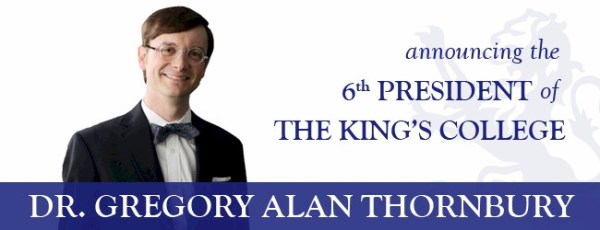
After its unhappy breakup with headline-grabbing conservative icon Dinesh D’Souza, The King’s College will now be led by Southern Baptist theologian and administrator Gregory A. Thornbury.

Image Source: The King's College

Image Source: The King’s College

The bowtie-wearing, Carl-Henry-loving, religious-school administrating Thornbury seems to be the exact opposite of D’Souza, at least within the world of conservative Christian higher education.

Thornbury’s career has been squarely within the world of conservative evangelical higher education.  Before Manhattan and The King’s College, Thornbury served as the founding dean of Union University’s theology school.  His academic background as a philosopher with degrees from the Southern Baptist Theological Seminary and Messiah College puts him in a different league from the sometimes-fevered punditry of D’Souza.

Leaders of the evangelical establishment love him.  Russell Moore of the Southern Baptist Convention called Thornbury “Jonathan Edwards meets Rolling Stone magazine.”

Thornbury himself seems to prefer the Jonathan Edwards part.  His recent book about theological Carl Henry hopes to make Henry “cool again.”  Unlike other leaders at The King’s College, who stress its Manhattan location as the ideal spot to influence mainstream American culture, Thornbury himself notes the location’s close ties to the strongest intellectual giants of American evangelicalism and conservatism, including Jonathan Edwards, Alexander Hamilton, and Carl Henry.

What’s next for The King’s College under its new president?  In the words of one enthusiastic King’s College alum, Thornbury will lend new life to The King’s College mission: “a counter cultural Christian college in New York City that leads with academic excellence and ‘convictional civility.’”