“Home-school Freak:” A Portrait of American Christian Homeschooling?

What is the world of conservative Christian homeschooling like?

A recent memoir in Salon painted a picture of cultic isolation and criminal parental negligence.

Author Leslie Patrick described a youth spent watching TV with her sister while her overworked mother slept.  They were told to stay away from windows so that the happy public-school children across the street wouldn’t witness their truancy.  They had some schoolbooks, but without parental guidance, Patrick and her sister spent their days curled up in front of the television instead.

The result?  No surprise.  When Patrick finally enrolled in a Christian school in tenth grade, she could not begin to keep up with the academic work.  Her natural shyness added to her “freak”-ish separation from the current fashions of teenagers in her school.  With good luck, Patrick reports, she somehow managed to survive her religious education and emerge “normal.”

Is this what Christian homeschooling is like?  As Patrick notes,

I realize that many of the nearly 2 million home-school students in the United States don’t have experiences like mine. They get sparkling educations, and come through the relative isolation with their social skills intact.

If this is the case, why do we find articles about religious-educational freakishness so compelling?

I wonder if a number of us liberals harbor deluded stereotypes about the world of Christian education.  The “secret” world of such intensely religious schools becomes an object of morbid fascination, a theological, cultural, and personal trainwreck from which we self-satisfied liberals cannot turn away.  This is why, perhaps, occasional glimpses like that of the recent “Bible dinosaur” quiz become such objects of fascination.  This is why, perhaps, the editors at Salon agreed to publish Patrick’s idiosyncratic expose.

My hunch is that the everyday world of the average Christian homeschooler is far too boringly mundane to ever rival the headline-grabbing allure of the “home-school freak.”  Nevertheless, in spite of Patrick’s belated acknowledgement of the real experience of “many” Christian homeschoolers, readers of her sad memoir are likely to come away with a skewed and misleading vision of conservative education.


Saintliest City in the USA?

Eve apparently didn’t take her bite out of the Big Apple.

According to one new survey, New York City leads the list of America’s saintliest cities.

How do they know?  This survey tallied up a list of presumably sinful institutions and events: strip clubs (lust), cosmetic surgeons (pride), violent crime (wrath), theft per capita (envy), charity (greed), obesity (gluttony), and physical activity (sloth).

By this tally, the megapolis of New York had the fewest such sinful occurrences per capita.

Does it mean much?  Not really.  In this quirky survey, New York scored big due to its relatively low levels of obesity and relatively high levels of physical activity.  Such things don’t paint a convincing picture of “saintliness.”

Nevertheless, this survey can serve as a reminder once again to watch out for simplistic assumptions about the nature of religiosity in 21st-century America.

Despite the presumptions of some culture-war pundits, the “God-fearing” America is not limited to small towns and the Midwest.  Big cities often host the most religious Americans, acting in the most religious ways.


UPDATE: Yoga Okay for Public Schools

When is a school prayer not a prayer?  According to Superior Court Judge John Meyer, once the “lotus” position has been transformed into “crisscross applesauce.”

As historian Natalia Mehlman Petrzela argued in these pages months ago, the fight in Encinitas, California over the teaching of yoga in public schools flipped some culture-war themes on their heads.  In this battle, conservative Christian parents fought against the use of religion in public schools.

Spearheaded by the National Center for Law and Policy, a conservative activist organization, Christian parents complained that teaching yoga amounted to promotion of a set of religious notions.

Judge Meyer ruled yesterday that the school district had stripped the yoga routine of its religious nature.  An objective observer, Meyer decided, would not perceive the practice as religious.  The program had been funded by a half-million-dollar grant from the Jois Foundation.  The judge found this entanglement “troublesome,” but not enough so to abandon the health program.

This kerfuffle resurrects some old school-prayer controversies in new ways.  First of all, does this case reveal a bias against Christian prayer?  That was the complaint of Dean Broyles of the National Center for Law and Policy.  As Gary Warth of the San Diego Union-Tribune reported, Broyles claimed, “If [the school practice] were Christian-based and other parents complained, it would be out of schools. There is a consistent anti-Christian bias in cases like this that involve schools.”  Could a case be made that non-Abrahamic religious traditions get more leeway in public schools?

Also, does this case open the door for a new spate of school-prayer policies?  In the early 1960s, the US Supreme Court ruled in Engel v. Vitale that school-sponsored prayers violated the Constitution.  The prayer in that case, however, had been composed by the State of New York as a broadly ecumenical prayer, one thought to offend no one.  Could this precedent open the door to a new sort of ecumenical school prayer?  A secular prayer?  If religious groups could argue the health benefits of a prayer and find a prayer practice sufficiently stripped of sectarian meaning, could Judge Meyer’s argument apply here?

Of course, as I’ve noted elsewhere about the Engel v. Vitale case, most evangelical Protestants supported the SCOTUS decision to ban a bland ecumenical prayer.  Would any conservative religious people want to include a prayer in public schools if that prayer had been secularized?  If Jesus on a cross had been transformed to “crisscross applesauce?”


Common Core = Christian Core

What is an evangelical Christian to do?

The prolific Karen Swallow Prior recently argued that evangelicals ought to embrace the emerging Common Core State Standards (CCSS).

The CCSS have been attacked and defended by both progressives and conservatives.  They have been called both totalitarian and liberating, intrusive and effective.

Conservatives are divided.  Some say the Common Core is the least-bad planOthers warn of “control by Obama administration left-wing bureaucrats.”

Not so fast, Prior wrote. She attended a workshop with Core Mastermind David Coleman, and came away convinced that the standards have promise to improve literacy skills in the USA.  Especially as Bible-centered Christians, Prior argues, evangelicals need to get behind this effort.

After all, Prior insisted, “no one more than evangelicals can appreciate the importance to a people and a culture of the ability to read, and read well—or the devastating effects of being unable to do so.”


Creation Wins the Culture War

Quick: What rhymes with mitochondria?

It’s a tough question, and it helps illustrate the uphill cultural battle evolution has faced for the past hundred years in America.

A fluffy piece in Sunday’s New York Times gives us an example of this persistent imbalance.

The article describes the results of an outreach program to New York City teens, Science Genius.  The program hopes to use hip-hop as a sweetener to connect urban youth to science.

A victory for evolution and mainstream science?  I don’t think so.  I’m no creationist, but I can’t help but conclude that pop music seems to be more suitable for creationism than mainstream science.

Though the supporters of the NYC program claim some limited successes, even those claims highlight the deep difficulties of engaging young people of every cultural background with mainstream science.

We don’t want to make too much out of just one example, but listeners are not likely to be much moved by rhymes like the following: “Bioclast, foliation, and that granite, . . . I can tell you something ‘bout an aphanitic.”

I applaud the student, and the program, but rapping the truths of mainstream science doesn’t fall as trippingly off the tongue as those of creationism.

How much evolution music can you name?  Good stuff?

Creationists, on the other hand, can claim all sorts of pop music from the headlining Jonas Brothers to internet-cluttering obscure artists across the world.  Christian and Creation rock has long been an enormous and aggressive cultural presence, as ex-fundamentalist Jonny Scaramanga has remembered.

Where is the evolution-rock?

As critic Jason Rosenhouse perceptively noted in his book Among the Creationists, mainstream science does not have to worry about creationist challenges to the strength of real evolutionary science.  But creationists, Rosenhouse argues, DO have an easy time of constructing narratives that make sense to people.  Mainstream science?  Not so much.

Perhaps this is why people trust their intuition about creation and evolution more than they trust mainstream science.  As Penn State political scientists Michael Berkman and Eric Plutzer noted in their book Evolution, Creationism, and the Battle to Control America’s Classrooms, even the small minority of Americans who agree that mainstream science is firmly evolutionist support the inclusion of creationism in America’s classrooms.  That’s right: even those Americans who recognize that scientists agree about evolution tend to agree that creationism should be part of public science education.

Why is that?  At least part of the reason must be because mainstream science does not offer a compelling story to which Americans can cling.  There is no telos, no plot, no conflict (in the literary sense), no protagonists worth following.

Creationism, on the other hand, makes a good deal of intuitive sense.  It makes sense that a world so complex, so morally challenging, must have been created on purpose.

Evolutionary science, for its part, needs to make the case that humanity occurred somehow, but we don’t know exactly how.  It needs to explain that the feelings people have of purpose, of cosmological intent, are only vestiges of happenstance.

A hard bill of goods to sell on the pop-culture marketplace.  Just like it is hard to find a rhyme for mitochondria.


Are We Post-Racial Yet? Conservatives and Affirmative Action

It appears the US Supreme Court’s non-decision today about affirmative action won’t settle anything. In its 7-1 ruling in Fisher v. University of Texas, the Court sent the case back down to lower courts to decide.  This doesn’t rule out university use of affirmative action policies in admissions, but it does not exactly endorse it either.

Significantly, Court conservatives including Justices Scalia and Thomas voted with the majority today, but both indicated they would be willing (eager?) to rule such affirmative-action policies unconstitutional.

Legal and higher-ed policy wonks will have plenty to chew over in coming days.

For me, the recent ruling underscores the ways debates over affirmative action in university admissions policies have become a stand-in for conservative sentiment about race and racism in America.  Though it is too simple to say anything about conservatism as a whole, the last forty years have established a new kind of anti-racist conservatism.  These self-described anti-racists, however, have struggled to convince anyone besides themselves of their sincere dedication to fighting racism and traditional preferences that favor whites.

The recent SCOTUS history alone has given the debate over race and schooling a kick in the pants.  In the late 1970s, in the Bakke case, the Supreme Court ruled against the use of any racial quotas in college admissions.

More recently, in Grutter v. Bollinger (2003), SCOTUS decided that race could be used in admissions decisions, as one category among others.  The key element in this decision was that race could be used to further the state’s interest in fostering a diverse learning environment.

One influential strain of opinion among conservatives can be summed up in a pithy statement by Chief Justice Roberts from 2007.  In a case from Seattle, Roberts insisted, “the way to stop discrimination on the basis of race is to stop discrimination on the basis of race.”

Conservative thinking on this issue has, in some ways, remained remarkably constant for the past generation.  In the mid-1980s, for instance, writing for the Heritage Foundation, Philip Lawler articulated a conservative critique of affirmative action admissions policies that sounds fresh today.  Such policies, Lawler argued, effectively promote racism against African Americans and other historically underrepresented college populations.  Affirmative action degrades true achievement and breeds resentment towards all African Americans.  It also leads to a racist dismissal of the true achievements of some African Americans.

Former US Representative Allen West made similar arguments in his amicus brief filed in the Fisher case.  “Race-conscious policies do not advance – in fact, they harm – the most compelling of all governmental interests: protecting and defending our Nation’s security. This is true whether practiced by colleges and universities (which, together with the Nation’s military academies, produce the majority of the commissioned officers in our country’s military), or by the military itself in the selection and advancement of its officer and enlisted personnel,” West argued.  West, a prominent African American conservative, argued that affirmative action policies degraded all applicants, African Americans most of all.

The problem with these kinds of conservative arguments is that they are often dismissed as mere window dressing.  With important exceptions such as Representative West and Justice Clarence Thomas, most African Americans support affirmative action policies.  The NAACP, for instance, has consistently and energetically supported Texas’ race-conscious admissions policy.  The National Black Law Students Association, in its amicus brief in the Fisher case noted the “systematic racial hierarchy that produces and perpetuates racial disparities in educational opportunities and outcomes.”  Affirmative-action admissions policies, the NBLSA insisted, remained necessary to promote a truly non-racist society.  Conservative insistence that such affirmative action policies actually support anti-black racism tends to fall on deaf ears among the majority of African Americans and whites who consider themselves racial liberals.

Conservative activists and intellectuals—white and black—often express what seems like honest surprise when accused of anti-black racism.  Perhaps one episode that illustrates this kind of conservative anti-racism might be that of Alice Moore and the 1974 Kanawha County textbook protest.  In this battle from the Charleston region of West Virginia, conservative parents and activists protested against a new series of English Language Arts textbooks.  Among the many complaints were protests against the inclusion of authors such as Eldridge Cleaver and George Jackson.  Such militant African American voices, many Kanawha County residents insisted, did not belong in school textbooks.  Conservative leaders insisted that this was not because they were black, but because they were violent and criminal, and apparently proud of it.

Conservative leader Alice Moore came to the 1974 controversy freshly schooled in the ideology of anti-racist conservatism.  She had attended a conference in which conservative African American politician Stephen Jenkins blasted the anti-black implications of multicultural literature.  Such literature collections, Jenkins insisted, implied that the violent, angry, criminal voices of militants such as George Jackson and Eldridge Cleaver represented the thinking of African Americans.  Such implications, Jenkins explained, proved that the true racists were the multiculturalists.  By pushing a skewed vision of African American culture, such multicultural textbooks implied that African Americans as a whole were criminal and violent.

Moore embraced this sort of anti-racist conservative ideology.  When she (politely, as always) confronted African American leader Ron English at a heated board of education meeting, Moore seemed honestly flummoxed that the English did not agree with her.  Moore pointed out that voices such as Jackson and Cleaver did not fairly represent the truths of African American life.  But The Reverend English rebutted that such militant voices represented an important part of the American experience, stretching back to Tom Paine.

Moore’s befuddlement in 1974 matches that of anti-racist, anti-affirmative action conservatives today.  Many conservatives feel that their opposition to affirmative action makes them the true anti-racists.  Yet they consistently find themselves accused of racism.  The fight over Fisher never seemed to be changing this dynamic.  Now that the Court has punted, there is even less resolution on offer.  Conservative notions that true anti-racism requires the elimination of race-based considerations in college admissions will likely continue to fall on deaf ears among leading African American advocacy groups.

Valedictorian Prays at Graduation

May a high-school student pray at a public-school graduation?  No, at least not according to the US Supreme Court. 

But CAN a student do it?  Sure.  This week, valedictorian Roy Costner IV dramatically tore up his pre-approved speech and recited the Lord’s Prayer instead. 

As reported by a local TV station, the school district in Liberty, South Carolina had been feeling pressure from the American Civil Liberties Union to hew closer to the Constitutional line in the town’s attitude toward public religion.  They had warned Costner to keep his valedictory speech secular.  But Costner decided to flout their warnings.  According to Christian News, Costner recited his prayer as a protest against the school district’s recent decision to ban prayer at other official events. 

Many of the townspeople approved.  By the end of his prayer, the crowd’s cheers had grown loud enough to drown out Costner.  A few people interviewed by the local TV station also supported Costner’s decision.  “It was pretty impressive,” local man Brian Hoover noted.  “I thought the guy had a lot of nerve.”

Another local man agreed.  Logan Gibson told the reporter, “I think it took a lot of courage to do that and people were proud that he stood up for what he believed in.”

Core Wars

What do conservative activists hate about the Common Core State Standards?

A recent essay by conservative commentator Stanley Kurtz in National Review points out some conservative objections.

As we’ve noted recently, conservatives share with progressives a fervent opposition to the CCSS, though usually for different reasons.  Everyone from Phyllis Schlafly to the Heritage Foundation has warned of looming implications for culture, politics, religion, and education.  For those of us trying to understand conservative attitudes toward American education, these diatribes against the CCSS are a good place to start.

Kurtz was responding to an article in the Washington Post about Tea Party objections to the new shared standards.  Obama officials, Kurtz complained, responded with deceptive statements and obfuscation.  In the end, Kurtz argued,

. . . the Tea Party is right when it accuses the Obama administration of nationalizing education standards through the back door. The Founders opposed that for a reason. Once de facto nationalization is achieved, parents will lose their ability to influence their children’s education. Leverage that can be easily exercised at local school-board meetings or through representatives in state legislators will be lost to unaccountable federal bureaucrats (like Lois Lerner), and worse, to the even less accountable private education consortia that are developing the Common Core. So if educators try to impose politicized curricula or “fuzzy” math, parents will have no recourse.

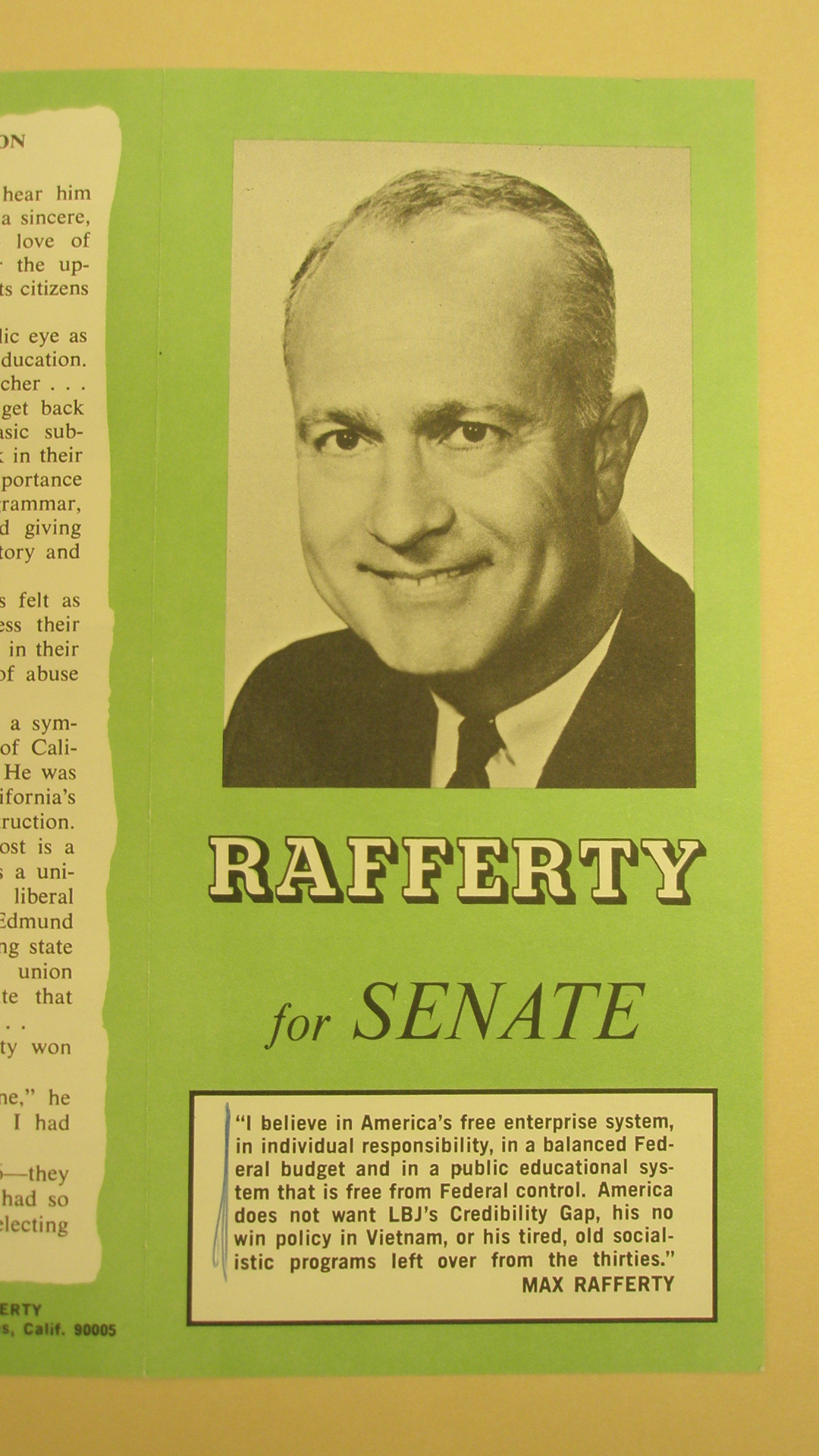
Kurtz’s “local control” argument echoes a long tradition among conservative education thinkers.  Most powerfully, California State Superintendent of Schools Max Rafferty pushed hard during the 1960s to combat increasing federal control.  Rafferty’s colorful prose often made the case more lyrically than I’ve seen it since.

In one speech from the archives,[1] Rafferty articulated a conservative position for local control that I suspect might still be appealing to today’s Tea Partiers.  As he told the California Small School Districts Association Convention on March 8, 1965,

You live and work in an out-of-the-way corner of this county.  A small town where the sky is still blue, where the roar and tension of freeway traffic has not yet penetrated; where a little boy can still run and play in open fields.  You’re there because you want to be.  You moved there deliberately a few years before because you liked that feeling of grassroots independence.  That unique sense of having an equal share in the controlling of one’s own destiny which has been the legacy of every American ever since the first little villages began to dot the New England countryside more than three centuries ago.  You’ve been happy there.  Your children are growing up clear-eyed and self-reliant with that indescribable look of quiet confidence which comes from life spent in a region where hills and trees are very real, very close at hand.  Where a neighbor is a lot more than someone who just happens to live close to you.  Suddenly, something goes wrong at your local school house, as things sometimes do.  Maybe it’s a new course of study which just doesn’t quite fill the bill.  Maybe it’s a neurotic old school administrator, we do run across one now and then!

No matter, you tell yourself, nothing can possibly happen in your community which can’t be solved by you and your neighbors, working and acting together in the traditional American spirit of mutual tolerance and good will.  But this time you’re wrong.  Shockingly, unbelievably wrong!  You and your friends try to arrange an appointment with your district superintendent to tell him of your problems and make your suggestions.  But you don’t have a district  superintendent anymore, in fact you don’t even have a district!  You try to contact your local school board, but it’s gone too!  A hundred miles away, a group of county or state officials meet once a month to decide the destiny of your children.  You don’t know any of them personally, in fact you never even heard most of their names!

But in our nightmare today, they tell you what your children will be studying.  They hire the teachers who will be molding the thinking and the behavior of your children throughout the years that lie ahead.  They decide whether or not the school bus is going to stop near your home or indeed if there is going to be a school bus at all.  Whatever they decide, you’re stuck with.

Rafferty worried about the Elementary and Secondary Education Act, the direct progenitor of No Child Left Behind.  As several of the commentators on Stanley Kurtz’s essay pointed out, the centralization of public schooling can be traced back through several generations of federal leaders, including President George W. Bush.

From the Hargis Collection.

From the Hargis Collection.

But that doesn’t mean that today’s version, the Common Core State Standards, will be greeted with anything but alarm among some sectors of conservative thought.


[1] This speech survives as a typescript in the Billy James Hargis Papers, University of Arkansas Mullins Library Special Collections, MC 1412, Box 48, Folder 2, Public Schools, 1950-1978 (1 of 2).  This collection of papers represents, IMHO, the best single-stop shop for any scholar hoping to understand the career of twentieth-century educational conservatism.  The Reverend Hargis was a leader in the Christian conservative movement in the second half of the twentieth century, and he was an avid collector of newsletters, correspondence collections, and other ephemera that shed a unique light on conservative thinking about education during the period.


Creationist Bogeymen

Say, did you hear what happened to Senator Kruse’s “Truth in Education” bill in Indiana?

Unless you’re a close personal friend of the Senator, I’m guessing you haven’t.  The career of bills like this one can tell us a thing or two about the cultural politics of creationism.

Senator Kruse garnered some headlines six months ago for his plan.  Kruse, the chairman of the Indiana State Senate Education Committee, promised a new law that would guarantee students’ right to challenge their teachers’ pronouncements.  The barely disguised goal was to allow creationist students to confront evolutionary teaching.

At the time, pundits and scribblers announced Kruse’s plan as the latest offensive in a creationist juggernaut.  Reporters noted the connections to Seattle’s Discovery Institute, the leading intelligent-design think tank.  Progressives lamented this latest power play by religious conservatives.  One commenter called the bill the latest effort to “march the education of American children toward the 19th century.”  Another explained Kruse’s new effort as an end run around evolution.

But here’s the problem: Kruse’s bill didn’t do any of those things.  It didn’t do anything.

Kruse’s bill died the quiet death of most legislation.  As House Bill 1283, Truth in Education went nowhere.  But no one reported on that. [**DOUBLE CORRECTION: First, HB 1283 was not introduced by Senator Kruse, but by Kruse’s ally, Representative Jeff Thompson.  Second, the National Center for Science Education, that tireless watchdog of all things creationism, did in fact report on the fate of HB 1283.  Thanks to Glenn Branch of the NCSE for calling our attention to it.]

To be fair, several of the journalists who talked about the looming threat of Indiana’s latest creationist bill wondered if the bill would ever get anywhere.  But a casual news reader could be forgiven for assuming that creationists pass laws like this all the time.  The news media’s hunger for the sensational feeds a skewed perspective on what is and is not legal in America’s schools.

This is not new.  In 1942 Oscar Riddle and his colleagues conducted a survey of high-school science teachers.[1]  They asked teachers if they taught evolution or special creation, and why.  Those answers were illuminating.  Over three thousand teachers responded to the questionnaire.  Those who claimed not to teach evolution gave a wide range of reasons.  One teacher from North Carolina explained that evolution education was “a taboo subject to most people” (73).  A Nebraska teacher said she avoided evolution education mainly due to “Lack of time.”  One California teacher added, “Controversial subjects are dynamite to teachers” (74).  In the stereotype-shattering department, another California teacher from a “large city” explained that he or she didn’t teach evolution because the “Fundamentalist beliefs of majority of our students may not be attacked (negro and Mexican)” [sic] (74).

Most relevant here, lots of teachers incorrectly believed evolution education was illegal in their states.  Since the 1920s, as I detail in my 1920s book, a handful of states really did pass anti-evolution laws or education-department rules.  But a significant percentage of teachers in the 1940s believed incorrectly that their states had also done so.

Why?  My hunch is that anti-evolution bills get much more attention than they deserve.  Any conservative religious lawmaker can earn quick points for introducing a bill destined to go nowhere.  This was the case in the 1920s, the 1940s, and it is the case today.  Senator Kruse’s bill did not change anything for any students in Indiana.  But it did contribute to a widespread notion that creationism is on the march all over the country.


[1] Oscar Riddle, F.L. Fitzpatrick, H.B. Glass, B.C. Gruenberg, D.F. Miller, E.W. Sinnott, eds., The Teaching of Biology in Secondary Schools of the United States: A Report of Results from a Questionnaire (Washington, DC: Union of American Biological Sciences, 1942).

Eric Hedin and the Care and Feeding of Young Scientists

Scientists aren’t necessarily stupid.  Yet, as we’ve seen, some academic scientists demonstrate a curious ignorance or even proud self-delusion about important aspects of science and culture.

Perhaps the continuing kerfuffle over Professor Eric Hedin and Ball State University can shed some light on this puzzle.

The case began, it appears, with complaints by University of Chicago scientist and science activist Jerry Coyne.  Coyne complained that the teaching of Eric Hedin at Ball State University represented the indoctrination of students by a religious zealot. Professor Hedin taught a course cross-listed as “The Boundaries of Science” or “Inquiries in the Physical Sciences.”  True enough, Hedin’s reading list leaned heavily on old-earth creationism and intelligent design.  Worst of all, Professor Coyne argued, Hedin’s course proselytized for a specific sort of Christianity and called it science.  The university and department reluctantly agreed to investigate Hedin’s teaching.

Professor Coyne hoped the university would pressure Professor Hedin to stop his preaching.

Other leading science bloggers disagreed.  PZ Myers argued that Hedin’s teaching, though lamentable, must be allowed as an issue of academic freedom.  “If we’re going to start firing professors who teach things that are wrong,” Myers insisted, “we’re all going to be vulnerable.”

The debate between these science activists on the boundaries of acceptable university teaching might help us understand why so many scientists are so strangely unaware of the cultural context of their work.  Neither Professor Coyne nor Professor Myers seems to think that Professor’s Hedin course might actually be of value to the scientists-in-training at Ball State.  Myers defends the classes as a protection of Hedin’s rights, not the protection of student interests.

Is it not possible that such intellectual diversity could be a positive good?

In issues of race, the US Supreme Court has ruled that diversity is a legitimate goal of university admissions.  Racial diversity, in other words, is not only good for members of racial minority groups.  Diversity is good for everybody who wants to learn.

Does not the same principle apply here?

Of course, we would want to avoid the absurd extension of this principle.  We would not want to teach people things that were obviously not true only to give students some sort of intellectual workout.  But the ideas taught by Hedin are not the ravings of some isolated madman.  Rather, they represent an influential and important tradition in our culture.  Though these ideas do not qualify as representatives of mainstream science, they are nevertheless ideas about science.  Scientists should know about them.

Raising young scientists in an ideological or cultural hothouse produces fragile flowers.  It helps explain why so many smart people emerge from this training so remarkably dumb about important ideas.

If we looked into this question as one of encouraging intellectual diversity, we could shift the debate in useful ways.  Everyone can agree that students can benefit by being exposed to a diversity of ideas.  The question becomes, then, at what level and in what format should students learn about heterodox ideas?  What courses should count as requirements, and what courses should be elective?  Most important, where are the boundaries of acceptable diversity?  These are questions with which university faculties have long experience.

In my field, for instance, it would not make sense for introductory courses in American history to teach only a Marxist interpretation of the past.  Students from all sorts of fields take those introductory courses.  For many students, such a course may be their only collegiate exposure to American history.  It would not make sense for those students to learn that history is the unfolding of the class struggle.  But for history majors, students will benefit from having one or more advanced courses taught about specific interpretive traditions, whether or not the instructor is a Marxist.   Even though I do not think a Marxist interpretation is the best approach, I support the inclusion of such courses in university programs.  Not only to defend the teaching rights of professors, but more importantly, to ensure students experience a true diversity of intellectual approaches.

In the case from Ball State, it does not seem as if Professor Hedin’s religion-heavy course should be the ONLY exposure students have to science.  Nor should this course be taught as an introduction to science as a whole. But students who take a full course load of science classes could certainly benefit from considering such ideas.  Even if taught by an instructor who embraces the theological implications.  Other courses might study other aspects of science, and might usefully be taught by professors with strong intellectual commitments to a particular worldview.

Making the debate a question of when and how students encounter intellectual diversity is not as exciting as debating if religious ideas can be taught as science.  It is not as exciting as arguing whether professors have the academic freedom to teach heterodox ideas.  But it seems to me the most productive way to discuss Professor Hedin’s case.
