Get In Line, David Barton

What history books should American school children read?

Most recently, the history darling-in-chief among many conservatives has been Wallbuilders’ David BartonGlenn Beck, Mike Huckabee, and other conservative politicians have praised Barton’s vision of American history.

For those who haven’t followed the story lately, here’s a brief synopsis: Barton claims to be the best historian around, the only one honest and dedicated enough to discover the real Christian intention of most of the Founding Fathers.  His latest book, The Jefferson Lies, came under brutal attack for its historical inaccuracies and misrepresentations.  The accusations came not only from partisan leftists, but also from conservative Christian critics.  As a result, the original publisher pulled the book from store shelves.  Glenn Beck’s publishing arm quickly picked up the title.

Image source: Ebay

Image source: Ebay

In the research for my current book about conservative educational activism in the twentieth century, I came across an eerily similar story from the 1920s.  In that decade, the American Legion resolved to sponsor a two-volume school history.  Too many of the books on the market, the Legion concluded in 1922, “contain misrepresentation of American history.”  Legion leaders contacted Charles F. Horne, a professor of English at City College of New York.  Horne agreed to author the books, to be called The Story of Our American People.

This textbook, the Legion’s special committee in charge of the textbook project declared in 1925, would build “character.”  Too often, the Legion leaders lamented, young people “grow up ignorant or anarchistic or otherwise ‘destructive.’”  There was no chance, the Legion wrote, that such youth, taught that their government deserved nothing but contempt, could mature into healthy, productive citizens.  Most commercial history textbooks only tore down young people’s confidence in their society and government.  A good history textbook could fix this.  The proper teaching of history, the Legion argued, must teach, despite “occasional mistakes,” that American history has been “so glorious that its proper study must inspire any child to patriotism.”

When a preliminary draft emerged in 1925, it earned some instant praise from conservatives who had long fretted about the deplorable state of most history textbooks.  Walter M. Pierce, for example, in 1926 the Klan-backed governor of Oregon, dashed off a letter to Professor Horne.  The new volumes, Governor Pierce gushed, represented “the finest history of early America that we have ever had.”

But other early readers took a different view.  Writing in the pages of Harper’s Magazine, historian Harold Underwood Faulkner blasted Horne’s books as “perverted American history.”  No professional historian, Faulkner sniffed, would have produced such drivel.  The books represented nothing more than a “bombastic eulogy of all things American.” (Harold Underwood Faulkner, “Perverted American History,” Harper’s, Feb. 1926, pp. 337-346. [Subscription only.]) They could not even be criticized on historical grounds, Faulkner claimed, since the books did not really constitute a history.  Worse, the books were intended to “produce a bigoted and stereotyped nationalism . . . a deplorable subservience to the rule of ignorance.”

Such criticism from snobby historians might not have doomed Horne’s books.  But an internal committee of the American Legion itself also found the books “filled with incomplete and inaccurate statements.”  Instead of inspiring American youth to embrace a patriotic vision of America’s past, the Legion investigators concluded, such shoddy history could only mislead youth and heap ridicule on the American Legion.

The Legion abrogated its contract with Horne.  They agreed not to receive any revenue from the book project and withdrew their endorsement.

As a result, the books never made the impact on schools Legion activists had hoped for.  Even among Legionnaires, the 1920s textbook project quickly became a politely forgotten story.  In 1949, for example, one Legionnaire wrote in the pages of The American Legion Magazine that the Legion ought to sponsor its own patriotic textbooks.  Such a textbook series, this writer insisted—apparently utterly innocent of the history of the Horne histories—could replace the overabundance of boring pink textbooks with “the rich and meaty story of American history.” [See John Dixon, “What’s Wrong with American History?” The American Legion Magazine (May, 1949): 40.]

So get in line, Mr. Barton.  You are far from the first to attempt to impose sectarian history on America.  Just as the fiercest and most effective critics of the Horne books were the Legion investigators themselves, so the conservative Christian criticism of Barton’s books helped isolate and neutralize Barton’s influence.

Liberty and Intellectual Diversity

Can the faculty at a fundamentalist university embody a true intellectual diversity?  In some senses, of course they can.  Depending on the school, faculty at conservative Protestant schools may disagree vehemently on important issues such as the age of the earth, the best tax system, or the proper way to structure an election.  But fundamentalist schools still face a narrower list of potential faculty members than do less strictly defined colleges.  At many conservative schools, prospective faculty members must agree to an institutional creed.  This has the desired effect of cutting out a wide range of dissenting intellectual perspectives.

Journalist Michael McDonald brought up these issues of perennial interest this morning in a Bloomberg.com article about Jerry Falwell’s Liberty University.

McDonald’s main interest was in the financial aspect and prospect of Liberty’s enormous and lucrative on-line branch.  As McDonald notes, the deeply conservative evangelical Protestant school is now the largest private non-profit university in the country.  For a school dedicated to a sternly fundamentalist theology, that is a remarkable achievement.

In his research for the article, Mr. McDonald asked me if I thought Liberty’s success could mean that it will become a model for mainstream universities.  As McDonald quoted in his piece,

“This dream of turning it into Notre Dame won’t work for Liberty,” said Adam Laats, an assistant professor in education and history at Binghamton University in Binghamton, New York. “Liberty University faculty will always be more constrained in the breadth of intellectual diversity they can welcome.”

It’s true: most colleges and universities do not require faculty to sign a strict creed.  If Notre Dame could only hire Catholics, or if my alma mater Northwestern University could only hire Methodists, they might be in a similar situation.

But Liberty’s potential faculty will have to agree with the school’s strict evangelical Protestantism, and this will always set it apart from more pluralistic colleges.

Of course, I’m not the first person to note this, by any means.  Leading evangelical historians such as Mark Noll and George Marsden have long argued that evangelical institutions differ in important ways from pluralist ones, due largely to this tradition of faculty and institutional creeds.

But already I have heard some intelligent objections.  Dan Richardson contacted me to object to my premise in the Bloomberg article.  As Mr. Richardson wrote,

“I read your comments with interest on Bloomberg concerning Liberty University. As a graduate myself of the Virginia Public University system, I found essentially zero tolerance or professors willing to even consider or give any credence/discussion to any philosophy other than relativistic, humanistic,  at best agnostic culture on campus today. There are countless examples of ‘conservative’ speakers, hassled, disinvited, shouted down at many public universities. If you truly care about the breadth of intellectual diversity, start with thyself.”

Richardson makes an important point.  Simply because the faculty of fundamentalist colleges lack some of the inherent intellectual diversity of pluralist schools, this does not mean that pluralist schools do a perfect job of encouraging true diversity themselves.

As historian Jonathan Zimmerman has asked, what would it take to get real intellectual diversity on pluralist campuses?  Do we need an affirmative action program for conservative intellectual faculty?

Sometimes the creeds in place at pluralist universities are implicit.  Sometimes they are more aggressively spelled out.  The recent flap over the funding of a Christian student group at Tufts University, for example, demonstrates the way pluralist universities’ dedication to pluralism often has confounding and unpredictable results.

Nevertheless, I stand by my statement in Mr. McDonald’s article.  Mainstream universities will have different challenges from Liberty University when it comes to welcoming a variety of intellectual perspectives.  Liberty’s dramatic financial success with on-line education does not change that.

Death, Taxes, … and Teacher Abuse?

School bullying can be tough.  Once kids get the taste of blood, they will often hound their victims mercilessly.  The victims have no place to run, especially in the new world of cyber-bullying.

Anyone who survived middle-school in America knows that the tired old advice to “tell the teacher” is only guaranteed to make it worse.  But what about when the victim is the teacher himself?

A story on National Public Radio this morning details a new law in North Carolina designed to protect teachers from student cyberbullying.

Lisa Miller reported the story of one teacher:

“Chip Douglas knew something was up with his 10th-grade English class.  When he was teaching, sometimes he’d get a strange question and the kids would laugh.  It started to make sense when he learned a student had created a fake Twitter account using his name.

“‘It was awful,’ he says. ‘It had this image of me as this drug addict, violent person, supersexual, that I wouldn’t want to portray.’

“Douglas told the kids he planned to call the police—because under the new North Carolina law, the student behind the tweets could spend a month in jail and pay a $1,000 fine.”

As any educational historian will tell you, Facebook and Twitter aside, there is nothing new to teacher abuse.  In nineteenth-century schools, a prime consideration of teaching prowess was physical prowess.  In those “good old days,” teachers often had to physically overpower their students in order to control a classroom.  As historical Carl Kaestle argued in Pillars of the Republic (New York, 1983, p. 19), many schools in the 1800s required male teachers, since “the older boys were often stronger than [women teachers] were.  It was for this latter reason that female teachers were in many districts employed only during the summer sessions, when the older children were generally working.”

My research for my 1920s book found similar assumptions during that decade.  Perhaps the most intriguing glimpse of teacher abuse came in a little snippet I uncovered in the legislative record for the Florida State House of Representatives for 1923.  Tucked away with all the other proposed bills was this little mystery:

“House Bill No. 747:

“A bill to be entitled An Act to amend Section 5443 of the Revised General Statutes of Florida, relating to the insulting of teachers upon the school grounds. 

“Which was read the first time by its title and referred to the Committee on Education.”

Despite my digging, I couldn’t find out any more about the fate of this odd little bill.  I do know that it was submitted by request, meaning that some Floridian wrote to his or her state representative and asked for a law like this.

Did a teacher suffer insults on school grounds?

Did he or she yearn to prosecute the little brat?  Or brats?

If so, the hapless teacher would have been better off to teach in North Carolina in 2013.

Or maybe not.  The teacher described in the NPR story had to resign.  The law could not protect him after all.

Nothing New? Not Quite, Mr. Perlstein

Is Toni Morrison bad for young people?  How about porn and graphic violence?

In yesterday’s Nation, Rick Perlstein offered an insightful article into the nature of these sorts of school debates over books.  As usual, Perlstein writes with clarity and perspective.  But his argument would be better if he had included a longer historical perspective.

The specific issue that attracted Perlstein’s attention was a recent flap in Fairfax County, Virginia, over the reading of Toni Morrison’s Beloved.  As Perlstein reported, parents complained about gruesome depictions of bestiality and rape.

Beyond just reporting another such dust-up, Perlstein made some great points about the predictable pattern of such cultural controversies.

First, he noted from his historical research into the 1970s how common it has been for conservative activists to claim to be merely shocked and offended parents, taken by surprise by the filth brought home in student backpacks.

Second, he decried the too-easy sanctimony of some liberals.  It is too easy to take the Kevin-Bacon-in-Footloose position, Perlstein wrote.

“Liberals get in the biggest political trouble, . . .” Perlstein argued in his 2008 book Nixonland, “when they presume a reform is an inevitable concomitant of progress.”

Perlstein’s argument is certainly worth reading in its entirety.  But it would be even stronger if he had stretched his timeline beyond the wall of 1968.  As I argued in my 1920s book, and as I’m developing in my current book, in order to understand conservative educational activism we have to go back at least to the 1920s.

For instance, the tradition of objecting to textbook content has long been a central conservative educational tactic.  Anti-evolution firebrand T.T. Martin tried this strategy in 1923.  The textbook at issue, Harold Fairbanks’ Home Geography for Primary Grades, contained a few basic evolutionary concepts.  Children reading such things, Martin charged, would soon abandon their Christian faith.  In typically colorful prose, Martin warned, “that child’s faith in the Saviour is gone forever, and her soul is doomed for Hell; and with your taxes, you paid to have it done.”

Image Source: JacketFlap

Image Source: JacketFlap

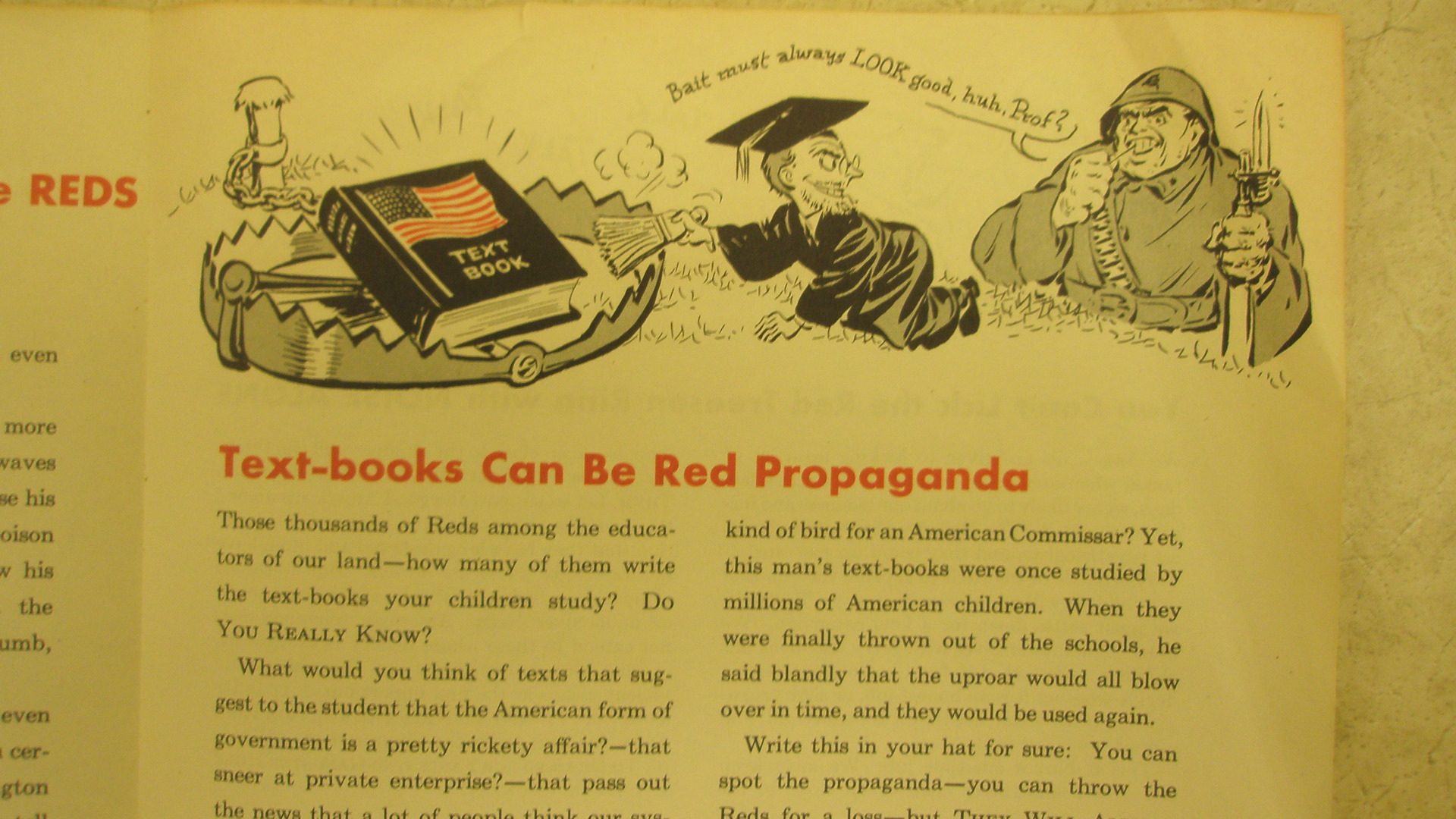
Similarly, an examination of the 1940 campaign to eliminate the social-studies textbooks of Harold Rugg could add a great deal to this conversation.  Before they came under attack from conservative activists in the American Legion and National Association of Manufacturers, these books sold in the millions.  Critics charged, however, that the books would pervert young people’s minds and morals.  As one influential American Legion critic put it in 1940, children reading Rugg’s books would soon be

“convinced that our ‘capitalistic system’ is the fault of selfish fellows like Benjamin Franklin and Thomas Jefferson who wanted to save their property; that the poor man wasn’t given proper consideration, that in Russia the youth are engaged in creating a beautiful, new democratic order, that modern business is for the benefit of the profit-makers, that advertising in an economic waste, that morality is a relative value, and that family life will soon be radically changed by state control.”    

Or consider this gem from the 1950s...

Or consider this gem from the 1950s…

Including the longer history of these sorts of controversies offers more than a chance for historians to sell a few more books.

In cases like this, a longer perspective helps us see that there are indeed ways in which each new book controversy offers “nothing new,” as Perlstein’s title suggested.  But there are other aspects of this long history that show us how things have changed dramatically.

Most compellingly, Perlstein comments that activists in 2013 seem to be reading from a conservative script in some ways.  In every case—whether from 2013 or 1974—activists claim to be mere surprised parents, frightened and disgusted by the literature imposed on their students.

Perlstein compares this to similar stories from the 1970s.  But there are equally familiar stories from much further back.  The wildly popular evangelist Bob Jones Sr. used to warn his audiences in the 1920s about the surprises in store for conservative parents at many modern schools.  One family had scrimped and saved to send their daughter to a fancy college.  The parents had no idea what kind of teaching went on there.  After one year, Jones preached,

“she came home with her faith shattered.  She laughed at God and the old time religion.  She broke the hearts of her father and mother.  They wept over her.  They prayed over her.  It availed nothing.  At last they chided her.  She rushed upstairs, stood in front of a mirror, took a gun and blew out her brains.”

In the 1920s, as in the 1930s, ’40s, ‘50s, and ‘60s, these claims of parent shock and surprise at the influence of schooling have resonated powerfully among American conservatives.

In other ways, the longer view can give us hope that this culture war is not simply and eternally deadlocked.  Since the 1970s, for instance, conservatives like the ones Perlstein mentioned have all argued that their opposition to books such as Toni Morrison’s Beloved did not make them racist.  Perlstein cites 1970s activist Alice Moore, who argued that her policies echoed those of the NAACP.  (Listen to this clip from a 1974 school board meeting in which Moore makes her case: Kanawha Board 4 – 11-74 – 3.

Such conservative efforts to fight an image of racism go back beyond the 1970s.  In a school fight in Pasadena in the late 1940s and early 1950s, conservatives insisted they did not fight against new zoning rules because they were racist.  In one telling comment, a conservative activist insisted that she could not have been racist, since her school petition had been signed by “her Negro, Mexican and Oriental neighbors” as well as whites.  She could not be a racist, she said, because she had quickly become friends with one of her new neighbors, a “Negro physician.”

However, before World War II, conservative activists made no such efforts to combat an image of racism.  As historian Jeffrey Moran has long argued (see here and here) white religious conservatives in the 1920s often paid little attention to their African American co-religionists.

Does it matter?  Can a longer historical perspective give us better understanding of the battle over Beloved in Fairfax County?

If we don’t see the ways conservative school activism has changed over the decades, we might be tempted to conclude too quickly, as Perlstein seems to do, that nothing ever changes.  That would be misleading.

Instead, the longer lens shows us that school battles have indeed changed dramatically over the course of the twentieth and twenty-first centuries.  For those of us who agree with Perlstein that schools should force students to “think and question, to blow apart settled ways of looking at the world, and, yes, force them into mental worlds that disturb,” the historical perspective offers a more profound reason for optimism.

Why School Choice?

As National School Choice Week moved into the history books, we have to ask: Is school choice a “conservative” issue?

There is no doubt that conservatives support choice.  Stalwart conservative organizations such as the Family Research Council and the Heritage Foundation make choice a centerpiece of their education policy platforms.

But the arguments conservatives usually make in favor of school choice often sound more traditionally “progressive” than anything else.  Is this mere political strategy?  Or a more profound commitment to social justice for those without economic resources?

The stereotypically “conservative” reasons for school choice are fairly simple.  First, opening up a variety of schools that receive tax dollars will enshrine the principles of free-marketism into public education.  Second, a thriving choice system will send more tax dollars to religious schools.

And we do occasionally see such arguments by conservative intellectuals.  The Friedman Foundation, for instance, legacy of free-market guru Milton Friedman, argues that choice will fix America’s public-education system.  According to Milton and Rose Friedman, that system has too often been “deprived of the benefits of competition.”

Similarly, Notre Dame’s Richard Garnett recently argued that school choice could help save struggling Catholic schools like the one that educated US Supreme Court Justice Sonia Sotomayor.

More often, however, conservative activists argue for school choice using different themes.  Most commonly, choice is presented as the best hope of low-income families in neighborhoods with sub-par public schools.  During National School Choice Week, we saw an outpouring of such rhetoric.
For instance, the Heritage Foundation publicized a speech in favor of choice by former Alabama Congressman Artur Davis.  Choice, Davis argued, could give options to a seventh-grader who submitted the following barely literate argument:

“[Y]ou can make the school gooder by getting people that will do the jod that is pay for get a football tame for the kinds mybe a baksball tamoe get a other jamtacher for the school get a lot of tacher.”

According to Davis, this student from Highland Park, Michigan was passed into eighth grade despite his struggles with basic writing.  Choice, Davis argued, could help.  It could offer parents, teachers, and students better schools now.  According to the Heritage Foundation article, Davis believed that school choice offered “the education [children] need right now, instead of simply pouring more money into the program or waiting for some new reform plan.”

Similarly, a writer at the social-conservative Family Research Council insisted that the main reason to support school choice was that “School choice gives students an opportunity to achieve a quality education and helps them not to fall through the cracks. We should all be in favor of helping children reach their fullest potential.”

Perhaps the most compelling statement of this conservative argument for the progressive virtues of school choice came over twenty years ago in an essay by Berkeley Law School’s Professor Emeritus John Coons.  As Coons argued in his 1992 essay, school choice advocates too often focus only on choice as a free-market device.  Instead, Coons insisted, such choice must be seen as “Simple Justice.”  Despite efforts to desegregate schools and make schools less imposingly Protestant, Coons wrote,

“we still arrange education so that children of the wealthy can cluster in chosen government enclaves or in private schools; the rest get whatever school goes with the residence the family can afford. This socialism for the rich we blithely call ‘public,’ though no other public service entails such financial exclusivity. Whether the library, the swimming pool, the highway, or the hospital—if it is ‘public,’ it is accessible. But admission to the government school comes only with the price of the house. If the school is in Beverly Hills or Scarsdale, the poor need not apply.

Choice is the obvious remedy for such maldistribution and discrimination.”  

Coons argued that non-elite parents deserved the right to send their children to schools that matched parents’ religious and cultural beliefs.  Such parents did not write op-eds in the New York Times.  Such parents did not have the option to influence the greater culture by making award-winning films or prize-winning books.  “Children,” Coons wrote, “are the books written by the poor.”

Yet despite such protestations among conservative intellectuals and pundits, school choice remains its reputation as a conservative issue.  As one angry commenter noted on the Family Research Council website,

“you see, school choice is really about getting as many students to pray to God each day. And, how many of these school choice advocates would have pressed for integration back in the 50’s? Very few. It’s about supporting religious schools through taxpayer dollars.”

Similarly, Americans United for Separation of Church and State has protested,

“It’s about funding religious and other private schools with taxpayer dollars and ultimately destroying the public school system.

“If you think the Heritage Foundation, the Koch Brothers and Betsy DeVos are in this just to help to some poor kid in the inner city, they’ve got a privatized bridge in Brooklyn they want to sell you.”

We ask again: Why school choice?  Do conservatives support school choice because choice will crush teachers’ unions?  Because choice will promote a freer free market?  Because choice will get more students praying in schools?

Or do conservatives support choice in order to help more children faster?  Because choice offers a way to deliver better education to low-income students?

My hunch is that, for many conservatives, the best answer is all of the above.  No doubt many conservatives want freer markets and a more Christian public square.  And school choice promises to deliver those things.  But choice might also be attractive because it gives better schools to more people faster than any other measure. 

God and the Super Bowl

It’s no surprise the National Football League plays its games on Sundays.

Journalist David Gibson offers a fascinating look at the importance of Christianity to the upcoming Super Bowl.  Writing in the pages of Religion News Service, Gibson notes the complicated mish-mash of conservative religion and the religion of big-league sports.

First of all, Gibson notes a recent PRRI survey in which just over a quarter of respondents agreed that God would play a significant role in determining the winner of the big game on Sunday.

But that’s not the whole story.  For this game in particular, as Gibson describes, we see two devout Catholic coaches, one of whom is famous for profane sideline behavior.  We see two superstars loudly proclaiming their evangelical Christian faith, one of whom has fathered six children with four mothers.  We also see leading players speaking publicly about their lack of religion, or about the ways their Christian faith helps them to physically crush their foes.

So Tim Tebow may be far, far out of the running for MVP.  But that does not mean that conservative Christianity will not be a key feature of America’s favorite game.

School Choice: Not Just for Conservatives Anymore?

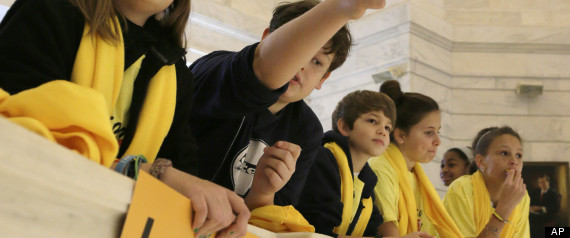
Have you seen the yellow scarves around?

Image Source: Huffington Post

Image Source: Huffington Post

They are the symbol of National School Choice Week, going on right now.

In a one-minute off-the-cuff interview with the Milwaukee Journal Sentinel, scarf-clad Wisconsin Governor Scott Walker claimed that the issue of school choice had outgrown ideology.  Support for school choice, Walker insisted, now “transcends party lines, it transcends ideological beliefs. . . .”

Walker himself is not exactly the poster child for post-culture-war dialogue.  His anti-union policies led to an unsuccessful recall attempt in Wisconsin.  In early 2011, Walker’s moves to curb collective-bargaining prerogatives led to a virtual caricature of the culture wars descending on the Capitol in Madison.

The history of “school choice” has been an ideological mishmash.  On one hand, one of the earliest and most influential proponents of vouchers has been free-market guru Milton Friedman.  As I argued in an article in Teachers College Record, Friedman saw vouchers as the single biggest reform to fix American education.  The quest for more school choice has been enthusiastically embraced by leading conservative organizations such as the Heritage Foundation.

Many liberals have offered across-the-board denunciations of vouchers and “school choice.”  Americans United for the Separation of Church and State, for instance, calls vouchers a thinly disguised propaganda program to divert tax dollars to religious schools.

However, some progressive leaders have supported vouchers and charter schools as a way to deliver better education to students who felt trapped in bad public schools.  Recently, however, outspoken voucher supporter Howard Fuller insisted that voucher programs must set clear limits.  If the programs did not specifically target low-income students, Fuller argued, they became just a shill for rich people.

Some education scholars have argued that the rhetoric of school choice has mainly served to redefine American democracy.  Instead of promoting equitable education choices, these authors contend, “school choice” tends to assume that free-market solutions are the only solutions, the best possible educational goals.

So is Governor Walker’s claim just a conservative pipe dream?  Has the goal of “school choice” overcome all ideological resistance?  Or will we see yet another split, between “progressive” supporters of school choice and “conservative” supporters, with “progressive” choice focusing on greater equity, and “conservative” choice emphasizing the God of the Free Market?

Fundamentalist Homeschoolers Seize Control of American Pop Music!

I am happy to say I don’t know anything about the Jonas Brothers.

I survive the shame of my ignorance by putting them in a mental category along with Hannah Montana, Barney, and all other noxious pop culture targeted at America’s youth.  As far as I am concerned, these are things I do not need to know about.

So imagine my surprise to learn that this pop group has become a leading advocate of school choice.  Imagine my surprise to learn that this leading pop group learned about the world and everything in it from their conservative evangelical Protestant homeschool curriculum.  It appears the Jonas Brothers have been educated with the Accelerated Christian Education curriculum, one of the most ferociously conservative Protestant curriculum choices available.

But let’s start at the beginning.

This morning, I came across a story from the libertarian Reason TV.  The Jonas Brothers headlined a National School Choice Week kickoff event.

Curious as to why such a high-profile pop band would sign up for an event so popular among conservatives, I looked into the Jonas Brothers.  As usual, everyone but me seemed to be already aware of the Jonas Brothers’ deep commitment to conservative evangelical religion.  Slack-jawed comedian Russell Brand, for instance, earned some opprobrium for mocking the Brothers’ virginity pledges.

When I checked out a “Day in the Life of the Jonas Brothers” video, I was surprised to see (check out the video at 3:58) that the homeschool curriculum they used was from Accelerated Christian Education.

Image Source: Accelerated Christian Education

Image Source: Accelerated Christian Education

As I argued a couple years ago in the pages of History of Education Quarterly, among Christian fundamentalist school publishers, ACE stands out for its rigid traditionalism and strict sectarian notions in every subject, from creationism to the religious meanings of the US Constitution.

I have no beef with conservative religious families who choose to use ACE materials to teach their children.

But I am surprised to find that young people educated with such materials have had such a meteoric rise to the peaks of pop culture.  After all, one common theme among conservative educational activists is that American pop culture peddles filth and trash.  Long before the Beatles, long before Elvis, conservatives worried about the sex and loose morals associated with such pop singers as Jimmie Rodgers.

Yet with the Jonas Brothers, we find a group doing very well in the choppy seas of pop music.  As far as I am aware, the Jonas Brothers did not come to fame as a particularly “Christian” music group, but rather as a particularly saccharine tween-idol music group.

Is it fair to say that conservative worries about the anti-Christian nature of American pop culture are overstated?  Or are groups like the Jonas Brothers simply exceptions that prove the rule?

Teaching the Culture Wars

Isn’t it nice to be included?

Andrew Hartman of Illinois State University, author of Education and the Cold War, has announced his reading list for a graduate seminar in America’s culture wars.

fundy and education scopes era coverI am tickled pink to see my 1920s book on the list (now available in paperback!).

It is an honor to be included with books that shaped my intellectual development, including Jonathan Zimmerman’s Whose America, James Davison Hunter’s Culture Wars, and many other wonderful titles.

Makes me want to join the seminar…

Do Georgians Hate Gay Kids?

About a week ago, an article in the New York Times drew attention to a report about anti-gay discrimination in tax-funded private schools in Georgia.  Though liberal groups such as Americans United for Separation of Church and State have publicized the findings, responses from conservative America seem more muted.  I wonder if this lack of indignant defenses from conservatives results from the implicit connection between this issue and racial discrimination.

The report from the Southern Education Foundation warned that of the 400+ Georgia private schools that receive tax-funded scholarship money, 115 schools discriminate openly and explicitly against homosexuality.

The report included policy statements from several such schools.  For instance, according to the report, the parent/student handbook at Shiloh Hill Christian School in Kennesaw warned that any student who said, “I am gay,” “I am a homosexual,” or a male saying, “I like boys,” could be expelled.  Another school statement quoted in the report warned,

“In accordance with the Statement of Faith and in recognition of Biblical principles, no ‘immoral act’ or ‘identifying statements’ concerning fornication, adultery, homosexuality, lesbianism, bisexuality, or pornography, will be tolerated.  Such behavior will constitute grounds for expulsion. . .”

These schools all receive funding from student scholarship organizations (SSOs).  SSOs, active in eleven states, according to the New York Times, allow taxpayers to divert taxes dollar-for-dollar to these scholarship organization.  Instead of paying their money in taxes, in other words, taxpayers can pay for students to attend private schools.

How have conservatives defended the program?  Fairly quietly, it seems to me.  Perhaps my antennae are simply not sensitive enough, but I have not read many endorsements of the Georgia program.  This is surprising, since other school-funding options such as charter schools and school vouchers usually draw vociferous defenses from conservatives.

There have been some arguments in defense of Georgia’s policies.

In a post on First Things’ First Thoughts blog, for example, Joseph Knippenberg made a religious-liberty defense of the Georgia program.  First, Knippenberg argued, taxpayers ought to have control over their tax dollars, to some extent.  Until their money enters the public treasury, it is still private, Knippenberg pointed out.  Therefore, choosing to donate to certain schools must be considered in the same category as choosing to donate to certain churches, or hospitals, or advocacy organizations.

Second, Knippenberg extended this argument to people’s right to practice their religions freely.  “To deny people the opportunity to make a contribution to the faith of their choice,” Knippenberg wrote, “is to deny their religious freedom.”

It seems there are other arguments conservatives could make.  As one commenter on a Christianity Today blurb noted,

“Sexual preference or orientation is not a person. It is not unjust discrimination to discriminate between acts, including sexual acts that respect the personal and relational essence of the human person and are thus acts of authentic Love, and acts, including sexual acts, that do not respect the personal and relational essence of the human person and are thus demeaning.”

These comments from “Kathleen” articulate a deeper possible defense of Georgia’s policies.  Though I personally agree that Georgia’s tax money ought not fund schools that discriminate against homosexual students, let me try to spell out this possible argument a little bit.

Here goes:

The argument against Georgia’s tax-funding scheme implicitly uses the history of racial school discrimination to discredit the current policy of religious school discrimination.  It fudges the difference.  This implied analogy does not hold water.

All schools, all people, all organizations discriminate.  Any school that admits some people and does not admit others discriminates.  In some cases, private schools discriminate openly against people who can’t or won’t pay their tuition.  And this sort of discrimination raises no objections.

The issue, then, is which sorts of discrimination are legitimate.  On the whole, Americans agree that discrimination by race is not legitimate.  Of course, there are plenty of white- and black-supremacist holdouts.  In general, however, in terms of constitutional law and explicit policy practice, America has abjured its white-supremacist past of schools segregated legally by race.

To imply that all school discrimination belongs in the same moral, legal, and Constitutional category as racial discrimination unfairly smears religious dissenters as bigots.

Again, just to ward off misunderstanding, let me be clear: I’m playing devil’s advocate here.  In this case, I personally believe that public money should not fund private schools that discriminate against homosexuality.

But intelligent scholars have pointed out the flaw in the “bigotry” analogy.

In an essay on Public Discourse a few months back, Princeton’s Robert George assailed the tendency to label all forms of discrimination “bigotry.”  Speaking in regard to the definition of marriage, George argued,

“Thus, advocates of redefinition [of marriage] are increasingly open in saying that they do not see these disputes about sex and marriage as honest disagreements among reasonable people of goodwill. They are, rather, battles between the forces of reason, enlightenment, and equality—those who would ‘expand the circle of inclusion’—on one side, and those of ignorance, bigotry, and discrimination—those who would exclude people out of ‘animus’—on the other. The ‘excluders’ are to be treated just as racists are treated—since they are the equivalent of racists. Of course, we (in the United States, at least) don’t put racists in jail for expressing their opinions—we respect the First Amendment; but we don’t hesitate to stigmatize them and impose various forms of social and even civil disability upon them and their institutions. In the name of ‘marriage equality’ and ‘non-discrimination,’ liberty—especially religious liberty and the liberty of conscience—and genuine equality are undermined.”

Similarly, Peter Berger noted the increasing tendency of homosexual-rights advocates to frame their arguments as matters of rights.  As Berger wrote in The American Interest,

“At the time [the 1950s] homosexual rights were advocated by a discourse of individual freedom, basically freedom to choose one’s values and way of life. In other words, the discourse was in terms of the first amendment to the US constitution. The discourse now is very different: Homosexuality is not a choice, but a destiny—an individual does not, cannot choose to be gay—one is born gay—and society should acknowledge and respect this congenital fate. I think it is very clear why this change in discourse occurred: If homosexuality is destined not chosen, it is analogous to race—and thus the movement for homosexual rights can wrap itself in the mantle of the Civil Rights movement. Let me reiterate: I have identified all along with the insistence on the rights of homosexuals, and I think I understand the rhetorical logic of the changed discourse. Is it based on good scientific evidence? I don’t know.”

In other words, if conservatives hope to maintain schools—even private schools, even religious schools—that discriminate against homosexual students, it will be imperative for conservatives to reframe this issue.  If Americans see Georgia’s funding of anti-homosexual schools as a fair analogy to public funding of anti-African American schools, the writing is on the wall.  Such racial discrimination no longer musters any public support.

Arguing that this is an issue of religious freedom will not be enough.  Conservatives must do more than just argue that discrimination against certain lifestyle choices is a legitimate part of their religious freedom and expression.  After all, religious freedom has been abridged in the quest for racially desegregated schools.  Conservatives, it seems to me, must do what Professor George advocates: break the intellectual connection between discrimination on the basis of race and discrimination on other bases.  Only if discrimination against homosexuals is seen as a legitimate option—even by those who do not agree—will religious institutions manage to maintain such policies.