From the Archives: Yoga, Schools, and “Those Dirty Books”

As Natalia Mehlman Petrzela has argued in these pages recently, a yoga program in Encinitas public schools has raised the ire of some religious conservatives.  The story has subsequently been  picked up by the New York Times and National Public Radio.

As Professor Mehlman Petrzela pointed out in her article, such fears of yoga as religious indoctrination are not new among American conservatives.

During my research into an earlier generation’s fight over school textbooks, I discovered such complaints as early as 1974.  In that year, a school controversy exploded in Kanawha County, West Virginia.  As journalists such as Trey Kay and scholars such as Carol Mason have described recently, the bitter fight over new textbooks led to a months-long school boycott and repeated shootings and bombings.

In 1974, the beleaguered Kanawha County Board of Education appointed an eighteen-person committee to investigate the accused textbooks.  A majority of the committee found the books unobjectionable.  But in November, 1974, a minority splinter committee issued a blistering 500-page denunciation of the textbook series.  The minority report included specific objectionable passages with comment.

For instance, from a first-grade teachers manual from the DC Heath “Communicating” series, the committee extracted the following suggested discussion-starters: ‘Has anyone ever awakened and found a stranger looking at him?  Has anyone ever broken a toy, a chair, or some other article the first time he was visiting an unfamiliar house?  Has anyone ever had a dream in which he talked with some animals?  Has anyone ever seen a deserted house?  Did you go in?’

In the minority committee’s opinion, “A child should not be forced to discuss his own personal feelings.  This constitutes an invasion of privacy.  This is also
behavioral change.  Why should a 6-year-old child be subjected to questions that will implant fears and frustrations in his mind.  Why not have questions on pleasant and wholesome attitudes?”

The minority report complained that the textbooks’ version of the Jack and the Beanstalk story was “more sadistic and gruesome than usual.”  Elsewhere, the minority report objected, students were instructed to make up their own myths, including one about why all humans don’t speak the same language.  “The question why men do not speak the same language,” the minority insisted, “is answered in the Book of Genesis.  The inference that the answer can be classified as a myth again presupposes that the Bible is based on a myth.”

Most interesting to the folks of Encinitas, however, might be the minority committee’s complaint that articles about yoga amounted to “religious indoctrination.”

Makes me wonder where and when else the conservative campaign against the teaching of yoga in public schools has surfaced.  As Mehlman Petrzela points out, school-yoga supporters in the press and school district seem utterly unaware of this longer history.  As she wrote in her December article,

“The press, the EUSD, and scores of online commenters expressed shock that anyone would suggest, ‘a little stress-reducing exercise ever hurt anyone,’ especially in the context of a much-discussed ‘obesity crisis.’ The Los Angeles Times couldn’t believe the degree of the plaintive parents’ worries, as yoga is regularly practiced in San Diego spots as disparate as the Camp Pendleton naval base and the Jois yoga enclave, which funds the school program. Glamour commented, ‘most people associated with the controversy are scratching their heads,’ quoting similarly incredulous Jois chief executive: ‘It’s hard to know how to respond to someone who says if you touch your toes, you’re inviting the devil into your soul.'”

Perhaps this posture of surprise is put on only to discredit conservative opponents.  After all, if anti-yoga activism seems startling and unexplainable, it might gain fewer political supporters.  But at least some of the surprise sounds genuine to me.  It seems another good illustration of the ways widespread ignorance of the history of conservative educational activism impairs any sort of useful discussion of current educational policy.

Homeschooling and the Common Core

Education folk these days are a-flutter with talk about the Common Core State Standards.

Recently, William Estrada of the Home School Legal Defense Association has warned about the implications for homeschoolers of such national curricula.

Without an historical perspective, it would be easy for readers of recent headlines to assume that conservatives have always opposed greater educational centralism.  After all, Ronald Reagan came to office on a promise to eliminate the then-new Department of Education.  Recently, Republican Presidential hopefuls such as Rick Perry, Michele Bachmann, and Ron Paul promised to fulfill Reagan’s plan.

Back in the 1920s, however, leading conservatives often made the strongest case for a federal department of education.  As I explored in a recent article in the History of Education Quarterly, the 1920s Ku Klux Klan hoped greater educational centralization would help Americanize immigrants and standardize Americanism education.  The main institutional opponent of such centralization in the 1920s, as Douglas Slawson’s wonderful book The Department of Education Battle, 1918-1932 points out, was the Catholic Church.  In that turbulent decade, social traditionalists, conservative Protestants, and many leading progressives all agreed that the nation needed greater centralization and increased educational funding.

By the 1940s, however, educational centralization had become a leading bugbear of anti-communist conservatives.  From the fringes of conservative anti-communism, influential pamphleteer Allen Zoll denounced federal aid to local schools as the central strategic goal of subversive communism.

Allen Zoll, They Want Your Child! (New York: 1949)

Allen Zoll, They Want Your Child! (New York: 1949)

In “They Want Your Child!” (New York: National Council for American Education, 1949), Zoll warned, “We had better stop smiling.  There IS a conspiracy.  The conspiracy against the American way of life, against everything that we hold dear, is probably the most completely organized, ruthless design against other people ever set in motion in all human history. . . . THE INFILTRATION AND CONTROL OF AMERICAN EDUCATION BECAME COMMUNISM’S NUMBER ONE OBJECTIVE IN AMERICA.  THEY WANT THE CHILDREN OF AMERICA.  THEY WANT YOUR CHILD.”  To Zoll and many of his readers, centralization of education meant that subversives could collect all the threads of education policy in their grasping claws.

Once the US Supreme Court began ruling in favor of school desegregation in the 1950s and against school prayer in the 1960s, the notion of greater educational centralization became anathema to wider and wider circles of American conservatives.  Centralization became associated purely with the long-standing enemies of traditionalist and conservative education: evolution science, progressive pedagogy, left-wing anti-racism, anti-patriotic politics, and secularism.

In his December 2012 brief, Will Estrada of the HSLDA made some of the traditional conservative arguments against greater educational centralism.  First, Estrada pointed out, states were pushed into accepting these common standards out of financial desperation, not out of any educational benefit.  President Obama’s Race to the Top funding, as Estrada noted, was often tied to adoption of common core standards.  Second, centralized education would decrease quantifiable student achievement, Estrada argued.  Scores on English and math tests would likely decrease after these standards were in place, at the cost of billions of dollars.  Perhaps most in line with the complaints of many American conservatives, Estrada warned that common standards weakened parental control.  “Top-down, centralized education policy,” Estrada wrote, “does not encourage parents to be engaged.”

Specific to homeschoolers’ interests, Estrada worried that centralized curricula would encourage greater pressure on homeschoolers to follow along.  If every college and every college entrance exam measured student achievement by success on common-core-linked tests, homeschool students would feel pressured to master that common curriculum.

Supporters of today’s Common Core State Standards argue that the standards will bring greater efficiency and equality to education in the United States.  However, the idea of centralization has had a checkered career among American conservatives.  Will Estrada of the HSLDA raised one voice in opposition to today’s centralization effort.

School Shootings and the “Crime of ‘62”

Governor Mike Huckabee is not alone.

As we’ve noted, the former governor of Arkansas and prominent conservative radio personality denounced the lack of prayer and Bible-reading in public schools.  Such a-religiosity, Huckabee declared, must be part of the reason for last week’s terrible school shootings in Connecticut.

More recently, Bryan Fischer, public face of the conservative American Family Association, echoed Huckabee’s sentiments.  In this video posted by the watchdog group RightWingWatch, Fischer intoned, “Back when we had prayer, the Bible, the Ten Commandments in school, we did not need guns.”  In a follow-up article on the AFA website, Fischer offered similar explanations:

“The truth may be that God was made unwelcome and left. God submits himself to the law of faith, and will not go where he is not wanted. He will not force us to put with him if we don’t want him around. It may be that his protective presence is being removed from our land and from our schools because he has been told repeatedly that his protective presence is not wanted.

“We have, as a culture, systematically booted God from our public schools for over five decades.. In 1962, the Supreme Court issued a diktat that American schools could no longer seek his help and protection. In 1963, the Supreme Court issued a second diktat prohibiting the reading of his Word in our public schools. And in 1980, the Supreme Court issued a third diktat prohibiting the display or teaching of the Ten Commandments, God’s abiding and transcendent moral standard for human conduct.

“So God is no longer prayed to, his counsel is no longer sought and his standards are no longer respected. Is it any wonder that he might not be around when we need him? If we have spent 50 years telling him to get lost, it should not come as a surprise that we eventually begin to feel the absence of his powerful presence.”

Fischer’s evocation of 1962 as a major turning point in American culture is one that resonates deeply among conservative evangelical Protestants in the United States.

Yet among the broader culture, the year does not have the same dramatic power.  This was noticed by conservative evangelicals at the time, as well.

First of all, for evangelicals at the time, it was not 1962, but 1963 that was the real watershed.  In 1963, after all, the US Supreme Court’s decision in Abington Township School District v. Schempp ruled that public schools may not lead devotional Bible readings or teacher-led classroom prayers.

The similar but distinct 1962 decision, Engel v. Vitale, was actually welcomed by many evangelical leaders.  In that decision, SCOTUS ruled that the state could not impose an ecumenical state-written prayer on public schools.

As I argue in my recent article in the Journal of Religious History, evangelical intellectuals at the time could not understand the widespread mainstream indifference to the US Supreme Court’s Schempp decision in 1963, especially when contrasted with the popular uproar that met 1962’s Engel decision.  The article is subscription-only, but here is a small snippet:

“A Moody Monthly poll of evangelical editors in early 1964 found that they considered the Schempp decision the most important event of 1963, outranking the year’s civil-rights activism and Birmingham’s 16th Street Baptist Church bombing in importance to American culture and society.[i]  Yet compared to the popular outrage against the Engel decision, the Schempp decision caused less public protest.[ii]  As the editors of Christianity Today noted in the aftermath of the Schempp decision, ‘Why church leaders and the public at large took the broader 1963 decision more calmly deserves nomination for the mystery of the year.’”[iii]

It is difficult to know what to say in the wake of an event like the recent school shootings.  The public remarks of prominent conservative Christians such as Governor Huckabee and Bryan Fischer demonstrate the deeply held feelings among many Americans that the SCOTUS decisions of 1962 and 1963 put America on a woeful path.  Public schools, many feel, must embody the religious traditions of the nation.  Not only as history or literature, but as guideposts for morality and prayer life.

As Fischer’s comments illustrate, it is not the specifics of the SCOTUS decisions of 1962 and 1963 that matter to conservatives, but the notion that mainstream America has turned its back on God by kicking God out of public schools.


[i] “Report: The Month’s Worldwide News in brief,” Moody Monthly 64 (January 1964): 8.

[ii] Donald E. Boles, The Two Swords: Commentaries and Cases in Religion and Education (Ames, IA: Iowa State University Press, 1967), 111-112.

 [iii]  “Compliance, Defiance, and Confusion,” Christianity Today 8 (11 October 1963): 34.

Scooping the New York Times

“All the News That’s Fit to Print” . . . eventually.

An article in yesterday’s New York Times describes the controversy over a yoga program in Encinitas public schools.  The same controversy that guest blogger Natalia Mehlman Petrzela analyzed in these pages a week ago.

I imagine NYT writer Will Carless had a stricter word count, but whatever the excuse, yesterday’s article doesn’t come close to matching the depth or context provided in Professor Mehlman Petrzela’s account.

Sorry, Grey Lady, ILYBYGTH got there first…and better.

School Shooting? Blame the Supreme Court

Is the US Supreme Court responsible for the recent horrific shooting at an elementary school in Newtown, Connecticut?

That is the implication made by Mike Huckabee, conservative radio personality, former Governor of Arkansas, and occasional presidential candidate.  Huckabee told Fox News that school violence could be prevented by letting God back into public schools.

Asked by reporter Neil Cavuto how God could allow such a tragedy, Huckabee responded,

“We ask why there’s violence in our schools, but we have systematically removed God from our schools. Should we be so surprised that schools would become a place of carnage? Because we’ve made it a place where we don’t want to talk about eternity, life, what responsibility means, accountability. That we’re not just going to have to be accountable to the police if they catch us, but one day we stand before a holy God in judgment. If we don’t believe that, then we don’t fear that. . . . Maybe we ought to let (God) in on the front end and we wouldn’t have to call him to show up when it’s all said and done at the back end.”

As I argued recently in an article in the Journal of Religious History, this argument has been a standard theme among conservative evangelical Protestants since SCOTUS’ 1963 Schempp decision.  The journal is subscription-only, but the essence of my argument is as follows:

many religious Americans, far beyond the ranks of evangelical Protestants, concluded that the Court had kicked God out of public schools.  Unlike other religious Americans, however, evangelicals had long had special influence over public education.  These Court decisions had a unique impact on evangelical attitudes because evangelicals had harbored an implicit trust in their own unique role in public education.  When the Supreme Court ruled that evangelical staples such as recitation of the Lord’s Prayer and reading from the Bible could no longer be performed in public schools, it forced evangelicals to an unexpected grappling with their wider relationship to American society.  Not only did the Court decisions kick God out of public schools, in other words, but it effectively kicked evangelicals out of the American mainstream.  

            As a result, evangelicals shifted from feeling part of a politically invulnerable religious majority to feeling themselves part of a put-upon minority. This dramatic and relatively sudden change in evangelical sentiment had important results.  For decades, politicians and politically minded preachers attracted evangelical support by articulating these new minority sentiments.  Jerry Falwell, for example, organized the significantly named Moral Majority as an effort to represent the values of conservative Fundamentalists, whom Falwell called “the largest minority bloc in the United States.”[i]  Similarly, in a stump speech in early 1984, Ronald Reagan played to the sensibilities of evangelical voters when he condemned “God’s expulsion” from public schools.[ii] 

Could a more robust religious curriculum in America’s public schools have deterred the school shooter in this case?  That does not seem to fit the facts.  However, Governor Huckabee has articulated a notion that remains very common among some religious conservatives: Schools cannot teach without religion.


[i] George Vecsey, “Militant Television Preachers Try to Weld Fundamentalist Christians’ Political Power,” New York Times, January 21, 1980, A21.

[ii] Quoted in Catherine A. Lugg, For God and Country: Conservatism and American School Policy (New York: Peter Lang, 2000), 159.

Election Update: Darwin Defeated in Georgia

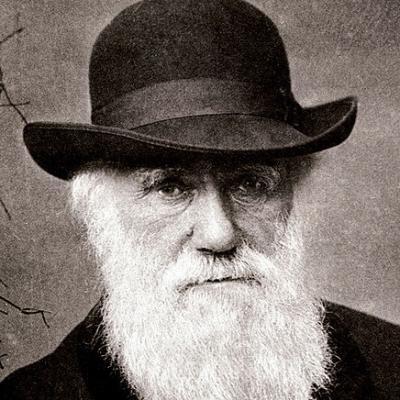
As we reported recently, some evolutionists hoped to make an election-day point in Georgia with a write-in campaign for Charles Darwin.  The incumbent, Dr. Paul Broun, had called evolution, embryology, and the Big Bang Theory “lies straight out of the pit of hell.”

The tallies are not fully in, but it looks as if Darwin went down to a decisive defeat.

The candidate could not be reached for comment.

Election Coverage: Evolution Skeptic Wins Seat on Texas State School Board

Education-watchers have long focused on the politics of education in the Lone Star State.  From The Revisionaries to Rod Paige’s skewed statistics, Texas education often serves as a harbinger of education trends nationwide.

Nowhere is this more true than in the touchy issues of education culture wars.

Yesterday’s election put one more conservative voice on Texas’ 15-member State Board of Education.

Marty Fowler of Amarillo won a resounding victory over Steven Schafersman.  The politics of the two candidates demonstrate what Texas voters in district 15 want out of their public schools.

Schafersman went down to defeat with his pro-mainstream science, pro-sex ed platform.  According to mywesttexas.com, Schafersman, “a practicing scientist in the petroleum industry with 23 years of college  teaching experience, said he ran for the board because he wants students to have  unbiased, factual and scientific textbooks and increase[d] knowledge about  contraception.”

Schafersman won a measly 20% of the vote with these positions.  Earlier this year, Fowler explained his support for teaching multiple scientific approaches–intelligent design along with evolution–in Texas’ public schools.  As Fowler put it in an interview with an Amarillo newspaper:

“Evolutionists would say that we progressed to this point through a series of unplanned, random circumstances and random events.  I don’t believe that tells the whole story. I think there is more to our creation that indicates an intelligent being that has played a significant role.”

Beyond the issue of evolution/creation, Rowley won support as the more consistently conservative candidate, with opinions on issues from standardized testing to vocational education that more closely matched the conservative district.

As fence-sitting observers like me have pointed out, this is the real crux of the issue in educational culture wars.  Schools prohibit sex ed and teach creationism not because teachers are ignorant, not because administrators are prudes, but rather because those educational policies are often the clear mandate from large electoral majorities.

Much as it pains me to admit it, Marty Rowley would be acting in an irresponsible fashion if he did not go to work to promote multiple scientific theories in Texas textbooks and schools.  That, after all, is what the voters seem to be demanding.

Election Day Coverage: Voting “Darwin” in Georgia

Darwin for Congress?

He’s not on the ballot.  He’s not even alive.  But Charles Darwin is campaigning for the US House of Representatives in Georgia.

After US Representative Dr. Paul Broun famously opined that evolution, embryology, and the Big Bang theory were “lies straight out of the pit of hell,” Georgia’s evolutionists decided to push for a write-in election for Charlie D.

Does Darwin stand a chance?  Maybe if given billions of years to evolve a campaign.

All joking aside, Representative Broun will win in a cake walk.  Even Broun’s most ardent foes are hoping for only a small symbolic protest vote for Darwin.

For those like me who hope to see better education in America’s schools–including better evolution education–Broun’s lack of opposition comes as a sobering reminder of the political nature of American education.  Those evolutionists such as Bill Nye who slam Broun’s credentials forget one crucial detail: Representative Dr. Broun was elected, and he’s going to be re-elected.  Signing a petition–as have roughly 85,000 people at Change.org–is not the easy way to remove Dr. Broun from the House committee on science.

The way to do it is to get involved in local and state politics.  Don’t just run a last-minute write-in campaign for a dead Darwin.  Seek out a plausible electoral alternative to politicians whom you don’t think are qualified to make decisions about science.

God and the Battlefield States

At Religion News Service Mark Silk offers a sketch religious breakdown of important battleground states for Tuesday’s election.

Of course, the broad categories of “Mainline Protestants,” “Evangelicals,” “Catholics,” “Nones,” and “Mormons” do not offer a nuanced portrait of religious life in America.  Nor does it tell us enough to see various percentages.  Among every category, there are important differences.  Catholics, for instance, break in many different directions electorally.  Some Catholic groups, such as Latinos, tend to vote Democratic.  But other Catholic groups, such as pro-life voters, tend to vote Republican.

Nevertheless, even with all those caveats, Silk’s sketch is worth looking at.  It must make a significant difference, for instance, to have religious make-ups as broadly different as those of North Carolina and New Hampshire:

“North Carolina

  • Mainliners: 32%
  • Evangelicals: 44%
  • Catholics: 9%
  • Nones: 6%

“New Hampshire

  • Mainliners: 27%
  • Evangelicals: 10%
  • Catholics: 38%
  • Nones: 16%”

For each of the 12 battleground states, Silk offers a brief commentary on the trends suggested by the data.  For those interested in religion and politics, Silk’s article is certainly worth a read.

A Long Way from Texas…

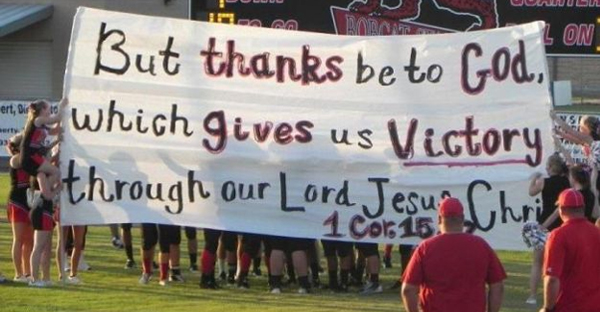
Can cheerleaders at a public school sport Biblical phrases on banners?

The cheerleaders in Kountze, Texas, think so.  So does the Texas Attorney General.  So do tens of thousands of Facebook supporters of the cheer team.

But an important part of this story is often being left out by coverage in some mainstream media outlets. Why?

We’ve reported on this story before.  In short, this group of cheerleaders sued when their school superintendent banned their religious banners from football games.  So far, the cheerleaders have been allowed to keep on cheering for Jesus at their games.

Recently, we’ve noticed a puzzling trend in the reporting about this story.  An editorial in yesterday’s New York Times, for instance, bemoaned the situation in Kountze.  “In this country — including in Texas — the Constitution does not leave religious freedom up to majority rule,” the editors insisted.

I agree with the NYT‘s basic position: the SCOTUS precedent in 2000’s Sante Fe ISD v. Doe speaks directly to this case.  Even student-led prayer, if sanctioned by the school district, implies an endorsement of particular religious beliefs by the government.  Though the Kountze cheerleaders insist that their banners represent purely private speech, this seems a stretch.

However, I’m puzzled by the way NYT coverage has left out a vital part of this story.  For those of us who want to understand the ways conservatism works in American education, whether it be about evolution, school prayer, sex education, or other issues, the skewed coverage in the NYT makes the job much harder.

Here’s the problem:  In yesterday’s editorial and in earlier reporting on this Kountze story, the NYT left out an important key player in the drama.  The NYT neglected to mention the role of the Freedom from Religion Foundation.  This Wisconsin-based group warned the school superintendent of its plans to sue over the banner issue.  Only then did the superintendent ban the cheerleaders’ religious practice.

The NYT misled readers with its description of the reasoning in Texas.  The editors described the case as follows:

“Those banners are not merely personal expressions of belief, but in that setting become religious messages endorsed by the school, the school district and the local government.       

“That’s why officials of the school district last month prohibited the banners at football games.”

But the way the story really played out, the school district only prohibited the banners under pressure.  In fact, as the Los Angeles Times reported, the school superintendent himself supported the cheerleaders.

If we hope to understand the dynamic, in this case or in the many other school-prayer cases in history and in the news, we must not omit such an important element.

Please do not misunderstand: I am not denouncing the Freedom from Religion Foundation.  I do not think that sectarian prayers belong at public-school events.  But I do want to understand these cases, and ignoring important elements such as the role of outside organizations leaves us unable to understand the situation.

As political scientists Michael Berkman and Eric Plutzer have argued in their books Ten Thousand Democracies and Evolution, Creationism, and the Battle to Control America’s Classrooms, teachers and school districts respond to local culture.  When communities want prayer and creationism in public schools, schools include prayer and creationism.

As Berkman and Plutzer proved with their survey of high-school biology teachers, the beliefs of those teachers usually closely match those of their local communities.

In the Kountze case, the school district, including even the superintendent who banned the banners, supports the cheerleaders.  As superintendent Kevin Weldon told the LA Times, the judge in this case “was in a pretty tough predicament, like myself. . . . I personally applaud the kids for standing up for their beliefs in such a bold way.”

If we hope to understand the ways issues such as creationism and school prayer play out in America’s schools, we can’t let ourselves miss the way schools, teachers, and school districts actually function.  Teachers, as Berkman and Plutzer insist, are “street-level bureaucrats.”  They represent majority opinion in their communities.  The same is often true for superintendents such as Kevin Weldon in Kountze.

None of this is new.  In the Scopes Trial in 1925, the prohibition of evolution in Dayton, Tennessee only became controversial when the American Civil Liberties Union became involved.  More recently, as political scientists Kenneth Dolbeare and Phillip Hammond demonstrated in the 1970s, US Supreme Court decisions about school prayer and Bible reading often have no discernable effect on school practice.  After the 1962 and 1963 Supreme Court decisions against the reading of the Bible and reciting of the Lord’s Prayer in public schools, Dolbeare and Hammond found that all the schools in their survey continued to pray and read the Bible.  Most important, those practices caused absolutely no controversy in the communities they studied.

If we hope to understand school prayer controversies, we can’t allow ourselves to leave out the role of key players such as the Freedom from Religion Foundation.  Perhaps the NYT editors hoped to avoid the old chestnut that only “outside agitators” brought about this sort of school controversy.  Whatever their reasons, they misrepresent the story and make it more difficult for outsiders like me to understand the nature of these school battles.