IN THE NEWS: Faith and Race

What does it mean to be a citizen of Fundamentalist America?  For some, it means making hard choices.

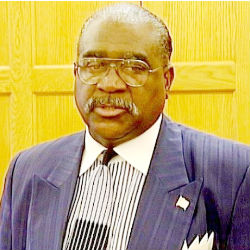
For instance, the Reverend Keith Ratliff of Des Moines, Iowa recently resigned his leadership post in the NAACP.  He did so after the NAACP officially endorsed same-sex marriage.  Ratliff was forced to choose between his religious beliefs and his leadership post, and he chose religion.

Ratliff’s story highlights the changing nature of Fundamentalist America.  For most of American history, conservatives, like progressives, have been starkly divided by the color line.  The recent decisions of prominent African American conservatives, like Ratliff, to emphasize their conservative ideology and theology demonstrates this change.  Even before resigning his leadership post in the NAACP, for instance, Ratliff publicly endorsed conservative Republican Bob VanDer Plaats for governor in 2010.

As reported by Catholic Online, Ratliff defended his decision as part of his Biblical faith:

During a Statehouse rally in March 2011, Ratliff said his support for traditional marriage was biblically based, adding, “This isn’t a private interpretation, a Burger King religion, and by that I mean a ‘have it your way’ religion.”

In the News: “Gay” Is not Slander in NY

In a story from my new hometown, a New York appellate court ruled recently that it no longer counted as slander to falsely accuse someone of being homosexual.  In this case, a woman spread a rumor that Mark Yonaty was gay in order to get his girlfriend to break up with him.  Yonaty sued and lost.  As the New York Times reported, the appeals court threw out earlier rulings in Yonaty’s favor, saying they were “based on a false premise that it is shameful and disgraceful to be described as lesbian, gay or bisexual.”

What does this mean for Fundamentalist America?  On one hand, it could mean that FA will find itself more marginalized if it maintains its opposition to homosexual sex and relationships.  Some conservative groups, for instance James Dobson’s Focus on the Family, emphasize love and care for those engaging in homosexual behavior or identifying as homosexuals, even while condemning all sex outside of marriage, especially including gay sex. 

Other FA voices keep up harder-edged language against homosexuality.  A recent article by Bryan Fischer, for instance, on Rightly Concerned, affiliated with the American Family Association, notes that America must discriminate against homosexuals not out of hate but out of love.  However, Fischer also compares healthy anti-homosexual discrimination to other healthy forms of discrimination:

We discriminate against adults, even priests, who have sex with children. We discriminate against teachers who have affairs with students. We discriminate against teachers who moonlight in the porn industry. We discriminate against students who engage in sexting. We discriminate against rapists. We discriminate against those who expose sexual partners unknowingly to the AIDS virus. We discriminate against those adults who commit statutory rape against minors.

If the recent ruling from Albany is a bellwether for the direction of mainstream American culture–and that’s a big if–then Fischer’s type of argument is swimming upstream.  If it is no longer an insult to call someone ‘gay,’ then it will make no sense legally, politically, or culturally to discriminate against homosexuality. 

There’s another lesson we can draw from this article.  At least one gay-rights activist has warned that this decision must not be taken as the end of discrimination against homosexuality.  As the UK’s Daily Mail reported, New York activist Jay Blotcher insisted that being identified as gay could still summon up “something akin to a lynching mob” in parts of the country.  “It’s still a thorny issue,” Blotcher said. “Bottom line, just because you have gay characters on television that make everybody laugh doesn’t mean that the entire country embraces gay people as equal citizens yet.”

Blotcher’s comments illuminate one of the most puzzling aspects of these kinds of “culture-war” debates.  Instead of celebrating the achievement of mainstream acceptability for homosexuality, Blotcher emphasizes the continuing persecution of homosexuals.  Like Blotcher, many voices from FA insist on their own status as beleaguered cultural minorities.  This tradition among American Protestantism has long roots, back to the seventeenth-century persecution of “Pilgrims” and “Puritans” that led in part to the founding of New England.  In the twentieth century, fundamentalist activists have often used Blotcher’s language of continuing discrimination to defend the borders of Fundamentalist America.     

To cite just one example, in 1965 in the wake of the US Supreme Court rulings against school-sponsored religious devotions in public schools, fundamentalist editor and publisher John R. Rice insisted that “White Minorities Have Rights, Too.”  In the pages of his Sword of the Lord magazine (volume 31, September 3, 1965, page 1), Rice asked,

“If Christian people do not have a right to have the Bible taught in the schools, then infidels have no right to teach infidelity in the schools . . . . Why not have freedom in America as much for one minority as another?  Why not observe the rights of white people as well as the rights of Negroes?  Why not observe the rights of nonunion workers as much as the rights of union workers?  Why not observe the rights of Bible believers as well as the rights of the infidels in the churches and infidels in courts or schools?” 

Just as Jay Blotcher warned not to remove homosexuality from the category of defended minorities, so fundamentalists such as Rice insisted that they be allowed to claim minority status.  One of the quirks of America’s culture wars is that both sides often claim the rights and privileges of both majority AND minority status.  If we hope to understand Fundamentalist America, we need to understand the continuing propensity of fundamentalists to do both at the same time.    


Berger on the Pentecostal Elephant in the Room

Peter Berger at American Interest has offered this week a helpful reminder about the importance of understanding Pentecostalism.  Berger’s article reminds us of a few looming intellectual traps that anyone hoping to understand Fundamentalist America must avoid.  The first is that conservative religion in America is some sort of monolith.  Far from it.  The first generation of Protestant fundamentalists that I’ve studied vehemently disputed the legitimacy of the Pentecostal style.  One typical fundamentalist writer in the early 1920s dismissed Pentecostalism as a kind of “hysterical fanaticism,” arguing that “Disorderly confusion in the assembly is not of God.”   Another agreed: “Usually people carried away by this movement are of a nervous, mystical, hysterical temperament, such as are considered a bit queer.”

Historian Grant Wacker has called this division the “Travail of a Broken Family.”  As Berger notes, even among the Pentecostal tradition there are a variety of sub-traditions.  As a generalization, though, Pentecostals emphasize an immediate connection with, and a baptism by, the Holy Spirit.  Pentecostal worship can be characterized by distinctive physical manifestations among worshippers, including “jerking,” laughing, or glossolalia (“speaking in tongues”).  The faith has also long been known for its emphasis on divine healing.  But beyond those headline-grabbing outward signs, Pentecostal faiths are also focused on a very “fundamentalist” reading of the Bible.  And although Pentecostals can be less noticably political than their evangelical cousins, they often have equally conservative political and cultural beliefs.

Berger’s article also reminds us of the danger of dismissing any intellectual tradition much different from our own.  As Berger notes,

I think that even today the notion of Pentecostal scholarship, especially if undertaken by scholars who are themselves Pentecostals, must strike many people as an oxymoron. Evangelicals in general are still widely regarded as backwoods provincials, like those described with contempt by H.L. Mencken in his reports on the 1925 “monkey trial” in Dayton, Tennessee—or, in the profoundly revealing 2008 comment by Barack Obama about folk in small towns (revealing, that is, about him, not about the people he was talking about): “They get bitter, they cling to guns or religion or antipathy to people who aren’t like them.” These stereotypes were never empirically correct, and now are grossly incorrect. What has been happening in recent decades is the emergence of an increasingly sophisticated Evangelical intelligentsia, some of it based in a network of Evangelical academic institutions, publishing houses and journals, some (more interesting) infiltrating secular elite academia. Pentecostals are still lagging behind other Evangelicals in this development, but they have started to move in the same direction in America and elsewhere.

I would add that another disturbing part of this tendency to ignore the intellectual aspect of Pentecostalism is its heavy load of racial and class prejudice.  In the United States, Pentecostal churches have long been popular among low-income folks from ethnic minorities, especially Latinos and African Americans.  If those of us outside of conservative religion dismiss all emotive, traditional worship as mere snake-handling, we risk misunderstanding the cultural experiences of huge numbers of people who don’t have a lot of money or a lot of cultural clout.  This is the sort of misunderstanding that fuels the bitterness of America’s culture wars.  When activists on each side wholly misunderstand one another, the amount of wiggle room for compromise and mutual respect vanishes.  Berger’s article reminds us of the importance of approaching different cultural traditions with a healthy dose of humility and open-mindedness.

Atheists Assemble!

Alfredo Garcia at Religion & Politics offered a report recently from Reason Rally 2012.  The rally welcomed 10,000 non-theists to the national mall to celebrate and recognize freedom from God.  As Garcia notes,

life remains hard for non-theists in the United States. There is, of course, the cultural stigma—of being nontheistic in a nation where more than 90 percent of people believe in a higher power. There is only one openly atheist member of Congress, Rep. Peter Stark from California (who had a video appearance at the Reason Rally). Atheists are viewed more negatively than any other U.S. religious group, with less than half of Americans (45 percent) holding a favorable opinion of them. It can be a lonely existence. With no single umbrella organization to bring non-theists together, individuals can feel isolated, compounded by the fact that the various non-theist organizations are often fragmented in their approaches.

There are a couple of lessons here for those of us trying to understand Fundamentalist America.  The first is that conservative religious folks tend to over-emphasize the power and influence of atheism.  Bogeys like Madalyn Murray O’Hair, Robert Ingersoll, and the American Humanist Association have been used by generations of fundamentalist activists as warnings of the growing power of anti-God “forces.”

Second, we can see that the real divide in America’s culture wars isn’t between conservative religious people and atheism.  The atheist side is a small percentage.  The real contenders are between conservative and liberal religious people.  The central issues are between contending visions of the role of religion in public life.  In this fight, atheism punches far above its weight.  That is, many religious people in America support the notion that the public square must be resolutely secular.

Finally, as Garcia insightfully notes, though small, the atheist community has long struggled with the stereotype of the aggressive iconoclast:

It’s the image of the atheist out to pick a fight, the unbeliever who is constantly seeking the next debate. As [Paul] Fidalgo from CFI [Center for Inquiry] put it, O’Hair was an “extremely polarizing” figure who “gained visibility for American Atheists but may have been integral in forming the image of atheism in the U.S. as arrogant.”

And, indeed, as Garcia reports, the reliable Richard Dawkins told the assembled crowd that they must go forth to “ridicule and show contempt” for religious people.  Perhaps the menace of atheism–from the viewpoint of Fundamentalist America–comes from this aggressive, arrogant, in-your-face sort of attitude more than from any sense of growing political clout.

REQUIRED READING: “The New Phrenology”

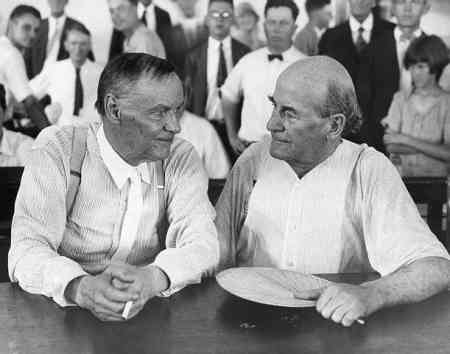
Fundamentalists resent liberals’ smugness.  Fundamentalist intellectuals, especially, have long chafed at their opponents’ equation of conservatism with ignorance and isolation.   In the Scopes Trial of 1925, celebrity anti-evolutionist William Jennings Bryan–former Secretary of State, holder of multiple earned and honorary college degrees–protested that he had met with “kings, emperors, and prominent public men,” but he had never been called an “ignoramus . . . by anyone except an evolutionist.”  Until his dying day, Bryan maintained a protest membership in the staunchly pro-evolution American Association for the Advancement of Science.

Bryan and the man who called Bryan an "ignoramus."This week we have a new articulation of this fundamentalist tradition.  In a scathing piece in this week’s The Weekly Standard, editor Andrew Ferguson tees off on liberal “psychopundits” who use questionable social-science research to prove “that Republicans are heartless and stupid.”

The first of Ferguson’s targets is journalist and academic Thomas Edsall.  In a March article in the New York Times, Edsall summed up a handful of research studies that prove that richer people tend to pooh-pooh poor people’s problems.  Ferguson takes Edsall to task for wrapping his punditry in a hazy gauze of shady research.

Ferguson also attacks writer Chris Mooney.  Not surprisingly, Ferguson was offended by the premise of Mooney’s new book, The Republican Brain: The Science of Why They Deny Science—and Reality.  As with Edsall, Ferguson blasts Mooney’s “wide-eyed acceptance of this social science, no matter how sloppy or ideologically motivated.”

As with other conservative intellectuals, what seems to gall Ferguson the most is the combination of ignorance and intellectual snobbery.  On one hand, liberals, evolutionists, and other anti-fundamentalists lambaste conservatives for attacking “Science.”  On the other, those same anti-fundamentalists often misuse or misunderstand the very science they claim to be supporting.

In the News: Gay Rights, Bullying, and the “Homosexual Agenda”

Thanks again to Charles Haynes of the First Amendment Center for drawing our attention to Missouri’s “Don’t Say Gay” bill.

This bill, Missouri House Bill 2051, would prohibit teachers in public schools from discussing homosexuality with their students.

The impetus for the bill comes from a widespread belief in Fundamentalist America that public schools push what Fundamentalists call a “homosexual agenda.”

Understandably, non-fundamentalists see bills like this as an attempt to limit rights for gay people.  One Missouri activist called this bill “a desperate tactic by frightened, bigoted, cynical individuals who are terrified at the advancement the LGBT community has made.”  Other interweb voices blasted the move as “moronic legislation” by the “elected bullies” in the Missouri legislature.

I agree with the sentiment expressed by these anti-2051 activists.  This Missouri bill, like other bills that seek to control teachers’ ideological performance, promotes a poisonous educational atmosphere in which the best teachers are forced into cynicism or subversion.  Meanwhile, the bulk of public school teachers trudge along in a bland mediocrity, avoiding any topic that might have potential interest or relevance in students’ real lives.

But I wonder if opponents of the Missouri bill understand that the polemic strategy they use actually reinforces the notions of their Fundamentalist opponents.  Here’s what I mean:  The most common defense of discussing sexual orientation openly and frankly in public schools is that such discussions can help limit bullying.  Defenders of the rights of gay people, especially of gay students in schools, point to the dangerous and even fatal bullying of gay students as the threat of gag rules like HB 2051.  To attack HB 2051, gay-rights activists wrap their assertion of rights for homosexuals in the language of a wider, faddish anti-bullying campaign.

In doing so, they confirm the suspicion of anti-gay activists from Fundamentalist America.  Such activists warn of a creeping “homosexual agenda.”  Such an agenda, Fundamentalists warn, focuses on using public schools to promote an idea that all sexual orientations must be considered equal.  A central trait of this “homosexual agenda” in public schools, as this CitizenLink (an offshoot of James Dobson’s Focus on the Family) video emphasizes, is that the homosexual agenda is “sneaky.”  [This video is just under ten minutes long, but well worth the time for those who hope to understand the thinking of Fundamentalist America.]

Fundamentalists warn that homosexual activists will wrap their true agenda in other causes.  And, when gay-rights activists point to bullying as the main reason to oppose 2051, they add more legitimacy to this Fundamentalist claim.

Let me be clear here: I am not in support of 2051.  But arguing that this is a bullying issue, instead of a gay-rights issue, is exactly what Fundamentalist America expects of gay-rights activists.  I suspect a better understanding of Fundamentalist America would allow gay-rights activists to avoid playing into Fundamentalists’ hands in this way.  Using the broader issue of bullying to promote fuller equality in public schools ends up strengthening Fundamentalist arguments, not weakening them.  Equality should be enough.  That is, gay-rights activists and others should keep it simple: Public schools must be places where every student, teacher, parent, staff member, and administrator feels welcomed and valued.  Regardless of race, religion, sexual orientation, gender, or other distinction.  This is sufficient reason to oppose Missouri’s 2051 and similar bills.  Saying that gay students must have equal rights only because they might otherwise be bullied muddies the issue.  It fuels Fundamentalist fears that a “homosexual agenda” is being foisted on public schools, hidden in common anti-bullying campaigns.


Fundamentalist America: A Lock for the GOP?

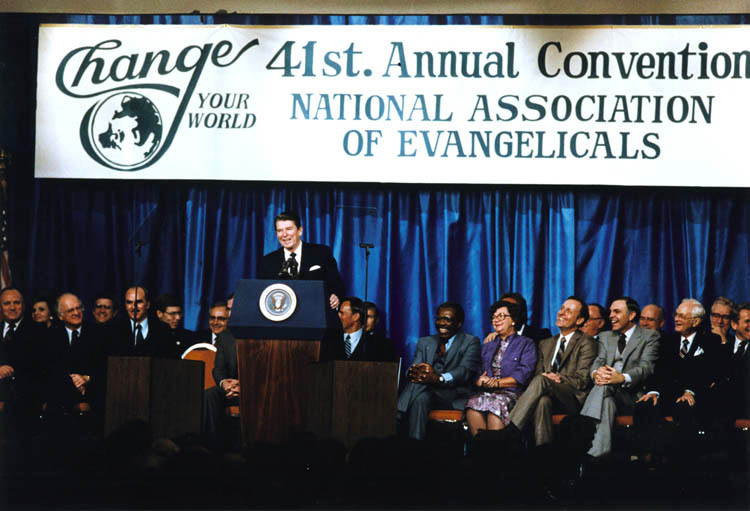
Casual observers might assume that every Fundamentalist vote is a lock for the GOP.  After all, at least since Reagan took the evangelical vote away from the evangelical Jimmy Carter, the Republican Party has cultivated an image as the staunch defender of life, family, and traditional values.

Reagan at the 1983 NAE Convention.


So even though the presumptive GOP nominee is a leader of the LDS Church, it is a general electoral rule of thumb that Bible voters will go for Romney in 2012.

But will they?

An article in this week’s Economist tries to pick apart the “evangelical vote.”  The article offers some interesting numbers.  Here are a few to consider:  in 2008, 65% of (self-identified) white evangelicals called themselves Republicans.  A recent poll put that number at 70%.  Self-identified white evangelicals made up 44% of Republican primary voters in 2008, compared to “over half” in the first 16 GOP primaries in 2012.  That’s a strong vote of support.

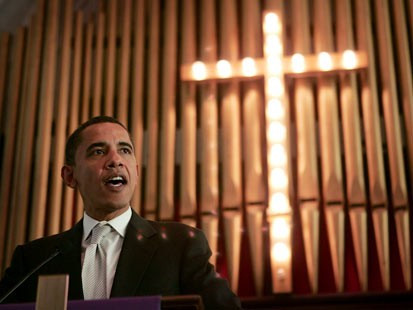
But look at the other side of those numbers.  In 2008, almost one-quarter of evangelical voters voted for Barack Obama.  Part of that support comes from a closer look at the meaning of “evangelical.”  President Obama, according to the Economist article (citing a Pew Research Center poll), enjoys a 93-point lead over Governor Romney among African American voters.  And those voters, after all, include a large percentage who are evangelicals.

The numbers get even dicier when we expand our understanding of “Fundamentalist America” beyond the boundaries of evangelical Protestantism.  Many conservative Catholic voters line up these days with conservative Protestants to vote for a vision of traditional Christian values.  And the conservative Catholic vote includes large numbers of Latino voters.  Such voters may vote for the GOP as the pro-life, pro-family, pro-Jesus party.  But many Latinos might be turned off by the Republicans’ growing support for harsh anti-immigration laws, many of which seem to target Latinos specifically.  As the Economist article points out, President Obama leads Governor Romney by 67% to 27% among surveyed Latino voters.

Could these numbers harken a shake-up of the relationship between Fundamentalist America and the two major parties?  For those who know their history, it would not be the first time.  After all, before the 1980 presidential elections, white evangelicals often portrayed themselves as above party politics.  They claimed to vote for candidates who best embodied the values of Bible-believing America.  And before the 1930s, African American voters reliably voted Republican, the Party of Lincoln.

Could we be on the verge of another party shake-up?  Could the Democratic Party attract young and non-white conservative Christians by appealing to social justice issues?  Could the GOP fumble by alienating non-white Fundamentalists and young social-justice evangelicals?  Even more interesting, could we be on the verge of a vast party realignment, of the kind that has revolutionized party politics a few times in the past?  In the mid-1800s, the new Republican Party built a powerful coalition out of the remnants of the Whig Party, the American Party, and abolitionists.  In the 1930s, the Democratic Party built another blockbuster with a Solid (white) South, urban “ethnic” voters, the union vote, and non-whites.

These powerful electoral coalitions don’t need to be logical.  But a new party that combined today’s Democratic Party’s tradition of social justice, plus the GOP’s tradition of traditional Christian values, could capture this broad middle from Fundamentalist America.

Google Trends and Fundamentalist America

Fundamentalist America is aflutter.  One of Fundamentalism’s favorite sons made a big splash last week.

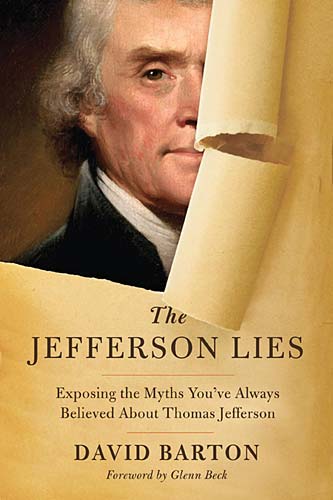
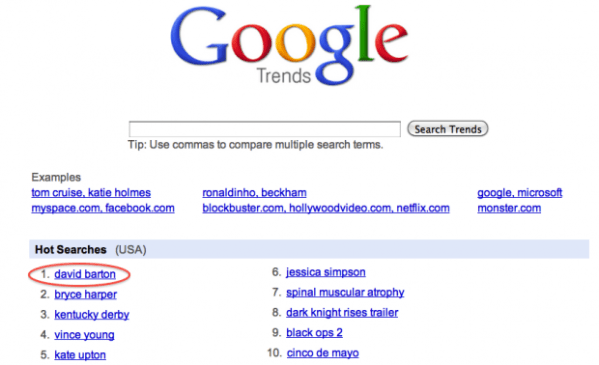
After David Barton’s appearance on Jon Stewart’s Daily Show to promote his new book The Jefferson Lies, the Beckite Blaze reported that the term “David Barton” had surged to number one on the list of trendy Google search terms.

When I followed up, I couldn’t confirm The Blaze‘s claim.  When I checked Google’s “Hot Searches” for May 2, 2012, Barton shows up as number nine.

The experience led to me tinker around a little bit with Google Trends.  Now, I know I need to apologize for my lateness at showing up to this party.  This is yet another example of the way I am far behind the times in finding out about the possibilities of the Google Mothership.

But I want to share a few of the interesting results for those outsiders interested in Fundamentalist America.  First, for those who are as backwards as I am, I’ll explain the premise a little bit.  Google Trends gives users a chance to find out how many people have Googled specific terms over time.  Today (May 5, 2012), many of the hottest search terms concern the recent death of Beastie Boy Adam Yauch.  In general, it seems as if the biggest topics in the daily news tend to attract the most Google searches.

But Google Trends also lets us see what people are googling over time.  If we want to understand what googling Americans are interested in, it gives us a chance to find out.  Now, I won’t make any claims that these results are definitive.  We can’t know very much about the intentions of googlers.  But there are still a few interesting results that I want to share, just to give everyone something to think about.

For example, I checked the trends for terms in tandem and got some interesting results.  For instance, “evolution” has trumped “creationism” by a long sight for the past several years.  On the other hand, comparing the google history of “Bible” and “Origin of Species” shows a huge tilt toward Bible googlers.    And, in the past few years at least, Jesus has almost always been comfortably bigger than the Beatles.  In fact, “Jesus” as a search term has held a comfortable lead over most other topics I could think of, including “David Barton,” “atheism,” and even “cats,” although “cats” seemed to hold its own pretty well.

What does all this tell us about Fundamentalist America?  Not much, really.  But it does demonstrate the enduring popularity of Christian terminology on Google.  Of course, people Google all sorts of different terms for all sorts of reasons.  Are there any other term comparisons that can tell us something about the nature and meaning of life in Fundamentalist America?

Required Reading: Greg Forster and the Hundred Years’ War

At the Witherspoon Institute’s Public Discourse this morning, Greg Forster introduced a three-part series inquiring into the changing relationship between evangelicals and politics in the United States over the past century.  The series, Evangelicals and Politics: The Hundred Years’ War, promises to examine the tense relationship between conservative evangelicals and political life.

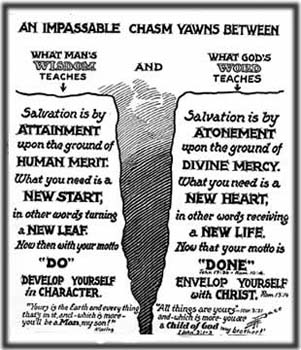
An Impassible Chasm

From EJ Pace, Christian Cartoons, 1922

Forster is deeply sympathetic to the cultural claims of conservative evangelical Protestants.  Though he would likely dispute the label, he writes about what I call Fundamentalist America from deep inside its boundaries.  He works and has worked for a variety of conservative foundations, including the Kern Family Foundation and the Friedman Foundation for Educational Choice.  He has written about the Joy of Calvinism and argued in favor of the marketization of schooling.

In this series, he asserts that evangelical political activism has been a force for good throughout the twentieth century.  “Good citizens,” he notes,
“don’t stand by while their nation is threatened, and evangelical political activity has accomplished much good. Although the rising tide of moral disorder has not been reversed, its progress has been halted in many respects, and forces of renewal are gathering. All of this was made possible largely by evangelical efforts.”

But Forster does not simply present the History of Heroic Fundamentalists.  He takes conservative evangelicals to task for misunderstanding the implications of the Great Schism, the split among Protestants around the turn of the twentieth century between “modernists” and “fundamentalists.”  In Forster’s words:

“Before the schism, America had a longstanding social consensus on how to reconcile religious freedom with public morals: the state would legislate based on the moral consensus of society, but keep its hands off directly confessional issues and try to steer clear of inhibiting diverse religious exercise. Meanwhile, beyond the bounds of state power, America’s leading institutions would be predominantly defined by and loyal to the Protestant view of the world. This strong yet informal Protestant cultural authority would keep the citizenry moral, so the coercive power of the state could be mostly kept out of moral formation in the interests of religious freedom.

“The Protestant schism was the decisive factor that ended the old social order. To be sure, a variety of other factors were already weakening it; for example, the injustices imposed upon Catholics and Jews were becoming steadily harder to ignore. However, the schism destroyed the framework of the social order from within. Protestantism could no longer serve as a moral center of society once no one could say with any confidence what “Protestantism” was.

“But evangelical leaders misunderstood the nature of the threat. They didn’t seem to grasp that the schism had destroyed America’s Protestant cultural consensus. They spoke and acted as though it was still basically sound in the country at large, and was only being challenged by a cabal of liberal secularists who were hijacking America’s culturally leading institutions (especially denominational bodies and universities). In short, they thought of the crisis more in terms of apostasy by a relatively narrow set of leaders than a true schism of the church.

“Because of this misunderstanding, evangelicals turned to politics as a tool for mobilizing social power and cultural influence to wage their battle against the liberal secularists. They expected that politics would give them the power they needed, because elections are based on majority rule and America was still basically a Protestant country.”

Forster’s analysis fits.  In some key “fundamentalist” political battles, conservatives hoped to mobilize the power of the state to support their cultural power.  As I argue in my book Fundamentalism and Education in the Scopes Era, (coming soon in paperback, pre-order now!) 1920s fundamentalists were successful when they mobilized a broad spectrum of Protestant support.  They were less so when they fought against liberal Protestantism.  So, for instance, when they disputed the teaching of evolution in public schools, liberals successfully castigated them as hillbillies and anti-intellectuals.  But when they pressed for laws mandating Bible reading in public schools, they met far less resistance.

I’m looking forward to the rest of Forster’s series.

In the News: Tennessee Two-Step

Tennessee’s lawmakers recently passed a law that—according to supporters—will allow teachers to work with more academic freedom.  It will encourage students, supporters insist, to explore ideas beyond the surface.  Opponents argue that the new law is only a sneak-attack by creationists and intelligent designers.  The law speaks in the language of academic freedom, opponents say, only to mask its true creationist intent.

The law itself claims to want to “help students develop critical thinking skills.”  Since the teaching of “some scientific subjects, including, but not limited to, biological evolution, the chemical origins of life, global warming, and human cloning, can cause controversy,” the law asserts that Tennessee teachers need clarification and assistance in teaching such issues.  The law mandates that school districts allow and encourage teachers to teach such controversial issues.  The law states that “teachers shall be permitted to help students understand, analyze, critique, and review in an objective manner the scientific strengths and scientific weaknesses of existing scientific theories.”  Finally, the new law notes that this law “shall not be construed to promote any religious or non-religious doctrine.”

In presenting the issue as one of academic freedom, Tennessee lawmakers apparently hope to overcome constitutional objections that have overwhelmed other anti-evolution laws.  The inspiration seems to have come from the Discovery Institute, a think tank dedicated to promoting the teaching of intelligent design.  In 2007, the Discovery Institute offered a similar-sounding model Academic Freedom bill.

Tennessee is not the first state to enact such a law.  In 2008 Louisiana lawmakers passed a similar “academic freedom” law.  Even earlier, in 2001, then-Senator Rick Santorum inserted a non-binding note into the No Child Left Behind Act that recommended teaching a full range of ideas whenever “controversial issues” were taught.

The Tennessee law has attracted more than its share of journalistic attention because of the easy connection to the 1925 Scopes trial.  The editors of the New York Times, for example, began their objection to the Tennessee law by intoning, “Eighty-seven years after Tennessee was nationally embarrassed for criminally prosecuting the teaching of evolution, the state government is at it again.”

Nearly all the news coverage of the new law insists on connecting it to the famous 1925 trial.  Coverage in USA Today and the Huffington Post offer a sample of the way every journalist seems obliged to mention Scopes.

However, as perspicacious observers have noted, this new law represents something very different from the 1925 event.  Today’s laws demonstrate a remarkable shift in the strategy and nature of anti-evolution activism.  As Charles Haynes of the First Amendment Center pointed out, today “the curriculum shoe is on the other foot.”

Haynes is right.  The power in public schools has shifted decisively.  Anti-evolution activists today do not try to ban evolution from public schools.  Rather, anti-evolutionists these days struggle to insert wedges into school curricula.  They hope to create opportunities for teachers and students to question the scientific claims of evolution.  At the time of the Scopes trial in 1925, anti-evolutionists had a much different agenda.
In my book Fundamentalism and Education in the Scopes Era, (coming soon in paperback edition, pre-order today!), I explore the ways so-called “anti-evolution” laws in the 1920s included much more than simply the teaching of evolution or creation.  The laws themselves, including Tennessee’s 1925 Butler Act, usually preserved a special role for Protestant theology in public schools.  Other bills considered “anti-evolution” made much more sweeping claims.  In 1924, Representative John W. Summers of Washington successfully inserted an amendment banning “disrespect of the Holy Bible” among Washington D.C. teachers.  In a similar vein, one so-called anti-evolution bill in North Carolina (1927) actually would have banned any teaching that would “contradict the fundamental truth of the Holy Bible.”  A proposed bill in West Virginia cut an even broader swath.  That bill would have banned the teaching of “any nefarious matter in our public schools.”  In Florida, a 1927 bill hoped to prohibit teaching and textbooks that promoted “any theory that denies the existence of God, that denies the divine creation of man, or that teaches atheism or infidelity, or that contains vulgar, obscene, or indecent matter.”

These bills were about more than just prohibiting evolution. They asserted ideological and theological control over public schools.  Public schools, in the vision of these bill’s supporters, ought to do more than just ban evolution.  They ought to be purged of any notion that might challenge the traditional evangelical morality of students.
Today’s laws are also about more than the teaching of evolution, but in a very different way.  Rick Santorum’s non-binding rider to NCLB was more about making a statement about the nature of science, culture, and education than about transforming education.  It didn’t and couldn’t actually change the way teaching happened.  Some observers have suggested that Tennessee’s law will also not change a thing.

But such laws do change something.  For one thing, laws like the ones in Tennessee and Louisiana demonstrate the political power of anti-evolutionism.  These laws show that significant numbers of voters in those states agree with this kind of cultural statement against the claims of mainstream science.  Laws like these also tell us something about the ways schooling is controlled.  If mainstream scientists cannot simply decide what will be the best sort of science education, then we can see that schooling is not simply a neutral institution in which knowledge is disseminated.  Rather, laws like this show clearly that knowledge is political.  Schools do not simply teach what is true.  Schools teach what culture decides children should know.