In the News: Fundamentalist Religion and the “Liberal Media?”

Fundamentalist America has long had a somewhat uncertain relationship with mass media.  On one hand, lots of prominent conservatives make their mark by bashing the biases they see in what they call the “liberal media.”  For a recent example, check out William Kristol’s challenge to the New York Times regarding its treatment of Andrew Breitbart.  On the other hand, conservatives such as Rush Limbaugh, Glenn Beck, and the late Andrew Breitbart himself have relied on their mastery of mass media in order to win whatever influence they may have.

Conservative religious folks usually complain the loudest about media bias.  Two years ago, for instance, a comment by Fox News’ Brit Hume that golfer Tiger Woods ought to embrace Christianity evoked a teapot tempest of discussions about the anti-Christian bias in most media outlets.

Thanks to Walter Russell Mead at Via Meadia, we come across a new study by scholars at the University of Southern California and the University of Akron.  This survey suggests that there may be more to conservative religious folks’ complaints than just Fox News sensationalism.  This study surveyed 2000 media consumers and 800 producers.  Some of the findings seem to confirm an anti-religious bias among most journalists.  More precisely, they seem to confirm a NON-religious bias.  Among the reporters, only 20% described themselves as “very knowledgeable” about religion.  Also, the category of white evangelical Protestants was notably underrepresented among the reporters surveyed.  Reporters tended to feel that the most important part of religion was its impact on politics (48.1%), while fewer media consumers (37.0%) saw that as the most important religious topic.  Also, the general public tended to think there was far too much sensationalism in religious coverage (66.5%), as opposed to reporters (29.8%).

The survey broke down media producers into categories including “Focused,” “Frequent,” “Infrequent,” and “Non-producers” of religion coverage.  In terms of religious identity, only a small minority of the reporters surveyed (5.1%) called themselves white evangelical Protestants, compared to 20.8% white Catholic, 34.9% white mainline Protestant, and 12.8% unaffiliated.  This doesn’t match the percentage of the general population.  According to the Pew Forum on Religion and Public Life, evangelicals make up just over a quarter of the US population.  If we look a little closer, even among the self-identified white evangelical Protestant reporters, there is a distinct skew toward religious coverage.  White evangelicals made up just over 16% of the “focused” religion reporters, and only 2.1% of the “non-producers.”

What does it all mean?  First of all, as with any such survey, the results mustn’t be overdone.  The fact that a minority of journalists who took part in this survey called themselves “very knowledgeable” about religion doesn’t mean that they are biased against religion, much less against a certain type of religion.  But the fact that white evangelical Protestants are notably underrepresented among this sample suggests that there is a trend among reporters away from evangelical Protestantism.  Especially when the responses are broken out into more detail.  Even among the small minority of evangelical reporters, the percentage of such reporters who are not specifically focused on religious issues shrinks to near-nothingness.  One way to look at this might be to think that evangelicals—when they become journalists at all—tend to restrict themselves to specifically religious issues.  Just as with other minority groups, evangelical reporters might find themselves pigeonholed into just one aspect of their public identity.  In this case, evangelical reporters might be considered to be legitimate only for reporting on religious issues, not for sports, education, politics, or foreign affairs.
Does it mean that the “mainstream media” are unfair to Fundamentalist America?  From this limited evidence, of course, it’s impossible to say for sure.  However, this survey does suggest that reporters tend to look different from the rest of America.  They tend to be less knowledgeable about religious traditions than the rest of America. They tend to be less interested in spirituality than the rest of America.  And they tend to be less often from a white evangelical Protestant background than the rest of America.

As with any sort of bias, it is much easier to be inadvertently biased about groups different from ourselves.  It is even easier to be biased when we know very little about such groups.

Fundamentalist America complains that most reporters don’t “get” them.  This study seems to support that complaint.
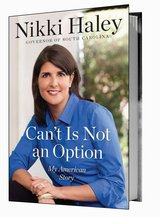
Governor Haley and the Changing Face of Fundamentalist America

Governor Nikki Haley of South Carolina has a new book out.  The cutely titled Can’t Is Not an Option may be a bald-faced bid for the 2012 Republican vice-presidential nomination, but it can also tell us something about the ways Fundamentalist America is changing.  The book itself sounds sugary, but Haley’s personal story is compelling.

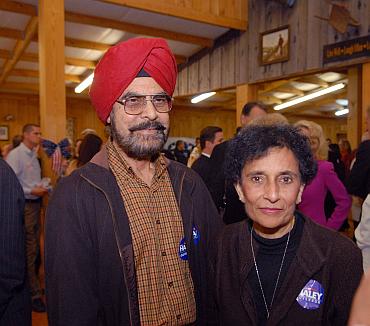
Haley is an Indian-American child of immigrants.  The fact that a dark-skinned female politician whose father wears a turban can succeed as a conservative Republican politician in a state known for racism and evangelical Protestantism means a lot. 

Haley joins a small but growing list of non-white conservative heavy hitters: businessman/politician Herman Cainwriter Dinesh D’Souza, politicians Bobby Jindall and Allen West, and jurist Clarence Thomas, among others.  Such a showing, especially among African Americans, makes a good deal of sense from a fundamentalist perspective.

Conservative intellectuals, notably those at the Heritage Foundation, have made a concerted strategic effort to overcome fundamentalism’s traditional connection to white supremacist ideology.

But although it may make strategic sense, it is a tall order politically.  African Americans have been tightly linked to the Democratic Party since the 1930s.  Before that, African American voters stuck just as close to the Republican Party, the Party of Lincoln.  For most of American history, the vortex of race and race consciousness has overwhelmed all other identity issues, pushing most African Americans to vote first as African Americans, and only second as conservatives, liberals, secularists, religious, etc.

But beyond party politics, African Americans tend toward a deep fundamentalism.  Gallup polls consistently demonstrate this.  For example, one 2005 poll showed that about seven in ten African Americans called themselves “evangelical” or “born again” Christians.  African Americans, according to a 1999 Gallup/CNN/USA Today poll are significantly more likely (85%) to support school prayer than are whites (69%).  This conservative religiosity among African Americans has influenced cultural attitudes among African American young people as well.  A 2002 poll found that only 8% of African American teens say they drink alcohol, compared to 25% of white teens, likely due to higher rates of conservative religiosity.  Among non-whites in general, according to a 2003 poll, only 52% think that premarital sex is morally acceptable, compared to 59% of whites.

Race is a tough issue for fundamentalists.  There are plenty of fundamentalist whites who seem to cling to traditionalism in their white supremacist ideology, just as they cling to traditionalism in religion, education, and culture.  But non-whites, in large majorities, are fundamentalists in everything except party politics.  If more non-whites like Nikki Haley continue to emphasize their cultural conservatism, and if they tie that cultural conservatism to political conservatism, then more and more non-whites may continue to embrace all the meanings of Fundamentalism.

In the News: Tebow in Fundamentalist New York

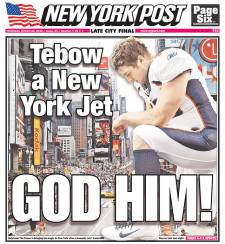
I know I’m not alone in hoping for some kind of Tim Tebow media blackout.  I was hoping the end of the football season, especially with the Broncos’ defeat, would bring some quiet to the Tebow-as-Christian-in-a-strange-land stories.  But Tebow’s move to the New York Jets brought a new round of media focus on Tebow’s style of loud public Christian-ness.
IMHO, the most interesting comment on the Tebow move came from Paul Moses at dotCommonweal.  Moses noted that the New York press tended to gasp at the incongruity of an extravagantly Christian celebrity in the extravagantly pagan Big Apple.

Moses pointed out,

The Times put it this way: “Tebow is also a somewhat incongruous fit: an outspoken Christian playing  in a city known for its extensive night life and a member of a  franchise made famous by the bachelor stylings of Joe Namath and  currently known for the profane speeches of its coach, Rex Ryan.”

And this, from the National Enquirer: “It is unclear how the pie-eyed pundit of the pigskin will respond to the multitude of temptations New York has to offer.”

Moses took such papers to task for assuming too much about life in New York City.  New Yorkers are a decidedly religious group.  Moses cited a Gallup poll from 1991 in which a majority of respondents–53%–said they prayed at least once a day.  The problem, Moses claimed, is that too many people equate Manhattan with the entirety of New York City.  In Manhattan, 17% of poll respondents claimed to be atheists.  In the Bronx, that number dwindled to 1%.

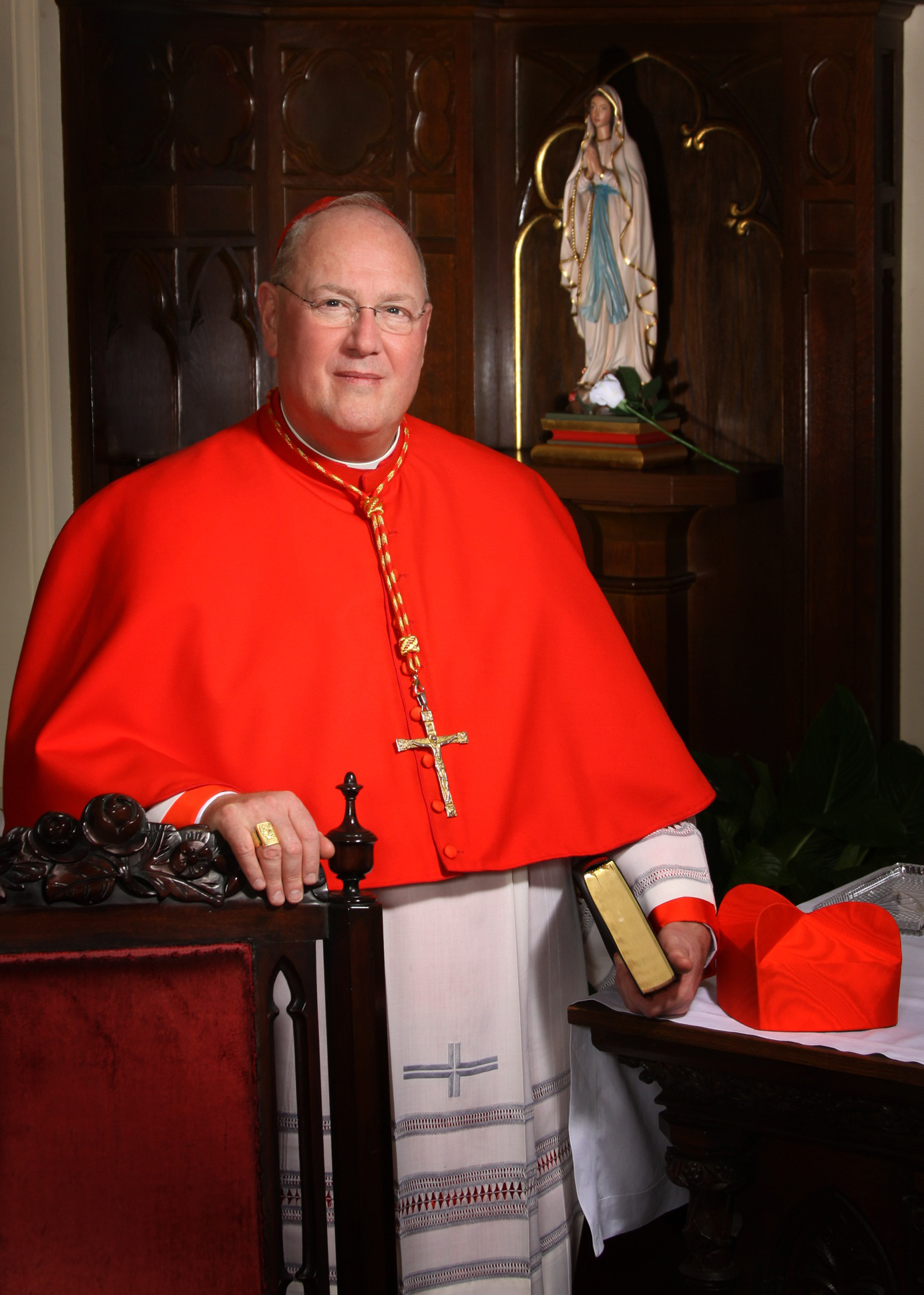
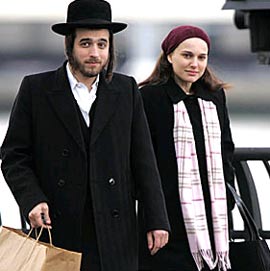
As we’ve pointed out here before, people who do not know much about Fundamentalist America often assume that religiosity goes up only with distance from big cities, education, and indoor plumbing.  It is just not true.  The myth might come from the association in the United States of conservative evangelical Protestantism with conservative religion as a whole.  But if we look at other conservative religious folks, New York City has as much of a claim to fundamentalism as anywhere else.  In the Catholic Church, for example, New York City is now home to genial Archbishop Timothy Dolan.  Dolan’s blog and very public presence inject a strain of conservative religiosity into life in the Big Apple.  And, of course, outside of Christianity, New York City is host to innumerable conservative religious groups.  The old joke about the hayseed who comes to New York and is surprised by the number of “New York Amish” demonstrates that New York has its own profound tradition of deeply conservative culture and theology.

Even within the bounds of conservative Protestantism, large urban areas have always served as strongholds.  True, someone wanting a Protestant fundamentalist education could go to Bob Jones University in lovely Greenville, South Carolina.  Or she could go to Liberty University in Lynchburg, Virginia.  But she could also head to Los Angeles to Biola University, or to Chicago’s Moody Bible Institute or Wheaton College.

The roots of this commonly held misperception, I think, come from the utter dominance of conservative evangelical Protestantism in some rural areas.  When folks from the big city drive around in fly-over country, they are shocked by the public dominance of this type of fundamentalism.  But such folks ought to look closer at their own cities.  Look for storefront Pentecostal churches.  Look for big cathedrals.  Look beyond the stereotypes of cities as home only to nightlife and paganism, and you’ll notice a deeply religious urban America.

There might be a few translation difficulties as Tebow  moves from the Bible Belt to the Big Apple, but there will not be any lack of fundamentalists ready to greet Tebow as he (if he?) makes his New York Jets debut.

IN THE NEWS: Ignorance or Disdain? Fundamentalists, Science, and Alternative Intellectual Institutions

The folks at Scienceblog recently reviewed the findings of Gordon Gauchat, a postdoctoral fellow at University of North Carolina.  In his study, Gauchat found that Americans who self-identify as conservatives trust “science” less in 2010 than conservatives did in 1974.  In contrast, self-identified liberals and moderates kept a stable attitude toward “science” during that period.

So what do these findings tell us?  On first glance, it might seem as if conservatives simply don’t like science.  After all, we’ve seen a rush to denigrate climate-change science and evolution among 2012’s Republican Presidential candidates.  This confirms some culture-war stereotypes, which paint Fundamentalist America as the hillbilly redoubt of Nascar, meth labs, married cousins, and a hatred for all forms of higher learning.

But the study needs a second look.  The level of respondents’ education had an inverse relationship to their reported trust of “science.”  That is, conservatives who had more education tended to trust science less.  This is not about anti-intellectualism or anti-science, at least not as such.

Let me suggest an historical analogy.  I’m not sure if it’s got legs, but I think it’s worth thinking about if we want to understand the phenomenon of educated conservatives maligning “science.”

In the Glory Days of American liberalism, a deep distrust of the cultural and political establishment took hold among the well-educated Left.  With the founding of the Students for a Democratic Society in 1962, some of the best-educated young people in the country announced their disdain for the establishment world of universities, governments, and research centers.  These earnest, intelligent young leftists would have responded to a survey that they did not trust mainstream intellectuals.  As they agreed in their 1962 Port Huron Statement, SDS disdained academic culture. They attacked their “professors and administrators,” as tools of The Man who

“sacrifice controversy to public relations; their curriculums change more slowly than the living events of the world; their skills and silence are purchased by investors in the arms race; passion is called unscholastic.”

Did this disdain for the culture of higher education mean that the intellectuals of SDS were anti-intellectual?  No, what it signaled was an active disdain for the dominant culture of American higher education.

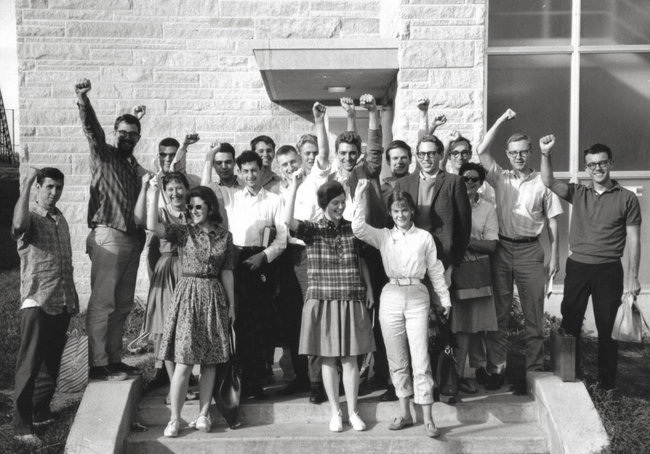
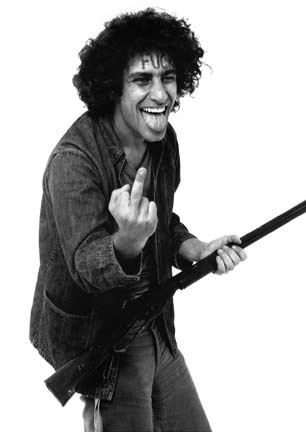
In less than a decade, this anti-establishment impulse among well-educated young leftists had careened down a startling path and mutated into a very different animal.  By 1970, the scattered remnants of SDS had resorted to bombing the Pentagon, army bases, and—accidentally—themselves.  Leftist disdain for the establishment had morphed from the smiling, fist-shaking intellectualism of the 1963 SDS meeting pictured above into the gleeful nihilism of Abbie Hoffman pictured below.

So what might this analogy tell us about the feelings of today’s conservatives and fundamentalists about mainstream science?  For one thing, it suggests that the proper term here is not “ignorance,” but “disdain.”  Well-educated American fundamentalists are not ignorant about mainstream science, but they feel a deep disdain for it.  That disdain has increased in the last generation as alternative intellectual institutions have propagated an anti-establishment culture.

Other studies have supported this intuition.  As we reviewed here recently, Jonathan Haidt’s Righteous Mind included a survey of 2000 respondents.  In this study, self-identified conservatives and moderates were very good at predicting the moral responses of liberals.  Self-identified liberals, on the other hand, could not guess what conservatives might say.  This suggests that Fundamentalist America is well aware of what liberals think, but liberals have allowed themselves to become ignorant of other intellectual options.

Let’s return to our analogy to see if it helps explain this phenomenon.  If fundamentalists in 2010 share the disdain for mainstream intellectual culture that was espoused by well-educated young leftists in the early 1960s, what might be the results?

In the case of the Left, this divorce from academic culture was merely a trial separation.  Most of the student radicals of the 1960s and 1970s ended up the boring center-leftists of the 1990s.  The academically inclined among them founded or joined friendly academic centers hoping to eliminate racism or poverty or war.  The more talented and lucky managed to open new fields of study and press for new visions of education, promoting successful “ethnic studies” programs and multicultural education initiatives.  For a small minority of 1960s/70s leftists, those who followed the logic of anti-establishment culture to its bitter 1970s conclusion, this meant increasingly bizarre forms of dress and behavior, meant to signal distance from the establishment.  For a tiny fraction, this meant political and cultural violence, such as bombs at the Pentagon and Days of Rage.

What will it mean for fundamentalists?  If the historical analogy holds any weight, this distancing between mainstream science and fundamentalists will lead a small fringe on the Right to continue its violent campaign against America.  Like the violent Weather Underground, some fundamentalists will likely follow the logic of separation from mainstream culture to a violent conclusion.  But for the overwhelming majority of conservatives and fundamentalists, if the historical analogy holds any weight, it will mean the continuation of a trend toward alternative intellectual institutions.  Many conservative and fundamentalist intellectual types will find congenial homes in the widening world of the academy and private foundations/think-tanks.  Since the 1970s, indeed, we have seen a proliferation of conservative think tanks and foundations, such as the Heritage Foundation.  In recent years, these conservative alternative intellectual centers have offered well-educated fundamentalists a happy home in which to continue their intellectual work while continuing to feel a deep disdain for mainstream intellectual culture.  In some cases, this has included a disdain for mainstream science.  For example, a new intellectual center at Biola University, the Center for Christian Thought has promised to offer

“scholars from a variety of Christian perspectives a unique opportunity to work collaboratively on a selected theme. Together, they develop their ideas, refine their thinking, and examine important cultural issues in a way that is informed by Scripture. Ultimately, the collaborative work will result in scholarly and popular-level materials, providing the broader culture with thoughtful and carefully articulated Christian perspectives on current events, ethical concerns, and social trends.”

Just as the 1970s witnessed a huge increase in Left-friendly academic centers and fields of study, so this widening cultural distance between educated fundamentalists and mainstream science and academic life should lead to an increase in fundamentalist-friendly academic centers like this one.  It will lead to a deepening division between types of well-educated people; it will force Americans to confront their notions that there is one “correct” version of science and intellectualism.

***Thanks for the reference to Tim Lacy at USIH  ***

Bible in America: RAH interview with Robert Alter

Fundamentalists don’t always make the best historians.  American fundamentalists tend to insist on an American past that is far too rosy.  When she was still an up-and-coming Presidential nomination contender, for example, Michele Bachmann insisted that the Founding Fathers had “worked tirelessly” to end slavery.   Though she later tacked away from her statement, noting that she meant John Quincy Adams, it doesn’t take a slanted leftist historical perspective to notice that her claim is just not true.  The Founding Fathers may have accomplished a good deal.  Some of them may even have tried to improve the conditions of slaves, or to hurry the day when human chattel slavery would be abolished.  But overall, the issue of slavery was one that the Founders explicitly pushed off on a later generation.

However, as we’ve noted here in the past, one of the historical claims of fundamentalists in America lines up more neatly with the findings of non-fundamentalist academics.  On the Religion in American History blog, Randall Stephens recently interviewed scholar Robert Alter about his newish book, Pen of Iron: American Prose and the King James Bible.

Alter’s book is focused on the ways Biblical themes and language infuse American literature and culture.  In the RAH interview, he makes the point that American culture in the past was thoroughly Biblicized:

“In nineteenth-century Protestant America, the Bible, almost always in the King James Version, was a constant companion for most people. They not only heard it in church, but very often it was regularly read out loud in the family circle at home.”

Fundamentalists often make the case that America is and should remain a Christian, Biblical society.  They insist on a vision of American history in which early European settlers and Founding Fathers planned to create a Christian Nation.  (For the leading example of these kinds of arguments, check out David Barton’s Wallbuilders articles.)

Academic historians have noted that these historical claims must be treated carefully.  John Fea, for instance, has argued that there was indeed a good deal of Christian intent among the founding generation, but this is often used by activists in unfair and ahistoric ways.

However, it is only fair to notice that in some cases, the vision of the past promoted by fundamentalist activists lines up neatly with that of non-fundamentalist scholars.  According to Robert Alter, at least, American culture in the past really was thoroughly infused with the KJV Bible.


Another Fundamentalist Mystery: Protestants and Rick Santorum

We asked recently why there seems to be so little anguish among conservative Protestants over the fact that there are no Protestants on today’s US Supreme Court.

The 2012 Republican Presidential primaries have raised a similar question: Why do today’s conservative Protestants seem to love the Catholic candidate Rick Santorum?

Political scientist Matthew Franck pondered this question this week.  Franck identifies as a conservative Catholic who has lived and taught for years in a region dominated by conservative evangelical Protestants.  Franck asks:

So what’s up with the victories of Rick Santorum, a western Pennsylvania Italian Catholic, in two states, Alabama and Mississippi, where upwards of four in five voters described themselves in exit polls as evangelical or “born-again” Christians?  Although the New York Times’ Bill Keller famously misidentified Santorum last year as an evangelical, these voters know better.  They knew going to the polls Tuesday that they could choose the LDS Mitt Romney, the Lutheran-turned-Baptist-turned-Catholic Newt Gingrich, or the lifelong Catholic Rick Santorum.

Franck notes the novelty of this situation:

The first observation to make about the role of religion in these two deep-south states, then, is that three non-evangelical candidates all did respectably well in a heavily evangelical (and conservative) electorate.  Each of the candidates topped 30 percent of the vote.  Just a half century ago, John F. Kennedy had to go to Houston to make a case to Baptist ministers that a Catholic deserved a shot at the presidency.  (Some Catholics, then and now, think JFK surrendered too much of his faith to mollify his critics.)  Only four years ago Mitt Romney felt similarly compelled to reassure voters that a member of the Church of Jesus Christ of Latter-day Saints deserved a fair chance as well.  Now in 2012, we seem past all that.

Just as many conservative Protestants care more about the politics of US Supreme Court justices, especially on social issues such as abortion, gay marriage, and the role of religion in the public square, Franck concludes that Protestant fundamentalists are judging the current crop of Republican Presidential contenders more on their positions than their faith backgrounds:

For better or worse, Santorum is widely known as the “social issues” conservative in this race, the consistent defender of life, of marriage and family, and (as he himself put it last night) of the “centrality of faith” in many Americans’ lives.  Look at how strongly he did among voters who think a candidate’s “moral character” matters most, and you get the picture.

If Franck is correct–and his conclusion makes intuitive sense to me–it tells us a lot about the changing nature of Fundamentalist America.  It seems to confirm James Davison Hunter’s 1992 thesis in Culture Wars.  In that book, Hunter argued that creed and denomination had come to mean less than the divide  between orthodoxy and progressivism.  That is, the old divisions between Catholic, Protestant, and Jew had eroded, replaced by a split between conservative and liberal factions within each faith.  Along with the deafening silence among conservative Protestants about the current makeup of the US Supreme Court, the non-issue of Santorum’s Catholic faith among conservative Protestants certainly seems to confirm Hunter’s argument.

IN THE NEWS: Arizona Fights the Cult of Multiculturalism

In today’s New York Times, you’ll find an update on Arizona’s remarkable effort to purge its schools of what educational traditionalists might call “The Cult of Multiculturalism.”  We’ve written about traditionalist objections to multicultural ideology here, here, and here.  Arizona’s law makes these theoretic objections legally enforceable.

Today’s article focuses on the dispute between the state and the Tucson school district.  Since January 1st, the school district has been ordered to enforce Arizona’s 2010 law.  According to the Huffington Post, Judge Lewis Kowal agreed with the state in late December that Tucson’s Mexican-Studies curriculum was guilty of “actively presenting material in a biased, political and emotionally charged manner.”

The law itself, passed two years ago, declared that no school curricula in Arizona could legally

  • Promote the overthrow of the United States government.
  • Promote resentment toward a race or class of people.
  • Are designed primarily for pupils of a particular ethnic group.
  • Advocate ethnic solidarity instead of the treatment of pupils as individuals.

The state superintendent of education at the time, Tom Horne, planned an energetic enforcement of the law.  According to a Fox News story, Horne declared in 2010,

Traditionally, the American public school system has brought together students from different backgrounds and taught them to be Americans and to treat each other as individuals, and not on the basis of their ethnic backgrounds.  This is consistent with the fundamental American value that we are all individuals, not exemplars of whatever ethnic groups we were born into. Ethnic studies programs teach the opposite, and are designed to promote ethnic chauvinism.

In today’s New York Times story, John Huppenthal, the new state superintendent of public instruction, told a reporter he viewed the enforcement of the law as a war.  Quoth Huppenthal, “This is the eternal battle, the eternal battle of all time, the forces of collectivism against the forces of individuality.”

We can’t help but wonder what Arthur Schlesinger Jr. would make of this law.  In his 1998 book The Disuniting of America the eminent historian denounced the “cult of ethnicity [that] has arisen both among non-Anglo whites and among nonwhite minorities to denounce the goal of assimilation, to challenge the concept of ‘one people,’ and to protect, promote, and perpetuate separate ethnic and racial communities.”

But in Arizona’s case, the fight against the tendency of multicultural education to promote what Schlesinger called the “fragmentation, resegregation, and tribalization of American life” has included some ideologically extraneous elements and politically unpalatable images.

First of all, the law itself targets not only ethnic-studies classes, but includes a remarkably broad shot at any schooling that “promote[s] the overthrow of the United States government.”  This boilerplate antiradical language would feel entirely at home in earlier generations of legislative attempts to control schooling.  In the 1920s, for example, the bundle of state laws that were generally called “anti-evolution” actually had a much broader goal.  They hoped not only to ban evolution but to assert traditional Protestant control of public schooling.  As I argued in my book Fundamentalism and Education in the Scopes Era, school laws with these limitless mandates are more of a cultural statement than a practical attempt at crafting educational policy.

For example, a law passed by the US Congress in 1924 prohibited teachers in Washington DC from any teaching that smacked “of partisan politics, disrespect for the Holy Bible, or that ours is an inferior form of government.”  The goal was more a statement of support for traditional values than to regulate school policy.  Arizona’s inclusion of a clause banning anti-US-ism seems similarly vague and symbolic.

Also, as Arizona state superintendent of public instruction John Huppenthal made clear, this law is part of a broader political and cultural effort to battle not only multiculturalism, but any perceived victory by “the forces of collectivism.”  Not only does this bundle the Arizona law into a broader package of anti-leftist activism, but it also reflects the simple political partisanship behind Arizona’s efforts.

Part of the energy behind the 2010 law came from a perceived effort by Democratic activists to use ethnic-studies programs as a way to turn Latinos against the Republican Party.  One of the reasons for the law was Republican outrage about a speech at Tucson High School by activist Dolores Huerta in which she assured students, “Republicans Hate Latinos.”

Republican lawmakers have united behind this school law as more than a way to keep schools from teaching what Schlesinger denounced as the “cult of ethnicity.”  They also see the programs as part of a deliberate partisan effort to undermine their influence with Latino voters.

However, their efforts might do more to undermine that influence than any ethnic-studies programs ever could.  It doesn’t take a political genius to see the electoral damage that might result from the image of school administrators going into classrooms in Tucson collecting copies of seven prohibited books.  Such stormtrooper tactics to save children from the likes of Paolo Friere’s Pedagogy of the Oppressed  and F. Arturo Rosales’ Chicano! The History of the Mexican-American Civil Rights Movement spell political suicide.

I imagine that Schlesinger and others who oppose the ideological overreach of multiculturalist education might recoil from these heavy-handed partisan attempts to control Tucson’s schools.  Such critics of multiculturalism, I imagine, would hope that the effort to ban aggressive assertions of the “cult of ethnicity” must only limit itself to the realm of ideas, not to knee-jerk partisan politics and twenty-first century book burnings.

A Fundamentalist Mystery: Protestants and the Supreme Court

Why aren’t conservative Protestants more interested in the religious makeup of today’s US Supreme Court?  Today’s Court is made up of six Catholics (Scalia, Thomas, Roberts, Kennedy, Alito, Sotomayor) and three Jewish members (Breyer, Ginsburg, Kagan).  Fundamentalist Protestants are intensely interested in the Court, since it has turned into the government agency most closely associated with ultimate decisions about abortion, gay rights, and religion in the public square.  At nearly any other time in American history, the notion that once-dominant Protestantism wouldn’t even have a representative on the Court would have sparked ugly and angry denunciations of the Court’s legitimacy.  Today, I don’t hear much about it.  Just before the most recent new justice, Elena Kagan, was nominated, a Gallup poll asked respondents if they cared if the new judge was Protestant. Only 7% of respondents thought it was “essential.”  This indifference is puzzling.  Is it simply due to the fact that the cultural animosity between Protestants, Jews, and Catholics has been overcome by other cultural identities?  This was James Davison Hunter’s thesis in his 1992 book Culture Wars.  He argued that the differences between groups had diminished, in favor of a more important distinction between orthodox and progressive variants of each individual group.  One of contemporary evangelicalism’s premier evangelicals agreed.  In a 2010 article in the evangelical magazine Christianity Today, historian Mark Noll noted that evangelicals have given “intense” support to the nomination of conservative religious justices, even when those justices were Catholic.  More decidedly fundamentalist Protestant intellectuals agreed.  Mathew Staver, dean of the Liberty University law school, noted in the same CT article, “I don’t think a person’s religious affiliation matters as much as their judicial philosophy.”

It makes sense.  But anyone familiar with the bitter twentieth-century hostility of many conservative Protestants to Catholicism might find this explanation a little too pat.  Has it really dissipated to such a remarkable extent?  Are there other likely explanations for the deafening silence among America’s Protestant fundamentalists on this issue?

In the News: A Fundamentalist Epistemology?

The New York Times yesterday ran some excerpts from a discussion on its philosophy series, The Stone.

ILYBYGTH readers should check out the exchange, since it is one of the few recent forums in which the issue of creation/evolution is given a respectful, intelligent back-and-forth.  It also centers on the notions of a Biblical understanding of knowledge.

In this dialogue, philosopher Michael P. Lynch and physicist Alan Sokal discuss the reasons why there has been no simple cut-and-dried solution to the creation/evolution debates.  In this snippet, Lynch insists–correctly in my opinion–that the issue is not really the science of evolution, but rather the source of epistemic first principles.  That is, how do we come to know something?  Fundamentalists will insist that the first source of knowledge must be Holy Scripture.  If we “know” something that contradicts the Bible, we can’t really “know” it, any more than we can “know” that a dog is a cat.  The reason for the evolution/creation “stalemate,” Lynch argues, is that the arguments have simply circled round and round one another, each arguing convincingly from its own perspective.

In response, Sokal offers what seems to me to be a very concise and cogent explanation of the non-fundamentalist position.  Fundamentalists, he argues, DO share the epistemic principles of non-fundamentalists, except for a few irrationally privileged categories.  Here’s a snippet from Sokal:

The trouble is not that fundamentalist Christians reject our core epistemic principles; on the contrary, they accept them. The trouble is that they supplement the ordinary epistemic principles that we all adopt in everyday life — the ones that we would use, for instance, when serving on jury duty — with additional principles like “This particular book always tells the infallible truth.”

But then we have a right to inquire about the compatibility of this special epistemic principle with the other, general, epistemic principles that they and we share. Why this particular book? Especially, why this particular book in view of the overwhelming evidence collected by scholars (employing the general epistemic principles that we all share) that it was written many decades after the events it purports to describe, by people who not only were not eyewitnesses but who also lived in a different country and spoke a different language, who recorded stories that had been told and retold many times orally, and so on. Indeed, how can one possibly consider this particular book to be infallible, given the many internal contradictions within it?

Lynch responds with a defense that might hearten intellectual fundamentalists.  Here is just a small selection:

The second reason we can’t rest content with the fact that some principles are widely shared is that some debates are over the priority of principles. Some people reject the idea that scientific reasoning should always trump more traditional methods of knowledge. Thus, believers in creationism typically don’t deny induction and abduction (coming up with the best explanation of the data) full stop. Rather they deny that these principles have priority everywhere. Imagine, for example, a dispute over these two principles:

(A) Abduction from the fossil and physical record is the only method for knowing about the distant past.

(H) Consultation of the holy book is the best method for knowing about the distant past.

The friends of (H) aren’t rejecting abduction outright: they are merely asserting that in some situations abduction is trumped by the more fundamental principle (H). So we can’t just call them out for using abduction in some cases and not in others. And obviously, we can’t travel back in time and use observation (another commonly shared method) to settle who is right and who isn’t about the distant past. What that shows is that debates over even very specific principles like these can end up grounding out — either the participants will end up defending their favored principles by appealing to those very principles (citing the book to defend the book) or appealing to other specific principles that the other side shares but gives a lower priority. So shared “natural instincts” and methods can’t always win the day, simply because the problem isn’t always about what is in common. The problem is about what trumps what.

The root cause of the discussion is whether or not there is a distinctive fundamentalist epistemology.  Lynch defends the notion (without embracing or defending the claims of that epistemology), while Sokal dismisses it.  In other words, is the fundamentalist, Bible-centric understanding of human knowledge a legitimately different way of knowing about humanity and the universe?  Or is it simply an overly complicated apologetic?  That is, do fundamentalists merely claim to have a different way of knowing when it suits their theological needs?


IN THE NEWS: Santorum and Satan

We’ve argued here before that anyone who wants to understand Fundamentalist America should keep an eye on Rick Santorum.  During this year’s Republican presidential primaries, Santorum keeps singing in the key of Fundamentalism.

Recently, Santorum attracted criticism for some comments in 2008 about the dangers posed to Americans by none other than Satan himself.  The Drudge Report, for instance, posted a snarky expose of Santorum’s Satan comments.


However, as David Kuo and Patton Dodd pointed out in the Washington Post, Santorum’s notion of a literal devil is shared by the overwhelming majority of Americans.  They cite a 2007 Gallup poll in which 70% of respondents agreed that Satan was real.

Once again, as with other Fundamentalist notions such as a young earth, non-Fundamentalist Americans might be shocked and dismayed by this level of popular belief.  But lots of the usual critiques don’t really fit.  Please don’t misunderstand: this is not a defense of Rick Santorum’s politics or even of his Satan speech.  As Kuo and Dodd argue, there is plenty to disagree with in Santorum’s 2008 speech as with his politics in general.  But calling Santorum’s evocation of Satan “out of touch,” “ignorant,” “medieval,” or any of the other standard epithets only reveals the ignorance of the accuser.  The existence of a literal, threatening, scheming, embodied Satan is one that most Americans these days share.  More than that, it is a belief that billions of humans in different cultures and different eras have held.  We certainly don’t need to believe it.  But to dismiss it out of hand reveals an embarrassing ignorance of not only Fundamentalist America, but of the nature of humanity more broadly.

As Kuo and Dodd conclude:

[Santorum’s] acknowledgment of embodied evil—particularly in a room filled with his fellow believers—was completely un-extraordinary. What’s extraordinary is the current fainting couch response from American pundits left and right.