If You Don’t Like It, Get Out: Hasidim and Schooling in Rockland County

“The hand that writes the paycheck rules the school.”

That was the line of William Jennings Bryan in the 1920s.  As I describe in my 1920s book, the conservative Presbyterian leader hoped to purge American public schools of theologically suspect notions, especially evolution and atheism.

Almost a century later, we can see a case in which religious conservatives have put this saying into action.

But William Jennings Bryan would have been surprised.  The conservatives in this case are not Protestants, but Hasidic Jews.

Journalist Benjamin Wallace-Wells offers a spellbinding account of the takeover of the public-school system in Rockland County, New York by Hasidic Jews.  Over the past several years, the ultra-orthodox Jewish sect has moved in large numbers into towns such as Ramapo.  Members of the community have used their demographic dominance to win control over the East Ramapo school board.  Since community members send their children to private schools, the school board has shifted funding from those public schools to private yeshivas, most commonly in the forms of special-education services.  Public-school funding has also been cut to the bone and beyond.

Public school students, Wallace-Wells describes, often have a hard time filling their schedules, since so many teachers have been laid off.  When non-Hasidic parents and activists complain, the president of the school board has a simple message: “You don’t like it?  Find another place to live.”

According to Wallace-Wells, the origins of the public-school takeover came from the unlikely field of special education.  Hasidic parents noticed that many of their children needed special-education services.  Yet they could not—for religious reasons—attend the pluralist public schools where such services were provided.  As a result, the Hasidic community won spots on the school board.  That school board then allowed students with special-education needs to receive needed services at private religious schools.

Many of the foes of conservative educational activism and policy worry about a “fundamentalist takeover” of public education.  What would it mean if conservatives won control of public schools?  In this fascinating essay we can see one example of conservative takeover in action.


Testing, Testing, 1, 2, 3…

Some conservative commentators these days swing school tests around like bludgeons.  Testing and more testing is often the conservative answer to school woes.

William J. Reese reminds us that school testing has a much longer history than most of today’s school culture warriors tend to recognize. (Full disclosure: Bill was my PhD director and is still a good friend.  But I’d still want everyone to buy his book even if I didn’t know the guy.)

testing wars in the public schools

Get your copy today!

In an op-ed in this morning’s New York Times, Reese offers a reminder from his new book that testing wars have a history as old as public education itself.

In the 1840s, it was the conservative side that opposed standardized, written tests, according to Reese.  Progressive reformers such as Horace Mann hoped to undermine the power and authority of stuffy school masters.  Traditionally, those masters administered oral exams to each student.  Reformers claimed written tests could abolish prejudice and subjectivity.  Written tests, progressives promised, would shake the cobwebs out of conservatives’ school power.

To be fair, there are plenty of thoughtful conservatives around today who echo this nineteenth-century anti-testing conservatism.  But we still often think of testing as a typically conservative notion.  Those tests, after all, are often sold as a way to hold left-leaning teachers’ unions’ feet to the fire.  Bill’s essay and book remind us that testing itself has long been used as a club to beat up conservative education curmudgeons.


So ARE Colleges Liberal?

H/T: Andrew Hartman

Among some conservatives, it is a simple truism that American colleges have swerved dangerously to the left.  But have they?

We’ve reported lately on news from the National Association of Scholars, who reported that universities had been taken over by liberal bias.  And news from Colorado, where conservative politicians pushed a program to bring a real live conservative scholar to the Boulder campus.

Conservatives insist on it.  But do college campuses really lean left?

In a recent review for The American Prospect, Jennifer Ratner-Rosenhagen offers concrete answers from Neil Gross’s Why Are Professors Liberal and Why Do Conservatives Care? 

Turns out there are more registered Democrats among the professoriate than among the general public, 51% versus 35%.  But “liberal” doesn’t necessarily track evenly with “Democrat.”  A more interesting 8% of professors identify as “radical.”  Gross concludes that some 50-60% of professors can fairly be identified as “liberal,” compared to 17% of the general public.

Gross concludes, however, that this liberal lean does not turn American universities into doctrinaire re-education centers.  Professors tend to sort out their political from their professorial interests.  As Ratner-Rosenhagen puts it,

Why Are Professors Liberal provides evidence that college does not make students more liberal. Rather, time at the university gives students analytical and rhetorical resources to strengthen the political leanings they had when they entered. While it is true that college graduates tend to be more liberal than those their age who didn’t attend college, college-goers tend to be more liberal than their non-college-going peers. So it’s a wash.

As Ratner-Rosenhagen writes, the book offers a careful and moderate set of conclusions sure to anger both liberals and conservatives. Sounds like it is worth a read.

Liberal Education or Left-Wing Indoctrination?

What is college for?  Should students stretch their minds by considering all sorts of competing, even conflicting ideas?  Or should young adults learn to intone the hackneyed, ideologically purified phrases of a single viewpoint?

Many conservative pundits these days insist that too many colleges have become left-wing reeducation camps.  But does that match our experience?

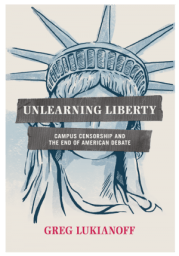
In a recent review of Greg Lukianoff’s Unlearning Liberty for the Hoover Institution’s Defining Ideas, Bruce Thornton heartily agrees that too many institutions of higher education have slid into the heavy mire of politically correct intellectual conformity.

unlearning_libertyA self-proclaimed “liberal,” Lukianoff’s Foundation for Individual Rights in Education has led a campaign to open college campuses to true intellectual controversy.

As Thornton notes, Lukianoff’s book chronicles example after example of over-eager campus authorities cracking down on students’ free speech rights.  For instance, one Yale student was punished in 2009 for wearing a t-shirt that quoted F. Scott Fitzgerald.  The offending shirt proclaimed—in the run-up to a big football game—that “all Harvard men are sissies.”

These and a host of other speech clampdowns are led by an army of humorless, vindictive student enforcers, whom Thornton calls “sensitivity commissars.”  The problem, as Thornton relates, is that “in orientation programs, only one point of view, the progressive-leftist one, is allowed a hearing, and students who resist it are subjected to sanctions and shaming exercises worthy of religious cults.”

The pattern of repression, Thornton insists, is not applied equally.  “Christians,” Thornton writes, “are particularly singled out for censorship, as are Republican organizations and other conservative groups, especially pro-Israel ones, whose publications are often vandalized, campus events attacked, and speakers shouted down.”

These notions of an oppressive left-wing campus Red-Guardism seem widely shared among conservative writers.  But do they match our experience?

I teach at a large public university in the northeast.  Perhaps I’m not sensitive enough to it, but our sprawling campus seems to welcome a real variety of speech, student and otherwise.  We have student groups for a variety of religious viewpoints, some of them resolutely conservative.  Self-identified “conservative” students with whom I talk report that they do not feel particularly shut out or victimized.  The campus is peppered with outside speakers who promote a kaleidoscope of ideas, from Biblical literalism to aggressive atheism.

Colleagues report similar experiences.  One science-education academic from a large public university in the Southeast tells me his education colleagues repeatedly indoctrinate their pre-service teachers with a message of Christian religiosity.

These are admittedly sketchy and anecdotal reports, but some more careful research seems to back it up.  David Long’s ethnography revealed a host of creationist students and faculty at public, pluralistic colleges.  Amy Binder’s and Kate Wood’s study of two leading schools revealed plenty of opportunity for conservative students at such schools, even if some students reported feeling victimized or shut out of campus life.

Perhaps the answer lies in broadening the lens.  Elite schools such as Yale might have rigid thought-police regimes.  However, we must remember two important facts: not many college students go to Yale, and even Yale produced William F. Buckley.

Required Reading: Meet Tim LaHaye

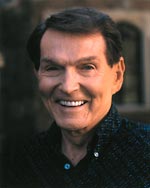
Do you know Tim LaHaye?

LaHaye

LaHaye

If you’re interested in conservative educational thinking in the United States, you should.

Steve Fouse at AliveReligion recently offered a helpful introduction to LaHaye’s enormous influence among conservative and fundamentalist circles.

As Fouse points out, arguments about conservatism that seek to explain away its popularity miss the boat on LaHaye.  Fouse takes Thomas Frank to task for making such oversimplistic assumptions.  Fouse prefers the explanations of historians such as Darren Dochuk.  Dochuk’s more complex perspective fits better the career of a fundamentalist Renaissance Man like LaHaye.

Fouse notes LaHaye’s wide-ranging interests, from LaHaye’s role in the Institute for Creation Research, to his best-selling apocalyptic novels, to his evangelical sex guides.

Fouse mentions LaHaye’s central interest in educational issues, from sex ed to creationism.  If anything, Fouse downplays the influence LaHaye has had in late twentieth-century educational conservatism.

Fouse could have mentioned, for instance, LaHaye’s role in arguing for increased phonics instruction.  In his 1983 book The Battle for the Public Schools, LaHaye argued that abandoning phonics could be part of a massive conspiracy to “reduce the standard of living in our country so that someday the citizens of America will voluntarily merge with the Soviet Union and other countries in a one-world socialist state”   (46).   Disappearing phonics instruction showed the extent to which Christian America had been undermined.  It served as a canary in the secular coalmine.  “Some modern educators,” LaHaye insisted, “use look-and-say instead of phonics because the material enables them to secularize our once God-conscious school system” (50).

Similarly, Fouse did not mention LaHaye’s ardent activism in favor of more traditionalism in US History instruction.  In LaHaye’s 1987 Faith of Our Founding Fathers, LaHaye argued that the nation had endured a “Deliberate Rape of History” (5). Between 1954 and 1976, LaHaye insisted, a generation of “left-wing scholars for hire” worked for secularizing organizations such as the Carnegie Foundation (6).  Such authors systematically distorted the truth of America’s Christian heritage.  Thus, in order to find the true history of America’s founding, readers needed to look to older books, written by those “closest to the events they describe” (6). LaHaye insisted on the Christian beliefs of the Founding Fathers, demonstrating that “most were deeply religious, all had a great respect for the Christian traditions of the colonies, and all were significantly influenced in their thinking by the Bible, moral values, and their church” (30).

Thanks to Steve for offering his post about this important figure.  All of us who hope to understand conservatism in American education should check it out.


Required Reading: Learning to Hear Why Evangelical Christians Hear God

Guest Post by David Long

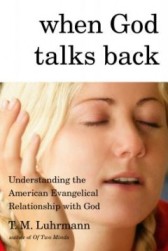
Tanya Luhrmann, When God Talks Back

Tanya M. Luhrmann, When God Talks Back: Understanding the American Evangelical Relationship with God (New York: Vintage, 2012).

Adam Laats’s testimonial for his creation of I love you but you’re going to hell was one of the most refreshing perspectives I’ve read in a long time.  Laats’ roots in Boston—having, what those of us living in the “fly-over” states might skeptically be inclined to see as the judgment of a  limited, Northeastern Liberal metropolitan view—make for interesting reading given his apparent surprise at thoughts and tendencies of ‘Red State’ America. In short, the general tone sounds something like—”these creatures really still exist?!”  In fact, as I suppose Laats has encountered through reader feedback, such creatures not only exist but make up a good bit of the Union.Countering Laats, those of us raised where ‘olde-timey’ religion has never faded, and where it remains an assumed keystone of responsible civic participation, raise an eyebrow to what we see as shortsighted judgment of those disinclined to ever value living in the interior.  Calming our nervous eye, Laats is on the right track.  His earnestness rings true.  Try to figure these curious people out.  Know where people are coming from.  But then what?  Historians are great at drawing on the past to inform the present.  Often, due to the normal purview of their back-looking view, they’re not as good at analyzing the dynamics of here and now.

The American relationship to God has not been static as historians show well.  Unabashed liberal  theologians such as Marcus Borg and sociologists such as Robert Putnam and David Campbell show that the American response to the sacred has been changing.  As Putnam and Campbell show most clearly, the old “Mainline” Christianity of Laats’ and many other’s childhood has eroded.  Congregations reduced by half in many cases over the past half century, the “Mainline” is Main no longer.  American Protestantism has changed dramatically in recent decades, ever more and more defined by the new Evangelicalism featured in T.M. Luhrmann’s When God Talks Back.

As Luhrmann sees it, “this is an important story because the rift between the believers and non-believers has grown so wide that it can be difficult for one side to respect the other.  Since evangelical Christianity emerged as a force in American culture, and especially since the younger George Bush rode a Christian wave into office, non-evangelical observers transfixed by the change in the American religious landscape.  Many have been horrified by what they take to be naïve and unthinking false beliefs, and alarmed by the nature of this modern God” (p. xv).

When God Talks Back follows the emergence of the rapidly growing neo charismatic evangelical movement in the U.S. through the lives, thoughts, and hopes of dozens of fellow church goers.  Luhrmann, a psychological anthropologist, presents a salient answer to those ILYBYGTH readers who wonder not only how such people exist, but how such views are cultivated.  Luhrmann’s work is ethnographic—she became a congregant of the Vineyard Church in a number of U.S. cities over a few years.  Countering some of Laats’ personal narrative, and further deflating modernist hopes that science and theories of progress would dissolve American religious commitment in time, Luhrmann shows that neo charismatic Evangelicalism is spreading throughout the U.S.—including major urban areas.  “There are pockets of liberal Christianity left in America and Europe,  but Christianity around the world has exploded in its seemingly least liberal and most magical form—in charismatic Christianities that take Biblical miracles at face value and treat the Holy Spirit as if it had a voltage” (p. 302).

Underscoring Luhrmann’s work, and worth what is a sometimes lengthy and ranging ethnographic treatment of Vineyard Church members, is the strongly theorized, yet easily digestible insight about science, faith, and the near American future.  The neo-Evangelicalism explored in Luhrmann’s work points strongly to a theory of religious practice—of knowing from doing religion—rather than the usually scientistic efforts of explaining Evangelicalism through evaluation of epistemological pathways of coming to know.

As Luhrmann explains, “…what I saw was that coming to a committed belief in God was more like learning to do something than to think something.  I would describe what I saw as a theory of attentional learning—that the way you learn to pay attention determines your experience of God.  More precisely, … people learn specific ways of attending to their minds and their emotions to find evidence of God, and that both what they attend to and how they attend changes their experience of their minds, ad that as a result, they begin to experience a real, external, interacting living presence” (p. xxi).

What unfolds chapter by chapter is a unique and deeply insightful look into the social practice of being an Evangelical Christian in early 21st century America.  As Luhrmann sees it, and given my own experience working and talking with creationists, such views are much more saliently explainable once you come to acknowledge the social support evangelicals get from their churches, appended by the reality of time allocation.  As Luhrmann makes a convincing case, being an Evangelical in today’s charismatic style—through the many, emotionally exuberant hours of praise and worship—changes one’s style of thinking.  Like Aristotelian phronesis, one can become quite good—a master—at the virtues of evangelical worship regardless of whether liberal America thinks it’s silly, backward, or indicative of sloppy thinking.

“They seemed to think about sensing God more or less the way we think about sophisticated expertise in any field: that repeated exposure and attention, coupled with specific training, helps the expert see things that are really present but that the raw observer cannot, and that some experts are more expert than others.  A sonogram technician looks at the wavy grey blur on the screen and sees a healthy boy.  This is not a matter of taste or aesthetic judgment: there is, or is not, a boy in the woman’s womb, and the technician can see evidence for the fact in a picture that leaves the expectant mother bewildered.  And a very good technician sees details that a merely competent one cannot” (p. 60).

In fact Luhrmann’s work offers another compelling insight into the durability of evangelical christianity in the early 21st century American milieu.  Countering the shrillness of some “New Atheists” such as Richard Dawkins, etc., Luhrmann repeatedly follows evangelicals through life trials for which their church homes offer not only a sense of purpose, but a foil to those who might critique religious practice as being an inadequate explanatory matrix to respond to the world.  As Luhrmann makes clear, “in some quite fundamental way, modern believers don’t need religion to explain anything at all.  They have plenty of scientific accounts for why the world is as it is and why some bodies rather than others fall ill.  What they want from faith is to feel better than they did without faith.  They want a sense of purpose; they want to know that what they do is not meaningless” (p. 295).

Luhrmann’s book then is an invitation to those willing to suspend their critique of Christian America’s current form in favor of a an exploration of how and why it currently comes to be.


DAVID LONG is an anthropologist who studies the American relationship towards science, particularly as it unfolds in schools and universities.  His work examines the role of religious faith, social class, ethnicity, and gender in people’s lives as they relate to science.   He is the author of Evolution and religion in American education: an ethnography (Springer 2011), where he followed a cohort of college students, many of whom were Creationists, documenting the rationales and anxieties they encountered while thinking and talking about evolution.  He is currently conducting longitudinal research on the administrative decision making in K-12 schools which does or does not support science teaching.  Dr. Long currently directs implementation research for the Virginia Initiative for Science Teaching and Achievement at George Mason University.  He can be reached at dlong9@gmu.edu


You Might Be a Fundamentalist If…

What does it mean to be a “fundamentalist” in America? And what does “fundamentalism” mean for American education?

Theologian Roger E. Olson offers a great introduction to the intricate theological and cultural boundaries of American fundamentalism.

As with any theological tendency, the definition of “fundamentalism” has long been fraught with bitter disputation.  As I learned in my study of 1920s American fundamentalism, there will be exceptions to every rule and protestations of every boundary.

Olson offers outsiders like me a convenient double list.  First, he gives his carefully hedged list of theological determinants.  In the context of American Christianity, someone is likely a fundamentalist if he or she agrees with some or all of the following list:

  • Embrace of traditional conservative Christian doctrine, such as divinity of Christ, the trinity, inspiration of Scripture, salvation by grace through faith, and so on;
  • Refusal to fellowship with those who are not similarly theologically aligned;
  • Refusal to fellowship with those who fellowship with those who are not similarly theologically aligned;
  • Embrace of Biblical inerrancy—the notion that the original autographs of the Bible are without error;
  • Belief that the King James Version is the proper English translation;
  • Belief that young earth creationism and premillennial eschatology are central to true Christian faith;
  • Belief that America is “God’s Nation;”
  • An insistence that good education must be Bible-based;
  • Belief that Catholics are not real Christians.

Does Professor Olson insist on this list as the ultimate definition?  No.  As he warns, “These are not absolute litmus tests. It’s theoretically possible that a person might hold most of these beliefs and, for some unforeseen reason (a fluke) not be a fundamentalist.”

Most helpful of all, Professor Olson notes that the label “fundamentalist” is often used in looser ways.  The list above describes a certain tradition among American Protestantism.  But “fundamentalism,” as Olson argues, has long been used to describe other phenomena as well.

Olson gives us four of these other traditional uses of “fundamentalism.”

First, there’s a sense that “anyone considered religiously conservative and fanatical” is a fundamentalist.  Second, some people use “fundamentalism” to describe any sort of religiously motivated anti-modernism.  Third, some folks call anyone they don’t like a fundamentalist.  If you are conniving, or manipulative in your dealings with other church folk, even if you are theologically liberal, you might be called a fundamentalist.  Finally, Olson offers his “historical-theological meaning:” “militant defense of conservative Protestantism against liberal theology and higher biblical criticism.”

Many thanks to the good professor for offering this nuanced public definition.  My summary here doesn’t do justice, and I suggest reading the article in its entirety.  Outsiders to the world of conservative American Christianity like me often have a very difficult time decoding the dense layers of meaning attached to such labels.  Yet for many within the porous boundaries of “fundamentalism,” many of the distinctions remain more inherited and implied than intellectually understood.

Olson relates one anecdote that reveals some of these implicit meanings, the sort of meanings that might often be lost on outsiders.

“About fifteen years ago I noticed that a seminary historically noted for being fundamentalist (in the historical-theological sense) had set up a table in the evangelical college where I then taught to recruit undergraduates. I approached the recruiter, a relatively young (early middle aged) employee of the seminary. I told him I would have difficulty recommending that any of my students attend his seminary. He asked why. I told him that the seminary had a reputation for being fundamentalist. He said ‘No, we’re changing. We’re evangelical now.’ So I asked him this question: ‘If Billy Graham volunteered to preach in your seminary’s chapel free of charge, no honorarium expected, would your president allow it?’ His slightly red-faced response was ‘We’re moving in that direction.’ Enough said.”

Before I started my academic research into American religion, I wouldn’t have made much sense of this encounter.  For insiders, though, it is just obvious, even humorous, that some seminaries just would not have Graham.  And some might claim to be “evangelical” while everyone knows they are still “fundamentalist.”

Before we move on, let’s consider some of the implications of this definition of fundamentalism for American education.  If, as Olson argues, his list includes broad and widely shared tendencies among conservative Protestants, we can see why such folks have long been so keenly interested in educational issues.  Some of the connections are obvious.  Professor Olson suggests that young-earth creationism is considered a “crucial Christian belief…” among many fundamentalists.  Supporters of creationist school policies, then, would have ardent supporters from the fundamentalist community.  Second, Olson’s fundamentalists often believe “the Bible ought to be the basis of an entire educational curriculum, including studies of science, philosophy, psychology, etc.”  Again, the educational implications are obvious.

But beyond creationism and Bible, elements of Olson’s definition offer insights into the intersection between American fundamentalism and American education.  For instance, the notion of “secondary separation” should deflate some of the ever-present suspicion of a vast fundamentalist educational conspiracy.  As Olson describes, many fundamentalist types refuse to work with those with whom they disagree.  More than that, fundamentalists often refuse to associate with those who fellowship with those with whom they disagree.  That is, a fundamentalist must be very careful to associate only with those who are free of any connection to any organization or church that has any sort of suspect connection.

In educational politics, this sort of rigid separationism can have important consequences.  Many fundamentalists might sternly oppose policies, for instance, that promote teaching intelligent design in public schools.  Or fundamentalists might (and have) fought against prayers in public schools, when those prayers become broad and ecumenical.

Finally, the rigid separationist tradition has led to a long history of separate educational institutions.  From Bob Jones University and Dallas Theological Seminary in the 1920s, through a host of new colleges and schools throughout the twentieth century, fundamentalists have often been keen to found their own schools.  After all, if education must be based on the Bible, and young people must be taught to avoid the dangers of less-strict separationism, then many fundamentalists would insist on their own schools, their own textbooks, their own teachers, and so on.

As with any theological or cultural definition, Professor Olson’s attempt to give a brief and readable account can be disputed endlessly.  But for those of us outsiders trying to understand the complicated landscape of conservatism in American education, Olson’s article is a good place to begin.


Teaching the Culture Wars

Isn’t it nice to be included?

Andrew Hartman of Illinois State University, author of Education and the Cold War, has announced his reading list for a graduate seminar in America’s culture wars.

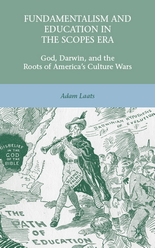
fundy and education scopes era coverI am tickled pink to see my 1920s book on the list (now available in paperback!).

It is an honor to be included with books that shaped my intellectual development, including Jonathan Zimmerman’s Whose America, James Davison Hunter’s Culture Wars, and many other wonderful titles.

Makes me want to join the seminar…

Teaching the Bible, Texas Style

A new report from the Texas Freedom Network warns that some public schools in Texas are teaching religion.  Not all religions, but the Bible-loving, apocalypse-watching, evolution-denying type of conservative evangelical Protestantism.

How do these public schools justify it?  According to the TFN report, public schools fold these sectarian doctrines into their Bible courses.  Public-school courses about the Bible are explicitly constitutional.  US Supreme Court Justice Tom Clark made very clear in his majority opinion in Abington Township v. Schempp (1963) that public schools can teach the Bible, if they did so in a non-devotional way.  As Clark specified,

“Nothing we have said here indicates that such study of the Bible or of religion, when presented objectively as part of a secular program of education, may not be effected consistently with the First Amendment.”

However, the TFN report argues that many of the Texas school districts are using Bible classes to teach religious doctrine, including the notion that the Bible demands a young earth.  The report’s author, Mark A. Chancey of Southern Methodist University, reports that the courses are generally poorly taught, with low academic rigor, by underprepared teachers.

Professor Chancey includes excerpts from some of the teaching materials.  In the Dalhart Independent School District, for example, one student information sheet included the following information:

“Since God is perfect and infallible, an inspired book is absolutely infallible and errorless in its facts and doctrines as presented in the original manuscript” (pg. 28).

In the Bible courses of Lazbuddie, Texas, students will read the following:

“We should have an understanding of what happened in Noah’s day if we are to know when the coming of our Lord is near.  What are the similarities between the days of Noah and the days preceding the coming of Jesus Christ (Matthew 24:37-39)?” (pg. 32)

In Dayton schools, students watch the Left Behind movie, fundamentalist author Tim LaHaye’s dramatization of the rapture and final days (pg. 19).

As Chancey points out, these doctrines are intensely sectarian.  They teach a specific interpretation of the Bible as eternally true.  Students in these public school classes would be told that the doctrines of conservative evangelical Protestantism are the correct and only interpretation of the Bible.

Are we shocked?

We shouldn’t be.

Here’s why not:

First of all, the numbers of schools and students involved is very small.  Professor Chancey found 57 districts plus three charter schools who taught Bible courses in 2011-2012, a small percentage of the 1037 districts in Texas.  Not all of these districts taught the Bible in such heavy-handed sectarian ways.  And of the districts that reported their student numbers, only three had more than fifty students enrolled in Bible class.  Six districts had fewer than five students in Bible (pg. 5).

Second, the practice of teaching sectarian religion in public-school Bible classes has a long and surprisingly uncontroversial history.  As I explored in my 1920s book, while public attention was focused on anti-evolution laws, between 1919 and 1931 eleven states quietly passed mandatory Bible-reading laws for public schools.

Finally, even after the anti-Bible SCOTUS ruling in 1963, many public schools simply continued the practice.  As political scientists Kenneth Dolbeare and Philip Hammond found in their survey of schools in a Midwestern state, the Supreme Court rulings against public-school Bible reading made absolutely no difference in school practice.  Where students had read the Bible before, they continued to do so, without raising any controversy.

So Professor Chancey’s findings that a few students in a few public schools in Texas learn a sectarian interpretation of the Bible should come as no surprise.  As Chancey notes, similar Bible classes go on in several other states as well (pg. v).  Moreover, as political scientists Michael Berkman and Eric Plutzer have convincingly argued, public school teachers usually teach ideas that are locally uncontroversial.  In some places, that means teaching creationism as science.  In others, it means teaching the Bible as history.


Progressive Education Hurts Poor Kids: E.D. Hirsch’s “Wealth of Words”

Progressive Education hurts poor kids.  For those familiar with E.D. Hirsch’s work over the past twenty-five years, that argument won’t sound new.

In a recent piece in the conservative Manhattan Institute’s City Journal, Professor Hirsch lays out his case for why progressive attitudes and policy toward vocabulary education inflicts the most damage on those it claims to help: students from families with fewer resources.

Hirsch, a literary critic and scholar, first came to fame with his 1987 book Cultural Literacy.  The book and Hirsch shared a public career somewhat similar to Allan Bloom and his Closing of the American Mind.  Though both authors identified as politically and culturally liberal, their books became favorites of cultural conservatives.  Like Bloom, Hirsch claimed that American education had “progressed” in woefully misguided directions.

In brief, Hirsch argued that every American ought to master a certain core of cultural knowledge.  Critics charged Hirsch of elitism and even bigotry.  Insisting on an exclusive body of important cultural knowledge, critics insisted, blocked out too many vital cultural voices, voices that had not made the canon but that represented authentic elements of the real American experience.

In Hirsch’s new essay, “A Wealth of Words,” he argues that the best way to improve life chances for all Americans is to insist on a rigorous and systematic curriculum of vocabulary improvement.  In a nutshell, here is the argument:

1.) College degrees represent the best single path to economic well-being.

2.) The verbal section of the SAT college-entrance exam is largely a vocabulary test.

3.) Therefore, to bring people out of poverty, we need to improve vocabulary education.

Most interesting to ILYBYGTH readers will be Hirsch’s idiosyncratic combination of an attack on “progressive education” with a progressive-sounding prescription for improved schooling.

Like nearly every conservative educational activist of the past fifty years, Hirsch takes progressive education to task for dumbing-down American education.  As I’ve argued in an essay in Teachers College Record, a variety of leading conservative educational activists—with very different ideas about education—all agreed that America’s educational system had been hijacked by progressivism.

In Hirsch’s telling, this progressive coup took place roughly one hundred years ago.  This “well-meant but inadequate” progressivism, according to Hirsch, included the following poison pills:

“optimism about children’s natural development, a belief in the unimportance of factual knowledge and book learning, and a corresponding belief in the importance of training the mind through hands-on practical experience.” 

Once these “progressive educational theories” took over school publishing and teaching, vocabulary education suffered bitterly, Hirsch argues.  In response, Hirsch calls for “an intellectual revolution . . . to undo the vast anti-intellectual revolution that took place in the 1930s.”  Most important, Hirsch believes, is the need to overcome the notion that schools should not teach factual knowledge.  For a century, the “progressive” notion that school should teach students how to learn, instead of mere facts, has come to dominate education policy.  That, Hirsch believes, is a terrible mistake.

For those familiar with the twentieth-century development of conservative educational activism, it is easy to see how Hirsch could have become a favorite of conservatives.  Educational conservatism has largely centered itself on the notion that schools must remain true to their traditional purpose; schools must dedicate themselves to transmitting knowledge from one generation to the next.

However, a closer read of Hirsch’s prescriptions might give some conservatives pause.  True enough, Hirsch calls for a renewed focus on teaching children a rich vocabulary.  He insists that an emphasis on “literacy” rather than good “literature” hurts the life chances of those students who need schooling the most.

But Hirsch also calls for a profound investment in government-run and tax-funded preschooling.  He cites French studies of intensive instruction for students as young as two.  Such intense schooling, Hirsch claims, will allow students from lower-income homes to match the educational opportunities of those from more affluent ones.  Furthermore, Hirsch dismisses the notion that improved vocabulary instruction will come from more time spent with word drill.  Instead, Hirsch advocates “domain immersion,” in which students learn vocabulary as part of an immersion in interesting and important reading.

Thus, in his goal and his method, Hirsch still sounds provocatively “progressive.”  Yet even in his outlet, the conservative City Journal, we can see that Hirsch still finds his most eager audience among conservatives.  In the end, this might come as no surprise.  No critic of progressivism is more appealing than one who comes from the progressive camp itself.  In education as anywhere, a whistle-blower can claim a certain credibility others cannot.

In his recent essay, Hirsch continues his long career as progressive education’s leading whistle-blower.  The best way, Hirsch insists, to determine whether any education policy will help poor kids is simple.  We do not need elaborate justifications of “pedagogies of the oppressed” or “dreamkeeping” teaching strategies.  All we need do, Hirsch argues, is ask one simple question: “Is this policy likely to expand the vocabularies of 12th-graders?”