I Love You but You Didn’t Do the Reading: Teachers’ Strike Special Edition

Maybe I’m just too close to see it clearly, but to my eyes the LA teachers’ strike is pushing last year’s teacher walkouts in new directions, directions that will shape our conversations about public education for years to come. Here are a few of the most compelling commentaries to come out so far:

When we lambaste the charter schools that urban parents may choose as undermining public education, but say nothing of the urban private schools and exclusive suburban public schools that enable affluent parents to exit struggling districts, we not only apply a dangerous double-standard, but we also place the blame for low-performing schools on those who must attend them.

these modern walkouts are about the very idea that public schools should be kept healthy at all.

What inspires well-paid teachers to deny the needs of kids they love in exchange for angry strikes they loathe? Union deception and brutality.

Numerous Latino teachers repeatedly told me that a sense of solidarity with their students is what’s driving them to the picket lines—a profoundly personal connection to those children, and a fear that current school conditions are not serving them.

My advice to the district: Hold strong. Replace them all. If they want a dramatic impact on education, fire the union and begin to repair the schools, just like Reagan fired the air traffic controllers.

Crime and Punishment

I don’t often agree with free-marketeer Michael Petrilli, but this time he’s exactly right. When pragmatic issues such as school discipline become culture-war footballs, students are always the losers. What we need instead are policies that put students first. Alas, the history of educational culture wars makes me pessimistic that we can replace polemics with pragmatics.

Petrilli recently lamented the unhelpful back-and-forth over the issue of school discipline. The Obama administration supported the idea that racial disparities in punishments could be cause for federal intervention. Trump’s administration, in chest-thumping contrast, rejected the notion.


As Petrilli rightly noted, schools need something different. They need policies that recognize the cruel injustices of racially loaded punishments while still creating safe schools. Petrilli hoped even

In this age of base politics . . . communities nationwide can reject such cynical approaches and craft school discipline policies that can bring us together rather than drive us apart.

That would be nice, but as I found in my research into the history of educational conservatism, school discipline has always been about more than pragmatic problem solving. Planting a flag for harsher school punishments has always been a hallmark of American conservatism.

Consider the flood of pro-discipline conservative outrage that confronted Pasadena’s superintendent in the late 1940s and early 1950s. The new superintendent, Willard Goslin, became the whipping-boy for a host of perceived problems with “progressive” education. As one furious conservative critic wrote in the local paper in 1949,

But pity the poor teacher!  After all, it is his job to pamper the pupils (in progressive schools), and it is worth his job if he tried any old-fashioned discipline.  Problem children are not only tolerated but pushed right along ‘to get rid of them’—out into society, for others to worry about.

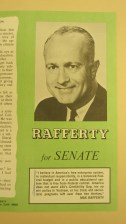
Better-known conservative pundits have also always taken pot-shots at non-traditional ideas of school discipline. Max Rafferty, a nationally syndicated columnist and one-time state superintendent of public education in California, had nothing but scorn and contumely for new-fangled ideas about punishment.

OLYMPUS DIGITAL CAMERA

…he didn’t win.

In one 1964 column, Rafferty lambasted new ideas of school discipline in his typically colorful language. As he put it,

a child usually has neither the maturity nor the judgment to understand the need for self-discipline. Too many instructors, fresh from college and still pretty Dewey-eyed about things, compromise themselves and their careers in a hopeless attempt to convince some freckled-faced [sic] urchin with devilment coming out visibly all over him that he must discipline himself when all he really needs is a session after school with the ruler.

In every decade, in every educational situation, school discipline has always been an us-or-them culture-war issue. Progressives have always lamented the racially loaded and ineffective traditions of whipping and my-way-or-the-highway teaching. Conservatives have always been sure that new-fangled ideas about child-rearing tragically misunderstood real human nature. As Rafferty explained in 1964,

The psychologists had been right in one respect.  Junior certainly had no repressions.  He could have used a few.

What Today’s Educational Conservatives Need to Say Instead

I don’t see any good reason why they would listen to me. But if today’s conservative pundits and intellectuals are really serious about identifying the “future direction of American education,” they need to come to terms with the elephant in the conservatives’ room. At the Fordham Institute and Hoover Institution at least, they seem to be doing the opposite.

This isn’t only a conservative problem. Progressives like me need to be more willing to remind ourselves of the unpopular truths of the progressive tradition, too. We need to be willing to acknowledge the fact that excesses of campus left-wing Puritanism do not come out of nowhere. When smart students feel the need to exhibit their devotion and purity to radical egalitarian ideals, they are simply speaking the logical conclusions of the progressive tradition. At least, it’s ONE logical conclusion.


And when conservative intellectuals opine about American education, they need to do more to acknowledge their own history. As I argued in my book about the history of American educational conservatism, one idea has been awkwardly ignored and muffled by American conservatives. That hasn’t made it go away. Rather, it has only made it more pressing for conservatives to address it more forthrightly and explicitly.

I’m not surprised to see that they aren’t.

In a series they call “Education 20/20,” the Fordham Institute and Hoover Institution have brought a series of conservative speakers, thinkers, and policy-makers to Washington DC to tell one another what they want to hear.

For example, according to Chester Finn, the kick-off lecture by Heather Mac Donald warned that the real solution to school discipline problems had to come from addressing students’ “lack of self-control.” Speakers such as Ian Rowe told the conservative crowd that the main problem was not race, not class, but rather dysfunctional family structures, “particularly the presence or absence of two married parents.” Other speakers hoped schools could do more to teach traditional values, including

character, emotional well-being, and personal behavior, as well as help in making choices and following up on them.

What’s wrong with all that? Honestly, nothing at all. I think we can all agree that students in school should learn to control their own behavior. We all probably agree that healthy families are absolutely required for healthy schools. And all of us—even progressive history teachers like me that conservatives have always loathed—want to teach children to love America, “warts and all, yes, but also replete with heroes, principles, and triumphs.”

So where’s the beef? Why can’t we all agree on these goals and ideals?

There’s one obvious problem with events like this one. And it is a big one; one that conservatives need to address openly and bravely if they ever want to gain real traction in designing school reform that works. Namely, conservatives need to come to terms with the fact that their ideas have always been used as cover for racist policies.

I’m not accusing any of the speakers here of racism. Unlike some of my allies and colleagues, I don’t believe that conservatives are scheming to cover up their own racism. As I think we all should, I give my conservative friends the benefit of the doubt when they say they really want to heal racism’s ugly legacies, not promote it.


As the folks at Fordham Institute and Hoover Institution lament, when conservatives were able to get broad support for their policies, they have scored big successes. In their words,

Twenty years ago, conservative ideas were gaining traction in K–12 education. Charter schools were opening all over the place, vouchers were finally being tried, academic standards were rising, results-based accountability had become the watchword in policy circles, and reformers were taking the idea of “character education” seriously.

Why did charters and vouchers score so big in the 1990s? Because conservative activists were able to make common cause with center-left reformers to pitch them as a real solution for low-income, non-white families.

These days, lambasting non-white students for lacking self-control and non-white families for lacking proper structure is not likely to gain any sympathy outside of conservative circles. Talking about focusing on teaching American “ideals” is likely to be ignored by non-conservatives as mere cover for “Making America Great Again.”

If conservatives really want to get another taste of reform influence, they need to take the brave step and acknowledge the legacy of their own campaigns. Instead of saying “We’re not racist, but…” they need to say “These ideas WERE used by racists, but here’s why they are good anyway.”

Why Do We Keep Falling for School Scams?

It was a very depressing story. When the New York Times broke the ugly truth about Louisiana’s T.M. Landry school, the real question was why so many people believed the lies of the school’s leaders. Today, Will Stancil connects the dots. And as I’m arguing in my new book, this scam is no exception; it is the oldest story in the checkered history of American school reform.

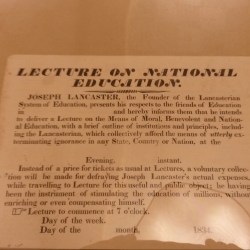
Lecture flyer 1

Magic-bean level school reform, c. 1834.

You’ve heard the story by now. T.M. Landry College Preparatory School in small-town Louisiana seemed to have found the magic recipe. Its viral videos told the heart-warming stories of low-income African American students who beat the odds and went to elite universities such as Harvard and Princeton.

It didn’t take long for the sad other shoe to drop. As the New York Times reported,

In reality, the school falsified transcripts, made up student accomplishments and mined the worst stereotypes of black America to manufacture up-from-hardship tales that it sold to Ivy League schools hungry for diversity. The Landrys also fostered a culture of fear with physical and emotional abuse, students and teachers said. Students were forced to kneel on rice, rocks and hot pavement, and were choked, yelled at and berated.

We make a mistake if we just shake our heads and lament the gruesome conditions of this single scam school. The real problem is much deeper.  Given the remarkable claims of the school’s leaders, Will Stancil asked recently, why did so many of us believe them for so long? As he puts it, all of us need to take a hard look at ourselves. Americans treasured the unbelievable success stories coming out of T.M. Landry, Stancil writes,

because it offered something that a lot of people wanted to believe. Their viral videos told a story of black children magically beating the odds. . . . people took solace in the idea that such a transformation was possible, and moved on.

Other commentators have made similar points. As Casey Gerald noted recently,

When we highlight those few against-all-odds stories, we send the message that all it takes to succeed is grit and resilience and willpower.

For those who hope that the right school reform can offer a quick and easy fix to social inequality, the reality gets even worse. As I’m finding in the research for my current book, America’s head-in-the-sand addiction to Horatio Alger stories has always been a problem.

Two hundred years ago, Joseph Lancaster promised America’s elites a T.M. Landry-style solution to their burgeoning urban anxieties. As one industrial leader fretted in 1817, new cities and factories threatened to become

disgusting exhibitions of human depravity and wretchedness.

If they had the right schools, however, all could be well. As this industrialist explained, with only a small financial investment, American cities could install Lancasterian schools,

where good instruction will secure the morals of the young, and good regulations will promote, in all, order, cleanliness, and the exercise of the civil duties.

Just like T.M. Landry in 2018, back in 1817 these promises were obviously too good to be true. Yet, as one commentator described at the time,

The extent of the delusion . . . was so widely and so energetically advocated that thousands of intelligent men believed that a final and immediate remedy had been found for the evils of popular ignorance and that the era of universal intelligence had begun.

Things didn’t end any better for the students in Lancaster’s schools than they did for T.M. Landry’s. In a few years, parents, children, teachers, and eventually elite reformers realized that the promises of these school reforms couldn’t match the challenges of social inequality. Lancaster was exposed as a fraud. School leaders noted with chagrin that their miracle schools were not miracles at all. At the end of his rope, in 1838 Joseph Lancaster stepped out in front of a rushing horse carriage in New York and ended his life.

These scams and cons work because we want them to be true. We want to believe that society is fundamentally fair. We want to think that with a little gumption, a little “grit,” everyone can make it. What we don’t want to admit is the ugly truth: America has always been unequal. Some people are freer than others. Some live in a land of opportunity, but many don’t.

If only, we fantasize, if only there were a reading method or an ipad app that would make this problem go away. That’s why the Education Department pours billions of dollars into “innovation” grants.

As Will Stancil makes so painfully clear, our addiction to these sorts of fairy tales allow scammers to get us to believe the unbelievable. Americans like to hear about low-income African-American students “beating the odds,” because we can’t figure out how to make those brutal odds more equitable.

And as I’m finding out in my current research, it is America’s oldest educational fantasy. We need to reckon instead with the sobering truth: Schools can’t save society; schools ARE society. Unless and until society itself gives everyone a fair chance at success, schools won’t be able to.

The Keto Diet of Ed Reform

Why is it so difficult to find out if school reforms are working? Journalists tell us that big investments often don’t lead to big results. Why not? The real “dirty secret” of ed reform isn’t the difficulty involved. It is that reformers tend to fall into the Keto-diet trap. Instead of promoting things that work, they scramble for headline-grabbing new labels and gimmicks. Then they are forced to use skewed ways to measure their own success.

hechinger reform chart

What works? We need less flash and more uncomfortable conversations

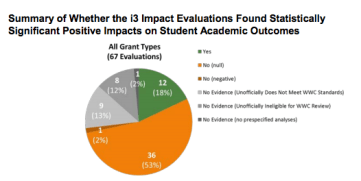
Here’s what we know: Hechinger reported recently on the disappointing results of $1.5 billion+ in i3 funds from the Education Department. Only a few of the funded “innovations” actually led to measurable improvements in student test scores.

The researcher charged with measuring the success of this school reform investment explained,

That’s the dirty secret of all of education research. . . . It is really hard to change student achievement. We have rarely been able to do it. It’s harder than anybody thinks.

As she lamented,

We are desperate to find what works.

Except we’re not. Not really. We KNOW what works to improve schools and educational outcomes. Schools work better when they are connected to healthy communities. Schools work better when families and students have abundant resources, including flexible work schedules and access to community resources.

The problem is that those things are more difficult to talk about. As I’m arguing in my new book, it has always been easier to slap flashy “innovations” on schools for low-income kids than it has been to address the topics of inequality and poverty in the USA.

What does this have to do with Keto dieting? Just this: Like healthy eating, healthy schools are not really all that mysterious. They require investments of time and resources. They need involved teachers, families, students, neighbors, and administrators. They need to be connected to their communities and in touch with the dreams and backgrounds of their families and students.

keto diet

Let’s be real: No one buys books titled, “Good Food Is Good for You.”

It’s not a mysterious recipe, but it is a difficult one to pitch to grant programs. Instead, like the Keto diet, reformers are forced to create new names and new programs that highlight their “innovations.” Like the Keto diet, they are forced to focus—to an obviously unhealthy degree—on short-term, quantifiable outcomes.

What would be better? How about measuring education reforms by something other than student test scores? Why not survey families to see how happy they are in their schools? Why not hire trained researchers to gather qualitative data about a fuller range of improvements in students’ lives?

Like the authors of fad-diet books, too many grant funders are tied to flashy headlines and quick-but-fake improvements. What we need instead is a willingness to focus on the non-flashy things that we know will work.

Carts and Horses

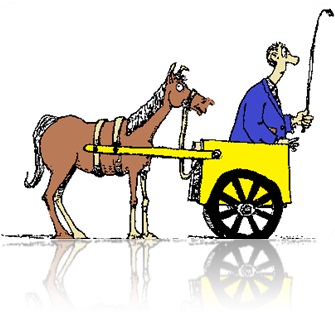
I know, I know, it’s dangerous to conclude too much from one research study. Especially if that study seems to confirm our pre-existing ideas. But the news from Tennessee seems to confirm what school-reform mavens know: Just fixing classrooms isn’t enough. If we want to make a more equitable society, we have to include everything.cart before horse

Here’s what we know: A new study suggests that African American students can experience measurable benefits from having African American teachers. The authors say it is more than just about teaching methods; it is more to do with a “role-model effect.” As they put it,

black teachers provide a crucial signal that leads black students to update their beliefs about the returns to effort and what educational outcomes are possible.

We don’t want to exaggerate its importance, but this seems like yet more evidence for our vision of real school reform. SAGLRROILYBYGTH are tired of hearing it, but historically there have been competing visions of how schools can and should help make America a better place. Some well-meaning reformers have hoped to tweak classroom practices to help students from low-income families do better in school. If they can just succeed in school, the thinking goes, then they can go to college, get a good job, make more money, and escape the cycle of poverty.

If we can just scale up that sort of reform—the thinking goes (and we can’t, but that’s another story)—then schools can fix the woes of social inequality.

As I’m arguing in my new book, this vision of school and social reform is as old as public education itself. And it’s not bad, but it is wrong. Don’t believe it? Check out the archive of studies and evidence that all seems to point in the same direction: here or here or here.

And the current study from Tennessee seems to add more fuel to the fire. The real problems of education, poverty, and social inequality are bigger than any single, isolated curricular reform can fix. The problem is that American society includes a bunch of unfair hierarchies: racial, religious, ethnic, and economic. If we try to tweak classroom practices in isolation, we won’t be able to do much.

But, as this study suggests, if students can see a possibility of achievement, they will be more likely to achieve. If students can see glimmers of a society that rewards people like them for talent and hard work, they’ll be more likely to work hard to move ahead.

Is it a good thing to improve classroom practice? Sure. But fixing the insides of classrooms alone isn’t enough. Students need to live in a society that is less biased against people like them. Students need some reason to think that school achievement will pay off.

When it comes to the old chicken-and-egg problems of schools and social reform, we need to remember the refrain: Schools don’t change society; schools ARE society.

More Proof: America Has No Public School System

We could be mad that it took them this long to notice. Or we could celebrate the fact that we’re finally getting some attention to the issue. In addition, though, we have to recognize another big implication of this story.

First, the bummer. How can it be “news” that American public school teachers are working too hard? A recent series in USA Today profiled fifteen teachers across the United States. As they reported,

We found that teachers are worried about more than money. They feel misunderstood, unheard and, above all, disrespected.

That disrespect comes from many sources: parents who are uninvolved or too involved; government mandates that dictate how, and to what measures, teachers must teach; state school budgets that have never recovered from Great Recession cuts, leading to inadequately prepared teachers and inadequately supplied classrooms.

We’re glad to get some front-page attention to the difficulties of teaching, of course, but it’s difficult not to say…well, duh. Of course teachers have a tough row to hoe. After we digest that non-bombshell, though, there’s more in this story that we should notice.

As historian Jack Schneider wrote recently for WaPo, Americans tend to have a unique love/hate relationship with public schooling. We hear over and over again that public schools are failing, yet most of us cherish our local public schools. And statistics tell us that—as a whole—America’s public schools are doing as well academically as they ever have.

Behind the fake-exposé headlines of the USA Today series, we can see a glimmer of truth that helps explain the weird relationship of Americans to their public schools. Reporters fanned out across the country to tag along with teachers.

manseau usa today

Oh give me a home…

In one case, that meant braving the wilds of Montana, where Traci Manseau teaches seventeen kids of all ages, all with the same last name, all in the same one-room schoolhouse. The students are all Hutterites, and they leave school at age sixteen to work on the communal farm.

At another school, 1,584 miles away (I looked it up) in Detroit, students wear a different sort of uniform. Instead of bonnets and cowboy shirts, the mostly African-American students wear uniform polo shirts and khakis. Their teacher, Felecia Branch, loves to hear them relate to fiction. And she hates it when they fight.

Down in Phoenix, meanwhile, teacher Rebecca Garelli welcomes 21 students in her English-Language-Learners class (ELL). Two of them come from Rwanda. Many of them speak only Spanish. Her job is to teach them—according to Arizona law—in English. And get them all to learn science.

branch usa today

…where the Chevrolets roam…

Are there similarities? Sure. All teachers feel stressed. And all good teachers care a lot about all their students. Whatever their backgrounds and locations, teachers want the best for their students and they can get frustrated when bad rules or bad situations make that unlikely.

But the vast differences between just these three examples show how inappropriate it is to talk about an American public school “system.” What it means to go to school in the United States can mean vastly different things.

Of course, SAGLRROILYBYGTH did not need to open the pages of USA Today to find that out. All of us can see the huge disparities in public education if we just take a tour around our local area. Even in the same city, the populations and possibilities of public schools can be worlds apart.

As Professor Schneider concluded,

Our schools haven’t failed. Most are as good as the schools anyplace else in the world. And in schools where that isn’t the case, the problem isn’t unions or bureaucracies or an absence of choice. The problem is us. The problem is the limit of our embrace.

If we waste our time asking about the American public-school system, we’ll always end up at an impasse. America’s schools are so diverse that there’s really no system to it all. When it comes to our sad history of educational culture wars, pundits on all sides have been able to say whatever they wanted about America’s schools and find real evidence to back it up. They could always find proof of almost any trend they wanted to celebrate or despise.

Are America’s schools mere “sorting machines?” Yep. Do they harbor left-wing teachers who sneakily try to subvert patriotic traditions? Uh-huh. Do America’s schools remain trapped in ancient ruts? Of course. Do they engage in innovative, world-class education? That, too.

Like the blind scholars and the elephant, pundits and politicians will always be able to prove anything they want to about America’s schools, because they can all be right.

Why Can’t Facebook Fix Schools?

[Warning: Explicit goose-related content.]

It’s not news. Facebook founder Mark Zuckerberg and other tech-illionaires keep trying and failing to fix schools. The latest story from Connecticut gives us a few more clues about why these smartest-people-in-the-room can’t get it right. In the shocker of the year, it turns out parents don’t like having their kids read about people having sex with geese.

sex with a goose

Will this be on the test?

It’s not the first time Zuckerberg has goofed when it comes to school reform. As SAGLRROILYBYGTH may recall, he has dropped the ball in Newark and with SAT prep classes. He has mistaken the right way to think about schools, repeating centuries-old errors.

What’s the latest? Parents in an affluent section of Connecticut have rebelled against a facebook-sponsored introduction of Summit’s “personalized” learning system. These sorts of systems promise that students will be able to work productively instead of marching at lockstep with the rest of the class. They hope to use technology to allow students and teachers to learn, instead of just sitting idly in classrooms.

In towns like Cheshire, Connecticut, the Summit system was run on free student computers, sponsored by the Chan Zuckerberg Initiative, facebook’s philanthropic arm. Students in middle school and elementary school would be able to work at their own pace toward clearly delineated learning goals.

It was gonna be great.

As New York Magazine reported, it didn’t work out that way:

the implementation over the next few months collapsed into a suburban disaster, playing out in school-board meetings and, of course, on facebook. The kids who hated the new program hated it, to the point of having breakdowns, while their parents became convinced Silicon Valley was trying to take over their classrooms.

What went wrong? As anyone who knows schools could tell you, the Summit/facebook folks made a fundamental error about the nature of schools. They forgot or never knew a couple of basic, non-negotiable requirements of real schools.

First, they fell into the start-up trap. Priscilla Chan of the Chan Zuckerberg Initiative described her awe when she first saw a Summit-style school. As she gushed,

I walked into the school and I didn’t recognize where I was. . . . My question was like, ‘What is this? Where am I? Because this is what I see folks actually doing in the workplace: problem-solving on their own, applying what they’re learning in a way that’s meaningful in the real world.’

Like other techies, the facebook folks thought that schools could should look like tech companies, with maximum productivity and maximum independence. What they don’t seem to notice is that schools are not only open to those few nerds who like to work that way.

In Cheshire, teachers found that about a third of the students flourished in their new classrooms. But that left a vast majority of students floundering. As teachers do, they filled in the gaps. As New York  Magazine describes,

The teachers started holding “Thursday Night Lights” sessions, where they’d stay until about 8 p.m., helping students rush through the playlists and take assessments while the information was fresh in their memories. To make up for the rest, he said, teachers found “workarounds,” like rounding up half-points in students’ grades, or coming up with reasons to excuse students from certain segments. (The other educators confirmed this.) “Looking back,” he said, “it was grade inflation, and it was cheating the system that we had spent the whole year trying to figure out and couldn’t make work.”

Maybe even more crucially, the facebook approached crashed in Cheshire because it failed to satisfy another absolute requirement of all schools. Viz., it failed to convince parents that it was keeping children safe.

First off, parents fretted about the ways facebook was selling data about their kids. Even if the company bent over backwards to be accommodating to parents’ concerns, no parents liked the idea of putting their children’s data on the market.

More dramatically in this case, the Summit approach doesn’t try to protect kids from the informational anarchy that the interwebs can provide. Instead of textbooks and other vetted classroom content, Summit mostly provides a set of links that students can follow to read content. In this case, that lead to some dramatic difficulties. In fact, the whole controversy in Connecticut might have blown over if one concerned parent hadn’t discovered what Summit students might be reading in class.

When the parent—Mike Ulicki—followed up on some social-studies links, he came across this page from factsanddetails.com. Yes, the page explained, ancient Romans had some pretty wild sexual habits, including sex with geese.

As anyone who knows anything about real schools could have told you, that was all it took.

As NYMag reported,

Ulicki posted the image on Facebook. As outraged comments multiplied on the thread, a school-board member announced he would call for a vote at the next meeting on whether to keep the program in place. But before the meeting could happen, they all received a letter from the superintendent’s office, announcing that Summit was being removed by executive order.

Now, honestly, any parent knows that their middle-schoolers could have found those kinds of images on their own. But for a school to be sending students to a picture of man-on-goose kink blew open one of the most foundational rules of schools. [There are other not-PG-13 images available at that site that I am too prudish to share. Interested readers can follow up here, though you might not want to do it at school.]

Schools are not only about giving students information. They are not only about preparing students to be life-long learners. They are not only about math, history, English, or science. Above all, schools must promise to keep students safe. Safe from physical threats, of course, but also safe from intellectual dangers such as the wild sexual practices of ancient Rome.

Until facebook’s founders and other would-be tech saviors recognize the way schools really work, they’ll never be able to deliver on their reform promises.

The End of Public Schools

Maybe the dream died a long time ago. Or maybe it was all only a dream. The more time I spend researching the rise and fall of America’s first major multi-city urban school reform, though, the more and more depressed I get that America no longer has a real public school system, if it ever did. News from the Southwest this morning reminds me that we lost our public-school ambitions somewhere along the way.

Here’s the latest: Chalkbeat describes a newish network of charter schools that started in a Texas border town. The IDEA network (originally “Individuals Dedicated to Excellence and Achievement”) serves mostly low-income students, mostly Latinx. As have many charter networks, it claims big successes in improving student test scores and sending graduates to college. And as have many charter networks, it has attracted criticism for siphoning off lower-need students from public schools and for its dictatorial methods.

And from a historian’s point of view, there’s the rub. As I’m finding out these days as I research the Lancasterian mania in the early decades of the 1800s, old dreams for America’s public schools were big. Lancasterian schools were lauded for improving basic academic skills of low-income students, but they fell apart because low-income parents wanted something more than mere holding pens for their children. They wanted their children to attend schools in which they could mix and mingle with students of all economic backgrounds; schools that did not segregate off poor children to be yelled at and drilled with basic academic skills.

Public schools were supposed to do all that. They were supposed to be schools for the entire public, not only those who could afford tuition. Most important, they were intended to do more than train students to do basic math or literacy. Public schools were supposed to teach the young public–all the young public–that they were America. They were meant to attract all students together, not segregate out the poor for harsher treatment.

Lancasterian schools didn’t do all that. And today’s crop of “no-excuses” charter schools for low-income students seems to have smaller ambitions as well. Some charter schools hope to yell at students to make them be better citizens. Students sit silently at lunch, march militarily down halls, and chant rote answers to repetitive test-driven curricula.

At New York’s famous Success Academies, for example, students are famously dictated to for their own good. Teachers and students follow a scripted set of behavioral norms. Students are directed to sit with their hands folded properly, their backs straight, and their eyes always on the teacher. As the New York Times exposed a few years ago, the tone could sometimes get creepy.

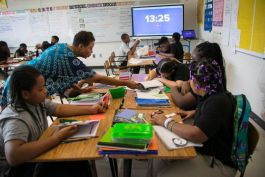
In this vision of good public education, students are thought to need intense behavioral control for their own good. Silent lunches, single-file marching in silence from class to class, and instant obedience are the hallmarks of the “no-excuses” approach. As Joan Goodman of the University of Pennsylvania has argued, the goal is submission. As Dr. Goodman put it,

To reach these objectives, these schools have developed very elaborate behavioral regimes that they insist all children follow, starting in kindergarten. Submission, obedience, and self-control are very large values. They want kids to submit. You can’t really do this kind of instruction if you don’t have very submissive children who are capable of high levels of inhibition and do whatever they’re told.

In New York and other big cities these days, this approach is often touted as the latest thing, a new idea to help low-income students overcome unfair social hurdles to achieve academic success. As I’m finding in the archives, however, it’s the oldest approach in the books.

LOOK AT ME

Notes from 1804…or is it 2016?

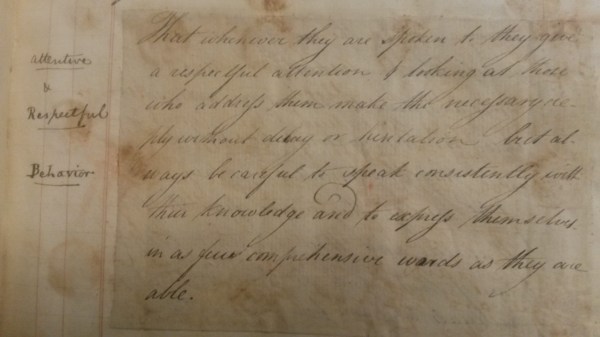
In an 1804 note, for example, school reformer Joseph Lancaster clarified the proper way schools must exert total control over students from low-income homes. As Lancaster argued,

That whenever they are spoken to they give a respectful attention by looking at those who address them make the necessary reply without delay or hesitation but always be careful to speak consistently with their knowledge and to express themselves in as few comprehensive words as they are able.

Way back then, urban schools in Philadelphia, New York, Baltimore, Albany, and elsewhere were already forcing low-income students to endure the rigors of a no-excuses approach. As Lancaster went on,

That they forbear talking to each other at meals—school hours or reading unless there be sufficient occasion. That they avoid running in the house but walk uprightly and take care to shut all doors after them (that they know out [sic] to be) with as little noise as possible.

That was what “no excuses” looked like 200 years ago. Public schools—REAL public schools—were supposed to be different. They were intended to be a meeting ground for all children. They were the embodiment of an American educational dream—a place where rich and poor could learn together, with equal chances for all.

I don’t blame parents and students for choosing the best available school. Not at all. But I lament the loss of the bigger dream, the hope that public schools would bring the entire public together.

Chicken? Egg?

At the very least, it has to be in the top five least surprising headlines for any experienced classroom teacher: “Home Life Influences School Performance.” Yet the idea that students’ lives outside of school are decisive parts of their school performance has had a surprisingly contentious history. This week we see a renewed interest in the interaction between educational performance and alleviation of poverty.chicken and egg

As I’m finding in the research for my new book, Americans have long assumed that improving schools would simply and quickly eradicate poverty. In the early 1800s, school-reform celebrity Joseph Lancaster promised that he could eradicate poverty with his simplistic school plan. His fans believed him. For example, New York Governor DeWitt Clinton lauded the Lancasterian reform

as creating a new aera [sic] in education, as a blessing sent down from Heaven to redeem the poor and distressed of this world from the power and dominion of ignorance.

Or, as the New York Free School Society wrote in 1814, thanks to the “Lancasterian system of education,”

the darkness, which has overshadowed the minds of the poor, will gradually disappear.

The assumption that better schools could “fix” poverty has been so strong that a fifty-year old sociological report on the subject remains controversial. As historian Leah Gordon has noted, the Coleman Report of 1966 suggested, in part, that changes in schooling could do little to improve students’ lives.

As James Coleman wrote,

For most minority groups, then, and most particularly the Negro, schools provide little opportunity for them to overcome this initial deficiency; in fact they fall farther behind the white majority in the development of several skills which are critical to making a living and participating fully in modern society. Whatever may be the combination of nonschool factors poverty, community attitudes, low educational level of parents-which put minority children at a disadvantage in verbal and nonverbal skills when they enter the first grade, the fact is the schools have not over-come it.

Coleman’s work was controversial at the time and it remains so. Can it really be true that schools don’t hold the golden ticket to economic mobility? That making schools better isn’t the first and best way to help people improve their lives, economically?

Or, as Coleman suggested, was the key to improving lives and increasing equality to be found outside of school, in factors such as family income, family education levels, and other non-school factors?

wash-learn-edited-900x0-c-default

This just in: Benefits for students benefit students.

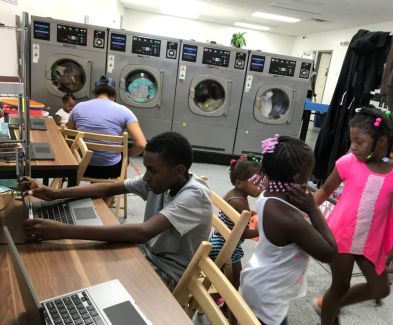
Writing in Chalkbeat recently, Matt Barnum reviewed studies of the relationship between improving students’ living conditions outside of school and those students’ educational achievement. Not surprisingly, when students had better home conditions, their school performance improved. As Barnum wrote,

A large and growing body of research . . . [shows] not only that poverty hurts students in school, but that specific anti-poverty programs can counteract that harm. These programs — or other methods of increasing family income — boost students’ test scores, make them more likely to finish high school, and raise their chances of enrolling in college.

Seems obvious, right? As every teacher knows, though, it really isn’t only one thing or another. In order for students to thrive in both school and life, it makes the most sense to improve everything at once.

If we want students to do better in life, we should work to improve schools. And if we want students to do better in school, we should work to improve their lives.