Charles Murray, Extremist?

No one doubts that scholar Charles Murray is controversial.  Best known for his book The Bell Curve, Murray ruffled feathers by asserting that some sorts of people are naturally less intelligent than others.  Though he denies every accusation of racism, Murray’s reputation has caused the administration of Asuza Pacific University to abruptly cancel Murray’s upcoming campus talk.

Has Murray’s reputation as a racist caused him to be seen as too extreme even by administrators at conservative Christian colleges?  The leaders of APU, for example, worried that Murray’s talk might be hurtful to “our faculty and students of color.”
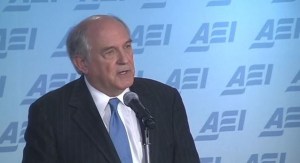
Scholar?  Or Racist?  Can He Be Both?

Scholar? Or Racist? Can He Be Both?

After all, Murray has been labeled as a “white nationalist” by the Southern Poverty Law Center.  Murray, the SPCL charged, uses

racist pseudoscience and misleading statistics to argue that social inequality is caused by the genetic inferiority of the black and Latino communities, women and the poor.

For his part, Murray accuses Asuza Pacific of pusillanimity and closed-mindedness.  In an open letter to APU’s students, Murray challenged them to think for themselves.  Murray invited students to explore his website and read some of his publications.  The more you know about me, Murray suggested, the harder it will be for you to take these accusations of extremism seriously.  “The task of the scholar,” Murray told APU students,

is to present a case for his or her position based on evidence and logic. Another task of the scholar is to do so in a way that invites everybody into the discussion rather than demonize those who disagree. Try to find anything under my name that is not written in that spirit. Try to find even a paragraph that is written in anger, takes a cheap shot, or attacks women, African Americans, Latinos, Asians, or anyone else.

There is no reason, Murray concludes, why students should not listen to talks by “earnest and nerdy old guys” like Murray.

This cancellation of Murray’s talk raises key questions.

First of all, does the goal of intellectual diversity on college campuses include the inclusion of unpopular conservative ideas?  We’ve seen recently examples of speakers protested against at Montana Tech for their support of creationism, pro-life student groups at Yale being refused fellowship in a social-justice club, and Steven Hayward’s lonely life as a token conservative campus intellectual at Colorado.

Second, what does it mean that this cancellation comes from a relatively “conservative” campus?  APU is one of the oldest evangelical universities in the country.  No one could safely accuse the leadership of APU of pandering to the traditional secularist campus leftism run amok.  Yet this school’s leadership saw fit to cancel Murray’s speaking appointment due to worries about Murray’s reputation.

Finally, who decides which ideas are extreme?  By any measure, Charles Murray’s work has been part of recent mainstream American conversations about race, class, and society.  His 2012 book, Coming Apart, for example, was prominently reviewed by such leading publications as the New York Times, Wall Street Journal, and the New York Review of Books.  It does not make sense to suggest that Murray has only some sort of fringe status as a scholar.  Yet in this case, even a conservative Christian school saw Murray as too controversial to speak on campus.



“The Long Game” Is Coming to Binghamton

What do schools teach?  What SHOULD schools teach?  The problem is not that we don’t have an answer to this question.  The problem is that can’t agree on which answer is the right one.

Tomorrow night award-winning documentarian Trey Kay is bringing his latest radio documentary to the scenic campus of Binghamton University in sunny Binghamton, New York.  This work, “The Long Game: Texas’ Ongoing Battle for the Direction of the Classroom,” explores school politics in the Lone Star State.  As ILYBYGTH readers know well, those Texas politics tend to be more exciting versions of the sorts of school fights we hear all over the country: Can cheerleaders use the Bible at public-school football games?  Can textbooks preach a neo-Confederate vision of US History?  Can creationism and evolution jostle along side-by-side in public-school science classes?

long gameThe battles in Texas schools reflect our cultural disagreements over the proper form of public schooling.

Tomorrow evening, Trey will share an excerpt from his earlier documentary, “The Great Textbook War.”  Then we’ll listen to “The Long Game.”  Afterwards, we’ll benefit from Trey’s commentary, as well as that of world-renowned historian Jonathan Zimmerman of New York University.  Binghamton’s own Matt McConn, a recent émigré from Houston public schools, will also join the panel.

Unfortunately, we won’t be web-streaming the event.  But for all those who can make it to the Binghamton area, you are most welcome to attend.  The fun will begin at 6 PM, Thursday, February 27, in University Union room 120, on the campus of Binghamton University.  The event is free and open to the public.  Pre-registration has closed, but everyone is still welcome to come by without registration.

What Does Your Kid Sing in the Bathroom?

In the pages of Christianity Today, Andrea Palpant Dilley makes the case for private Christian schooling.  Her best argument?  Thanks to her new Christian school, Dilley’s daughter now sings “Holy, Holy, Holy” while going to the bathroom.

Dilley’s being humorous, of course, but her main point is this: despite legitimate arguments among evangelical Christians over the proper type of schooling, a good Christian school can push young people in healthy Christian directions.  A good school can help turn their souls and minds to the beauties and challenges of living a faith-filled life.  Does a Christian school guarantee that each kid will grow up to be a good Christian?  No.  But it gives young people a different set of mental furniture with which to fill their young heads.  Instead of singing the Ninja Turtles theme song, Dilley’s daughter sings “Holy, Holy, Holy.”

As I’ve reviewed in some of my academic publications, the decision to send children to private Christian schools is not a simple one.  Many Christian schools have been accused of being nothing more than “segregation academies.”  In practice, though, the racial politics of private schooling includes complicated decisions about where to send our children.

We have a few academic studies of these sorts of schooling decisions.  One 1991 study from Stanford wondered why parents chose Christian schools.[1]  Not surprisingly, the question turns out to be remarkably complex.  School founders and parents offered a mélange of explanations for their choice of a private Christian school, from bad discipline at public schools to creationist belief.  Similarly, a 1984 study from Philadelphia found that parents had many reasons for choosing private Christian schools.[2]  Again, parents listed public-school factors ranging from “secular humanism” to drug use and poor discipline.

Moreover, as Dilley notes, some Christian parents insist their children should remain in public schools in order to provide needed moral backbone in struggling schools.  Fair enough, Dilley acknowledges.  But for her daughter, the “Christian-school bubble” was the right choice.  Though the family had to scrape together money for tuition, Dilley’s daughter is able to attend a school that includes authentic diversity.  More important to Dilley, a Christian school also lets Dilley’s daughter learn the rich heritage and faith of evangelical Christianity.


[1] Peter Stephen Lewis, “Private Education and the Subcultures of Dissent: Alternative/Free Schools (1965-1975) and Christian Fundamentalist Schools (1965-1990),” PhD dissertation, Stanford University, 1991.

[2] Martha E. MacCullough, “Factors Which Led Christian School Parents to LeavePublic   School,” Ed.D. dissertation, TempleUniversity, 1984.

Registration Is Open!

You are invited.

In a few weeks, Binghamton University’s Graduate School of Education will be hosting a terrific event.  Documentarian Trey Kay will be sharing his new radio documentary, “The Long Game: Texas’ Ongoing Battle for the Direction of the Classroom.”  You probably remember Trey from his award-winning documentary about the textbook battle in West Virginia, 1974-1975.  In his new work, Trey explores the themes so close to the hearts of ILYBYGTH.  Should schools teach creationism?  Should they teach sex?  If so, how?  And what sorts of history should public-school students learn?  Should students be taught that America is awesome?  Or that the United States has some skeletons in its closet?  There has been no place more interesting than Texas to see these politics in action.

long game

After the listening session, Trey will offer a few comments.  He’ll be joined by the world-famous historian Jonathan Zimmerman of NYU.  ILYBYGTH readers will likely know about Zimmerman’s books, including especially his seminal work Whose America.  In addition, BU faculty member Matt McConn will say a few words.  McConn is new to New York, fresh from a long career as a teacher and school administrator in Houston.

There will even be cookies.

So please come on down if you’re in the Upstate area.  It will take place on Thursday, February 27, at 6 PM, in room G-008 in Academic Building A, on the beautiful main campus of Binghamton University.

We’d love to have you.  The event is free and open to all, but registration is required.  To register, please go to the BU registration site.

Jesus in Public Schools: In through the Back Door?

Is it okay for religious missionaries to use public schools as recruiting grounds?

Usually we say no.  But what about when the religious missionaries just want to help struggling districts?  What if they promise to leave the Jesus at the door and just provide social services to low-income students?

In the pages of Christianity Today we read of the public-school leadership of evangelical Don Coleman.  Coleman recently won election as chair of Richmond, Virginia’s school board.

For those of us who watch the intersections of public education and religiosity, ought we be concerned by Coleman’s attitude that “education is one of the greatest open doors for urban missions”?

According to the Christianity Today piece, Coleman supports a heavily intertwined church and state.  Local churches “adopt” students, in order to help students overcome significant personal problems.  Coleman wants local churches to become so helpful to schools in low-income areas that the public schools eventually welcome churches’ help.

The story raises some tricky questions.  Personally, I think a students-first approach is a good idea.  As Coleman says, “We don’t fight over prayer.”  Why can’t churches help struggling public schools?  Seems like a win-win.  Seems like someone would have to be pretty heartless to oppose helping a young woman go to college while the rest of her family languishes in jail.

But the underlying issues don’t seem any different from other school-church cases.  Constitutionally, public schools ought to be institutions in which all students are made to feel welcome, regardless of religious or non-religious background.  What about non-Christian students in Richmond schools?  Will they feel equally at home in schools “adopted” by evangelical Christian churches?  Or what about atheist students?  Ought public schools be places in which they have the gospel preached to them by outside missionaries?

Worst of all, we must ask if there is a racial or class bias at play here.  Richmond’s schools are heavily black and poor.  Would students in a more affluent or whiter school district be subjected to religious proselytization as part of their school day?  Or, if they were, wouldn’t activist groups such as the Freedom From Religion Foundation or the Americans United for the Separation of Church and State have more to say about it?


Save the Date!

Keep your evening free on Thursday, February 27th.  Here on the beautiful campus of Binghamton University in sunny Binghamton, New York, we’ll be hosting a listening session and panel discussion about Trey Kay’s new radio documentary, “The Long Game: Texas’ Ongoing Battle for the Direction of the Classroom.”

Readers may remember Trey Kay’s earlier award-winning radio documentary, “The Great Textbook War.”  In that piece, Trey explored the 1974-1975 battle over schooling and textbooks in Kanawha County, West Virginia.  In that fight–a fight that is also the subject of a chapter in my upcoming book–conservatives worried that a new textbook series presented students with perverted values and distorted grammar.

In his new documentary, Trey looks at ongoing ideological battles in Texas.  As filmmakers such as Scott Thurman and activists such as Zack Kopplin have demonstrated recently, there has been no better field for exploring cultural conflicts in education than the great state of Texas.

The details of our upcoming February 27 event are not yet finalized, but the general plan is clear.  We’ll be listening to “The Long Game,” then Trey and NYU’s electrifying historian Jon Zimmerman will offer a few comments, followed by a general discussion and Q & A.  I’ll post more details as they come available.

Learning by Discipline

What should schools do with students who behave badly?  Who assault other students?  Who treat teachers disrespectfully?

A new announcement about school discipline from Education Secretary Arne Duncan and Attorney General Eric Holder might drive some conservative pundits to distraction.  Discipline, the two leading officials of the Obama Administration announced yesterday, must be more sensitive to student background and more responsive to individual situations.  Blanket zero-tolerance policies, they proclaimed, lead to worse school discipline, not better.

Those zero-tolerance policies, however, grew out of a groundswell of popular conservative opinion throughout the 1980s and 1990s.  Conservative commentators and activists long complained that schools treated students too gingerly.  Good old-fashioned discipline, some conservative writers insisted, would help return schools to their proper role.  Instead of being places where polite students and teachers cower and wince at the domineering swagger of loud-mouthed punks, schools should be calm and orderly places where infractions of the rules are not tolerated.

Some studies have demonstrated the central importance of a reinvigorated school discipline to many conservative parents in the 1980s.  One Stanford study[1] of two new fundamentalist schools in the 1970s and 1980s found that leaders put bad discipline in public schools as one of their top reasons for opening their own school, right up there with “secular humanism,” “evolution teaching,” and the fact that “kids weren’t learning.”  In a fundamentalist school that opened in September 1974 with a grand total of eleven students, one teacher informed the Stanford researcher that most parents assumed that the fundamentalist school was “solving discipline problems the public schools could not.”

Another study, this one from Temple University in Philadelphia,[2] found that parents listed poor discipline as one of their top reasons for abandoning public schools in favor of private Christian ones.  Nearly 65% of switching parents listed “discipline” as a leading reason for changing schools.  By way of comparison, just over 68% of parents listed “secular humanism” as a primary reason for their switch.

It may come as no surprise that some conservative parents choose Christian schools out of fear of disorderly public schools.  Leading conservative religious writers throughout the 1980s insisted that public schools had utterly abandoned all attempt at imposing discipline.  Jerry Combee, for example, warned readers in a 1979 book,

Without Biblical discipline the public schools have grown into jungles where, of no surprise to Christian educators, the old Satanic nature ‘as a roaring lion, walketh about, seeking whom he may devour’ (I Peter 5:8).  Students do well to stay alive, much less learn.

Similarly, in his 1983 book The Battle for The Public Schools, blockbuster fundamentalist author Tim LaHaye insisted that one of the vital reforms that could save education was a return of traditional discipline.  As LaHaye put it, “We must return discipline, authority, and respect to public schools”

In 1986, conservative Texas school watchdogs Mel and Norma Gabler asked readers, “Why has discipline become so bad that policemen must patrol the halls of many schools?”  The Gablers’ answer was simple:

We were taught that if you plant potatoes, you get potatoes.  If you plant rebellion and immorality in children’s minds by teaching them that only they can decide what is right and wrong, that parents are old-fashioned, and that the Judeo-Christian Bible is a book of fairy tales, then what can you expect?  Garbage in—garbage out!

These conservative critiques of the sorry nature of school discipline were not limited to conservatives of a primarily religious background.  After his turn as Education Secretary under Ronald Reagan, William J. Bennett lamented the sorry state of school discipline.  In his 1994 book Index of Leading Cultural Indicators, Bennett cited a fraudulent but evocative historical comparison:

In 1940, teachers identified talking out of turn; chewing gum; making noise; running in the halls; cutting in line; dress code infractions; and littering [as “top problems”].  When asked the same question in 1990, teachers identified drug abuse; alcohol abuse; pregnancy; suicide; rape; robbery; and assault.

Due at least in part to this widespread sense that American public schools had reached a nadir of weak discipline, many states and school districts imposed variants of “zero-tolerance” policies.  According to these policies, student infractions would be met with an escalating series of ever-harsher punishments, including out-of-school suspensions and reports to police.  Politicians could claim that they were taking action to ensure a no-nonsense disciplinary attitude in America’s schools.

Yesterday’s announcement by Arne Duncan and Eric Holder represents the Obama administration’s repudiation of that zero-tolerance approach.  Though “zero-tolerance” may sound good, Duncan told an assembled crowd at Frederick Douglass High School in Baltimore, “Too many schools resort too quickly to exclusionary discipline, even for minor misbehavior.”  According to the Baltimore Sun, Duncan described a new federal approach that would de-emphasize suspensions and put more emphasis on creating nurturing in-school environments.  Attorney General Holder agreed.  Principals, not police, should be responsible for school discipline, Holder insisted.

Will conservatives care about this shift in school disciplinary policies?  If history is any guide, I’m guessing that conservatives will paint this new policy as yet another soft-headed, over-complicated liberal approach to a simple problem.  Folks such as Eric Holder and Arne Duncan may worry that zero-tolerance policies unfairly target racial minorities, but I’ll be surprised if conservative educational activists don’t complain that such social-science talk only obscures a far more obvious point.

If students misbehave in school, conservatives will likely insist, they should not be allowed to be in school.


[1] Peter Stephen Lewis, “Private Education and the Subcultures of Dissent: Alternative/Free Schools (1965-1975) and ChristianFundamentalistSchools (1965-1990),” PhD dissertation, StanfordUniversity, 1991.

[2] Martha E. MacCullough, “Factors Which Led Christian School Parents to LeavePublic   School,” Ed.D. dissertation, TempleUniversity, 1984.

Fundamentalist Ducks

Okay, okay, I admit it.  I’ve been itching to write something about the recent Duck Dynasty culture-war imbroglio.  But until now there didn’t seem to be much worth saying.  One sentence said it all: Famous redneck shows ugly blind spot in racial issues and homosexual identities.  Didn’t seem like much more needed talking about.

For those of you who live in caves, bearded patriarch Phil Robertson ruffled feathers with recent ignorant and hateful comments about homosexuals and racial history.  In all his Louisiana life, he told a GQ reporter, he never saw an African American who seemed upset about lacking basic civil rights.  And homosexuals, he opined, should learn to prefer vaginas to men’s anuses.  After all, as Robertson concluded with invincible logic, “I mean, come on, dudes!  You know what I’m saying?”

Until today, everything I’d read about the scandal either defended Robertson’s right to his theology or attacked him for his hate.  But this morning I came across the comments of the brainy conservative Rod Dreher in the pages of Time.com.  For those not familiar with Dreher’s story, he moved back to his small-town Louisiana roots from a go-go New York media career after a family tragedy.

Dreher hit the nail on the head.  While Dreher doesn’t agree with Robertson’s positions, he remarked on the ridiculously excessive shock expressed by many media mavens.  Too many of those “culture-makers,” Dreher lamented,

are often every bit as parochial as those they condemn, but flatter themselves that they are the tolerant, cosmopolitan ones. I have lived in Manhattan, and I live once again in my tiny south Louisiana hometown. To paraphrase Solzhenitsyn, the border between narrow-minded and tolerant runs not between city and country, North and South, degreed and uneducated, but down the middle of every human community and every human heart.

. . .

The Duck Dynasty mess revealed that not all fundamentalists live in the Bible Belt, and that some of the biggest hicks live in Hollywood. The Duckman’s win is a score for authentic diversity and pluralism in the public square, and a victory for the right to be wrong without being ruined.

Hear hear.

When I began my current job as a university professor, I gave a talk about my dissertation research.  That work—which became my first book—concerned the first generation of American fundamentalists.  I soon realized that my tolerant, cosmopolitan university audience contained more than its share of Dreher’s hip hicks.  Not the entire audience, by any means, but certainly an influential group.  These culture-makers did not hope to understand fundamentalists; they did not seem interested in puzzling out the intellectual world I had tried to portray.  Instead, they only rushed to demonstrate their shock and horror at the ideas of people very different from themselves.

At the end of the talk, one member of my academic audience raised her hand and asked in a frustrated tone, “What is WRONG with these people?”  Heads nodded throughout the room.  The person who asked the question was not dumb, was not ignorant.  She was a prolific researcher and dedicated teacher.  In fact, she had worked throughout her career to make schools more inclusive for all sorts of students.  Yet she saw no contradiction in dismissing the thinking of a large percentage of Americans as “these people” out of hand.

Like Dreher, I don’t think Robertson’s comments are worth talking about, much less defending.  But the reaction to his comments can tell us a good deal about the current state of America’s intellectual myopia.   It serves as a sobering reminder of the widespread and unacknowledged ignorance among many Americans about what America is really like.


Year-End Quiz: Do You Speak Conservative?

It’s the end-of-the-year rush for every sort of retrospective.  Can you take the ILYBYGTH challenge?

Thanks to the folks at the Texas Freedom Network Insider, we have several lists of the most contumacious quotes from America’s conservative punditry.  One list describes the year in creationist/no-climate-change quotations, one from the anti-Islam contingent, and one from the continuing “War on Christmas” campaign.

Here’s the idea: The Insider compiled these quotes as a demonstration of the intellectual outrageousness of contemporary conservatism.  Here at ILYBYGTH, we have a different goal: Can we understand what these conservatives meant?  Can we see the point each speaker hoped to make?  Of course, we know that some quotations are just plain dumb.  This is not only true for conservatives, of course.  Every sort of political blabbermouth can say stupid stuff.  But in some cases, it seems that the quips that seem the most outrageous to liberal secular folks like me actually represent a coherent, compelling conservative worldview.

If you call yourself a conservative, can you explain these quotations in terms that might seem less outrageous to non-conservatives?

Or, if you think of yourself as non-conservative, can you try to put yourself deep enough into the conservative mindset to understand what each speaker was getting at?

So put down the pumpkin pie, stop donning your gay apparel, and try the quiz!

Quote #1: Pat Robertson on the definition of Islam:

I hardly think to call it a religion, it’s more of — well, it’s an economic and political system with a religious veneer.

Quote #2: Rafael Cruz, father of obstreperous Tea-Party favorite Ted Cruz, on the connection between evolution and communism:

You know most Americans have their head in the sand about evolution. I’ve met so many Christians that tell me ‘well, evolution is a scientific fact.’ Baloney! I am a scientist, there is nothing scientific about evolution. But you know something, Karl Marx said it, ‘I can use the teachings of Darwin to promote communism.’ Why? Because communism, or call it socialism if you think communism is too hard a word, necessitates for government to be your god and for government to be your god they need to destroy the concept of God. That’s why communism and evolution go hand in hand. Evolution is one of the strongest tools of Marxism because if they can convince you that you came from a monkey, it’s much easier to convince you that God does not exist.

Quote #3: Fox News’ Megyn Kelly, complaining about efforts to imply that Santa was not white:

Just because it makes you feel uncomfortable doesn’t mean it has to change. Jesus was a white man, too. It’s like we have, he’s a historical figure that’s a verifiable fact, as is Santa, I just want kids to know that. How do you revise it in the middle of the legacy in the story and change Santa from white to black?

How bout it?  Can you beat this year-end quiz?  What did these conservatives mean?  For folks like me, can you do the mental gymnastics to put yourself into a world in which these statements make sense?  Be sure to check out the fuller lists at the Texas Freedom Network Insider.

Happy 2013 and best wishes as we slide into 2014!


School Is Life

For one homeless girl in New York City, school is life.  In any case, that’s the story told recently in a New York Times feature article.  “For Dasani,” the story opens,

School is everything—the provider of meals, on-the-spot nursing care, security and substitute parenting.

In the progressive tradition, as Bill Reese demonstrated so powerfully almost thirty years ago in Power and the Promise of School Reform, this vision of school as social-redistribution center fulfills a long-held and deeply cherished ideal.

But how do conservatives view this use of public schools?

To be sure, in various instances, as I noted in an article several years ago in Church History, conservatives have also taken advantage of the wide reach of public schools.  Conservative evangelicals, for example, have used schools as a convenient distribution network for Bibles and religious tracts.  But in general, conservatives in America have not yearned for redistribution the same ways progressives have.  Schools, many conservatives might agree, must be understood as educational institutions, not welfare agencies.  When public schools try to do too much, some conservatives might argue, they end up doing nothing at all.

When school reform has worked for conservatives, Ross Douthat argued recently, it has been when market-based reforms have made schooling more equitable for low-income and minority students as well as affluent whites.  That sort of concrete reform, Douthat wrote, has been the primary success conservatives have scored in overcoming their legacy as the party of white racism.

But that is not the sort of success trumpeted in the NYT feature.  Those market reforms, the article argues, merely move schooling and public services farther out of the reach of girls like Dasani.

No, the article concludes, for homeless youth like Dasani,

school and life are indistinguishable.  When school goes well, she is whole.  When it goes poorly, she can’t compartmentalize like some students, who simply ‘focus’ on their studies.

According to the New York Times feature, Dasani’s life as a homeless eleven-year-old in glitzy New York City is rough.  She shares a room in a shelter with her entire large family.  They endure infestations of mice, roaches, and sexual predators.  In contrast, Dasani’s classroom is a “cozy haven of book-lined shelves and inspirational words scrawled in chalk.”  At school, Dasani gets attention from a brilliant and caring classroom teacher, as well as a social worker and medical professionals.

For us at ILYBYGTH, this seems like a perfect example of a perennial question at the heart of educational culture wars.  What are schools for?  Ought they provide all the services needed by every child, no matter how extensive those needs might be?  Or should schools limit themselves to a narrower definition of “education,” focusing on academic work and leaving families to provide the rest?

In America’s twentieth century, one’s position on this question often served as a quick-and-easy definition of “progressives” vs. “conservatives.”  Progressives wanted schools to think of education as a whole-life question, meeting children where they were and providing every social service possible to ensure a high-quality education for everyone.  Conservatives, in contrast, have pushed for the elimination of “fads and frills” from public schools.  The government—in school or anywhere else—ought not take primary responsibility for children or anyone else.

In this story, we see one example of the way this long-running disagreement has been won, largely, by the progressive vision.  Dasani’s life is far from easy.  But her ability to secure a range of services through her public school demonstrates the long-run triumph of one central progressive idea.