Is Sex Ed Religious Persecution? Is Evolution?

Am I persecuted if my kid is taught sex ed that goes against my religious beliefs?  That’s the question coming out of Arizona this morning.

And it has echoes far beyond the questions of contraception and sex ed.  If kids have a constitutional right to protection from ideas that challenge their religions, it will change the ways we teach evolution, history, literature…really, everything.  But so far, courts have generally not recognized conservatives’ claims of religious persecution. The good news is that there is a simple solution, though it’s one that everyone might hate.

But that doesn’t stop conservatives from making their cases.  As the New York Times reports, a new sex-ed textbook controversy is roiling school politics in Arizona.  Back in 2012, conservatives pushed through a state law mandating that adoption be given preferential treatment in schools.  That is, children in Arizona public schools have to be nudged toward thinking of adoption as a more moral choice than abortion.  An alert parent noticed that a commonly used biology textbook discussed contraception, including the drug mefipristone. According to the NYT, mefipristone can be used to terminate a pregnancy.

A pro-choice lemur...

A pro-choice lemur…

In Gilbert, Arizona, a suburb of Phoenix, the school board voted narrowly that the information violated the 2012 law. What to do? The Gilbert school board ruled that two textbook pages must be removed, somehow.

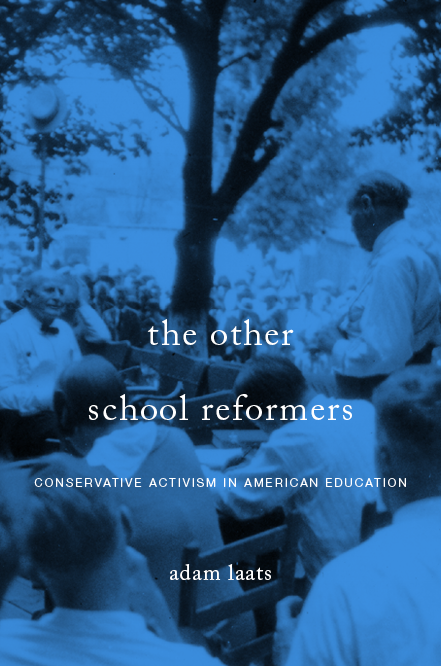
So far, so ho-hum.  In school controversies, textbooks have been snipped, blacked-out, removed, even burned.  What’s more, the narrative told by conservative school board member Julie Smith seems almost like pages from a tired old script. As I note in my upcoming book about educational conservatism in the twentieth century, nearly every conservative activist has told a similar story. From the 1920s to the 1970s, conservatives have insisted that they were floored by the salacious, socialist, or heretical material their kids brought home from school.

Mrs. Smith brings this tradition into 2014. As she told the New York Times, when her son told her what he was learning about contraception, “I almost drove off the road.”

But Mrs. Smith did not stop with this old chestnut. She also insisted that including this material in textbooks represented an unconstitutional abuse of her religious freedom. As she told the NYT, by having her son read about contraception, the schools “have violated my religious rights.”

Is Smith right? Do religious conservatives have a constitutional right to free exercise of religion in public schools? Is that right violated when public schools force students to learn ideas that contradict their religions?

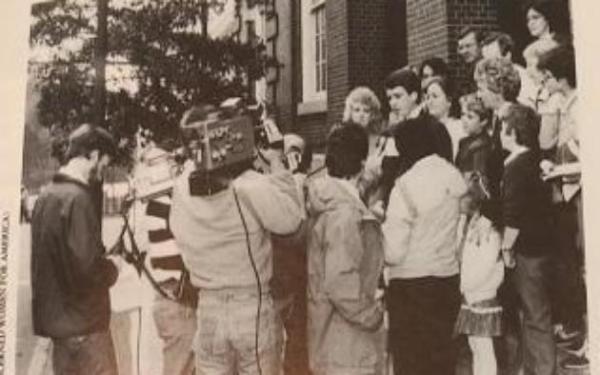
This question received the most thorough examination in the tortuous path traced by the case of Hawkins County, Tennessee, in the late 1980s. Parents complained that textbooks promoted a bevy of anti-Christian ideas, including secular humanism and occultism. These conservative parents wanted to have their children exempted from reading such anti-religious material.
Mozert makes his case...

Mozert makes his case…

The conservative parents had some initial success in court, but eventually the 6th circuit court ruled against them. In the opinion of that court, the children did not have the right to protection from exposure to mainstream ideas. If the children had been forced to perform religious acts, the court ruled, the parents would have had a better case. But public schools have a duty, not just a right, to expose children to the best current knowledge about every subject, including presumably sex ed.

It’s not for me to tell conservatives what to do, but in this case, it seems Julie Smith is pursuing a losing strategy. Claiming to be religiously persecuted because children are exposed to mainstream ideas is not going to work. If, instead, conservatives could claim that their children were being forced to perform religious acts, conservatives would have a better case.

And, IMHO, contraception is not the right issue for conservatives to pursue with this strategy. Public schools don’t FORCE students to use contraception. Schools simply give students information about contraception.

Conservatives might have a better shot with evolution. Folks like me want to give every person in the United States more information about evolution. There is nothing religious about this goal. For me and other evolution mavens, evolution simply represents the best current science, and students must be exposed to the best current knowledge in every field.

The way I see it, exposing students to knowledge does not violate anyone’s religious rights. But here’s the kicker: The fact that I have a secular purpose in teaching evolution does not mean that evolution does not have religious meanings for others. Again, I don’t want to dictate political strategy to conservatives, but it seems to me creationists could have some success if they claimed that their children have a constitutional right to a certain sort of protection from evolutionary ideas in public schools. Not a right to be protected from hearing or reading those ideas. That would count as simple exposure.

But creationist kids WOULD have a right to be protected from performing religious acts in public schools. For some religious groups, saying that humans evolved from other animals is a religious act. For some religious groups, saying that the earth is billions of years old is a religious act.

In other words, IMHO, public schools have a right and a duty to expose all children to the best current knowledge in all fields. In biology, that means human evolution without any supernatural guidance. In geology, that means an ancient earth and cosmos. At the same time, however, creationist kids have a right to freely practice their religions. And they have a right to insist that the government does not push religious actions upon them. If their religion forbids them from saying that the earth is ancient, kids have a right not to be coerced into saying such things.

This may seem like an unsolvable situation, but there is a simple solution. Public schools and public school teachers have a simple two-word answer to all these conundrums. Instead of pushing students to say that the earth is ancient and that humans have evolved, teachers need only to help students to understand that scientists think these things to be true.

By letting kids say “Scientists say” humans evolved; by letting kids say “Scientists say” the earth is ancient, public schools protect themselves from charges of religious indoctrination. And at the same time, creationists get schools that will not be hostile to their faiths.

The bad news for Julie Smith from Gilbert, Arizona is that she cannot claim any similar sort of constitutional protection. Even if the fact that her son is learning about contraception causes her to drive her car off the road, the public school is not persecuting her by teaching such things.
Binghamton: The Place to Be

If you care about our educational culture wars—and you know you do—there’ll be no better place to be in 2015 that Binghamton University in sunny Binghamton, New York. We’ll have two of the world’s best scholars coming to campus to talk about their work. They will share their research into some of the most confounding culture-war questions: Who decides how and what to teach about evolution? How has sex education spread worldwide?

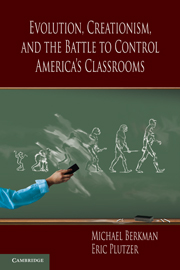
In late March, Professor Michael Berkman will be coming. Along with his colleague Eric Plutzer, Prof. Berkman published a bombshell book a couple years ago about the teaching of evolution in public high schools. Berkman and Plutzer are political scientists at Penn State. They got funding from the National Science Foundation to survey high-school science teachers about their teaching. Their results attracted a good deal of attention.

Required reading for anyone interested in evolution/creation issues

Required reading for anyone interested in evolution/creation issues

In the January, 2011 issue of Science (sorry, subscription required), for example, Berkman & Plutzer described the results of their survey. They found that about 13% of teachers taught creationism in public schools as science. Another roughly 28% taught recognizable evolution. The rest, roughly 60%, are the most interesting. This large majority of teachers reported that they taught a mish-mash of watered down evolution, religious- or religion-friendly ideas about creation, or a menu of evolution and creationism.

But the book was bigger than just this survey. As political scientists, Berkman & Plutzer argued that the important question was the way these decisions were made. Who decides what gets taught? State standards don’t do it. In states with good evolutionary science standards, teachers still teach non-evolution. Textbooks don’t do it. Glittering new science books with all the evolution bells and whistles can’t teach by themselves.

For Berkman & Plutzer, the answer was simple: Teachers. Teachers function as “street-level bureaucrats,” making daily decisions about what to teach and how to teach it. In most cases, teachers fit in with their local communities. If their communities want evolution to be taught, teachers teach it. But if communities want it watered down or kicked out, teachers do that, too.

Professor Berkman will be visiting our scenic campus as part of the Evolution Studies Program. We’re not sure yet what the focus of his talk will be, but he tells us he’s got some new data he’ll be sharing. Can’t wait to see what it is.

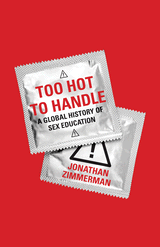
Our second campus visit will be from Professor Jonathan Zimmerman of New York University. Over a decade ago, Prof. Zimmerman defined the historical vision of America’s educational culture wars with his book, Whose America? In that volume, Zimmerman argued that two main tensions had divided Americans’ vision of proper education. Since the 1920s, conservatives and progressives had squared off on fights over patriotism and religion. Does loving our country mean teaching students to question it? Or to support it unhesitatingly? And should schools incorporate prayer and Bible-reading? Who gets included in history textbooks, and how?

Professor Zimmerman’s new book looks at sex education as a global phenomenon. Though the United States was an early exporter of sex ed, by the end of the twentieth century the US government joined some uncomfortable allies to battle sex education. As Zimmerman has argued, sex ed has created a new and sometimes surprising worldwide network of conservative alliances. For example, at a 2002 United Nations special session on children, US delegates joined Iran, Iraq, Sudan, Libya, and Syria in condemning a sex-ed proposal.

Who's for it?

Who’s for it?

When it comes to culture-war topics, national boundaries aren’t as important as we tend to think. It’s difficult for historians to look beyond them, though, due to language barriers and the high cost of research travel. In his new book, Prof. Zimmerman hopes to overcome those prosaic difficulties and tell the story of sex ed in its full global context.

And when he journeys north to our campus in early May, Zimmerman promises to share some of his insights from this book.

So whether you care about evolution, creationism, sex ed, history, school politics, school prayer, or any other culture-war issue, there will be nowhere more exciting than Binghamton University in 2015.

Be here or be square.

Who’s the HERO in Houston?

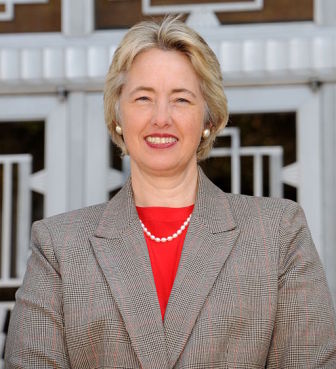
Turn ‘em over. That’s the order from Houston’s mayor to the city’s conservative pastors. According to Fox News, Houston Mayor Annise Parker has subpoenaed sermons from pastors. She wants to see if those folks are bashing homosexuality. Though she has backtracked recently, Mayor Parker accuses conservatives of bigotry and anti-gay hate speech. Most important, legally, she accuses them of using their pulpits for political agitation. Not surprisingly, conservatives have reacted with furious indignation.

Parker puts political pressure on pastors.

Parker puts political pressure on pastors.

At issue here is a new anti-discrimination ordinance in Houston, the Houston Equal-Rights Ordinance (HERO). Back in August, conservatives submitted a petition challenging the new rule. Among other things, conservatives worried, the rule would have forced Houstonians to allow women in men’s bathrooms, and vice versa. The city threw out the petition, claiming a lack of legitimate signatures. In response, conservatives sued.

The city ordered conservative pastors to turn over their sermons as part of the lawsuit. According to World Magazine, Mayor Parker tweeted her reasons for ordering the subpoena: “If the 5 pastors used pulpits for politics, their sermons are fair game. Were instructions given on filling out anti-HERO petition?”

Conservatives suspect more cynical motives. The activist group Alliance Defending Freedom jumped in to defend the pastors. The ADF accuses the mayor of quashing any political dissent. In a brief filed to fight the subpoenas, the ADF claimed,

The message is clear: oppose the decisions of city government, and drown in unwarranted, burdensome discovery requests. . . . These requests, if allowed, will have a chilling effect on future citizens who might consider circulating referendum petitions because they are dissatisfied with ordinances passed by the City Council.

Writing in Forbes Magazine, conservative intellectual David Davenport agreed. Davenport, former president of Pepperdine University, called Mayor Parker’s action “outrageous. . . . legal intimidation.”

Even the mayor herself might agree. According to World Magazine, the mayor’s office has backed off its initial subpoena claims. A city spokeswoman said the mayor now planned to “narrow the scope” of the subpoenas.

Writing from the sidelines, I can’t help but wonder if conservatives have this one right. I personally support rules such as HERO, and I think more and more Americans are with me on this one. To the chagrin of conservatives, religious opposition to equal rights for homosexuals is increasingly seen as bigotry and hatred. But that does not mean that Americans will stand by as religious speakers are hounded by aggressive and unconstitutional demands from a city government.

Whatever the legal merits of the case, headlines about subpoenaing sermons make the mayor look bad. It changes the culture-war discussion. Instead of framing Mayor Parker as the brave defender of equal rights for all, this kind of move makes her look like an anti-religion crusader. No matter how much Americans might be shifting towards acceptance of homosexuality, we still love our churches, and we love our freedom.

Why Don’t More College Christians Fight Campus Rape?

The fight against sexual assault on college campuses has cranked into high gear. At least one conservative intellectual is asking where the conservatives are in this fight. We could get even more specific: Where are all the campus Christians? Wouldn’t it make sense for conservative religious folks to lead the charge against drunken fornication?

California attracted attention recently for its new “yes means yes” law. Both (or all) partners in any sexual activity must give continuing and explicit consent to every new advance. Just because someone grinds on the dance floor, the reasoning goes, she or he has not consented to sex. Even the White House has gotten involved, launching a task force to investigate campus rape culture.

Allies in the fight against hook-up culture?

Allies in the fight against hook-up culture?

In this week’s Weekly Standard, Heather Mac Donald wonders why more conservatives aren’t participating in the current campaign against campus rape. As she puts it,

Sexual liberation is having a nervous breakdown on college campuses. Conservatives should be cheering on its collapse; instead they sometimes sound as if they want to administer the victim smelling salts.

She argues that the so-called “epidemic” of campus rape is a figment of the overheated leftist imagination. Yet Mac Donald acknowledges that college leftists have succeeded in their fight to redefine sexuality on many college campuses. They have done so, Mac Donald writes, by unintentionally creating a “bizarre hybrid of liberationist and traditionalist values.”

As we’ve seen, some evangelical groups have found themselves at loggerheads with secular schools. Why don’t they jump on this bandwagon? Could campus evangelical groups such as Intervarsity Christian Fellowship build bridges to campus feminists on this issue?

In the past, we’ve seen efforts in this direction. This same not-coalition of feminists and cultural conservatives has struggled to come together to fight against pornography.

Of course, what seems like an obvious partnership has even more obvious reasons to stay separate. Even when both groups staunchly oppose pornography or fornication, their yawning differences tend to split them apart.

The new batch of anti-rape rules, for example, never suggest that casual sex should be avoided. Rather, the rules imply that pleasurable, consensual sex is a valuable experience.  Schools should improve this experience, not eliminate it. In other words, the new campus affirmative consent rules do not hope to limit fornication, but rather to encourage it by making it safer and more pleasurable for all. As one proponent of affirmative-consent laws put it, “good communication between sexual partners can be fun, even sexy.”

It might make conservative campus Christians a little queasy to become political partners with activists who have this sort of attitude about the proper relationship between sexual partners. But historically, conservative evangelicals have managed to forge political partnerships with other groups they found theologically objectionable.

Perhaps the most dramatic example has been in the fight against abortion rights. As historians such as Daniel Williams have demonstrated, at the time of the Roe v. Wade decision, many conservative evangelical Protestants viewed the anti-abortion cause as a peculiarly Catholic issue. Yet over time, the pro-life cause united conservative Protestants with conservative Catholics. Though it may be hard to remember in retrospect, for decades—centuries even—conservative evangelicals viewed the Catholic Church as the embodiment of the Anti-Christ. For evangelicals to team up with Catholics required—for some—an enormous amount of nose-holding.

Couldn’t conservative evangelicals do the same here? They don’t need to agree with the sexual-liberationist ideology that guides many campus activists. Instead, they could partner with feminists to fight campus rape, while maintaining their own very different reasons for doing so.

Evangelicals and Homosexuality on the College Campus

Maybe President Lindsay feels better knowing that only high pressure can create diamonds. Because the leader of evangelical Gordon College is feeling intense pressure from two sides right now. On one hand, the school’s accrediting agency has threatened to take away its accreditation if Gordon does not revise its policy on homosexuality. On the other, the school’s conservative supporters insist the policy must stay in place. If history is any guide, it appears one group might make the crucial difference in this case.

Are all welcome?  MUST all be welcome?

Are all welcome? MUST all be welcome?

This Gordon-ian knot is one that all conservative evangelical colleges have tried to pick apart. Schools such as these are in a pickle: they need to remain intellectually respectable and financially viable, yet a decision either way threatens both intellectual consistency and the bottom line.

As I’m finding as I research my new book, similar schools have had a difficult time walking this line. In the 1930s, for example, Wheaton College leaders moved fast to bring Wheaton up to accreditors’ standards. As historian Michael Hamilton argued, the president at the time, Oliver Buswell, viewed accreditation as more than just a piece of paper. To Buswell, accreditation was the “one of the best ways to earn intellectual respect for fundamentalist Christianity.”

But college leaders such as Buswell were also under intense pressure to maintain both the appearance and the reality of theological steadfastness. Leaders needed to maintain the confidence of the evangelical community that their schools were not slipping into secularism. In 1929, for instance, Buswell withdrew from publication a controversial book he had written. Why? As he explained to a colleague, above all Buswell felt the need to keep “the confidence of fundamentalist leaders . . . in the administration of Wheaton College.”

Losing either accreditation or the respect of the “fundamentalist” community could mean a wasting death for an evangelical college. And the two have often pushed in opposite directions.

WWBD?

WWBD?

Much has changed since then, but President Lindsay at Gordon College finds himself coming under similar pressure from both sides. [Full disclosure: I worked with Michael Lindsay in the Spencer Foundation/National Academy of Education Postdoctoral Fellows program. I consider him a friend and colleague.]

For those who are just joining us, this story began back in July, when President Lindsay signed an open letter to President Obama about religious exemptions to an anti-discrimination law. Now, the question has become whether Gordon’s Statement on Life and Conduct violates the rules of its accrediting agency.

At issue is the Gordon ban on “homosexual practice.” The New England Association of Schools and Colleges has collaborated with Gordon in setting up a “discernment” group to examine the policy.  (As an aside, we could ask why only this part of the policy has come under investigation. After all, the Gordon policy also bans “blasphemy” and “profanity,” not to mention heterosexual sex outside of marriage. Doesn’t this impinge upon the free speech rights of potential students?)

For a host of reasons, the accrediting agency doesn’t care about blasphemy. But it is threatening to withdraw accreditation over the ban on “homosexual practice.” For Gordon College, loss of accreditation would have serious consequences. Its graduates would not necessarily be considered qualified for graduate school. Nor could they receive student loans backed by the federal government. Perhaps most important, though, loss of accreditation would be a symbolic slap in the face. Gordon would face the challenge of proving its continued intellectual respectability.

But that is not the only pressure facing Gordon right now. Just as President Buswell at Wheaton worried about both mainstream intellectual respectability and credibility within the world of conservative evangelicalism, so President Lindsay faces a double-sided threat.

Beyond accreditation pressure, Lindsay must consider the opinions of the far-flung community of conservative evangelicals. As one conservative pundit wrote recently in the pages of the Christian Post,

To Michael Lindsay, the gifted president of Gordon, and to the board of trustees, I remind you: Many eyes are watching you, knowing that the decisions you make could either strengthen or dishearten many other schools that will soon be put under similar pressure.

As this conservative writer worried, Gordon might be willing to “sell its soul” to maintain accreditation.  If it did, conservative students and parents might take their tuition dollars elsewhere.  But if it doesn’t it might lose accreditation.  Without that sort of mainstream credibility, students and parents might take their tuition dollars elsewhere.

So what is a conservative school leader to do? How can President Lindsay balance the pressure to reform with the pressure to hold fast to the faith once delivered to the saints?

In this case, there is a new wrinkle. Traditionally, alumni are one of the groups most likely to push school leaders to maintain conservative positions. Today, though, some Gordon alumni are hoping to convince Gordon to change its ways. A group of two dozen alums have published a letter encouraging Lindsay to remove any hint of anti-gay discrimination from Gordon’s policies.

In the past alumni have been one of the most vocal groups fighting any change at evangelical colleges. Conservative evangelical colleges have long been keenly aware of the pressures to modernize and secularize. Traditionally, alumni of these schools have been staunch foes of any perceived change, since any change could lead to an utter loss of the school’s steadfast character. Historian Michael Hamilton described this alumni attitude this way:

colleges, more than any other type of institution, are highly susceptible to change, and that change can only move in one direction—from orthodoxy toward apostasy. . . . The very process of change, no matter how slow and benign it may seem at first, will always move the college in a secular direction, inevitably gathering momentum and becoming unstoppable, ending only when secularization is complete.

In Gordon’s case, however, alumni—at least some of them—are pushing in the other direction. It is impossible to predict what will happen at Gordon. The board of trustees may decide this policy needs updating. Or they may not. And President Lindsay might decide that this language is a central part of the school’s evangelical character. Or he may not.

This case highlights the double pressure faced by conservative evangelical colleges. In a sense, they must serve two masters: the pressure to maintain a vague and shifting “respectability” with mainstream institutions; and the pressure to remain bastions of orthodoxy in a world hurtling headlong into secular mayhem.

From the Archives: Campus Rape in the 1930s

Do fundamentalist colleges encourage sexual assault?  It’s a terrible and difficult thing to talk about.  As we’ve seen in these pages, some alumni insist that fundamentalist schools force victims of sexual assault to blame themselves.  But we’ve also seen that sexual assault is not at all unique to religious schools.  As I continue the research for my new book about the history of evangelical colleges and universities, I’ve stumbled across a story that might shed light on these tricky questions.

Despot in Denver

Despot in Denver

The way we word the questions themselves is controversial: Are fundamentalist schools cults that pander to the lusts of authoritarian leaders?  Or do the strict sexual ethics of conservative evangelicalism help protect young women and men from predatory teachers and authority figures?

Critics of conservative evangelical colleges warn that that the pervasive “purity culture” of these schools leads directly to rape.  Bloggers such as Samantha Fields have accused fundamentalist colleges of blaming victims of sexual assault.  Journalists have blasted schools such as Patrick Henry College for fostering a rape-friendly environment.  Prominent evangelicals have suggested that the problem is not one of theology, but of an authoritarian institutional culture.  For example, Boz Tchividjian famously suggested that abuse can happen “in any culture, elevating leaders beyond accountability, leaving victims’ rights to their whim, and sidelining critics who challenge their rule.”

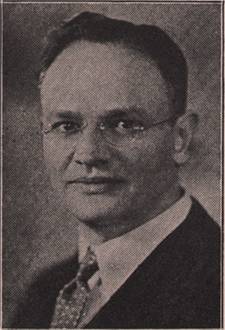
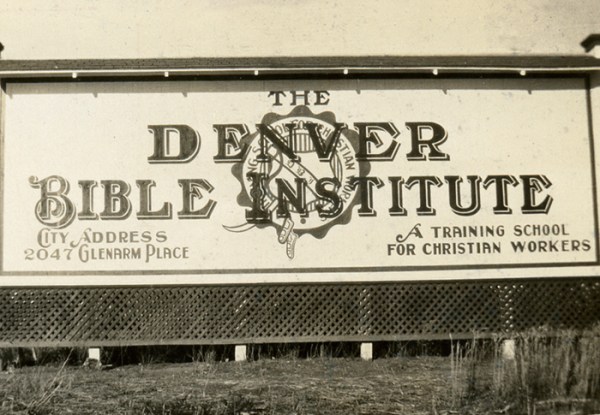
I’ve stumbled across a story from the 1930s that might illuminate the longer history here.  In 1936, a high-powered panel of fundamentalist leaders convened to investigate Denver Bible Institute (now part of Colorado Christian University).  At the time, DBI was led by charismatic founder Clifton L. Fowler.  Fowler wanted to join the Evangelical Teacher Training Association, and to do so ETTA demanded that rumors be cleared up.

Unfortunately for Fowler, an extremely disturbing picture emerged.  Fowler, the investigators concluded, ran DBI like a sex-crazed despot.  Students and faculty were pressured to declare lifelong commitments to the schools.  Married faculty members were pushed into pledging “continence.”  (I’m not sure what was meant by “continence” in this context.  Any suggestions?)  Students were encouraged to separate from parents and home churches.  Community members felt pressure to offer Fowler detailed confessions of their sexual sins.  And, yes, Fowler apparently routinely engaged in sexual activities with male students.

From one perspective, this historical episode might seem to confirm the dangers of authoritarian fundamentalist schools.  For as long as there have been fundamentalist schools, we might conclude, leaders have felt free to engage in predatory sexual practices.  Community members felt constrained by their own admitted sexual sinfulness from criticizing the dictatorial leadership.

On the other hand, as Michael Hamilton argued in his excellent 1994 dissertation, Fowler did not have a free hand to do as he pleased.  The accusations against Fowler forced DBI out of decent fundamentalist company.  Local fundamentalist churches cut off DBI.  The Evangelical Teacher Training Association would not let DBI join.  Fowler, in other words, was restrained in his behavior because of the network of fundamentalist schools and churches in which he worked.

As usual, history does not offer any pat solutions.  But this episode does demonstrate the long lifespan of these questions at fundamentalist schools.  It shows that school founders have always been accused of sexual predation.  But it also shows that fundamentalist leaders and communities worked hard to police their own ranks.

In this case, at least, both national leaders and local community members refused to look the other way.

Why Did This Politician Hold Up This Sign?

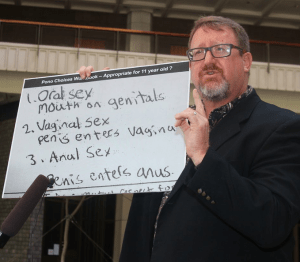
The politics seem obvious.  In this picture, Representative Bob McDermott of Hawaii displays classroom notes from an eleven-year-old student.  The point?  McDermott hopes to convince voters that young children should not be learning these things in school.  To us at ILYBYGTH, the campaign illuminates two leading traditions among conservative educational activists.

Too much too soon?

Too much too soon?

The tactic is part of McDermott’s campaign against a new sex-ed program in Hawaii, “Pono Choices.”  Fans of the program insist that it is “medically accurate and age appropriate.”  Representative McDermott disagrees.  And in his activism, McDermott leans heavily on a couple of tried-and-true conservative traditions.

First, McDermott objects to the experimental nature of the program.  As McDermott complained,

Parents simply were not informed that their kids were being used as human guinea pigs for research. This is a monumental breach of trust between the DOE and the owners of the system, the parents.

The language of the “guinea pig” has long been a favorite of conservative educational activists.  Recently, pundit Michelle Malkin blasted the Common Core State Standards with precisely this same language.  “Our kids,” Malkin insisted, “are not anybody else’s guinea pigs.”

Just as central, McDermott is using the language of cultivated ignorance.  For just as long as conservatives have worried about their children being turned into guinea pigs, they have fought to ensure that children are kept ignorant of certain ideas.  In many cases, conservatives don’t dispute the truth of those ideas.  They simply insist that certain truths should be kept away from children of a certain age.

Obviously, one doesn’t have to be a “conservative” to agree that some images and some ideas are not appropriate for some age groups.  Films and other media are labeled by age-appropriateness.  Some video games come approved for “mature audiences” only.

But in culture-war battles over sex, the desire to keep children deliberately ignorant of certain facts becomes controversial.  In the case of sex education, some conservatives tend to fight for more ignorance for longer.  Progressives and public-health types tend to argue for more knowledge earlier.

In this case, Representative McDermott is clearly hoping that a little street theater will help his case.  How many parents, McDermott might ask, want their children’s school notebooks to look like this?


Don McLeroy’s Long Game

What do Phyllis Schlafly, Moses, and country/western music have in common? They all get happy shout-outs in new history textbooks in Texas.  Or at least, that’s what conservative education leaders wanted.  As Politico reported yesterday, new history textbooks in Texas are causing a stir.  But this time, it is liberal activists, not conservative ones, who are denouncing the textbooks as biased and ideological.

What Hath McLeroy Wrought?

What Hath McLeroy Wrought?

The new textbooks were written to satisfy new standards approved years ago by the Texas State Board of Education.  Back then, conservatives on the board, led by the genial Don McLeroy and the obstreperous Cynthia Dunbar, pushed through new standards that warmed the hearts of conservative activists.

No one who watched Scott Thurman’s great documentary about these Revisionaries can forget the moments when the SBOE debated including more country-western music and less hip hop.  More positive statements about Reagan and the National Rifle Association.  More happy talk about America’s Christian past and less insistence on the horrors of racial segregation.

The Revisionaries

The Revisionaries

As Don McLeroy said at the time, “America is a special place and we need to be sure we communicate that to our children. . . . The foundational principles of our country are very biblical…. That needs to come out in the textbooks.”

Now those changes in the Texas standards have shown up in new social-studies textbooks.  As Stephanie Simons reports in Politico, liberals have complained that the new texts are woefully biased.  In some spots, the books apparently knock Affirmative Action.  They pooh-pooh the benefits of taxes.  They imply that racial segregation was really not so bad.

For those who know the history of America’s educational culture wars, this seems like a drastic turnabout.  Throughout the twentieth century, conservative school activists complained that they had been locked out of educational influence by a scheming leftist elite.  Textbooks and standards, conservatives complained, had been taken over by pinheaded socialist intellectuals.

In one of the most dramatic school controversies of the twentieth century, for instance, conservative leaders lamented the sordid roots of new textbooks.  That battle took place in Kanawha County, West Virginia, across the tumultuous school year 1974-1975.  Conservatives were disgusted by the sex and violence embedded in new literature textbooks.  But some of them weren’t surprised.

Conservative leader Elmer Fike told readers that the textbooks were bound to be rotten.  In Fike’s opinion, conservatives didn’t even need to read the books.  As he explained,

You don’t have to read the textbooks.  If you’ve read anything that the radicals have been putting out in the last few years, that was what was in the textbooks.

As the Kanawha County battle ground on, California’s conservative celebrity schoolman Max Rafferty came to town.  Rafferty, too, told a crowd of West Virginians that they shouldn’t put any faith in textbook publishers.  Those publishers, Rafferty explained, only wanted to make a buck.  As he put it,

They have no particular desire to reform anybody, do anybody any good or find a pathway to heaven.

These days—in Texas at least—the shoe is on the other foot.  The conservative standards that the state adopted in 2010 have pushed market-conscious textbook publishers to come up with books that meet them.  And at least some conservatives are delighted with the success of their long game.  As conservative school board member David Bradley told journalist Stephanie Simon, liberals who complain about biased textbooks can lump it.  “They need to put on their big-girl panties,” Bradley crowed, “and go run for office.”


Kids: You’re Not Really Gay

What should conservatives tell gay kids?  One writer suggests that kids should learn that they’re not really gay.  But that writer, Michael Hannon, also wants us to tell non-gay kids that they’re not really straight.

Hannon’s original argument suggested that the construction of the notion of sexual identities in the nineteenth century doomed conservative Christians to a double danger.  First, it led some people to identify as homosexuals.  According to Hannon, such an identity enshrines sinful behavior as the core of a person’s identity.  To Hannon, anyway, it seems there is no moral way to have sex as a homosexual, since gay marriage is not for him a moral possibility and sex outside of marriage is immoral.

But heterosexuality is just as bad.  By allowing conservatives who identify as heterosexuals to rest satisfied that they had the “right” sexual identity, heterosexuality left people clueless about the abundant dangers of the entire idea of sexual identity.

In other words, if I understand him correctly, Hannon hoped religious conservatives would take their argument up one level.  Instead of suggesting that homosexuality was sinful and heterosexuality was not, Hannon wants us to recognize that the concept of a sexual identity—any sexual identity—was deeply problematic.  As he elaborated in a recent follow-up, Hannon argued that the real goal of religious people must not be Hollywood’s marriage-as-happy-ending, but a more complicated goal of spiritual friendship.

This is not the usual semi-hysterical “homosexual agenda” talk we hear from some religious pundits.  Over and over, conservative activists have warned that “sneaky” homosexuals are using public schools to infect young minds with gayness.  Hannon is making a much more subtle argument.

To be clear, Hannon does indeed think that homosexuality tends to promote sinful behavior.  As he put it,

Self-describing as a “homosexual” tends to multiply occasions of sin for those who adopt the label. . . .  Whereas the infusion of the theological virtues sets the Christian free, identifying as homosexual only further enslaves the sinner. It intensifies lust, a sad distortion of love, by amplifying the apparent significance of concupiscent desires. It fosters a despairing self-pity, harming hope, which is meant to motivate moral virtues. And it encourages a strong sense of entitlement, which often undermines the obedience of faith by demanding the overthrow of doctrines that seem to repress “who I really am.”

But this is not the only problem of sexual identities.  Too many conservatives, Hannon charges, accept heterosexuality as a healthy sexual identity.  They yearn for boy-meets-girl and scorn boy-meets-boy or girl-meets-girl, but in essence such conservatives miss the point.  Encouraging young people to understand themselves as primarily sexual beings—gay or straight—puts too much emphasis on sexual identities entirely.

What should young people hear about sexual identities?  Neither that they are inherently gay nor straight, Hannon says.  Rather, that sex is part of humanity, but never should make up the core of a person’s identity.

Critic John Corvino doesn’t buy it. According to Corvino, Hannon seems to be

asking for something much more difficult for us moderns to imagine: a world without sexual orientation as we understand it. Yet it’s hard to see how to avoid the closet as a necessary first step toward this goal. Worse, one worries that aiming for this goal would at most achieve a disastrous middle ground: a world where orientation categories were still salient but where the taboo against voicing them would leave those with same-sex desires lonely and miserable.

How about you?  Do you think Hannon’s argument has legs?  Can religious conservatives get out of their culture-war pickle by moving away from a condemnation of homosexuality and instead to a broader distaste for sexual identities as a whole?


How Much Sex Is Too Much for Kids?

What should teenagers be learning about sex?  It is a perennial question at the center of our educational culture wars.  A recent controversy from California’s Bay Area shows how this old battle has changed, and how it has stayed the same.  This time, parents in Fremont, California objected to a sex-ed textbook they found too racy.  After parent protests, the district pulled the book.

Too titillating?

Too titillating?

As I note in my upcoming book about educational conservatism in the twentieth century, the pattern seems familiar: A textbook includes explicit information about sex.  Parents object.  The administration buckles, allergic to any whiff of controversy.  Progressives lament the parents’ Victorian attitudes toward sex. Conservatives crow that their children are being pimped by an educational establishment that does not respect their values.

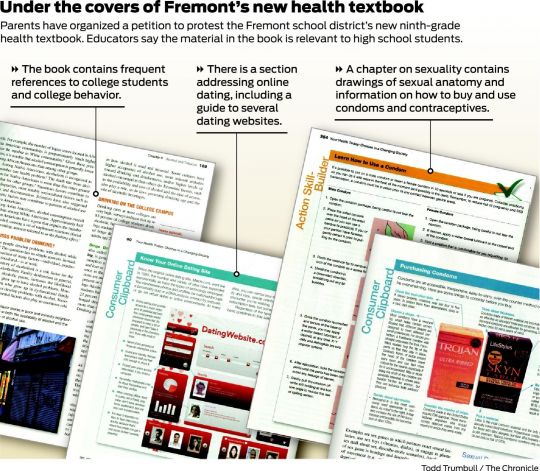
That script certainly seems to be playing out in Fremont, but there are some wrinkles.  The textbook, Your Health Today, contained a twenty-page section on sexual behavior.  As the parent petition protested, this section included information about more than just the mechanics of sex.  It told students about

sexual games, sexual fantasies, sexual bondage with handcuffs, ropes, and blindfolds, sexual toys and vibrator devices, and additional instruction that is extremely inappropriate for 13 and 14 year-old youth.

And, as in similar controversies in the past, the protesting parents quickly reached out to national conservative activist organizations for support.  In this case, Fremont parents contacted the conservative Christian Pacific Justice Institute for back-up.

But the “conservative” parents made clear that they did not oppose sex ed in general.  What they did not like was the inappropriate college-level sex ed this book contained.  Parent activist Asfia Ahmed told the Christian Post that the problem was not sex ed as such; the problem was that this book in particular “speaks to adults; it does not speak to teens and adolescents.”

Predictably, progressive commentators accused conservatives of being trapped in the past.  As one writer noted, “It’s frustrating that this is still controversial.” I personally agree. I’m a teacher and parent. I want my students and daughter to have frank, explicit information about sex. And I think that such information needs to include some sense of the wide variety of sexual behaviors that are common in our society. It needs to include the basic fact that sex should be pleasurable and should never be coerced.  Perhaps most tricky, I think that public schools have a duty to convey this information.  After all, with pregnancy and HIV on the line, these are literally life-and-death subjects.

But the notion of some anti-conservatives that these issues have been resolved in the past demonstrates the dunderheadedness of my fellow progressives. Some progressive commentators seem to think that these debates have already been settled. Whether the issue is sex ed, school prayer, or creationism, progressives often express surprise that these questions are “still” controversial. Such attitudes demonstrate the ignorance of progressives.

Conservative notions about sex ed in public schools have always had a decisive influence on the goings-on in those schools. In this case, for instance, we see how quickly the administration caved to parent protests. Here and elsewhere, the notion that there is some healthy connection between kids and sex is a very touchy one in our society. Conservatives need only say that a book goes too far to have that book quickly yanked by the district.

Perhaps the hard-hitting journalists of the Today Show made the most salient point about this story. They interviewed some of the young teenagers who would have read this textbook. As one told them, “Like ewwww. . . . I don’t really feel like I need to know about that right now.”