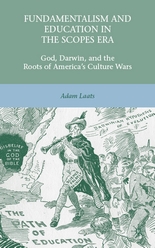
The Ink Is Dry!

I’m tickled pink to announce I’ve signed a deal with Harvard University Press to publish my next book.  The subject?  No surprise to ILYBYGTH readers: the book takes a historical look at educational conservatism in America’s twentieth century.  What did conservatives want out of schools?  How did they work to make that happen?

I’m extremely pleased to have the book join HUP’s top roster of educational histories.  All my favorite books are on that list: David Tyack & Larry Cuban’s Tinkering Toward Utopia, Jon Zimmerman’s Whose America?, Jeffrey Moran’s Teaching Sex, and now Bill Reese’s Testing Wars.

I’m honored to join this all-star lineup.  My book—which at this point I’m calling The Other School Reformers: The Conservative Tradition in American Education—takes a look at the four most explosive school controversies of the twentieth century.  My approach has been to examine these four culture-war fights to see what sorts of educational reform conservatives wanted in each case.  At first, I thought I’d pile up histories of leading conservative organizations and individuals: the American Legion, Max Rafferty, the Gablers, etc.  But I couldn’t find a way to decide whom to include and whom to leave out.  Did the White Citizens’ Councils count as educational conservatives?  Did the Institute for Creation Research?  Did Arthur Bestor?

Instead of imposing my own definitions on the outlines of educational conservatism, I took more of a naturalist’s approach.  I set up my blind, so to speak, at the four most tumultuous fights over the content of American schools and watched to see what kinds of conservative activists showed up.

The school controversies were all very different.  First I examine the Scopes Trial of 1925.  Then the Rugg textbook controversy of 1939-1940.  After that, the firing of Pasadena’s progressive superintendent in 1950.  Finally, the literally explosive fight over schools and textbooks in Kanawha County, West Virginia, in 1974 and 1975.

What did I dig up?  In short, I argue that there is a coherent tradition linking conservative school reform across the twentieth century.  Not that these different activists had any sort of conscious organization or program.  Conservatives differed—often differed widely—about key issues such as public religion, race, and the role of government and experts.  More than that, the consensus among conservatives changed over time, as American culture and society changed.  For example, racial attitudes among white conservatives changed enormously between 1925 and 1975.  But in spite of all this change and difference, a recognizable tradition of educational conservatism linked these disparate school reformers.  Conservatives usually agreed with progressive school reformers that good schools were the key to a good society.  But unlike progressives, conservatives wanted schools to emphasize traditional knowledge and beliefs: patriotism, religion, and the benefits of capitalism, for example.

In addition, my book makes the case for the importance of understanding these conservative activists as school reformers in their own right.  Too often, the history of American education is told as the heroic tale of progressive activists fighting bravely against a powerful but vague traditionalism.  My book argues instead that educational conservatism is more than just a vague cultural impulse; conservatism has always been a raft of specific policy ideas for specific historical contexts, fought for by specific individuals and organizations.

So be sure to save some space in your holiday gift list for next year.  The book is slated to appear just in time for Christmas/Hannukah/Kwanzaa/Festivus 2014.


In Defense of the Lecture

Outside of dunce caps or ferule-slapping, it would be hard to find a teaching technique that has been more roundly disparaged by generations of progressive educators than the lecture.

Stultifying and obsolete, ineffective and time-wasting, the “sage-on-the-stage” approach to education has long been Pedagogic Enemy Number One for progressives.

Not so fast, writes Collin Garbarino in the pages of First Thoughts.  In spite of snarky progressive claims to the contrary, Garbarino argues, the lecture “worked in the fourteenth century, and it still works today.”

Garbarino is responding to an interview in The Atlantic with technophile David Thornburg.

Thornburg used a 1350 painting to illustrate the continuing ridiculousness of lectures.  In the painting, students sleep, chat, and otherwise while away the time while a puffed-up Henry of Germany imparts some Teutonic knowledge on Bologna’s university students.

Image Source: First Thoughts

Image Source: First Thoughts

Hold the phone, Garbarino challenges: Take another look at that painting.  Sure, many students are not listening.  But many are.  The front rows are packed with students avidly drinking in Henry’s wisdom.

Don’t blame the lecture for shoddy education, Garbarino argues.  After all, as Garbarino points out, we don’t blame books for ignorance; we don’t attack all blog posts because most of them are stupid.  Garbarino suggests two proper targets for reform: disengaged students and weak lecturers.

As in Bologna in 1350, some students benefit from lectures, others do not.  The lecture as a format is an efficient and practical way to educate, Garbarino says.  The fact that some students choose not to participate does not mean that the format itself is no good.

Similarly, lots of lecturers are terrible.  They are more concerned with publishing than with preparing scintillating lectures.  Or they may lack that ineffable something that makes someone a compelling speaker.  But just because some lecturers do a bad job of it does not damn the lecture entirely, Garbarino argues, any more than terrible books imply that we should no longer read.


Catholics against the Common Core

Don’t do it, a group of Catholic academics advised their bishops recently.  Don’t let Catholic schools follow the new Common Core Learning Standards.

As with everything Catholic, the signatories of this letter were a diverse bunch.

They were led by Notre Dame’s Gerard Bradley and included prominent conservatives such as Anthony Esolen, Robert George, and Patrick Deneen.  Also signing on was Lehigh University’s intelligent-design black sheep, Michael Behe.

Why did this group want to keep the new standards out of Catholic schools?

For one thing, they argued the new focus on nonfiction threatens to water down the rich cultural heritage of Catholic schooling.  “Common Core,” the letter charges,

shortchanges the central goals of all sound education and surely those of Catholic education: to grow in the virtues necessary to know, love, and serve the Lord, to mature into a responsible, flourishing adult, and to contribute as a citizen to the process of responsible democratic self-government. . . . Perhaps a truck-driver needs no acquaintance with Paradise Lost to do his or her day’s work.  But everyone is better off knowing Shakespeare and Euclidean geometry, and everyone is capable of it.

But there is more at stake than just a profound, moral education.  Bradley’s letter worries that future new standards will directly contradict the specifically religious values at the heart of the Catholic faith.  As the letter put it,

In science, the new standards are likely to take for granted, and inculcate students into a materialist metaphysics that is incompatible with the spiritual realities—soul, conceptual thought, values, free choice, God—which Catholic faith presupposes.  We fear, too, that the history standards will promote the easy moral relativism, tinged with a pervasive anti-religious bias, that is commonplace in collegiate history departments today.

As Richard Perez-Pena noted in the New York Times, the letter-writers do not represent the entirety of Catholic opinion.  Sister John Mary Fleming, executive director for Catholic education at the United States Conference of Catholic Bishops, said she viewed the new standards as an opportunity, not a threat.  And Sister M. Paul McCaughey, superintendent of Chicago’s Catholic schools, agreed that Catholic schools must maintain their high educational standards, but did not see the standards as a problem.


Creationism in Texas: A Foreshortened History

Read it.  It’s good.  But be warned: this story has a fatal flaw.

Brentley Hargrove’s history of the Texas textbook wrangles is a helpful introduction to the recent round of textbook fights in the Lone Star State.

In the pages of the Dallas Observer, Hargrove introduces readers to the recent history of creationist influence in the selection of Texas science textbooks.  He offers the backstory of review-board members such as intelligent-design proponent Raymond Bohlin.

Hargrove takes the story of the Texas Textbook Two-Step back to the 1970s, when self-appointed watchdogs Mel and Norma Gabler wielded outsize influence on the adoption of books.

He describes the rise to educational power of creationist dentist Don McLeroy and the board membership of theologue Cynthia Dunbar.

This story is a must-read for everyone interested in today’s culture wars over education, not just in Texas but around the nation.  It joins films such as The Revisionaries and documentaries such as the Long Game in pointing out both the peculiarities of educational politics in Texas and the broader meanings Texas school politics has for all of us.

But as a historian of these school battles, I must protest against the foreshortened history Hargrove describes.  He gives a nod to the long history of cultural battles over education.  He mentions the nineteenth-century Bible wars that rocked America’s cities.  But then he skips from 1844 to 1961.  He leaves out the formative period of today’s educational culture wars.

As he puts it, since the nineteenth century,

the fear of secularism and modernity remains as potent as ever. Yet it wasn’t until the Gablers came along that this fear took shape in Texas and assumed power.

Now, that’s just not true.  I understand Hargrove is interested in the way these battles have developed over the past fifty years.  But the way they did so was decisively influenced by earlier generations of Texas activists.

To be fair, Hargrove’s historical myopia is widely shared.  In his Observer article, he quotes prominent sociologist William Martin.  “The Gablers,” Martin told Hargrove, “were the first people to have taken this on in such as systematic way.”

Even if we make allowances for the contemporary interests of journalists and sociologists, this sort of misrepresentation of the history of Texas’ school battles can’t be given a pass.

The tradition of conservative activism in which the Gablers, McLeroy, Bohlin, and Dunbar take part has direct roots in the 1920s battles in Texas and elsewhere.

As I argue in my 1920s book, anyone with even a passing familiarity with Texas history will recognize the historical importance of J. Frank Norris, for example.  In the 1920s, Norris established the activist precedent that later conservatives followed.  Norris fulminated against the directions of 1920s public schools in ways that McLeroy, Dunbar, and the Gablers would have appreciated.

And he had even more political pull.  In the 1920s, though a state-wide law banning the teaching of evolution failed in the Texas legislature, the governor ordered textbook publishers to remove any mention of evolutionary science from the state’s textbooks.

All well and good, you might say.  But does that pre-history have anything to do with today’s textbook fights?  If we want to understand the current moment, do we really have to go so far back?  Isn’t it enough to look to the Gablers and start there?

The school fights of the 1920s are of interest to more than just nitpicky academic historians like me.  Even if we want to start with the Gablers, we need to understand the formative school battles of the 1920s.  Mel Gabler was ten years old in 1925.  The content and structure of the schools he attended was decided by the activism of pundits such as J. Frank Norris and the pusillanimity of politicians such as the Governors Ferguson.

It was in the 1920s that America first battled over schooling in the terms that have remained so familiar ever since.  The issues and positions laid down in the 1920s have become the durable trench lines in American education.

As Gabler biographer James Hefley described, by the 1960s the Gablers had become

the cream of self-reliant Middle America.  They lived by the old landmarks, took child-rearing seriously, supported community institutions, sang ‘God Bless America’ with a lump in their throats, and believed that the American system of limited and divided governmental power was the best under the sun.

How did they get to be that way?  How did they become so confident that their vision of proper schooling and society must be fought for?  The Texas the Gablers loved had been defined by the activism of the 1920s and succeeding generations.  The vision of proper education that fueled the self-confident activism of the Gablers had been established as such in the controversies of the 1920s.

If we really want to understand what’s going on today, we need at the very least to acknowledge the longer history of these issues.  We need to understand that today’s fights grew out of earlier generations, and those earlier generations did not just spring up full-grown from the Texas soil.


Fundamentalism’s Roots: A Review

What does it mean to be a “fundamentalist?”

At his lively blog Leaving Fundamentalism, Jonny Scaramanga has offered a review of my 1920s book that puts this question squarely at the center.

Two Thumbs Up...

Two Thumbs Up…

As Scaramanga points out from his current work and from his personal life history, the term “fundamentalist” is often used as more of a bludgeon than a label.  People accuse each other of being “fundamentalist” about this issue or that.  People dither over whether this or that person is a true “fundamentalist.”

Scaramanga notes that unless and until we get a sense of the formative first decade of American fundamentalism—the 1920s—we’ll never wrap our heads around the contentiousness that has always been at the core of defining the term.  I agree entirely.

Best of all, he gave the book a thumbs-up.  As Scaramanga put it,

I was genuinely surprised how much I liked this book. I’m a longtime reader of Adam’s blog and he’s helped me out with research on numerous occasions, so I knew he’s an engaging writer and a top bloke, but I was still expecting to find this a dry, academic slog. Actually, I was riveted. Everything I’ve studied of fundamentalism makes so much more sense in the historical context this book provides. I’d recommend it to people with a casual interest in fundamentalism just as much as those with an academic interest.

Thanks, Jonny.  I don’t think I’ve ever been called a “top bloke” before.  A “top bloke’s” a good thing…right?

What You Need to Know about . . . Dorothy L. Sayers

By Patrick Halbrook

I Love You but You’re Going to Hell is pleased to announce a new series of guest posts.  Inspired loosely by the One Thousand Words series at Front Porch Republic, this series asks experts to describe briefly the most important contributions of the most important conservative educational theorists and activists.   

How did a British detective novelist inspire an evangelical pastor from a small town in Idaho to found one of the fastest growing Christian schooling movements in America decades after her death?

Dorothy L. Sayers (1893-1957) is most widely remembered today not for her writings on education (which were rather brief), but for her literary output.  Her Peter Wimsey detective novels continue to be re-printed, and were adapted for television by the BBC in the 1970s.  Her twelve-part radio play about the life of Jesus, “The Man Who Would Be King” (1941-42), was considered by her friend C.S. Lewis to have been one of her finest works, and he enjoyed re-reading the manuscript every year during the week before Easter.  Sayers continues to be praised for her translation of Dante’s Divine Comedy, on which she spent the final decade of her life after teaching herself Italian.  Her prolific career as a writer and social critic have led her to be called “the most significant female British Christian intellectual of the twentieth century,” and an author who “made a substantial impact on nearly as many fields as G.K. Chesterton or C.S. Lewis.”

But if you were to visit a conference on Christian education and pull aside a parent or teacher to inquire about the distinguished Ms. Sayers, more often than not she would simply be lauded as the author of a brief 1947 essay on education entitled “The Lost Tools of Learning.”

Throughout the past few decades, this essay has spread throughout the evangelical Christian community through a peculiar turn of events.  In the mid twentieth century it came to the attention of William F. Buckley, who reprinted it at various times in National Review.  In the pages of Buckley’s magazine, it was read by a pastor of a small church in Moscow, Idaho named Douglas Wilson (Wilson is now known, among other things, for debating Christopher Hitchens and writing an award-winning novel).  In the early 1980s, Wilson began a private Christian school in Moscow in which he implemented Sayers’ ideas; he later popularized them in his 1991 book, Recovering the Lost Tools of Learning.  Over the following years, hundreds of schools across the country began to form using Wilson’s school as a model.  Sayers’ ideas also appear in the pages of The Well-Trained Mind: A Guide to Classical Education at Home, an enormously popular book on homeschooling which is now in its third edition.

“The Lost Tools of Learning” presents a rather simple educational paradigm based on the medieval Trivium and the notion that the goal of education is to teach students to think and learn for themselves.  For Sayers, this paradigm was the solution to what she considered to be the rather sorry state of early twentieth-century education.  “Has it ever struck you as odd, or unfortunate,” she asked, “that today, when the proportion of literacy throughout Western Europe is higher than it has ever been, people should have become susceptible to the influence of advertisement and mass propaganda to an extent hitherto unheard of and unimagined?”  She continued,

For we let our young men and women go out unarmed, in a day when armor was never so necessary.  By teaching them all to read, we have left them at the mercy of the printed word.  By the invention of the film and the radio, we have made certain that no aversion to reading shall secure them from the incessant battery of words, words, words.  They do not know what the words mean; they do not know how to ward them off or blunt their edge or fling them back; they are a prey to words in their emotions instead of being the masters of them in their intellects.

Students were graduating from school unprepared for life, Sayers argued, because “we fail lamentably on the whole in teaching them how to think: they learn everything, except the art of learning.”  What was needed in such times was a system of education capable of producing “a society of educated people, fitted to preserve their intellectual freedom amid the complex pressures of our modern society.”

Sayers found in medieval education two insights which, if applied in the twentieth century, would offer modern man a way out of the mess in which he had found himself.  First, by way of the Trivium (grammar, logic, and rhetoric), medieval education offered a paradigm for stages of learning to think and express oneself.  Second, its emphasis on theology gave all knowledge a coherence and unity without which education could only disintegrate into a collection of irrational, disjointed parts.

Confessing that her views of child development were “neither orthodox nor enlightened,” Sayers maintained that children go through three basic stages of development.  Each of these she associated with a part of the Trivium.  In the elementary years, or “Poll-Parrot” stage, children excel at memorizing new facts.  This corresponds with the “grammar” stage of the Trivium, which consists of learning the basic facts for each subject.  The grammar of language is self-evident, but other subjects have grammar stages as well.  In history, for instance, it consists of memorizing names and dates and events.  The goal of this stage is therefore to get as many facts into children’s heads, whether they understand their significance or not, while memorization is still relatively easy and even fun.

In the “Pert” stage, which corresponds to middle school, children naturally begin mastering the art of talking back and contradicting their elders.  This makes them ideally suited for the “logic” or “dialectic” stage, which would include the study of formal logic, as well as the “logic” of various subjects.  At this point students take what they have learned in the grammar stage and learn to apply critical thinking skills to those facts.  In literature, they debate whether or not a character’s actions were justified; in history, they study the causes and effects of the events they have already learned about.

Finally, students of high school age enter the “Poetic” stage, in which they yearn to express themselves and to achieve real independence of life and thought.  Because during the grammar stage they have been given something to think about, and during the logic stage they have learned how to think clearly, they are finally ready during their high school years to begin the study of “rhetoric.”  The purpose of this stage is to teach students to express their thoughts with clarity and eloquence through writing and speaking.  Students by this point in time have also become competent to take up new subjects to study on their own, needing less and less guidance needed from their teachers.

(It is worth noting that Sayers has come under fire for allegedly misrepresenting the Trivium, whose parts were, during the medieval period, all studied together and never corresponded to stages of child development.  Yet Sayers admitted as much, recognizing that what she was suggesting was a modern application of a traditional paradigm using her own views on psychology.  On another note, it has also been pointed out that Sayers’ paradigm of learning stages parallels Bloom’s taxonomy, which was published about a decade after “The Lost Tools of Learning.”)

In addition to her explanation of the Trivium, Sayers also turned to medieval education for its emphasis on Christian theology.  She wrote,

I shall add it to the curriculum because theology is the mistress-science without which the whole educational structure will necessarily lack its final synthesis.  Those who disagree about this will remain content to leave their pupil’s education still full of loose ends.

Theology would provide a coherent worldview which would allow students to understand how each subject fit together.  For Sayers, Christianity was never merely a set of ethical principles and religious rituals, but was at its core a way of making sense of the world.  “To me, Christian dogma seems to offer the only explanation of the universe that is intellectually satisfactory,” she wrote on one occasion.[1]  It was therefore an indispensable part of her educational vision, its neglect being a significant cause of modern education’s impotence.

What would it look for these “tools of learning” to be rediscovered and once again put to use?  Ironically, Sayers never dreamed it would actually happen.  She considered it “in the highest degree improbable that the reforms I propose will ever be carried into effect.”  She would therefore be quite surprised to know that today, over 40,000 students in private Christian schools (not to mention countless homeschooled students) are being taught grammar, logic, and rhetoric in the way that she envisioned.

They may not know much about her detective novels, but multitudes of conservative Christian educators have been profoundly influenced by Dorothy L. Sayers.


For more on Sayers…

About the author: Patrick Halbrook teaches at a classical Christian school near Raleigh, North Carolina.  His research interests include the history of Christian education and the intersection of science and religion, and for his master’s thesis he explored the role of the Scopes trial in American memory.  You can reach Patrick at phalbrook@carychristianschool.org.


[1] Letters, 2:401

Sit Down, Shut Up: Old School Teaching for New School Results

What’s the best way to teach children?

Get them to suffer.  Get them to fear.  Get them to obey.

That’s the message, anyway, of a recent essay by Joanne Lipman in the Wall Street Journal.

Lipman, of course, might put in another way.  In her words, she wants us to “revive old-fashioned education. . . . with strict discipline and unyielding demands.”

How should we do this?  Lipman offers eight guidelines.

We should understand that the highest levels of performance are helped, not hurt, by “a little pain.”  We need to get back to memorization.  Kids need to be allowed to fail, to understand that failure is a necessary aspect of improvement.  Plus, “strict” teachers do better than “nice” ones.  Also, creativity can be achieved through hard work.  Not by coddling, but by teaching “grit.”  Teachers need to get out of the habit of fulsome, unearned praise.  Last but not least, children need to experience stress in order to maximize their improvement.

Lipman claims scientific support for her platform, even though some of her cited studies don’t sound rock-solid.  Some have small sample sizes.  Just because something worked for a couple dozen students doesn’t mean it will be generally true.  Others have unconvincing methodologies.  One study, for instance, asked undergraduates about the stresses they had experienced in their lives.  Then the researchers dunked the students’ hands in ice water.  Those who had experienced stress, the study concluded, did not feel as much discomfort.

Such dubious science does not make me clamor to expose my daughter to more yelling at school.  But whether or not we accept the scientific rigor of Lipman’s sources, we cannot deny the political and cultural clout her argument for more traditional teaching has had over the decades.

In the 1920s, one leader of the influential Daughters of the American Revolution denounced innovations in classroom teaching.  Too many ‘modern’ teachers, President General Grace Brosseau lamented in 1929, thought that teaching consisted of presenting students with options.  Balderdash, Brosseau insisted.  Teachers must continue to deliver information to students in an authoritative way.  “One does not place before a delicate child,” Brosseau argued,

a cup of strong black coffee and a glass of milk; or a big cigar and a stick of barley candy; or a narcotic and an orange, and in the name of progress and freedom insist that both must be tested in order that the child be given the right of choice.  Instead, one carefully supplies only what will make for the development of the young body and assure its normal growth.

Schools, Brosseau insisted, must return to authoritative teaching.  Teachers must insist on hard work and dedication.  They must decide, instead of foisting all decisions off on immature children.

This traditionalist theme was taken up in the 1960s by the influential education pundit Max Rafferty.  Rafferty insisted that the only way to improve education was to return to traditional methods and content.  Young people need to memorize, to compete, to work hard, Rafferty claimed.

In his 1964 book What Are They Doing to Your Children, Rafferty offered a vision of “Education-In-Depth” that might delight Lipman and other contemporary traditionalists.  Children, Rafferty argued, must submit to sometimes-unpleasant processes.  “Before a child can learn to write creatively and imaginatively,” Raffferty believed, “he must submit to the discipline of learning the writing trade—the metaphor, the syntax, the verb conjugations, and above all the spelling.”

Schools must stress “subject matter,” not feelings.  They must give lots of homework.  They must teach the basics, such as multiplication tables.  Perhaps most of all, they must reverse the “progressive” poison by teaching children to “not be afraid of hard work.”

As I’ve argued elsewhere, Rafferty’s model still has influential admirers today.  Lipman does not seem to be one of them, at least not consciously.  She does not seem aware of the tradition of traditionalism in education.  My hunch is that she’d like to dissociate her call for “old-fashioned” education with some of the views of Rafferty or Brosseau.  Lipman might prefer to have her vision of traditionalism associated with rigorous social science than with the flag-waving patriotism and anti-communism of earlier traditionalists.

Nevertheless, Lipman and other fans of traditional discipline and memorization might be well advised to study their own history.


War for the Core: Conservatives vs. Conservatives

Do conservatives like the new Common Core State Standards?

Yes and no.

And that tension has caused some consternation among conservative educational thinkers recently.

Writing in the Christian Post, Napp Nazworth has taken “several large international corporations” and “many Republican governors” to task for supporting the new educational standards.  At a panel discussion hosted by the Family Research Council, religious conservatives blasted GOP stalwarts such as Governors Chris Christie (NJ), Bill Haslam (TN), Rick Scott (FL), and others for “aligning their interests with those of international corporations.”

The article describes the lament of another faction of conservatives.  The Common Core Standards, conservative Glenn Jacobs worries, focus too much on “churn[ing] out young people who will be educated enough to work, consume, and pay taxes, but who are not encouraged to be creative, or to use critical thinking, or to develop anything remotely characteristic of those who possess superior minds and the ability to achieve great things.”

So what is a conservative to do?  Big-business types might embrace the promise of the new standards.  Traditionalists and religious conservatives, on the other hand, might lead the opposition.

Could inter-conservative squabbling lead to a real division in the decades-old conservative alliance?


To Win Elections, Conservatives Need to Win in Schools

What happened?

Why do conservative candidates lose elections?

That is the question Mark Bauerlein of Emory University asked in Friday’s Public Discourse.

Bauerlein finds the answer not in demographics or policy prescriptions, but in college and high-school curricula.  The revolution in teaching of the past forty years, he says, means that conservative candidates lack the intellectual heft and agility necessary to win.  Bauerlein modifies a Thatcher motto: “First you win the schools, then you win the government.”

Governor Romney, Bauerlein argues, exemplified the problem.  Romney’s famous blunder about “47%” of the electorate was a lost opportunity, Bauerlein thinks, to introduce a new generation of voters to true conservative principles.  Romney did not explain the central conservative principles of thrift, independence, and liberty that could have made his point.

The real remedy, Bauerlein insists, is not in new polls or smoother candidates.  The long-term conservative remedy will be to take advantage of the profound conservatism at the heart of American culture.  If young people receive a better education in the American tradition, they will be both more receptive to and more articulate about those conservative American principles.

“The lesson is this:” Bauerlein tells us,

Conservative candidates must possess, among other attributes, a conservative tradition in their heads, not just political principles, but great thinkers and artists of them, too. . . .

The best way, perhaps the only consistent one, to plant conservative writings and art in the formation of politicians is through the high school and college curriculum. There, individuals have the space to absorb them as common intellectual equipment, as regular facets of the world, not as political positions. . . .

What they encounter and how it is presented determine what they think is important. If English and history courses don’t include Brave New World and Fahrenheit 451 (an anti-political correctness novel) alongside multiculturalist fiction of the 2000s, if they don’t add David Horowitz’s Radical Son to celebrations of the 1960s counterculture, if James Madison doesn’t precede Malcolm X, then the conservative tradition has no place in the accepted body of cultural literacy. If The Scarlet Letter is taught as an indictment of sexual oppression in a Puritan community, not as a complicated tale in which the community has a valid claim upon Hester’s desires, then social conservatism is reinforced as an uptight, obsolete imposition.

This is to recognize the curriculum as an authorizing process. What makes it onto the syllabus has legitimacy, and the angle the teacher takes upon the materials tends to stick. If conservative donors wish to back winning candidates, to cultivate politicians who can deflect sallies of biased reporters and liberal counterparts with intelligent and informed convictions, they must reach conservative politicians not only in election years, but at impressionable ages, too.

The good news for conservatives, Bauerlein writes, is that many schools have already begun to implement this kind of strategy.  They teach conservative ideas not only in short-term intellectual boot camps, but as part of a thoughtful tradition that includes all the best thinkers from across the intellectual spectrum.

What could this look like?  According to Bauerlein, it could mimic the success of liberal efforts such as the Ford Foundation’s funding of centers for Women’s Studies.  That field went from zero to influential in a decade, thanks in part to such funding. Bauerlein thinks it’s time for conservatives to do the same.


CSCOPE and the Dustbin of History

CSCOPE is dead.

Anyone who hopes to understand the sort of conservative crusade that killed CSCOPE should draw two lessons from the news.

First: Historians should be invited to more dinner parties.

Second: The question is not why CSCOPE was suddenly targeted, but rather why so many Americans are so deeply suspicious of educational experts.

But before we talk about such things, an update: As reported by the Houston Chronicle and Texas Freedom Network Insider, leading Texas politicians announced a few weeks back that the suddenly controversial curriculum management system would no longer be offering lesson plans for Texas school districts.

CSCOPE had come under attack from conservatives in Texas and around the country as promoting a witches’ brew of “progressive,” “Marxist,” “pro-Islam” ideas for Texas schools.  Liberals such as those at the Texas Freedom Network complained in exasperated tones about an irrational “witch hunt” against lessons that had been used without controversy for years.

What does any of this have to do with the loneliness of historians?  The book I’m now finishing looks at the 20th-century history of this sort of school controversy.  Again and again, conservatives discover that the teaching in their schools has been infiltrated by nefarious ideas such as evolution, socialism, progressivism, or filthy sex and violence.  In each case, once a set of textbooks or curricular program gained attention as an example of such ideas, it was quickly tossed out by conservative activists.

I hate to quote myself, but in this case an historian’s perspective makes this outcome seem predictable. As I noted a few weeks back, “CSCOPE might offer an ideologically balanced, pedagogically efficient way for Texas school districts to streamline their teaching systems.  But once it has acquired the reputation for leftist indoctrination, the writing is on the wall.”

This is why historians should be invited to more parties.  Especially if there is food.  Not because historians can predict the future.  Every case is different. But an historical perspective eliminates much of the surprise of unfolding events.  For those who know the 20th-century history of conservative activism in America’s schools, the anti-CSCOPE crusade seems remarkably predictable.

Another important lesson should be drawn from the premature death of CSCOPE.  The career of CSCOPE illustrates the profound cultural divide at the heart of America’s continuing educational culture wars.   Personally, I sympathize with the liberal critics of the Texas Freedom Network, who noted that many of the attacks against CSCOPE seemed “bizarre” or “paranoid.”  As a parent and citizen, I worry about the exaggerated attacks made on this curricular program.

Such attacks, however, must be understood as an irruption of a profound suspicion among Americans about what any outside interference in public school curricula.  Like other commentators, I am deeply skeptical about claims that CSCOPE was a vast conspiracy to subvert patriotic Christian values in Texas public schools.  But the important question is not why this particular program was targeted for attack after years of controversy-free use in schools. The question, rather, is why so many Texans jumped so quickly to join the anti-CSCOPE bandwagon.

This has been the case with every curriculum controversy in the past.  As historians Charles Dorn[1] and Jonathan Zimmerman[2] pointed out about the Rugg textbook controversy in the 1940s, though the Rugg textbooks were banished, similar books continued to be used widely.

In the Kanawha County blow-up of the 1970s, the same sentiment surfaced.  What had seemed like a humdrum approval process for a new set of reading textbooks became a violent struggle over the content of the curriculum.  In that case as in this, many observers scratched their heads and wondered why these particular books had suddenly become such lightning rods.

The depressing truth is that most Americans are deeply skeptical about the intentions of the people who write the books and lesson plans for our public schools.  With curricular materials such as CSCOPE, the Rugg textbooks, or the Interaction series adopted in Kanawha County, as soon as materials were accused of subversion, many Americans believed it.  As conservative leader Elmer Fike explained about the Kanawha County books, “You don’t have to read the textbooks.  If you’ve read anything that the radicals have been putting out in the last few years, that was what was in the textbooks.”[3]

The sudden outrage against CSCOPE shows us this same dynamic at work.  In Texas as in the rest of our nation, a politically powerful plurality are willing to believe outlandish accusations against relatively bland curricular materials.  Though the books and lessons themselves may be moderate in tone, a significant number of parents and politicians are quick to believe they have set out to destroy America.

Why did CSCOPE meet such a sudden and violent premature death?  Because for generations, a significant proportion of Americans have looked with grave suspicion at the intentions of “experts” who write such classroom materials.  Parents are not surprised to hear that textbooks contain hateful language and shocking subversion.  Such accusations confirm what too many parents already believe.

We will not understand the CSCOPE story, nor the similar stories sure to come in future years, unless we grapple with the fact that many parents maintain an awkward ambivalence toward public education.  Many parents may approve of their local schools, but they feel a need to defend those schools from the control of grasping autocrats at far-flung universities and think-tanks.  At the bitter heart of the CSCOPE saga lodges the uncomfortable truth that Americans do not trust educational experts.


[1] Charles Dorn, “‘Treason in the Textbooks:’ Reinterpreting the Harold Rugg Textbook Controversy in the Context of Wartime Schooling,” Paedagogica Historica 44:4 (August 2008): 477.

[2] Jonathan Zimmerman, Whose America? Culture Wars in the Public Schools (Cambridge: Harvard University Press, 2002), 79.

[3] Quoted in James Moffett, Storm in the Mountains: A Case Study of Censorship, Conflict, and Consciousness (Carbondale, IL: Southern Illinois University Press, 1988), 70.