Progress and Punishment

What should teachers do when students misbehave? This might seem like a simple nuts-and-bolts question, but for generations it has triggered culture-war debates. Conservatives often insist that children need traditional punishments; progressives warn that those punishments only make behavior worse and that harsh discipline tends to land heaviest on minority kids.

Are we ready yet?

Are we ready yet?

In the recent issue of Mother Jones, Katherine Reynolds Lewis reviews the disciplinary work of psychologist Ross Greene. Like other progressives over the course of the last century, Lewis argues that traditional forms of school discipline are utterly wrong-headed.

As Lewis reports,

Under Greene’s philosophy, you’d no more punish a child for yelling out in class or jumping out of his seat repeatedly than you would if he bombed a spelling test. You’d talk with the kid to figure out the reasons for the outburst (was he worried he would forget what he wanted to say?), then brainstorm alternative strategies for the next time he felt that way. The goal is to get to the root of the problem, not to discipline a kid for the way his brain is wired.

Teachers using Greene’s approach build positive relationships with misbehaving kids. Instead of offering a set of rewards and punishments, teachers try to let students explain and vent their negative feelings.

According to Lewis, the system works. Reluctant teachers (and prison guards) have been brought around by the dramatic positive results.
Hooey.

Hooey.

Historically, not everyone has been so smitten with these sorts of interventions. As I argue in my recent book, conservative school activists in the 20th century insisted that Greene-style reforms were hopeless. Not only did they fail, conservatives thought, such progressive claptrap fundamentally misunderstood the nature of humanity and education.

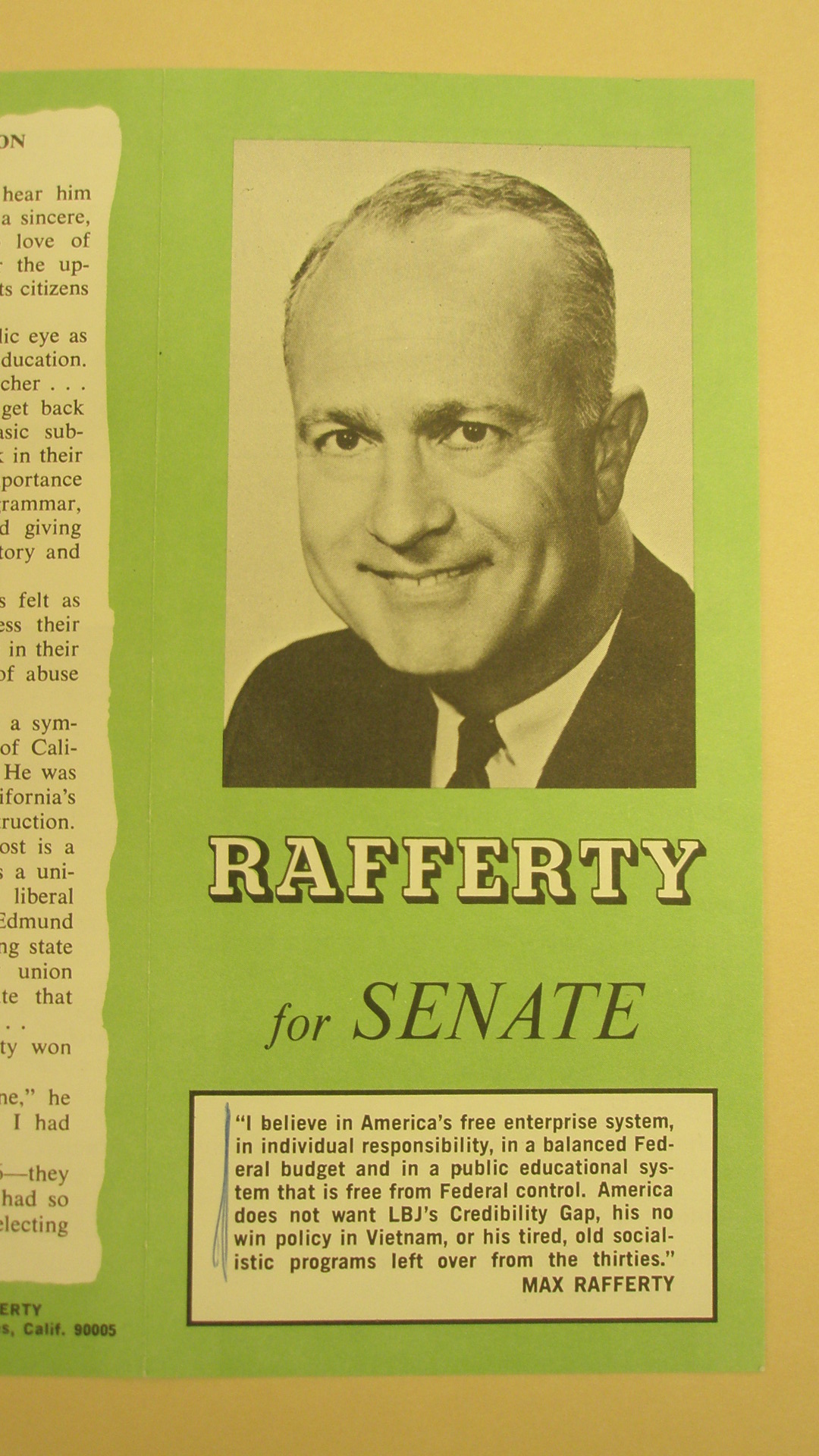
As Max Rafferty put it in 1968, children need to be understood on their own terms:

a child is not a little man. He is a being in transition and a lot closer to the raw simplicities of the primeval jungle than any of us will ever be again or than we like to think we ever were. Childhood may be mystic, as Victor Herbert said, but it’s often very far from merry.

For one thing, the child lives in a world where both time and space are vastly different from ours. A year to a child may easily be a week to us. A bungalow to us six-footers is a skyscraper to him, a wooded grove the limitless forests of Xanadu.

He is notably impatient where we have learned patience. He is openly and candidly selfish where we have been pressured by the needs of society to conceal our own self-interest. He is direct where we are devious, simple where we prefer to be complicated.

In response to earlier generations of Greene-style disciplinarians, Rafferty responded,

There speaks the progressive educationist. Adjust to your environment at any cost. Don’t try to change things. After all, nothing is really ‘right’ or ‘wrong.’

Bunk.

What’s wrong with teaching the kid that fighting in school is wrong?

Why not outlaw profanity and bring back the good old soap-in-the-mouth bit for youngsters who can’t keep a clean tongue in their heads? The school exists to make Johnny a better boy.

In an earlier work, Rafferty blasted the progressive assumptions of Greene-style approach to discipline.

a child usually has neither the maturity nor the judgment to understand the need for self-discipline. Too many instructors, fresh from college and still pretty Dewey-eyed about things, compromise themselves and their careers in a hopeless attempt to convince some freckled-faced [sic] urchin with devilment coming out visibly all over him that he must discipline himself when all he really needs is a session after school with the ruler. . . . Prior to 1930 school discipline was built around corporal punishment. It always had been. Education had walked and in hand with the hickory stick apparently since time began, and virtually every teacher who ever lived took this state of affairs for granted.

School, you see, was not considered ‘fun’ in those days. It was a mighty serious business and was conducted that way. At any rate, once the two premises are accepted that (1) boys won’t behave in schools unless compelled to do so and (2) boys must be made to behave so that they can learn things that are essential for them to know, then the whole paraphernalia of corporal punishment falls into proper perspective. . . . Things have changed of late in the field of discipline, and more than somewhat. They started to change at home first, back in the twenties and thirties. The prime mover in their change was the new psychology, which was widely publicized and which caused parents seriously to doubt their proper role vis-à-vis their children for the first time in the recorded history of the human race. . . . The result was the emergence of the least-repressed and worst-behaved generation of youngsters the world had ever seen. The psychologists had been right in one respect. Junior certainly had no repressions. He could have used a few.

In Lewis’s telling, Rafferty’s brand of traditionalism flies out the window when teachers and parents see the positive results of progressive discipline. I’m not so sure. After all, as Rafferty’s work from the 1960s shows, Greene’s brand of progressive reform has been around since the 1920s. It didn’t convince conservative skeptics then and I don’t think it will now.

The questions go deeper than just classroom efficiency. Some traditionalists, IMHO, will continue to believe that old-fashioned forms of discipline—yes, including corporal punishment—are not just more effective, but more closely connected to the true nature of childhood.
Does Your School Smell of BO?

Conservative intellectuals these days are talking a lot about the “Benedict Option.” The idea is to create intentional communities that preserve traditional values as mainstream culture hurtles ever-faster toward anti-Christian values. In the wake of Supreme Court rulings in favor of same-sex marriage, will such ideas catch on?

Short answer: No. If history is any guide, conservative evangelicals, at least, will continue to feel quite at home in their local mainstream communities. A quick burst of community-founding might happen, but it will likely ebb once conservatives realize how un-alienated they are from the mainstream.

Blogger Rod Dreher seems to have sparked the recent discussion of a “Benedict Option.” Dreher profiled intentional lay communities in Clear Creek, Oklahoma and Eagle River, Alaska. He asked if more conservative Christians would follow suit:

Should they take what might be called the “Benedict Option”: communal withdrawal from the mainstream, for the sake of sheltering one’s faith and family from corrosive modernity and cultivating a more traditional way of life?

As Dreher has developed the idea, it has naturally come to focus on educational goals. Even in staunchly Christian communities, Dreher has argued, the public schools lack any sense of guiding values. Kids in fifth grade share porn; they have no beef with same-sex marriage. Even in such apparent Christian havens as small-town Louisiana, Dreher believes, kids and their parents have embraced a bland, therapeutic religiosity. The Benedict Option, Dreher thinks, offers conservatives their only hope. As he put it,

There are no safe places to raise Christian kids in America other than the countercultural places we make for ourselves, together. If we do not form our consciences and the consciences of our children to be distinctly Christian and distinctly countercultural, even if that means some degree of intentional separation from the mainstream, we are not going to survive.

Dreher has taken some heat from fellow conservatives for culture-war pessimism. Not every conservative wants to turn inward. But as Dreher recently noted, many prominent evangelical thinkers such as Russell Moore seem to be adopting a BO approach to mainstream culture.

Similarly, Thomas Kidd of Baylor University has recently endorsed a BO attitude. Earlier this week, Kidd wrote,

for “paleo” evangelicals the Benedict Option is unquestionably the route we’ll need to take in the coming days. It is the way of fidelity for Christians, as the world around us sloughs off what remains of our quasi-Christian culture.

As Dreher and other BO-friendly conservatives repeat, BO does not mean Amish. It does not mean turning away entirely from mainstream culture. In some BO communities, for instance, families make their money from internet telecommuting. They insist on remaining engaged in mainstream politics and local affairs, even as they insist on retaining more control over their children’s upbringing.

Will the Benedict Option attract more and more support from conservative Christians? If history is any guide, the likely answer is no. As Dreher, Kidd, and Moore all realize, the tension among conservative Christians between engagement and withdrawal is as old as Christianity itself. In recent American history, as I’ve argued in academic articles about Christian schools and school prayer, evangelical Protestants have tended to wax and wane in their enthusiasm for BO approaches to schooling.

In 1963, SCOTUS decided that the Lord’s Prayer could not be recited in public schools, nor could the Bible be read devotionally. This decision caused some conservative evangelicals to conclude that they had been kicked out of public school and American society.

In the pages of leading evangelical magazine Christianity Today, for example, the editors intoned that the decision reduced Christian America to only a tiny “believing remnant.” No longer did the United States respect its traditional evangelical forms, they worried. Rather, only a tiny fraction of Americans remained true to the faith, and they had better get used to being persecuted.

Similarly, fundamentalist leader Carl McIntire insisted that the 1963 school-prayer decision meant the death of Christian America. In the pages of his popular magazine Christian Beacon, one writer warned that the Supreme Court decision meant a wave of “repression, restriction, harassment, and then outright persecution . . . in secular opposition to Christian witness.”

From the West Coast, Samuel Sutherland of Biola University agreed. The 1963 decision, Sutherland wrote, proved that the United States had become an “atheistic nation, no whit better than God-denying, God-defying Russia herself.”

These attitudes helped fuel a burst of new Christian schools in the 1970s. But as Christian-school leaders are painfully aware, many of those new schools couldn’t survive. Why? At least in part, because not enough conservatives feel alienated from their local mainstream communities. Why should they?

As I argue in my new book, public schools are far more conservative places than most pundits acknowledge. There is a lot of talk among both progressives and conservatives about the progressive takeover of public education, but for most Americans, their local schools remain fairly conservative places.

At the very top, leaders such as Arne Duncan embrace free-market approaches to education reform. In places such as Texas, creationist homeschoolers—folks who might fairly call themselves BO activists—have risen to the top of the state public educational hierarchy.

Why would conservatives think that they no longer had any pull in public schools? As Dreher is fully aware, many conservatives do not object to mainstream culture; they feel no yearning to give their children a radically different upbringing. If that’s the case, talk of BO in schools will not be a more than a minority sentiment.

Just as relatively few progressives abandon public schools for purer options, so too only a handful of conservatives will make the sacrifices necessary to give their children a BO education.

Watch a Conservative Lawmaker Abort a Progressive Ed Project

For a hundred years now, progressive educators have pleaded with teachers to help their students learn by doing. In New Hampshire recently, a bold teacher who tried to do so with a fourth-grade class got a brutal public smack-down from a conservative legislator. The vicious culture-war politics of abortion took over.

Teacher James Cutting had helped his fourth-grade class engage with real-world issues. The students, he told NH1, took the initiative and proposed a bill to make the red-tailed hawk the official state raptor. They delivered their bill to the state house and watched as it moved through committee. When the bill had a hearing in the full legislature, the students were in the gallery to watch the proceedings.

What they saw there might have blown their minds.

One conservative legislator, Warren Groen of Rochester, took the podium to denounce the bill. The students’ choice for state raptor, Representative Groen intoned, was a vicious bird.

It grasps [its victims] with its talons then uses its razor sharp beak to basically tear it apart limb by limb, and I guess the shame about making this a state bird is it would serve as a much better mascot for Planned Parenthood.

This was not the first time that Representative Groen used his time in Concord to fight against abortion. In an earlier speech, Groen compared abortion to slavery.

When Did Tests Become Conservative?

Something happened.

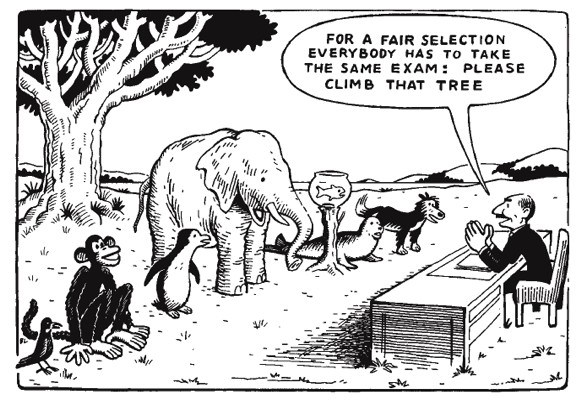
The idea of administering standardized tests to check the success of schooling has had a strange ideological career. Tests have been seen as a progressive panacea as well as a conservative coup. These days, a welter of standardized tests are used to evaluate teachers as well as students. In the eyes of some, these tests have become a hallmark of conservative educational policy. How did that happen? …and what does it mean?standardized-testing-comic3

Last night, historian and pundit Diane Ravitch talked to a crowd of teachers in my hometown, scenic Vestal, New York. Those familiar with Ravitch’s recent book and blog will have a good sense of her argument: Today’s testing regime is a scam by false-faced school “reformers” bent on installing corporate control over public education.

Testing was not always seen this way. As historian William J. Reese demonstrated in his latest terrific book, the first round of fights over standardized tests occurred way back in the nineteenth century. Early test mavens hoped to protect students from idiosyncratic and tyrannical schoolmasters who evaluated students by whim.

In the twentieth century, early testers hoped to use tests to help individualize instruction for children. They did not hope to replace the human touch. Rather, they hoped a set of tests could serve to move education in profoundly progressive directions.

These days, leading progressive pundits such as Ravitch and Mercedes Schneider denounce the testing regime as an attempt to corporatize education. They point to the suspicious support of billionaires such as the Koch Brothers and the Walton Family. Why do these corporate titans push for more tests? In order to strip teachers’ unions of power; in order to remake schooling in the image of corporate America.

Of course, the sophisticated and good-looking readers of ILYBYGTH (SAGLROILYBYGTH) know that the real situation is more complicated than these sorts of conspiracy theories allow. There are plenty of conservative pundits, too, who hate and fear the tests that accompany the Common Core standards. To these conservatives, a national testing regime gives progressives the opportunity to inject sneaky leftist ideas into classrooms across the country.

Plus, there are plenty of progressives who support more rigorous standardized testing as a way to ensure that lower-income students get their share of educational attention. Ravitch herself, in an earlier ideological incarnation, helped create today’s testing policy.  And Education Secretary Arne Duncan is no William J. Bennett. Duncan’s enthusiastic support of high-stakes tests does not come from the same sorts of cultural conservatism that animated President Reagan’s second Education secretary.

But there is something to Ravitch’s charges. There are plenty of conservatives who see testing as a way to find out what is really going on in public schools. Ravitch drew vigorous applause last night when she said she did not want to quantify kindergarteners’ college-and-career readiness. It was more important, Ravitch insisted, to be sure that children were happy, healthy, and improving every day.

And this, I think, is at the heart of today’s divide over standardized testing. Such tests have become “conservative,” I’m guessing, to the extent that they satisfy Americans’ traditional ideas about education. As I argue in my new book, across the twentieth century battles over education had a similar backstory: progressives wanted education to be mainly about the improvement of children; conservatives and traditionalists wanted education to be mainly about the delivery of information from teacher to student.

If the central goal of education is the transmission of information, then the success of that education can be measured by a simple paper-n-pencil test. This is an idea that resonates with lots of people. Not only self-identified “conservatives,” not only the scheming Walton family, not only Mayor Bloomberg, but lots of parents, teachers, and students buy into this fundamental notion of proper education.

To my mind, this situation is a good indicator of the tenuous hold of progressive education on the hearts and minds of Americans. Even self-identified progressive reformers such as Michelle Rhee embrace the notion that tests are a good measure of educational improvement.

The reason today’s test mania has been able to make such huge progress in public schooling is not due only to the funding of billionaires and the schemes of plutocrats, in spite of what smart people like Diane Ravitch may say. We Americans, with rare and beleaguered exceptions, never took to heart the central notions of progressive education. We tend to agree that real education means, in essence, the transfer of information from an authoritative adult teacher to a receptive child.

If that attitude is “conservative,” then it’s no wonder conservatism has come to dominate American public education.

Alert: Public Schools Teach Nihilism!

In the pages of the New York Times, philosopher Justin P. McBrayer repeated an age-old conservative fallacy: Our Public Schools Are Turning Our Children into Moral Monsters. Conservative intellectuals have seized upon McBrayer’s essay as more proof that they need their own conservative school refuges. But here’s the kicker: It’s just not true.

First, let’s clarify. Professor McBrayer is not writing as a conservative activist, it seems, but as a concerned citizen, parent, and philosopher. He notes that many of the college students he deals with seem to have little concept of moral facts. Why? Because, he concludes, “our public schools [are] teaching children that it is not true that it’s wrong to kill people for fun or cheat on tests.”

Scary! But not true. Let’s take a closer look at McBrayer’s argument. He admits that there is not any real evidence that college students these days are moral relativists. However, he asserts, “philosophy professors with whom I have spoken” have assured him it’s true. How does he know what’s going on in America’s public school classrooms? He took one (1) trip to his second-grade son’s classroom. He also looked at the Common Core standards.

From this scanty evidence, McBrayer makes sweeping claims about what’s going on in classrooms nationwide. He also uses this dog’s breakfast to insist that the moral attitudes of college students can be traced directly to this K-12 curricular problem. Why aren’t Americans more moral? Because The Public Schools Have Abandoned Moral Education.

Clearly, Professor McBrayer isn’t the first to make this sort of strained claim. As I argue in my new book, conservative educational activists have said similar things for nearly a century. The pattern is always the same. Texas textbook gadflies Mel and Norma Gabler, for example, claimed to have been minding their own business in 1961, when their son asked them to look at his textbooks. What they read, the Gablers later recalled, “set Mel on fire.” The textbooks, the Gablers concluded, were proof of “progressive education’s grand scheme to change America.”

In Pasadena in 1951, conservative activists became alarmed when one parent found a pamphlet under her daughter’s pillow: “How to Re-Educate your Parents.” Where did she get it? At school!

In 1938, American Legion activist Augustin Rudd found “to his utter astonishment” that his daughters’ textbooks mocked American values.

The problem with each of these claims, as with McBrayer’s, is that the goings-on in any school are not limited to readings and standards. What actually goes on in most classrooms is far more humdrum and traditional. Instead of making alarmist claims based on scanty evidence, it is important to dig deeper into the real practices of schooling.

That’s not easy to do, but scholars have been doing a lot of it for a long time. Perhaps the most relevant recent study might be Michael Berkman’s and Eric Plutzer’s look at teacher education in Pennsylvania. Berkman and Plutzer are well-known political scientists who have devoted a lot of attention to the ways evolution and creationism are taught in real schools. In their recent study, they found that most teachers-in-training are not activists; they are not classroom scientists. Rather, they are job-seekers who hope mostly to avoid controversy and prove their classroom competence.

In short, most public schools tend to reflect local values. They tend not to embrace bold challenges to the status quo. If people in any given school district seem to like evangelical Christianity, as we’ve seen recently, public schools will teach it, regardless of the Supreme Court or the opinions of academics.

Regardless of what standards say, teachers will tend to engage in what they see as common sense. Is it wrong to cheat on a test? Yes! Are there such things as right and wrong? Definitely.

Nevertheless, smart people like Professor McBrayer will likely continue to attribute America’s moral mayhem to K-12 classrooms, based on slim evidence. And conservatives will embrace those charges. In this case, conservative intellectual Rod Dreher has seized upon McBrayer’s charges. McBrayer’s indictment of public education, Dreher insists, proves the necessity of private schools. Only at conservative schools can real education take place.

Of course, I think there are plenty of problems with much of today’s public education, moral and otherwise. And I’m also mad because the New York Times won’t return my calls, even as it publishes flawed commentaries like this one. But in spite of all that, it is important to remember that schools are complicated places. It is not fair to blame our society’s moral morass on today’s curricular choices. Schools reflect our society’s values, they do not simply impose them on hapless children.

On the Reviewing Block

How do you decide what to read?  For nerds, academic journals provide page after page of book reviews.  I love to read and write these sorts of academic reviews.  But are they really worth the time?

Right now, for instance, I’m reviewing four books for a variety of journals.

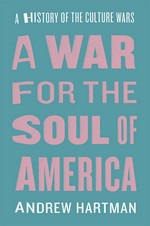
For History of Education Quarterly, I’m writing a review of Andrew Hartman’s War for the Soul of America (University of Chicago Press, 2015). Hartman

For the journal Church History and Religious Culture, I’m reviewing Christopher Rios’s After the Monkey Trial (Fordham University Press, 2014).rios

For Teachers College Record, I’m working on a review of Roger Geiger’s new book The History of American Higher Education (Princeton University Press, 2014).geiger

Last but not least, I just agreed to write a review of Bradley J. Gundlach’s Process and Providence: The Evolution Question at Princeton, 1845-1929 (Eerdman’s, 2013), for History: Reviews of New Books.gundlach

For those outside of the academic realm, here’s how the process works: Publishers send out review copies to a variety of journals and magazines.  Book review editors hunt down an appropriate reviewer, usually through word of mouth and academic reputation.  If the first person they ask can’t or won’t write a review, the editor asks for suggestions of other possible reviewers.

I love to write reviews for academic journals.  In each case, putting together a coherent review forces me to do more than simply absorb a book’s argument.  It forces me to take a sharper look at the sources, the implications, and the book’s strengths and weaknesses.  In all of the reviews I’m currently writing, I had planned to read each book already.  Writing the review simply forbids me to read any of them lazily.

But beyond the benefits for the writer, do these reviews matter?  After all, very few people read academic journals.  These days, the long peer-review process means that reviews in academic journals sometimes come out long after the books are published.  We might be tempted to conclude that these kinds of academic book reviews are merely an exercise in higher-education navel gazing.

I think there’s more to it than that.  After all, these reviews are not intended solely for individual readers or book buyers.  This is not just a “rotten-tomatoes” kind of review, in which readers might check out what has been said before choosing one book over another.  This is not simply “like”-ing something on Facebook or scrawling out an angry smear job on Amazon.  Those things may boost or crush sales and reach, but they don’t provide readers with careful descriptions of a book’s structure.

Book reviews in academic journals are different.  The audience for these book reviews is mostly university types, the professors who are choosing books to use with their classes and their students.  No one has time to read every book that comes out, but these short reviews allow academics to remain broadly aware of new trends in their fields.  A “good” review in this context does not mean glowing praise, but rather careful description of the book’s argument and significance.  A professor can choose which books to use in his or her classes.  Professors can also recommend certain titles to graduate students for further study.

Some things that are old fashioned deserve to wither away.  Cassette tapes, large lecture hall classes, and phones with cords come to mind.  This tradition of slow and careful review, on the other hand, may have its roots in a very different technological time.  Nevertheless, it remains a vital part of academic life.

OK: AP not OK

What does creationism have to do with the Continental Army? What does George Washington have to do with the Genesis Flood? This week the news from Oklahoma gives us an example of the ways conservative ideas influence every classroom, not just the science labs.

We will have more success understanding those ideas if we see them as part of a conservative notion of proper education. These are not just ideas about science, or the Book of Genesis, or George Washington at Valley Forge, but they combine all these things into a powerful educational impulse. As I argue more extensively in my new book, in order to make sense of any aspect of educational conservatism, we need to look at it as a whole, not just as a series of separate incidents.

First, let’s look at the goings-on in the Sooner State. Representative Dan Fisher has introduced a bill that will challenge the teaching of Advanced Placement US History in Oklahoma’s public schools. Why? As do many conservatives, Fisher believes that APUSH teaches a warped, slanted, leftist view of America’s past. The new APUSH framework, Fisher explains, emphasizes “what is bad about America.”

Fisher wants to blast progressive history out of Oklahoma's schools.

Fisher wants to blast progressive history out of Oklahoma’s schools.

Fisher is not alone. As we’ve explored in these pages, conservative activists have lashed out at the new APUSH framework. I’ve argued also that many conservatives see these AP standards as only the latest efflorescence of a vicious left-wing assault on real American history. These conservative notions about sneaky progressive subversion in history classrooms have a long history themselves, as I describe in the book. At least since the 1920s, conservative thinkers and activists have lambasted history curricula as hopelessly skewed. Children learn that the USA has been built on a legacy of greed and genocide. Children learn that traditional heroes such as George Washington and Thomas Jefferson have feet of clay, or worse.

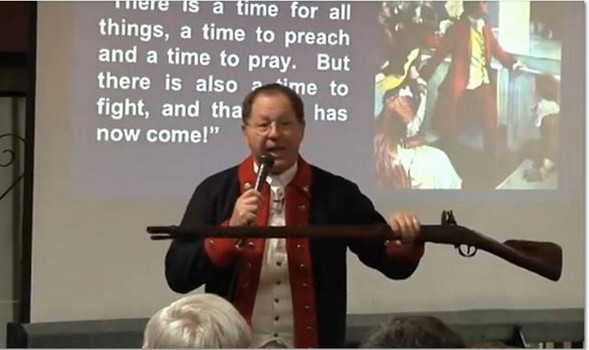
Representative Fisher, for instance, is a member of the Black Robe Regiment, according to the Tulsa World. As do many religious conservatives, this group ties together a romantic history of the United States with conservative attitudes about Scripture and religion. In those connections we catch a glimpse of the ways conservative thinking about education can link creationism with US History.

I want to be careful about what I’m saying here. I’m not arguing that there is some sort of vast underground conservative conspiracy connecting creationism with Fisher’s anti-APUSH activism. Nor am I saying that Fisher’s brand of religious conservatism is somehow the most real sort of conservative attitude about education. There are plenty of conservatives who will have no truck with this kind of religious and traditionalist interpretation of America’s past. But I do believe that deeply held attitudes about proper education fuel both creationism and Fisher’s sort of historical revanchism.

What’s the connection? At its heart, I suggest that this sort of conservatism springs from a notion that real education must come from a delivery of correct information from authoritarian sources to learners. That is, many conservatives—perhaps a better word would be “traditionalists”—believe that education must be a transmission of truth from top to bottom. That truth, if we back it up to its source, must come from God as the ultimate authority.

Perhaps this definition of proper education as the delivery of truth to each new generation seems unobjectionable. It is not. For about a century, educational thinkers have suggested that this “transmission” method is not good education. These “progressive” reformers have tried to impose instead an idea that students must construct knowledge on their own, not merely accept it or download it from authoritarian sources.

In the specific case of the new APUSH framework at issue in Oklahoma, historians have insisted that historical learning does not simply mean transmitting facts to children. And smart conservatives acknowledge that real education includes much more than just telling young people things that are true. But at its core, we might separate “traditionalist” from “progressive” ideas about education along these lines: Traditionalists think of education primarily as moving information from authoritative source to learners. Progressives think of education primarily as having learners construct knowledge.

With this sort of general attitude about education and knowledge, it’s easy to see the connections between creationism and the Continental Army, between George Washington and the Genesis Flood. For some religious conservatives, including apparently Representative Fisher of Oklahoma, knowledge about any subject must rely on traditional truths. Those truths have been delivered to us from on high. Proper education, in this mindset, consists of passing those truths along, not subjecting them to smarmy and self-satisfied criticism.

What Conservatives Want in Schools

When I started the research for my new book, lo those many years ago, my first stop was College Park, Maryland. The National Archives hold the papers of William J. Bennett, Reagan’s second Secretary of Education. To my thinking back then, Bill Bennett personified the tradition of conservative activism in education. In a recent long interview with Bill Kristol on The Weekly Standard, Secretary Bennett shares his memories of his conservative leadership in education. Among other things, Bennett articulates a long twentieth-century tradition of conservative thinking about proper education.

In addition to some wacky stories of practical jokes by President Reagan, Secretary Bennett explains what motivated him about America’s schools.

When he first took the job, Bennett explains, he visited 120 schools. Over and over again, teachers and students told him they needed some way to teach basic truths about American virtue, about American culture. The question he heard again and again, he explains, was, “How do we teach these kids moral values? They’re so different. They come from diverse backgrounds.”

It’s simple, Bennett insists: “There are certain common values.” Not only that. Students should not be taught vaguely how to learn, but rather should be taught knowledge. As he put it, “You have to start by learning something. . . . Content is what really develops the mind, the brain.”

The most important thing he has done in his entire career, Bennett explains, is his publication of his best-selling Book of Virtues. After it came out in 1993, the BoV spent eighty-eight weeks on the New York Times bestseller list. The big accomplishment of the book, Bennett says, is that it salvages traditional stories from our culture that are in danger of being lost. It insists that we all share common values, no matter our religious or cultural backgrounds.

As I argue in my new book, this notion about the first goal of American education has long been a central unifying theme of diverse conservative politicians and activists. Long before Bennett took over as Education Secretary, Max Rafferty had articulated similar sentiments from his post as State Superintendent of Public Education in California.

In addition to his bully pulpit in California, Rafferty authored a syndicated column that took his conservative ideas nationwide. Many of those ideas sound as if they could come directly from the mouth of Bennett himself. For instance, in one column from the 1960s, Rafferty argued,

Without the great hero-stories, we are left in the schools with statistics on immigration and economic development, dry-as-dust treaties and proclamations, accounts of population trends and antitrust legislation to give the children in the guise of history. They will grow up inevitably with the same amount of love and reverence for their native land which they would feel for a mathematical theorem or a chemical formula.

The best education, Rafferty wrote in another 1960s column, must include

the grand old stories that you and I remember so fondly from our childhood. Ben Franklin and his famous pun about hanging together or hanging separately. . . Sam Houston at San Jacinto, reminding enemy dictators for all time to come that Americans would forget attempts to enslave them only when Texans forget the Alamo—these and a hundred more great stories cluster about our history, bulwarking and supporting it, mingling it in a Red, White and Blue mist, clamorous with voices out of our past, dramatizing American history and American institutions so that wide-eyed children will always remember.

As Secretary Bennett remembers in this interview, his biggest success has been in putting a compilation of these traditional stories into the hands of millions of students, parents, and teachers. Like his boss President Reagan, Bennett argues that traditional stories teach virtue. Having students memorize these ancient nuggets of wisdom has done more to educate generations of Americans than all the progressive nostrums oozing out of high-falutin schools of education.

There is no simple definition of “educational conservatism.” But in this interview, Secretary Bennett articulates something that comes pretty close: the notion that proper education consists of transmitting traditional facts and values into each generation of schoolchildren.

Whose Values Rule the Schools?

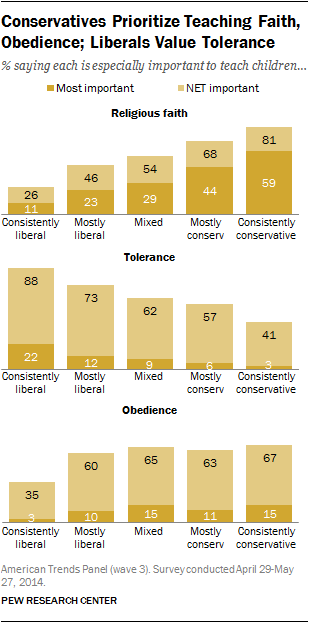
What are the dominant values in American public schools? Progressive activists tend to think schools are dominated by conservatism. But conservatives say that progressives are in charge. New poll data suggest that conservatives are wrong. When it comes to general attitudes toward children and education, conservative values seem enormously powerful.

Progressives have always hoped that schooling would soon be transformed into a progressive paradise. But they have also always acknowledged widespread public resistance. As far back as 1925, scholars Otis Caldwell and Stuart Courtis—from the progressive bulwark of Teachers College, Columbia University—argued that the “new philosophy” of progressive education could transform schools into a “childish utopia.” Unfortunately, they wrote, most Americans weren’t interested. Instead, most people “blamed teachers and schoolmen generally for ‘new-fangled methods.’”

These days, leading progressives agree. Pundits such as Alfie Kohn insist that progressive ideas are the best. As Kohn once put it, progressive education is “hard to beat, but also hard to find.” In spite of the clear superiority of progressive methods, Kohn writes, most schools only use them in dribs and drabs. Conservative, traditional schoolrooms, Kohn notes glumly, tend to be the norm.

We might think that conservative activists would celebrate their domination of American public education. But in fact we see just the opposite. Historically, conservative activists have taken progressive dominance for granted. Many conservatives have assumed without question that the progressive nostrums of philosopher John Dewey had long ago triumphed.

Writing in the wake of a tumultuous school battle in 1950s Pasadena, California, for instance, conservative activist Mary Allen explained that “traditional education” had been abandoned in the 1930s. Why? Because at that time “some of Dewey’s followers prepared to use the schools to introduce a new social order.” To Allen as to generations of conservatives, conservative values had long since been kicked out of public education.

Today’s educational conservatives voice similar frustration. For example, Peter Collier has lamented the dominance in public education of the progressive tentacles of Columbia University’s Teachers College. A pernicious leftist stew of “critical pedagogy,” Collier noted, “slowly infiltrated leftist ideas into every aspect of classroom teaching.”

How important is "curiosity" as an educational goal?

How important is “curiosity” as an educational goal?

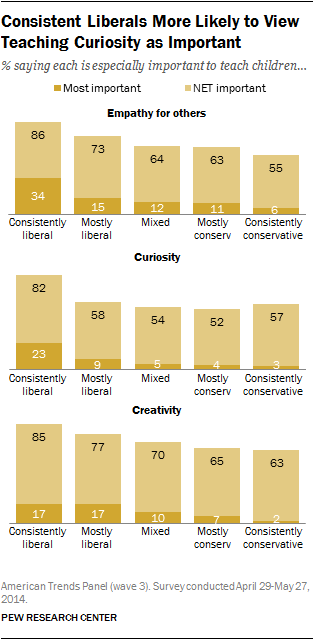
New poll data from the Pew Research Center for the People and the Press suggest that conservatives have this one wrong. When it comes to basic attitudes about children and proper education, conservative ideas tend to dominate. Those who call themselves “consistently liberal” find themselves on the outside looking in.

Who's the outlier here?

Who’s the outlier here?

To be fair, the poll also suggests that Americans of all ideologies share broad agreement about the proper way to raise children. Huge majorities of the “consistently liberal,” the “mostly liberal,” the “mixed,” the “mostly conservative,” and the “consistently conservative” agree that children must be taught responsibility.

But in a couple of other categories, those who call themselves “consistently liberal” stand out. And those differences tell us something about the values that dominate our schools and society.

For example, the “consistently liberal” place a much higher value on teaching curiosity than do any other groups, by a huge margin. Nearly a quarter of the consistently liberal place this among the three most important factors for children, and over three quarters think it is important. In contrast, none of the other groups, including the “mostly liberal,” thought that teaching curiosity was nearly as important. Only nine percent of the “mostly liberal” called curiosity one of the most important values, and only fifty-eight percent considered it important. And though fifty-seven percent of the “consistently conservative” agreed that curiosity was important, only a paltry three percent of consistent conservatives placed it at the top of their lists.

In addition, large majorities of every group except the “consistently liberal” placed a high value on teaching obedience. Even among the “mostly liberal,” sixty percent found this important. At the high end, two-thirds of the “consistently conservative” thought obedience was an important idea for children, compared to just over one-third of the “consistently liberal.”

Of course, it’s notoriously difficult to define “progressive” and “conservative” ideas about education. But in general, it’s fair to say that progressives tend to value curiosity above obedience, exploration above authoritarianism. Yet those values are only shared by a small sliver of the respondents in this survey.

The good news for conservatives? They are wrong about the values that guide American public education.   Progressive notions of child-centered learning, of students freed from the dictation of authoritarian teachers and exploring the creative curiosity of youth, have not sunk the deep roots that conservatives have often assumed.

Instead, when it comes to central ideas about obedience and curiosity, this poll suggests that conservative attitudes are the norm.

The Perfect Valentine’s Day Gift

Nothing says “I Love You” more than a book about conservatism and education in American twentieth-century history. Looks like the timing will be perfect.

How to say "I Love You" (But You're Going to Hell)

How to say “I Love You” (But You’re Going to Hell)

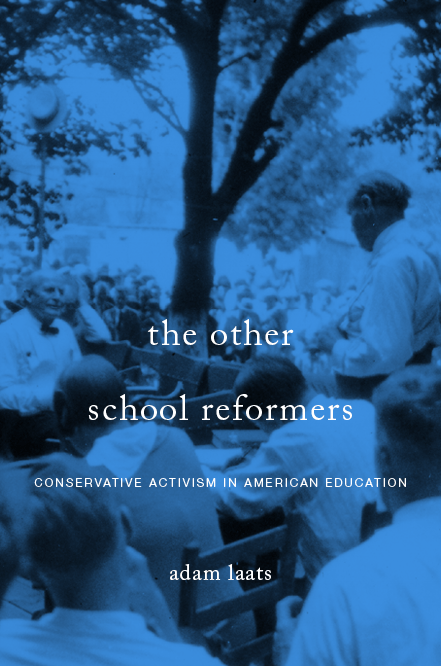
My new book is slated for release in early February. Hard to know how it will be received, but one pre-reviewer has called it “a major rethinking of the history of American education.” Another has added, “it would be flat-out wrong to ignore this important book.” Pshaw. . .

For the sophisticated and good-looking readers of ILYBYGTH, the content might not be surprising. In this book, I try to figure out what it has meant to be “conservative” about education in the United States.  How have issues such as creationism, school prayer, and sex ed developed over the course of the twentieth century?  How are they related?  How have conservative attitudes and strategies changed?  How have they remained the same?

In the early days of my research, I had planned to explore the educational activism of leading conservative groups such as the American Legion and the Institute for Creation Research. I was stuck with two big problems, though.

First, the Legion and other conservative groups remained active throughout the twentieth century. How could I describe different conservatives without rehashing the chronology over and over again? I didn’t want to work from the 1920s to the 1970s in every chapter. What to do?

My second problem was one of definition. How could I choose which “conservative” groups to study? I could copy the method of leading conservative scholars such as Russell Kirk or George Nash and use my selection to make an argument about the definition of conservatism. Both Kirk and Nash picked their subjects to give a particular definition to conservatism. For both writers, being a true conservative has meant being a heroic intellectual battling waves of ignorance and knee-jerk leftism. But I’m no conservative myself, and I wasn’t interested in imposing a flattering (or un-flattering, for that matter) definition on American conservatism. What to do?

Luckily for me, I had some help. At a conference back in 2009, I was describing my research. One of the audience members suggested a new approach. Instead of picking and choosing which activists counted as “conservative,” instead of describing the activism of one group after another, why not do it differently? Why not let conservative activists define themselves? This leading historian suggested that I investigate events, not groups.

That’s what I did. I looked at the four biggest educational controversies of the twentieth century: The Scopes Trial of 1925, the Rugg textbook fight of 1939-1940, the Pasadena superintendent ouster of 1950, and the Kanawha County textbook battle of 1974-1975. In each case, conservative activists and organizations fought for their vision of “conservative” schools. By looking at controversies instead of organizations, I could let conservatives define themselves. And I could move chronologically through the twentieth century without rehashing the stories in each chapter.

Did it work? Now I have to let readers and reviewers be the judge. My goal was to explore what it has meant to be “conservative” in the field of education. I did not want to make the relatively simpler argument that conservatism has really meant X or Y. I did not want to give conservatives a heroic history they could draw upon. Nor did I want to give their enemies a catalog of conservative sins. I’m hoping readers think this approach has worked.

So if you’re looking for that perfect romantic gift, consider The Other School Reformers!