Creationism, Conservatism, and the Common Core

What does creationism have to do with the newish Common Core Learning Standards? Some conservative activists and politicians are rejecting both in a knee-jerk attack on educational reform. In one new educational bill in Ohio, conservatives simultaneously threw out the Common Core and opened the door to creationism. But this isn’t just a question of creationism. Rather, this is a symptom of a broader conservative attitude toward public schooling.

Not just science, but history and literature are also targeted in this conservative educational power grab.

We first became aware of this new bill in Ohio thanks to the watchdoggery of the folks at the National Center for Science Education. The NCSE, naturally, worried first about the apparent opening of Ohio’s public-school science classes to intelligent design and creationism. Ohio’s House Bill 597 would insist on new standards that specifically “prohibit political or religious interpretation of scientific facts in favor of another.”  The sponsor of the bill, Andy Thompson of Marietta, told the Cleveland Plain Dealer that he included that language to allow school districts the freedom to include a variety of ideas about evolution, not to mandate that districts include intelligent design or creationism.

Representative Thompson wants the Common Core OUT and conservative curricula IN.

Representative Thompson wants the Common Core OUT and conservative curricula IN.

But the anti-Common Core bill also includes a broad-spectrum attack on the purportedly progressive nature of school curricula in other subjects as well. The original draft of the bill specified that 80% of the literature taught must be from American or British authors before 1970, though Thompson quickly backpedaled from that goal. But why was such a target included in the first place? As I detail in my new book, conservatives since the 1970s have looked skeptically at the trend toward “multicultural” literature. Conservative leaders from Max Rafferty to Bill Bennett have insisted that proper education—conservative education—must be based on the classics of our Western civilization. Anything else, they insisted, dooms children to a savage unawareness of their own cultural heritage.

In history, too, the Ohio bill insisted that history instruction include

the original texts and the original context of the declaration of independence, the northwest ordinance, the constitution of the United States and its amendments with emphasis on the bill of rights; incorporate the Ohio constitution; define the United States of America as a constitutional republic; be based on acquisition of real knowledge of major individuals and events; require the study of world and American geography; and prohibit a specific political or religious interpretation of the standards’ content.

Here also we hear echoes of long-time conservative worries. From Lynne Cheney to Dinesh D’Souza, it has become a commonplace of the conservative imagination that leftist history has taken over public education. As I argued recently in a commentary in History News Network, conservatives assume that students are taught that American history is the record of cruel white hate crimes against Native Americans, women, and African Americans. The Ohio bill hopes to rectify this America-bashing by mandating “real knowledge,” not just hate-filled Zinn-isms.

As we’ve seen time and again, conservatives are not united in their thinking about the Common Core. Some conservatives love them….or at least like them. Others blast the standards as yet another attempt at sneaky subversion from Washington.

In this new Ohio legislation, we see how some conservatives combine their loathing of the Common Core with a grab-bag of other conservative educational goals: Less evolution in science class, more America-loving in history class, and less multiculturalism in literature class. Taken together, conservatives such as Ohio’s Andy Thompson hope to broaden the anti-Common-Core juggernaut into a more ambitious conservative panacea.

 

Does Anyone Actually Read the Index?

My eyeballs are beginning to chafe.  This week, I’m finishing up the index for my new book.  It’s a lot of work, even though I had a gifted grad student do most of the intellectual heavy lifting.

How the sausage gets made...

How the sausage gets made…

So now I’m wondering: Does anyone actually read the index?  I know professional academic historians do.  In fact, that’s one of the first cheap tricks we learn in our PhD programs.  We flip quickly to the back to see what we can glean from the index.  What are the book’s themes?  What are its main ideas?  Its blind spots?

But do any normal people read a book’s index?  Make no mistake, I’m compiling a kick-ass index, whether anyone ever reads it or not.  But I can’t help but wonder if readers will find useful my painstaking distinctions between “authoritarian teaching” and “traditional education.”

Coming soon...

Coming soon…

Will anyone care that I spent so many long hours in a stuffy library teasing out the nuances of “educational conservatism” as opposed to the broader category of “conservatism” in general?


How to Hit your Child

What do you do when your kids misbehave?  Do you hit them?  Or is that a form of abuse?  It seems as if our culture is confused about this question.  Throughout the twentieth century, as I argue in my upcoming book, conservatives argued that parents and teachers MUST beat children in traditional ways.  Anything else threatened civilization itself.  Has that attitude changed?

Is this "abuse?" Or is this "parenting?"

Is this “abuse?” Or is this “parenting?”

In American culture, a certain form of physical correction of children by parents has long been the norm.  Especially “spanking.”  In this kind of punishment, the child is swacked on the butt by the parent, either with a hand, a spoon, a brush, a belt, or some other mild weapon.

As a survey article in National Review Online describes, states now differ in their laws about spanking.  In New York, for instance, a judge recently ruled in favor of parents’ right to spank, as long as it is done mildly, with only an open hand.  In the New York case, the parent insisted he had not used a belt on his child.  That would have crossed the line, he felt.  In other states as well, courts have struggled to draw clear boundaries between acceptable spanking and unacceptable child abuse.

Until 2012, according to the NRO article, all 50 states recognized parents’ right to spank their own children.  In that year, Delaware passed a law forbidding any form of physical punishment.  At the first and second degrees, parents in Delaware can be charged with a felony for causing harm to their children.

As you might expect, a certain sort of conservative finds this sort of law outrageous.  Not only should the rights of parents over their children be sacrosanct, some conservative activists have argued, but spanking is a healthy and humane form of punishment.  The Home School Legal Defense Association, for example, called Delaware’s new law “a violation of the right of parents to direct the upbringing of their children, including the long-recognized right to administer reasonable corporal discipline.”

It’s not a new issue.  As I found during my research for my upcoming book, educational conservatives have long insisted on the right and duty of both parents and teachers to use physical punishment on unruly youth.  For some conservatives, this sort of corporal punishment is the only way to properly shape character.  As the old saying goes, “Spare the rod and spoil the child.”

In 1950 Pasadena, for instance, local activists bubbled over with their outrage at progressive novelties in their local public schools.  One parent insisted that teachers must use “whipping . . . when the situation calls for such punishment.”  The problem, many conservatives in Pasadena thought at the time, was not that teachers might abuse students.  Rather, the danger came from a generation of children left uncorrected and unbowed to authority.  Such unguided youth, one letter-writer complained, were in danger of total “moral disintegration.”  And the obvious reason for that disintegration, according to this anonymous writer, was the “fatal lack of the right kind of instruction in our schools.”

A few years later, conservative stalwart Max Rafferty agreed on the importance of corporal punishment.  In his 1964 book What Are They Doing to Your Children, Rafferty warned of the dangers of progressive methods.  New teachers, Rafferty explained, came

Fresh from college and still pretty Dewey-eyed about things, [they] compromise themselves and their careers in a hopeless attempt to convince some freckled-faced [sic] urchin with devilment coming out visibly all over him that he must discipline himself.

Instead, Rafferty believed, the traditional methods remained the best.  Each teacher should learn when and how to correct a student using physical punishment.  In the old days, Rafferty wrote, such things were beyond argument.  In times past, Rafferty described, some parents might

Storm into the schoolyard and whip the teacher for abusing little Willie, but by far the more typical parental reaction to the tearful complaint ‘Teacher licked me!’ was to reach for the razor strop and give a home version of teacher’s treatment out in the woodshed.

Rafferty and the Pasadena conservatives knew that such physical punishment was controversial in their own times.  Each conservative writer appealed to a past in which teachers and parents had an unfettered right and duty to use appropriate methods to raise children right.  In 1950 and 1964, conservatives saw themselves as stalwarts of traditional methods.  Those methods had already come under attack by dunderheaded progressives.

So there is nothing new to controversy over corporal punishment.  Yet clearly, as the NRO review shows, things are changing.  Could we be on the cusp of a new age for corporal punishment?  Will more states follow Delaware in outlawing all forms of physical punishment?


Want School Reform? Go Medieval!

It’s hard to cross the street these days without bumping into a new panacea to fix America’s schools.  Longer school days, more parent choice, uniforms, more art, more math, more tech, less tech…everybody’s got a new idea to fix education.

We read today in the pages of Forbes Magazine a different sort of proposal.  To fix America’s high schools, Pascal-Emmanuel Gobry writes, we should go medieval.  To be specific, we should emulate the tutorial style of education developed in the middle ages at Oxford University.  Could it work?  Or, more intriguing, could proposals like Gobry’s serve as a new grand educational rapprochement between conservatives and progressives?

In that tutorial system, Gobry argues, students read a book every week and write a short essay about it.  Then they share the essay with a small group, including a tutor and two or three fellow students.  There is no grading, there are no test scores.  The reading list would include great books, however we wish to define them.

Could it work?  Gobry insists that this plan is both practical and “urgent.”  Elsewhere, Gobry wrote that too often education is misunderstood.  His plan would put it back on track.  Even liberal leaders, Gobry pointed out recently, seem to agree that education is meant mainly to produce technically qualified but dead-eyed engines of economic growth. “Nobody stops to ask what education is for,” Gobry lamented,

because the answer is implicitly accepted by all: an education is for getting a job. It is, in other words, for being a cog in the giant machine of post-industrial capitalism. It is, in other words, for the opposite thing that our forefathers wanted for us. I do not use these words lightly, but it is against–in the sense that a headwind is against a ship–the very foundations of our liberty and our civilization.

We could nitpick about whether Gobry’s plan could work.  As a ten-year veteran classroom teacher, I can see plenty of holes that Gobry does not seem to recognize.  But a more interesting question for ILYBYGTH readers is this: Could Gobry’s proposal serve as the foundation of a grand rapprochement between liberals and conservatives?

Here’s what I mean: At the roots of both “progressive” and “conservative” educational reform traditions there lurks a desire to free students of mindless routine and push them to more rigorous study, more authentic, transformational learning.  John Dewey, for example, hoped his school reform program would eliminate mind-numbing recitations and force students to engage more thoughtfully with the big ideas.  And William F. Buckley sparked the post-war conservative fusion movement with his searing critique of the soft and soulless education peddled at his alma mater.

Dewey became the spokesperson for progressivism, while Buckley personified conservatism.  But when it came to the goals and process of learning itself, the two thinkers were not very far apart.  This may seem a shocker, but Gobry’s short essay supports the notion.  What thinking conservative would not support a notion of education that presses students to engage profoundly with the formative documents of our civilization?  That forces teachers to do more than process young humans and train them in lock-step obedience?  And what thoughtful progressive does not want an education that makes human freedom its primary goal?  An education that tears up meaningless standardized tests and instead engages students of every background to struggle with humanity’s oldest problems?

In the end, I don’t really think Gobry’s great-books plan will work as a silver bullet to fix America’s public schools. But Gobry’s line of thinking might serve as a way to get conservative and progressive intellectuals to come together in recognition of their vast similarities.


The Handwriting on the Wall

Conservatives have been proven right!  About handwriting, at least.  A recent article in the New York Times suggests that teaching handwriting might be a good way to help students learn.

In the research for my upcoming book about educational conservatism, I kept coming across conservative complaints that schools were abandoning the traditional subject of handwriting, often called “penmanship.”

In the pages of the Pasadena Independent, for example, editor T.G. Wood complained in 1950 that “progressive” education fads had led to less learning of traditional subjects.  Parents were increasingly starting to wonder, Wood wrote acerbically,

why little Johnny puts two and three together and comes up with nine, why his penmanship shows little or no improvement, and why his reading is poor or backward.

An angry Pasadena reader agreed.  Back in the old days, one letter-writer explained, Pasadena’s schools had benefited from the work of teacher Albert P. Meub, “a penman of national note.”  Meub had tried to keep the subject of penmanship in the schools, the letter-writer complained, but to no avail.  The rush for progressivism in schools had led to the willy-nilly abandonment of traditional subjects such as penmanship.

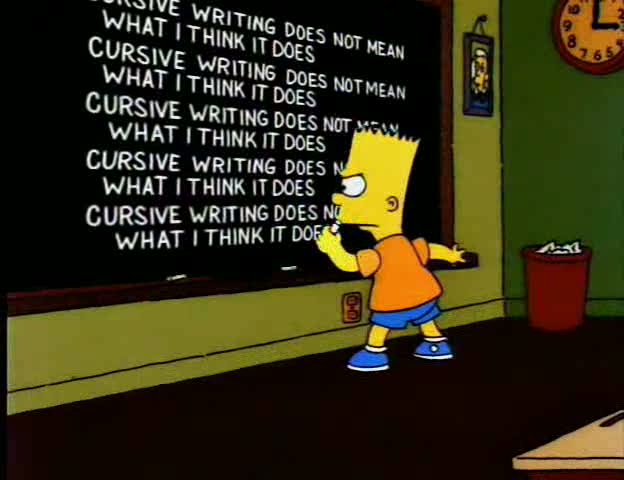
I can’t help but think of the Simpsons episode in which Bart’s new teacher asks him if he knows cursive.  “Well,” Bart replies, “I know hell, damn, and fart.”

Hell, Damn, and Fart

Hell, Damn, and Fart

According to the research review in the New York Times, both Bart and the children of Pasadena would have done better if they had spent more time learning to write by hand.  Some of the research compares writing by hand to writing by computer.  But some psychologists have also studied the difference between learning to write in cursive or by writing block letters.  Some think that students will do better when they learn cursive.

Why?

Karin James of Indiana University suggests that writing by hand helps students learn about the infinite complexity of letter variability.  Every Times-New-Roman “A” may look the same, but not every hand-written one.

Another study suggests that learning cursive may actually stimulate more brain activity and help fight language problems.

The crusty conservative editor T.G. Wood of the Pasadena Independent might have argued from his perch in 1950 that such studies only belabor the obvious.  Educational fads that abandon tradition out of a misguided trust in the superiority of the new and shiny will always lead young people astray.  Traditional education, conservatives have long insisted, has lasted so long for an obvious reason: It works.

Our Children: Evil & Successful

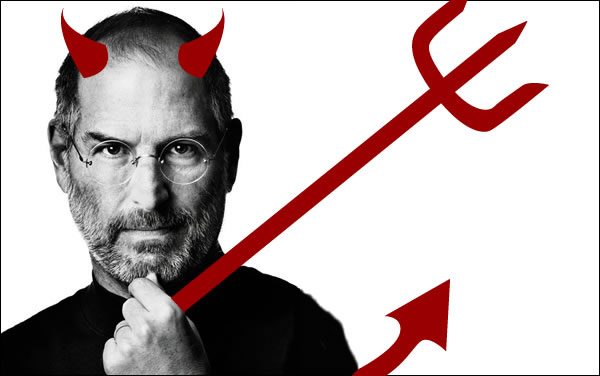
What have we done?  By giving our children everything, we’ve made them into self-centered, grasping monsters.  At the Imaginative Conservative, Bruce Frohnen accuses our culture of eating its own children.  As the perfect terrifying example, Frohnen uses the life and rapacious career of the late Steve Jobs.  Perhaps unconsciously, Frohnen dips into one of the strongest traditions of educational conservatism.

Spoiled Children, Spoiled Society

Spoiled Children, Spoiled Society

Frohnen, Professor of Law at Ohio Northern University, castigates Jobs as the exemplar of all things rotten in our culture.  Jobs, Frohnen writes, lived as

a mean-spirited narcissist who translated a certain aesthetic sensitivity and capacity for bullying and hucksterism into a colossal waste of money and collective time, further separating Americans from one another in pursuit of a false control over their environment. As bad, his personality and corporate ethos furthered highly damaging political and economic structures of a kind best described as libertarian socialism, in which corporations and rich individuals behave without conscience, expecting the social programs they vote for but seek to escape funding to pick up the pieces from their own “creative” destruction. I also see him as in many ways a sad character, emotionally and spiritually stunted in part because of the failings of the infantilizing environment in which he grew up.

Frohnen’s arch analysis of Jobs’ character serves as more than a brutal post-mortem on a unique American life.  Frohnen wants us to see Jobs as typical, the predictable result of American culture gone off the tracks.

Why was Jobs such a grasping bully?  Because he came out of the 1960s American culture that had wilfully abandoned its own traditions of child-raising.  Jobs, like so many of his generation, was relentlessly coddled, given everything and asked for nothing.

This was more than just a question of parenting.  Frohnen examines the college education on offer at Reed College in Oregon, where Jobs briefly took classes and where Frohnen briefly taught.  The faculty at Reed, Frohnen argues, deliberately discarded educational tradition and encouraged students to wallow in self-love.  As Frohnen remembers it,

Reed College in Portland, Oregon is one of those places where students dress in black to show how depressing it is to be young and well-off; lots of Volvos in the parking lot when I was there. And the drug culture remained. By my second semester at Reed several students had overdosed on illegal drugs. When the President, a “good” leftie from Oberlin, decided to take the minimal action of proposing a faculty resolution decrying the self-destructive behavior he was in for a surprise. At first I thought the principal opposition speaker was a bag lady. It turned out she was just some English professor in a poncho. She was nearly in tears as she argued that “we” could not hope to engage productively with students if we began with such a “superior attitude.” The resolution failed by an overwhelming margin.

Though Frohnen ties his bitter eulogy to a specific time and place—the 1960s lax parenting and education of the San Francisco era—conservative intellectuals and activists have made similar arguments throughout the twentieth century. As I argue in my upcoming book, at least since the 1920s conservatives have lamented the tendency of political liberals and educational progressives to coddle children. Parents and educators make a mistake, conservatives have insisted, when they offer too much to children.

Consider, for example, the educational vision of Grace Brosseau in 1929. At the time, Minor served as the President General of the Daughters of the American Revolution. She insisted, as Frohnen does, that parents and teachers must not abandon their duty to impose on children. “Flagrant cases of un-American tendencies have been brought to light and exposed,” Brosseau warned. America had gone to hell in a handbasket. And why? Too many teachers believed in the “decrepit theory that both sides of the question should be presented to permit the forming of unbiased opinions. This may be the proper system for the seasoned adult,” Brosseau warned, but

With the young, the chances are too great, for there a dangerous inequality exists.  One does not place before a delicate child a cup of strong black coffee and a glass of milk; or a big cigar and a stick of barley candy; or a narcotic and an orange, and in the name of progress and freedom insist that both must be tested in order that the child be given the right of choice.  Instead, one carefully supplies only what will make for the development of the young body and assure its normal growth.  Why then apply the very opposite theory when dealing with the delicate and impressionable fabric of the mind?

Writing in the 1980s, conservative activists Mel and Norma Gabler repeated this warning that too much choice spoils a child.  “The only absolute truth in modern humanistic education,” the Gablers warned,

is that there are no absolute values.  All values must be questions—especially home- or church-acquired values.  Discard the experience gained from thousands of years of Western civilization.  Instead, treat the students as primitive savages in the area of values.  Let them select their own from slanted, inadequate information.

By giving everything to our children, these conservative writers have insisted for generations, we’ve taken everything from them.  In the case of Steve Jobs, Frohnen argues, we see the perverted results that ensue from too much too soon.


The Files Are In!

Well, there’s nothing more to be done about it now.  I’ve just sent my final draft of my next book manuscript to the publisher.  There’s a sense of relief at being done, but also trepidation at the impossibility of further revisions.  After years of researching, writing, then revising, revising, revising, it’s hard to believe I won’t be able to keep tweaking and improving.

Pre-order your copy today!

Pre-order your copy today!

In general, though, I’m extremely pleased with the shape of the manuscript.  In a nutshell, I try to make the case that we’ve seen a potent tradition of educational conservatism in the United States, one that has had a decisive impact on the structure and content of schooling.  And, I argue, that tradition has not been recognized by historians or education scholars.

To make this case, I examine in four looooong chapters the four biggest school controversies in twentieth-century America: the Scopes Trial of 1925, the Rugg textbook controversy of 1939-41, the Pasadena superintendent ouster of 1950, and the Kanawha County textbook battle of 1974-75.  What did conservatives say and do in these controversies?  In each case, the attention-grabbing events attracted conservative participation from both locals and national leaders.  In each case, the issues prompted conservatives to articulate their visions of proper schooling.  To me, that’s the interesting question.

We’re still a ways from final publication.  The publisher will send me proofs in July.  At that stage, I’ll put together the index and fine-tooth-comb the proofs for any typos.  But I won’t be able to make substantive changes at that point, just minor corrections.

During these last weeks, as I’ve been going over the copy-edited chapter files, I’ve been very grateful for the careful work of the editor.  She or he pointed out some embarrassing errors on my part and I’ve been able to make changes in the argument.  Hopefully this draft is as crystal-clear as I can make it.

I’m looking forward to hearing what readers think of the book.  For that, I’ll have to wait until 2015.  The press will release the book on January 12, 2015.  Pre-orders are available!


Pre-Orders Now Available!

Want to be the first on your block to get your copy of The Other School Reformers?  Then pre-order your copy today!

Pre-order your copy today!

Pre-order your copy today!

As I was happy to announce recently, Harvard University Press will be releasing the book in early 2015.  But the pre-order just became available on sites such as Amazon.  The hardcover won’t be available until January 12, 2015, but if you pre-order today, you’ll be sure to WOW your friends and family by getting your hands on it first.

The Other School Reformers

Clear your calendars! We have a release date. The Other School Reformers will be hitting store shelves in February.  I know that’s a long time to wait, so I’m suggesting everyone dress up as their favorite conservative educational activist and camp out outside their local bookstore.

Coming January 2015.

Coming January 2015.

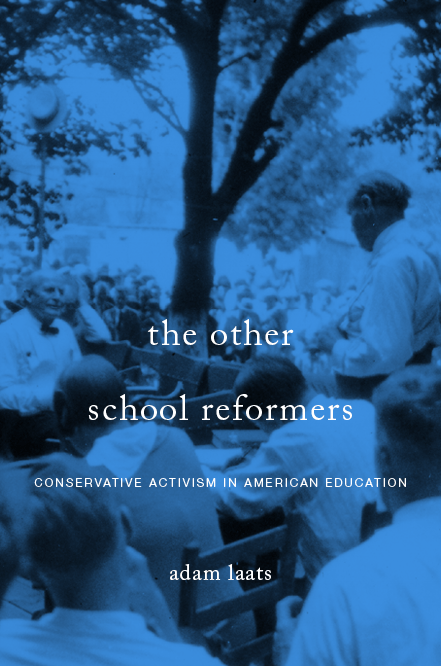
Thanks to the Smithsonian for this terrific cover image.  That’s Clarence Darrow (standing) facing William Jennings Bryan at the Scopes Trial.  In this book, I examine four epochal school controversies from the twentieth century.  In each case, I ask what conservative intellectuals and activists wanted out of schooling.  My goal is to find out what it meant to be “conservative” when it came to education.

The catalog listing just went up.  Here’s how the talented folks at Harvard University Press describe the book:

The idea that American education has been steered by progressive values is celebrated by liberals and deplored by conservatives, but both sides accept it as fact. Adam Laats shows that this widely held belief is simply wrong. Upending the standard narrative of American education as the product of courageous progressive reformers, he calls to center stage the conservative activists who decisively shaped America’s classrooms in the twentieth century. The Other School Reformers makes clear that, in the long march of American public education, progressive reform has more often been a beleaguered dream than an insuperable force.

Laats takes an in-depth look at four landmark school battles: the 1925 Scopes Trial, the 1939 Rugg textbook controversy, the 1950 ouster of Pasadena Public Schools Superintendent Willard Goslin, and the 1974 Kanawha County school boycott. Focused on issues ranging from evolution to the role of religion in education to the correct interpretation of American history, these four highly publicized controversies forced conservatives to articulate their vision of public schooling—a vision that would keep traditional Protestant beliefs in America’s classrooms and push out subversive subjects like Darwinism, socialism, multiculturalism, and feminism. As Laats makes clear in case after case, activists such as Hiram Evans and Norma Gabler, Homer Chaillaux and Louise Padelford were fiercely committed to a view of the curriculum that inculcated love of country, reinforced traditional gender roles and family structures, allowed no alternatives to capitalism, and granted religion a central role in civic life.

Almost makes me want to read it myself.  For me, the next steps will be to review and copy-edit the full manuscript next month.  Then in July I’ll put together the index, with help from a talented graduate student.

School Is Not the Place for Education

What does it mean to be educated?  This morning at The Imaginative Conservative, Steven Jonathan Rummelsburg blasts public schools for punting on this central question.

Rummelsburg relates his long quest to dig into the basic philosophy of public education.  No one he’s asked, he tells us, is able to answer the simple question: What is an education?

Rummelsburg, a veteran public-school teacher himself, asked public-school teachers, students, and administrators.  Most of the respondents, according to Rummelsburg, hemmed and hawed with answers about mastering standards and earning a diploma.  One math teacher, he tells us, paraphrased Steve Forbes.  What is an education?  This teacher answered, “Replacing an empty mind with an open one.”

When he asked his county superintendent’s office, he got a list of four points:

  1. You will get as many definitions of education as the number of people you ask.

  2. To be educated means to have learned enough language and math to be a good citizen.

  3. It is not about the subject being taught, but what the teacher does with her audience. It is all about the student teacher relationship and what she can get them to do.

  4. That is the answer today, the answer tomorrow will be different.

[I assume this was Rummelsburg interpretation of the superintendent’s office’s answers.  The language sounds a little too frank to come from a public official.]

What should the answer have been?  Rummelsburg wants teachers and schools to hew closer to GK Chesterton’s definition of education.  Education must not be thought of as a simple thing, but as a “method.”  It should be a transmission of all that is best in our culture.  The only way to do that properly, Rummelsburg concludes, is to separate out the unfairly conjoined notions of “school” and “education.”

As he concludes,

It is a terrible crime to hand the formation of our children over to an enormous class of uneducated teachers, yet that is what we have done. As it stands, there is nothing redeemable about the public schools or the lies they instil in our children. . . . Let us take our children back and assume our responsibility as their first teachers and teach them as they ought to be taught.

Certainly, Rummelsburg’s argument that today’s public schools have utterly lost their way resonates with intellectuals on both the cultural right and left. And I have a deep sympathy for his insider’s critique of public education. I work with many public-school teachers and administrators, and nothing makes me more pessimistic about our public schools than the number of teachers who choose to homeschool their own children.

But is Rummelsburg’s method sensible? If we can’t get an adequate philosophical definition of education from teachers and school administrators, does that mean that schools are not educating students?

Would this work for other institutions? For example, if I asked everyone who worked in my local supermarket to explain “the market,” would I get a coherent answer? An answer that captured the essence of social and economic exchange? Probably not. But does that mean that my supermarket is not functioning as a market?